
Last week, I was in a shopping area near my house, and got myself lost. Having no sense of direction, any set of streets can turn into a maze for me, and I can get lost hopelessly anywhere!
That is when I started thinking about real mazes. What would I ever do if I got into one? Probably panic and die!
But apparently that wouldn’t happen in a labyrinth. Because though most of us don’t really stop to think about the difference, they are very different! Labyrinths have a single continuous path which leads to the centre, and as long as you keep going forward, you will get to the centre eventually. So given enough time, it is close to impossible for anyone, even me, to get lost in a labyrinth.Mazes on the other hand, have multiple paths which branch off and will not necessarily lead to the centre or to the exit.
Mazes probably evolved from labyrinths, and over time took on elaborate forms including multiple branching paths, dead ends, etc.
The first recorded labyrinth is a 5th century BC one from Egypt. Labyrinths are found in many cultures, and generally seem to have an underlying spiritual meaning. Some represent spiritual journeys which guide visitors towards a single path, which may be full of twists and turns, but there is no doubt of reaching the goal as long as one is walking on the right path. In some cases, entering the labyrinth signified death and exiting it signified re-birth. They were also fertility symbols. Labyrinths were also thought to represent protection or fortification. Often in temples, forts etc., one can find carvings or paintings of labyrinths on the floor or walls, to represent one of these symbolisms.
Some temples are like labyrinths themselves, and their orientation, form and geometry have symbolic as well as spatial importance. The process of moving through the pathways is supposed to unwind the Kundalini or stored energy, releasing, magnifying, and ultimately harnessing its flow.
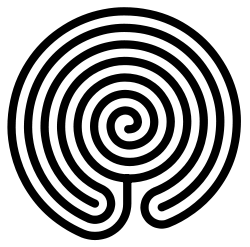
Many military formations adopted in ancient Indian warfare were labyrinths. The famous Chakravyūha (wheel formation, also called Padmavyūha—lotus formation) of the Mahabharata was one such. It was a very special formation and knowledge of how to penetrate it was limited to only Abhimanyu, Arjuna, Krishna and Padyumna on the Pandavas’ side. The Kauravas strategically diverted the senior warriors to different parts of the battlefield, and then went into the Chakravyuha formation, and succeeded in decimating the Pandava warriors. 16-year old Abhimanyu was there and bravely plunged into the wheel, killing many seasoned Kaurava warriors. Alas, he did not know how to get out of the formation, and at the sixth level, was slaughtered by a horde of Kauravas.
The Bara Imambara of Lucknow houses a famous Indian maze. Said to be the world’s largest structure that is unsupported by beams, the Imambara is considered a marvel of engineering. The fourth Nawab, Asaf-Ud-Dowhala, commissioned this building during the drought of 1784 to help people in the city earn a livelihood. He invited bids and it was won by Hafiz Kifayatullah, an architect from Shahjahanabad who was already well-known by then. Work on the building started in the 1784 and finished fourteen years later.
The Bhul Bhulaiya or Maze located on the upper floor of the Bara Imambara was Kifayatullah’s masterpiece. It is said that there are 1024 ways of getting inside the maze but only two ways of coming out! Once you enter the maze, you might end up going round and round and up and down staircases without being able to come back. It is even difficult to figure out which level you are at—you could think you have climbed down to the lower floor, but may still be on an upper one!
Interestingly, about 10 years ago, archaeologists uncovered a 2,000-year-old labyrinth that is the second-largest ever found in the country. This is in Gedimedu in Tamilnadu, along an ancient trade route on the east coast of India. It measures 56 feet by 56 feet, with passages ranging from 2.6 feet to 3.6 feet. It follows a pattern similar to Greek mazes found on clay tablets from 1200 BC. Archeologists are still studying the maze.
I am not sure I want to ever go into a maze or labyrinth. I don’t want to be loster than I am!
–Meena
.

 Millennial Matriarchs