
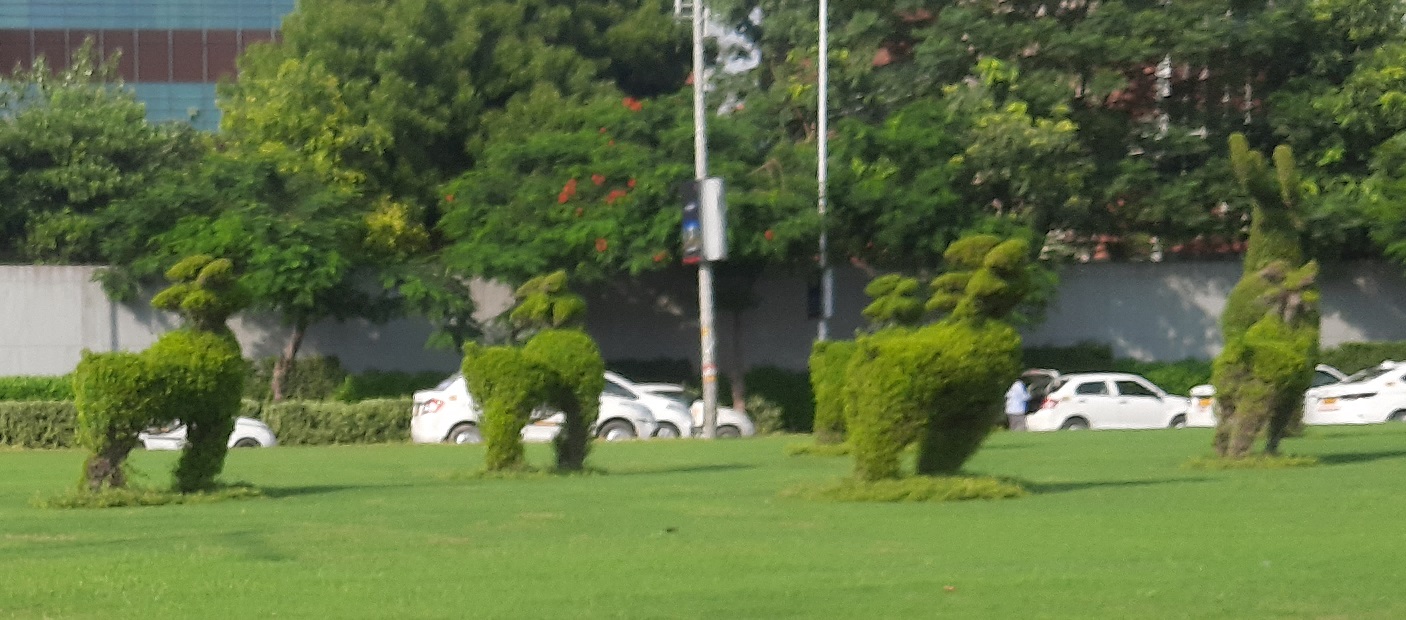
Have you seen deer walking across a traffic island in the middle of a crowded urban space? Or perhaps elephants in your city garden? Well, that is topiary.
Topiary, as per the Britannica, is ‘the training of living trees and shrubs into artificial, decorative shapes’. It is an ancient art, going back to the time of the Romans. In fact, Gaius Matius Calvinus, a contemporary of Julius Caesar is supposed to have been one of the first practitioners, and Caesar is said to have popularized it all over the Roman Empire.
There are three fundamental types of topiary:
- Shrub topiary which consists of shrubs which are designed and shaped in various shapes and sizes. Very experienced gardeners do the cutting freehand, while others use frames.
- Vine topiary, wherein vines and climbers are encouraged and shaped to grow in various topiary forms
- Moss topiary where a frame is filled with wet moss and the chosen plant, and grown in the desired shape.
Whatever the type of topiary, it is an endeavour which requires ongoing work, care, patience and expertise
The fortunes of topiary have waxed and waned. After a long lull, the Italian Renaissance, which saw the flowering of many arts, also saw the revival of topiary. It became the rage in Italy, France (including in the Versailles), and with the Dutch and English. The British took to it with passion, and it was found not only in the homes of the rich and the famous, but also in the modest gardens of peasants and tradesmen. Imagination was the only limit, with ships, fantastical beasts and human figures, all roaming the lawns.
Till topiary went overboard. And it was the mighty pen which defeated the scissors. Alexander Pope wrote a satirical essay “Verdant Sculpture” criticizing over-the-top topiary, and as a result, by the 1720s and ‘30s, topiary fell out of favour and was cleared from most prominent English gardens. The Levens Hall Garden was one of the few which escaped, and is today the oldest topiary gardens, with 30,000 bedding plants carved in a variety of shapes.
Till topiary was again revived in the 1840s. Not at the same scale, but it became moderately popular.
In its own unique forms, topiary has been quite popular in Asia too. China and Japan have practiced it for many centuries, with the objective of helping the trees achieve their “natural” form. Even the popular bonsai is a form of topiary. Japanese Zen Gardens make extensive use of different topiary techniques.
In 2021, a new event, World Topiary Day, was created by the owners of one of the world’s oldest topiary gardens, the Levens Hall and Gardens in Cumbria, UK, which dates from 1694. World Topiary Day marked on May 12th every year, celebrates ‘… the fantastic art of topiary (shaping and cutting particular types of tree into geometric shapes and forms that resemble common objects and people) and its heritage within the world of gardening’, and seeks to inspire ‘…keen gardeners and lovers of al fresco living to adopt topiary’s style and structure within their own private gardens.’
A new award for topiary has also been announced as recently as this year and the ‘…search is on for Britain’s best topiary artists thanks to the inaugural Topiary Awards, which are now open for entries until May 31.’
In India too, many gardens and public spaces have examples of topiary. But sadly, after the initial enthusiasm, they are not maintained well, and therefore go out of shape.
India is however home to the tallest topiary as per the Guinness Book of Records. This is the Samban-Lei-Sekpil in Manipur, started in 1983, which has now reached 18.6 m (61 ft) in height. The plant used is Duranta erecta, a shrub common in Manipuri gardens. It is shaped into a tiered structure called ‘sekpil’ that honours Umang Lei, the forest god.
Here is to tree-shapers, tree-barbers, tree-architects and their tribe, for adding green landmarks and a touch of whimsy to our lives.
–Meena

 Millennial Matriarchs