
George Mallory, when he was asked why he wanted to climb Mount Everest, is said to have replied: “Because it’s there”. Mallory was the only climber to take part in three of the British pioneering expeditions to climb Mount Everest in the 1920s. Mountains have always “been there” and have over centuries, challenged humans to ascend and ‘conquer’ them. Hundreds of books have been written about mountains, mostly by men. The books are characterised by the language of conquest and victory, and propelled by the goal of reaching the summit.
In the period when men were racing to scale and conquer the highest peaks, was a young woman who perceived, and described, mountains not in terms of heights but in terms of depths. This was Nan Shepherd, not only an explorer of mountains, but also one of the great early 20th century writers of nature, landscape and the Scottish mountains that she so loved.
Anna (she called herself Nan) Shepherd was born in February 1893 near Aberdeen on the North East coast of Scotland. Not long after she was born her family moved to Cults (now a suburb of Aberdeen). The hills of Deeside close by, were her natural playground, and her love for walking in the hills was encouraged by her father who was a keen hill walker. Nan was also an avid reader, and at the age of fourteen started filling notebooks with quotations and citations from her readings. She attended Aberdeen High School for Girls and studied at Aberdeen University, graduating with an MA in 1915. She went on to teach English literature at the Aberdeen Training Centre for Teachers (later the College of Education). She remained there for the next forty-one years, until her retirement in 1956, having become known as an inspiring teacher with a feminist slant to her work. Although she did travel extensively, she continued to live in her childhood home until she died in 1981.
Having explored the local hills almost from the time that she could walk, Nan ventured further afield, to the Cairngorms. These formidable mountains to the west of Aberdeen, are amongst the wildest landscapes in the British Isles. This was in June 1928, Nan was 35 years old. This first experience of the mountains was the start of a passion that came to define both her life and her writing. From then on, she would head for the Cairngorms whenever her job would allow, often alone, or occasionally with friends and fellow walkers.
For Nan, who conquered all six of the major peaks in the Cairngorms while still a young woman the goal was never to reach the summit of a mountain: it was not climbing up that excited her so much as “clambering down,” discovering all the hidden parts of the mountain that only an attentive walker would notice. It was this perspective of ‘looking within’ both at the mountain, and herself, that inspired Nan to also write copiously during the period between 1928 and 1933. During this time, she published three novels: The Quarry Wood, The Weatherhouse, and A Pass in the Grampians. As she said: “It simply must be written”. Shepherd drew inspiration from the places and people she knew well, setting her stories in the North East of Scotland, with a focus on country communities and the harsh way of life imposed by the landscape. Above all, what shone through was her deep love for the Scottish mountains and her knowledge of these through walking.
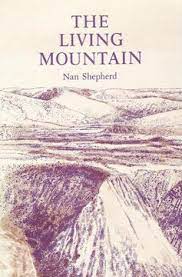
While Nan published these books, the book that was most inspired by these mountains, and her most inspirational piece of writing, was called The Living Mountain. The book, written in 1940, describes Nan’s explorations, as a walker and as a writer, of the Cairngorm Mountains. Nan sent her manuscript to a novelist and publisher friend Neil Gunn who appreciated it, but felt that it was not fit for publication unless she added photographs and a map. Nan put away the manuscript in a drawer and there it remained for over 30 years. It was finally published by the Aberdeen University Press in 1977.
The publication of The Living Mountain revealed Nan as one of the earliest ‘Nature writers’ who brilliantly captured the Cairngorms in their various seasonal moods. Her descriptions emerged out of her own immersion in the experience of walking in every kind of weather, swimming in the lochs, dipping in the streams, and camping under the sky. It also showed her incisive eye for detail, and her profound understanding not only of the geography and geology of the mountains, but equally of the living elements that made it a vibrant ecosystem. Long before ecology became a buzzword, Nan was acutely aware of the interconnections.
Shepherd was interested in the ‘essential nature’ of the mountain: in understanding it from all angles and in all seasons. She viewed the mountains not as looming objects of sublime terror, but as acquaintances. She wrote: Often the mountain gives itself most completely when I have no destination but have gone out merely to be with the mountain as one visits a friend, with no intention but to be with him.
The poetic descriptions of the routes are so vivid that the readers can literally walk these with Nan. But Nan Shepherd’s writing is not simply a description, it is equally an introspection. While most mountaineers think in terms of peaks, plateaus and cliffs, Nan looks within, “into” cracks in rocks, and the depths of lochs and rivers. Her prose is philosophical and often meditative: One does not look upwards to spectacular peaks but downwards from the peaks to spectacular chasms, for a mountain has an inside.
Although it was written nearly a century ago, The Living Mountain is today acclaimed as “one of the most brilliant works of modern landscape literature”. It is a lyrical memoir that combines field notes, natural history, and oral history. One of its most profound tenets is that we should not walk “up” a mountain but “into” mountains, thus exploring ourselves as well as them.
December 11 is celebrated as International Mountain Day. The theme for this year is Restoring Mountain Ecosystems. Nan Shepherd’s The Living Mountain is a reminder that healthy mountain ecosystems can restore us: in body and spirit.
–Mamata

 Millennial Matriarchs