
Continuing with the theme of food that Meena introduced this week. She urged gratitude for those who produce the food that sustains us all, and that we ponder on our relationship with food. Nothing expresses this sentiment better than the Japanese word kansha which refers to appreciation toward those who cultivate, harvest, and prepare food.
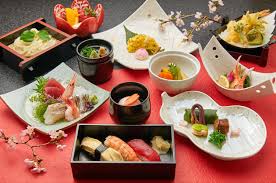
And nothing encapsulates the intricate relationship with food than the Japanese concept of washoku: the harmony of food.
My first introduction to the importance of balance in diet was through the classic book Totto Chan, an engaging memoir that tells about an ideal school in Tokyo during World War II, which combined learning with fun, freedom, and love. In the story the headmaster asks the parents to include in their children’s lunch boxes “something from the ocean and something from the hills.” This meant food from the sea (fish and seaweed) and food from the land (meat, grain and vegetables). This simple guideline ensured a nutritious and balanced diet that could be put together economically and easily in Japan.
Many years later when I visited Japan, the first thing that struck me about Japanese food was the delicacy and aesthetic with which it was presented. This was a visual demonstration of the principle of balance and harmony as small portions of each item were arranged so as to create a perfect composition of colour and form on the equally beautiful serving plates. The act of partaking from this palette of shades and forms was in itself a reverential and delicately synchronised process, which respected as well as celebrated the gift of food.
It was only some years later that I discovered that this harmony in Japanese cuisine is created by the nuanced combination of five essential elements: Goshiki (five colours), Go-Ho (five cooking methods), Gomi (five flavours), and Gokan (five senses).
Goshiki: Every meal should include each of the five colour groups. These are: Red (aka) which include tones of orange, purple, crimson etc., and Yellow (kii) including golden and ochre tones. These are warming colours said to stimulate the appetite. Green (ao) also includes blue, which is said to refresh. White (shiro) which includes tones of silver or ivory provides a sense of cleanliness. Black (kuro) including very dark tones like eggplant skin or shiitake mushrooms. A serving of a Japanese meal will include components that provide these colours, which are further enhanced with decorative leaves and flowers. The colours help give visual cues to the different nutrients included in the meal and including each colour group ensures nutritional diversity.
Go-Ho: In an earlier time when the ordinary Japanese people had limited food resources for daily meals, they brought variety by cooking the same ingredients in different ways.The tradition continued to become a principle of a Japanese meal which would include five modes of cooking.
Simmering (niru) anything cooked in a boiling liquid
Steaming (musu) any steamed dish, most often rice.
Grilling (yaku) including broiling, searing, roasting to create layers of flavours.
Frying (ageru) food is deep fried in oil
Cutting (nama) is a very important element especially in food that is eaten raw (sashimi or pickles). This requires skillful knife control and adroit fingers.
Gomi: The Japanese believe that by including five flavours in each meal, the craving for any one flavour is minimized through the balance. The flavours are: Sweetness, Sourness, Saltiness, Bitterness and Umami. While it is known that the human tongue can distinguish the first four flavours, the fifth, umami, is difficult to explain. It comes from the umami component of kelp (glutamic acid) and was discovered by Japanese scientists more than a hundred years ago. The word was coined in 1908 by Japanese chemist Kikunae Ikeda from the words umai (delicious) and mi (taste). In 2002 it was scientifically proven that our taste buds has receptors for umami, that translates from the Japanese as a ‘’pleasant savoury taste’.
These five flavours are provided largely by the five staple ingredients of every Japanese kitchen: Sato (salt), Shi (sugar), Su (rice vinegar), Se (soy sauce), and So (miso).
Gokan: The Japanese believe that in order to truly savour the five flavours, it is not just the tongue, but all five senses that come into play. Thus eating is not just a taste experience. It must begin with the sense of sight that takes in the attractive presentation of the food; the sense of sound which takes in the sounds from the surroundings (preferably nature) and evokes anticipation of the experience. The sense of smell enhances the gustatory experience, and the sense of touch does justice to the variety of textures that one puts in the mouth.
Food for the Japanese is thus as much about experience as it is about sustenance. The emphasis on simplicity of ingredients and cooking techniques, and seasonality of ingredients also makes the food nutritionally balanced. Washoku has been one of included in UNESCO’s Representative List of the Intangible Cultural Heritage of Humanity. It is described as a social practice based on a set of skills, knowledge, practice and traditions related to the production, processing, preparation and consumption of food. It is associated with an essential spirit of respect for nature that is closely related to the sustainable use of natural resources.
The recently popular series of documentaries on Blue Zones, the five places in the world where people live the longest, healthiest lives, included the Okinawan diet of Japan. While the segment did not go into the depths of the many principles of Five that make the Japanese cuisine what it is, it did add another interesting principle of hara hachi bu, an ancient mantra that reminds people to stop eating when their stomachs are 80% full. A gentle reminder that moderation and mindfulness are also key to the healthy consumption of food.
Japanese food has gained popularity in India in the last few years. This surprises me as this is so different from most Indian cuisine which is usually a rich mixture of multiple spices and flavours. However for most people here, Japanese food usually means Sushi. Perhaps it is time to learn more about, and appreciate the breadth and depth of this Oriental cuisine.
–Mamata

 Millennial Matriarchs
Thank you for such a wonderful article. I am an admirer of Japanese inclination towards creating a sort of poetry with their food. I developed this love during my visits to Japan but have never bothered to understand the finer aspects of their penchant for treating their food the way they do. Thank you so much for such an enlightening article. 🙂
LikeLike