
It was all the rage in the 1980s. Every house had one, and it was fought over by adults and children. It was in everyone’s hands that were never still; it sparked contests and competition across the world. It was the Rubik’s Cube.
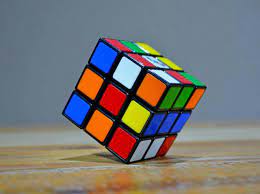
At first glance, the cube seems deceptively simple, featuring nine coloured squares on each side. In its starting state, each side has a uniform colour — red, green, yellow, orange, blue, or white. To solve the puzzle, you must twist the cubes so that eventually each side returns to its original colour. Easier said than done! To master the cube, you must learn a sequence of movements that can be performed in successive order. Mathematicians have calculated that there are 43,252,003,274,489,856,000 possible combinations or ways to arrange the squares, but just one of those combinations is correct.
The creator of the puzzle cube was an unassuming Hungarian architecture professor named Erno Rubik. Erno Rubik was born on July 13, 1944, towards the end of World War II in the basement of a Budapest hospital that had become an air-raid shelter. His father was an engineer who designed aerial gliders.
As Erno described his childhood: I was an ordinary boy, wanting to do everything possible—and not possible. I climbed trees and had fun in other ways that weren’t allowed but were exciting to me. And I was curious and tried to make things. Nothing special. He love to draw, paint and sculpt, and went on to study architecture at Budapest University of Technology because he felt it combined the practical with the aesthetic. He went on to teach architecture and taught a class called “descriptive geometry” where he encouraged students to use two-dimensional images to solve three-dimensional problems
In 1974, 29 year old Rubik was tinkering in his bedroom which had lots of odds and ends, including cubes made from paper and wood. He tried to put together eight wooden cubes so that they could stick together but also move around, exchanging places. The object quickly fell apart. Erno kept at it, taking it as a challenge. After much trial and error, he figured out a unique design that allowed him to build a solid, static object that was also fluid. He then decided to add 54 colourful stickers to the cube, with each side sporting a different colour – yellow, red, blue, orange, white and green. That way the movement of the pieces was visible and trackable. Erno was lost in the colourful maze, but with no clue how to navigate it. It took many weeks of twisting and turning before he could finally get the colours to align.
Once he found that the cube could be restored to its original state Erno Rubik submitted an application at the Hungarian Patent Office for a ‘three-dimensional logical toy’. Rubik now looked for a company who was willing to produce the cube commercially. It was not easy as no one believed that people would ‘play’ with such a toy. Finally in 1977 a small company that manufactured chess sets and toys agreed to manufacture 5,000 such cubes. The toy entered toy shops with the name Buvos Kocka or ‘Magic Cube’. By 1979, 300,000 cubes had sold in Hungary.
As the popularity of the cube grew and spread, even beyond Hungary, Rubik felt that taking it beyond Hungary needed an international collaboration, but that was the period of the Cold War when geopolitical tensions restricted collaboration with the so-called Western Bloc.
So Erno Rubik started to take his creation to international toy fairs where it met with lukewarm response. In 1980, at the Nuremberg Toy Fair, a marketer named Tom Kremer spotted the Magic Cube. He thought it was fascinating and made a deal to take it to America. Rubik got a contract at an American company, Ideal Toy, which wanted one million cubes to sell overseas. But due to copyright issues, they suggested that the name be changed. And so, Rubik’s Cube made its debut at a New York toy fair in 1980. Erno Rubik himself was invited to launch the cube. The shy professor with not very fluent English, was not the best of salesmen, but he was the only one who could demonstrate that the puzzle could be solved! The rest is history.
Rubik’s Cube became a craze. More than 100 million Cubes were sold over the next three years. Rubik initially believed the cube would appeal to those with science, math, or engineering backgrounds. He was shocked when, as he wrote, It found its way to people whom nobody would ever have thought might be attracted to it.
The Rubik’s Cube went on to become ‘one of the most enduring, beguiling, maddening and absorbing puzzles ever created’. More than 450 million cubes have sold globally, (not counting the many more imitations) making it the best-selling toy in history. It became much more than a puzzle. It has been described as ‘an ingenious mechanical invention, a pastime, a learning tool, a source of metaphors, and an inspiration.’ It has spawned speed-cubing competitions and an assortment of record breaking feats. But as Rubik once said, for him it is not the speed that is of essence; “the elegant solution, the quality of the solution, is much more important than timing.”
The educator in Rubik believes Arts should be an integral part of STEM education. He feels that the Cube demonstrates this fusion. The Cube has become a universal symbol of everything I believe education should be about: fostering curiosity, the rewards of problem-solving, and the joys of finding your own solution.
Even as the Rubik’s Cube became a global sensation, Erno Rubik remained a publicity-shy professor, continuing his “tinkering”. He started his own design studio in Hungary and began to work on new projects and revive abandoned ones, including puzzles called the Snake and Rubik’s Tangle. In an interview he said: I never planned to achieve this peak and had no idea that I would. And, after it, I had no thought that I’d like to do better. My only goal is to do well. I’m not thinking about whether people will like it or not. I need to love it and meet my targets, nothing else. What happens after that depends not on me but others. The Cube created the strongest connection with people—which is harder than being popular—maybe because it taught them that they could solve difficult problems and rely on no one but themselves to succeed. It has meaning, and that’s enough for me.
–Mamata

 Millennial Matriarchs