
Just over a month ago, the name Hormuz did not mean much for a large population of the world. Today the word is making headlines across the globe. The blockade of the Strait of Hormuz is having a ripple effect far from the waters of the Persian Gulf. Sadly, its claim to fame is rooted in the fall-out of a war that the world did not, and does not need.
For centuries ships have been sailing through the waters of the Persian Gulf, carrying people and cargo, and perhaps, not as visibly, culture. These waters are not just transporters, they are also the space for small land formations, many of which are unique in their geology and biogeography. One such island is the island of Hormuz.
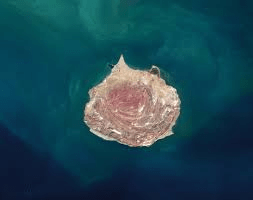
Hormuz Island is a part of the Hormozgan Province of Iran. Located about eight kilometres from Bandar Abbas on the coast of Iran, and 18 km from Qeshm Island in the Persian Gulf, it is strategically perched where the Persian Gulf and the Gulf of Oman meet. Hormuz island covers an area of approximately 42 square kilometres.
The ancient Greeks called it Organa; during the Islamic period it was known as Jarun, and later took the name Hormuz from a significant mainland port of Ormus. It is believed that around 1300 A.D. the ruler of this town and its inhabitants shifted to the island in order to evade attacks by Mongolian and Turkish troops. Thus they called their island home New Hormuz. Today it continues to be recognized simply as Hormuz.
Its strategic location at the entrance of the Persian Gulf has historically made Hormuz Island a key trading post. It was an important stop for traders on the Silk Road. In the 15th century a Russian merchant described it as “a vast emporium of all the world”.
It was part of a flourishing kingdom during the medieval period. This attracted the attention of the European powers. In the early 16th century it was taken over by the Portuguese who established a fort there, which helped the Portuguese to control strategic trade routes between Europe, India, and the Far East, and dominate the spice trade.
It remained a Portuguese colony for almost a century and a half, before being taken over in 1622, by the Safavid Empire, run by a powerful Iranian dynasty. It has been a part of the Persian empire since then, and is today a part of Iran.
Even today the island’s culture and customs reflects a blend of the Arab influences from neighbouring countries, as well as past interactions with Portuguese, English, and Indian merchants. The island today is home to Persians Arabs, and the indigenous Hormuzis, each contributing to the rich cultural mosaic.
What makes Hormuz Island unique are its dazzling geological features. It is one of the biggest salt domes—where a mound of salt layers rises up through overlying layers of rock. The formation glows with brilliant shades of red, yellow and orange. This palette is created by the deposition of minerals which constitute the layers of shale, clay, and volcanic rock. Geologists believe that hundreds of million years ago shallow seas formed thick layers of salt around the margins of the Persian Gulf. These layers gradually collided and interlayered with mineral-rich volcanic sediment in the area, leading to the formation of the brilliantly coloured soil and mountains. The high percentage of minerals, including iron, gypsum, oligiste, apatite and quartz has given colour to all the geographical features—ochre-coloured streams; beaches with sand ranging from white, silver and gold, to crimson; the Rainbow Mountains whose vibrant colours range from deep reds and oranges to purples and yellows, and natural salt caves that resemble vibrant works of art. The beaches are covered in crimson sand, and when the waves wash over these, the water also takes on reddish and pink hues. Because the beach’s red glow could be spotted from far out at sea, sailors once used it as a natural navigation marker in the Strait of Hormuz.
The geological formations on the island include the Valley of Statues, a surreal landscape with natural rock formations; Silence Valley which is has an eerie landscape of salt formations and is completely silent; and the Cave of the Salt Goddess formed over thousands of years by water erosion and salt crystals, the walls of which shimmer with vibrant shades of whites, blues, purple and pinks.
In this stunning landscape, the Red Mountain stands tall. This is even more unique because not only is its soil is bright red, it is also edible!
The red soil is caused by haematite, an iron oxide which comes from the islands volcanic rocks. The mineral is valuable in the production of cosmetics, paper, plastic, stainless steel, ceramics, tiles, pottery and glass, and was exported for this, but the exports have now been reduced to prevent overexploitation. This soil is found nowhere else in the world; however it is not permitted to carry any samples out of the island, even as a souvenir.
The soil plays an equally important part in local cuisine! Known as Gelack, it is an important ingredient, in local cuisine. It is used as a spice, especially in the traditional fish curry called sooragh. A rare edible soil that is a valued spice in itself!
If Hormuz Island is renowned for its geological features, it is equally rich in biodiversity. A patch of mangroves at its northern end adds a touch of green to the vibrant palette. The island ecosystem harbours a rich variety of bird species, and the waters are home to thriving marine life.
With its kaleidoscope of natural colours, Hormuz aptly deserves the title of Rainbow Island. Sadly the rainbow is today eclipsed by the dark clouds of war.
-Mamata
 Millennial Matriarchs