Going to the Zoo

As a child in Delhi, one of the major highlights of the year was a visit to the Zoo. And if we were lucky enough to have guests from out of town with children, it was a bonanza year, because the zoo would be on the itinerary for the guests, and we could go along too. The birds visiting the wetlands which are a major part of Delhi Zoo; the lions, tigers, elephants, zebras; the mischievous monkeys, the exotic zebras and giraffes—these were our only encounters with creatures that we otherwise only saw in 2-d in books. And from such visits grew our wonder at the world of nature and our love for it.

And that indeed is one of the stated purposes of zoos—to introduce visitors to nature and to lay the foundation for a conservation ethic. As India’s Central Zoo Authority (CZA) sums up, the objectives of zoos are:

‘CONSERVATION: To be involved in programs which assist the survival of wild populations of animals. This is often done in partnership with other organisations.

EDUCATION: To increase the level of awareness, knowledge and understanding of visitors about animals, the environment and conservation, and to motivate behaviour change which will help the environment.

RESEARCH: To conduct and facilitate research on animals both in captivity and in the wild, with particular emphasis on threatened species.

RECREATION: To provide enjoyment and enrichment for visitors through close contact with living things.’

I spent two decades of my career as an environmental educator, and zoo education was something I was involved in at some stage. I still carried the deep impacts of my childhood zoo experiences and worked with a passion to make zoo visits more educational, striving to sow the seeds of love, respect and care for the environment, nature and animals.
Zoo

But last week, I took a 4-year old to the Bannerghatta Zoo and Safari Park. She liked it. But I saw nothing like the excitement and wonder I remember feeling as a child. She was reasonably excited when she saw lions and tigers and bears close up during the safari. And then during the walk through the zoo, she did like the zebras and monkeys and giraffes, but I could see that she was disappointed that they were just standing there, not ‘doing’ anything. And then when we saw a herd of elephants, she could not see the baby-elephants clearly, which she was not happy about. And as she walked through the zoo, she was tired and hot and cranky. All in all, if my childhood zoo visits were an 11/10, hers was a 7/10.

I got to thinking why. And then I realized that she had the wildest and most remote of habitats and the most exotic of animals at her fingertips. She just had to switch channels in the comfort of home to see lion cubs playing with their mother’s tail; elephants mud-bathing; kingfishers swooping in for a fish catch; tigers chasing a deer. No wonder the physical sights were not so exciting.

I still believe that zoo-visits have a major role to play in nature education. But obviously, it cannot be business as usual. While zoos in India are making some efforts to make onsite education more exciting, there are international zoos which have taken this to new levels of innovation, immersion and interaction. Next week I will share some interesting and really cutting-edge programmes.

India has 145 recognized zoos in India as per CZA. Pre-Covid estimates indicate that zoos are one of the highest visited public spaces, with over 8 crore visitors every year. Zoos are still the most accessible way to see animals for real–national park and sanctuary visits are expensive and time-taking. We cannot lose this opportunity of zoo-visits to set off positive action for the environment.  And to do so effectively means we must understand the challenges that new media poses to traditional visit experience, as well as recognize the exciting opportunities it offers.

–Meena
Look, See, Wonder…

As environmental educators, our most important task with children as well as adults was to awaken them to the wonders of the world around them. From this wonder of the variety of life and the intricate connections therein would come an intellectual curiosity to understand the world better, followed by a passion to do something about it. So the responsibility was to take people through the steps of Awareness, Appreciation, Skills, Knowledge and Action.

So the first step seeing and sensing the world. I remember some of the exercises we used to do in our workshops to help people do this:

  1. Observe the greens : Closely observe the shades of the leaves of different plants/trees. Try to describe the differences.
  2. Observe the shapes of leaves: Sketch different leaves to scale.
  3. Bark rubbings: Find a tree, place a piece of paper on the bark and colour over with a pencil to get the impression of the bark design. Repeat with another tree.
  4. Listen to sounds: Sit in absolute silence for 5 minutes in a natural area and note down the sounds your hear.
  5. Smells: Go around a garden and sniff the flowers, the leaves, the plants, the soil.

Even the most cynical adult would get completely involved and excited, and the result would be a ‘Wow, who would have thought that there were so many shades of green;  that soil smelt like this; that there were so many different types of sounds in nature!’

Roles got reversed when the world decided to environmentally educate me two days ago, as I was on my walk. The very same path that I follow every day, but I was out a little earlier than usual. So the light was different and everything stood out with a brightness and clarity that I did not get to see later in the evenings.

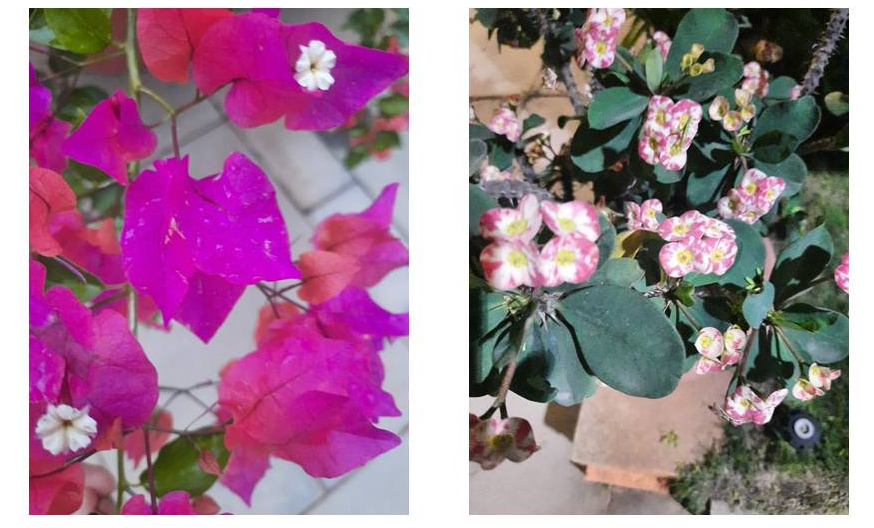
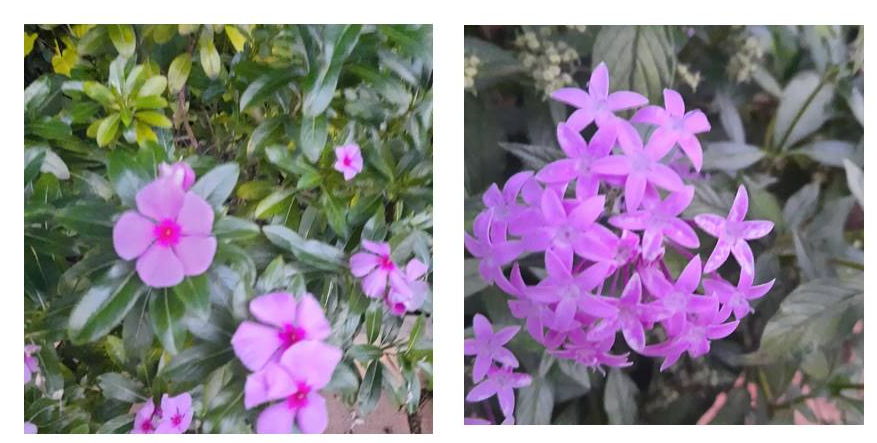
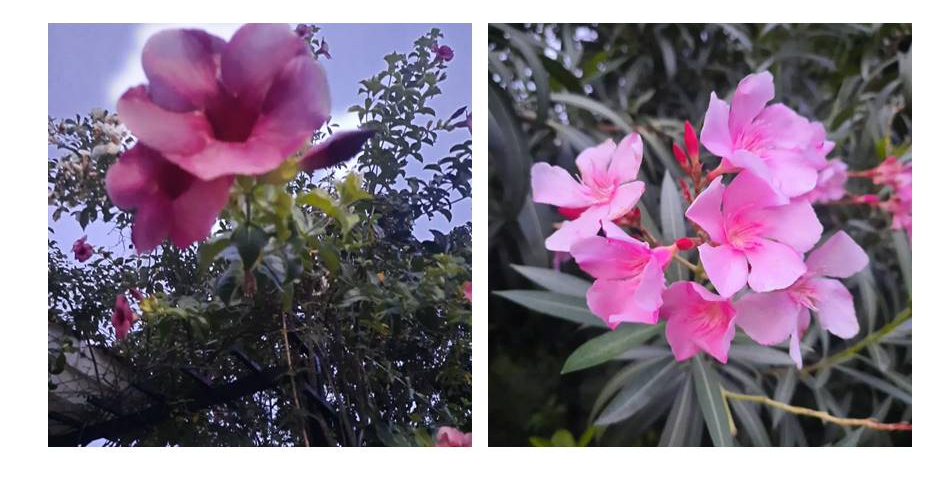
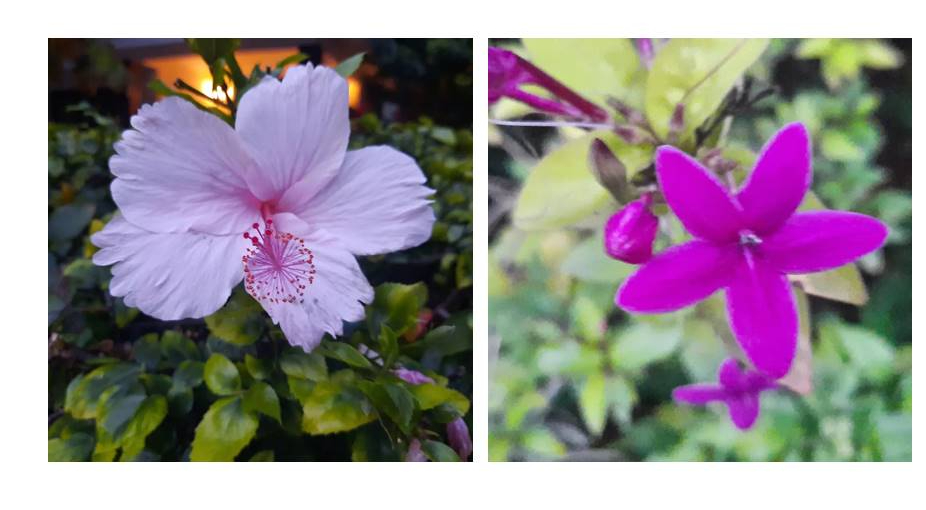
I saw one beautiful pink flower and decided to take a pic. I continued for 2 meters, and saw another one. And within the space of 10 minutes, I had 11 flowers in different shades of pink captured in my phone. I was wonder-struck!

I had obviously only been ‘looking’. I had forgotten to ‘see’. The difference, as Grant Scott, a famous photographer puts it: there is ‘.. a seriousness of intention that one of these words suggests, whilst the other gives the impression of a casual approach to perhaps what is the same thing. The word ‘see’ suggests a depth of visual engagement that allows the person ‘seeing’ to control the action and retain control of any further action that may take place after the initial seeing. To look suggests an observation of surface, it does not suggest any further depth than that. To look suggests both the beginning and end of the action, whereas to see suggests the beginning of a process of investigation.’

So while the popular adage is that we should take the time to smell the flowers, I would also urge that we take the time to see the flowers. And even more important, take the time to let a sense of wonder overtake us!

From this sense of wonder will come the sense of urgency to take care of our world!

–Meena

A Day for Sea Monkeys

My generation grew up reading comics usually borrowed from lending libraries. Foreign comics were very expensive and there were few parents in our circles who allowed us to buy them often. Maybe once or twice a year.

These precious comics therefore, were read and re-read and savored cover to cover. The last few pages would often carry ads for a fascinating variety of knick-knacks and gimcracks, of which the most fascinating were the quirkily illustrated ads for ‘Sea monkeys.’ Just add the contents of the package to a tank of clean water the ads promised, and lo and behold, in a few seconds or minutes (I forget which), your tank would have these fascinating little creatures swimming around.

Digging a little deeper, I found that in fact sea-monkeys are in a way manmade creatures. They were ‘invented’ in the 1950s and are a hybrid breed of brine shrimp  (Artemia NYOS, a hybrid of Artemia salina) created artificially by a person called Harold von Braunhut. Traditionally used as fish food, von Braunhut felt that brine shrimp could easily be maintained in home aquaria, and used to foster a love of nature among children and help them observe nature. He set about experimenting and found a way through which his hybrid shrimp could be preserved in dry conditions, and brought back to life when they came in contact with water. He patented the process, which is still a secret today. Sea monkeys are translucent and breathe through their feathery feet. They start life with one eye, and then in the course of time, develop two more. Von Braunhut named them ‘sea monkeys’ because of their monkey-like tails. Initially, these creatures lived only for a month or so, but with the help of marine-biology experts, he was able to create creatures which live up to two years.

Von Braunhut introduced them commercially in 1960 under the name ‘Instant Life’.

But marketing the concept and the product was not easy. No toy shops or pet shops would stock them. So von Braunhut came out with the idea of advertising them in comic books, to be bought directly from the company. Sales took off and never looked back! Generations of children in the US have kept sea-monkeys and become acquainted with the wonders of nature through observing them, caring for them and nurturing them. They are still very much an in-demand product.

Sea monkeys did not just find their way into homes and hearts. 400 million of them accompanied astronaut John Glenn to space. Sea monkeys even had their own TV show in the ‘90s revolving around the adventures of three microscopic sea monkeys which are enlarged to human size by a Professor. They have also featured in several TV shows and movies including The Simpsons. Needless to say, there are also several internet fora which discuss these creatures. Sea monkeys have their own Day too—May 16th is marked as National Sea Monkey Day in the US.

Sea monkeys continue to be ‘manufactured’ and sold, and are quite popular even today. They are available on the company site http://www.sea-monkeys.com/, as well as on Amazon, including in India. I am not sure if they are still advertised in comics though!

I have to confess that in my confused mind, for a long time I thought sea-monkeys and seahorses were the same. It was only many, many years later that I realized they were completely different. Sea horses are more bonafide– any of about 50 species of marine fishes allied to pipefishes.

Happy belated Sea Monkey Day!

–Meena

Image: Shutterstock

RIP Dr. SM Nair: Father of Natural History Museums

There are the pioneers, and he was among them. Museology is not a widely-known or popular field of study even today. Way back in the 1950s, it was even less so. This is the time at which a young boy from Kerala, after finishing his B.Sc in Trivandrum, travelled all the way to Baroda to pursue his M.Sc in the subject, at the M.S. University. He went on to do research on the Bio-deterioration of Museum Materials, and was awarded the first Doctorate in Museology from M.S. University for this work.

Dr. Nair started his career as an academic, first teaching at his alma mater in Baroda, and then moving on to Department of Museum Studies, BITS Pilani.

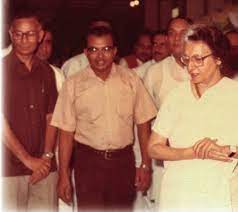
Mrs. Indira Gandhi, then-PM, and a leader who took great interest in the environment, had been very impressed by the Natural History Museums she saw during her visits to Europe. She wanted to create similar ones in India. She conceived of a plan for one in New Delhi and one in Bhopal. She put together an eminent team of museum professionals and scientists to take this idea forward. One thing led to another, and Dr. SM Nair, only 37 years old at that time, was chosen as the Project Director for this initiative in 1974.

Dr. Nair and Mrs. Gandhi at NMNH

Four hectic years followed, when the conceptualization, planning and execution was done by a dedicated core team including Shri D.P.Singh, S.K. Saraswat, B. Venugopal and several others. Dr. Nair visited the best Natural History Museums around the world. He got several artists and model-makers trained at the best centres in the world. And the National Museum of Natural History opened its doors to the public on June 5, 1978 (Environment Day). Subsequently, Regional Museums of Natural History came up in Mysore, Bhopal and Bhubaneswar  under Dr. Nair’s guidance.

The stuffed rhino that greeted one on the ground floor of the FICCI building where NMNH was housed, will surely be in the memories of many a Delhi school child. The rhino had died a natural death at the Delhi Zoo, and was stuffed and kept here.

The effort in NMNH was always to make the experience interactive for children. For those times, when most museums were static displays, this focus was unusual. The Museum also had a major thrust on outreach and extension. It had an active teacher training and orientation programme, which reached out to thousands of educators in its time.

Dr. Nair had a personal connect with every exhibit and activity at NMNH, and continued to take an interest in it even after his retirement in the late ‘90s. What he must have gone through on 26th April 2016, when the news of a fire breaking out in the museum and destroying the entire collection, can only be imagined.

Dr. Nair continued to be active in his mission of Environmental Education long after his retirement, working at WWF-India and Centre for Environment Education.

Not just at a national level, he was extremely respected internationally, serving as Chairman of Natural History Museum Committee of ICOM (international Council of Museums) and as

a Member of the Joint Museum Committee of the lndo-US Subcommission on Education and Culture.

Among his books are ‘Endangered Animals of India and their Conservation’, brought out by the National Book Trust, and  ‘Bio-deterioration of Museum Materials’ by Agam Kala Prakashan.

We knew Dr. Nair since the mid-eighties, as one of the fathers of the Environmental Education movement an India.

He mentored us first as a member of the Governing Council of CEE, and then as a senior colleague. Even today, old-timers in CEE-VIKSAT recall his contribution to these institutions with great respect—when it was a struggling NGO, he spotted the potential of the team and gave them a project to develop labels and take-away materials for the NMNH exhibits. This not only paid salaries for a couple of months, but gave them their first project from a national-level, government institution. This project was a critical stepping-stone.

We have also known him as the father of a colleague, Meena, who was inspired by him to follow in his footsteps in a career in Environmental Education.

NMNH and other natural history museums excited the imagination and curiosity of generations of children. NMNH may no longer exist, but Dr. Nair’s legacy lives on.

Dr. Nair passed away last week. May his soul rest in peace.

Dr. SM Nair (1937-2021).

–Meena

Online Nature?

As the global pandemic continues to keep children indoors in many parts of the world, there is a continuing barrage of information on how to keep them ‘meaningfully engaged’. And heading the list is online activities–the one-size-fits-all solution. It started with online classes and assignments to help complete the academic year and requirements. This grew to include online ‘activities’ with students following virtual instructions to make and do things. And then, on to stories being told through a face and voice on a one-way screen.  And now, invitations to discover Nature online.

This in itself seems to be a contradiction in terms. EspeciallIMG_20200611_093510y for an environmental educator whose work and mantra for over three decades had been ‘connecting children with nature’. Environmental education as we believed was learning in the environment, learning through the environment, and for the environment. More than anything else, this was true for nature education. Based on this conviction we worked with passion and imagination to create hands-on teaching-learning experiences–from stepping outside the classroom to observe a single tree, to a camping experience of immersion in natural surroundings. These were experiences that engaged not just the head, but all the five senses—seeing, hearing, smelling, tasting and feeling—and thence the heart. We believed that it was the heart and not the head which would create a new generation of sensitive, informed and able champions of the environment.

As Rachel Carson beautifully put it, “For a child…, it is not half so important to know as to feel. If facts are the seeds that later produce knowledge and wisdom, then the emotions and impressions of the senses are the fertile soil in which the seeds must grow”.

But this was a Sisyphean task. Even while people like us were advocating the ‘take children outdoors’ experience, children everywhere were beginning to stay indoors more and more, due to a variety of reasons. The seriousness of the situation was highlighted in a book titled Last Child in the Woods: Saving Our Children From Nature-Deficit Disorder. Published in 2005, the author Richard Louv expressed his apprehension at the growing phenomenon of alienation from Nature, and coined the term Nature-Deficit Disorder.

NDD was then an unwanted side-effect of the electronic age and a plugged-in-culture. Today, this is threatening to be a major fallout of an unfamiliar and unprecedented global pandemic. As our children remain cloistered in what we hope is a safe environment, our lives are slowly been taken over by technology.

Much can be taught and learnt online. But Nature? Will the most beautiful pictures and inspiring speakers be able to match the intangibles of a personal experience? Will a set of neatly-framed images on a flat screen be able to create an experience that engages all the senses? Will it have any room for the magic of “feeling”? Will it create the child-nature connection that is a fundamental element of a children’s cognitive development, as well as its psychological and physical health.

What will be the psychological, physical and cognitive costs of this technology-supported human alienation from nature, particularly for children in their vulnerable developing years?

When some day in the not too distant future we emerge from our sanitised cocoons, blinking our eyes in the sunshine, let us remember again that real and not virtual Nature is the best teacher.

“It is a wholesome and necessary thing for us to turn again to the earth in the contemplation of her beauties to know of wonder and humility.” Rachel Carson

–Mamata