
Recently there was news that the world’s tallest mountain, Mount Everest is growing taller! While the rate of growth (0.2-0.5 mm per year) may not be significant given the total height of the mountain, it is a subject of study and research. The process behind this growth is called isostatic rebound, where land rises when heavy material like rock or ice is removed. In this case this is happening as a nearby river is eroding and causing the land under Mount Everest to push up, thereby increasing its height.
The height of Mount Everest has always been in the news, from the time that its height was measured for the first time, providing proof that it was the tallest peak on earth. Thereby hangs a long tale.
In 1802 the East India Company who were then ruling India instituted an ambitious project to scientifically survey the entire Indian subcontinent. The survey, originally started in Scotland, was brought to India as a geographical survey of the conquered territory after the British defeated Tipu Sultan.
The Great Trigonometrical Survey (GTS), as it was called, was expected to take five years. It ended up taking seventy years!
From 1923 the Survey was being supervised by Sir George Everest. In 1927 Andrew Scott Waugh, who had joined the Bengal Engineers, a regiment of the East India Company army, was appointed as a cadet in the Company, and he was assigned to the Great Trigonometrical Survey in 1832. By the late 1830s, when the Great Trigonometrical Survey reached the Himalayan region, Andrew Waugh had become Superintendent of the Great Trigonometrical Survey of India. The surveying of Everest was carried out under his supervision.
In 1831, George Everest, who had become the Surveyor General of India, was looking for a mathematician who had specialised in Spherical Trigonometry, to be a part of the GTS. A professor at what was then Hindu College (now Presidency College) suggested the name of his 19-year old student Radhanath Sikdar.
Radhanath had been a student at what was then the Hindu School of Calcutta for seven years. He had supported himself on scholarships, and his mathematical abilities did not go unnoticed. George Everest appointed the young Radhanath as a ‘computer’ in the newly established computing office. This was an era when a computer did not refer to a machine, but to the people who did complex calculations. Radhanath’s skills in this were far superior to those of his colleagues. He did not just use the established methods but invented his own formulas and applications to accurately measure different factors. He was described as a ‘hardy, energetic young man, ready to undergo any fatigue, and acquire a practical knowledge of all parts of his profession’. The young Radhanath became a favourite of George Everest.
Radhanath was sent to Mussourie where the main office of GTS was based, and it is here that he spent the next 15 years. His regular job began in 1832 as a sub-assistant. His salary was Rs 107 per month, comprising a pay of Rs 50, tent allowance of Rs 40 and horse allowance of Rs 17. In 1838, when his monthly salary was Rs 173, Sikdar expressed a wish to leave GTS for a profitable post as ‘teacher to a public institution’. Everest made a strong plea to the government to grant Radhanath Sikdar a substantial increase as an inducement to stay. As a result he was given an increment of Rs 100.
Everest retired in 1843 and was succeeded by Colonel Andrew Scott Waugh. Eight years later, in 1851, Radhanath was promoted to the position of Chief Computer and transferred to Calcutta.
This is when Radhanath started measuring the snow-capped mountains in Darjeeling. Foreigners were not allowed in Nepal so observations were taken from the Terai on the Indian side. Till then, Kanchenjunga was believed to be the highest mountain in the world. But during this survey the team noted that a mountain, then called Peak B, appeared to be higher. As calculations continued, the mountain was renamed Peak XV. The mountain had local names, it was known as Chomolungma in Tibet, Chomolangma by the Sherpas of Nepal and Qomolangma in China. But it had not yet featured on the international scene.
In 1852, the chief computer Radhanath Sikdar, through a series of calculations was able to establish that this peak was indeed higher than Kanchenjunga, making it the highest mountain in the world. He gave proof of this to his boss Andrew Scott Waugh who had succeeded George Everest as both Surveyor General of India, and Superintendent of the Great Trigonometrical Survey of India. Waugh waited four years to confirm and reconfirm the information. This was officially announced in March 1856. He also proposed that the highest peak be named after his mentor Sir George Mallory. And thus what could have been Mount Sikdar became Mount Everest!
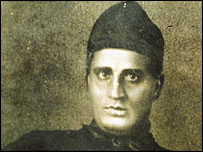
Radhanath Sikdar’s many years of path breaking ‘computing’ and his tallest discovery were eclipsed by the ruling powers of the day. However, Radhanath continued his passion and pursuit of mathematics, even after he retired from the Survey in 1862. He joined as mathematics teacher at what later became the Scottish Church College. He, along with a friend, also founded Masik Patrika, a Bengali journal aimed at promoting education and women’s empowerment. Radhanath Sikdar passed away in May 1870.
On 27 June 2004 the Department of Posts issued a commemorative stamp featuring Radhanath Sikdar and Nain Singh Rawat a legendary the Indian explorer who surveyed the vast unexplored expanses of Tibet in the late 19th century.
–Mamata
 Millennial Matriarchs