
As the country gears up to celebrate India’s 77th Independence Day, memories are revived of the significant events and persons in the unique movement that led India to her ‘tryst with destiny’ to become a free nation on 15 August 1947.
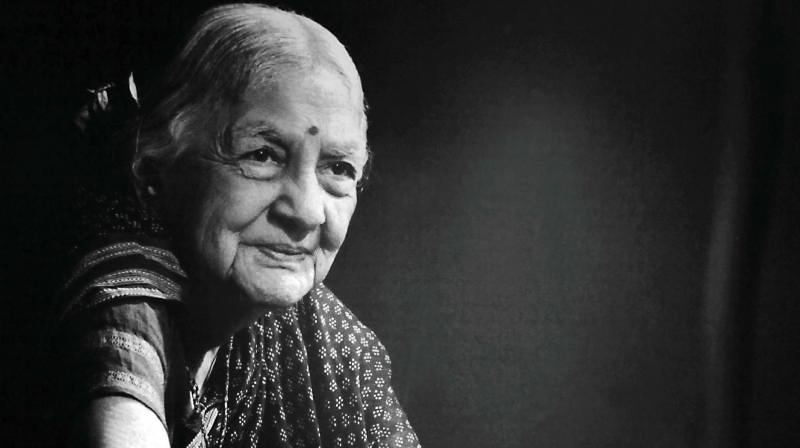
Among the innumerable individuals who contributed in different ways to reaching this momentous moment, is a name of a woman whose contributions were not limited to a single area, but spanned a wide range of fields, all of which coalesced into the empowerment and enrichment of the newly-independent nation. She was Kamaladevi Chattopadhyay—freedom fighter, actor, social activist, art connoisseur, and driving force behind the renaissance of Indian handlooms and handicrafts.
Kamaladevi’s interest in the area of crafts was nurtured in her childhood when she had participated in the creation of objects for the innumerable rituals, which were part of the daily life in many homes. She was drawn to the simplicity as well beauty in these everyday objects. But it was after she met Gandhiji that she understood this deep relationship between these objects and our daily lives. As she wrote: “How beneficial it was for us to live with them and make them an integral part of our daily existence”. She quoted Gandhiji: “Association is the essence of relationship which endears articles of everyday use to the user. This endearment finds a way of enhancing the aesthetic values in these articles, just as we love to dress up our loved ones, so we love to embellish our homes. Here, the Craftsman employs his ingenuity through creative imagination. We are mostly carried away by a finished product, may be excited by watching the process, but remain unmindful of the deep chords within us that are stimulated when we create something with our own hands. Therefore, in the Indian tradition, creation does not mean making novel and exotic articles to please one’s fancy, but endowing everything we use in our daily life with beauty. Therefore, nothing is created without a purpose”. Thus there was an inextricable link between form and function.
Khadi was more than a political symbol for Gandhiji; by making spinning an essential part of the process, he brought in respect for working with hands, and the act of creation, as well as a form of meditation and unification. Gandhiji also made the regeneration of crafts an integral part of the freedom movement. According to him, freedom was not to be defined in political and military terms only, but also in the social patterns that would lead to building inner personality, the spiritual content of the nation.
Kamaladevi was deeply moved by this philosophy. At the time, the long tradition of indigenous crafts was threatened by the rise of factory-made goods and mass production; many crafts were rapidly disappearing. For her, crafts revival and independence from British rule were interlinked agendas. Kamaladevi made it her mission to champion the cause of handicrafts and handlooms. She saw crafts not in isolation, but as a part of the rich fabric of our life involving all the creative expressions of people interwoven in their daily lives. She began at the grassroots, travelling to the remotest villages, getting to know the crafts people and understanding their issues. She formed crafts communities, involved the crafts people in training programmes, and opened up their work for a wider audience through exhibitions and exports of handicrafts. Thus she also supported the notion that crafts could have contemporary significance. Craftsmanship need not, however, be bound up wholly with tradition. While it continues to draw strength from the past, it has also to be tuned to the present, evolve a new relationship with the current flow of life.
Kamaladevi perceived that cottage industries had an important socio-economic and political role as these led to the decentralization of social and economic power, as well as providing employment and economic security to rural communities. Her efforts towards a crafts renaissance in India were multi-pronged. She made great efforts to rehabilitate women with craft-based livelihoods, in the refugee camps following Partition. She helped establish institutions and systems to empower artisans and to sustain their crafts: The Cottage Industries Board (CIB), the Indian Cooperative Union (ICU), the All India Handicrafts & Handloom Board, the Cottage Industries Emporium, Regional Design Centres, the Crafts Council of India (CCI), and the Crafts Museum, among others. She was appointed the chairperson of the All India Handicrafts Board in 1952.
For Kamaladevi, crafts were not only a way of recognising the significance of one’s own culture but also, of developing a sense of appreciation of other world cultures as well. It was her inspiration that created the World Crafts Council in affiliation with UNESCO. The Crafts Councils became an instrument of the different governments across the world to reach to the masters of their traditions.
Besides her seminal contribution to the revival of handlooms and handicrafts Kamaladevi was instrumental in the creation of several other initiatives and institutions in the field of the performing arts, music, and fine arts, as well as the All India Women’s Conference (AIWC) a national organization of repute that worked for legislative reforms and women’s empowerment. She is remembered not just for espousing the cause of craftspeople, but as a person whose vision was that every human being should live a life of dignity; and one who wanted to enrich the lives of people irrespective of caste, creed or nationhood.
Among the many awards that she was bestowed, the most fitting was the Charles Eames’ Award which honoured her as the one individual, who had contributed to the Quality of Life in India in this era.
Almost a century after Kamaladevi sparked the renaissance in Indian handicrafts and handlooms the country continues to celebrate their creators. 7 August is marked as National Handloom Day to remind us of their contribution to the cultural and economic landscape of the country. The date also commemorates the launch of the Swadeshi Movement in 1905, which emphasized self-reliance and indigenous craftsmanship.
–Mamata
More on Kamaladevi: https://millennialmatriarchs.com/2021/03/30/multi-faceted-nation-builder-remembering-kamaladevi-chattopadhyay
 Millennial Matriarchs