Famous Women on the Wall: Happy Women’s Day

This week we celebrate International Women’s Day.

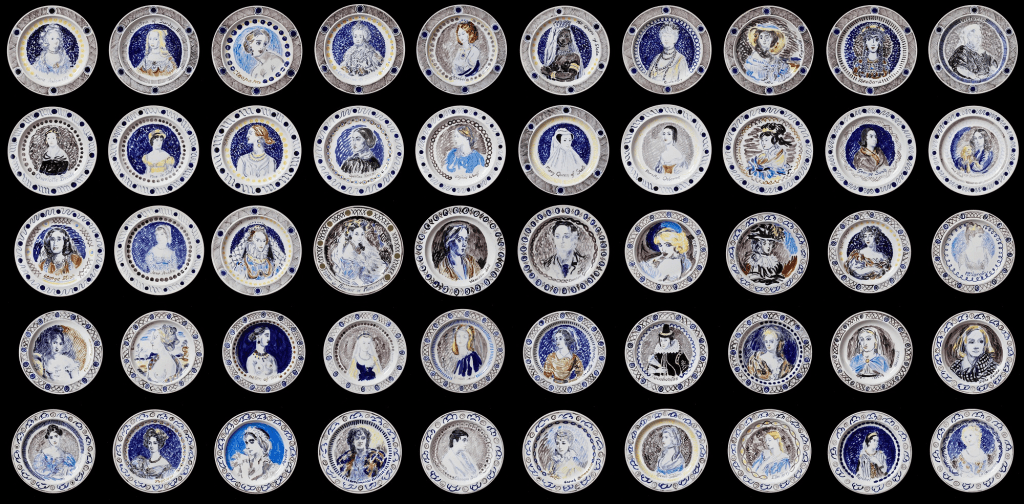
It was in 1911 that IWD started being marked. A couple of decades after that was when something called the ‘Famous Women Dinner Set’ was commissioned. This was a set of 50 dinner plates depicting famous women down history.

Kenneth Clark (Baron Clark), the art-historian and museum director, commissioned these. (Those of an older vintage may remember the BBC serial ‘Civilization’ which discussed Western art, architecture and philopsophy. Though made in 1969, it was broadcast in India in the late ‘70s or early ‘80s, and was one of the most popular art-history programmes in the world.)

Coming back to the dinner-plates, the artists given the commission were Vanessa Bell and Duncan Grant, of the famous Bloomsbury Group. This was the name given to a group of English writers, philosophers and artists who met between 1907 and 1930 in the Bloomsbury  district of London, the area around the British Museum , and discussed matters of art and philosophy.

It is said that Kenneth Clark got the idea of commissioning a special dinner service when he was dining off a historic blue-and-gold Sèvres service, originally made for Catherine the Great.

Kenneth and his wife did not interfere in any aspect of the creative work—what form or shape it would take, what pieces it would consist of, or even what it should portray.

In 1933 the work was completed, and after showing it to the Baroness, the artists presented the set of 50 plates to Kenneth Clark, who was probably quite surprised to see the result if his commission, because he thought he would be getting’…a wide ranging set of decorative crockery that included everything from soup tureens to mustard pots’

Picture from https://www.charleston.org.uk/event/famous-women-dinner-service

Vanessa and Duncan had selected 50 famous women down history—twelve each from four categories: Women of Letters (e.g George Eliot, Charlotte Brontë, 10th-century Japanese poet Murasaki. Virginia Woolf and Elizabeth Barrett Browning); Queens (including Catherine the Great, the Queen of Sheba, Elizabeth I, and Victoria); Beauties (among whom were Pocahontas and Helen of Troy); , and Dancers and Actresses (including Sarah Bernhardt, Ellen Terry and Greta Garbo). That made 48 women. The last two plates portrayed the artists Vanessa Bell and Duncan Grant. The artists had hand painted beautiful portraits of their subjects on Wedgewood plates.

Though he was initially a bit confused with the dinner service, it seems that Baron Clark quite grew to like his plates. It is said that he used to select specific plates from the service for use for particular guests, depending on their interests, or to poke fun at their sensitivities.

The dinner set, after being sold and re-sold disappeared from view for some decades, but later re-surfaced. They are now housed in the Charleston Museum in the UK—the original home of Vanessa Bell.

Another major work of art involving women and dinner is ‘The Dinner Party’, a 1979 installation by Judy Chicago. This is a dinner table arranged with place settings for 39 mythical and historical women. They are seated around a triangular table. Though controversial, this is considered a classic of feminist art.

In India we do have portraits (paintings and photographs) of women. But they are outnumbered by artistic works down the ages which put females at the centre—the oldest probably being the Harappan Girl, going back to 1750 BC or thereabouts. From there, to all the art in temples, to Raja Ravi Verma and his goddesses and mythical women, to the controversial portrayals of MF Hussain, to women painted by Amrita Shergill, Anjolie Ela Menon, Arpana Caur, Bharathi Kher and others, which are all classics today.

May many more artists immortalize real women in their art. It is an apt tribute.

Happy Women’s Day!

–Meena

And thanks to all our readers on this, the anniversary of our blog! And all those whose encouragement and support keeps it going!

Getting Over the Good Girl Syndrome: On the Occasion of International Women’s Day

For many years now, I have spoken at women forums, mentored and taught young women, and have had several women as part of my team.

The one message I try to give has been ‘don’t be a good girl’. What I meant was: don’t be confined by what your family and society expect of you; don’t do things just because someone thinks you should; you don’t have to be obedient; do think things out for yourself and rebel, disobey and question when you are convinced that is the right thing for you.

But I could never articulate it right. It often came out as if I was asking girls to be ‘bad girls’ or to be defiant just for the sake of being defiant! And I began to think maybe that is not what I should be telling them.

Till recently, when I started coming across the term ‘good girl syndrome’. I have been trying to read up a bit on this, and have discovered that it is not only a ‘thing’, but that it has been the subject of some (though not too much) academic interest.

Beverly Engel’s 2011 book ‘The Nice Girl Syndrome’ is a break-through book in this area, and I would rather quote her than try to define and explain the term myself:

‘A Nice Girl is more concerned about what others think of her than she is about what she thinks of herself. Being a Nice means that a woman is more concerned about other people’s feelings than she is about her own.’

‘Nice girls are compliant: they do what they are told. They’ve learned that it is easier to just do what someone asks than to risk an argument. Nice girls are passive; they let things happen. They are often too afraid to stand up for themselves… Nice girls are wishy-washy. ..They want to please everyone all the time…Because they are afraid of telling other how they feel, Nice Girls can be phony; they pretend a lot.’

From The Nice Girl Syndrome: Beverly Engel. (2011)

Characteristics of ‘good girls’ include: fear of disappointing others, fear of speaking out for fear of hurting others, need to always excel, avoid conflict, obey rules. They also find it difficult to refuse to do what they are asked.

I don’t know if it is true, but I find the need to conform and to be good girls is actually increasing. For women born in the sixties like me, any of us worth our salt did defy curfew times; did fight with mothers about dressing and hairstyles; did assert ourselves to pursue professional education and careers; did sometimes have to go on the warpath about when and whom to marry; and fight for space in the marriage to define ourselves. And each of those arguments made us stronger. And we emerged as strong women, who carved our own paths.

We of course stood on the shoulders of the women of the forties and fifties—they were pioneers: the early engineers, the early doctors, the women who defied purdah, the women who travelled alone, the women who fought family and society to create their own paths. We were not half as brave, but we did advance the agenda a bit.

Today, many of these things are taken for granted, and the girls don’t seem to be fighting any new battles. They in fact don’t seem to have as strong a sense of self as we did. I see them treading the path that society expects them. The paths that we trod and that they are treading look the same. But the difference is it is now the beaten path. We were bad girls when we trod this path, but now it is the norm, and good girls are expected to tread them and they are doing it! I would have thought they would go further, branch out, breach new barriers, reach new heights.

But maybe it is the world’s oldest story–one generation cribbing about the next!

IWD

At any rate, on the occasion of International Women’s Day, here is to BAD GIRLS. They are the ones who change the world!

–Meena

A Wise Lady from the 12th Century Guides Education Even Today

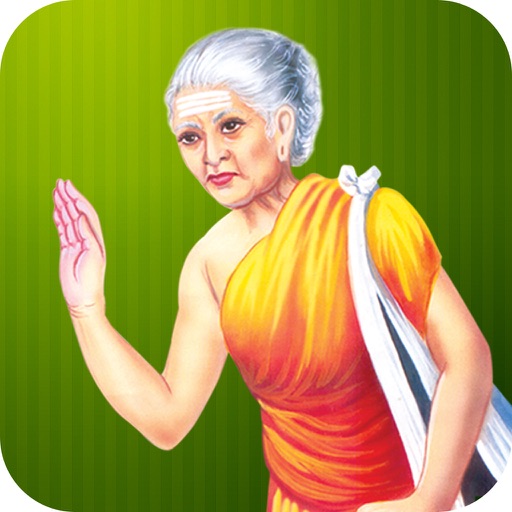
The Aathichudi is the alphabet primer with which every child in Tamilnadu takes its first step in education. It begins with: ‘A is for ‘Aram chaiya virumbu’. The phrase means ‘Intend to do good’. And this is the first thing that a child is taught. There cannot be a better way to start the journey of life.

And so the Aathichudi goes through the A to Z of Tamil, 108 lines in all, with short moral and practical aphorisms. It spans a wide variety of exhortations from ‘Control your anger’, to ‘Never stop learning’ to ‘Care for your parents’ to ‘Do not forget charity’ to ‘Do not allow suffering’.

If we think the ‘quote a day’ approach is new, let’s think again. The Aathichudi is a pithy moral-science textbook cum self-help book which was penned by the legendary Avvaiyar in the 12th century.  

Actually, there was not just one poetess called Avvaiyar  (meaning ‘Wise and respected lady’). There were at least three—the first was way back in the Sangam period (BC); the second probably in the 10th century; and the third, the author of the alphabet primer (among many, many other works) lived in the 12th century.

All of them were wise. They talked with kings and walked with common people. They effortlessly defied convention–they did not marry, they traveled alone across the length and breadth of several kingdoms, they advised kings. wrote poetry, and shared their wisdom. They shunned worldly wealth and power. They not only provided a moral compass to people of the time, but most of what they wrote is timeless.

How influential and independent these women were in their times—they were writing, advising, travelling, teaching, judging the literary works of others, acting as negotiators between kings to stop wars. Their works don’t just endure to this day; they are living documents which every adult, youth and child in the state can quote.

A few gems from Konrai Venthan, another of her works:

Oadhalin nandre vethiyarkku ozhukkam:  For priests, morality is more important than chanting.

Kutdram paarkkil suttram illai: Finding fault results in loss of relationships.

Kaip porul thannil meip porul kalvi: Education is the real wealth, more than the one in your hands.

Neraa noonbu seer aagaathu: A job not done well is not a job to be proud of.

Valavan aayinum alavu arinthu azhiththu unn: Even the super-rich should spend within limits.

Apart from being known to every school child through the Alphabet Primer, in Tamilnadu, the mass memory of Avvaiyar is, predictably enough, based on a film–one starring KT Sundarambal which was released in 1953. There are many, many stories and myths about the Avvaiyaars—from verbally jousting with Subramania (son of Lord Shiva), to being transformed from an attractive young girl to an old lady in an instant. This last was a result of praying to Ganesha, since Avvaiyar wanted to avoid getting into a marriage and family responsibilities, so that she could focus on her scholarly pursuits. There are besides, several statues across the State, including an imposing one at Marina (though how we know how she looked is not clear to me!). There are many college and educational institutions named after her.

For a long time now, people of Tamilnadu have been remembering her through the Avvai Vizha, an annual festival celebrated around mid-March, which is a gathering of scholars of Tamil and other subjects. This has, in recent times been taken over by the State Government. Besides this, the TN Govt. has instituted the Avvaiyar Award, to be given to ‘one eminent woman who has rendered excellent service in any one field such as Social Reform, Women Development, Communal harmony, Service for Language, Service in various disciplines in Art, Science, Culture, Press, Administration, etc., on the International Women’s Day which is being celebrated on March 8th every year’.

Avvaiyar even has a crater on Venus named after her—Feature 512!

But probably if she is looking down on us, what will please her most is that her work is still being used to lay the basics of literacy and education for children! And though she does not seem to make any explicit references to women empowerment nor set herself up as a role model, she will surely be happy that she is an inspiration for women through the centuries!

On the occasion of International Women’s Day…

–Meena

‘millennialmatriarchs’ was launched on 8 March, 2018. So this piece marks our third anniversary. Our heartfelt thanks to all those who have supported and encouraged us, and most of all, our kind readers!
Mamata and Meena