The Curious Case of Poop-Eating Plants

Poop. Not a subject of polite conversation. But with a six-year-old granddaughter, this is an integral part of my daily discussions—stories and jokes which feature poop, farts, and belches, and I thought nothing could get me.

But poop-eating plants did! This is one of those bizarrely strange tales from the natural world that makes me marvel at how much we don’t know.

The next time someone tells you that plants only need sunshine, nutrients from the soil and water, its time to pop out the word coprophagy. That’s the term for poop-eating. Most often it’s associated with animals—rabbits, dung beetles, and sometimes dogs. But it turns out that some plants may also be participants in this less-than-dainty buffet. Not many, mind you. It’s an exclusive club.

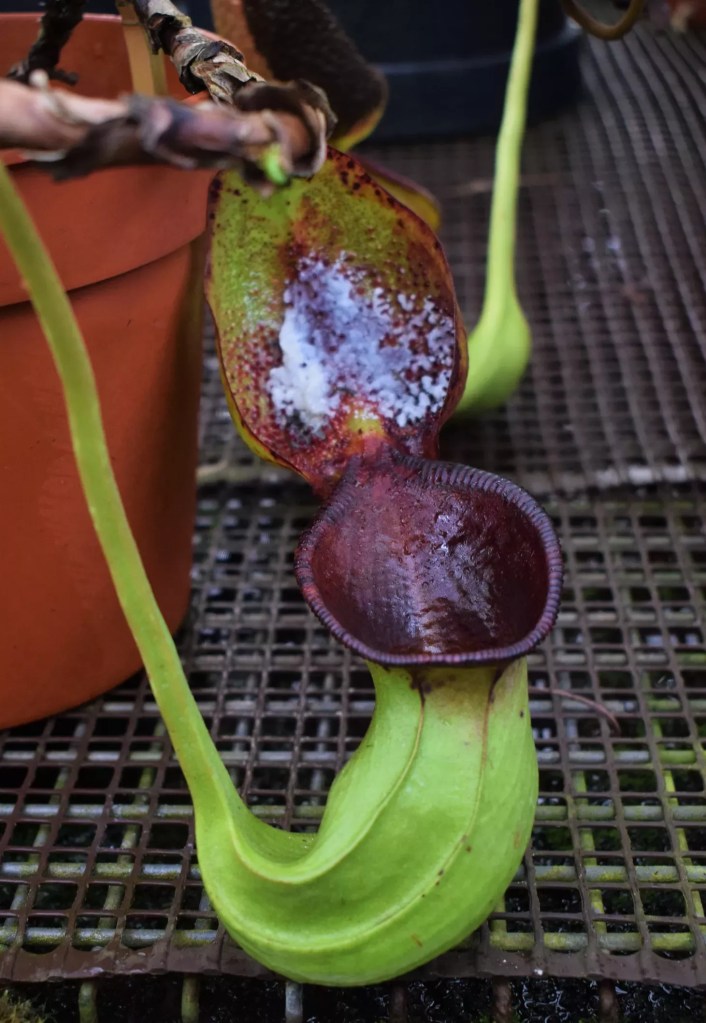
The pitcher plant (genus Nepenthes) is a frontrunner in this strange category. While most carnivorous plants are famous for trapping insects, some tropical species of Nepenthes have found an alternative nutrient source—bat poop. In places like Borneo, bats roost conveniently above the pitchers, and their droppings fall right in. Scientists call it a “nutritional mutualism.” The bats get shelter; the plant gets dinner. Apart from bat-poop, plants are known to eat the poop of tree shrews, lizards, and even of birds. These flowers even resemble toilets—all the better to catch the poop as it falls.

These plants don’t actually chomp up poop. Rather, they have evolved to extract nutrients from faeces, often via mechanisms like sticky leaves, enzymes, and old-fashioned decomposition. Some even form alliances with fungi or microbes to get the job done.

But why on earth would a plant choose poop? It’s a matter of efficiency. Poop, especially from animals like bats and tree shrews, is rich in nitrogen and phosphorus—two nutrients that are vital for plant growth but maybe in short supply in nutrient-poor soils where many of these carnivorous plants grow. Insects provide these too, but poop is like a ready-made fertilizer packet, no hunting required. Poop offers a shortcut—already digested, already broken down. Though the comparitive nutritive values have not been rigourously tested, it is believed that poop is more nutritious.The bats roost above the pitchers, do their business, and the plant simply absorbs the nutrients through specialized enzymes or microbes that help break things down. Also, insects are scarce on tropical peaks above 2,200 meters, so poop provides a good alternative source.  In fact, scientists are finding that some carnivorous plants are evolving from eating bugs to eating poop! Some pitcher plants have even evolved shapes and scents to attract the animals specifically for their droppings!

Are there any Indian coprophagic plants?

Yes indeed! North East India is home to several species of pitcher plants or Nepenthes. Recent studies suggest that some species in the Nepenthes family (including those found in Southeast Asia) are more than happy to lap up the occasional faecal nutrient.

The Western Ghats, another biodiversity hotspot, also hosts a variety of unusual plants, including some that partner with fungi to decompose animal droppings in the soil. While not technically “eating” poop in the way a pitcher plant might, these interactions are still part of the larger cycle of nutrient recycling—with poop part of this circle of life.

So, the next time you see a lovely green pitcher in a botanical garden or on a damp forest trek in the North East, give it a respectful nod. It might be doing more than just sitting pretty. It might be part of a brilliant, bat-poop-powered system we’re only just beginning to understand.

Well, I know that after this story, Botany is definitely going to be my granddaughter’s favourite subject! Who knew botany could be this…entertainingly gross?

–Meena

Picture: http://www.kew.org/read-and-watch/poo-plants

Paper Tigers

29 July is International Tiger Day. The day was first launched at the Saint Petersburg Tiger Summit in Russia in 2010 and is observed annually to remind the world about the decline of the global tiger population, and to encourage efforts for tiger conservation. On this day we will see many reports and statistics about tigers and their falling/growing population, and many conferences and seminars will be held on research and studies on tigers.

This is perhaps a good time to look at the tigers that roam not the forests, but that have also populated the pages of language and literature. The tiger has been a dominant character in folklore and mythology in many cultures.  

Perhaps China is the richest country in myths, representations, traditions, and legends related to tigers. Tigers have been a Chinese cultural symbol which has inspired story tellers, singers, poets, artists, and craftspeople for over 7000 years. In Chinese folklore, tigers are believed to be such powerful creatures that they are endowed with the ability to ward off the three main household disasters: fire, thieves and evil spirits. A painting of a tiger is often hung on a wall inside a building, facing the entrance, to ensure that demons would be too afraid to enter. Even in modern- day China, children wear tiger-headed caps, and shoes embroidered with tiger heads to ward off evil spirits; they are given tiger-shaped pillows to sleep on to make them robust. During the year of the Tiger, children have the character Wang painted on their foreheads in wine and mercury to promote vigour and health.

The tiger has equally captivated the people of the Indian subcontinent since time immemorial – feared and revered at the same time. These majestic beats and the lives of the people, especially those that live in close proximity to the tiger and its habitat, have long been intertwined, giving rise to several myths and legends surrounding them. Tiger lore has been interwoven with gods and legends, giving it a mythical status.

According to stories from Indian mythology, the tiger is believed to have powers to do everything from fighting demons, to creating rain, keeping children safe from nightmares, and healing. Humans are often attributed as having tiger characteristics. The consecration ceremony of a king in ancient times required the king to tread upon a tiger skin, signifying the King’s strength.

Songs, proverbs, and sayings in most Indian languages feature tigers as part of their treasury of folk lore and literature. Tigers appear in many stories in the Panchatantra.

A popular belief among many tribes in the Northeast of India is that the cosmic spirit, humans, and tigers are brothers. There are many folk tales based on this theme, with local variations. The belief that the tiger is a human’s brother has meant that the people of these tribes would rarely kill a tiger. There are traditional rituals performed even today to honour and worship the tiger.  

In more recent times, tigers were introduced to non-Asian audiences through the writings of Englishmen who had lived in colonial India by authors such as the famous hunter-turned-conservationist Jim Corbett. His books like The Man Eaters of Kumaon were perhaps some of the early depictions of human-tiger conflict.

In the culture of the West, where they are not found in the wild, tigers have nevertheless sparked the imaginations of writers, and have become popular fictional characters in stories, films, cartoons, songs, and even advertisements. Perhaps the best recreation of the fearsome tiger is Shere Khan of the Jungle Book fame.

Anthropomorphized tiger characters in children’s books have won their place in millions of hearts. There is boisterous and exuberant, Tigger, who is a one-of-a-kind friend in the world of Winnie the Pooh. He eagerly shares his enthusiasm with others—whether they want him to or not, and steals our heart.

Calvin and Hobbes

And we have the imaginary stuffed tiger Hobbes in the cartoon strip Calvin and Hobbes, who is very real to the irrepressible six-year-old Calvin—a faithful companion in all the capers, sometimes a comforting friend, sometimes a savage beast. The two friends have deep philosophical conversations, ruminating on how best to find meaning in their lives, the essence of which is what all of us are seeking.

Other than literature, tigers have permeated our language through numerous aphorisms, proverbs and sayings. Here are a few ‘tigerisms’.

Paper tiger: Someone who at first glance seems to be in charge but who, on closer examination, is completely powerless.

Tiger economy: A dynamic economy usually referring to of one of the smaller East Asian countries, especially that of Singapore, Taiwan, or South Korea.

Tiger mom: A particularly strict mother who makes her children work very hard in school to achieve success.

Catch a tiger by the tail: Try to control something that is very powerful; have a difficult problem to solve.

A tiger cannot change its stripes: You can’t change your true nature, even if you pretend or claim otherwise.

Eye of the tiger: Determined and focused

A new-born calf has no fear of tigers: A Chinese saying that means that the young are brave, but often due to inexperience.

As tigers in the wild continue to be threatened and pushed towards extinction, International Tiger Day is also an occasion to celebrate the power of words that keep the tiger alive and vibrant in the pages that they also inhabit.

Some beautiful words by Ruskin Bond capture this spirit.

Tigers Forever

May there always be tigers

In the jungles and tall grass

May the tiger’s roar be heard.

May his thunder

Be known in the land.

At the forest pool by moonlight

May he drink and raise his head

Scenting the night wind.

May he crouch low in the grass

When herdsmen pass.

And slumber in dark caverns

When the sun is high.

May there always be tigers

But not so many that one of them

Might be tempted to come into my room

In search of a meal!

Ruskin Bond

–Mamata

Seeds to Secure the Future

Every day at CEE (Centre for Environment Education) was an education one way or the other. One fascinating tour that I recall was to visit NGOs working in projects related to biodiversity and climate change as part of a national scheme that CEE was coordinating.

I was supposed to cover Chhattisgarh as part of this. My most memorable visit was to an NGO that was collecting local varieties of rice and cataloguing them.  It was a small project, maybe only a few lakhs. The NGO had collected rice samples, stuck them to sheets of chart paper and meticulously written down details that they had gathered from the farmers about the cultivation, characteristics, uses etc.  Like a school project, but preserving invaluable genetic resources and information. What a variety of rice—different shapes, different sizes; some fronds long and wavy, others densely packed. And for the first time I saw purple and black rice! And the enthusiastic NGO staff explained the traditional use of each type of rice.

 It was an eye-opener.

I knew that Chhattisgarh was known as the Rice Bowl of India and had over 20,000 rice varieties. But seeing those modest tin trunks with the samples of rice carefully stored brought this home to me in a way that no amount of reading could have. And with it, the realization that we were fast losing so many varieties–and not only of rice but every crop. And not only in India, but worldwide.

Seeds for Food Security

There are many factors responsible for this—unsustainable agricultural practices; industrialization; the focus on a few varieties of crops which are commercially attractive to the exclusion of others; urbanization, etc. According  to UN FAO (Food and Agriculture Organization), while over  6,000 plant species have been cultivated for food worldwide, only nine account for the majority of total crop production.With climate change, the need to preserve these varieties is even more urgent than ever before. The varieties that we cultivate today may no longer be viable tomorrow. And we may have to fall back on this preserved crop diversity to feed the world.

The small NGO that I saw in Chhattisgarh was a key in the whole chain. Several NGOs  in India have been working towards preserving crop diversity for decades—from Beej Bachao Andolan which started in the Tehri Garhwal, to Vrihi seed bank in East India, to the Navadanya movement.

The international community has set up such seed banks at large scale to preserve and conserve seed varieties. There are over 1700 such banks, the biggest of which is the Seed Vault at Svalbard, Norway. This has the largest collection of the world’s crop diversity. It stores duplicates of seed samples from the world’s crop collections and hence is a back-up in case anything were to happen to any collection anywhere. The geographical location of the Vault ensures the best possible chance for the survival of the seeds— low temperatures, permafrost and thick rock protect the seed samples and ensure they will remain frozen even without power. Deep inside the Arctic Circle, the location is very remote, but still accessible. It is well above sea level, and safe from flooding even in the worst climate change scenario. The vault is 100 metres into the mountain. It can store 4.5 million varieties of crops, with about 500 seeds per variety.  As of now, there are more than 10,00,000 samples in the Vault, originating from almost every part of the world.

India too has commissioned an impressive seed preservation facility. In fact, it is the second largest in the world. The stone and wood paneled vault is located in Chang La Pass, Ladakh, and is a joint initiative of the Defence Institute of High Altitude Research and the National Bureau of Plant Genetic Resources. In this facility, seeds are sealed in specially made three-ply foil packages, placed inside black boxes and stored on shelves. It currently holds olver 10,000 seed samples, and has plans to grow by inviting the international community it use it.

The loss of agricultural biodiversity is less focussed on than the challenges to wild biodiversity. But it can be as
devastating. Feeding the world will be impossible if we don’t act to conserve this now! As per FAO, since the 1900s, some 75 per cent of agricultural plant genetic diversity has already been lost. Seed banks, from local to international,
is one of the ways to do this. Kudos to the farmers, communities, NGOs and institutions which are doing this!

–Meena


Save Our Soil

Unless we are a farmer or a gardener, few of us consciously think about soil. And yet, it is soil that sustains life on earth. Scientists study biodiversity on land and in the water, but not as many look that closely at soil and what it harbours. Soil is home to more than 1/4 of our planet’s biodiversity, but we only know 1 per cent of this universe. 

December 5 is World Soil Day–an international day to celebrate Soil. This day was first recommended by the International Union of Soil Sciences (IUSS) in 2002; it was supported by the FAO and endorsed by the UN General Assembly in June 2013. The day means to raise global awareness about the importance of healthy soil and advocate for the sustainable management of soil resources. It is marked on December 5 was chosen because it corresponds with the official birthday of the late H.M. King Bhumibol Adulyadej, King of Thailand, who was one of the main proponents of this initiative.

There are more living creatures in a single teaspoon of healthy soil than there are people on Earth.

This year’s World Soil Day theme is Keep Soil Alive, Protect Soil Biodiversity. Now, more than ever before, soil biodiversity is under pressure due to unsustainable soil management that affects life belowground. This theme focuses attention on the workers belowground–from tiny bacteria to agile millipedes and slimy earthworms–all of which contribute to processes that are indispensable to life on Earth.

It is a reminder that unless people around the world proactively engage in improving soil health, soon, the fertility of soil will continue to be adversely affected at an alarming rate, threatening global food supplies and food safety.

Here is my small contribution to this day.  Giving soil a voice!

The Soil’s Lament

I am soil. Ever thought about me?

Always underfoot, you think I’m here for free.

In your fields and gardens, roads and lawns

On mountains in deserts, in cities and towns.

I can be living, feeling, strong and healthy like you

But I can also get sick, and sometimes tired too.

Then I get weaker, unable to nurture life to grow.

How can that happen, would you like to know?

Year after year, season after season

You plant me with the same crops with the reason

That the more you put in, the more you will get.

But that’s just where you will lose the bet.

In such a hurry you are, to sow and reap

Have you ever thought that I’d like time to breathe?

Ever considered that I too need to recuperate

From trying to deliver at such an unnatural rate?

Give me a break, give me a rest. Be kind to me, I’ll give you my best.

The unending cycle will sap all my strength

Suck the minerals and nutrients out from my depth

One fine day I’ll just run out of steam

Then those bountiful harvests will be just a dream.

And then you will pump me with every artificial aid

Chemicals, fertilizers, all the tricks of the trade.

Hoping the fruit I then bear will be so fast and good.

But could you thrive on pills alone, and no natural food?

Give me a break, give me a rest. Be kind to me, I’ll give you my best.

Or will you drug me with pesticides and insecticides

To destroy the “enemies”– the aphids, thrips and mites.

You don’t realize that with every deadly dose

My allies too are dying, not just my foes.  

You strip me of my protective cover

Tear away trees, shrubs, grasses, every small flower

That keep me secure with a protective cloak

From the fury of rains and the winds that blow.

You leave me exposed, vulnerable, and bare

To be blown, swept and washed away, here and there.

Or you clad me in an armour of concrete and stone

So I can no longer breathe, nor give my friends a home.

Give me a break, give me a rest. Be kind to me, I’ll give you my best.

Cover me again with a mantle of green

Let my own special magic do the job you’re so keen

To assign to the factories, the labs and the vans

And potions from bottles and boxes, sprays and cans.

Let the humus, leaf litter and the biomass,

The lichen, the algae, the roots and grass,

The bugs, the beetles, the worms and snails

Do the job they’ve always done, and that never fails.

It’s these millions of dwellers that give me life

That in turn I bestow on all plant life.

Let my friends and foes do all they might

If I’m strong and healthy, it’ll be all right.

Give me a break, give me a rest. Be kind to me, I’ll give you my best.

–Mamata

The Kardashian of Trees

Heroing and highlighting individual trees is a great way of drawing attention to trees in general, and to reinforce the value of nature, wildlife and biodiversity.

An example of a successful initiative in this direction is the  European Tree of the Year contest started in 2011, inspired by an older competition which originated in the Czech Republic in the late nineties. According to the Czech Environmental Partnership Foundation which started it all: ‘Tree of the Year is a contest looking for a tree with a story. The aim of the contest is to empower people and get local communities involved in the environmental and local heritage protection. We believe that by gathering around a tree, people are more likely to take action again in the future for other environmental causes and for the wellbeing of the community.’

The process of selecting the European Tree of the Year starts with a well set-out voting process at the national level of the participating countries (16 this year), and ends with a finale consisting of online voting to select from among the national winners.

Now the competition is moving to other parts of the world: In 2016, Sri Lanka started the Asian Tree of the Year, with India, Nepal, Malaysia and Singapore joining in soon after. Canada, Australia and Russia have also held national competitions, though not on an annual basis.

Beautiful old trees, with history and cultural connections to the community have found their spot under the sun through this process, and also generated a lot of public interest, involvement and learning.

Sounds good! But what has all this to do with the title?

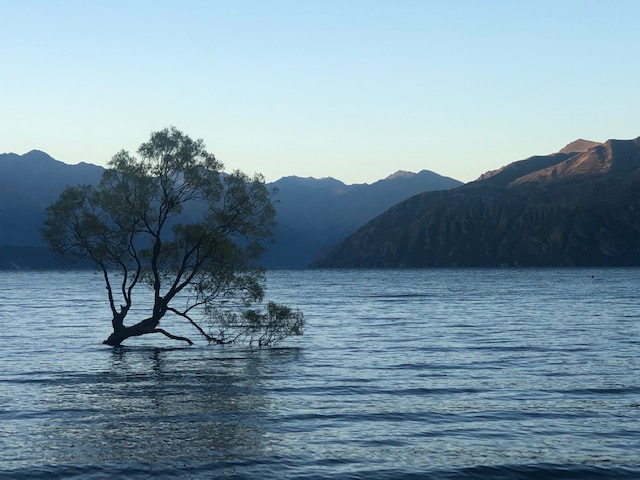
CF37A480-1747-49E9-9F79-48FCA5BAC580The connection is a tree that is reputed to be the most instagrammed tree in New Zealand, almost a symbol of NZ tourism. On a recent trip there, we were urged to set aside time to see the tree, specifically around sunset. So we worked around our program to ensure we got to the spot—a stretch of a beach—well ahead. We drove past a few times, keenly looking at the beach. We could see some people, but nothing special in the way of trees. We asked natives and tourists alike, and they all pointed us to the same area which our GPS had shown us, and which we had passed, looking in vain for a landmark. We decided to make our way down to the beach anyway. Lo and behold, there were many, many people there, jostling for some spot (we could not figure out what the spot was for), all setting up professional looking camera equipment. It came to a pass when we had to ask a friendly-looking lady what everyone was waiting to photograph, where the famous tree was, and what it was about. She kindly pointed to this spindly willow tree, standing a few feet into the waters of the beautiful Wanaka Lake, against a beautiful background of majestic mountains. But the tree itself? In my mind, this will forever define and exemplify ‘under-whelming’. ‘Why is the tree famous’, we asked many around us in bewilderment. While there was some story of how it was part of a fence and had survived in the water for several years, the general consensus was that it was famous because it was famous! So famous , it even has its own insta handle #ThatWanakaTree.
Does the title begin to make sense?

But yes, surely is a lesson to countries like ours, where we have such unimaginable treasures of cultural and natural heritage, but simply are not able to create anywhere near a proportionate buzz!

–Meena


Wild is Wondrous!

March 3 is celebrated as United Nations World Wildlworld wildlife day 2.jpgife Day. This marks the day of signature of the Convention on International Trade in Endangered Species of Wild Fauna and Flora (CITES) in 1973. Every year on this day, events are held around the world to celebrate and raise awareness of the world’s wild animals and plants.

The theme of World Wildlife Day 2020 is “Sustaining all Life on Earth”. This celebrates the special place of wild plants and animals in their many varied and beautiful forms as a component of the world’s biological diversity.

India is a treasure house of biological diversity. It harbours 8% of the world’s biodiversity on just 2% of the earth’s surface. It is one of the 17 mega-diversity countries in the world with ten biogeographic zones, and an incredible diversity of habitats, flora and fauna.

Here is my small ode to this wild and wondrous land and its denizens.

I live in such a magical land

Of mountains and valleys, plateaus and sand.

Jungles and farmland, deserts, islands and seas,

Here’s to my land of biodiversity.


Biodiversity Biodiversity

It’s all about Life and Variety


In forests and fields, deserts and seas,

Animals and crops, microbes and trees.

Colours and patterns, functions and form,

To survive and thrive, adapt and transform.


Snow leopard and yak, and double-humped camels

The Himalayan cold desert is home to these mammals.

Shining blue lakes in the rugged landscape

Welcome winged visitors many coloured and shaped.


Biodiversity Biodiversity

Experience it, share it, enjoy it.


Where the mighty Ganga flows

River dolphins swim and gharials are found.

Proud tigers prowl, and deer abound

The fertile plains with bounteous yields

From forests and farmlands and fields.


Biodiversity Biodiversity

See it, taste it, smell it, feel it.


The North East is truly a garden of Eden

Full of priceless treasures, many still hidden.

Feathery ferns, bright orchids, bamboos tall

Where rhinos roam and Hoolock Gibbons call.


Biodiversity, Biodiversity

Appreciate it, savour it, explore it.


Discover that deserts are dry but alive,

Their dwellers have special tricks to survive

Store water, shed leaves, or burrow in the sand.

Why, even tigers and lions roar in this land.


Biodiversity, Biodiversity

Treasure it, enjoy it, study it.


In the Western Ghats meet a tahr, and a tiger too

Jumbos in jungles and a hornbill or two.

Colourful frogs that croak and call

Snakes and snails that slither and crawl.


Biodiversity Biodiversity

Learn from it, weave with it, heal with it.


Deccan highlands and grasslands, plateaux that soar

Dotted with buffalos, cows, goats and sheep galore

There grow seeds and cereals upon which we feast

And people who celebrate it all with their dancing feet.


Biodiversity Biodiversity

Plant it, grow it, cook it, eat it.


Deep in the seas meet clown fish and anemone in a coral jungle

Crabs, crocs and tigers in a mangrove tangle.

On islands in waters blue and green

See a megapode, a monitor, a Nicobar pigeon preen.


Biodiversity Biodiversity

Track it, live with it, delight in it!


Biodiversity Biodiversity

It’s all about Life and Variety.

Biodiversity Biodiversity

Celebrate it, protect it, conserve it!

–Mamata


Institutional Campuses: Biodiversity Havens

Those who sanctioned academic, scientific and other national institutions in the days of yore, were generous in their land allocation. So you have such organizations sitting on tens, and sometimes even hundreds of acres of land.

Some institutions have built up on much of the land. But in others, the land is either landscaped, or left wild. Or a witting or unwitting mix of the two. Any which way, a boon in today’s rush for land development. Often, because these institutions are under-funded, they are not able to maintain lawns etc. and let the land go wild, which is also a good thing. These campuses are like havens, where both green cover and biodiversity thrive.

To take just one example, I go back to the campus of IIM Ahmedabad (see also my blog of last week, ‘Living in a Louis Kahn’).

I had commented in that piece that there was no landscaping to speak about on the campus. I was mistaken, as comes out from this personal communication from Prof. Marti Subramaniam, eminent academic, in a comment on the piece:

‘The high point of my contact with Kahn’s work was when I spied him with Kasturbhai Lalbhai, early one morning, walking right outside the house where we lived as students.  I quickly followed them to overhear their conversation which went roughly along the following lines:

Kasturbhai: What trees should we plant here, Louis?

Kahn: Of course, in one line they should all be of the same species.  Otherwise, how would they talk to each other?’

So in fact it seems, a lot of thought had gone into the landscape! My ignorance indeed!

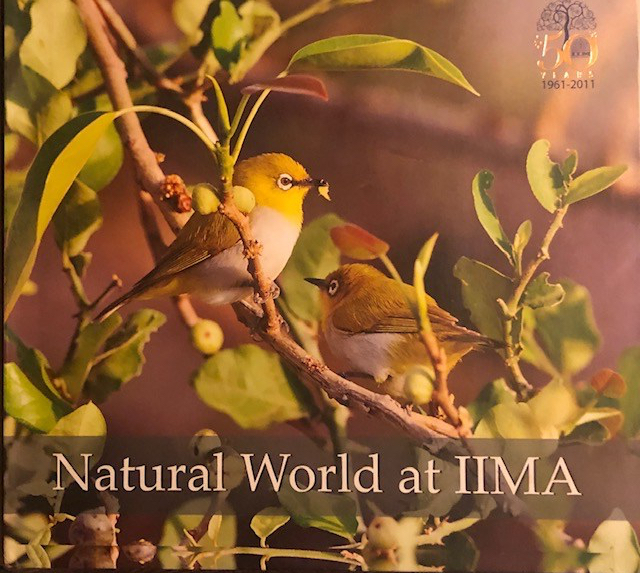
IIM A campus is a mix—from the manicured lawn of the Louis Kahn Plaza, to the utter wilderness on the edges. And this mix, it seems, has given rise to a good deal of biodiversity. And the great thing is, that as part of the Golden Jubilee celebrations of the Institute, these have been captured and documented in coffee table book called Natural World at IIMA.

725A7EA1-5F1C-4DD8-95C8-861F797A653B

A work of love and passion indeed! Close to 200 pages of colour plates, documenting the flora—trees, shrubs, climbers, sedges, grasses and herbs; as well as the fauna—birds, mammals, reptiles, insects, spiders, butterflies and moths.

One hears of pressures on several institutions to ‘not let the land go to waste, put it to use.’ Or worse, institutional lands being taken away for other uses, including commercial uses. We need to resist any such diversions. These are among the few remaining islands.

And documenting and disseminating these in the form of books, databases etc., helps to communicate the value of this diversity, and is the first step in making the campus itself an educational resource. And a matter of pride and joy for alumni.

Here is to large, unmaintained campuses, and books on them!

–Meena

Promoting GI, Protecting Diversity

Last week, I happened to go to Goa (regretfully, not a holiday!). The airport, as many airports across the country, is full of shops.

Apart from the usual brand shops and the special Goa memorabilia shops, I came across a fascinating outlet here. It was a ‘GIs of India’ shop!

Oh, I have jumped the gun! GI could stand for any number of things. I am referring to Geographical Indication, which is “an indication which identifies goods such as agricultural goods, natural goods or manufactured goods as originating, or manufactured in the territory of a country, or a region or locality in that territory, where a given quality, reputation or other characteristic of such goods is essentially attributable to its geographical origin and in case where such goods are manufactured goods one of the activities of either the production or of processing or preparation of the goods concerned takes place in such territory, region or locality, as the case may be.”. GI is a type of intellectual property right, which certifies a product as having originated in a specific geographic location—for instance, that the Mysore silk you just bought is indeed produced in Mysore; or the Jaipur Blue Pottery is indeed from Jaipur.

2EF3114E-4923-428D-BB53-0A1E05ED3D19
Madurai Sungudi is GI registered

India enacted the Geographical Indications of Goods (Registration and Protection) Act in 1999. The first GI product to be registered was Darjeeling Tea. Now there are 330 GI registered products—a fascinating range, from the usual suspects to the completely unexpected—from Kanpur Saddlery, to Beed Custard Apple; from Coimbatore Wet Grinder, to Varanasi Glass Beads!

The shop at the Goa Airport was very new, just being set up. But the staff were extremely enthusiastic and eager not just to sell their products, but also share information on the concept of GI shops. They said that a large chain of these was coming up across the country.

Indeed an exciting way to create a market for these amazing products, and preserve the diversity, both natural and cultural.

I’ll be on the lookout for these GI shops, for sure!

–Meena