The Race to be Wise: A Ganesha Tale

With Ganesh Chaturthi wishes!

‘Narada is here, Narada is here’, called Murugan to his elder brother Ganesha.5F27BFBF-2569-4CCB-9260-42B589B98DF0Narada’s visits were always exciting.  He travelled all over the three worlds and he had a nose for gossip and scandal.  He picked up news from here and there, and made sure people at the next stop got to know it.  He spoke so wittily, and sang and joked…there was never a dull moment when he was around.  And he brought such interesting gifts too!

Ganesha and six-headed Murugan rushed over to the main reception hall, where their parents Shiva and Parvati were receiving Narada.  The first greetings and exchanges were already over when the two boys arrived, and they could do their share of talking and asking and answering.

When the excitement and the decibel level had come down a little, Murugan the impulsive one asked Narada: ‘Narada, have you got anything for us?  Any new toy? Any wondrous weapon?  An interesting book?  A playful pet?’

‘Oh! I had almost forgotten!’ said the mischievous Narada, who had probably been waiting to be asked.  ‘Of course, I have something for you!  Something rare and precious, one of its kind’.

‘What, What?  Tell me quickly.  Is it for me or for everyone?  Must I share it with Brother?  Tell me!’ implored Murugan.

‘Well, I don’t know whom it is for.  There is but one piece.  I shall give it to your parents and they must decide as they think fit’, said Narada, looking forward to the trouble this was going to lead to.  He handed over a luscious, rich yellow-orange mango to Parvati.  The fruit was obviously no ordinary mango–it shone with the lustre of gold and smelt divine.

A mango?  Is it a very sweet one? Asked Ganesha, a little confused.

‘Not only the sweetest, tastiest and most flavoursome mango in the world, it is also the fruit of wisdom.  He who eats it will be the wisest among gods and humans,’ said Narada.  ‘It is indeed a special fruit, for there is no other like it in the world.  So I thought, who else to give it to but Shiva and Parvati?’

Murugan got down to business.  ‘Ma, I think you should give me the fruit, I am the youngest and so I must get it, if there is only one.  Anyway, you always give Ganesha everything.

‘That is not true Kartikeya’ said Shiva.  ‘You get an equal share of everything–often more, for you throw such tantrums.’

‘I do NOT throw tantrums’, said Murugan, promptly losing his temper.  ‘Ma always favours Ganesha.  She is always making modaks and laddus for him.  For me, nothing.  And you also.. you always praise him for being intelligent and for knowing the scriptures.’

‘Enough Subramania.  You know both of you are equally dear to me–my two eyes.  Vinayaka is the older, so he gets more of some things.  But you are the younger, so you get the preference in certain other things.  That is how it has to be ‘, said Parvati.  ‘But in this case, I am not sure who should get the fruit.  You are both brave boys, intent on doing good in the world, proud and intelligent.  The wisdom this fruit will give you, I know both of you will put to good use.  What shall we do?  Let your father and I have a talk so we can decide.’

Shiva and Parvati conferred while everyone waited, impatient but silent. Murugan paced up and down, while Ganesha sat quietly by, playing with his pet, vehicle and companion, the shrew.

At last Shiva spoke: ‘We have decided to set a test for the two brothers, to see who deserves the sweet fruit of wisdom.  Both brothers shall set out immediately, and he who circles the world three times and comes back here first, shall get the fruit.  Is that agreeable with you, Kartikeya, Ganesha?

Murugan was quite happy.  He knew he was much faster and more skilled at physical activities than his brother.  The test was set up so that he could win! ‘ Its fine by me.  How can I have a problem when my parents have decided?’ he said.

Ganesha smiled his slow smile.  ‘I agree‘ he said. ‘My wise mother and father have decided it is to be so.  I know that it must be the right way.’

Murugan went into a flurry of preparations.  He called his trusted peacock who flew faster than the winds.  He sharpened his spear and unfurled his flag.  Ganesha stood quietly, a thoughtful look on his face.

’Come Brother, get on with your preparations.  Nothing ventured, nothing won,’ called out Subramania, just a little mockingly.

‘I will see you off, little brother, before I leave on my journey.  A minute here or there will not make a difference to me,’ said Ganesha calmly.

‘Yes, that is true.  Well, I am off now.’  Kartikeya mounted his peacock, and in a flurry of flapping wings, he was off.

Hours later, weary and sweaty, dusty and damp, but sure that he had won the competition, he approached Mount Kailash.  He could see the crowd of people gathered there, looking up at him.  He could see his mother and father, Narada, all the minor gods, courtiers. But what was this?  Sitting at his parents’ feet … could it be Ganesha?

There was no way he could have come back ahead of him! His peacock had flown faster than ever before.  The winds had aided him.  He had used all his skills to steer the easiest path.  No, it just was not possible that Ganesha could have been faster than him.  Then what was it? Had he not gone at all, knowing that he would not be able to beat his younger brother?  No, that could surely not be true.. his brother would not give up without even trying.  Confused, Kartikeya landed back.

‘Welcome, my son.  We are glad to see you back safely,’ said his father as he rose to greet him. ‘And you have really been fast.’

Shiva turned to the waiting people.  ‘Now the time comes to declare the winner,’ he said.

Subramania was still confused.  What was going on?  Ganesha looked so calm and tranquil, he could make out nothing from his face.

‘I congratulate both of you, my sons.  Subramania has performed a wondrous physical feat.  He has gone around the world three times, faster than any God, human or demon has ever till date.  He is indeed incomparable.  I wish I could give him the fruit, but I cannot.’

‘Why,  why? You said I was the fastest,’ said Murugan, turning in confusion to his father.

‘Because my son, your brother went around the world much faster.  No, not the globe, not the physical world,’ explained Shiva.  ‘He went around us, his parents, three times, and it took him but a moment.’

‘I don’t understand.  What is this all about?’  Subramania was vexed and perplexed.  Was it some kind of a joke?

‘I will explain, little brother, why I did that.  For dutiful children, their parents are the world.  Moreover, with parents like ours, the mighty Shiva and Parvati, they are the greatest of Gods, they are indeed the world.  They are the repositories of all knowledge, all wisdom, all power.  What need is there to go any further?  If I go around them, I have gone around the world.’ said Ganesha.

The crowds cheered.  For indeed, was there a world without Shiva and Parvati?  Was there a world beside Shiva and Parvati?  Ganesha was indeed wise and deserved the fruit of wisdom.  Even Subramania was convinced. He could win any race against his brother, but when it came to racing minds, it was another matter!

And so Ganesha became the wisest of the Gods.

–Meena

From ‘Elephantasy’. Centre for Environment Education.
Totum maior summa partum

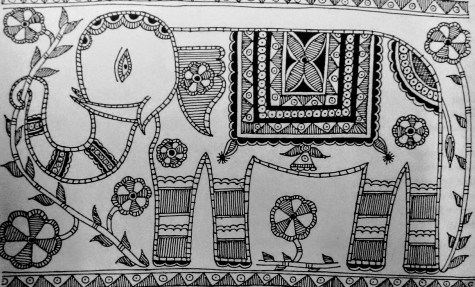
Six blind humans once encountered an elephant. Each of them tentatively approached the unknown form that they could neither see nor hear, and each happened to touch a different part of the great beast. They moved their sensitive fingertips across what their hands could reach, and curiously explored.

Meeting together again, each was excited to exchange notes. For what a curious thing this was! What was it called and what purpose did it serve?

The first one said:

“What tree is this that we have chanced upon?

Its trunk just seems to go on and on.

Or is it a pillar thick and round

Solidly planted in the ground?”


The second one shook his head to exclaim:

“Oh no, you are mistaken, friend

It is simply a wall without end.

I just ran my hand from side to side

It is so solid, so firm, broad and wide.”


The third person was amazed at such tall tales:

“What do you mean ‘so high and strong’?

I assure you that you have got it quite wrong.

It’s quite simply a snake, soft, thick and long,

I could feel its breath as it swayed along.”


The fourth one was a bit confused now:

“It’s true it was long, but I have a doubt,

It wasn’t supple nor smooth as you make out.

It was surely a rope you felt my friend

Why, it even had long tassels at the end.”


The fifth individual thought the four were quite crazy:

“Imagine, imagining it to be a tree or a wall

Just what has come over you all?

Do snakes or ropes flap like sails on boats?

They were those giant punkhas, like ones in the royal courts.”


By now the sixth was convinced that the rest were mad:

“Why are we making wild guesses and playing foolish games?

I know not to what you give different names.

Firm to the touch, sharp at the end; nothing large or loose or long

How could it be anything but a spear sharp and strong?”


And thus each one ‘saw’ a different sight

And each was convinced that they were right.

Alas the six could only see a part, but never understand

That it all the parts together that made the whole elephant.

IMG_20180910_165057.jpg
Illustration: Roopalika V.

“The whole is more than the sum of its parts.” Aristotle

–Mamata

In a Word

When we were in school we were told that the Eskimos have a hundred or more words for Snow and forest-dwelling indigenous people have a multitude of words for Green. In recent years this information has been debunked by many linguists. While the numbers are not that important, to my mind this example is still meaningful as it draws attention to the fact that every culture and language has its own vocabulary to describe the nuances of a phenomenon or event or feeling.

In the past few years I have come across some really evocative words which I love to share.

Tsundoku A Japanese word which refers to the habit of accumulating books with the intention of reading them by and by, as opposed to obsessively collecting books just for the sake of having them. This word apparently has been used for over a century, and a person with a large collection of unread books was called a tsundoku sensei. This is something I have always done, and I was so happy to find a respectable name for the same!

Komorebi Another Japanese word for the delicate interplay of light and leaves when sunlight filters through the foliage of trees. How often we have been touched by this delicate and fleeting moment. Artists and photographers have tried to capture this, but this single word perfectly paints the picture.

Shinrin-yoku If you want to prolong the moment and immerse yourself in the experience—the Japanese have a word for that too. This word means ‘forest bathing’, a practice that includes mindfully experiencing the beauty of the komorebi while breathing the cool fresh air and hearing the leaves rustle in the gentle breeze.

Waldeinsamkeit If you were German and enjoying Shirin-yoku, a feeling of solitude, and a connectedness to nature, this is the perfect word to describe how you feel!

Mångata If you lingered long enough for the sunlight to be replaced by moonlight, this is what you would also see. A Swedish word for the glimmering, road-like reflection that the moon creates on water. Another luminescent word that paints a perfect picture.

Hygge Back home after a rejuvenating walk in the woods, what could be better that to curl up with a book from your tsundoku and get lost in the wonderful world of words! The Swedish have the perfect word for just such cosy comfort and contentment!

If only, we may say, our life could be a series of shinrin-yoku and hygge! The Japanese say that there is no reason why it cannot be. After all, is it not a lot about how you approach life? It is all about having a sense of purpose and meaning and a feeling of wellbeing–essentially ‘a reason to get up in the morning’, and to see the sunlight rather the clouds. They call it Ikigai.

IMG_20180902_085434387.jpg

According to the Japanese, everyone has an ikigai. We just have to find our own.

–Mamata

A Register of Opportunity

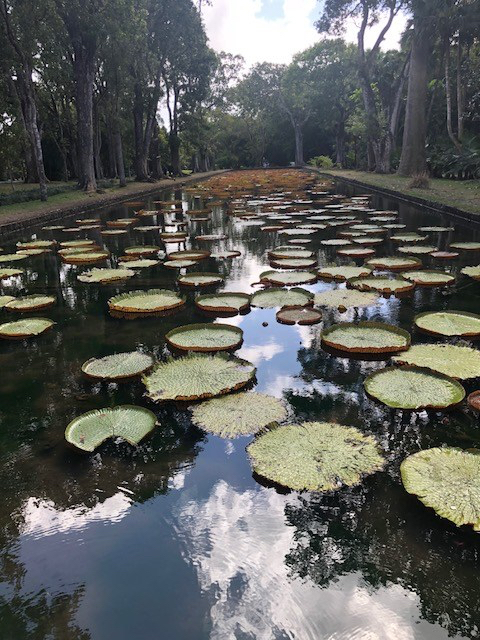
BDB307A0-742C-4A7E-B7E0-18323D154F33As botanic gardens go, the Sir Seewoosagu Ramgoolam Botanic Gardens in Mauritius are not large. 92 acres to Bangalore’s Lal Bagh of 240 acres to put it in perspective (but of course we need to factor in the size of the two countries!).  We don’t need to dwell on the variety of flora, both endemic and exotic, on display there. Nor the few but interesting animals—specifically some deer and some huge tortoises. The only endemic Mauritian mammal, a bat, the Peropus niger, may also be spotted on the trees, it is said.

But it was not all this that really fascinated me. Let me tell you what did.

Little shelters dot the gardens. At the shelter overlooking the beautiful lily pond was2C9A861B-73C8-4075-9652-6A6A1E1591B9 a table. And on the table was a register. I sneaked a peak into the register. And this is what I saw: Several entries each day on the condition of the pond, the leaves, the flowers; the birds and insects seen. And a sketch of the pond, done at the same time every day, showing where flowers had bloomed and where there were buds. And it was not only the lily pond. There was a similar register at the lotus pond, and some other spots in the garden. As I flipped the pages, I could see that no day was missed, no entry casual

What seriousness of purpose and systematic application, to a job that may seem not to have any particular outcome. But the person behind the system and the people implementing it obviously know the importance.  After all, scientific method consists of : ‘systematic observation, measurement, and experiment, and the formulation, testing, and modification of hypotheses.

The Botanic Garden in Mauritius is definitely doing its part! It is obvious that they know the value of keeping systematic notes and data. It may seem trivial, but who knows what it may lead to? After all, research is one of the stated objectives of Botanic Gardens, Zoos, Aquaria and all such facilities do. And keeping such meticulous notes may be the single most important contribution they can make.

Are we in India at all using such opportunities? I am not sure!

An excerpt from Darwin’s Beagle Notebooks. He observed and noted down everything around him—flora, fauna, geology, weather conditions, animal behaviour. And at the end of the day, changed human understanding of the world! Without his notes, he may not have reached his conclusions!

Extraordinary numbers of Turpin —

 drinking bury head above eyes — Will drink when a person is within 2 yards of them about 10 gulps in minute.

Noise during cohabitation.

Eggs covered by sand soil from 4 to 5 in number — require a long time before they are hatched.

Eat Cacti in the dry Islands

Yellow Iguana1 intestine full of Guyavitas & some large leaves

All morning descended highest Crater — Glassy Feldspar — red glossy scoriæ:

Iguana1 — shakes head vertically;, hind legs stretched out walks very slowly — sleeps — closes eyes — Eats much Cactus:

run walking from two other carrying it in mouth — Eats very deliberately, without chewing — Small Finc[h] picking from same piece after alights on back —

In the Tent generally 85-80˚ —

Trade wind & sun 77˚ or 78 —

On Rock out of wind 108˚ — —

http://darwin-online.org.uk/content/frameset?

A Seven Point Something Guide to Coping with the Big C

My friend Anita, who told her story in BRAVELY BATTLING THE BIG C had many people reach out to her after they read the blog, to tell her how much it had helped them. Hence she decided to share a few things which might help them further. Here goes…

–Meena

1.Do not panic. Take action as swiftly as possible. Time is of the essence. Once you have got the diagnosis, there is no time to be wasted. It is a disease which anyway presents itself very slowly and sometimes not very typically. That is why many a times, it is not diagnosed until last.  So don’t waste even a moment once you know.

2.Choose your oncologist with care. This is extremely important as you are going to stay with this doctor for a very long time, at least 4-5 months for sure! So it becomes imperative that you have a good rapport with your him/her. Believe me, that’s half the battle won ! Once you have taken the decision, have firm faith in your doctors.

3.Solicit help of your near and dear ones. It is hard to accept the situation any which way. But to face it alone without the support of your loved ones makes it that much harder. You need a lot of emotional strength during this period and there is nothing like having your dear ones encouraging you, looking after you, supporting you.

4.Take care of your nutrition and exercise. Surgery, chemotherapy, radiation..all of this take a heavy toll on our body. The only way to throw out the toxins is to have good nutrition. Healthy fresh food during the entire period of treatment is an absolute must. This helps guard against secondary infections which can delay the treatment. So it is important to take good care of food. No eating out during this time should be the mantra. And of course, exercise is a must. I know the energy levels are depleted beyond imagination but half an hour of brisk walking is essential…if only to remind ourselves that we can walk! The hormonal treatment adds quickly to body weight. And don’t forget the chemo dose you get is directly related to your body weight. So why not reduce some weight and save money too, besides feeling fitter!

5.Cry buckets behind closed doors but put up a brave front when you face people. Crying is inevitable when you have such a big disease to tackle. The chemotherapy and its side effects only make it worse. You tend to become emotionally unstable and cry for no apparent reason all the time. It’s okay, cry it out. But wipe your tears when you are with people. For you get courage when you show courage..you don’t know how strong you are till being strong is the only option.

6.A s in pregnancy, with cancer too there are many old wives tales .People will tell you it’s your karma and blah blah. Or of some miracle cure. Do not listen to other people’s stories. You need only positive inputs and positive attitude. Surround yourself with people who can make you laugh and make the situation lighter. Concerted efforts of scientists are focused on understanding the disease and cure, and it is unlikely that some diet or herb or cure is likely to be the answer ! Listen only to your Doctors.

7. Have faith in yourself and modern medicine to combat the disease. Your happiness and wellness depend only on you. If you bravely, resolutely fight it out ,the disease will soon be on its way out! Just treat this as another challenge in your life which has to be dealt with and vanquished, and so it will be!!!


The Dodo and The Myna

The Dodo is the textbook example of man’s role in driving other species to extinction. This defenceless bird was hunted and harried to disappearance through the appearance of humans on the uninhabited island of what is now called Mauritius. Sailors on the high seas—the Arabs, the Portuguese and then the Dutch, discovered and re-discovered the pristine isle. For dodos, the beginning of the end was in 1598 when the Dutch discovered them on the island. Dodos were flightless birds, and also fearless because they had never encountered predators. So when humans appeared with their guns and weapons, they had no clue how to protect themselves. Moreover, humans brought along dogs, cats, pigs, rats—all which hunted the birds and raided their nests. Till there were none left.

8887BB0D-6F92-4CD0-AE58-EDF689F6A0AA

But if this is a story of man’s role in the loss of a species, what follows is an equally sorry tale of havoc cause by man’s deliberate introduction of a species into an alien eco-system. And on the very same island of Mauritius!

Sugarcane did and continues to play a key role in the economy of Mauritius. The sugarcane crop in Mauritius was beset by grasshoppers, which ate the leaves. In the 1780s, the French deliberately introduced mynas to the island to help control these. To a certain extent they did, but soon enough the mynas figured out the local lizards were easier to catch than the grasshoppers, and so made the lizards the mainstay of their diet. One consequence of this was that the insects that the lizards fed on multiplied, as they now had no predators! And even more seriously perhaps, the mynas themselves became pests to native species. Mynas are by nature aggressive and raid nests for eggs and newly hatched chicks. They compete with native birds for nesting sites. In Mauritius, they have been known to compete with an endemic species, the endangered Echo Parakeet, for nesting spaces.

Island ecosystems are very special. Human interventions can have disastrous results. To quote the IUCN Island Ecosystem Specialist Group:

‘Earth is home to over 100,000 islands, which support 20% of global biodiversity. The characteristics of size, shape and degree of isolation make many of these islands ecologically and culturally unique.

However, these same characteristics also make islands fragile and vulnerable ecosystems. Islands have the highest proportion of recorded species extinctions. Eighty percent of known species extinctions have occurred on islands and currently 45 percent of IUCN Red List endangered species occur on islands.’

Mauritius and all islands are beautiful and special! Let’s hope that we humans can preserve what makes them special, and leave the generations to follow this precious legacy.

An interesting aside:  A Mughal-time painting found in St. Petersburg  shows a dodo along with several Indian birds. The painting is believed to be from the 17th century and is attributed to the artist Ustad Mansur. The bird depicted probably lived in Emperor Jahangir’s zoo in Surat!

–Meena

Snakes Alive!

This is the month when many parts of India celebrate Nag Panchami or festival of snakes, by worshipping the Snake God for protection. The many rituals and myths associated with this perpetuate many false perceptions about snakes. This takes me back to my own snake story.IMG_20180830_100525311.jpg

When I started my career as an environmental educator, one of my first close encounters of the wild kind was when we were asked to touch a snake! This was in Sundarvan, a small snake park. The snake was a Red Sand Boa—a non-venomous snake. For someone who was, at that time, far from being a passionate wild-lifer, this was indeed an experience that served to dispel the many myths that one had grown up with. One of these were that snakes were “slimy”, and to be avoided at all costs. The skin of the sand boa felt dry and smooth, and we learnt that most snakes are in fact non-venomous.

And there began my long and fascinating journey in the natural world. A journey along which I had the most wonderful encounters with some of India’s best known naturalists and educators.

One of these was the Snakeman of India Romulus Whitaker.

Not so long after my induction by snakes, Romulus himself came to CEE and fascinated us with snake tales and the importance of breaking the myths that associated snakes with all things creepy and vile, and communicating the vital role of snakes in the ecosystem, especially as friends of farmers because they eat the rats that destroy crops.

A little later, Romulus graciously accepted to write a piece for a book that Meena and I were editing. In this he recounted how he first came to India from New York city when he was 8 years old, and returned a few years later  to make India his home, and herpetology his career. He recalled how “the snake charmers at Juhu Beach in Bombay were my first tutors but it wasn’t long before I outgrew their mixture of magic and nonsense.”

Romulus’s passion for setting the record straight about reptiles has manifested itself in a long and close association with the Irulas, an indigenous tribe of snake catchers of Tamil Nadu who became his friends and mentors; setting up of India’s first Snake Park in 1970 and the Madras Crocodile Bank in 1975 and, in 2005 the Agumbe Rainforest Research Station in Karnataka. These Parks continue to attract and educate millions of visitors every year, and they have also become the base of conservation research projects in many parts of India including the Andaman islands.

His never-ending impulse to show and tell people about reptiles led Romulus to start making documentary films, many of which have won international awards. One of his first films Snakebite tells about how to avoid and treat snakebite. While studying incidents of snakebites in India, Whitaker discovered that numerous lives were lost due to inadequate production and distribution of anti-venom serum. That is when he mobilised the Irula community to form a snake catchers’ cooperative, who under licenses from the Wildlife Department, extract and freeze-dry venom from snakes and sell it to anti-venom producing laboratories before releasing the snakes back into the wild.

In 2018 Romulus was awarded the Padma Shri for nature conservation. In one of the interviews following the award Romulus said “I believe that touching a snake opens people’s minds and changes it forever.” I can totally vouch for that!

Thank you Rom for helping to open a new world, and for being a continuing inspiration!

–Mamata

The Great Babbler Mystery

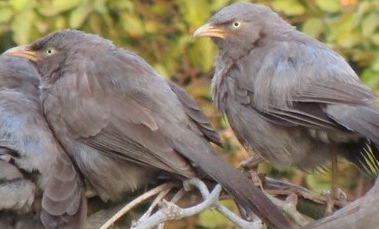
I call them Angry Birds! They are continually at war with the world, making their views heard with an incessant grating cacophony of sounds. Their beady eyes glint as they stare angrily at you, and their dusty khakhi-brown feathers are always dishevelled, as if they have just emerged from battle!

They are ubiquitous, making their bedraggled group appearance in the garden, on the sun deck, in the wash area and on the window ledges. They make their presence felt with their incessant quibbling and squabbling. In the morning they are busy poking at the lawn before our first cup of tea. In the afternoon they hop around in the verandah and outside the windows, peering through the glass and rapping sharply with their beaks as if to reprimand us for some misdeed. They are the band of vigilantes—sounding a harsh and strident chorus that makes the intruding cat slink away to safety. They fight like fishwives! Screeching, pecking, pulling, merging into a heaving mass of untidy feathers; and emerging with scrawny bare necks that reveal the wounds of war.

They are the Jungle Babblers or the Seven Sisters as they are called in English, and for some reason, Seven Brothers in some Indian languages.

And I wake up with the comfort of starting the day with them.

Until last week….

My angry birds have disappeared en masse!

At first I thought it may be the grey drizzly weather that we have been having after a long, blazing hot and dry summer that was deterring their forays. Then I thought that maybe they had decided to put in a late appearance; I watched for them morning, noon and evening. Not a straggly feather to be seen! I looked at all their haunts, their favourite foraging patches; the bare branches of the tree at the gate and the wires running overhead, but nary a glint of an eye could I see. I thought maybe they have taken off on vacation, but my bird book tells me that they like their home turf and are not likely to wander far.

How can they all vanish? I haven’t a clue!

jungle-babblers-in-Lucknow-India-bird-festival-uttar-pradesh-2 (2)
Missing from action!

Will they reappear soon? I do hope so!

Till then, the great babbler mystery continues!

–Mamata

Bravely Battling the Big C

I requested my friend who has resolutely conquered her cancer to share her experiences, and she generously agreed, though it was not easy for her to re-visit this part of her life. And what I realized is that you need 4Cs to battle the Big C: Courage of the person concerned, Caring Family, Compassionate Doctor and a network of Concerned Friends.

I share her story in first person and have the conviction that she has left it behind forever.

–Meena

It’s hard to go down memory lane to the fateful day when I got to know that I had the dreaded C disease. It was so hard to accept that diagnosis and to be able to actually say the word: CANCER!

A17DE18F-B261-4714-B3C5-D772E24CF012

‘Oh my God ! it can’t be happening to me…’ was obviously the first thought.

It took Dr Sarin less than five minutes and a physical examination to deliver the verdict which sealed my fate. But the journey to get to this point was not an easy one. I had been going from pillar to post, from doctor to doctor to doctor in my country of residence for a full year, and nobody so much as even suspected anything this drastic. I used to repeatedly get a ulcer on my left nipple which was not amenable to any treatment –I tried allopathy, homeopathy, ayurveda…you name it! I visited all streams of experts…GP, Dermatologist, Gynaecologist. Finally, as luck would have it, I came across a surgeon who suggested a biopsy, and on getting the result, he suspected something and asked me to go to India immediately.

A friend of mine had taken me for this biopsy. She immediately got into action and contacted her cousin in Delhi who knew a thing or two about doctors there. Though I have my whole family in Delhi and I belong to Delhi, here was a friend in this alien country who helped me to not only find an ACE DOCTOR, but took the pains to ensure I got to see the doctor—from arranging the appointment to everything.. all without my knowledge. She contacted my sisters and gave them the doctor’s contacts and my appointment time.

So Jan 23, 2017..can I ever forget this date !! I met Dr Sarin with 10 of my family members. There were tears and tears and tears all around as Dr Sarin gave her verdict. But I have to say, if ever there was an angel in a doctor’s guise, it was Dr Sarin. She tried to soften the blow as much as possible. Convinced my family that this was the easiest cancer to handle and that it was completely curable. We latched on to every single word she uttered and put our complete faith on her.

My Paget’s disease needed to be dealt with immediately. Straight on, we dived into a whirlpool of tests and more tests! Mercifully Jan 26th was a National holiday, so I got some respite to catch my breath! My surgery was planned for Jan 27th morning. God was surely holding my hand! I say so because I didn’t get time to think about what had hit me, everything was moving so fast (and trust me that’s the best way to go about it!). On Friday morning, I went into the OT. I was constantly praying to my Sai to hold my hand through this ordeal even as I saw doctors and nurses preparing for the operation. Dr Sarin came to me in the pre-surgery room, talked to me and gave me courage. There I saw my Sai Baba on her locket and suddenly I felt that He would work through Dr.Sarin’s hands and cut away my cancer. I was ready for the surgery. Everything went off well ..I was sent home the next day.

While all looked well, the tissues were sent for a detailed exam. On the third day when I went back for check-up, I was shocked to learn that a gene mutation had been found and I needed hormone therapy (Herceptin) for a year to completely take care of my problem. BUT to give that, they had to give me 6 cycles of chemotherapy. OMG! Once again I was in Dr Sarin’s room flooding it with tears. I could not handle the thought of chemotherapy. Apart from everything else, I could not accept the thought of losing hair and becoming bald. And also the fact that I would have to stay back for 4 1/2 months at least, to finish six rounds of the three-weekly chemo sessions.

Then started the second phase of my treatment journey. We had left Delhi about 10 years before this incident. I have two sisters and a brother-in-law living in Delhi and a hoard of school and college friends whom I had been close to. By God’s grace they all came forward and were there for me. They were like my suraksha chakra. I can never thank them enough or do anything to repay their love and support and courage which helped me go through this trial.

For after this, it was never-ending trips to Apollo every Monday and Thursday. I decided to look upon these as my outings! Remember in chemo we have to be confined to a room in the most sanitized atmosphere possible ! Oh God ! how seriously we took it..my US-based sons would send us Dettol wipes in huge dibbas and Chlorex to clean the floor. My husband was quite depressed through it all…he felt sad and guilty as he could not be there with me. But he had a job to keep and cancer is an expensive affair !

My sons would put a positive spin on everything. They’d say ‘Mummy, when will you ever get so much attention in your life? Just take it in your stride and go through it bravely. We have to come out a champ from this ordeal. Sai Baba is with you, providing all support. You have to do your bit by hanging in there.’

And that was true. I had the best doctors treating me. Dr Sarin is nothing less than God for me. Her healing touch was enough to lift my spirits every time I met her. With every passing chemo, she would say, ‘chalo one more done, ab to katam hone wala hai…’, and I would feel happy that we were crawling towards the end, slowly but surely. May God give her long, blessed life! My medical oncologist Dr Manish Singhal, took care of all the side effects so beautifully that I had minimum discomfort (that the minimum is also difficult to handle is another matter!).

Then again, the hardest part was to lose my hair…however much you may be prepare for it, it does make you cry!!!! I lost mine after the second chemo, but again my children had already sent me wigs, so I didn’t have to move around bald. Dr Sarin, Pooja, Dr Parag and my whole family would always pull down my scarf and urge me to have the confidence to move around like that!

I had my whole family rallying around me. My nutrition was being well taken care of..Nariyal pani first thing in the morning, healthy palak parantha for breakfast, anar mid morning etc etc. The whole meal plan was  ‘cooked fresh, fresh, fresh’.

All in all my sisters were a great source of strength for me during my difficult period.The two who were in Delhi physically present with me through it all and with whom I took turns to stay with for months on end and my sister from afar praying for me and cheering me up always!

My sister from Dubai too gave me immense strength through it all.As soon as she heard about my diagnosis,she took the next flight and was by my side for the surgery. Then all through my chemotherapy days she kept sending me beautiful scarves and prayer threads and what have you! Twice more she flew down to spend time with me.She is an excellent cook n as we know during chemo the taste buds really go for a toss .She would prepare yakhni and other delicious stuff that would appeal to my palett.It was a delight to have her around whenever she could make it ! Its because of her prayers and best wishes that I stand strong today !

I used to sleep a lot, something that came naturally to me after every chemo. In each cycle, in the first week, I only slept.  The second week onwards, felt a bit stronger. The third week was the golden week when was all ok. My relatives made a ritual of entertaining me on the day before the next chemo. In the safe period, we would go out for a movie followed by dinner. So in this way, I saw six movies and ate in six plush restaurants to mark my six chemos. Perks of being a patient!!

I felt God all around me, as if He had sent these people to lovingly look after me, and all I had to do was to be a little brave and keep my eye on the light at the end of the tunnel.  I thanked God a million times every day for giving me these people to help me through my most difficult times.

I tried my best not to let myself be dragged down by negative thoughts. I used to always go to the temple on the Apollo premises before going in for chemo. It gave me immense strength. A quirky habit I developed was that I wanted a room facing the temple only. That had become my good omen. After two chemos, they knew i wouldn’t take a room on the other side!

After the six chemos were over, I was finally given the go ahead to go back to my home and country to continue with Herceptin for the rest of the year, and then come back for a check-up. In Feb 2018, my last Herceptin was administered. I flew to India end of March and got my check-up done by Dr Manish Singhal, Dr Parag and my dearest Dr Ramesh Sarin, and got the ALL CLEAR signal.

The relief in my heart is difficult to express in words. When Dr Sarin told me I could have my chemo port removed, I was as unbelieving as I was the day I was told that I needed one!

Thank you, Apollo Hospital!

I love my doctors and I love my family and friends, who with the grace of God, brought me to this day where I have left cancer behind….hopefully forever!


A Parliament of Owls

No this does not refer to a House of sleep-deprived MPs at an all-night Parliament debate!

This is what a group of Owls can be called!

IMG_20180822_160618795.jpg

The English language has some wild and wonderful names to describe groups of animals or birds. We use some of these collective nouns occasionally when we talk about a Herd of cattle or a Flock of sheep. In school we often had to fill in the blanks or match the following– a Pride of lions, a School of fish or a Pack of wolves.

I have always been intrigued and fascinated by some of these collective nouns. I think that a Gaggle of Geese sounds just so appropriate, as does an Army of Ants (especially having once been literally attacked and badly bitten a marching regiment of army ants—no joking!).

Here are some delightful feathery ones!

Imagine a Parliament of Owls which includes members from the following: A Murder of Crows, a Convocation of Eagles, a Deceit of Lapwings, a Ballet of Swans, a Siege of Cranes, a Conspiracy of Ravens, a Company of Parrots, a Murmuration of Starlings and a Flamboyance of Flamingos!

And what about our four-legged friends? Here are some quirky ones!

When Noah invited representatives of all animals onto his Ark, he had to select a pair each from: An Ambush of Tigers, an Array of Hedgehogs, a Bloat of Hippos, a Crash of Rhinos, a Rumpus of Baboons, a Shrewdness of Apes, a Singular of Boar, a Skulk of Foxes, a Sleuth of Bears and a Mob of Kangaroos!

Not to mention the hoppers and slitherers from a Colony of Frogs, a Knot of Toads, a Quiver of Cobras, a Bask of Crocodiles, and even a Culture of Bacteria!

These are only a small taste of the numerous terms used to describe groups of different kinds, the history of which can be traced back to the Middle Ages in England. The earliest known collection of terms of collective nouns or ‘venery’ (an archaic term for ‘hunting’) is in the Book of Saint Albans, a kind of handbook for hunters first published in 1486. Included among chapters was a list of the Compaynys of Beestys and Fowlys, where many of the common terms of venery made their first appearances including pride of lions, flock of sheep and herd of deer.

While serious scientists may not be amused at the attribution of human traits to describe the animal world, for the language lovers, discovering new terms can be great fun.

Even more fun is trying to coin one’s own terms! Here are some that I thought of: A Cacophony of Koels, a Preening of Peacocks, a Menace of Mosquitoes, and a Buzzload of Bumblebees!

–Mamata