
June 5: For an ex-Environmental Educator, the date has huge significance.
June 5 in 1972 was the day the first UN International Conference on the Environment kicked off in Stockholm, Sweden. And since then, the day is observed as World Environment Day.
What was this Conference about? Well, it was called the United Nations Conference on the Human Environment. While it was termed a conference on the Environment, developing countries and NGOs brought to fore the need to link Environment with Development, insisting that the environment could not be considered in isolation. Today, this seems obvious, but back in those days, this point had to be lobbied for, fought for and agitated for.
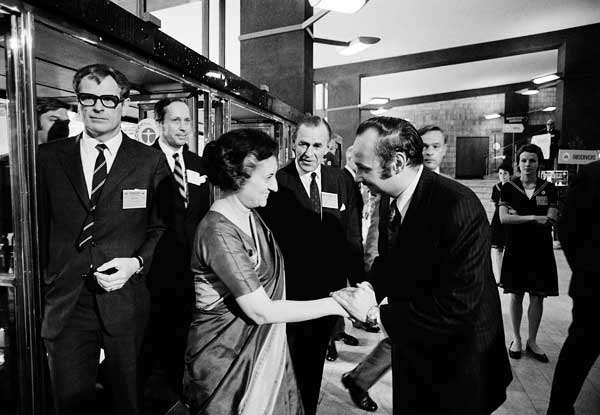
India can be proud of its contribution to this paradigm shift in thinking. Mrs. Indira Gandhi who attended the Conference, famously said in her address ‘Poverty is the biggest polluter’. Interestingly, India had even then realized the importance of Environmental concerns—Mrs. Gandhi was the only Head of State (other than that of the host country Sweden), to attend the Conference.
By contrast, the event to mark the 20th Anniversary of this conference, popularly called the Earth Summit and held in Rio de Janeiro, had 108 Heads of States in attendance!
Equally in contrast is India’s own attitude towards the environment. The high standards we set for ourselves and the world are certainly being diluted by our policy decisions and actions—now more rapidly than ever.
This, coupled with the disasters we are seeing around—from COVID to cyclones–all in some way or the other related to humankind’s exploitation of the environment, make it important to observe World Environment Day with even more seriousness than ever.
And while we are here, here is a quick look at WED themes over the years.
| 1973 | Only one Earth |
| 1974 | Only one Earth (during Expo ’74) |
| 1975 | Human Settlements |
| 1976 | Water: Vital Resource for Life |
| 1977 | Ozone Layer Environmental Concern; Lands Loss and Soil Degradation |
| 1978 | Development without Destruction |
| 1979 | Only One Future for Our Children |
| 1980 | A New Challenge for the New Decade: Development without Destruction |
| 1981 | Ground Water; Toxic Chemicals in Human Food Chains |
| 1982 | Ten Years after Stockholm (Renewal of Environmental Concerns) |
| 1983 | Managing and Disposing Hazardous Waste: Acid Rain and Energy |
| 1984 | Desertification |
| 1985 | Youth: Population and the Environment |
| 1986 | A Tree for Peace |
| 1987 | Environment and Shelter: More Than A Roof |
| 1988 | When People Put the Environment First, Development Will Last |
| 1989 | Global Warming; Global Warning |
| 1990 | Children and the Environment |
| 1991 | Climate Change. Need for Global Partnership |
| 1992 | Only One Earth, Care and Share |
| 1993 | Poverty and the Environment |
| 1994 | One Earth One Family |
| 1995 | We the Peoples: United for the Global Environment |
| 1996 | Our Earth, Our Habitat, Our Home |
| 1997 | · For Life on Earth |
| 1998 | For Life on Earth (Save Our Seas) |
| 1999 | Our Earth – Our Future |
| 2000 | The Environment Millennium |
| 2001 | Connect the World with a World Wide Web |
| 2002 | Give Earth a Chance |
| 2003 | Water |
| 2004 | Wanted! Seas and Oceans |
| 2005 | Green Cities |
| 2006 | Deserts and Desertification |
| 2007 | Melting Ice – a Hot Topic |
| 2008 | CO2, Kick the Habit – Towards a Low Carbon Economy |
| 2009 | Your Planet Needs You – Unite to Combat Climate Change |
| 2010 | Many Species. One Planet. One Future |
| 2011 | Forests: Nature at your Service |
| 2012 | Green Economy: Does it include you? |
| 2013 | Think. Eat. Save |
| 2014 | small island developing states |
| 2015 | One World, One Environment |
| 2016 | Zero tolerance for the illegal trade in wildlife |
| 2017 | Connecting People to Nature |
| 2018 | Beat Plastic Pollution |
| 2019 | Beat Air Pollution |
| 2020 | Time for Nature |
–Meena
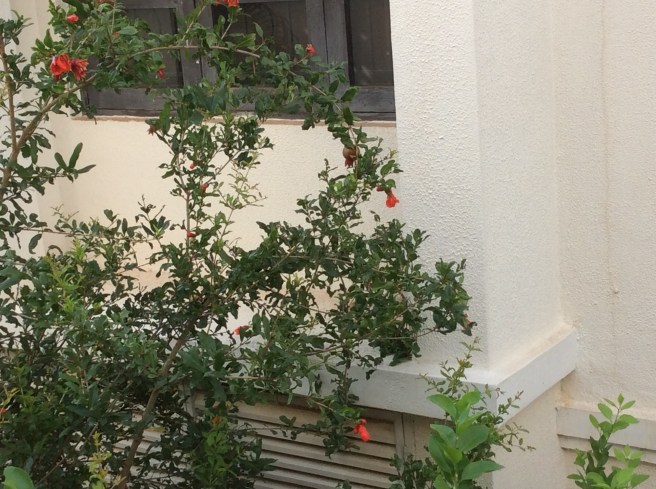 Lockdown has certainly make us more observant and has given us new ways of looking at things. There is a pomegranate tree whose top I can see from my window—and considering I spend eight or nine hours working in that room, it is very central to my vision! It is currently flowering, abuzz with bees, and fruits have started forming.
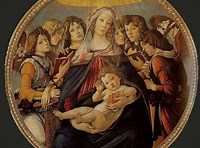 The pomegranate is a symbol of resurrection and life everlasting in Christian art, and the pomegranate is often found in devotional statues and paintings of the Virgin and Child, as in Bottecelli’s ‘Madonna of the Pomegranate’ shown here.
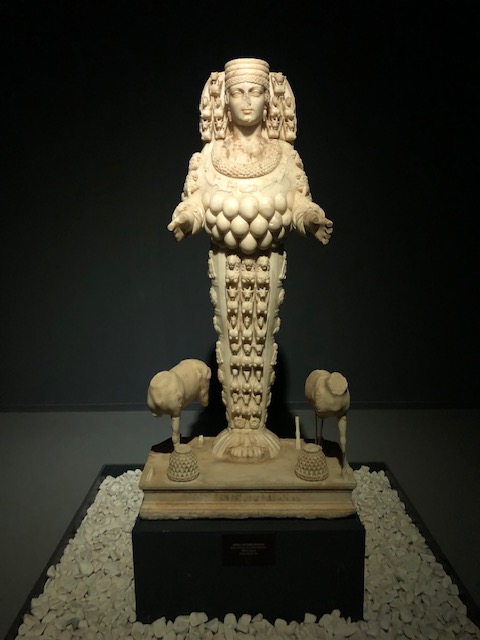 Why the sudden question? Well, because May 18th is International Museum Day—observed as such since since 1977. The idea is that on this day, museums engage with their stakeholders and highlight the importance of the role of museums as institutions and the role they play in society.
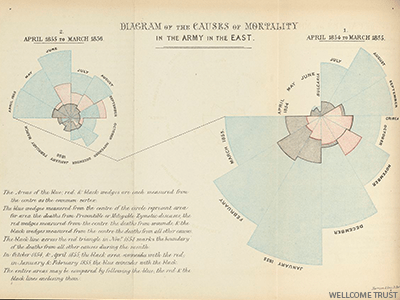 Florence was also one who shook up systems and brought in systemic changes. She battled with entrenched bureaucracies most of her working life, in order to bring about these changes. She was aware that it would be difficult to convince decision makers of the need for change, and maybe out of this requirement was born what is today counted as her major contribution to statistics—the first infographics ever made. The best-known of the infographics she invented are what are called the “coxcomb” diagrams, understandable by even the public. ‘The coxcomb is similar to a pie chart, but more intricate. In a pie chart the size of the ‘slices’ represent a proportion of data, while in a coxcomb the length which the slice extends radially from the center-point, represents the first layer of data. The specific organization of Nightingale’s chart allowed her to represent more complex information layered in a single space. In her coxcomb during the Crimean War, the chart was divided evenly into 12 slices representing months of the year, with the shaded area of each month’s slice proportional to the death rate that month. Her color-coding shading indicated the cause of death in each area of the diagram.’*
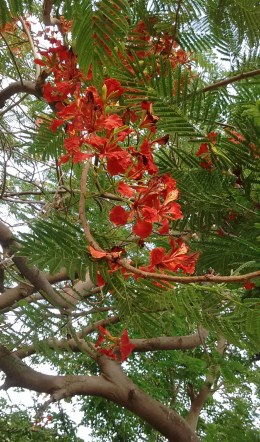
 In the case of demarcation of COVID zones in India, Orange is the New Freedom! Lucky enough to fall into this zone, I can now do some things I could not last week. But since my neighbouring zone 5 kms away is Red, there is nothing very exciting I can do. But I suppose it is all in the mind.
 Millennial Matriarchs