Broken Frames, Broken Lives

Today, each one of us harbours doubts and fears about the rapid rise of Generative Artificial Intelligence (Gen AI), smart robots, driverless cars etc., especially whether these will take away jobs from people and give them to machines.

This has happened with every new technology since the industrial revolution. Maybe the time of maximum anxiety around technology and jobs was in the late 1700s to early 1800s, a time when quite a few people in the UK depended on the cotton, wool and silk industries for their livelihoods. This was based on the labour of framework knitters, who like some of our weavers even today, worked in their own homes. Though the hours were long and they got small wages, they were at an equilibrium. 

In the early 1800s, there were around 30,000 knitting-frames in England. But change had already started to set in. Change of fashion (men moving from stockings to trousers) and increasing exploitation of weavers by the middlemen were two major factors. But perhaps the most important was the mechanization and wide-frame machines that were coming in to make production faster. Production moved from homes to factories with this mechanization.

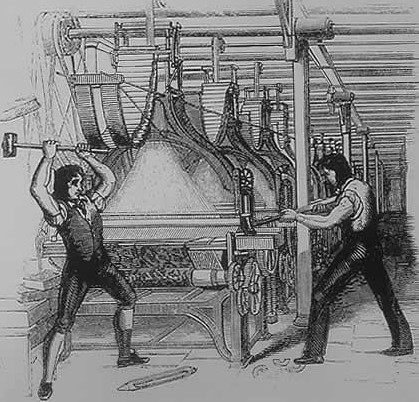
As more and more people lost their livelihoods, anger and frustration boiled over, and mill-owners and the new machines were targeted. The scale of the sabotage that occurred in England between 1811 and 1816 was beyond anything seen before.  In the peak three months of the riots, 175 of these new frames were broken per month! The people involved in these riots and destruction called themselves ‘Luddites’. The origin of the name is not quite clear, but some said it was after Ned Ludd, a legendary weaver who in 1770 was supposed to have smashed such machines.

Governments then, as today, were heavy-handed. Their response to the riots was to pass the Frame-Breaking Bill in the House of Commons in February 1812. The Bill was drastic– it proposed transportation or the death penalty for those found guilty of breaking stocking or lace frames. Not everyone was happy with the draft Bill– in the House of Lords, the poet and social campaigner Lord Byron argued against it saying that it was placing the value of life at “something less than the price of a stocking-frame”.  But such passionate appeals did not help, and the Bill was passed.

The Government would have expected all such riots to stop after the Bill. But exactly the opposite happened. The riots actually became more violent and rioters started using arms. The logic was that if they were going to be punished by death or deporatation for breaking frames, then they might as well do something that really deserved such drastic measures. A popular rhyme at the time was “you might as well be hung for death as breaking a machine”. A few mill owners were in fact killed. Government response also got harsher and several Luddites were hanged.

The climax of the Luddite Rebellion took place at midnight on Friday 28 June 1816. Sixteen men raided the factory of Heathcoat and Lacy at Loughborough, with around 1000 sympathisers cheering them on.  They destroyed nearly all of the fifty-five lace-frames.  Subsequently eight men were sentenced to death and two were transported.

The protests died down after that. Mechanization marched on, and the thousands who were involved in their traditional occupation lost out.

Technology will come. But how do we make the changes so we can reduce the negative impacts? How do we make the world a more inclusive place? Surely we cannot let history repeat itself!

–Meena

Photo-credit: historicalbritain.org/

A Woman of Many Parts: Sarojini Naidu

In a week when women are being celebrated, and their achievements extoled, it is fitting to remember that in every era of history, in every part of the world, there have been women who have broken boundaries and glass ceilings, and have excelled in numerous fields. This is a good week to celebrate a woman who combined seemingly contrary abilities, and played a significant role in several fields of endeavor. This is Sarojini Naidu.

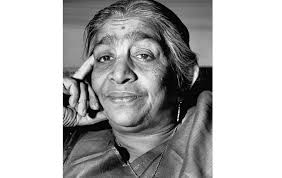
Textbooks traditionally describe Sarojini Naidu as the Nightingale of India. But she was far more just a singer of songs. A poetess, patriot, fierce nationalist and freedom fighter, politician, eloquent orator, inspirer of masses, perfect hostess, and a feminist and firebrand leader in every sphere.

Sarojini was born on 13 February 1879 in a Bengali Brahmin family, the eldest of eight siblings. Somewhat of a prodigy, she entered the University of Madras at the age of 12; she composed 1000-line poems at 13. After graduating in 1895 with the highest rank, she was awarded a scholarship by the Nizam of Hyderabad, and she spent three years in England, studying at King’s College London, and later at Girton College in Cambridge. During this period she also became involved with the suffragist movement in England. She returned to India in 1898 and married Dr M Govindarajulu Naidu whom she had met in England, (the inter-caste marriage attracted opposition) when she was 19. By the age of 25, Sarojini was mother to four children. Her first major collection of poems was published when she was 26. She had literary fame, and a comfortable lifestyle in Hyderabad where she played the perfect hostess.But this was hardly a deterrent to what was to be an extremely active political life.

Sarojini and Gandhiji shared a special relationship. She had first met him in 1914 in London just as the First World War had broken out. That was the start of a long and close bonding between the two. Sarojini was one of the few who could joke about, and with, Gandhi (she nicknamed him Mickey Mouse!). The two exchanged witty repartees, and reproaches, which were totally free from malice. She could stand up to Gandhi and never hesitated to speak her mind. Yet she remained one of his staunchest supporters all her life, and revered him as a guru.

Sarojini Naidu was drawn to Gandhi’s non-cooperation movement and in 1924 travelled across the world to spread the word about the movement. She was a sought after public speaker. In 1925 she became the first Indian President of the Indian National Congress. She was a front-line participant in the Independence movement. Her participation in the Salt Satyagraha and the Quit India Movement was deemed as ‘anti-British activity’ and she was imprisoned several times for this.

Sarojini Naidu believed that the nationalist cause could not be separated from the movement for women’s rights. She helped establish the Women’s Indian Association along with Annie Besant and a few others, in 1917, which championed women’s right to vote. The same year, along with Annie Besant she went to London to represent the case for women’s franchise before the Joint Select Committee.

She was elected to the Constituent Assembly that drafted the Constitution of India. After India achieved independence on 15 August 1947, Sarojini Naidu was appointed governor of the United Provinces, making her the first woman governor in the country. She remained in the post until she passed away on 2 March 1949.

Sarojini Naidu’s contribution to the freedom movement and to the early years of our new republic was marked by her total dedication combined with her boundless energy and multi-faceted brilliance. This was summed up thus by her fellow freedom fighter Jawaharlal Nehru: She began life as a poet, in later years when the compulsion of events drew her into the national struggle, she plunged into it with all the zest and fire she possessed…. whose whole life became a poem and a song and who infused artistry and grace in the national struggle, just as Mahatma Gandhi had infused moral grandeur to it.

Despite her active political life Sarojini’s literary output was also prolific. She published several volumes of poetry, and held ‘salons’ which attracted an array of intellectuals. She led a hectic and productive life despite suffering from a variety of ailments throughout her life. Her zest for life was undiminished till the end, when she passed away at the relatively young age of 70.   As she wrote to her youngest child a few years earlier: One is not so concerned with a long life as with a ‘merry one’—merry as the sum of worthwhile, rich, full, interesting, and who can say that mine has not been and is not in that sense ‘merry’ as well as long?

On a more serious note, several years earlier when she was in Yervada jail, Sarojini wrote to her daughter Padmaja Naidu: In the course of a long and most variegated life I have learned one superlative truth…that the true measure of life and oneself lies not in the circumstances and events that fill its map but in one’s approach and attitude and acceptance of those things.

An inspiration, and a role model indeed!

–Mamata

Famous Women on the Wall: Happy Women’s Day

This week we celebrate International Women’s Day.

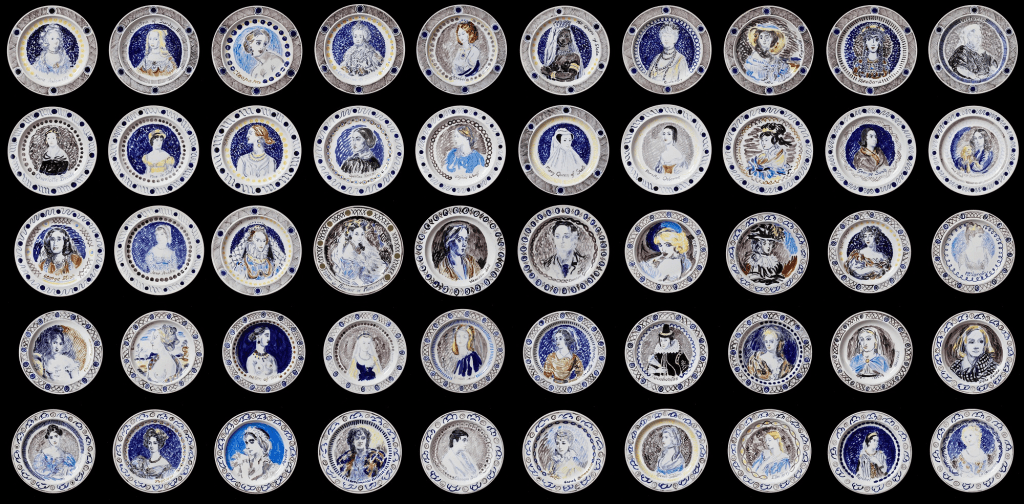
It was in 1911 that IWD started being marked. A couple of decades after that was when something called the ‘Famous Women Dinner Set’ was commissioned. This was a set of 50 dinner plates depicting famous women down history.

Kenneth Clark (Baron Clark), the art-historian and museum director, commissioned these. (Those of an older vintage may remember the BBC serial ‘Civilization’ which discussed Western art, architecture and philopsophy. Though made in 1969, it was broadcast in India in the late ‘70s or early ‘80s, and was one of the most popular art-history programmes in the world.)

Coming back to the dinner-plates, the artists given the commission were Vanessa Bell and Duncan Grant, of the famous Bloomsbury Group. This was the name given to a group of English writers, philosophers and artists who met between 1907 and 1930 in the Bloomsbury  district of London, the area around the British Museum , and discussed matters of art and philosophy.

It is said that Kenneth Clark got the idea of commissioning a special dinner service when he was dining off a historic blue-and-gold Sèvres service, originally made for Catherine the Great.

Kenneth and his wife did not interfere in any aspect of the creative work—what form or shape it would take, what pieces it would consist of, or even what it should portray.

In 1933 the work was completed, and after showing it to the Baroness, the artists presented the set of 50 plates to Kenneth Clark, who was probably quite surprised to see the result if his commission, because he thought he would be getting’…a wide ranging set of decorative crockery that included everything from soup tureens to mustard pots’

Picture from https://www.charleston.org.uk/event/famous-women-dinner-service

Vanessa and Duncan had selected 50 famous women down history—twelve each from four categories: Women of Letters (e.g George Eliot, Charlotte Brontë, 10th-century Japanese poet Murasaki. Virginia Woolf and Elizabeth Barrett Browning); Queens (including Catherine the Great, the Queen of Sheba, Elizabeth I, and Victoria); Beauties (among whom were Pocahontas and Helen of Troy); , and Dancers and Actresses (including Sarah Bernhardt, Ellen Terry and Greta Garbo). That made 48 women. The last two plates portrayed the artists Vanessa Bell and Duncan Grant. The artists had hand painted beautiful portraits of their subjects on Wedgewood plates.

Though he was initially a bit confused with the dinner service, it seems that Baron Clark quite grew to like his plates. It is said that he used to select specific plates from the service for use for particular guests, depending on their interests, or to poke fun at their sensitivities.

The dinner set, after being sold and re-sold disappeared from view for some decades, but later re-surfaced. They are now housed in the Charleston Museum in the UK—the original home of Vanessa Bell.

Another major work of art involving women and dinner is ‘The Dinner Party’, a 1979 installation by Judy Chicago. This is a dinner table arranged with place settings for 39 mythical and historical women. They are seated around a triangular table. Though controversial, this is considered a classic of feminist art.

In India we do have portraits (paintings and photographs) of women. But they are outnumbered by artistic works down the ages which put females at the centre—the oldest probably being the Harappan Girl, going back to 1750 BC or thereabouts. From there, to all the art in temples, to Raja Ravi Verma and his goddesses and mythical women, to the controversial portrayals of MF Hussain, to women painted by Amrita Shergill, Anjolie Ela Menon, Arpana Caur, Bharathi Kher and others, which are all classics today.

May many more artists immortalize real women in their art. It is an apt tribute.

Happy Women’s Day!

–Meena

And thanks to all our readers on this, the anniversary of our blog! And all those whose encouragement and support keeps it going!

Missing People: The Village of Dolls

It sounds like something out of an imaginary futuristic scenario. Entire countries with no young people, no babies being born, and the old dying out until finally there are entire countries without a human population. Incredibly, this is happening here and now. Many countries in Eastern Europe, Southern Europe and East Asia are facing drastic declines in new births, even as the elderly population declines due to deaths. News reports say that the number of babies born in Japan in 2024 was the lowest since records began in 1899. The prospect of population extinction is becoming a reality in South Korea, which has been moving towards a childless society. Of the already dwindling population, young people are abandoning their rural homes and migrating to cities in search of work, leaving no workforce for agriculture and fishing. What will these abandoned villages look like?

There is a village in Japan which is an ironically graphic example of such a scenario. This is Nagoro, an isolated valley town on the Japanese island of Shikoku, the smallest and least visited of Japan’s four main islands. Originally populated by around 300 people, a few years ago only about two dozen old people remained. One of these old people was a father whose daughter moved back to the village to be with him. Tsukimi Ayano who had spent most of her life in Osaka moved back to the island in 2002. 

One of the things that Ayano did when she came back was to make a scarecrow (called kakashi in Japanese) that resembled her father to scare away the birds that were raiding the seeds that she planted on the family plot. In addition to keeping the birds away, Ayano liked that the scarecrow added a dash of something different in the deserted landscape. Having the time, and the skills, Ayano continued making these life-sized and life-like scarecrows for other people’s fields also. From scarecrows, Ayano moved on to making other figures. It became her hobby, and her pleasurable pastime. Initially she made the scarecrows for the fields; then she started making figures that resembled old neighbours who had passed away, or people who had moved away. Ayano felt that these gave her a sense of having some company. It was also a way of commemorating the erstwhile residents of the village, while infusing some spirit in their rapidly vanishing village.

These figures (she calls them ‘dolls’) soon began to populate different parts of the village. They were placed in people’s gardens, at bus stops, in village meeting places—depicted as being engaged in everyday tasks. Walking around the village one could see figures of construction workers installing a road sign, a fisherman on his porch with his daughter, a couple sitting on a river bank, all looking real and ‘ready for action’. After the village school closed down as there were no students, Ayano recreated a classroom with students and teachers, with two of the dolls wearing the same clothes as the last two students who had attended the school.

As she said “I just wanted people to enjoy looking at the dolls and I want to enjoy making them.” Ayano makes all the dolls herself using wooden slabs for the base, cotton clumps for the head and rolled newspapers for the ‘skeleton’ as well as straw and fabric. The dolls come to life with the unique facial expressions she gives each one, shaping the nose and the mouth, choosing the buttons for the eyes, and meticulously crafting the ears. Ayano wants to make sure that her kakashi can hear well!  She dresses them in clothes that, in many cases, belonged to the real characters, or are donated. It takes Ayano about three days to make a doll. Each doll has a life of two to three years as the natural materials weather quickly. Ayano tries to recycle as much of the material as she can, as she makes new dolls to replace the old ones.  

Ayano’s village of dolls Nagoro remained undiscovered and unknown until 2014 when a German filmmaker made a short documentary titled Valley of Dolls. This attracted global attention, and led to an influx of curious tourists to this remote island. Ayano personally felt that the film was dark and sad, whereas for her the process of creating the dolls is a joyous one, and the village itself is a now a curiously vibrant and animated place. Ayano’s acknowledgement of the filmmaker is his replica doll as a figure at a bus stop!

For Ayano these dolls are a celebration of life, not weird reminders of the past. In her mid-seventies now, Ayano continues to live in the village with its population that she has created and continues to nurture.

–Mamata

Advocate for Invertebrates: EO Wilson

Call them spineless, or call them creepy crawlies! As Meena wrote this week, they make up a majority of the living things on earth, and yet they are largely unnoticed (unless of course one is stung by one, or has one creeping up your leg!) Invertebrates however have had their own champions. One of whom is EO Wilson that Meena has quoted as saying that “invertebrates don’t need us, we need them!”

This was indeed the case with EO Wilson one of the most distinguished and recognized American scientists in modern history. While he began his scientific career by specializing in the study of ants, Dr Wilson became an advocate for all species, particularly invertebrates, as essential to the health of the planet and people.

While his key discovery was the chemical by which ants communicate, EO Wilson spent the rest of his life also looking at the bigger picture of life on Earth. And so, to his lifelong fascination with ants, E. O. Wilson added a second passion: guiding humanity toward a more sustainable existence. He devoted his life to studying the natural world, and inspiring others to care for it as he did.

Edward Osborne Wilson was not just the world’s foremost authority on the study of ants (a myrmecologist!) but one of the founding fathers of, and leading expert in, biodiversity. His autobiography titled Naturalist traces his evolution as a scientist. Young Wilson knew early that he wanted to be scientist. A childhood accident left him with weak eyesight and hearing, so instead of studying animals and birds in the field, he concentrated on the miniature creatures such as ants and bugs that he could study right under his nose through a microscope. This was the perfect tool to spark a lifelong passion for insects.  I turned to the teeming small creatures that can be held between the thumb and forefinger: the little things that compose the foundation of our ecosystems, the little things, as I like to say, who run the world.

As a schoolboy Wilson was not a great reader. But he claimed that one of the few books that he read from cover to cover was The Boy Scout Handbook. (I wrote about this in my recent piece Be Prepared!) It was the Boy Scouts which nurtured his early love for nature. As he once said: The Boy Scouts of America gave me my education.

His autobiography Naturalist also reveals how these first steps led to a lifelong journey of exploration and discovery which involved a mix of endeavour, random encounter, enthusiasm and opportunism. Underpinning all these was his sheer delight of the pursuit of knowledge. As he wrote about an expedition to Fiji in 1954:

Never before or afterward in my life have I felt such a surge of high expectation—of pure exhilaration—as in those few minutes. I know now that it was an era in biology closing out, when a young scientist could travel to a distant part of the world and explore entirely on his own. No team of specialists accompanied me and none waited at my destination, whatever I decided that was to be. Which was exactly as I wished it. I carried no high technology instruments, only a hand lens, forceps, specimen vials, notebooks, quinine, sulfanilamide, youth, desire and unbounded hope.      

Edward Osborne Wilson is widely considered one of the greatest natural scientists of our time. He is also credited for being the founding father of the branch of biology known as socio-biology and biodiversity. He was a pioneer in the efforts to preserve and protect the biodiversity of our planet and was instrumental in launching the Encyclopaedia of Life, a free online database documenting all 1.9 million species on Earth recognised by science.

In a tribute to his lifelong dedication to science, two species of organisms have been named after him. Myrmoderus ewolsoni, an antbird indigenous to Peru, and Miniopteru wilsoni, a long-fingered bat discovered in Mozambique’s Gorongosa National Park. Wilson once told Scouting Magazine that being recognized in this way was an honour akin to being awarded a Nobel Prize because it’s such a rarity to have a true new species discovered.

EO Wilson was driven by the passion of guiding humanity toward a more sustainable existence. To do that, he knew he had to reach beyond the towers of academia and write for the public. He believed that one book would not suffice because learning requires repeated exposure. Thus he wrote several bestselling books that eloquently pleaded his case, while also providing facts and figures backed by solid research. His books On Human Nature and The Ants received the Pulitzer Prize.

While he remained a Harvard professor for 46 years, he was conferred with many accolades and honours by universities and organizations across the world. EO Wilson passed away on 26 December 2021 at the age of 92, leaving behind a legacy of conservation action that continues to inspire the global movement to end the threat of extinction.

In 2023, the United Nations Convention on Biological Diversity (COP15) agreed to a Global Biodiversity Framework (GBF) with a goal to maintain, enhance, and restore Earth’s natural ecosystems by 2030, halt human-induced extinction of known species, and by 2050, reduce the extinction rate tenfold and increase the abundance of native wild species to healthy and resilient levels. A key component to the GBF is a target to conserve at least 30 percent of land, seas, and freshwater by 2030 (known as “30×30”).

EO Wilson once wrote:

Looking at the totality of life, the Poet asks, who are Gaia’s children?

The Ecologist responds, they are the species. We must know the role each one plays in the whole order to manage Earth wisely.

The Systematist adds, then let’s get started. How many species exist? Where are they in the world? Who are their genetic kin?

EO Wilson was a rare combination of all three.

–Mamata

Spineless!

Fountain of Bees, Rome

They make up over 90 per cent of life on earth.

There are about 1.3 million species of them.

They are found in every part of the world.

They range from one-fifth the thickness of a strand of your hair, to the 30 ft long giant squid.

These are the invertebrates—animals without a backbone. Why backbones, in fact, invertebrates don’t any bones at all! Invertebrates include ants, spiders, worms, snails, bees, butterflies, corals, lobsters, crabs…they are the spineless majority!

As the famous biologist EO Wilson put it, ‘Invertebrates don’t need us, we need invertebrates’.  Critically, they pollinate flowers, hence allowing plants to propagate so that there is food for all. They are at the base of all food-chains.  Humans also eat invertebrates—think crabs, lobsters etc. They maintain the ecological balance by eating each other and being eaten! Earthworms and some related creatures help dig up and aerate the soil, and make it fertile. They are important in another way too—most parasites are invertebrates!

All invertebrates are cold-blooded and about 80 per cent of them are terrestrial. Most of them undergo metamorphosis.

They fall into nine phyla, compared to vertebrates which all belong to one phylum.

In spite of their ubiquitous presence and the role they play in our lives, we don’t pay enough attention to these co-inhabitants of our world. For instance, while most countries have national animals or birds, few have national invertebrates. Exceptions include Denmark, which lists the Small Tortoiseshell as its national butterfly; Estonia which lists the Swallowtail; Finland which lists the Seven-spot Ladybird as its national insect and Latvia which has the Two-spot Ladybird for its. Several US states have State Insects, as does Karnataka (the honeybee). Many Indian states also have State Butterflies.

India is unique in that it has named a National Microbe—the Lactobacillus bulgaricus. This was done in 2012, based on a nation-wide completion. It was selected based on its importance in making yogurt or curd. Some US states also have State Microbes. The first state to declare an Official State Microbe was Oregon which chose brewer’s or baker’s yeast as the Official Microbe because of its importance to the craft beer industry there.

Designating such national and state symbols is important, given that we don’t focus enough on these creatures which make up about 95 per cent of all species on earth. Creating a buzz brings attention to them, hopefully leading to more studies and research, ensuring their well-being which is so critical to ours.

In order to increase awareness about invertebrates, last year the well-known British newspaper The Guardian started an ‘Invertebrate of the Year’ contest. This was confined to the UK. This year’s competition, the second of the series, has gone international. So any of us can send in a nomination for an invertebrate, along with reasons why we favour this particular one.

To give you an idea, last year’s winner was the earthworm, which was voted in with 38 per cent of the total votes. The least number of votes was garnered by the invasive Asian or yellow-legged hornet.

Surely you have an invertebrate you love or hate. This is your chance to put it on the world map. Submit your entries at https://www.theguardian.com/environment/2025/feb/12/nominate-your-invertebrate-species-of-the-year by midnight (GMT) on Tuesday 4 March.

–Meena

Be Prepared! World Thinking Day

A recent mention of World Thinking Day to be marked on 22 February set me thinking! This was the first time I had heard about such a day, and I was curious about what lay behind it. There I discovered an unusual link to a collective that was very much a part of my life in my primary school days. This was the Scouts and Guides.

The history of this global movement goes back more than a hundred years. Robert Baden-Powell a military officer who had been in the Boer War organized an experimental camp in 1907 on Brownsea Island off the southern coast of England. The idea was to immerse young boys in activities aimed at developing in them various outdoor skills, chivalrous behavior and good citizenship. This was inspired by the military “scouts” in the army who were sent out to gather information, learn survival skills, and be prepared to help others.

Baden-Powell’s idea was that boys should organize themselves into small natural sub-groups of six or seven under a boy leader. They would be trained in all skills that would be required in camping–tracking and reconnaissance, mapping, signalling, knotting, and first aid.

The camp was a success. Following this, and based on his ideas for training boys, Baden-Powell published a book Scouting for Boys. The book became one of the bestsellers of the twentieth century. Thousands of boys began to join the Boy Scouts movement. To become a scout, a boy would promise to be loyal to his country, help other people, and in general obey the scout law, which was a simple code of chivalrous behaviour.

In 1909 Baden-Powell organized a Boy Scout rally in London. It was here that a small group of girls ‘gate crashed’! The girls had been secretly following the activities that their brothers did, and they demanded that there be something similar for girls. This was radical in a period when girls were expected to be docilely engaged in domestic tasks and ‘ladylike’ activities such as needlework and art. Baden-Powell was encouraging. He asked his sister, Agnes Baden-Powell, to help him with a girls’ organization and she became the first President of the Girl Guides. Working together, the two outlined programme ideas for girls, and later produced The Handbook for Girl Guides. Visitors to Britain were impressed by this and took the idea back to their own countries. By 1910 Guiding had started in Canada, Denmark, Finland and South Africa. Within the next two years it spread to Ireland, Holland, Sweden and the United States. The movement continued to spread across the world. The girls who joined acquired many skills. During World War I they made important contributions to war efforts including growing food, working in hospitals, factories and soup kitchens.

The First World Conference held in England, in 1920 was a historic occasion that gave representatives of the Girl Guiding and Girl Scouting world the opportunity to meet and exchange ideas and experiences and shape the future and direction of the Guiding and Scouting World. As the Movement grew and expanded, country representatives began to feel that it was time to create something more solid and binding and the idea of forming a world association was proposed after the 4th World Conference in 1926. The delegates from across the world also decided to create a special day for guides and girl scouts. They selected the joint birthday of Lord Baden-Powell, the founder of the scout and guide movement, and his wife Olave as appropriate to mark such a day. This was 22 February, and the day was to be called Thinking Day.

The World Association of Girl Guides and Girl Scouts (WAGGGS), was formed when Delegates from 26 countries met at the Fifth International Conference in Hungary in 1928. Its Secretariat was to be located in London.

The World Association of Girl Guides and Girl Scouts grew to become the largest voluntary Movement dedicated to girls and young women in the world, representing millions of girls and young women from 152 countries. Through innovative non-formal education programmes, leadership development, advocacy work and community action, the movement has empowered girls and young women to develop the skills and confidence needed to make positive changes in their lives, in their communities and countries.

India was not far behind in this movement. The Girl Guiding Movement was started by Dr Cullen in 1911. The Boy Scouts had been established in 1910. But at the time India was under colonial rule, and no Indian boys and girls were included in the movement till 1916. A number of different Guiding and scouting Associations were formed in the following years. In 1928 the All India Girl Guide Association was admitted as a founding member of the World Association of Girl Guides and Girl Scouts (WAGGGS). 1951 On 15 August 1951, the All India Girl Guide Association merged with the Bharat Scouts and Guides. Following the merger, the Girl Guide Association ceased to be a member of WAGGGS.

In the 1960s and 1970s Girl Guides and Boy Scouts were part of the extra-curricular school activities. I clearly remember that as a Bulbul (as the younger guides were called in India) I struggled with learning how to tie different kinds of knots. My dark-blue Bulbul uniform with epaulets, scarf, and a brown leather belt stayed with me for many years. I am not sure if Bulbuls still have a place in the myriad of extra-curricular activities that schools offer. Today the educational system advertises that it trains children in ‘life-skills’ and ‘global citizenship’. To my mind, Girl Guiding introduced these a century ago, along with the attributes of being a good human being. The essence of these are encapsulated in its Motto: Be Prepared. And elaborated in the nine points of Guide Law: A Guide is trustworthy; A Guide is loyal; A Guide is a friend to all and a sister to every other guide; A Guide is courteous; A Guide is a friend to animals and loves nature; A Guide is disciplined and protects public property; A Guide is courageous; A Guide is thrifty; A Guide is pure in thought, word and deed.

As we approach the centenary of World Thinking Day, 22 February is a good day to reflect on these simple but powerful tenets. It is also a day to celebrate friendship, sisterhood, and empowerment, as also to take action to speak out for the millions of girls who, even today, do not have an equal voice, nor the opportunity to Be Prepared. 

–Mamata

The Other Kumbh

The town of Kumbakonam in Tamilnadu has a hoary history. It is supposed to be the cradle of life of this yug, namely the Kali Yug. Each yug ends with a pralayam or flood which leads to the destruction of all living beings on the earth. When the last yug was about to end, Brahma put the seeds of all living organisms as well as the Vedas and Puranas, in a pot called the Amrita Kalasam or Kumbham (pot of nectar).

The pot was befittingly decorated with flowers, leaves, ausipicious cloth, sandalwood paste and a sacred thread. The Kumbham’s mouth was stopped with a coconut and it was placed on the top of mount Meru.

When the floods came, they destroyed all creatures on earth. The Kumbham prepared by Brahma was displaced, and floated on the flood waters for years and years. Finally, it settled at a spot considered to be present-day Kumbakonam.

But the seeds had to be released in order for life to start again on earth. Siva, in the guise of a hunter, discharged an arrow from His bow, breaking open the pot. The seeds of life and the Vedas and puranas in the pot were scattered around, and thus life on earth re-started.

And this spot is the site of the other great Kumbh festival. The place where the pot broke and the contents flowed out–Mahamaham kulam (tank) is where the Mahamaham festival is celebrated.  

While Masimaham is an annual event that occurs and thousands of people gather for a dip during this time, it takes on special significance once in twelve years. For it is believed that every 12 years, when Jupiter passes over Leo, the waters of all of India’s holiest rivers, including the Ganges, flow into the tank, and it is at this time that the Kumbh mela of South India is celebrated at the Mahamaham tank. Since it is believed that all the rivers of India meet at the tank on this day, a bath here is considered equal to the combined dips in all the holy rivers of India! Over 10 lakh people congregate here for the event.

Kumbakonam, meaning ‘pot’s corner’ to remind us of where the pot-of-life landed, is considered a very holy place. There are any number of ancient temples in and around the town—there is a temple wherever any shard of the pot landed. In all, there are around 188 temples within the municipal limits of Kumbakonam!

The region around Kumbakonam was inhabited as early as the Sangam Age (third century BC to third century AD), and it has played its role in the history of the region.

Down the passage of time, Kumbakonam has been a major learning center. During the British times, it was referred to as the “Cambridge of the South” with several institutions of repute, the most notable of them being the Government Arts College, considered one of the oldest colleges in Tamil Nadu. The town is home to many libraries and is considered the hub of modern Tamil writing.

Kumbakonam, relative to its size, is associated with more than its share of great achievers, including:

Srinivasa Ramanujam, the world-famous mathematician was born here and studied here. After a stint in Chennai, he went to Cambridge where he shook the world of mathematics with his uncanny understanding of numbers.

MS Swaminathan, the agricultural scientist who saved India from food-crisis and laid the foundation for food-security in our country.

Indira Parthasarathy, a Padma Shri awardee and reputed Tamil novelist whose works have been translated into many world languages.

Srinivasa Sastry, dubbed the Silver Tounged Orator of the British Empire by Winston Churchill, who played a prominent role in the Independence struggle and was an educator and administrator of repute.

2028 will see the next Mahamagam in Kumbakonam. Over 20 lakh people are expected to participate. But don’t wait till then to visit this town—it has so much to offer.

-Meena

Dedicated to Malathi Athai, whose house in Kumabakonam is the site of the most cherished memories of summer vacations.

A Kumbh Experience

It has dominated the news for the last month or more. It has broken records. The numbers are counted not in thousands, but in crores. It is the headline-making event of a century and a half…It is the Mahakumbh Mela.

The many records being broken may also include the media coverage which breathlessly recounts every VIP visit and holy dip that has become a “must do must show” part of every itinerary.

Over a hundred years ago, another newsmaker also visited the Kumbh. And as was his wont, wrote about the experience in his own words. This was Mohandas Karamchand Gandhi.

Gandhi had returned to India in January 1915 after spending almost a quarter century in South Africa. After spending a few days in Mumbai, he proceeded to Pune to meet Gopal Krishna Gokhale who he considered as his mentor. Gokhale advised that if Gandhi were to plan to remain in India and work for the people of this country, he first needed to acquaint himself better, first hand, with the country and its people. It was decided that this orientation would be through a journey across India by train, travelling by third class, as the common people did. Gandhi did indeed embark upon such a journey after a short visit to Calcutta, Shantiniketan and Burma.

In his own words: I, having been out of India for so long, have no business to form any definite conclusions on matters essentially Indian, and that I should pass some time here as an observer and a student. This I have promised to do, and I hope to carry out my promise.

Early in these travels Gandhi visited the Kumbh Mela at Haridwar. He recounts his experiences and impressions in his autobiography. Some excerpts:

This year – 1915 – was the year of the Kumbha fair, which is held at Hardvar once every 12 years. I was by no means eager to attend the fair, but I was anxious to meet Mahatma Munshiramji who was in his Gurukul. Gokhale’s Society had sent a big volunteer corps for service at the Kumbha. Pandit Hridayanath Kunzru was at the head, and the late Dr. Dev was the medical officer. I was invited to send the Phoenix party to assist them, and so Maganlal Gandhi had already preceded me. On my return from Rangoon, I joined the band.

Our stay in Shantiniketan had taught us that the scavenger’s work would be our special function in India. Now for the volunteers in Hardvar tents had been pitched in a dharmashala, and Dr. Dev had dug some pits to be used as latrines. He had to depend on paid scavengers for looking after these. Here was work for the Phoenix party. We offered to cover up the excreta with earth and to see to their disposal, and Dr. Dev gladly accepted our offer. The offer was naturally made by me, but it was Maganlal Gandhi who had to execute it. My business was mostly to keep sitting in the tent giving darshan and holding religious and other discussions with numerous pilgrims who called on me. This left me not a minute which I could call my own. I was followed even to the bathing ghat by these darshan-seekers, nor did they leave me alone whilst I was having my meals. Thus it was in Hardvar that I realized what a deep impression my humble services in South Africa had made throughout the whole of India.

But this was no enviable position to be in. I felt as though I was between the devil and the deep sea. Where no one recognized me, I had to put up with the hardships that fall to the lot of the millions in this land, e.g., in railway travelling. Where I was surrounded by people who had heard of me I was the victim of their craze for darshan. Which of the two conditions was more pitiable, I have often been at a loss to determine. This at least I know that the darshanvalas’ blind love has often made me angry, and more often sore at heart. Whereas travelling, though often trying, has been uplifting and has hardly ever roused me to anger.

I was in those days strong enough to roam about a lot, and was fortunately not so known as not to be able to go in the streets without creating much fuss. During these roamings I came to observe more of the pilgrims’ absent mindedness, hypocrisy and slovenliness, than of their piety. The swarm of sadhus, who had descended there, seemed to have been born to enjoy the good things of life.

The day of the fair was now upon us. It proved a red letter day for me. I had not gone to Hardvar with the sentiments of a pilgrim. I have never thought of frequenting places of pilgrimage in search of piety. But the seventeen lakhs of men that were reported to be there could not all be hypocrites or mere sight-seers. I had no doubt that countless people amongst them had gone there to earn merit and for self-purification. It is difficult, if not impossible, to say to what extent this kind of faith uplifts the soul.

I therefore passed the whole night immersed in deep thought. There were those pious souls in the midst of the hypocrisy that surrounded them. They would be free of guilt before their Maker. If the visit to Hardvar was in itself a sin, I must publicly protest against it, and leave Hardvar on the day of Kumbha. If the pilgrimage to Hardvar and to the Kumbha fair was not sinful, I must impose some act of self-denial on myself in atonement for the iniquity prevailing there and purify myself. This was quite natural for me. My life is based on disciplinary resolutions.

So I pledged myself never whilst in India to take more than five articles in twenty-four hours, and never to eat after dark. I gave the fullest thought to the difficulties I might have to face. But I wanted to leave no loophole. I rehearsed to myself what would happen during an illness, if I counted medicine among the five articles, and made no exception in favour of special articles of diet. I finally decided that there should be no exception on any account whatsoever.

But the Hardvar experiences proved for me to be of inestimable value. They helped me in no small way to decide where I was to live and what I was to do.

Just over a century later, how much has changed, and yet, how much remains the same? Food for thought!

–Mamata

Angostura Bitters to settle the Stomach

Queasy stomachs have plagued humanity since ancient times. Many have been the remedies, each with its own followers and detractors. For instanc, in India, ginger, omam (ajwain), jeera, curd are all popular.

Somewhere in ancient times, probably in Egypt, wine infused with herbs became a popular remedy for uneasy stomachs.  The popularity of such infusions, called bitters, was high till even a hundred years ago.

Bitters are ‘liquid aromatic alcohol-based infusions of bittering botanicals and flavoring agents’. They are extracts of seeds, herbs, roots, bark, leaves, flowers, and fruit liquid from various plants.  While they started out as medicines, soon another use was found for bitters.

Today, we have two types of bitters: Digestive bitters and Cocktail bitters. Digestive bitters aid in the digestion of food and are usually sipped straight, on the rocks, after a meal and are popular in Europe. Cocktail bitters are made from a tincture of water and alcohol, containing spices and plant-based components.  They are too strong to be had neat, and are added to cocktails to elevate the taste and add a dash of sophistication.

Of all the bitters, Angostura Bitters are probably the best known, and are a staple for every bartender and cocktail-mixer, and are used in classic cocktails like the Old Fashioned and Manhattan. More than that, they are in every kitchen cupboard in Trinidad and Tobago where they are made, as a home remedy for stomach problems. They are also an important ingredient in many local dishes.

Angostura is a tree native to South America, but strangely, the famous bitters are not made from the bark of this tree. Rather, they get their name from the town of Angostura in Venezuela, where they were invented. (The name of the town was changed subsequently, and it is now known as Ciduad Bolivar).

They were first concocted in 1824 as a medicine for the army of Simon Bolivar by a German army surgeon called Johann Siegert in the town of Angostura. He called it ‘Amargo Aromatico’. Dr. Siegert started exporting this to Europe, USA and the Caribbean. Apart from its use as a medicine, this product caught the fancy of bartenders at a time when cocktails were just becoming popular. Demand boomed.

The Siegert family migrated to Trinidad in the mid-19th century and started manufacturing the tincture in Port of Spain, the capital. And the company flourished.

Angostura Bitters were something one had vaguely read about. It definitely did not loom large in our lives. Till we visited family in Trinidad. Then we realized how big a thing it was!

A tour of the Bitters factory was of course on the essential itinerary. It was an overwhelming experience, especially to the nose! The pervasive smell of alcohol and herbs and tinctures almost made one dizzy.

All the processes of making the Bitters were on display. But the critical part is a secret—the mix and proportions of the herbs which go into making the product! It is apparently one of the world’s longest-held culinary mysteries, and no one has been able to replicate it exactly! Apparently only five people are privy to the secret.

Another part of the myth and legend of Angostura Bitters is the over-sized labels on the bottles. Apparently, in the late 1800s, Siegert’s sons decided to re-brand the product.   As a part of a competition, one brother designed the new bottle, while another designed the new label. But they did not discuss their designs with each till it was too late. So the labels that had been printed were too big for the bottles they made!  Though the Siegerts lost the competition, one savvy judge advised them to keep the design as it was. He said that this would help the packaging stand out among the competition. And that is exactly what has happened! The oversize labels area distinctive feature even today.

I remembered my bottle of Angostura Bitters from our trip to Port of Spain trip when I recently had a stomach upset. Whether thanks to this or some of the other home remedies I tried, I was better soon!

–Meena