Angostura Bitters to settle the Stomach

Queasy stomachs have plagued humanity since ancient times. Many have been the remedies, each with its own followers and detractors. For instanc, in India, ginger, omam (ajwain), jeera, curd are all popular.

Somewhere in ancient times, probably in Egypt, wine infused with herbs became a popular remedy for uneasy stomachs.  The popularity of such infusions, called bitters, was high till even a hundred years ago.

Bitters are ‘liquid aromatic alcohol-based infusions of bittering botanicals and flavoring agents’. They are extracts of seeds, herbs, roots, bark, leaves, flowers, and fruit liquid from various plants.  While they started out as medicines, soon another use was found for bitters.

Today, we have two types of bitters: Digestive bitters and Cocktail bitters. Digestive bitters aid in the digestion of food and are usually sipped straight, on the rocks, after a meal and are popular in Europe. Cocktail bitters are made from a tincture of water and alcohol, containing spices and plant-based components.  They are too strong to be had neat, and are added to cocktails to elevate the taste and add a dash of sophistication.

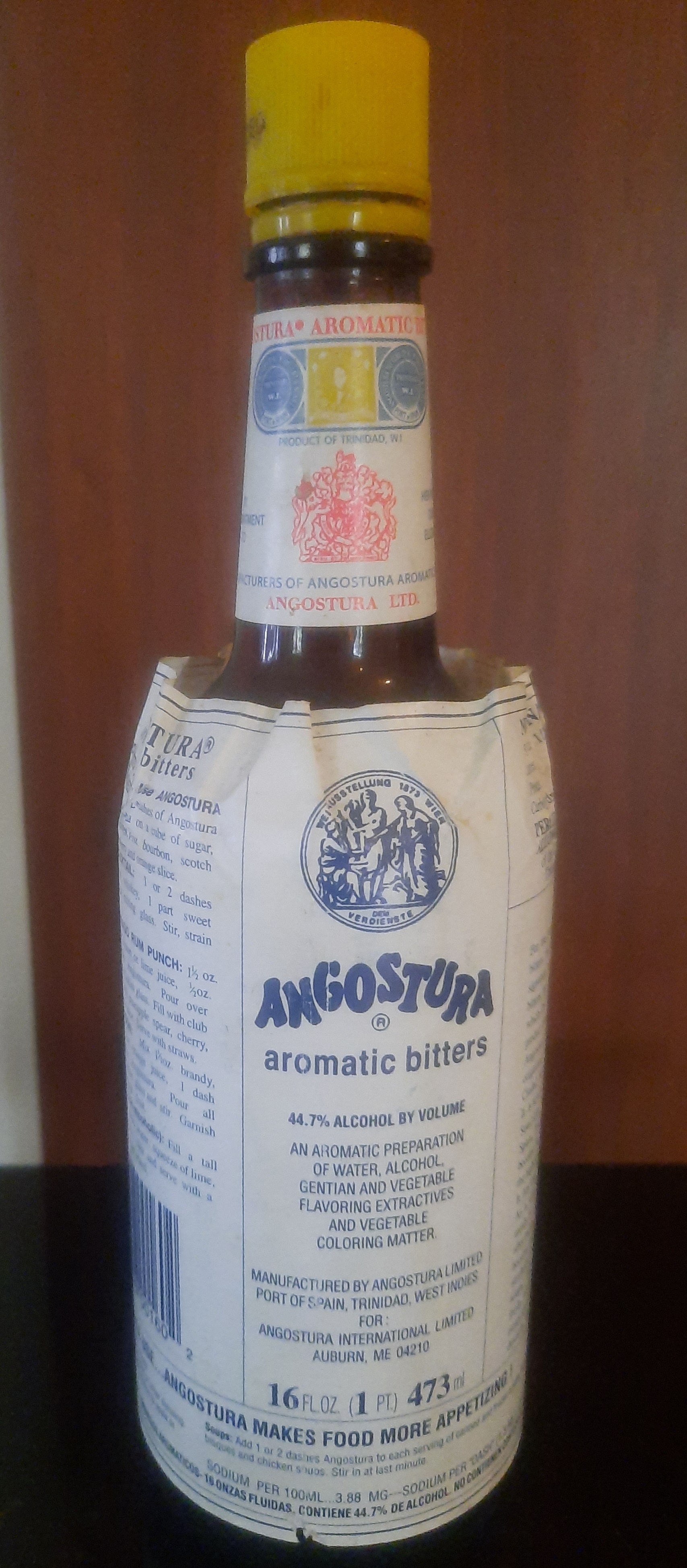
Of all the bitters, Angostura Bitters are probably the best known, and are a staple for every bartender and cocktail-mixer, and are used in classic cocktails like the Old Fashioned and Manhattan. More than that, they are in every kitchen cupboard in Trinidad and Tobago where they are made, as a home remedy for stomach problems. They are also an important ingredient in many local dishes.

Angostura is a tree native to South America, but strangely, the famous bitters are not made from the bark of this tree. Rather, they get their name from the town of Angostura in Venezuela, where they were invented. (The name of the town was changed subsequently, and it is now known as Ciduad Bolivar).

They were first concocted in 1824 as a medicine for the army of Simon Bolivar by a German army surgeon called Johann Siegert in the town of Angostura. He called it ‘Amargo Aromatico’. Dr. Siegert started exporting this to Europe, USA and the Caribbean. Apart from its use as a medicine, this product caught the fancy of bartenders at a time when cocktails were just becoming popular. Demand boomed.

The Siegert family migrated to Trinidad in the mid-19th century and started manufacturing the tincture in Port of Spain, the capital. And the company flourished.

Angostura Bitters were something one had vaguely read about. It definitely did not loom large in our lives. Till we visited family in Trinidad. Then we realized how big a thing it was!

A tour of the Bitters factory was of course on the essential itinerary. It was an overwhelming experience, especially to the nose! The pervasive smell of alcohol and herbs and tinctures almost made one dizzy.

All the processes of making the Bitters were on display. But the critical part is a secret—the mix and proportions of the herbs which go into making the product! It is apparently one of the world’s longest-held culinary mysteries, and no one has been able to replicate it exactly! Apparently only five people are privy to the secret.

Another part of the myth and legend of Angostura Bitters is the over-sized labels on the bottles. Apparently, in the late 1800s, Siegert’s sons decided to re-brand the product.   As a part of a competition, one brother designed the new bottle, while another designed the new label. But they did not discuss their designs with each till it was too late. So the labels that had been printed were too big for the bottles they made!  Though the Siegerts lost the competition, one savvy judge advised them to keep the design as it was. He said that this would help the packaging stand out among the competition. And that is exactly what has happened! The oversize labels area distinctive feature even today.

I remembered my bottle of Angostura Bitters from our trip to Port of Spain trip when I recently had a stomach upset. Whether thanks to this or some of the other home remedies I tried, I was better soon!

–Meena


The Moving Finger…

Last week was devoted to calligraphy, which we are assured by practitioners, is not handwriting at all. Rather, they aver, it is an art form.

Calligraphers are few and far between. But each and every one of us is a hand-writer. Children start doodling and scribbling by the age of two, and most write the alphabet before they are four. It might be one of the most universal of skills! And an essential one too, because research suggests that writing by hand enhances learning and memory. Brain patterns established during handwriting are important for memory formation and learning new information. And of course it improves fine motor skills. So hand writing practice is pretty important even for children who are digital natives and may not use the skill very much as grown-ups.

There are 12 characteristics on which quality of handwriting is evaluated: line quality, spacing, size consistency, pen lifts, connecting strokes, complete letters, cursive vs. print, pen pressure, slant, baselines, embellishments, and placements.

But it is a fact that the quality of penmanship has gone down with time. As we use the skill less, we get worse at it. In fact, there are times when I can’t decipher my own scribbled notes. Reports and records based on these notes are my only forays into fiction!

Which is why it is probably important to highlight and celebrate this skill.

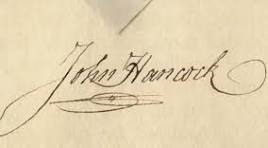
In the US, they observe National Handwriting Day on January 23rd. Why this date? Well, it is the birthday of John Hancock, the first signatory of the Declaration of Independence. Among the 56 signatures on the document, his large, flamboyant signature stood out. In fact, so prominent was it that “John Hancock” is an informal synonym for signature in the US!

The Day started to be observed in 1977, when educators were already beginning to feel that the art of handwriting was getting lost. The Writing Instrument Manufacturers Association came forward to do something about this (and of course at the same time, increase sales of pens, pencils, paper and writing instruments). They initiated National Handwriting Day.

(Incidentally, though we use handwriting and penmanship interchangeably, they are not quite the same. Handwriting is the act of writing out full words or sentences by hand on paper. Words may be written either legibly or illegibly. Penmanship is the art or skill of having excellent writing, and good penmanship makes the process of reading written work much easier.)

Lately, something called the World Handwriting Contest has been initiated. Each year, the World Handwriting Contest opens for entries between January 1 and June 30. There are eight age categories, starting from Children below age 7, right through –Teens, Teens, Adults and Seniors (age 65 up). And it is open to anyone, anywhere.

There are two styles for which prizes are given:

Functional Handwriting which strives for legibility, speed, and fluency without aiming at artistic effect. For this category, the judges will further separate entries as cursive, which joins 50% or more of its letters or manuscript printing, which joins fewer than half of its letters; and
Artistic handwriting which uses a monoline or calligraphy marker, pen, or brush along with decorative strokes, flourishes, and/or combinations of shading, hairlines and/or thick and thin strokes to create an artistic effect.

NRI domination over the Spelling Bee contests is well accepted. People of Asian origin now seem to dominate among winners of the Handwriting competition too, with Indians and Indian-origin names finding frequent mention (with stiff competition from Bangladesh!). Among Indians, Salil Jha of Bhopal has won a prize (above 65 category). Roslin Richard of Bangalore is first place winner in the Adult Category; Feba Sara Saji of Kerala is a winner in the Teens category. Keep it up people! May the moving finger keep writing beautifully!

–Meena

A Quarry Blooms: Butchart Gardens

Victoria, the capital of British Columbia, Canada, is a place renowned for its tranquil beauty. And the crown jewel of Victoria is the Butchart Garden. Visited by about 1 million people every year, this 55-acre garden houses about 900 varieties of flowers  tended by 50 gardeners.

Two things are especially interesting about the Butchart.

The first, it is cultivated on the site of an abandoned quarry. Way back in the 19th century, the Butcharts were into cement production–Robert Butchart had started manufacturing Portland cement in 1888 in Ontario, Canada. As his business grew, he and his wife Jennie Butchart decided to move to the west coast of Canada because it had rich deposits of limestone—a critical input for cement production. They started quarrying limestone there, in the Saanich Penisula on Vicotria Island. Jennie trained as a chemist and worked in the company laboratory.

The couple also decided to build a house there, and in 1904, established their home near the quarry.

Jennie was always interested in gardening. In 1907 Isaburo Kishida, a Japenese garden designer from Yokohama, Japan, came to Victoria to build a tea garden at the Esquimalt Gorge Park. Following this, Japanese-style gardens became the rage in the area. Several prominent citizens, including Jennie Butchart, commissioned Kishida to build Japanese gardens in their estates.

This was the start of Jennie’s horticultural journey. In 1909, the limestone quarry was exhausted. Jennie was devastated to see the degradation and destruction left behind. She set about turning it into what came to be known as the Sunken Garden.  She transported tonnes of topsoil by horse-carts and is said to have personally tucked ivy into any hole or crevice in the rock and the grim quarry walls, suspended in a boson’s chair. It was a long process to get the ravaged quarry to bloom, but the garden was ready in 1921. So rather than a wound on the face of the earth which the abandoned quarry might have been, thanks to the relentless efforts of one woman, the site houses a world-famous garden.

After this highly successful reclamation project, Jennie’s ambitions grew and in 1926, she converted their tennis courts into an Italian garden. In 1929, the kitchen garden gave way to a rose garden. 

The reclamation is one part of the story.

The other interesting aspect of the Butchart Gardens are that they family-owned but perfectly accessible to the public.

The gardens came up on land owned by Robert and Jennie. And since then, have passed from generation to generation. The couple gifted the gardens to their grandson Ian Ross on his 21st birthday. He took the mission passionately forward, transforming the garden into an internationally-recognized landmark. Over the course of five decades, Ross not only enhanced the horticultural aspects, but added several performance features, like outdoor symphony concerts, a variety stage show, and in 1987 introduced a Magic of Christmas display.

When Ross died in 1997, his son Christopher took over, expanding the gardens and staff. The weekly fireworks, for which the Gardens are famous even today, were started by him.

After Christopher’s passing in 2000, Christopher’s sister Robin-Lee has been managing the legacy. Barnabas Butchart Clarke, the only child of Robin-Lee and David Clarke, and great-great-grandson of the founders, is next in line.

While the Butchart Gardens continue to be family-owned, they have been a designated a National Historic Site of Canada since 2004.

That the legacy has stood the test of time for almost 130 years is testimony to the fact that Jennie was a woman out of the ordinary. She cared more for her gardens and flowers than fashion, and was usually to be found dressed in overalls and a straw hat. She wanted people to see and enjoy the gardens, and even though there were thousands of visitors even in her lifetime, she was against charging.

The Butchart Gardens have always been at the forefront of taking up environmental causes. Even currently, their site features a campaign against improper disposal of biosolids (nutrient-rich, organic material that are produced as a result of wastewater treatment). They also support NGOs in their area through in-kind donations.

A legacy beyond flowers indeed!

–Meena

Slugs and Snails

Snails: UGGGGG!

Slugs: UGGGGGGGGGGG!

Yes, that indeed is the normal reaction.  Both of these creatures are gastropods, a type of mollusk. They are both soft-bodied creatures which are covered with mucus—and it is this which usually makes people go ‘UGGGG’. But they need the mucous to stop them from drying out.

Gardeners hate them too, because some species of slugs and snails (S&S) feed on live plant material. These species are particularly fond of eating soft fleshy leaves and seedlings. Some slugs which stay underground tunnel holes in potatoes and other tubers. Snails and slugs are sporadic pests in those places where damp conditions prevail.

And yes, there are worrisome trends too. Some species of exotic snails and slugs can destroy native biodiversity and multiply madly. They have no natural predators when they travel out of their native lands, and so thrive.

In India, 1500 species of land snails have been reported, but the number of species of slugs is limited. Of these, nine species of snails and 12 species of slugs are pests, including the Giant African Snail, which is a serious problem with regards to fruits, vegetables and ornamental plants specially in the east, northeast and south; the common snail, Helix spp. ;  the  common garden snail; and the black slug.  

These gastropod-pests are a worldwide problem. For instance, the Giant African Snail is native to East Africa. But it has spread to many, many parts of the world, either by stowing away on ships, or being deliberately brought to other countries for experiments, as pets etc. And wherever it has travelled, it is creating problems– over 500 plant species may be targeted by the giant African snail, including most vegetables, legumes, ornamental plants, banana, citrus, etc.


But wait! Before we condemn them outright, we must understand that slugs and snails are generally beneficent to the environment and have a key role to play in the ecosystems, as they are recyclers, feeding on dead leaves, dung and sometimes even on dead animals. They play a useful role in composting.  And as important, they are an important food source for birds, beetles and reptiles.

Snails and slugs

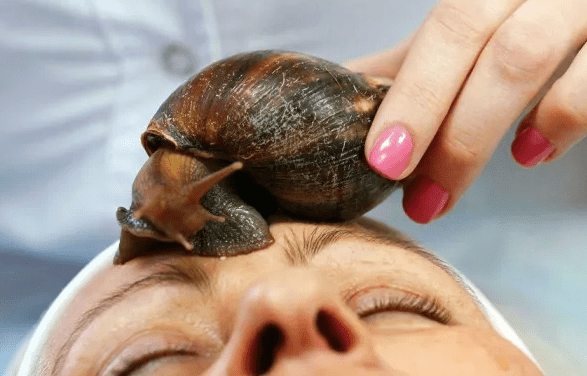
And in recent years, the fashion world has taken to these gastropods in a big way. Snail mucin and slug slime have become popular in the world of beauty. Gastropod slime has been shown to have many beneficial properties–antibacterial, anti-inflammatory and antioxidant, anti-tumoral, anti-aging, tissue regeneration, wound healing etc. Snail mucin contains antioxidants that may help reduce signs of aging like wrinkles, uneven skin tone and sagging. Studies indicate that snail mucin helps with skin regeneration and protects against damaging free radicals.

And let us also recognize that the seriously devastating snails and slugs are often introduced exotic species. There is never anything fundamentally ‘wrong’ about any species. They fit and have a role in the ecosystem where they have evolved. But a species can be in the ‘wrong place’, and then they can cause devastation.

So yes, it is up to us humans to ensure S&S stay where they belong, and don’t travel.

But there is no doubt people, especially gardeners don’t like them. And this is why a wildlife NGO in the UK, The Herts and Middlesex Wildlife Trust and Royal Horticultural Society (RHS) want to challenge negative perceptions. The  organisers want to create a positive image for snails and slugs by showing people how they contribute to ecosystems. Campaign organisers hope that by learning to “appreciate and co-exist” with snails and slugs, gardeners can adopt a more environmentally friendly approach. The trust, with the RHS, has produced a guide with tips to “live harmoniously alongside slugs and snails”.

And here is some S&S Trivia

Slugging is a slang term for a skin care technique that involves applying an occlusive moisturizer to one’s face, typically before sleep, primarily as a way to prevent moisture loss.

Slugging-it-out is to fight, argue, or compete with someone until one person wins.

Sluggish isbeing lazy and slow.

Sluggish in the computer world is when you use human-readable terms in a URL instead of a database number or some other form. It supposedly originated when programmers became too “lazy” to look up a proper code or ID for a website, and began naming them using words. Those “lazy URLs” became slugs.

And FYI: Snails move at a pace of 0.029 miles per hour, or 153 ft per hour. If we convert that to human speed, that’s the equivalent of walking almost 3.2 km per hour. Not too bad! So in this too, it seems snails are getting unnecessary flak!

S&S are nice fellows. Let’s not blame our problems on them!

-Meena

See also:

https://wordpress.com/post/millennialmatriarchs.com/3209

https://wordpress.com/post/millennialmatriarchs.com/2617

PIC: https://www.medicaldaily.com/snail-slime-touted-latest-miracle-beauty-product-243080

Cufflinks are a Man’s Best Friend

It seems a little unfair to insist that only women crave for diamonds and gold and jewelry. Down the ages, men have worn a lot of jewelry—one only has to look at paintings and pictures not only of Indian Kings and nobles, but of rich people from around the world. If the Koh-i-noor is on the crown of the Queen of England, the Cullinan (the largest gem quality diamond ever found on earth)  is on the scepter of the King of England, and Cullinan II, the second largest diamond, is on his imperial state crown.

Today, male jewelry is back with a bang. One only has to look at rappers and their gold chains. Closer home, apart from being a means of self-expression, it is both a way to show off wealth, as well as to appease the gods. The popularity of the navaratna ring, which is supposed to cure all ailments, bring wealth and good fortune, is more often seen on men than women. As also rudraksha bracelets and chains.

Of course it’s not all about flashy chunky stuff which sometimes runs into kilos (think Bappi Lahiri). There is also well-designed, subtle stuff.

From crowns to chains to jeweled collars, to bracelets, pendants, brooches, ear rings, to ankle adornments, there have been male versions of almost every piece of jewelry.

However, cufflinks are fairly unique in that they are quintessentially male jewelry rarely worn by women.  There has always been a need for some device to fasten shirt cuffs. In the 13th century, men used ribbons to do this. It was in the early 17th century that cufflinks as we know them today started to emerge. King Charles II popularized them, but they still remained very expensive items which were handmade, and therefore confined to people who could afford them.

It was only in 1876 that George Krementz, a German immigrant, adapted the manufacturing process used to make bullets to make cufflinks, and started mass production. And from that point on, they gained wide usage and popularity.

A cufflink has three parts:

The front face – the top of the cufflink, which is the decorative part, with a design, gemstone, or any other attractive design.

The post – the part that goes through the cuff holes and is attached to the toggle.

The toggle – the bottom part of the cufflink, which locks the link in place and prevents the cufflink from slipping out of the cuff holes

Cufflinks

While a cufflink may be a cufflink to many of us, apparently there are several types:

Whale Back cufflinks have a straight post, a flat head, and a tail shaped like a “whale” flips completely flat against the post.

Fixed back or fixed stud cufflinks do not have any moveable hardware. This means putting them in requires that they are manually secured by pushing the backing through the buttonhole. 

Bullet back cufflinks have a metal bar that attaches to the bridge of the cufflinks. This metal bar, which has a bullet aesthetic, rotates 90 degrees.

Chain link cufflinks are made of two usually identical faces attached by a chain.

Stud or button cufflinks look and work like studs.

Ball return cufflinks are those whose rear features a largish ball, attached to the decorative face by either a chain or curved post.

Locking Dual-Action cufflinks are secured shut with a mechanism similar to that of a wristwatch.

Silk Knot cufflinks are made entirely from silk, with two identical knots attached to a cord.

As I look around me, fewer and fewer men seem to be wearning cufflinks, something I felt sad about, because this is definitely an elegant addition to men’s attire. But a report on the cufflinks market says that the market is at $1.52 billion, and predicted to grow at 5.9% over the next few years. So maybe their demise is not so imminent after all!

Predictably, China is the biggest exporter, but surprisingly, India is one of the importers!

I shall surely look out more carefully to spot cufflinks around me!

–Meena

Trendhim.com; Nextmsc.com

A Cry for Children

This week Meena wrote about Children’s Day in India which is celebrated on 14 November each year, marking the birth anniversary of Jawaharlal Nehru. It is in this same week that another children’s day is celebrated. This is Universal Children’s Day which is celebrated on 20 November every year to mark the date when the United Nations General Assembly adopted, in 1989, the Convention on the Rights of the Child.  

There had been previous discussions about children in the international community. Declarations on the rights of the child had been adopted by both the League of Nations (1924) and the United Nations (1959). Also, specific provisions concerning children had been incorporated in a number of human rights and humanitarian law treaties. However amidst global reports of children bearing the brunt of grave injustice in many forms–from health and nutrition, to abuse and exploitation, it was felt that there was a need for a comprehensive statement on children’s rights which would be binding under international law.

In response to this the UN initiated a process of consultation which led to the drafting of a comprehensive document keeping the child as the focus in all realms—civil, political, economic, social and cultural. The Convention on the Rights of the Child was adopted by the UN General Assembly on 20 November 1989 and entered into force in September 1990.The Convention is the most rapidly ratified human rights treaty in history; more countries have ratified the Convention than any other human rights treaty in history. Three countries, the United States, South Sudan, and Somalia, have not ratified the Convention.

The Convention outlines in 41 articles the human rights to be respected and protected for every child under the age of eighteen years.

The articles can be grouped under four broad themes:

Survival rights: include the child’s right to life and the needs that are most basic to existence, such as nutrition, shelter, an adequate living standard, and access to medical services.

Development rights: include the right to education, play, leisure, cultural activities, access to information, and freedom of thought, conscience and religion. The term ‘development’ includes not only physical health, but also mental, emotional, cognitive, social and cultural development.

Protection rights: ensure children are safeguarded against all forms of abuse, neglect and exploitation, including special care for refugee children; safeguards for children in the criminal justice system; protection for children in employment; protection and rehabilitation for children who have suffered exploitation or abuse of any kind.

Participation rights: encompass children’s freedom to express opinions, to have a say in matters affecting their own lives, to join associations and to assemble peacefully. Children have the right to be heard and to have their views taken seriously, including in any judicial or administrative proceedings affecting them. As their capacities develop, children should have increasing opportunity to participate in the activities of society, in preparation for adulthood.

The Convention establishes in international law that States Parties must ensure that all children – without discrimination in any form – benefit from special protection measures and assistance; have access to services such as education and health care; can develop their personalities, abilities and talents to the fullest potential; grow up in an environment of happiness, love and understanding; and are informed about and participate in, achieving their rights in an accessible and active manner.

Even as the world will be reminded of the Convention on the Rights of the Child this week, this year is tragically one where these very rights are being destroyed minute by minute. More than one hundred children are killed every day in the ongoing war in Gaza and the West Bank. Thousands more are believed to be buried under the rubble of entire townships razed to the ground. Hundreds are dying in hospitals which are being ruthlessly attacked from the air and ground, including premature babies who have not even yet had a chance to take a breath on their own.

Never before in history have so many children faced the horrors of relentless violence, hunger, thirst, displacement, and so many as yet untold terrors. What will be the future of those who do survive this new holocaust?

Which of the Rights listed above will we have the courage to place before them? How can the world appease them, and our own consciences, with a flourish of the Convention on the Rights of the Child?  

In the words of Ghassan Kanafani, eminent Palestinian activist, essayist, novelist, who was killed by a car bomb in 1972 at the age of 36 years.

I wish children didn’t die.

I wish they would be temporarily elevated to the skies until the war ends.

Then they would return home safe, and when their parents would ask them: “where were you?”

They would say: “we were playing in the clouds.

How much longer? How much further?

–Mamata

The Dolls of Dusshera

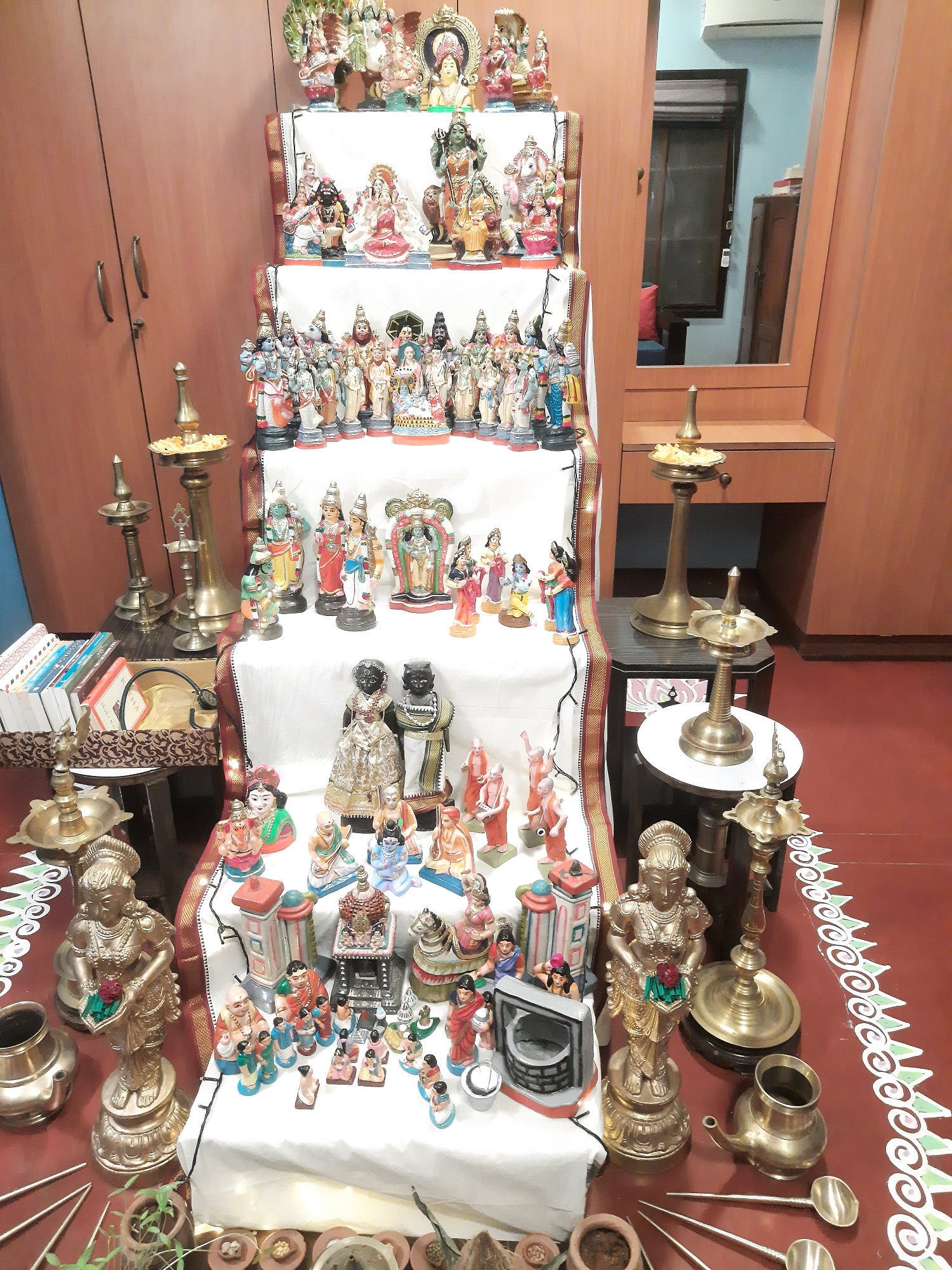
Dusshera is celebrated in a myriad ways across the country. In Tamil Nadu, Karnataka, Andhra Pradesh and Telangana, it is marked with a beautiful display of dolls called golu (with state-specific variations of the name).

Dolls
Navratri Golu

Golu is an elaborate set-up wherein dozens of dolls are exhibited for the period of the nine days. Traditionally ladies and children would visit each other’s houses in the evenings (nowadays, it has become more inclusive with men joining in too). The displays would be praised, the new dolls and arrangements oohed and aahed over; those who could sing would be persuaded to do so; and then they would depart with vatalai-paaku (paan and betel nut),  sundal (legume soaked-boiled and tempered with mustard, chilly, curry leaves and coconut), and maybe a coconut, fruit, flowers and a blouse piece. Nowadays, the party favours run into sophisticatedly-packed lamps, candles or agarbatti; organic cosmetics; millet-based snacks and sweets, etc.

The dolls in the golu display are arranged in steps—the ideal is nine, but smaller odd numbers are also acceptable. Some super-extravagant displays go up to eleven, but this is not usual. What exactly the standard nine steps represent is not quite clear: The steps to moksha? The nine nights of the festival? Three steps for each of the Goddesses Lakshmi, Parvati and Saraswathi?

Whatever the number of steps, the convention is to place the major Gods and Goddesses on the top-step. While the details of the displays differ from family to family, often Ganesha, Vishnu, Shiva, Parvati, Lakshmi, etc. are on the top step. On the step below this, some people display the eight forms of Lakshmi, and then come the avatars of Vishnu.    

Below come the humans, with a hierarchy. On the step closest to the Gods are the sages and saints: Sankaracharya, Meerabai, Sai Baba etc., as also revered leaders from Mahatma Gandhi to Netaji Subhas Chandra Bose.

And below these are normal people—shopkeepers, doctors, musicians, kings, queens; and thematic displays. These thematic displaysiare where most households put their creative energies, and these scenes could range from agricultural scenes, to weddings, processions, etc. Often a contemporary note is struck with displays of cricket matches, the launch of Chandrayaan—the imagination being the only constraint. Somewhere in all this would be animals, fruits and vegetables, etc. And below on the floor would be gardens, ponds, zoos, airports and other outdoor scenes. Somewhere in the display, marapaachies—traditional wooden man and woman dolls—must find a prominent place.

While this is a puja essentially celebrated by women, the putting up of the golu is an enterprise involving the whole family. The complex exercise—from taking down the steps or ladder from its storage place, to assembling it, to choosing the themes and dolls, doing the lighting, to creating elaborate structures like ponds and lakes and parks—requires all hands onboard. It is also customary for families to buy a few new dolls for the display every year. So while golus may have dolls which may be a century-old, there are also the latest fashions, including sometimes the newest Barbies!  

I have of course been seeing golus for many decades now, but have taken it for granted that it is how Tamilians celebrate Navartri, never questioning why the occasion was marked with a display of dolls. It is only recently that I learnt the story and significance behind the doll display. Dusshera marks the triumph of Devi Durga over the wicked, demonic  Mahishasura who had the boon that he could not be killed by any male—human or divine. The Gods had sent many an army to fight this buffalo-demon, but he had decimated all of them. Things were getting really serious and the Gods were at their wits’ end. And that was probably the dawn of woman-power! The Gods and Goddesses all came together to create the Goddess Durga, imbuing her with all their powers. And she went out, fought the demon in a bloody battle for 10 days, finally defeating and killing him on Vijayadashami.  Once the Gods and Goddesses had given Durga their powers, they became lifeless and powerless. It is to honour them that they are represented as statues or dolls in the golu, and they are contributions are acknowledged in the 10-day celebration.

This Navaratri, may good once again prevail over evil, and may woman-power be a force for good in the world.

Happy Dusshera!

Meena

Lollipop Day

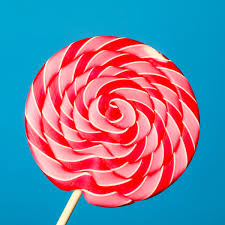
July 20th last week was marked as Lollipop Day—where else but in the US!

Well, and why not? Lollipops have been ubiquitous since for as long as any of us can remember. Toddlers and young children are happiest when their tongues are red or yellow or any of the other colours of the rainbow, and the sugar of the lollipop is coursing through their blood. So what if this is every mother’s nightmare!

The human predilection to lick and suck at sweet things goes back to pre-history. At that time of course, it was much more ‘natural’—people would poke sticks into honeycombs and suck the sticks—probably the earliest form of lollipops.

In China, Egypt and in the Arab world, fruits and nuts were glazed with honey and sticks inserted into them, to make for more convenient sweet-treats.

But the sweet as we know it today, has its origins in the late 16th and early 17th century. This was the time when sugar started becoming abundant in Britain (on the back of inhuman and slave labour in the colonies). The English started making boiled hard sweets, and inserting sticks into them. And there they were—the first official lollipops. The name itself probably originated in North-England, where tongue is called ‘lolly’ and pop means ‘slap’ — so ‘lollypop’ meant ‘tongue slap.’ 

The McAviney Candy Company started marketing lollipops in 1908, but it was the Bradley Smith Company which really took it to scale. Manufacturing got automated, when the Racine Confectioners Machinery Company built a machine which could attach hard candy to a stick at the rate of 2400 sweet per hour.

Today, there are over 100 varieties of lollipops available today in all shapes and sizes.

And of course something like lollipops are sure to have many a bizarre record associated with them. So here are a few:

The largest lollipop ever made weighed 3176.5 kg and was created by See’s Candies (USA) for Lollipop Day 2012. It was chocolate-flavoured and was 4 feet 8.75 inches long, 3 feet 6 inches wide, and 5 feet 11 inches in height. The lollipop stick which was 11 feet 10 inches tall was not counted towards the record.

A lollipop-licking event was organized in 2008, in Valladolid, Spain. Here a world record of the most people (12,831)  licking lollipops was made.

27 people lined up 11,602 lollipops in a line stretching half-a-kilometre in length to create a Guinness record. This was in South Africa.

But the weirdest has to be the record set by two boys bouncing a balloon back and forth 56 times without letting it touch the ground, using lollipops held in their mouth!

Today, there are lollipop flavours that suit the adult palate as well– lollipops in beer and wine flavours, as well as tea and coffee-flavoured lollipops.

And lollipops don’t need to be sweet. The Indian version—imli-based lollipops are, in my reckoning, the best! Today they are marketed commercially, but back in the day, my grandmother used to pound together tamarind, jaggery, chilli powder, salt, ghee and hing, put the shiny ball at the end of a stick and hand the treat around to us kids. Of course these were extremely restricted and made once a month or so, after much begging and pleading.

But we did also enjoy the store-bought sweets occasionally. Lollipops in those days were generally flat and in one colour. A particular favourite of ours used to be a longish one which had a hole towards one end so that it doubled as a whistle as well.

Today lollipops are often round, and come in a variety of other shapes as well. There is a wide range of sizes, and they are often in a riot of colours. Some are so large that even the most-eager 4-year olds cannot finish them at one go—leaving the mothers with the challenge of a sticky, drooly mess.

Popular as this sweet may be, one also has to be aware that it not only can lead to cavities, and other tooth and gum-related issues, but the sugar-high can sometimes be too much. So it should definitely be a rare treat.

–Meena

Maryam the Mathematician

I often write about women in different time periods, who have struggled, against all odds, to break glass ceilings in numerous fields. Their stories continue to inspire and move us even today. This is a contemporary story of a young woman who scaled new heights in mathematics, in a short life.

Maryam Mirzakhani was born in Tehran, Iran, on 12 May 1977. Her father was an electrical engineer, and she grew up with three siblings. Her parents were always supportive of their children, and encouraged them to work towards something that would be meaningful and satisfying to them, rather than for what society would consider success and achievement. The nineteen-eighties were difficult years for growing up in Iran which was in the middle of the Iran-Iraq war. But Maryam was secure in the love of her family. She loved to read and wanted to become a writer. She would make up stories about a girl who achieved great things, like travelling the world. Science was not her first love; it was her older brother who gradually wakened the spark when he used to tell her what he had learned in school.

The war ended when Maryam finished elementary school, and she joined Farzanegan Middle School in Tehran where she met Roya Beheshti who became a close friend. The two shared an interest in reading and used to spend a lot of time going to bookstores and buying books. Their school which was administered by Iran’s National Organization for Development of Exceptional Talents, aimed to educate the brightest pupils, and the Principal and teachers of the school were keen that their students should get the same opportunities as would students in a boys’ school. 

Maryam did not do well in Mathematics in her first year at Farzanegan middle school. Her teacher told her that she was not particularly talented in that subject and Maryam lost interest and confidence in maths. However, in her second year she had a different mathematics teacher who encouraged her. This led Maryam, and Roya, to become excited and engaged with Mathematics.

When the two friends progressed to high school, they found a copy of six Mathematical Olympiad problems and Maryam managed to solve three of them. Encouraged by this, the girls asked their school principal if she could arrange for them to have mathematical problem-solving classes, as boy’s schools had for talented students. The principal was supportive, and classes were arranged for the girls. Later Maryam recalled that this positive mind set was a great influence in her life.

Both Maryam Mirzakhani and her friend Roya Beheshti made the Iranian Mathematical Olympiad team in 1994—the first girls to do so. The international competition was held that year in Hong Kong and Mirzakhani was awarded a gold medal, while Roya bagged the silver. The next year, Mirzakhani, still in high school, was a member of the Iranian Mathematical Olympiad team, and was once again awarded a gold medal in 1995.

In 1995 Maryam joined the Sharif University of Technology in Tehran to study mathematics. She enjoyed the problem-solving sessions and informal reading groups, and also the support and friendship of many professors and students who inspired her, and shared her growing excitement with mathematics. She published several papers while still an undergraduate. After obtaining her degree from Sharif University in 1999, Mirzakhani left for the United States to join graduate school at Harvard University. She earned a Ph.D. from Harvard University in 2004 for her 130-page thesis Simple Geodesics on Hyperbolic Surfaces and Volume of the Moduli Space of Curves. 

In 2004 she was offered a junior fellowship at Harvard, but turned down the offer. In the same year she was awarded a Clay Research Fellowship and was appointed as an Assistant Professor of Mathematics at Princeton University. This was a great opportunity for her. As she recalled: The Clay Fellowship gave me the freedom to think about harder problems, travel freely, and talk to other mathematicians. I am a slow thinker, and have to spend a lot of time before I can clean up my ideas and make progress. So I really appreciate that I didn’t have to write up my work in a rush.

The fellowship gave her the time to produce some brilliant papers. After completion of her Research Fellowship in 2008, Maryam moved to Stanford University where she was appointed as Professor of Mathematics in 2009. She was 31 years old. Maryam married a computer scientist Jan Vondrak whom she met while at Princeton, who also joined the faculty at Stanford in 2016. Their daughter Anahita was born in 2011. Maryam would spend hours at home with large sheets of paper sketching out ideas, diagrams and formulae; her young daughter would say “Mummy is painting again!”

When once asked what was the most rewarding part of her work Maryam said: Of course, the most rewarding part is the “Aha” moment, the excitement of discovery and enjoyment of understanding something new, the feeling of being on top of a hill, and having a clear view. But most of the time, doing mathematics for me is like being on a long hike with no trail and no end in sight! I find discussing mathematics with colleagues of different backgrounds one of the most productive ways of making progress.

Maryam’s work soon led to her receiving recognition and awards. The most significant was the Fields Medal that Maryam was awarded in 2014.

The Fields Medal, established in 1936, is often described as the Nobel Prize of mathematics. But unlike the Nobel Prizes, the Fields Medals for Mathematics are given only to people aged 40 or younger, not just to honour their accomplishments but also to predict future mathematical triumphs.

Maryam was the first woman, and the first Iranian to win this prize. It was presented to her at the International Congress of Mathematics, held in Seoul, South Korea on 13 August 2014. The award recognized Mirzakhani’s “outstanding contributions to the fields of geometry and dynamical systems, particularly in understanding the symmetry of curved surfaces, such as spheres, the surfaces of doughnuts and of hyperbolic objects”. 

Even before she got this award, Mirzakhani had been diagnosed with breast cancer. She continued her work, producing not only results of great significance but developing tools that would be used by other researchers in the field. The cancer spread to her liver and bones and she passed away in July 2017. Her death robbed mathematics of one of its brightest stars who, at the age of 40, was at the peak of her creativity.

The little girl who loved to read and to imagine, reached unimagined peaks in a subject that did not initially excite her. As she once said about the pursuit of mathematics: I don’t think that everyone should become a mathematician, but I do believe that many students don’t give mathematics a real chance. I did poorly in math for a couple of years in middle school; I was just not interested in thinking about it. I can see that without being excited mathematics can look pointless and cold. The beauty of mathematics only shows itself to more patient followers.

Described as one of the greatest mathematicians of her generation, several mathematics prizes have been named after her, including the Maryam Mirzakhani New Frontiers Prize to be awarded to outstanding young female researchers in the field of mathematics each year.

In 2020 Maryam Mirzakhani was named by UN Women as one of seven female scientists (dead or alive) who have shaped the world. 12 May, her birth anniversary, is now celebrated as International Women in Mathematics Day.

–Mamata

A Parade to be Proud Of

26 January always evokes many memories of waking up at the crack of dawn in the chill of the Delhi winter, bundling up in our warmest clothes, packing sandwiches and hot coffee, and setting out to see the republic day parade. This was one of the highlights of the year during the time my family lived in Delhi.

The parade itself was a magnificent spectacle with the many components that made it so special. The perfectly synchronized marching of the many contingents of the armed forces, the display of the new developments in different fields from technology to trade, and the exuberance of the participating school children and cultural troupes; the vibrant “floats” as we called them, and finally the breathtaking ‘fly past’. Every part of the long march of the passing groups made us swell with pride that we were also a part of this ‘unity in diversity’ that is India.

It is only this year that I stopped to wonder about what went behind this parade.

The Indian Constituent Assembly adopted the Constitution of the newly independent India on November 26, 1949. This came into effect one year later, on January 26, 1950. Hence this day marks Republic Day. On 26 January 1950, the newly-sworn in President of India rode through the roads of Delhi to reach what was then called Irwin Amphitheatre (now the Dhyan Chand National Stadium) to take the salute of the first ever national parade where 3000 officers of the armed forces and more than 100 aircraft participated.  The parade was led by then Brigadier Moti Sagar of the Gorkha Regiment. From 1950 to 1954, the celebrations took place in different parts of Delhi including the Red Fort and Ramleela Maidan. The format of the current parade was adopted in 1955, and Rajpath (then called Kingsway, and now Kartavya Path) was chosen as the permanent venue.

Since the first parade when the Indonesian President Dr. Sukarno was the chief guest, it has been a tradition to invite the head of state of a country to be the chief guest for the event every year.

Every step of the parade is meticulously planned and coordinated so that there is perfect accuracy in the movement without the slightest hitch or delay. While the participants in the parade seem to move in perfect precision and coordination, this is the end result of months of rigorous training.

All the participants from the different participating groups across the country are notified in July of the preceding year. The practice begins right then at the respective centres and goes on till August. The participating groups reach Delhi in December where the intensive training commences which culminates in the ‘dress rehearsal’ a few days before the big day. While the practice march covers a distance of 12 km, the actual march on 26 January covers a distance of 9 km. On 26 January the participants reach there designated places on Rajpath at 3 a.m. for the ultimate Great March. By then they would each have put in over 600 hours of training!

All army personnel that take part in the parade go through four levels of investigation. All of the defence vehicles and equipment are housed in a dedicated camp near India Gate.

After the regimented procession of foot marchers the parade takes on a smoother and slower pace as the tableaux roll (at 5 km an hour) along the wide avenue of Rajpath. As children it was these ‘floats’ as we called them that provided animated lessons in the geography, history and culture of our country. At the time all we looked for was the sign that indicated what state the tableau represented, and then sat back and took in the diverse “scenes” as it were from that state, complete with live people doing activities on the moving tableaux.

It is only recently that I discovered that behind the creative presentations lies a long and bureaucratic process. The process is spearheaded by the Ministry of Defence. States are invited to submit proposals for a tableau that represents some historical event, culture, heritage, development programmes, and environment of that state. The tableaux proposals received from various states, Union territories, central ministries, and central departments are evaluated in a series of meetings by a panel of experts comprising of eminent persons from various disciplines such as art, culture, painting, sculpture, music, architecture, choreography, etc. The expert committee examines the proposals on the basis of theme, concept, design and its visual impact before making its recommendations

The selection process of the tableaux passes through various stages of development and evaluation. It begins with an initial appreciation of sketch/design and the themes of the demonstration. It culminates, after many interactions between the expert committee and the states/UTs/departments/ministries, with a three-dimensional model of the tableau. For the selected tableaux, the Ministry of Defence provides, free of charge, one tractor and one trailer upon which the tableau can be fabricated. There are also a series of other guidelines regarding the use of logos, animation, electronic displays, music and much more that need to be adhered to. And finally, the tableaux that ‘float by’ to mark the tail end of the awe-inspiring parade!

In recent years there have been a lot of controversies and contention with respect to the selection/rejection of tableau proposals from different states. Sad indeed, for an occasion that started as a celebration of the diversity that made our republic so unique and rich.

I certainly prefer to hold on to my youthful memories of the spectacular spectacle that made me proud to be a citizen of this republic. I celebrate the warp and weft of diversity that weaves the rich tapestry of this vast and varied country.

–Mamata