Colours of Childhood: Crayons

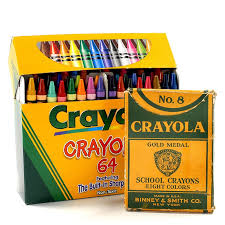
A recent weekend spent with a toddler revived the memories and joys of crayons. While playthings and pastimes have changed considerably, especially in this digital age, there are some that continue to retain their charm. Crayons are among these.

Opening a fresh box of these colourful sticks neatly lined up with their wrappers, has been a special feeling, over generations. The distinctive smell from the paraffin used in their making, equally triggers memories, long after childhood. According to a Yale University study the scent of Crayola crayons is among the 20 most recognizable scents to American adults; coffee and peanut butter are numbers 1 and 2!

The attractive colours and the smell almost triggers an urge to bite into one. And, certainly, most toddlers are often more interested in tasting the colours, rather than drawing with them!

What makes crayon? A crayon (or wax pastel) is a stick of pigmented wax used for writing or drawing. Wax crayons differ from pastels, in which the pigment is mixed with a dry binder such as gum arabic, and from oil pastels, where the binder is a mixture of wax and oil.

While these wax sticks as we know them date back a few hundred years, the technique of using wax with colours was a method known to Ancient Egyptians who combined hot beeswax with coloured pigment to fix colour into stone. Ancient Greeks and Romans used wax, tar and pigment to decorate ship bows and for drawing. The first crayons, used for marking, appeared in Europe, and were made with charcoal and oil, and hence were in a single colour—black.

Crayons in their more recognizable form were invented in the United States in 1903. They were developed by a company called Binney and Smith who were originally manufacturers of red iron oxide for painting barns and lamp black which had a number of applications including making rubber tyres black.

In the early 1900s the company moved on to making marking crayons for commercial use. These were used as waterproof markers in factories but they contained toxic substances and were not suitable to be used by children. The company then entered into the school market with slate school pencils and dustless chalk. Here they saw that there was potential for the use of colouring tools for educational use in the classroom. Based on feedback from schoolteachers Edwin Binney and his wife Alice developed wax crayons. They mixed waxes, talcs and pigments to form non-toxic sticks which were wrapped in paper, making these safe and mess-free. They put these on the market in 1903 under the brand name Crayola. The name was created by Alice as a blend of craie, the French word for chalk and ola from oleaginous (oily paraffin wax). Ola was also a popular ending for products at that time. The first boxes had 8 coloured crayons (red, orange, yellow, green, blue, violet, black, and brown), and sold for 5 cents, in yellow-and-green boxes which were labelled ‘school crayons’. For the next 45 years, the colour mix and the colour names remained unchanged.
While later many companies began manufacturing crayons, the word Crayola became synonymous with crayons and continues to be so to this day.

For the first forty years, each Crayola crayon was hand-rolled in paper wrappers with distinctive labels and names. Automated wrapping started only in the 1940s. Over the next hundred years Crayola introduced packs of 16, 24, 32, 48, 64, and 96 crayons. There have been over 400 Crayola colours created since the crayons were launched. The company now manufactures 120 standard crayon colours. In addition, there are specialty crayons like metallic, gel and glitter crayons.

The history of naming the colours is a reflection of the changing times and perceptions. While the set of 8 colours remained unchanged for the first 45 years, by 1949, with 48 colours in the box, the palette included colours with more imaginative name such as thistle, periwinkle, carnation pink, bittersweet, cornflower, melon, salmon, and spring green. With the addition of new crayons taking the number up to 64 the colours included Copper, Plum, Lavender, Mulberry, Burnt Orange, and Aquamarine. The psychedelic spirit of the 1970s was reflected with the addition, in 1972, of fluorescent colours: Chartreuse, Ultra Blue, Ultra Orange, Ultra Red, Hot Magenta, Ultra Green, Ultra Pink, and Ultra Yellow.

The 1990s saw the retirement of eight old shades and their replacement with new ones–Cerulean, Vivid Tangerine, Jungle Green, Fuchsia, Dandelion, Teal Blue, Royal Purple, and Wild Strawberry. The decade also reflected the response to cultural sensitivities. In 1999, the name Indian Red was changed to Chestnut because educators believed that children would think the name represented the skin colour of American Indians rather than the reddish-brown pigment found near India.

In 1993, to mark its 90th birthday Crayola invited the public to name 16 new Crayola crayon colours. Some of the winning suggestions included Asparagus, Macaroni and Cheese, Timber Wolf, Cerise, Mauvellous, Tropical rainforest, Denim. Pacific Blue. Granny Smith Apple, Shamrock, Purple Mountains Majesty, Tickle Me Pink, Wisteria and Razzmatazz. The last name was the suggestion of 5 year-old Laura Bartolomei, who was declared the younger Crayola colour winner.

In 2000 Crayola’s first online consumer poll to name the favourite Crayola colour was held. Blue emerged as the all-time favourite, and six shades of blue made up the list of top ten colours!

Crayola marked its 100th anniversary by once again inviting crayon users to contribute names. With increasing diversity in schools and growing awareness of being ‘politically correct’, in 2020 Crayola introduced a new line of 24 colours named Colors of the World to reflect the multicultural skin tones of people around the world.

Thus Crayola remained on top of the game by always being dynamic, responsive, and participatory to reflect the signs of the times, as it were. Crayola continues to be synonymous with crayons, not only in the USA, but now across the world. I remember when we were children, and our local palette limited to the standard box of 12 colours from Camel or Camlin, our great dream was to be gifted with multi-layered jumbo box of Crayola crayons by a relative coming from the USA!

Today perhaps the choices of art materials and techniques have increased, but the fascination with crayons certainly has not decreased! There are Crayola crayon collectors who are always searching for samples of rare or discontinued colour pieces. And America celebrates National Crayon Day on 31 March every year, to celebrate the colourful history of these simple sticks that have provided generations of children with hours of creative fun.

–Mamata

International day of Happiness: Caring & Sharing

In recent times there have been a number of articles about experiments/initiatives to create ‘safe’ places for GenZ achievers where they can simply meet others of their ilk, and as one piece put it “form communities of shared interests and ideas, far away from the superficial posing of the digital world”.   

It is thought provoking, and indeed saddening to read about these. Caught in the frenetic pace of a work culture where people feel they do not have the ‘luxury of time’ that they perceive friendship demands. As one person put it “Colleagues can never be your friends in a competitive space; besides you don’t want to see them in your private time and space”.  The frequent moves from job to job, even place to place, the “stress” of meeting targets, and the long hours spent in cyberspace where the screen is king, leave little time and energy for meaningful human interactions. There is a sense of isolation, leading to a precipitous plunge towards the ultimate act of giving up everything, including one’s own life. What a very sorry state of affairs. Such futility, such a waste of the best years of one’s life. “Burning out” at an age when they should be blossoming into vibrant human beings. 

I feel so blessed that I grew up, and came of age, in an age of friendship. A time when ‘Time’ was a gift freely given and shared between human beings, and not the ubiquitous screen. When families caught up on the day’s doings and happenings over the evening meal, talking face-to-face. When the school days ended with playing with neighbourhood friends at whose homes we were fed and pandered to, as they were in ours. Graduating to college where new friendships blossomed in canteens and bonded through bunked classes. College was indeed the cradle for what was later to be described as the ‘all-round development’ for which today there are Life Coaches. Not to forget a course offered at Yale University called Psychology and the Good Life which is basically about teaching college students how to be happy! A course that “teaches” that feelings of happiness are fostered through socialization, exercise, meditation and plenty of sleep!

A bigger reminder of how far away we have come from those days is the designation of an international day by the United Nations which is called the International Day of Happiness.

The idea for the International Day of Happiness was proposed by UN advisor Jayme Illien in 2011. The UN General Assembly adopted a resolution which recognised happiness as a “fundamental human goal” and called for “a more inclusive, equitable and balanced approach to economic growth that promotes the happiness and well-being of all peoples”.

In 2012 the first ever UN Conference on Happiness took place, and the UN General Assembly adopted a resolution which decreed that the International Day of Happiness would be observed every year on 20 March. The resolution was initiated by Bhutan, a country which recognized the value of national happiness over national income since the early 1970s and famously adopted the goal of Gross National Happiness over Gross National Product. All 193 United Nations member states have adopted the resolution calling for happiness to be given greater priority.

The day was celebrated for the first time in 2013. This day aims to highlight the importance of happiness and well-being as universal goals and aspirations in the lives of people around the world. 

Every year, on this day, the United Nations publishes the World Happiness Report which explores the latest research on the importance of benevolence, empathy and trust as vital drivers of both individual and national happiness. It also announces the theme for the year.

The theme for the International day of Happiness 2025 is Caring and Sharing. This is a reminder that lasting happiness comes from caring for each other, feeling connected and being part of something bigger. The theme brought for me a flashback to my years of work in a workplace where this was the very theme that ran through every day of every year. I remember how this was also the name of the precious meeting space and time that the ‘girls’ called their own—one where, in addition to “theme sari days” there was an open and non-judgemental sharing of angst, anxiety, dilemmas and doubts, highs and lows, laughter and tears. This engendered a seamless blending of many generations, and the mutual caring and sharing that made our lives so rich. This was the ‘safe space’ where bonds were built; bonds that endure even when time and distance have separated us physically.  

A more inclusive gender-neutral space and time was the twice a day tea-table time. Tea table became the venue for easing in the newcomers; teasing and ribbing the old-timers; there were no hierarchies and no bosses. The agenda was whatever the mood of the table—sharing, admonishing, admiring, agonising and venting, and yes, laughing a lot.

It was an important support system in so many ways. After just 15 minutes, one returned to one’s desk feeling much better. You weren’t the only one who struggled to keep going as you juggled work and home; your child’s behaviour was not as worrisome as you imagined it was; and yes, in-laws happened to the best of us! It was not only about chit-chat and food; it was where serious discussions took place—about work and work culture; about the state of the world and the nation; about books read and films seen, people met and to be met. It was where so many “aha” moments happened. Above all it was a sense of sharing and caring that permeated.

It is sad that people today are craving such time and space, and above all the comfort of sharing and caring. It is sad that we need a reminder that the world is a better place when we connect and care about the people around us.

Many years before such a reminder became necessary, Eleanor Roosevelt, wife of Franklin D. Roosevelt who was the President of the United States during the Great Depression and World War II shared these words of wisdom:

Someone once asked me what I regarded as the three most important requirements for happiness. My answer was: A feeling that you have been honest with yourself and those around you; a feeling that you have done the best you could have in your personal life and in your work; the ability to love others. Happiness is not a goal, it is a by-product. Paradoxically, the one sure way not to be happy is deliberately to map out a way of life in which one would please oneself completely and exclusively. After a short time, a very short time, there would be little that one really enjoyed. For what keeps our interest in life and makes us look forward to tomorrow is giving pleasure to other people.

–Mamata

Missing People: The Village of Dolls

It sounds like something out of an imaginary futuristic scenario. Entire countries with no young people, no babies being born, and the old dying out until finally there are entire countries without a human population. Incredibly, this is happening here and now. Many countries in Eastern Europe, Southern Europe and East Asia are facing drastic declines in new births, even as the elderly population declines due to deaths. News reports say that the number of babies born in Japan in 2024 was the lowest since records began in 1899. The prospect of population extinction is becoming a reality in South Korea, which has been moving towards a childless society. Of the already dwindling population, young people are abandoning their rural homes and migrating to cities in search of work, leaving no workforce for agriculture and fishing. What will these abandoned villages look like?

There is a village in Japan which is an ironically graphic example of such a scenario. This is Nagoro, an isolated valley town on the Japanese island of Shikoku, the smallest and least visited of Japan’s four main islands. Originally populated by around 300 people, a few years ago only about two dozen old people remained. One of these old people was a father whose daughter moved back to the village to be with him. Tsukimi Ayano who had spent most of her life in Osaka moved back to the island in 2002. 

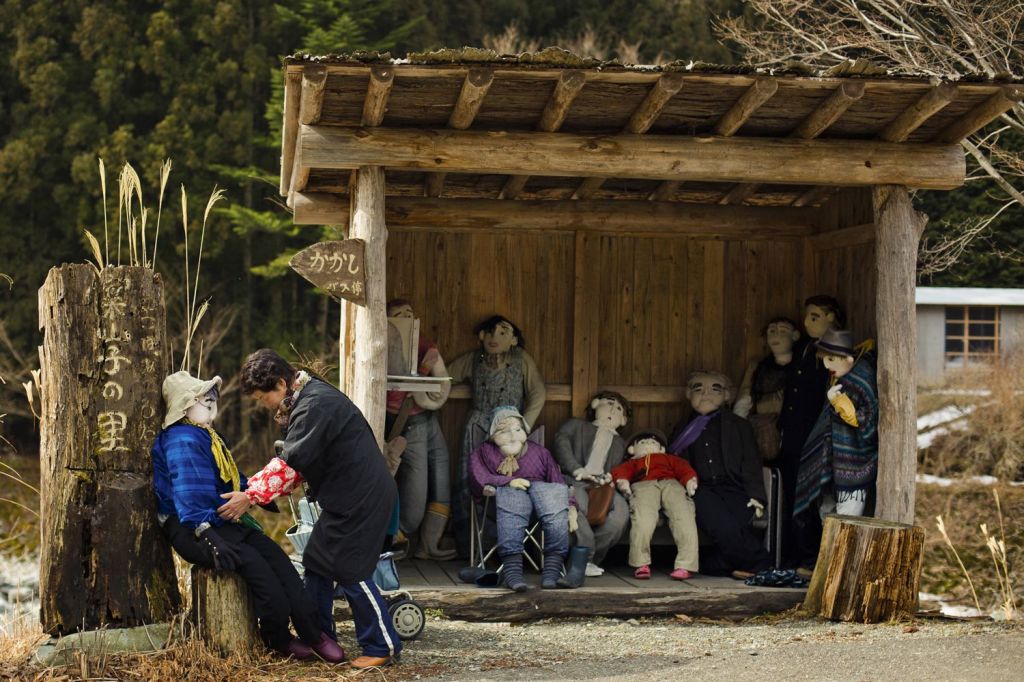
One of the things that Ayano did when she came back was to make a scarecrow (called kakashi in Japanese) that resembled her father to scare away the birds that were raiding the seeds that she planted on the family plot. In addition to keeping the birds away, Ayano liked that the scarecrow added a dash of something different in the deserted landscape. Having the time, and the skills, Ayano continued making these life-sized and life-like scarecrows for other people’s fields also. From scarecrows, Ayano moved on to making other figures. It became her hobby, and her pleasurable pastime. Initially she made the scarecrows for the fields; then she started making figures that resembled old neighbours who had passed away, or people who had moved away. Ayano felt that these gave her a sense of having some company. It was also a way of commemorating the erstwhile residents of the village, while infusing some spirit in their rapidly vanishing village.

These figures (she calls them ‘dolls’) soon began to populate different parts of the village. They were placed in people’s gardens, at bus stops, in village meeting places—depicted as being engaged in everyday tasks. Walking around the village one could see figures of construction workers installing a road sign, a fisherman on his porch with his daughter, a couple sitting on a river bank, all looking real and ‘ready for action’. After the village school closed down as there were no students, Ayano recreated a classroom with students and teachers, with two of the dolls wearing the same clothes as the last two students who had attended the school.

As she said “I just wanted people to enjoy looking at the dolls and I want to enjoy making them.” Ayano makes all the dolls herself using wooden slabs for the base, cotton clumps for the head and rolled newspapers for the ‘skeleton’ as well as straw and fabric. The dolls come to life with the unique facial expressions she gives each one, shaping the nose and the mouth, choosing the buttons for the eyes, and meticulously crafting the ears. Ayano wants to make sure that her kakashi can hear well!  She dresses them in clothes that, in many cases, belonged to the real characters, or are donated. It takes Ayano about three days to make a doll. Each doll has a life of two to three years as the natural materials weather quickly. Ayano tries to recycle as much of the material as she can, as she makes new dolls to replace the old ones.  

Ayano’s village of dolls Nagoro remained undiscovered and unknown until 2014 when a German filmmaker made a short documentary titled Valley of Dolls. This attracted global attention, and led to an influx of curious tourists to this remote island. Ayano personally felt that the film was dark and sad, whereas for her the process of creating the dolls is a joyous one, and the village itself is a now a curiously vibrant and animated place. Ayano’s acknowledgement of the filmmaker is his replica doll as a figure at a bus stop!

For Ayano these dolls are a celebration of life, not weird reminders of the past. In her mid-seventies now, Ayano continues to live in the village with its population that she has created and continues to nurture.

–Mamata

Colours of the Year

This is the time of year to look back upon the months gone by, of the highlights and the nadirs that marked the passage of time. Of the many exercises that have become a regular part of this stock-taking is the announcement of the Words of the Year by different dictionaries. Meena has just described the history, as well as the process for this selection.

There is another announcement that is perhaps not as much noticed. That is the one of the Colour of the Year. This selection is not the outcome of as long, and oftentimes, as participatory a process that the different dictionaries undertake prior to the announcement of the Word of the Year; and perhaps its history does not date as far back. The Colour of the Year is declared by the Pantone Company which is best known for its Pantone Matching System (PMS). This is a colour order system used in a variety of industries including graphic design fashion design product design and printing. Today Pantone has become the worldwide standard for selecting communicating and matching colours.

Pantone began as a commercial printing company of the Levine brothers, two advertising executives in 1950, in New Jersey. In 1956 the Levine brothers hired Lawrence Herbert who used his knowledge of chemistry to systematically order and simplify the company’s stock of pigments and production of coloured inks. By 1962, Herbert was running the ink and printing division, and was able to buy out the original owners. He renamed the company Pantone which was a combination of the words Pan (meanng All) and Tone (meaning colour).

The company’s primary products include the Pantone Guides, which consist of a large number of small (approximately 6×2 inches or 15×5 cm) cardboard or plastic sheets, printed on one side with a series of related swatches of colours in different shades and tones. Pantone colours are described by their allocated number (For example, PMS 130). The samples are bound into a deck that opens out into a fan.   

The idea behind the PMS is to allow designers to “colour match” specific colours when a design enters production stage, regardless of the equipment used to produce the colour. This system has been widely adopted by graphic designers and reproduction and printing houses. The standardization of colours is very helpful because different manufacturers in different locations can all refer to the Pantone system to make sure colours match.  

The idea of declaring a Colour of the Year was initiated by the Pantone Colour Institute in 1999 as a way to mark the entry into a new millennium, and in keeping with Pantone’s belief that colour “has always been an integral part of how a culture expresses the attitudes and emotions of the times”.

The colour selected each year was envisaged as one that captured a moment in time, tapped into collective values, and heralded the year ahead. It was also meant to reflect people’s changing attitudes and aspirations. Thus it is not randomly selected but an outcome of research that finds its way into discussions by representatives from various nation’s colour standards groups. These are at secret meetings hosted twice a year by Pantone in a European capital. The colours are chosen after two days of deliberations. With a database of thousands of colours at their fingertips, Pantone’s challenge is to narrow down a colour family and explore within it to find a hue that best expresses a widespread feeling. As the company says “We don’t simply come up with our thoughts about it; we look into our research and see what people are telling us they’re looking for.” The results of the meeting are published in Pantone View, which fashion designers, florists, and many other consumer-oriented companies purchase to help guide their designs and planning for future products.

Pantone’s Colour of the year 2024 was Peach Fuzz which was described as a light, delicate shade between pink and orange. The soft hue expresses the desire to nurture kindness, compassion, and connection. All of this helps foster a peaceful future and everlasting cosiness.

In 2024 more than ever before the world needed to be reminded of these qualities which alas were sadly lacking.

However continuing its hopeful optimism Pantone has just announced its colour for the Year 2025. It is a shade of brown that is called Mocha Mousse which, as the company reminds us, is all about thoughtful indulgence. The warm shade reflects a desire for nourishment in every facet of our lives, especially through simple pleasures like morning coffee, a chocolate treat, or taking a walk. And it’s not solely about treating ourselves but also the possibility of sharing those sweet moments with others. 

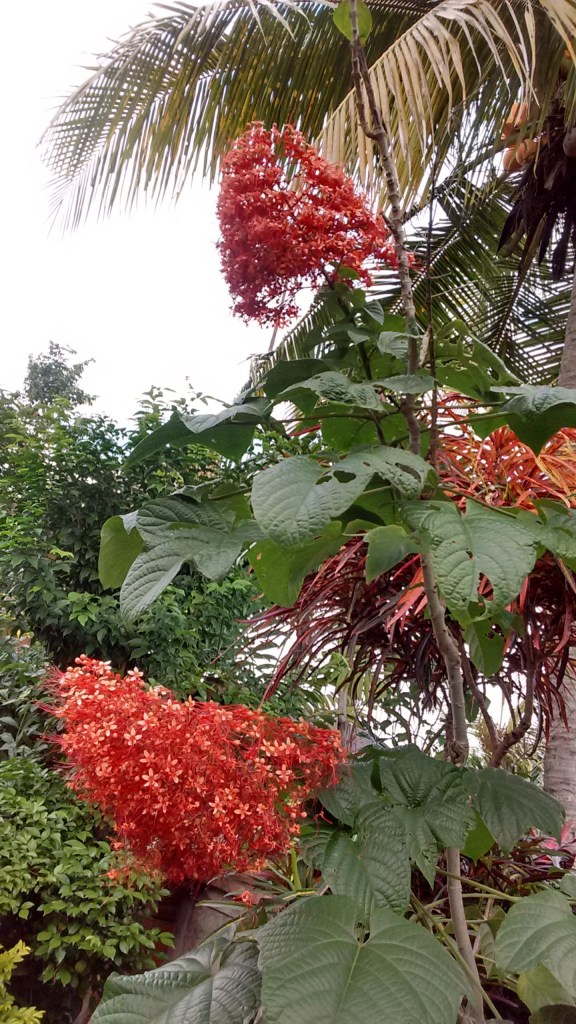
While fashion designers and architects play around with the colours of the year, for every one of us, Nature is the best reminder that every colour has its own shade and season. All we need to do is look around and marvel at its unmatchable palette.

And who better to remind us of this than the gentle author Ruskin Bond.

The Colours of Life are Everywhere

Colours are everywhere,

Bright blue the sky,

Dark green the forest,

And light the fresh grass;

Bright yellow the lights

From a train sweeping past,

The flame tree glow

At this time of year,

The mangoes burn bright

As the monsoon draws near.

A favourite colour of mine

Is the pink of the candy-floss man

As he comes down the dusty road,

Calling his wares;

And the balloon-man soon follows,

Selling his floating bright colours.

It’s early summer

And the roses blush

In the dew-drenched dawn,

And poppies sway red and white

In the invisible breeze.

Only the wind has no colour;

But if you look carefully

You will see it teasing

The colour out of the leaves.

And the rain has no colour

But it turns the bronzed grass

To emerald green,

And gives a golden sheen

To the drenched sunflower.

Look for the colours of life –

They are everywhere,

Even in your dreams.

–Mamata

The Moving Finger…

Last week was devoted to calligraphy, which we are assured by practitioners, is not handwriting at all. Rather, they aver, it is an art form.

Calligraphers are few and far between. But each and every one of us is a hand-writer. Children start doodling and scribbling by the age of two, and most write the alphabet before they are four. It might be one of the most universal of skills! And an essential one too, because research suggests that writing by hand enhances learning and memory. Brain patterns established during handwriting are important for memory formation and learning new information. And of course it improves fine motor skills. So hand writing practice is pretty important even for children who are digital natives and may not use the skill very much as grown-ups.

There are 12 characteristics on which quality of handwriting is evaluated: line quality, spacing, size consistency, pen lifts, connecting strokes, complete letters, cursive vs. print, pen pressure, slant, baselines, embellishments, and placements.

But it is a fact that the quality of penmanship has gone down with time. As we use the skill less, we get worse at it. In fact, there are times when I can’t decipher my own scribbled notes. Reports and records based on these notes are my only forays into fiction!

Which is why it is probably important to highlight and celebrate this skill.

In the US, they observe National Handwriting Day on January 23rd. Why this date? Well, it is the birthday of John Hancock, the first signatory of the Declaration of Independence. Among the 56 signatures on the document, his large, flamboyant signature stood out. In fact, so prominent was it that “John Hancock” is an informal synonym for signature in the US!

The Day started to be observed in 1977, when educators were already beginning to feel that the art of handwriting was getting lost. The Writing Instrument Manufacturers Association came forward to do something about this (and of course at the same time, increase sales of pens, pencils, paper and writing instruments). They initiated National Handwriting Day.

(Incidentally, though we use handwriting and penmanship interchangeably, they are not quite the same. Handwriting is the act of writing out full words or sentences by hand on paper. Words may be written either legibly or illegibly. Penmanship is the art or skill of having excellent writing, and good penmanship makes the process of reading written work much easier.)

Lately, something called the World Handwriting Contest has been initiated. Each year, the World Handwriting Contest opens for entries between January 1 and June 30. There are eight age categories, starting from Children below age 7, right through –Teens, Teens, Adults and Seniors (age 65 up). And it is open to anyone, anywhere.

There are two styles for which prizes are given:

Functional Handwriting which strives for legibility, speed, and fluency without aiming at artistic effect. For this category, the judges will further separate entries as cursive, which joins 50% or more of its letters or manuscript printing, which joins fewer than half of its letters; and
Artistic handwriting which uses a monoline or calligraphy marker, pen, or brush along with decorative strokes, flourishes, and/or combinations of shading, hairlines and/or thick and thin strokes to create an artistic effect.

NRI domination over the Spelling Bee contests is well accepted. People of Asian origin now seem to dominate among winners of the Handwriting competition too, with Indians and Indian-origin names finding frequent mention (with stiff competition from Bangladesh!). Among Indians, Salil Jha of Bhopal has won a prize (above 65 category). Roslin Richard of Bangalore is first place winner in the Adult Category; Feba Sara Saji of Kerala is a winner in the Teens category. Keep it up people! May the moving finger keep writing beautifully!

–Meena

River as a Living Entity

World Rivers Day is marked across the world on the fourth Saturday of September every year. In times when rivers in every country in the world face an array of threats, this day is an opportunity to highlight the integral role of rivers in the environment and lives of all living beings, and to encourage the improved stewardship of all rivers.

The proposal for a global event to celebrate rivers was led by Mark Angelo an internationally-renowned river advocate. The proposal was accepted by the United Nations which had launched the Water for Life Decade in 2005 to help create greater awareness of the need to better care for the world’s water resources. The World Rivers Day was observed for the first time in 2005. Since even as people are reminded of the critical role of rivers as indicators of a healthy ecosystem, rivers across the globe are being sapped of their vital lifeblood.

Whanganui River

The ancient civilizations and peoples not only understood this role of rivers, but also revered it. Perhaps the most telling example of this reverence is the link between the indigenous Maori community in New Zealand, and their deep connection with the Whanganui River. The Whanganui tribes have for centuries lived along the river from which they get their name, and fished in it for food and livelihood. But for them the river is equally central to their spiritual practices; it is sacred. It defines their self-identity; as their proverb indicates: I am the river. The river is me.

The large-scale advent of European settlers to New Zealand in the 1840s changed the situation. Increasing trade and riverboat traffic began to take a toll on the river ecosystem. While Maori chieftains and the British Crown signed a treaty to guarantee the Maori the continuation of their rights and privileges, the situation on the ground was very different. Over time, the different resources of the river–water, aquatic life, riverbed gravel, the waterways that supported trade and transport, and the land along the river bank were each exploited separately for their utility to the settlers called Pākehā by the local people, and parcelled out to individual ownership, even as the indigenous inhabitants were being pushed to the brink. This was completely against the traditional belief that the river was a single and indivisible entity, and not something to be owned. The tribes believed that rivers resources could be used but only the people who contributed to the community had the right to benefit. Under Māori belief, all things have mauri – a life force and personality. When the river’s water quality was degraded, the mauri of the river wasn’t respected, in turn affecting the mauri of the local people, who relied on the river to sustain them. The local people protested, and even initated legal action to claim an independent identity and right for the Whanganui River. The earliest of such petitions date back to 1873.

The case went on through the century and into the next. Tribunals were set up and hearings were conducted. In 1999 the Tribunal agreed that the river was a treasure, but that the local people did not have legal rights over the river. Once again, the litigation stalled. It took another two decades to gain legal recognition for the river itself. The local people, many who were descendants of the original litigants, continued their fight. The case went on to become one of New Zealand’s longest-running court cases.

Finally on March 15, 2017, after over 160 years of negotiation, Whanganui gained “legal status as a person.” The river henceforth will be considered as a living entity. This means that polluting or damaging the river is now legally equivalent to harming a human. Two representatives from the Māori tribes can speak on the river’s behalf, and it can be represented in court cases in an arrangement similar to a legal trust.

The Whanganui River became the world’s first natural resource to be granted its own legal identity, with the rights, duties, and liabilities of a legal person. Having the river recognised as a legal person means that harming it is the same as harming the tribe. If there is any kind of abuse or threat to its waters, such as pollution or unauthorised activities, the river can sue. It also means it can own property, enter contracts and be sued itself.

The legal identity reinforces the deep and inalienable connection that the Māori have to the river, which they consider to be an ancestor, and acknowledges their inherent role in maintaining its well-being. The river continues to be the font of their spiritual sustenance and renewal. It is a caregiver, a guardian, and a totemic symbol of unity.

This case is also indicative of a growing movement called Rights of Nature. This initiative which was launched in 2010 is a broad alliance of civil society organizations in partnership with governments, Indigenous Peoples, members of the scientific community, and future generations delegations.

The Rights of Nature model seeks to recognize Nature and her elements as rights holders, providing them with a voice through representation, and reorienting western law around principles of relationship, interconnection, reciprocity, responsibility, and the recognition that all Earth’s beings, ecosystems, and components have fundamental rights to exist, thrive, and evolve.

The movement is committed to advocating, accelerating, and escalating the global adoption and implementation into legal systems of the Rights of Water Ecosystems (e.g. rivers, mangroves, ocean, and others) and in general, the Rights of Nature.

The Whanganui River which became the first waterway in the world to be granted legal personhood, provided a boost to the movement which is today active in several parts of the world. It seeks to repositioning people and Nature as members of a collective whole working together towards a shared vision of a healthy and livable planet, promotes holistic water management approaches.

–Mamata

Here Come the Clean-Green Olympics!

This Friday, 26 July, will see the start of the 33rd Summer Olympics. Over the next few weeks, till 11th August, Paris—the main host city, and 16 other cities around France as well as Tahiti, a French overseas island, will see 800 sporting events. With this, Paris becomes only the second city in the world (apart from London) to host the Olympics for the third time. But it is a good long time since the last time it held the Games—a century to be exact!

 The arrangements for the games are aimed at setting new benchmarks for quality, convenience, security and aesthetics. The 4-hour opening event will set the tone. The Paris 2024 opening ceremony will be unique in that it will not take place in a stadium. Instead, nearly a hundred boats will be deployed, which will carry thousands of competitors and other guests on a 6 km scenic route on the River Seine. The boats will be organized by country. Along the way, they will sail by the newly-repaired Notre-Dame Church, several bridges and other Paris landmarks, and will arrive at the Eiffel Tower. The banks of the river will be alive with music, dances and performances woven together into a 12-part show. The speeches and other formalities will all be a part of the overall presentation-experience, as the Games are declared open by French President Emmanuel Macron.  The show will end around 9.30 pm when the sun sets.

Paris Olympics

About 10,500 athletes will participate in the ceremony, which will be attended by about 100 heads of state. There will be over 3 lakh spectators on the banks. 80 giant screens will be put up along the way.

Other unique aspects of the 2024 Olympics:

  • This will be the first Olympics in history to achieve numerical gender parity, with an equal number of female and male athletes– 5250 men and 5250 women.
  • Break-dancing: For the first time break-dancing will be introduced as a competitive event. There will be two events, one for men and the other for women.
  • For the first time in history, the public will be part of Olympic experience! They will be allowed to run the same course of the Olympic marathon on the same day as the Olympians.
  • The marathon swimming event and the swimming leg of the triathlon will be held in the River Seine, as they were in 1900. From 1923 until recently, swimming had been banned in the Seine due to water-quality issues, but the authorities have put in their utmost to clean up the river, and have assured that it is safe.

Most significantly, the organizers have vowed to make these the ‘greenest Olympics’, with efforts to make to make it carbon-neutral, and to cut the carbon footprint of the Olympics in half compared to previous editions. They will try to offset more emissions than the Games create. Some of the steps the organizers are taking include:

  • The Olympics will run on 100% green energy generated from new sources of wind and solar energy, like windmills on the Normandy coast as well as solar panels on the roofs of venues in Paris.
  • The Games will mainly use only existing venues and temporary structures, thereby avoiding the carbon footprint of building new ones. Only two new venues will be built–for aquatics and basketball.
  • There will be no air conditioning in the athletes’ rooms. Instead, buildings in the athletes’ village have been designed with a cooling system drawing water from underground. Moreover, facades have been designed so they get little direct sun.
  • The Village will use 94 per cent recycled materials and a special construction process that emits half as much carbon.
  • After the games are over, the Athletes’ Village will allocate the houses for permanent residences.
  • Athletes’ mattresses will be made from recycled fishing nets, and the base of the beds will be made from reinforced cardboard.
  • Local farms will provide 80 per cent of the 13 million meals served during the Games, thereby lowering emissions.
  • Most Olympic venues will be accessible by public transport, and 1000 km of new cycling lanes have been created. 3000 pay-and-use bikes will be deployed.
  • About 2 lakh new trees have been planted.

Sounds like these Olympics are going to set new benchmarks! Appropriately so, for the motto “Citius, Altius, Fortius – Communiter” or “Faster, Higher, Stronger – Together” is not just about the sports events themselves, but every aspect of the Games!

Here is to the spirit of the Games!

–Meena

Sweet Celebration

Time was, when cakes and pastries were not as ubiquitous as they are today. Indian sweets (most often made at home) marked every occasion. A rare treat was the gift of a bar of chocolate, for a birthday, a good exam result, or a sweet sixteen romance. The purple wrapping gave the bar a special identity as a Cadbury chocolate. So much so that Cadbury became the synonym for any chocolate!

Today the market offers a wide choice of chocolates from ‘imported’ to ‘artisanal’ custom-made ones. Chocolate hampers have replaced the traditional mithai boxes as gifts for all occasions. While Charlie and the Chocolate Factory was once the daydream of every child, today children are spoilt for choice. And as a tribute to this, the world celebrates Chocolate Day on 7 July every year.

This is a good occasion to go back in history to follow the story of this universal favourite. The history goes back at least 2,500 years or more. While the cocoa bean plant may have been growing in the wild for centuries, it is believed to have been first domesticated by the Olmec Indians somewhere near southern Mexico. But in a large part of its early history, these beans were used to make a beverage. This was a bitter drink, a far cry from the ‘hot chocolate’ we know today. Moving further south, the cacao tree became part of the Mayan culture where it was known as cacahuaquchtl, and the bitter drink made from the beans was called xocoatl. This could have been the root of the word ‘chocolate’. The tree continued to migrate on to South America, through trade between the Mayans and the Aztecs for whom xocoatl continued to be the drink. Both the Mayans and Aztecs believed the cacao bean had magical, or even divine, properties, suitable for use in the most sacred rituals of birth, marriage and death. The Latin word for the cocoa tree Theobroma cacao means ‘food of the gods’.

It was the Spanish adventurers who carried the seeds back to Spain from South America. By then cocoa seeds had become an integral part of trade and commerce, even being used as currency. The seeds also transferred the tradition of the drink to this part of the world. By the late 1500s the drink became a favourite in the Spanish court. Other Europeans trading with South America brought back the beans to Italy and France. The bitterness of the drink was offset by adding cane sugar, and spices such as vanilla and cinnamon to suit the European palate. The trend moved to England where the first coffee house selling the drink opened in 1657.

By the 17th century chocolate, believed to have nutritious, medicinal and even aphrodisiac properties was a fashionable drink throughout Europe. But it was expensive because of its elaborate production process. In 1828, a Dutch chemist discovered a way to remove about half the natural fat (Cacao butter) from the liquid cacao, and pulverizing what remained and treating it with alkaline salts to cut the bitter taste. The process became known as ‘Dutch processing’ and the powder produced was called ‘Dutch cocoa’. This was what led to the creation of the early form of solid chocolate.

Meanwhile, in England a young Quaker named John Cadbury opened a grocery shop in Birmingham. John believed that alcohol was the main cause of poverty, and his shop offered alternatives such as tea, coffee and other provisions. Among other things he sold cocoa and drinking chocolate, which he prepared himself using a pestle and mortar. By 1842 John was selling 11 kinds of cocoa and 16 kinds of drinking chocolate. Soon John’s brother Benjamin joined the company to form Cadbury Brothers of Birmingham. The Cadbury brothers opened an office in London and received a Royal Warrant as manufacturers of chocolate and cocoa to Queen Victoria in 1854. The business was taken over by John’s sons George and Richard who continued to expand the product line. Cadbury’s Cocoa Essence, which was advertised as ‘absolutely pure and therefore best’, was an all-natural product made with pure cocoa butter and no starchy ingredients. Cocoa Essence was the beginning of chocolate as we know it today.

In 1847 Joseph Fry of JS Fry and Sons in England discovered that by adding extra cacao butter to liquid chocolate, he could make a mouldable chocolate paste. This led to the first modern chocolate bar. Cacao the drink took on a new form that would go on to become its better known avatar—chocolate that one could bite and chew. 

Now the Cadbury brothers had a new form of chocolate to offer, and they became so successful that they stopped selling other items.  A master confectioner Frederic Kinchelman was appointed to share his recipe and production secrets with Cadbury workers. This resulted in Cadbury producing chocolate in a variety of forms and combinations. By 1868, Cadbury’s boxes of chocolate candies became very popular in England. In 1879 the brothers moved their manufacturing operations to a larger facility four miles south of Birmingham at Bournville. The factory and area became known as the ‘factory in a garden’ which provided a safe and healthy environment for their employees to live and work. Cadbury manufactured its first milk chocolate in 1897. By the turn of the century, the Bournville factory employed 2,600 people and Cadbury was incorporated as a limited company. Cadbury’s most iconic chocolate Cadbury Dairy Milk chocolate was launched in 1905.

During World War I, more than 2,000 of Cadbury’s male employees joined the Armed Forces. Cadbury supported the war effort, sending warm clothing, books and chocolate to the soldiers. When the workers returned, they were able to return to work, take educational courses, and injured or ill employees were also looked after. During this period overseas trade increased, and Cadbury opened its first overseas factory near Hobart, Tasmania. In 1919 Cadbury merged with JS Fry & Sons, once a market leader in chocolate.

In 1920 the purple and gold Cadbury wrapper was introduced as a tribute to Queen Victoria. For many years Cadbury claimed exclusive rights to use that shade of purple. The original Cadbury logo depicted a stylized cacao tree interwoven with the Cadbury name. This was replaced, in 1921, with the cursive script logo which was inspired by the signature of William Cadbury, the founder’s grandson. With some simplification, it was adopted as the worldwide logo in the 1970s and continues to be its identity.

In the 1930s, Cadburys became the leading chocolate manufacturer in the United Kingdom. Cadbury also supported the war effort during World War II by converting parts of its factory into workrooms to manufacture equipment like milling machines for rifle factories. During the two wars chocolate was a scarce luxury but Cadbury supported workers and soldiers with chocolate in care packages to keep the morale high. 

In 1969 Cadbury merged with Schweppes, a well-known British brand that manufactured carbonated mineral water and soft drinks, to form Cadbury Schweppes. Cadbury Schweppes went on to become the largest confectionery company in the world, employing more than 70,000 employees. Today it is believed to be the second-largest confectionery brand in the world.  

Cadbury was first launched in India in 1948. It had a rocky start as it tried to find a foothold in a culture where traditional mithais were firmly ensconced. It was only in the mid-1990s that a series of attention-catching advertisements helped in creating a brand which was promoted as the symbol of celebration for all occasions and all ages. Cadbury Dairy Milk chocolate became the benchmark for other chocolates in India.

Once there was simply Cadbury. Now there are exclusive chocolatiers. Whatever one’s pick, chocolate is always celebrated!

–Mamata  

The Colours of Life

We just marked the day of colours. Yes, Holi of course.  

But another one too–the International Colour Day which just went by on March 21. This Day celebrates all aspects of colour and the impact they have on our lives, and how they make the world a better place.

Now who would declare a day for colours? Well, an organization called the International Colour Association (ICA). This is an old and respected institution, which counts the National Colour Associations of over 30 countries among its members. It aims to ‘encourage research in all aspects of colour, to disseminate the knowledge gained from this research, and to promote its application to the solution of problems in the fields of science, art, design and industry on an international basis.’

The idea of an international colour day was proposed in 2008, and adopted in 2009. The particular date—21 March—was chosen because it is the summer equinox—the day when the sun shines directly on the equator, and the day and night are of equal length.

International Colour Day
International Colour Day Logo

If there is a day, can a logo be far behind? Well, not too far! The International Colour Day logo was adopted in 2012. The creator was Hosanna Yau of Hong Kong, who explained the logo thus: ‘two circles form an eye, with an equal half of rainbow color and black representing light a nd darkness, day and night, everyone feast one’s eye on the international color day.

The study of colour is known as chromatics, and is basically about light and its interactions with matter. Colorimetry, which sounds so much more likely a candidate for this, is actually about a related field—‘ the measurement of the wavelength and the intensity of electromagnetic radiation in the visible region of the spectrum. It is used extensively for identification and determination of concentrations of substances that absorb light.’

Colours because of their ubiquity and the emotional and psychological impacts they have, often become a shorthand for other things.

Coming to one of the colour-related matters which has recently been much in the news in India is the Pink Tax. A viral video put out by Sanjay Arora, an advertising veteran, and commented on by several well-known people including Dr. Kiran Mazumdar-Shaw has kept this in the headlines. I have to admit, I had never heard of this, so thanks Mr. Arora!

What is Pink Tax? As the World Economic Forum explains it: ‘Men and women often buy similar day-to-day products. But research shows that consumer products targeted and advertised to women are sometimes more expensive than comparable products marketed to men. This disparity is referred to as a so-called pink tax.’  The video gives several everyday examples, from deos to haircuts, where the  women’s version is more expensive. A research study in the US looked at 800 gender-specific products from nearly 100 brands and found enormous price disparities across product categories.   For instance, personal care products targeted to women were 13% more expensive than similar men’s products. Dry cleaning costs for women’s dress shirts was  almost double that for dry cleaning of men’s shirts!

You will find plenty of examples close to home. Next time you are browsing or shopping, just do a quick comparison Such differential pricing imposes an extra burden on women, who anyway earn less and have less economic power.

My Colour Day resolution is to boycott products which have stark disparities. I will be happy to buy a men’s deo—I don’t there is any difference anyway.

–Meena

Belated Happy Holi!

Valentine’s-Galantine’s

Media are frantically trying to sell us everything from roses to chocolates to romantic dinner. ‘Tis the season—the Valentine season. The origins of Valentine’s Day as a day to celebrate romantic love go back a long time.  But the commercialization is a phenomenon of the last century.

Fortunately, at least in India, the sellers have not fully caught on that it is actually Valentine’s Week celebrated from 7 February to 14 February, with the seven days including  Rose Day, Propose Day, Chocolate Day, Teddy Day, Promise Day, Hug Day, Kiss Day, and finally, Valentine’s Day.

The origins of Valentine’s Day may lay in the Roman festival of Lupercalia which used to fall around the same time–essentially a spring festival which included fertility rites. A 5th century pope banned the celebration of Lupercalia, but it came back with renewed vigour in the 14th century and has been celebrated since then.

There have been many St. Valentines down history, and it is not quite clear after whom the festival is named. From a priest who was martyred about 270 CE by the emperor Claudius? According to legend, this priest who was incarcerated by the Romans, was friendly with his jailer’s young daughter, whose blindness he is said to have cured, and subsequently wrote her a letter which he signed off with “from your Valentine”. Or was it St. Valentine of Terni? Or a St. Valentine who defied the emperor’s orders and secretly married couples to spare the husbands from war?

At any rate, the festival is now celebrated world-wide on the 14th of Feb as a day of love.

But another day which is of fairly recent origin, and celebrated on 13th Feb is Galantine’s Day. It is like Valentine’s Day, but for girl-pals! It celebrates the bonds between best friends, sisters, moms, grandmoms….

The origins of this one are quite clear—it all started with the comedy show ‘Parks and Recreation’. Leslie Knope, played by Amy Poehler used the term in the second season of the show in 2010. She kind of makes up this day and says ‘What is Galentine’s Day? Oh, it’s only the best day of the year. Every February 13th, my lady friends and I leave our husbands and our boyfriends at home, and we just come and kick it… ladies celebrating ladies.”

Guys of course don’t need to feel left out. After all, the term ‘bromance’ is much better known than Galentine’s Day. It was coined sometime in the 1990s, by Dave Carnie, the editor of the skateboard magazines Big Brother, in reference to the close bond that develops between skaters who spend a lot of time together.

Bromance is a portmanteau word, made up of bro (or brother) and romance  A bromance is officially defined as ‘a very close and non-sexual relationship between two or more men’. It is distinguished from normal friendship by a particularly high level of emotional intimacy.

Here is to Galentine’s Day! May we celebrate it in the true spirit of friendship and bonding, and not let it go the commercial way of Valentine’s Day.

With a shout out to all my girl-pals!

–Meena

PS: www.millennialmatriarchs is a Galentine initiative!