The Tree Pies Are Here!

The last couple of weeks we have been hearing a new addition to the usual morning symphony of bird calls in our garden. This new sound was different—a somewhat harsh and raucous intermittent call. The other birds fall silent while this fills the air. As we looked for the source of sound, at first we could not see anything except the familiar babblers and doves and crows going about their morning business, until a rustling among the drying leaves of the tall old palm tree caused us to look closer. Suddenly we saw a hitherto unknown bird emerge and perch on the branch. Another swoop brought its partner flying from beyond to perch next to it. The first thing that struck us was the striking colouring and long tail that set these birds apart from the more staid and dull-hued birds that usually frequented the tree.

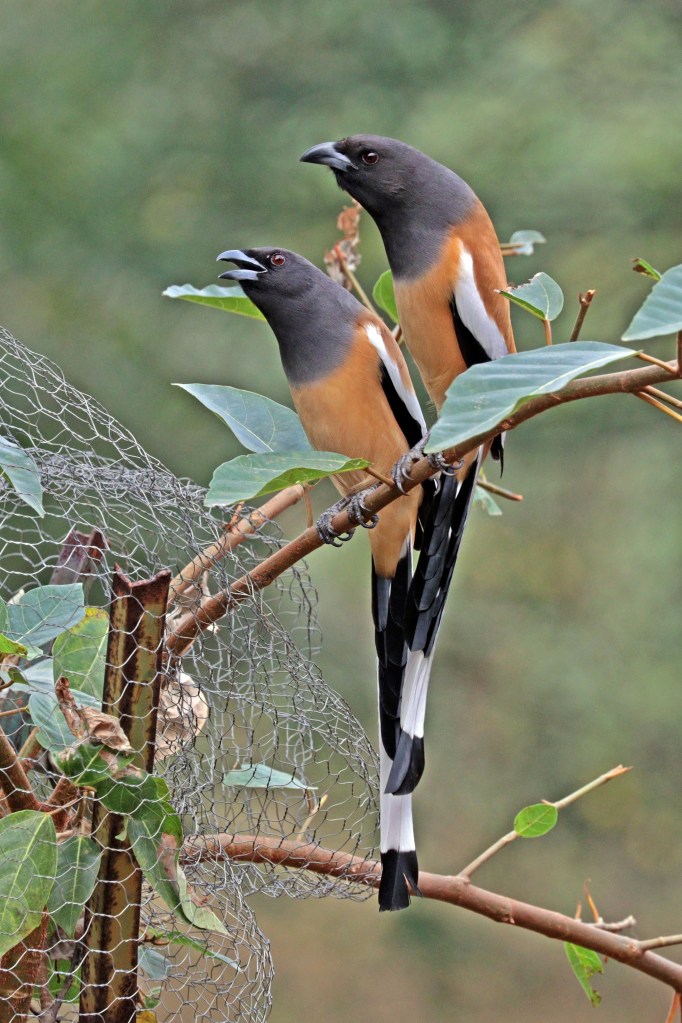
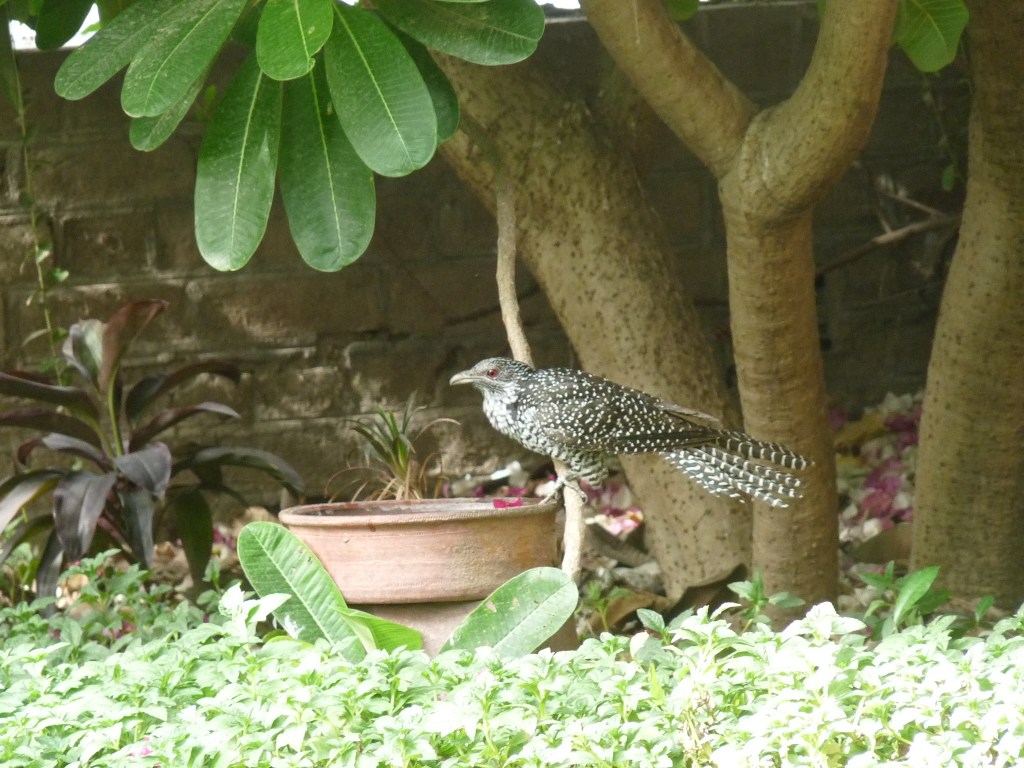
Rufous treepie
Rufous treepie

The tree-pies were in the neighbourhood! Last year they had caused a similar excitement when we had spotted them one day, but sadly that was only a one-time sighting, and we did not see them again. This time it seemed as if they were seriously prospecting the tree as a suitable site for potentially settling in to nest and breed.  

The Rufous treepie (Dendrocitta vagabunda) belongs to the Corvidae family, to which also belongs the common crow. The bird is endemic to the Indian subcontinent, and it is found in open forests, woodlands, groves and gardens in cities and villages. This species is not found elsewhere.

The body of the bird is the size of a myna, but it is elongated with a long tail which distinguishes it. The body is rust orange, with an ashy-black head and breast. The tail feathers are black interspersed with light grey, and the wing feathers are black with a white-grey band down the outside. The beak, legs and feet are black; the eyes are deep red with black pupils. The beak is slightly hooked at the tip.  With such striking colouring, the tree pie makes quite a contrast to its relative, the common crow, with its monochromatic colouring.

What this bird does share with its Corvid family kin is the attraction to shiny objects. Tree pies look for and steal shiny objects such as coins and small jewellery, and stash these in their nest. Possibly a male ploy to attract the females! No wonder then that one of the local Indian names for this bird is taka chor, literally ‘coin stealer’. The bird is also called kotri, derived from one of its calls which sounds like a screeching ‘ko-tree’.

The tree pie indeed has quite a repertoire of calls—from the loud, harsh and guttural to some which are sweet and melodious like ko-tree or bob-o-link. Thus it is confusing when one looks for the source of the squawking call, only to find a melodious tune emanating from the same place. It makes one wonder if it is one bird or several different ones calling.

The tree pie is an arboreal bird, rarely seen on the ground. It is an agile climber and hops agilely from branch to branch, or flies from tree to tree with a swift noisy flapping followed by a short glide on out stretched wings.

The rufous tree pie is an omnivorous and opportunistic feeder. Its diet includes fruits, seeds, small lizards, insects, as well as the eggs of other birds, and even small birds and rodents. In the forest tree pies often join mixed hunting groups of birds like drongos and woodpeckers; they collectively disturb insects in tree canopies and feast on them. 

Tree pies make their nests concealed in the foliage of middle-sized trees. The nest resembles that of its cousin the crow, made of thorny twigs, but it is deeper and well-lined with rootlets. It is here that 4-5 eggs are laid, and when they hatch both male and female share the parental duties.

A fortnight has passed since we heard the first harsh call of the tree pies. Since then we have been able to also enjoy the rest of their repertoire, in something like sound-surround. The soft melodious chirping coming from the foliage of the karanj tree, the bob-o-links that punctuate from the neem tree, and the kotri call from the top of the straggly palm. If we look hard enough we can also spot the tip of the long tail peeping out from the leaves, and occasionally are treated to a glimpse of its sweeping graceful flight from one perch to the other. It looks like the tree pies are here to stay this year.

–Mamata

Splendid Bloomer: Silk floss Tree

In most parts of India, March is usually the month when the big trees are in bloom. In cities like Delhi which have avenues of old trees, it is a delight to see the changing colours of the blooms on different trees. October however, is the month that is marked by the spectacular blooming of the Silk floss tree.

Sometimes mistaken for the Silk Cotton tree with its flamboyant red flowers, the Silk floss tree (Ceiba speciosa), is unique in many ways. The species was originally named Chorisia speciosa in 1828. The generic name Chorisia was in honour of Louis Choris, a Russo-German painter and explorer who was one of the earliest expeditionary artists (artists who accompanied military, exploring, and trade expeditions to document the expedition through sketches and paintings). He accompanied Otto von Kotzebue, a Baltic German navigator in Russian service on several expeditions across South America and Europe, and is said to have painted nature as he saw it.  However, in 1998 the genus Chorisia was merged with the genus Ceiba (which is the Brazilian name for the tree). Speciosa means ‘beautiful’, or ‘splendid’ (Latin), alluding to its spectacular flowers. Thus, the currently accepted name for the species is Ceiba speciosa.

This grand ornamental deciduous tree is in fact native to Argentina and Brazil. With its bulging prickly trunk, exotic flowers, great height, and pods with pea-sized seeds and silky floss, this unique tree literally stands out from other trees.

The Silk floss tree begins as a young sapling with a small bulge near the base of the trunk that slowly enlarges as it grows. But the tree tapers again upwards of the bulge, reaching a height of anywhere between 50 to 70 feet, with wide-spreading branches. The immature trees have an attractive green bark, which turns grey as the tree ages, and its girth increases. The trunk and branches are characterized by the coarse sharp conical spines that cover it, but these fall off as the tree gets older. The spines not only protect the tree from climbing animals, they are also good dew collectors; they collect the moisture from the air that the drips down to the soil below, making the tree capable of surviving even in arid conditions. In dry regions, in ancient times, the presence of the ceiba trees indicated the presence of nearby water sources, which led to the establishment of human settlements where these trees grew.

It may take many years before the trees start to flower. But when they do, it is the flowers that make this tree a show-stopper. Each one as large as an open hand, the hibiscus-like flowers are usually in different shades of mauve-pink. The five petals envelope a delicate creamy-white centre. The flowers appear after the tree has shed its leaves, and they cover the branches with a profusion of blossoms that make for a spectacular sight. The nectar attracts pollinating insects such as butterflies and bees, as well as hummingbirds in their native South America.

It takes a Ceiba tree at least seven years to mature to produce its first seed pods. These woody avocado-shaped pods were called pochote by the Mayan people. The pods grow gradually, and then crack open, exposing pea-sized black seeds surrounded by flossy white fibres.  It is this component that gives the tree its common English name Silk floss tree. In Hindi it is popularly known as resham rui (literally silk cotton). In pre-Hispanic times this fibre was important for making cloth. The floss was traditionally used for stuffing pillows and mattresses as this did not cause any allergies. In the 1940s it was also used to fill life jackets because of its buoyant properties and water resistant abilities. In the 1950’s it was used to fill automobile seats and upholstery. Over time it has been replaced by synthetic fibres.

Other parts of the tree also have multiple uses; the wood from the trunk has been used to make wood pulp; the light and flexible wood is suitable for making boxes, packing material and even canoes; while thin strips of the bark can be woven to make ropes, and the seeds pressed into edible and industrial oil. 

As in all indigenous cultures, where people lived in close connect with their surroundings, this tree is associated with its share of myths and legends in its native lands. In Argentina the tree is commonly referred to as Palo Boracho, literally ‘drunken stick’ referring to its swollen trunk that tends to lean on one side.

In Bolivia this tree is called Toborochi which means ‘tree of refuge’ or ‘sheltering tree’. A beautiful legend explains why this is so.

When the world was still very new, the Aña, or spirits of the darkness, liked to abuse and kill humans. When they found out that Araverá, the beautiful daughter of a native chief, cacique Ururuti, who had married the god Colibri (Hummingbird), was pregnant and would give birth to a son, the spirits were alerted. The spirits believed the son would punish them when he grew up, so they decided to kill Araverá. With the help of a flying seat her husband Colibrí had given to her, Araverá fled from the village, but the evil spirits followed her and harassed her wherever they found her hiding.

Finally she was so exhausted that she decided to hide in the trunk of a Toborochi tree. Sheltered within, feeling secure and at peace, she gave birth to her son. The boy grew up and fulfilled the prophecy, killing the spirits and avenging his mother. But as the gods had decreed, Araverá, could never come out of hiding, and had to stay inside the tree until she died.

But as the legend goes, while forever buried in the bulging trunk of a Toborochi, Araverá does come out, in the shape of a beautiful flower that attracts hummingbirds. And thus, she keeps contact with her husband.

While the tree is indigenous in South America it is also native to Central America, where the ceiba or yaxché, is considered as the sacred tree of the Mayas, a place to withdraw for meditation. The Mayans believed that the ceiba tree connected the different levels of the universe, from the underworld to the sky. The story is told of a mythical ceiba tree that functioned as the axis or centre of the world, encompassing the three planes of the universe: the roots are Xibalba, the underworld, the trunk and branches are Cab or the terrestrial level, and the bird Quetzal, perched on top of its canopy, the sky. Once again, reinforcing the link between the flowers and the birds. The Ceiba is thus a tree of life that plays an important part in ceremonies, art and mythology.

Though far from their native lands, the Silk floss trees which have taken roots in other parts of the world, are a majestic symbol of the ancient spirit of trees of life. And nothing is a better reminder of this than the magnificent flowering of these towering trees.  

–Mamata

Spider Art and Science

In India this is the time of year when “spring cleaning” takes place. In the run up to Diwali, homes are thoroughly aired, dusted and cleaned, and every nook and corner cleared of dirt and cobwebs. Just as this frenzy of cleaning activity has begun, I read a news item that in one of the most famous art museums in the world, the Rijksmuseum in Amsterdam, the cleaning crew had been given an  order “No vacuum cleaners and no dusters”. They had been given special instructions not to clear, or even slightly disturb, a single cobweb inside the gallery for the last three months. In fact, the Museum Curator takes a round every week to check that all crevices and corners have adequate cobwebs!

This preparation has been the prelude to an exhibition titled “Clara and Crawly Creatures” which will open to the public from 30 September 2022. The exhibition explores how perceptions of insects in art and science have changed over the centuries. In the Middle Ages, lizards, insects, and spiders were associated with death, and with the devil in European culture, but the exhibition notes that in the 16th and 17th centuries there was a re-imagining of the role of insects after the microscope allowed artists and scientists to appreciate beauty that wasn’t always so obvious.

The exhibition prominently displays Albrecht Dürer’s 1505 painting of a stag beetle, its pincers raised. The exhibits take one through the history of how insects have been perceived over the centuries by artists and scientists who have been fascinated by the beauty and ingenuity of these small creatures. The culmination and the highlight of the exhibition is a dark room which has a huge installation by artist Tomas Saraceno– made from silk woven by four spider species that he houses in his studio in Berlin. In fact Saraceno emphasizes that it is not him, but the spiders who should be recognized as the artists.

Attention is also drawn to the uncleared cobwebs in the rest of the gallery by An Open Letter for Invertebrate Rights, written by Saraceno and placed next to one of the webs in which he makes a strong case for coexisting with creepy-crawlies rather than viewing them as pests. Saraceno, who allows spiders to thrive in his own home, suggests that it is humans who are living in the spiders’ world rather than the other way round. As he puts it: “Spiders have been on the planet almost 280 million years and we humans only 300,000. With this letter on invertebrate rights, we say: ‘Hey look, spiders have the right also to come to the museum, spiders are around you’.”

Tomas Saraceno, the person, also breaks all the traditional perceptions of ‘artist’ and ‘scientist’. Trained both as an architect and a visual artist Saraceno’s works demonstrate a stunning intermeshing of art, physics, biology, astronomy and engineering. Saraceno is also an environmental activist who is constantly exploring   new, sustainable ways to inhabit and sense the environment. In 2015, he achieved the world record for the first and longest certified fully-solar manned flight. In the quest for more sustainable ways of living he has worked closely with indigenous people as well as with renowned scientific and technological institutions.

Among all his other passions and accomplishments, Saraceno is an ardent ‘arachnophile’—an advocate for spiders and their ingenious airborne lifestyle, and spiders’ webs that inspire a lot of his work!  As he often reminds us: “Somehow, when people talk about spiders, they forget that some spiders weave webs; [in fact,] they’re very dependent upon their multifunctional webs that provide shelter, protection, food and, when vibrated, a means of communication.”

The multi-functionality of the web, as well its unique structure, can be attributed to the incredible spider silk which it produces and uses not only to spin its web but which has multiple functions. Any individual spider can make up to seven different types of silk, but most generally make four to five kinds. This is produced in internal glands, moving from a soluble form to a hardened form, and then spun into fibre by the spinnerets on the spider’s abdomen.

The sticky silk prevents the prey from slipping off the web, and is useful to wrap and immobilize the prey once it is caught. The spider used the long strands or draglines as a safety line, to keep itself connected to the web; these are also used for parachuting or ballooning to help the young to disperse and find new areas as food sources; they also act as shelter for the spider. The chemical properties of the silk make it tough, elastic and waterproof. Each strand which is finer than the human hair is believed to be five times stronger by weight than steel of the same diameter, and thus has an incredible tensile strength. No wonder then, that Tomas Saraceno can use it for his installations!

Spiders are master engineers, gifted with amazing planning skills and a material that allows them to precisely design functional webs, which they create in a mind-boggling variety of patterns. Saraceno sees the web as vital for the life of a spider. “The web is a tool for a spider to sense what’s around them—it’s part of their body, almost. Some spiders are blind, or some spiders have eyes but their vision is very bad. They also don’t have ears—they can’t hear. They feel vibrations on their web to understand what’s going on around them. I wanted to build something that allowed a human to be inside the mind of a spider.”

It is this that drove his first major show in the United States called Particular Matter(s). This included a giant spider web installation that enabled humans to experience (in a dark room) the vibrations around them, as a spider would.  

Saraceno was born in Argentina but currently lives and works in Berlin, and exhibits in different parts of the world. He is much more than an artist. He is a passionate social and environmental justice warrior. His mission, he feels, is simply to get humans to understand that they are not the top of a pyramid of power in what is called the Anthropocene era, but exist on a horizontal plane with all non-humans, to which they should be sensitized and from which they have plenty to learn. He advocates for what he prefers to call the Aerocene era in which interspecies-cooperation and clean air are required.

The exhibition that opens this week is yet another reminder of this message and its urgency. In India the first week of October is celebrated as Wildlife Week when the spotlight is usually on the more charismatic and larger mammals and birds. Tomas Saraceno’s mission to celebrate the less visible but vital members that make up the much larger proportion of ‘wildlife’ is a timely reminder that in the web of life, each and every strand is critical.

–Mamata

Cheetah Lore

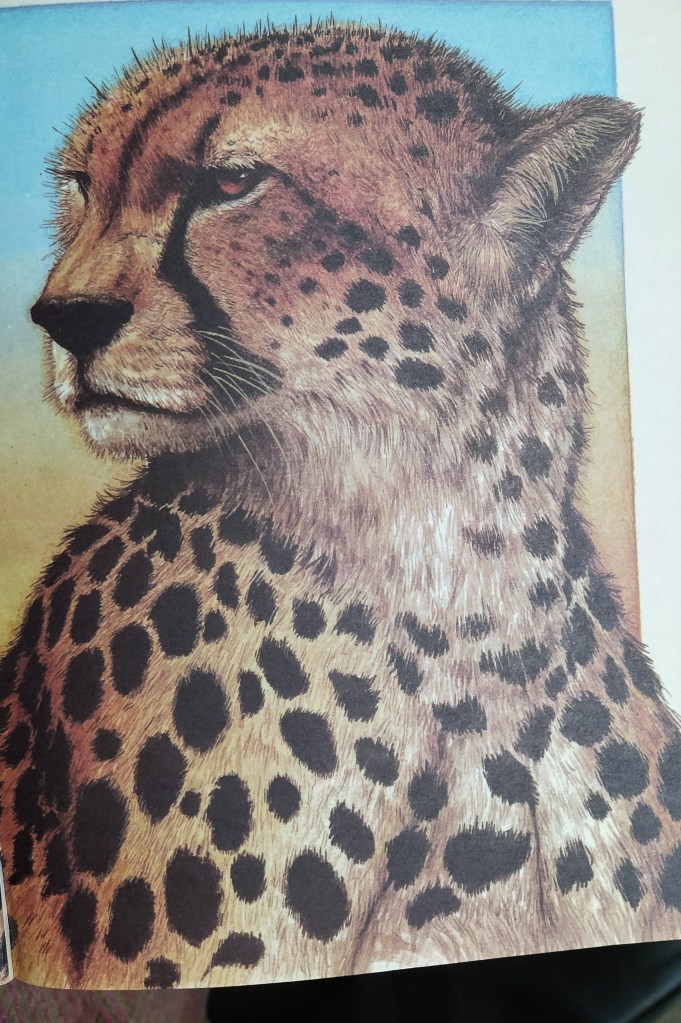
The last week’s news coverage was unusual. The faces that dominated the newsprint were not those of politicians or movie stars, but of the new celebrities in India—eight cheetahs! The beautiful face and body of this graceful animal captivated our attention. The vital statistics of the new arrivals from Namibia were shared and analysed, compared and contrasted with that of the other Big Cats.

Indeed the cheetah is a beautiful creature. With its narrow lightweight body, the cheetah is quite different from all other cats, and is the only member of its genus, Acinonyx. The cheetah’s unique form and structure—flexible spine, long slender  legs, and long muscular tail that acts as a counterbalance to its body weight, allowing it to attain the high speeds for which it is famous as the fastest animal on land.

Unlike other cats, the cheetah’s foot pads are hard and less rounded. The hard pads function like tire treads providing them with increased traction in fast, sharp turns. The short blunt claws, are closer to that of a dog than of other cats. The semi-retractable claws work like the cleats of a track shoe to grip the ground for traction when running to help increase speed.

While these characteristics are studied by zoologists, these have equally been noted by the indigenous peoples who have traditionally lived in proximity to these animals. And these have found a place in their imagination and folk lore. The Bushmen of southern Africa have a charming story about the cheetah’s speed and special paws.

How Cheetah Got Its Speed

Long long ago, the Creator designated certain special qualities to the different animals that he had created. When it came to deciding which one had the greatest gift of speed, he decided that there should be a race. He shortlisted the cheetah and the tsessebe antelope to run the final race. The race was to start from the giant Baobab tree and the two contestants were to run across the plains to a hill on the far side. The cheetah was a fast runner over short distances, but it realised that its soft paws would not be able to take the rigour of a long run. So it borrowed the sturdier set of paws from a wild dog.

The Creator himself flagged them off. The tsessebe sprang off and was away, soon leaving the cheetah far behind. But alas! Suddenly it stumbled on a stone and fell, and broke its leg.

When the cheetah caught up, it found its rival lying on the ground, in pain. All the cheetah had to do was to run ahead and win the race. Instead it stopped to help its opponent.

The Creator, on seeing this was so pleased with the cheetah’s unselfish act that he bestowed on the cheetah the permanent gift of great speed, and the title of the fastest animal on land. He also allowed it to keep the paws of the wild dog.

Along with its streamlined form, the cheetah is also distinguished by its markings of solid black spots, and especially by the distinctive black stripes that run from the eyes to the mouth. These stripes resemble the track of tears and needless to say, this feature must have led to a lot of stories told around the fireplace in the days when the desert people in South Africa lived in close harmony with their natural surroundings.

Here is a Zulu story that tells one of these tales.

Why the Cheetah’s Cheeks are Stained with Tears

Long long ago a hunter was idly sitting under a tree. While most hunters were out all day in pursuit of food, this one was different. He was lazy, and always looking for an easier way of doing things. As he lolled under an acacia tree, he saw a herd of springbok (antelopes) grazing on the grassy veldt. The hunter was daydreaming about how wonderful it would be if he could get their meat without having to chase them. Just then he noticed a movement, and saw that that there was a female cheetah close by. He noted how the cheetah was silently advancing, keeping downwind of the herd, so that they could not sense her presence. As she stalked noiselessly, the cheetah identified a springbok that had strayed from the rest. In the blink of an eye the cheetah gathered her long legs under her and hurtled forward with the speed of lightning. Even as the rest of the herd sensed danger and fled, the lone springbok did not have a chance. The cheetah’s hunt was over.

The hunter, still unmoving, observed how the mother cheetah dragged her prize to the edge of the clearing. In the undergrowth he saw that there were three cubs waiting to be fed. The hunter thought: how nice to be given a meal without having to toil for it; these cubs are lucky. The second thought that struck him was: Imagine if I had a hunter who would do the hunting for me! And further, a wicked idea dawned. If he stole one of the cubs and trained it to hunt for him, his desire would be fulfilled.

The lazy daydreamer continued to lie there as he plotted and planned how to do this. At sunset when the mother cheetah went to the waterhole, leaving the cubs concealed in a bush, he took his chance. The cubs were too young to know what was happening, nor to protect themselves. He first picked up one cub, but then got greedy and stole all three, thinking that he was getting a triple bonus! And away he went before the mother returned.

When the mother cheetah came back and found her cubs missing, she was heartbroken. She cried and cried all night. By morning her tears had left dark stains as they flowed down her cheeks. An old hunter who was passing by heard her loud crying. This wise old hunter knew the ways of the animals. When he found out what the lazy hunter had done, he was very angry. Stealing the cubs from their mother was not only wicked, it was also against the traditions of the tribe which decreed that every hunter must use only his own strength and skill in hunting. Any other way of obtaining prey was a dishonour to the whole tribe.

The old hunter returned to the village and told the elders what had happened. The villagers became angry. They found the lazy hunter and drove him away from the village. The old man took the three cheetah cubs back to their mother. But the long weeping of the mother cheetah stained her face forever.

And so the Zulu believe that even today the tear-stained cheeks of the cheetah are a reminder to the tribesmen that it is not acceptable to hunt in any way other than that what the ancestors had decreed as wise and honourable.

As we in India welcome these unique animals, let us also welcome the ancient lore and wisdom from the days when humans and animals were closely linked in more ways than one.

–Mamata

View From the Window

In a recent piece, my favourite nature columnist reminded us that while the Red Lists continue to add to the growing number of species that are endangered, threatened and even close to extinction, there are many small ‘disappearances’ that are happening all around us, ones that we do not obviously notice on a day-today basis. The author, a reputed bird watcher and note-keeper realised this when he looked back over his old records of birds around his house, and found that many of these were no longer to be seen. 

This led back to my own observations, jotted down over the years.

Circa 2000

Before the first rays of the sun painted the sky pink, the echoing call of the majestic Sarus crane would wake me from deep sleep. I knew that the pair would be flying off to an unknown destination for the day, to return after sunset.

The summer heat was compensated by the brilliant scarlet of the gulmohar at our front gate and the molten golden blooms of the laburnum at the back. The melodious tunes of the magpie robin filled the dawn, while the metronomic tuk tuk tuk of the coppersmith echoed from the top of the raintree. The morning haze was often streaked with the dazzling blue of a kingfisher in flight, while the green bee-eaters lined neatly on the wires, made swift graceful swoops in search of a breakfast-insect or two. Our little patch of grass and the surrounding hedge was lively with the orchestra of calls from tailorbirds, sunbirds, bulbuls, doves, mynas, and babblers that co-existed harmoniously, each finding their own pockets for food and shelter. The same space also saw the raucous coucal proclaiming its territory from the champa tree, and the occasional visits by the Shikra that immediately silenced the rest of the avian crowd

When the first rains came, so did the jacanas, with their mewling cries, almost like that of babies. They would make their floating nests on leaves in the vacant ground across from our house which turned into a wetland in the monsoon. Once the water dried they would disappear, as quickly as they had appeared. 

The stream of other seasonal guests to that water-filled depression in the ground across the road included buffaloes that spent the day wallowing in the mud, naktas or comb ducks that glided smoothly on the water, and an occasional water hen awkwardly crossing the road on its long yellow feet. As evening fell the air filled with the symphony of the frogs.  

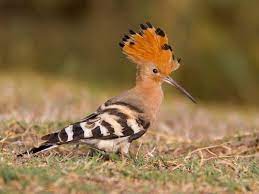
The first nip of winter brought back the single Yellow wagtail to our small lawn. It came from far away to spend the winter soaking up the golden sunshine that seemed to glow on the patch on its breast. Another familiar visitor was the Hoopoe. We would see it walking back and forth on the dusty roadside, with its pickaxe head bobbing constantly.

And then there was the monitor lizard which seemed to put in an appearance only on weekends. And the shy mongooses that streaked across the gravel, disappearing soundlessly into the undergrowth. The little turtle that we found one day in our garden may have been washed in with the rain. It adopted us before we adopted it. We named it Tortolla and no matter how early we awoke, it was up before us, taking its morning walk from one end of the courtyard to the other. Not to forget the adventures of discovering snakes in the house—once coiled in a corner of the kitchen, and once neatly tucked under the dining table.

These were some notes that I made of the life around me—not from a cottage in a beautiful forest, but from my windows in the dusty city of Ahmedabad that I made my home. The house that we made was at the time, in a slowly developing area of the city, close to a natural talavdi or small lake. There were still open spaces around; and the trees and shrubs that we planted when we moved in provided homes and shelter to many other fellow living beings—winged and tailed, with two, four, a hundred, or even, no feet. As a newly-minted environmental educator this was my private lab for observing, noting, researching, and discovering the excitement of seeing the little things from my windows. Little then did I imagine that things could change so much.

Circa 2022 (Same window different view)

The wetland that once was a soothing symphony of sound and sight has metamorphosed. My days (and often nights) are filled with the sound of concrete mixers, trucks offloading mountains of gravel and bricks, the incessant hum of machinery, and the clatter-bang of steel and iron. The Sarus cranes, long flown, have been replaced by the huge construction cranes. These swing their gigantic metal arms as they lift and drop the raw material from which begin to sprout the concrete blocks that will grow into the new jungle of high rise apartments. Where the jacanas and water hens stepped daintily, now the humungous metal claws of the JCBs dig ruthlessly, scooping out mountains of soil, and creating abysses to be filled with cement. Now the rains only bring waterlogging, floating litter, and swarms of mosquitoes.

I haven’t heard the nightly frog chorus in so many years. I am beginning to forget the cries of the jacanas. My morning wake-up call is no longer that of the magpie robin. The permanent dust haze has suffocated the gulmohar and the raintree to an untimely demise, and deprived so many feathered friends of perches and abodes. The wagtail no longer visits, and I miss the comforting sight of the neatly-groomed hoopoe on its regular march. A rare flash of kingfisher blue, remains just that, as also the aerial antics of the bee eaters in pursuit of prey. The incessant din of the traffic has drowned out even the strident call of the koel, the twitter of the little birds, the soothing murmurs of the doves, and the soft babble of the bulbuls.

Day after day, the concrete jungle closes in relentlessly, we are engulfed by dread and despair. And now a single flower that blossomed, or a simple bird call can uplift our spirits.

–Mamata

Tippy-tippy Tap…

The last few weeks have been a time of looking closely at flowers, and marvelling at their variety. I observed about 12 types of pink flowers, about 8-10 types of orange flowers, about 5-6 red, a few yellow ones, a few white ones and two types each of purple flowers and blue flowers–all in my colony. 

So of course the question came to my mind: Was this the typical distribution of flower colours? Was pink the predominant colour, followed by orange and red? And so started my search to find out a little more about this.

First and foremost, what gives flowers their colours? Colours mainly come from the presence of pigments in the chromoplasts or cell vacuoles of floral tissues.  The most common pigments in flowers come in the form of anthocyanins which range in colour from white to red to blue to yellow to purple and to even black and brown. The other major group are the carotenoids, which provide the yellow colours, along with some oranges and reds. While many flowers get their colours from either anthocyanins or carotenoids, there are some that can get their colours from a combination of the two. Other classes of pigments, but of less importance in relation to flower pigmentation, are chlorophylls (greens), quinones (occasional reds and yellows), and betalain alkaloids (giving yellow, red and purple). 

Coming back to which is the most common flower colour, all my web- searching only told me that there was no definitive answer! To begin with, we don’t even know how many flowering plants there are. And of the flowers we know and have catalogued, colour data are seldom maintained. There is no repository of flower colour information. There is no database which documents flower colours, let alone rank them.

There are many good reasons that make it difficult to document these colours. There is no absolute measure. Colours look different in different lights, at different times of the day. Each person perceives colour differently—what looks orange to me look yellow to you. And we all describe them differently—I may say violet for a colour and you may say mauve.

Moreover, colours vary from genus to genus, and even within a species. A plant growing in one area (say, the plains) can have flowers  that are very different from the same plant growing elsewhere (say in higher altitudes). The colours of flowers depend very much on the growing conditions—soil, sunlight etc. So they may change somewhat with season too.

Recent research suggests that factors like ozone depletion and global warming have caused flowers to change their colours over time. For instance, of the 42 species studied in that research, UV-pigmentation in flowers increased at a rate of 2% per year from 1941 to 2017.

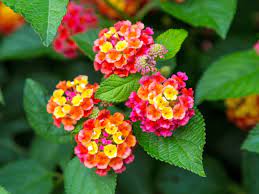
lantana
Lantana is one of the flowers which changes colour on pollination

Flowers also use colours as signalling mechanisms. Some flowers change their colour once they are pollinated, so that bees do not come back to them, but rather go to unpollinated flowers. (Eminent teacher, Prof. Mohan Ram, who developed a generation of botanists, ecologists and environmentalists, taught us this during a memorable nature walk.) Some flowers change their colour with age.

But here are some speculations about flower colours:

Counter-intuitively, some people believe green may actually be the most common flower colour–many plants, including most trees, bear flowers in various shades of green. This may be followed by white, yellow, blue and the reds in that order.  Brown is not uncommon either. But all scientists and naturalists emphasize that these are only guesses.

So don’t worry too much about how many. Just enjoy the flowers and their colours!

–Meena

Look, See, Wonder…

As environmental educators, our most important task with children as well as adults was to awaken them to the wonders of the world around them. From this wonder of the variety of life and the intricate connections therein would come an intellectual curiosity to understand the world better, followed by a passion to do something about it. So the responsibility was to take people through the steps of Awareness, Appreciation, Skills, Knowledge and Action.

So the first step seeing and sensing the world. I remember some of the exercises we used to do in our workshops to help people do this:

  1. Observe the greens : Closely observe the shades of the leaves of different plants/trees. Try to describe the differences.
  2. Observe the shapes of leaves: Sketch different leaves to scale.
  3. Bark rubbings: Find a tree, place a piece of paper on the bark and colour over with a pencil to get the impression of the bark design. Repeat with another tree.
  4. Listen to sounds: Sit in absolute silence for 5 minutes in a natural area and note down the sounds your hear.
  5. Smells: Go around a garden and sniff the flowers, the leaves, the plants, the soil.

Even the most cynical adult would get completely involved and excited, and the result would be a ‘Wow, who would have thought that there were so many shades of green;  that soil smelt like this; that there were so many different types of sounds in nature!’

Roles got reversed when the world decided to environmentally educate me two days ago, as I was on my walk. The very same path that I follow every day, but I was out a little earlier than usual. So the light was different and everything stood out with a brightness and clarity that I did not get to see later in the evenings.

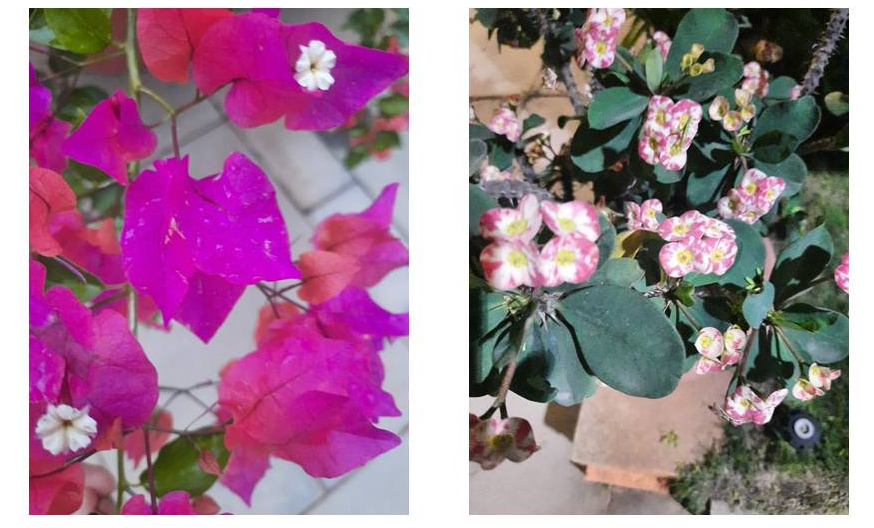
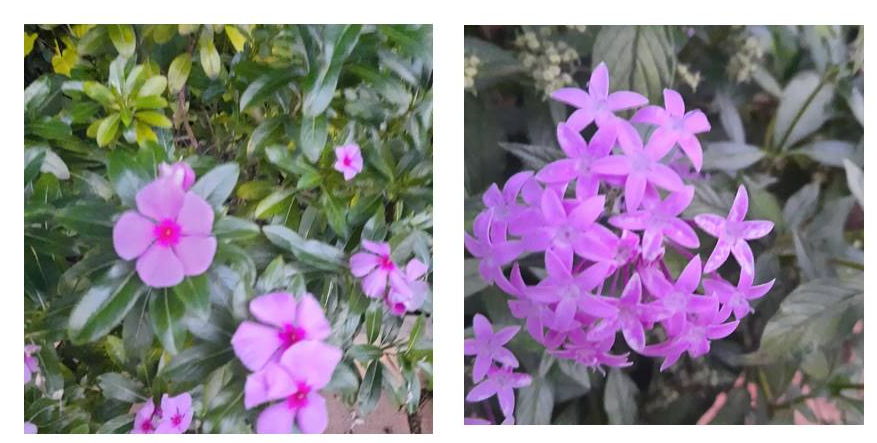
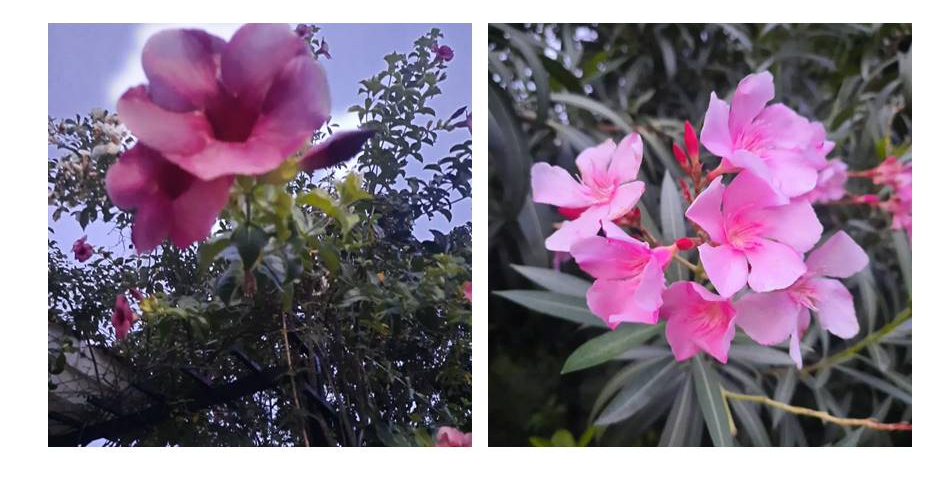
I saw one beautiful pink flower and decided to take a pic. I continued for 2 meters, and saw another one. And within the space of 10 minutes, I had 11 flowers in different shades of pink captured in my phone. I was wonder-struck!

I had obviously only been ‘looking’. I had forgotten to ‘see’. The difference, as Grant Scott, a famous photographer puts it: there is ‘.. a seriousness of intention that one of these words suggests, whilst the other gives the impression of a casual approach to perhaps what is the same thing. The word ‘see’ suggests a depth of visual engagement that allows the person ‘seeing’ to control the action and retain control of any further action that may take place after the initial seeing. To look suggests an observation of surface, it does not suggest any further depth than that. To look suggests both the beginning and end of the action, whereas to see suggests the beginning of a process of investigation.’

So while the popular adage is that we should take the time to smell the flowers, I would also urge that we take the time to see the flowers. And even more important, take the time to let a sense of wonder overtake us!

From this sense of wonder will come the sense of urgency to take care of our world!

–Meena

The Versatile Shoe Flower

Within urban myths (defined by the Collins Dictionary as ‘a story, esp one with a shocking or amusing ending, related as having actually happened, usually to someone vaguely connected with the teller’), there should be a special category for ‘school myths and beliefs’  which could be defined as ‘stories and other things believed by a generation or generations of school children’.

One such myth subscribed to fervently by our generation was that if pencil shavings were soaked in milk, left in the moonlight, and some incantations recited over them, they would turn into erasers. Hundreds of children tried this, but since the incantations were not known to anyone in our circles, we attributed our failures to the lack of this knowledge.

The other widely held belief was that we could polish our leather shoes to wonderous lustre with the shoe flower or hibiscus. This was a very convenient belief to hold, as we thus avoided putting in 10 minutes hard work a day with brush and polish, and getting all messy. On the way to school, we would grab some red hibiscus flowers which were ubiquitous, and just before assembly, surreptitiously give our shoes a wipe-around. When the shoes were still kind of wet with the juice from the flowers, they looked ok, but I was never sure if they actually did anything.

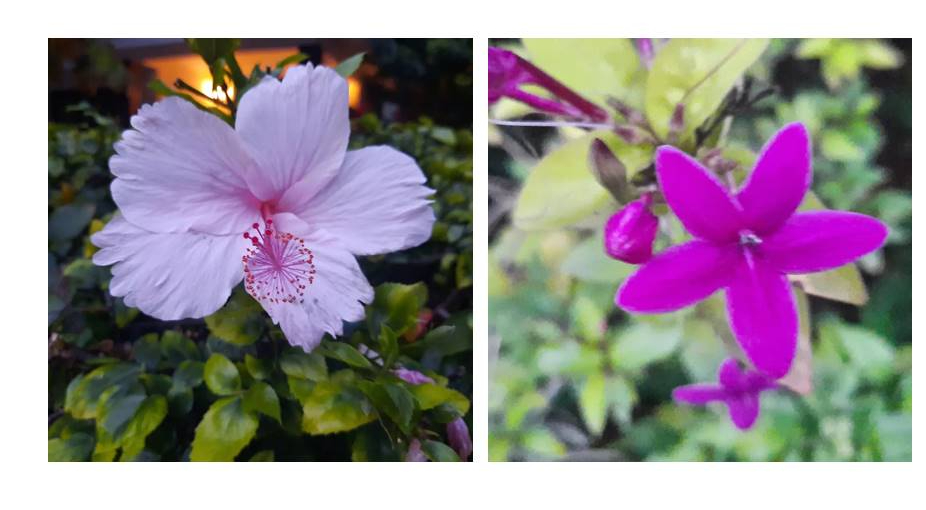
Hibiscus

But unlike other urban myths, maybe this one has some basis in fact. The hibiscus is called shoe flower because in Malaysia and Indonesia, the flower petals were used to produce a black dye for shoe polishing.

Hibiscus belongs to the genus Malvaceae of the mallow family. There are many hundred species, and the genus is native to warm temperate, subtropical and tropical  regions throughout the world. 

In fact, the hibiscus is an extremely versatile flower. It is used extensively in pujas, and having a bush in the garden assures the devout that they will have flowers throughout the year.

And then of course, its use as a hair tonic. Remember the jabakusum hair oil? The jabakusum or javakusum in fact is a name for hibiscus. It was C.K. Sen, a vaidya from a family of Ayurvedic practitioners, who took this oil commercial. He formed a company C.K.Sen & Co Ltd in 1878, with Jabakusum Taila as the first product. It became an instant hit. Its inherent qualities were assisted by smart marketing—it was positioned as ‘The Royal Toilette’ and ‘By the appointment to the Princess of India’ (no one seems to have asked who that would be!). It was the first hair oil brand in Asia to have a commercial film ad.

Even today, some people dry the flowers and steep them in coconut oil and use it for their hair. The leaves and flowers are also used as the base of hair packs and shampoos.

The humble hibiscus has several medicinal uses as well—it is a laxative as well as a diuretic. It is used to treat colds, fluid retention, stomach irritation and a number of other ailments.  There are claims that it may help to reduce high blood pressure and cholesterol.  Hibiscus tea, made by steeping the flowers in hot water for five minutes is a popular drink and home remedy.

In the Philippines, children use the flower to make bubbles. The flowers and leaves are crushed until the sticky juices come out. Hollow sticks or straws are dipped into this and bubbles are blown. 

The hibiscus flower is worn by girls in Tahiti and Hawaii. Traditionally, if the flower is worn behind the left ear, the woman is in a committed relationship. If the flower is worn on the right, she is single.

The hibiscus is a national symbol of Haiti, and the national flower of many countries including the Solomon Islands and Niue, South Korea, Malaysia and Hawaii.

With all this, we seem to tend to take the hibiscus for granted just because it is so common and easy to grow. I never knew of a hibiscus which did not take wherever it was planted. Even a ten-thumbs like me can plant and see a hibiscus bush flower.

Hibiscus come in various colours, with red, pink, white, yellow, orange, multicoloured ones being most common. There are even purple hibiscus. In many cases, the colour of the flowers of a hibiscus bush will change with changes in temperature, hours of daylight etc. For instance, the hotter it gets, the brighter the orange and yellow flowers bloom.

There is something special in the bush outside your house. Marvel at it!

–Meena

Twiga’s Tales of the Giraffe

One of the most majestic sights while on safari in East Africa is not necessarily the lion nor the elephant, but that of a ‘tower’ (what better way to describe this group!) of giraffe silhouetted against the setting sun, as they stride gracefully across the flat grassland. For animals that at first glance seem somewhat ungainly with their long stilt-like legs and outstretched necks, the Twiga as they are called in Swahili, move like a bevy of tall ballerinas.

Giraffes are an integral part of the landscape in the semi-arid savannah and savannah woodlands in sub-Saharan Africa, and also occupy a unique place in the cultural landscape of the African continent. They are highly regarded throughout the continent, and the giraffe spirit animal is seen as a being who can connect the material world to the heavens. In Botswana they call the giraffe Thutlhwa which means ‘honoured one’. Cave paintings from early civilizations in Africa depict giraffes, and giraffes feature in a lot of mythology and folklore of the different tribes. These indicate a high regard for this unique animal, as well as delightful tales that link to the origins of the characteristic features of the giraffe.

The name ‘giraffe’ itself has its earliest origins in the Arabic word zarafa, (fast walker), which in turn may be have been derived from the animal’s Somali name geri. The Italian word giraffa came up in the 1590s, and the modern English form developed around 1600 from the French word girafe. The history of the word follows the history of the European’s exposure to this unusual animal.

This animal has always fascinated people through history. The Greeks and Romans believed that this creature was an unnatural hybrid of a camel and a leopard and called it a Camelopardalis (which also became its scientific name). Julius Caesar is believed to have brought and displayed the first giraffe in Rome in 46 BC. In the Middle Ages Europeans knew about giraffes through contact with the Arabs. A giraffe presented to Lorenzo de Medici in 1486 caused a great stir on its arrival in Florence. In the early 19th century a similar gift to the Charles X of France from Egypt caused a sensation. He loved this animal, and it was something he showed to special guests for 18 years. His palace featured many paintings of his beloved giraffe.


In 1414 a giraffe was taken on a ship to China along with precious stones and spices. It was placed in a zoo where it was a source of fascination for the Chinese people who saw in it a beast that represented the characteristics of various animals and identified it with the mythical Quilin which is a part of Japanese, Chinese and Korean mythology. 

What makes the giraffe so unusual? To start with, it is the tallest mammal on earth, reaching a height of up to 18 feet. The height is achieved by its very long neck and legs.

African folklore has a number of tales that explain why the giraffe has such a long neck. Here is a delightful Twiga tale from East Africa.

In the beginning the Creator gave the same legs and neck to all the animals. One year there was a terrible drought, and all that could be grazed and browsed was eaten by the grazers and browsers, until only a hot and dusty expanse spread before their hungry eyes. One day Giraffe met his friend Rhino, and they walked hungrily and thirstily in search of a water hole. Giraffe looked up and sighed “Look at the fresh green leaves on the acacia trees. If only we could reach them we would no longer be hungry”. Rhino said, “Maybe we can visit the wise and powerful magician and share our troubles.” The two friends trudged on till they reached the place where the magician lived. He told them to return the next day. The next day Rhino forgot all about this and did not show up, but Giraffe was there. The magician gave him the magic herbs that he had prepared for the two animals. Giraffe greedily ate up both the portions. Suddenly he felt a strange tingling in his legs and neck, and felt giddy, so he closed his eyes. When he opened them he saw that the ground was way beneath, and his head was way up, close to the fresh green leaves on the high branches of the tall acacia trees. Giraffe looked up at the sky and down at his long legs, and smiled as he feasted. Meanwhile Rhino finally remembered, and went to the magician. But the magician said he was too late! Giraffe has eaten all the magic herbs! Rhino was so angry, that he charged at the magician, and continued to do so at everyone he encountered. And so, they say, the rhino remained bad tempered, while the giraffe retained his gift of height.    

Interestingly, the giraffe’s long neck has only 7 vertebrae, the same as other mammals. The long neck enables the giraffe to browse on the leaves and shoots of thorny acacia trees in the flat grasslands that it inhabits. This is helped by the strong, long (45-50 cm) and dexterous tongue which is bluish-purple in colour, and the ridged roof of their mouth.

The long neck with eyes located near the top of the head also provides it with a vantage view of the surroundings. The giraffe can spot approaching danger well before the other grazing animals, who are usually found around the giraffe. If they sense any nervousness on the part of the giraffe, they take it as a cue to stay alert or flee.

Curiously, once the height of the legs is added, the long neck is too short to reach the ground. Thus in order to drink from a water hole giraffe have to splay their forelegs and/or bend their knees. This is also the time when they are the most vulnerable to predators like lions. However as giraffes do not need much water, this exercise is not needed very often.  

The long slender legs make the giraffe a very fast runner. Although initially the gait may seem stiff-legged, once they get into rhythm they are a graceful sight. The legs provide more than momentum, they are also a giraffe’s only means of defense. A powerful kick from its hind legs has been known to kill a lion, and its front legs with sharp hooves can come down just as hard.

Female giraffe give birth standing up, which means that the new born has a fall of about 2 metres before it touches ground. And yet the calf can stand up within an hour of its birth; but this is the time when it is most vulnerable to attack by predators.

Giraffe have very thick skin, and they are distinguished by their reddish brown coats with irregular patches divided by light coloured lines. While they may look alike at a glance, each of the different species of giraffe have very different types of spot patterns. In fact, just like human fingerprints, no two giraffe have the same spot pattern.

Certainly an animal that “stands out in a crowd!” But where once they stood tall and strode majestically across their land, giraffe are numbers are declining alarmingly. As with all wildlife, the loss, degradation, and fragmentation of their habitat, poaching, disease, and encroachment of human settlements into their home range and competition for resources is endangering this unique animal. In 2016, according to the IUCN Red List of Threatened Species, the status of giraffes was changed to ‘vulnerable to extinction.’

In response, the Giraffe Conservation Foundation has dedicated 21June to raising awareness about giraffes by celebrating World Giraffe Day. A day to remind ourselves that the loss of the Twiga is not only a loss for biogeography, but equally a significant cultural loss.

–Mamata

A Day for Sea Monkeys

My generation grew up reading comics usually borrowed from lending libraries. Foreign comics were very expensive and there were few parents in our circles who allowed us to buy them often. Maybe once or twice a year.

These precious comics therefore, were read and re-read and savored cover to cover. The last few pages would often carry ads for a fascinating variety of knick-knacks and gimcracks, of which the most fascinating were the quirkily illustrated ads for ‘Sea monkeys.’ Just add the contents of the package to a tank of clean water the ads promised, and lo and behold, in a few seconds or minutes (I forget which), your tank would have these fascinating little creatures swimming around.

Digging a little deeper, I found that in fact sea-monkeys are in a way manmade creatures. They were ‘invented’ in the 1950s and are a hybrid breed of brine shrimp  (Artemia NYOS, a hybrid of Artemia salina) created artificially by a person called Harold von Braunhut. Traditionally used as fish food, von Braunhut felt that brine shrimp could easily be maintained in home aquaria, and used to foster a love of nature among children and help them observe nature. He set about experimenting and found a way through which his hybrid shrimp could be preserved in dry conditions, and brought back to life when they came in contact with water. He patented the process, which is still a secret today. Sea monkeys are translucent and breathe through their feathery feet. They start life with one eye, and then in the course of time, develop two more. Von Braunhut named them ‘sea monkeys’ because of their monkey-like tails. Initially, these creatures lived only for a month or so, but with the help of marine-biology experts, he was able to create creatures which live up to two years.

Von Braunhut introduced them commercially in 1960 under the name ‘Instant Life’.

But marketing the concept and the product was not easy. No toy shops or pet shops would stock them. So von Braunhut came out with the idea of advertising them in comic books, to be bought directly from the company. Sales took off and never looked back! Generations of children in the US have kept sea-monkeys and become acquainted with the wonders of nature through observing them, caring for them and nurturing them. They are still very much an in-demand product.

Sea monkeys did not just find their way into homes and hearts. 400 million of them accompanied astronaut John Glenn to space. Sea monkeys even had their own TV show in the ‘90s revolving around the adventures of three microscopic sea monkeys which are enlarged to human size by a Professor. They have also featured in several TV shows and movies including The Simpsons. Needless to say, there are also several internet fora which discuss these creatures. Sea monkeys have their own Day too—May 16th is marked as National Sea Monkey Day in the US.

Sea monkeys continue to be ‘manufactured’ and sold, and are quite popular even today. They are available on the company site http://www.sea-monkeys.com/, as well as on Amazon, including in India. I am not sure if they are still advertised in comics though!

I have to confess that in my confused mind, for a long time I thought sea-monkeys and seahorses were the same. It was only many, many years later that I realized they were completely different. Sea horses are more bonafide– any of about 50 species of marine fishes allied to pipefishes.

Happy belated Sea Monkey Day!

–Meena

Image: Shutterstock