
Vaulting strut roots crisscross one another, spikes of air breathing roots project from the mud, water casts a silvery shimmer on the underside of leaves…endless changing patterns. David Attenborough
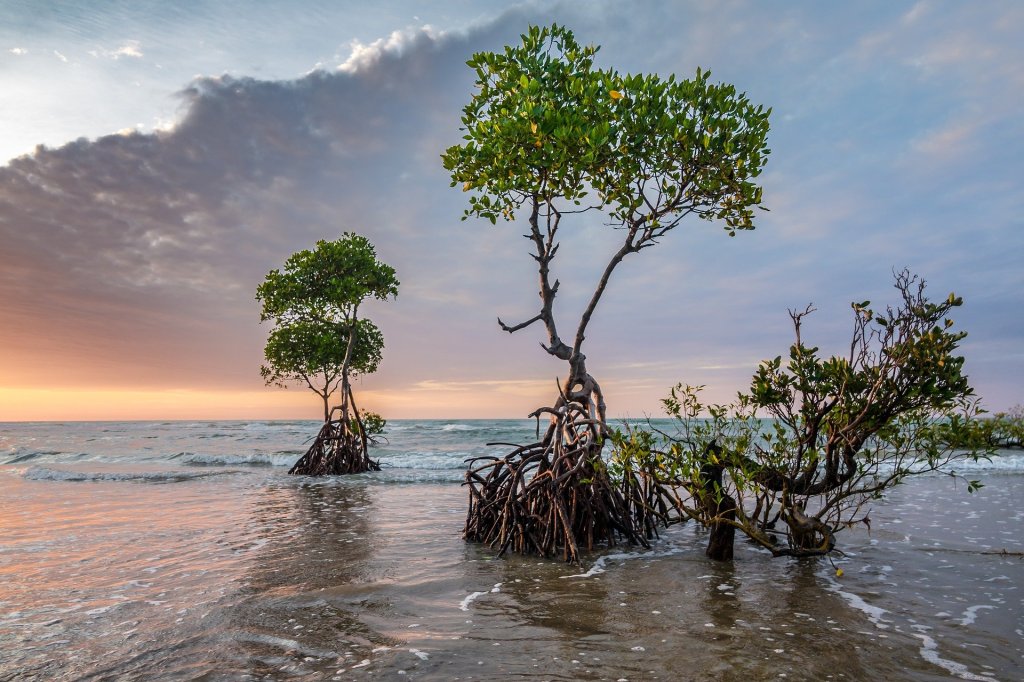
Among the sandy and rocky shores of estuaries and muddy sea coasts, in places where any other tree would perish as a seedling, beneath daily tides and a salty diet, lives a special type of tree. These are the mangroves. There are many species of mangroves, but all are united by a common property: their tolerance to salt.
What makes these trees salt-resistant? Some mangroves take in sea water, extract the salt with special glands and secrete it from their leaves. Others have roots that filter out most of the salt even as it enters the tree. The remaining salt is stored in the oldest leaves of the tree—those that are about to fall. Thus the salt does little harm.
Mangrove trees have to adapt not only to living in salt water, but also to growing in continually shifting sandy soil which gives little scope for the trees to get a firm hold. Mangroves anchor themselves to the soil by sending out long roots from trunk and branches. These act as stilts to support the tree and prevent it from toppling over. The muddy water where they live contains very little oxygen, but the mangroves have an ingenious solution to this problem too. The trees send out a second air-breathing root system—not downwards, but poking up above the mud, like the snorkel of a diver!
The offspring of the mangroves are as remarkable as their parents. The seeds of most mangroves germinate on the tree, producing a pointed stem about a foot long, with roots and leaves just formed. If the juvenile plant drops into the water at low tide, the stem plummets into the mud below, and is ready to take root immediately. If the young plant is washed out to sea, it may eventually hit land—a sand bar or coral reef, and start to grow there. Someday, given the right conditions, this mangrove and its own offspring could start a mangrove swamp of their own.
In addition to the props that come down and the roots that poke up, the tangled roots at the base of the mangrove trap the silt and debris from the sea, as well as the trees’ own fallen leaves. Over time, this accumulation helps to create more land area around the mangrove trees. And a new habitat is created.
Mangrove swamps perform a very important role for the land and the ocean that they straddle. They provide vital breeding grounds and habitats for a wide variety of fish and crustaceans. The nutrient-rich soil provides food and shelter to innumerable organisms, including monkeys, deer and birds, and a source of nectar for honeybees. The fallen leaves provide shelter to tiny shelled creatures. Floating mangrove leaves provide a base for larval growth and micro fauna. The rotting leaves provide food for insects, reptiles and shellfish. These smaller creatures form food for the larger creatures that live or pass through the swamps. Many fish-eating birds come here for the abundant food and shelter. Mangroves support complex communities, where thousands of other species interact. It is a world teeming with biodiversity.
Mangroves also ensure food security for human beings. By sustaining fisheries and through the numerous forest produce they provide, mangroves also sustain local communities with food and livelihoods.
Mangroves nurture the seas and protect the land. Mangroves act as a form of natural coastal defence: reducing erosion, attenuating waves (including tsunamis) and reducing the height of storm surges. They protect coral reefs, sea grass beds and shipping lanes against siltation. They help control floods by catching and spreading high velocity flood waters and trap it amongst their roots. Thus they protect coastlines from erosion and extreme weather events, and contribute to water quality by filtering out nutrients and sediments. Mangrove soils are highly effective carbon sinks. They are among the most carbon-rich tropical ecosystems globally, and can contain more carbon per square metre than tropical rainforests. They also fight climate change – with global mangrove forests sequestering as much as 22.8 million tons of carbon each year.
Healthy mangrove ecosystems are vital for the wellbeing, food security, and protection of coastal communities worldwide. Mangroves are among the world’s most dynamic ecosystems, but increasing encroachment by development and industry means they are also among the most at risk.
All over the world mangroves are being degraded at an alarming rate. They are being destroyed at rates 3-5 times greater than average rates of forest loss. Multiple pressures are destroying these unique ecosystems which perform vital functions for both the terrestrial and marine habitats that they nurture and protect.
Mangroves are exploited, directly or indirectly, for food, timber, medicines, honey, charcoal, and fisheries. There is tremendous pressure on the areas where they grow due to increasing population and its demands. One of the main threats to mangroves is from habitat destruction for coastal development and aquaculture. Mangroves have been converted into salt pans, aquaculture ponds or paddy fields. Rising sea levels are a longer-term challenge.
Pollution and over-exploitation are also reducing the ecosystem services provided by mangroves. Changes in local water conditions caused by upstream dams, irrigation and pollution have led to the loss of many mangroves. Mangroves are often used for dumping waste, including plastics that do not degrade, harming both these ecosystems and the species living there. The accumulation of marine debris can alter the physical and chemical composition of sediments.
Mangrove swamps are called ‘mangals’ in India. About 50 species of mangrove trees are found in our mangals. The maximum number of mangrove species have been reported from the Orissa coast. The best mangrove formations in India occur in the Sundarbans in the Bay of Bengal, and in the Andaman and Nicobar islands. The Sundarbans is believed to be the largest single block of tidal mangrove forests in the world where all the species of Indian mangroves are represented. Sundarbans has been designated a UNESCO World Heritage Site. However these unique ecosystems are under as much threat as those across the world.
The earth and humanity simply cannot afford to lose these vital ecosystems.
In recognition of this the General Conference of the UN Educational, Scientific and Cultural Organization (UNESCO) has declared the International Day for the Conservation of the Mangrove Ecosystem to be celebrated on 26 July every year. The day aims to raise awareness of the importance of mangrove ecosystems as “a unique, special and vulnerable ecosystem” and to promote solutions for their sustainable management, conservation and uses. There are several international as well as national initiatives that are working towards these solutions. This day is a reminder of the pivotal role of mangroves in preserving ecosystems.
–Mamata



 Millennial Matriarchs