The Call of the Mountains: Nan Shepherd

December 11 is marked as the International Mountain Day. Mountains have always fascinated human beings not only for their sheer scale and majesty, but also as a natural element that offers a challenge, as well as a test of physical and mental strength, and the thrill of scaling the peaks. There are numerous narratives of expeditions that describe these challenges and achievements, most of these by, and about men.

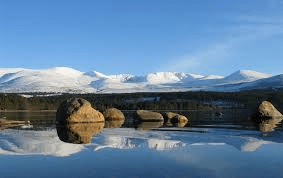
The Cairngorms

A different perspective, and approach towards mountains reminds us that there is more to mountains than the thrill of conquest.

This was lyrically described by Anna (who called herself Nan) Shepherd, a Scottish poet, writer and explorer of mountains. Nan was born in February 1893, close to Aberdeen on the North East coast of Scotland. When she was one month old, her family moved to nearby Cults and lived in a house with a garden overlooking the hills. Nan continued to live in the same house almost till the end of her life. As a young girl Nan was encouraged by her father, a keen hill walker, to explore the nearby hills, and this planted in her a lifelong love for nature and the mountains. Nan was an equally avid reader, and from her early teens she would fill notebooks with passages that inspired her from the wide spectrum of her reading. After completing her schooling in 1912, Nan joined the University of Aberdeen in the first decades after women were allowed to do so. She was an outstanding student, and graduated in 1915 with an MA in literature. Following this she taught English literature at Aberdeen Training Centre for Teachers, and continued to give enthralling lectures until she was well into her eighties. She was not only an inspiring teacher but also a role model for her students, as an early feminist. She wryly described her role as “the heaven-appointed task of trying to prevent a few of the students who pass through our Institution from conforming altogether to the approved pattern.”

Although she had always enjoyed walking in the hills, Nan Shepherd became deeply engaged with climbing in the period between the two World Wars. She was thirty years old when she began her explorations in the Cairngorms in 1928. This experience was the start of a passion that came to define both her life and her writing. From then on, she sought to escape into the Cairngorms whenever her job would allow. Often she would walk alone, camping out, and wading into hidden lochs. Occasionally she was accompanied by friends and fellow walkers from the local Deeside Field Club, or by students from the university.

By the 1940s Nan had scaled some of the highest peaks in the Cairngorms, among the wildest landscapes in the British Isles. However Nan’s expeditions were not about ‘reaching the top’ but rather a spiritual journey to ‘understand herself and the world’. She became fascinated by what happened to mind and matter on this journey up and down the mountain slopes.

These experiences were reflected in her literary work. The harsh landscape, as well as the people and places she knew well, provided the background to her first three books, published while she was teaching. These novels focussed on the harsh landscape which made for a harsh way of life, and within these, complexities of women struggling with maintaining traditional roles in a dawning age which was opening up new opportunities

But Nan Shepherd never wrote for recognition. She wrote only when she felt she had something worth saying. “I don’t like writing, really. In fact, I very rarely write. No. I never do short stories and articles. I only write when I feel that there’s something that simply must be written.”

For her teaching was as, if not more, important than her writing. However she continued to document her explorations of the Cairngorms, which came together around the end of the Second World War, under the title The Living Mountain. She combined her knowledge of the mountains, her observations of their rugged beauty, and her literary skills to muse on the philosophical and spiritual offerings from mountains. She wrote of the Cairngorms as “friends” that she “visits”, and with whom her imagination is fired as if “touched by another mind.”

 Nan Shepherd completed her book in the summer of 1945, and sent her manuscript to a novelist friend. He cautioned that it may be hard to find a publisher of a book of this nature. Nan put the manuscript away in a drawer where it remained for 30 years. Towards the end of her life, Nan retrieved the manuscript from her drawer and felt that it still resonated in many ways. Given her long association with Aberdeen University, she submitted it to Aberdeen University Press. The Living Mountain was finally published in 1977.

The Living Mountain threaded together, beautifully geography, geology, history and philosophy, along with everything that she herself had experienced in the mountains that she had fallen deeply in love with. For Shepherd, the mountains were living beings, and her book describes how she nurtured her relationship with them by walking. She wholeheartedly believed that only through walking and experiencing could insight be gained. “The more one learns of this intricate interplay of soil, altitude, weather, and the living tissues of plant and insect … the more the mystery deepens.”

The Living Mountain, continues to be timeless, since its publication 30 years after Nan Shephard wrote it. It provides a rare lens into a world that has been viewed mainly through the eyes of male climbers, who focus on the challenges, and the conquests. Nan Shepherd’s lens is that of a naturalist and poet, one of contemplation, reverence, and an exploration of the profound. The book suggests that the summit should not be the organizing principle of a mountain; it urges the practice of not walking “up” a mountain, but rather “into” them, so as to explore not just the physical forms but also ourselves, peering into the nooks and crannies.

Today, mountains across the world are facing their own challenges. Climate change is melting glaciers and distorting landscapes; the surge of climbers are leaving behind manmade mountains of garbage that threaten to bury the real mountains. This is a good time to remember The Living Mountain, and a mountain lover who looked beyond the ascents to the journeys within.

–Mamata Pandya

Birdwoman Jamal Ara

12 November marks the birthday of Salim Ali the Birdman of India. Much has been written and published by, and about, Salim Ali. However very little is known about a young woman who was recognized as the first Bird Woman of India by Salim Ali himself. This was Jamal Ara, a path breaker in more ways than one.

Jamal Ara was born in 1923 in Barh, Bihar, in a conservative Muslim family. She could study only until class ten before she was married off at a young age, much against her wishes. She moved to Calcutta with her husband where a daughter, Madhuca, was born. Sadly her marriage broke down, leaving her in dire straits. Fortunately a cousin who was in the Forest Service in Bihar, came to her aid and Jamal and her daughter moved to Ranchi. As a forest officer, her cousin was posted to different forest divisions of Bihar, and Jamal often accompanied him on his trips. This sparked in her a great love for wildlife, and Jamal would spend hours observing the flora and fauna in her surroundings. The English wife of a senior forest officer encouraged her to keep notes of her observations, and helped her to hone her writing skills. As her proficiency grew, they also encouraged her to turn her notes into articles and send them for publication.

Jamal Ara spent many years doing extensive field work in what is now Jharkhand, and her study of birds in the Chota Nagpur plateau was comprehensive and detailed. She meticulously documented her observations, and wrote prolifically from 1949 to 1988.  She contributed over 60 papers and articles to the journals of the Bombay Natural History Society and Bengal Natural History Society. She could communicate equally well with a lay audience. She wrote for The Newsletter for Birdwatchers, which was popular with amateur as well as seasoned birdwatchers, and also a book for children, Watching Birds which was published by National Book Trust, and translated into many Indian languages. I remember this book as being one of my own early introductions to nature study.

Jamal Ara was a multi-faceted writer. She wrote fiction, translated stories, and worked as a journalist for a short time. She also did programmes for All India Radio. Jamal Ara was also much more than a birdwatcher. She saw birds as an integral part of a healthy ecosystem, and advocated for a balanced conservation approach, something that was not common in an age when shikar was also a popular pastime.

After such an intense involvement in ornithology, and a prolific contribution to the field, in 1988, Jamal Ara suddenly vanished from the Indian ornithology scene. Her contributions stopped, and she herself disappeared. It is believed that a series of personal losses and setbacks affected her badly. She stopped writing, and after a few years also burnt her notes and photographs. She died in 1995.

Gradually Jamal Ara’s name and contributions sunk into oblivion. She would have been lost to the history of Indian conservation if not for a young researcher Raza Kazmi, who stumbled upon a story by Madhuca Singh, a celebrated basketball coach of Ranchi who mentioned Jamal Ara, her mother, who was a great bird lover. Raza Kazmi was intrigued by this mysterious bird lover, and embarked on a search for this woman and her work. After chasing numerous leads, he finally connected with Madhuca who shared her mother’s story.

It is thanks to Raza Kazmi’s single-minded pursuit, and the publication of Jamal Ara’s story in the book Women in the Wild edited by Anita Mani published in 2023, that we can join in celebrating this enigmatic, but brilliant bird woman of India.

It is also heartening that whatever had remained of Jamal Ara’s original work has been collected and digitized as part of the Archives at NCBS, a public centre for the history of science in contemporary India. The Jamal Ara Collection has archival papers relating to her life and work from 1940s to 1980s, including correspondence, unpublished manuscripts, field diaries and notebooks, and drafts of articles.

This week, as we celebrate Salim Ali, as well as Jamal Ara, both passionate bird watchers, here are a few words from them that remind us of the simple joys of bird watching.

”A bird’s song is a sound that touches the soul; it reminds us of the beauty of nature that we must protect. For me, birds have always been the greatest source of joy and inspiration.”  Salim Ali

“Even if you are not a birdwatcher and are not even faintly interested in them you cannot barricade yourself successfully against fugitive but striking impressions that the sight of a bird invariably leaves. The impression is not altogether fleeting although the sight may have been. It persists in memory. Colour, song, manner of flight, the build or some aspect of physiognomy may have thrust itself into your consciousness and nestles there pleasantly. That is why there is no person entirely uninterested in birds. Most persons are unattentive but a few helps to their stored memories and they start taking an interest in birds. They become attentive and surprise themselves by evolving into birdwatchers.” Jamal Ara 

–Mamata

A Moon of Many Names

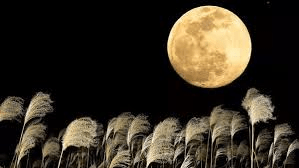
This week offered a rare celestial phenomenon which also coincided with the festival of Sharad Purnima, the full moon heralding the beginning of the winter season in India. This was the appearance of the Harvest Moon. This was one of the Supermoons that are scheduled to appear this year.

The Moon’s orbit around the Earth is not circular but elliptical, meaning that the distance between the two varies throughout the year. A Supermoon is when the moon is full at its closest point to the earth, called the perigree, or within 90% of its closest point. When it is at this point, the full moon appears noticeably larger and brighter. The term Supermoon was first coined by astrologer Richard Nolle in 1979.

The recent October full moon is known as the Harvest Moon. The Harvest Moon is the name given to the full Moon that rises closest to the Autumn equinox which is usually around 22 September, but aligning with the time between late September and November. During these weeks, the full moon tends to rise earlier than usual for several nights in a row, causing the evening sky to stay illuminated for a longer time. The name dates from the time before electricity, when farmers in the northern hemisphere depended on the Moon’s light to harvest their crops late into the night. The Moon’s bright light and extended period of illumination was particularly important during fall, when harvests are the largest in America.

Over time different cultures, have traditionally given names to full moon across the lunar calendar. The cycles of lunar phases were also a method of timekeeping. For example, in many Native American tribes, names of full moons reflected what was happening in Nature at that time. For example: January: Wolf Moon named after the howling of hungry wolves lamenting the scarcity of food in midwinter. February: Snow Moon reflecting the month’s typically cold, snowy weather. March: Worm Moon after the worm trails that would appear in the newly-thawed ground. April: Pink Moon after a species of early blooming wildflower. May: Flower Moon as thanks for the abundant blooming of spring flowers. June: Strawberry Moon to reflect the time for harvesting of strawberries. July: Buck Moon for the time when male deer, which shed their antlers every year, begin to regrow them. August: Sturgeon Moon which is when this fish species appeared. September: Full Corn Moon when crops are gathered at the end of the summer season. It is often the nearest full moon to the autumnal equinox, earning the title of ‘harvest moon’. October: Hunter’s Moon which gives hunters enough light to be able to stalk prey and hunt at night. November: Beaver Moon which refers to both the time when beavers are actively building dams, and also when hunters set beaver traps. December: Cold Moon which marks the setting in of winter.

The moon and its cycles have fascinated people from time immemorial. While the Native American tribes found a close connection of these cycles with their own life and work cycles, the mystery of the moon has also been the staple of folklore and fantasy. Several Asian cultures have tales about the moon. In China and Japan one of the zodiac animals–the rabbit—also has links with the moon.

There is a popular folktale in Japan about the Moon Rabbit which is believed to have its origins in the Buddhist origin tale. As one version of the story goes:

Many years ago, the Old Man of the Moon decided to visit the Earth. He disguised himself as a beggar and asked Fox (Kitsune), Monkey (Saru), and Rabbit (Usagi) for some food.

Monkey climbed a tree and brought him some fruit. Fox went to a stream, caught a fish, and brought it back to him. But Rabbit had nothing to offer him but some grass. So he asked the beggar to build a fire. After the beggar started the fire, Rabbit jumped into it and offered himself as a meal for the beggar to eat.

Quickly the beggar changed back into the Old Man of the Moon and pulled Rabbit from the fire. He said “You are most kind, Rabbit, but don’t do anything to harm yourself. Since you were the kindest of all to me, I’ll take you back to the moon to live with me.”

The Old Man carried Rabbit in his arms back to the moon and he is still there to this very day exactly where the Old Man left him. Just look at the moon in the night sky and the rabbit is there!

The rabbit on the moon is called Tsuki no Usagi in Japanese. People imagine when they look up at the full moon that they can see the shape of the rabbit pounding rice cakes with a pestle. At Jugo-ya the Japanese mid-autumn festival, people gather to watch the full moon, and children sing a song about Usagi the moon rabbit.

There is a similar legend in Korea where the moon rabbit is known as Daltokki, and also pounds rice cakes. In Vietnam, in a similar legend, the white rabbit is named Tho Trang. All these are celebrated at the Mid-Autumn festival.

The legend has also captured the fantasy of modern artists. A Dutch artist Florentijn Hofman created a giant moon rabbit as part of a display at the Taoyuan Land Arts Festival in Taiwan in 2014. It was made of 12,000 pieces of Tyvek, a kind of high-density polyethylene fibre, and placed in the open where it looked as if it was staring at the clouds in the sky and daydreaming, as the breeze ruffled its tyvek ‘fur’.  

India too has its share of moon legends. Whatever we may imagine we see in the shadows on the moon, the sight of a full moon is always breath-taking. This year the Harvest Moon which usually occurs in September, was on 6 and 7 October, a rare occurrence. Sadly many missed a clear viewing as many parts of the country had rain or cloud cover. But not to despair, this year will still allow us to enjoy two more Supermoons—on 5 November and 4 December.  

–Mamata

Stars in the Forest: Fireflies

Photo source: https://www.firefly.org/

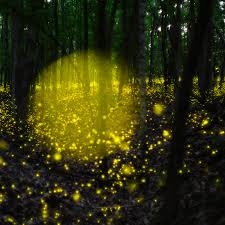
Poets have celebrated them, children have been awe-struck by their magic, scientists have not yet unravelled all their mysteries …These are fireflies that glow and twinkle in the dark of the night, like the stars come down to earth.

What makes a firefly? The ‘fly’ part of the name is misleading as these insects are not flies but soft-bodies beetles.

The ‘fire’ in the name is more self-explanatory. It comes from the flashes of light that these insects naturally produce. This phenomenon is called bioluminescence. It is caused through a chemical reaction by two enzymes in a firefly’s tail: Luciferin which is heat resistant and glows under the right conditions (in Latin the word Lucifer means ‘light-bearing’), and luciferase, an enzyme the triggers light emission. The two enzymes combine in the presence of magnesium, oxygen and ATP (Adenosine Triphosphate), to emit light.

This bioluminescence in fireflies is nearly 100 per cent efficient, in that very little energy is wasted to produce their light. By contrast, in an incandescent light bulb 90 per cent of the energy is lost as heat. Because it produces no heat, scientists refer to firefly lights as “cold lights.

Like most insects, fireflies have four life stages — egg, larvae, pupa, and adult. Their average lifespan is around two years, most spent of this is spent as larvae. But fireflies emit light at all stages of their life. Their tiny eggs glow in the darkness underneath leaf litter; the worm-like larvae glow as they crawl around the forest undergrowth, and the adults shine as they fly around among the forest foliage.

Scientists believe that fireflies evolved the ability to emit light to avoid predation, warn predators (like bats, birds, and toads), and signal that they are distasteful. Fireflies release drops of toxic, foul-tasting blood, and their light is an early warning that keeps predators away.

Over time, adult fireflies began using this ability to emit light as a mating signal. Every firefly species has a unique flash pattern, much like Morse code. When a male firefly wants to communicate with a female firefly, he flies near the ground while he flashes his light every six seconds. Once he’s near the ground, a female can more easily tell if he’s from the same species as she is. (Most female fireflies can’t fly.) She answers his flashes by turning on her lights. Then the male finds her. That’s how males and females of a species identify each other and mate.

After the twinkling courtship, an adult firefly lives only long enough to mate and lay eggs in the soil or on aquatic plants. The larvae hatch in around 25 days. The larval form lasts two months to over a year (depending on the species), before becoming adults and giving birth to the next generation. The larvae eat snails, worms, and slugs, which they inject with a numbing chemical to disable. An adult firefly’s life span is just one to three weeks.  Not much is known about what the adults eat; they may feed on plant pollen and nectar, or they may eat nothing.

Presently there are about 2,000 firefly species globally, although there may exist many more which are not yet known to science. They are found on all continents except Antarctica, and inhabit a wide range of habitats: forests, grasslands, marshes, coastal mangroves, and even vacant plots and city parks which meet their two important requirements: adequate food for their larval form (slugs, snails and small insect larvae), and darkness so that adult fireflies can use their light signals to find mates. At least 50 species have been reported in India, distributed across the country.

Fireflies have been on earth for at least 100 million years. Sadly in this  anthropocene epoch firefly populations are in decline. This is because the natural habitats where the adults fly and mate are destroyed or degraded, the pesticides in agriculture fields kills firefly larvae and the insects that they depend on for food. Artificial lighting from streetlights, buildings and vehicles creates light pollution and wipes the darkness that is necessary for the firefly’s signalling during mating season.

A recent year-long study carried out by Tamil Nadu Forest Department’s Advanced Institute for Wildlife Conservation (Research, Training and Education) about the insect’s genetic diversity, distribution, habitat and their ecology, and seasonal changes in population, as well as the environmental conditions at ten different locations within the Annamalai Tiger Reserve identified at least eight distinct species within different micro habitats. The studies aimed to understand the health of the ecosystem and develop strategies to conserve firefly habitats.

The study reinforced the concern that human activities, especially those that create a lot of artificial light (headlights, floodlights from religious festivals, and even the glow of mobile phones) in buffer areas around protected areas are adversely affecting fireflies. This affects synchrony, the phenomenon where thousands of fireflies flash in unison and which is an ecological marker, an indicator of habitat health.

At the same time there are also opportunities for non-scientists to enjoy the pure magic of firefly illumination at some places in Maharashtra which hold Firefly Festivals in May-June every year. Two of these are in Bhandardara (Kajwa Mahotsav) and Purushwadi.

But one can always be on the lookout for even a little spark of the magic in a dark park or garden (even your own) between May to July when adult fireflies emerge. And if you are lucky enough to spot fireflies you can become a citizen scientist by becoming a part of FireflyWatch (https://citsci-india.org/projects/project/fireflywatch/)

–Mamata

Celebrating Artful Elephants

August 12 is marked as World Elephant Day. And it is also Ganesh Charurthi time. So an appropirate time to talk about elephants.

The Asian Elephant is an endangered species, with less than 50,000 left in the wild across the world. And hence the importance of marking this day as a way of raising awareness about elephants and the dangers that threaten them.

What we see is what we grow to love and respect. And hence the importance of all the depictions of elephants we see around us—from sari borders to sculptures in ancient temples to the life-sized sculptures made from invasive weeds found in the Nilgiris, crafted by indigenous communities. Each and every one of them is an opportunity for education about our biodiversity and this magnificent species.

One can understand the ubiquitousness of elephant imagery in India—after all we hold about 60 per cent of the numbers. But interestingly, it is Taiwan which was well-known for elephant imagery all over its public parks and schools, in the form of Elephant Slides.

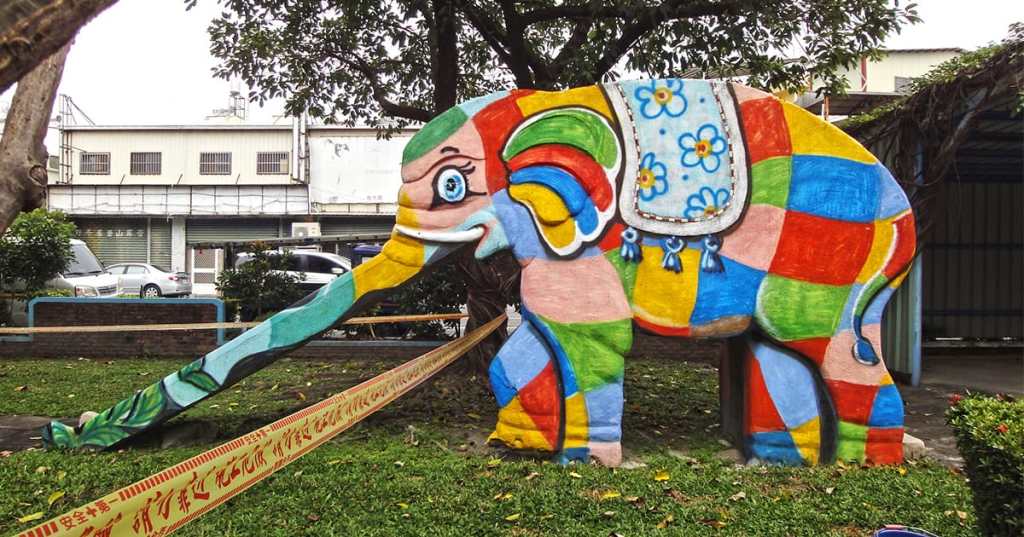
These are the whimsical, solid, painted playground fixtures affectionately known as “Grandpa Elephant”— and they hold fond memories for a generation of Taiwanese kids, now grown.

The elephant slide was a fixture of childhood in Taiwan from the 1960s through the 1980s. Found in schoolyards and public parks, these slides were typically made from china-mosaic or concrete, with a stairway or ladder up the back and a gently curved trunk functioning as the slide.

Many bore motivational slogans etched into the sides: “Strengthen your body to build the country.” Even in play, the messaging was patriotic. But for kids? It was all about the joy of scrambling up that broad back and riding the trunk like it was the gateway to an imaginary world.

Now, with safety codes tightened and tastes modernized, many of these eleslides have disappeared. But a movement to preserve and honour them has taken root, led by artists, writers, and nostalgic grown-ups determined to keep these gentle giants from fading away completely.

A Concrete Revival

Writer Yu Chiu-ling and designer Hsiu Pi-cheng have been at the forefront of this effort. Yu founded the Facebook group “Find Our Elephant Friends,” a digital scrapbook of elephant slide-sightings across the island. Hsiu has documented over 400 slides, many tucked away behind schools or community centres, quietly waiting to be remembered.

Their work isn’t just about playground preservation — it’s about cultural memory. About honouring the handmade, the imperfect, and the deeply local.

Elephants Across Borders

Asian elephants range across. Bangladesh, Bhutan, Cambodia, China, India, Indonesia, Laos, Malaysia, Myanmar, Nepal, Sri Lanka, Thailand, and Vietnam. Strangely, there have never been elephants in Taiwan in the wild in recorded history. While elephant fossils have been found on the island, indicating their presence in prehistoric times, there is no evidence to suggest that elephants lived in Taiwan during the period of human history documented by archaeology and literature. 

But Taiwan does have the most emotionally iconic version of the elephant slide!  You will also find their cousins in parks across Japan, Thailand, Vietnam, and parts of Eastern Europe. From Soviet-era concrete sculptures to candy-coloured cartoon versions in Tokyo suburbs, the idea of turning a beloved elephant into a playmate has clearly crossed cultures. But sadly, no ele-slides in India!

Unfortunately today, both real elephants and their concrete urban renderings are endangered. One is fighting for survival in an increasingly human-dominated world. The other is quietly disappearing with changing times.

Elephants have always symbolized memory, strength, and gentleness.

Let’s protect the real ones. And let’s remember the playful ones, too.

Happy Ganesh Chaturthi!

–Meena

PIC: https://www.thisiscolossal.com/wp-content/uploads/2023/07/pi-og.jpg

Nature’s Libraries: Where the Wild Data Lives

National Librarian’s Day is celebrated on August 12th every year to commemorate the birth anniversary of Dr. S.R. Ranganathan, the “Father of Library Science in India”.

When we say “library,” most people imagine rows of books, a quiet reading room, and perhaps a stern librarian at the desk. But in the language of library science, a “library” is defined less by its shelves and more by its functions — acquiring, organising, preserving, and making knowledge accessible.

By that definition, the world is full of libraries that hold no books at all. Some store bird calls. Others archive satellite images. Some collect DNA sequences. In fact, they are not physical spaces at all. Many are vast online repositories where scientists and citizens alike can deposit, discover, and use data.

On this Librarians’ Day, let’s explore how these nature and biodiversity depositories perform the same core functions as traditional libraries — only their collections are wild, living, and often invisible to the naked eye.


Acquisition: Gathering the Wild

Libraries begin by collecting materials. In biodiversity repositories, this might mean researchers uploading recordings to Macaulay Library (Cornell Lab of Ornithology) or Xeno-canto, which crowdsource bird calls from around the world.

  • Example: iNaturalist “acquires” photographs and species observations from millions of contributors.
  • Example: GBIF (Global Biodiversity Information Facility) harvests species occurrence data from institutions and citizen scientists alike.

Just as a public library acquires books from publishers and donors, these nature libraries acquire data from field biologists, monitoring equipment, and enthusiastic amateurs.


Organisation: Making Sense of the Collection

Without organisation, a library is just a warehouse. And hence the focus on developing classification systems. Dr. S.R. Ranganathan primarily used and developed the Colon Classification (CC) system. The Dewey Decimal system is the widely prevalent one used in most libraries across the world.

Biodiversity data portals however are based on the Linnaean system of classification and organize living organisms based on evolutionary relationships. This involves classifying organisms into hierarchical groups like kingdom, phylum, class, order, family, genus, and species. This is.

  •  Example: BOLD (Barcode of Life Data System) and GenBank organise genetic sequences by species, geography, and collection method.
  • Example: ITIS (Integrated Taxonomic Information System) standardises names so scientists worldwide speak the same language.

The result? You can search for a frog by its Latin name, its genetic barcode, or the location where it was found — just like you can search for a book by title, author, or subject.


Preservation: Guarding the Record

One of a library’s noblest duties is preservation — ensuring the information remains available for future generations. In biodiversity repositories, this may involve:

  • Storing acoustic recordings (bat calls, whale songs) in durable digital formats.
  • Archiving satellite imagery in systems like NASA Earthdata and Global Forest Watch for long-term environmental monitoring.
  • Keeping herbarium records in Tropicos and long-term forest data in ForestGEO.

Like rare manuscripts in acid-free folders, these data are preserved against loss, decay, and obsolescence.


Access: Opening the Doors

Libraries thrive when they are accessible. Many biodiversity repositories are open access — anyone can explore them. And importantly, contribute to them.

  • eBird lets birdwatchers view migration patterns and personal checklists.
  • FishBase offers species profiles for students, fishers, and marine scientists alike.
  • OBIS (Ocean Biogeographic Information System) gives marine biologists open access to ocean species occurrence data.
  • Merlin helps users identify birds by their calls.

Some repositories, like Wildlife Insights or certain ethnobotanical databases, may have restricted access for sensitive data — similar to a library’s rare books section.


Dissemination: Spreading Knowledge

A library doesn’t just keep information — it shares it. Biodiversity repositories publish datasets for conservation planning, scientific research, and education.

  • Movebank shares animal movement data for migration studies.
  • TRY Plant Trait Database supports climate change modelling.
  • The Digital Himalaya Project disseminates ethnographic and ecological knowledge, bridging science and tradition.

Why These Libraries Matter

By meeting the same functional standards as a traditional library — acquisition, organisation, preservation, access, and dissemination — biodiversity depositories are not just “like” libraries, they are libraries. Their collections may be recordings instead of novels, or genetic codes instead of encyclopaedias, but the principles are identical.

In a time of rapid environmental change, these libraries are our collective memory-keepers for life on Earth. They store the songs of rare birds, the paths of migrating whales, the genetic fingerprints of endangered plants, and the traditional wisdom of communities who have lived with nature for centuries.

So this Librarians’ Day, remember: the guardians of knowledge are not only in buildings with books. They are also in digital sound archives, genetic databases, satellite imagery vaults, and underwater biodiversity surveys. Wherever knowledge is collected, cared for, and shared — there, you will find a library. Dr. Ranganathan, I am sure,  would have been excited to explore the new realms of libraries and library science!

–Meena

There are a wide range of data depositories and libraries related to nature and biodiversity across different domains—ranging from sounds (like bat and bird calls) to genetics, species observations, satellite imagery, and more. Here is a list of some of these depositories, which Chat GPT has been kind enough to put together!


🦇 Acoustic and Sound Libraries

  1. Bat Call Library – Region-specific databases like EchoBank or ChiroVox.
  2. Macaulay Library (Cornell Lab of Ornithology) – Massive archive of bird sounds, videos, and photos.
  3. Xeno-canto – Open-access database of bird calls and songs from across the world.
  4. AmphibiaWeb – Includes some amphibian vocalization data.
  5. BLB (British Library Sound Archive – Wildlife Section) – Historical and contemporary recordings of animals.

🌍 Species Observations and Biodiversity Portals

  1. GBIF (Global Biodiversity Information Facility) – Gigantic open-access database of species occurrence data from around the world.
  2. iNaturalist – Crowdsourced species observations with photos, locations, and identification support.
  3. India Biodiversity Portal – India-specific citizen science portal on biodiversity with species pages, maps, and observations.
  4. eBird – Global birdwatching database with detailed observation checklists and trends.
  5. OBIS (Ocean Biogeographic Information System) – Marine species occurrence data.

🧬 Genetics and Taxonomy

  1. BOLD (Barcode of Life Data System) – DNA barcoding records of species.
  2. GenBank – Nucleotide sequences, often used for genetic identification of species.
  3. Encyclopedia of Life (EOL) – Species information including taxonomy, distribution, and media.
  4. ITIS (Integrated Taxonomic Information System) – Authoritative taxonomic info, mainly for North America.

🛰️ Remote Sensing and Environmental Data

  1. MODIS / NASA Earthdata – Satellite data on vegetation, land cover, fires, etc.
  2. Global Forest Watch – Forest cover, loss, and gain data based on satellite imagery.
  3. NOAA Climate Data Records – Atmospheric, oceanic, and climate-related datasets.

🐾 Camera Trap and Movement Data

  1. Movebank – Open-access database for animal movement (GPS collar) data.
  2. Wildlife Insights – Global camera trap image database, AI-assisted.
  3. PanTHERIA – Ecological and life-history data of mammals.

🌿 Botanical and Ecological Datasets

  1. TRY Plant Trait Database – Global plant trait data.
  2. Tropicos (Missouri Botanical Garden) – Botanical information with herbarium specimen records.
  3. ForestGEO (Smithsonian) – Long-term forest monitoring data across the globe.

🌊 Marine and Aquatic Life

  1. FishBase – Comprehensive fish species database.
  2. SeaLifeBase – Same as FishBase but for all non-fish aquatic life.
  3. Reef Life Survey – Citizen science marine biodiversity data.

📚 Literature and Traditional Knowledge

  1. Digital Himalaya Project – Ethnographic and ecological archives.
  2. Ethnobotanical Database – Plant use in indigenous and traditional medicine.

PIC: wildlifedata.org/

Farmers of Our Forests: Hornbills

Last week saw the launch of India’s first Centre of Excellence for Hornbill Conservation. This is hosted by the Anamalai Tiger Reserve in Tamil Nadu, and will be dedicated to the long-term study and conservation of this threatened species.

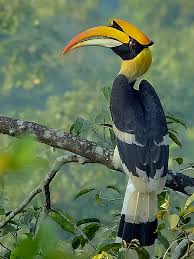
Great Hornbill

What are hornbills, and why are they threatened?

Hornbills get their name from the casque—a horn-like projection on the top of their long and downward-curving beak. While this is their defining feature, bright skin around their eyes and long eyelashes, and a brilliantly-coloured pouch of loose skin at their throat add to their striking appearance. They also have distinctive calls. Hornbills are giants among the forest birds in many ways.

There are 62 hornbill species worldwide, with 32 found in Asia and 30 in Africa. India is home to nine species. Among these: The Great Indian Hornbill or the Great Pied Hornbill is the largest among the hornbills found in India. The Malabar Pied Hornbill is endemic to tropical forests in India and Sri Lanka. The Rufous-necked Hornbill which is the most endangered, and the least studied of the nine hornbill species is found in the North-eastern parts of India.  The Narcondam Hornbill is only found in a 12 sq. km stretch in the tropical forest of the Narcondam Island in the Andaman Sea. The Malabar Grey Hornbill is endemic to the Western Ghats. The Indian Grey Hornbill is the most commonly seen hornbill species in India, and is sometimes spotted even in cities. 

Whatever the species, hornbills play a vital role in forest ecosystems as dispersers of seeds of forest plants, aiding the regeneration of forests. Hornbills are among the very few birds that can feed on fruits with large seeds. They digest only the fleshy parts of fruits that they swallow and then regurgitate the seeds, spitting them out, or defecating the seeds intact. As the hornbill flies from tree to tree, or during the nesting season flies back and forth over long distances to search for and carry food for its mate, the regurgitated cleaned seeds are dropped far and wide, enabling them to grow into trees far from the original trees from which they originated. The Namdapha National Park in Arunachal Pradesh has the highest density of hornbills across Asia. Studies have indicated that hornbills here disperse seeds at the rate of 11,000 seeds per day per sq. km! 

Thus hornbills are critical in keeping the forest alive. If we lose hornbills, many forest trees that depend on them to spread their seeds may eventually disappear from the forest too. Hornbills symbolise not only the health of a forest, but also a key to their continued survival.

Hornbills in turn, depend on a healthy tree density in the forest for their own survival. All hornbills are cavity nesters. While they cannot build their own nests or dig cavities, they use existing holes in a variety of trees to make their nest. The process begins during a month-long courtship when the male presents the female with food. As they embark on playful behaviour the pair also check out tree cavities to select their nesting site. Having done this, the two prepare the nest by cleaning it, creating the wall lining, and undertaking repair work. Once the nest is ready, the female prepares to confine herself in the nest while the male continues to provide for her needs by bringing food and nesting material. The female then seals the nest entrance with her own faeces, food and bark fragments, and mud pellets brought by the male. Only her beak protrudes out from the sealed nest. This helps to protect the eggs and chicks from predators. She lays her clutch of between two and five eggs and incubates them for over 20 days. Throughout this period the male diligently flies back and forth, feeding his mate through her protruding beak. The mother emerges from the nest shortly before the chicks themselves are ready to fly, and the chicks once again seal the nest from the inside, even as they continue to be fed. Now both the parents share in providing food and caring for the chicks. One of Nature’s many marvellous examples of nurturing the young.

This unique nesting habit of hornbills has also, in recent times, become a threat to the very existence of these birds. The fact that they use the same nests over the years makes it important to protect their nesting trees, and the habitats where they grow. The destruction of forests by habitat fragmentation, deforestation and clearance of forest areas for agriculture and dams is depriving these birds of places to nest and breed. The loss of native trees also affects their diet, posing a significant threat to their survival. Adding to these human-made threats is the impact of climate change which disrupts flowering and fruiting patterns critical to hornbill feeding and breeding. Thus it is imperative that the trees that they use, and the trees and forests that that provide them food and shelter to breed be protected. Sadly these are being rapidly depleted, thus endangering the birds

The rapidly increasing threat to these magnificent birds calls for urgent action at all levels, from the government measures to people’s efforts.

The Hornbill has great cultural symbolism among many tribes of North East India, especially in Nagaland and Arunachal Pradesh. A unique community-based initiative to protect nesting trees of hornbills is the Hornbill Nest Adoption Programme spearheaded by the Nyishi tribe in the Pakke Tiger Reserve in Arunachal Pradesh. The tribe which traditionally hunted hornbills for their casque which were a symbol of their tribal identity have become active partners in protecting and conserving the hornbill nesting areas. The programme invites donors across the world to become ‘hornbill parents’ by adopting hornbill nests. The donations help pay salaries to the local community nest protectors who patrol the area, and ensure that the habitat continues to invite these birds. What an appropriate way to celebrate a bird that is, in its unique way, a diligent nest protector and parent.

A great People’s Science initiative is Hornbill Watch, a website where anybody can share details of a hornbill sighting from anywhere in India. This user-friendly website can be accessed by people from all backgrounds to share their hornbill sightings; being a wildlife conservationist or photographer, or even an avid birder, is not a necessity. The website has information on Asian hornbills in general, and detailed descriptions of the nine species found in India, as well as photographs submitted by contributors. Over time the data collected would help in identifying and prioritizing sites for hornbill conservation.

Now the setting up of a dedicated Centre of Excellence for Hornbill Conservation is another important step. The Centre will focus on the four species that are found in the Western Ghats which is a globally recognized Biodiversity Hotspot. The four are: the Great hornbill, Malabar grey hornbill, the Malabar pied hornbill, and the Indian grey hornbill. The great hornbill and Malabar grey hornbill are categorised as vulnerable, while the Malabar pied hornbill is near threatened as per IUCN. The Centre will monitor hornbill populations, study their breeding habits, map their nesting sites and food sources, and track their movements using GPS or satellite telemetry techniques. The Centre will also engage with the local communities to work for habitat restoration and nest protection. 

The initiative looks beyond monitoring the species to protecting entire forest ecosystems upon which the hornbills depend for their survival, and which in turn are kept vibrant with help from their farmers—the Hornbills.

–Mamata

Waxing Moon? Waning Moon?

We usually think we know what we need to about the Moon. After all, we see it almost every night—peeking between clouds, trailing us on evening walks, or gleaming quietly over exam-season all-nighters. But ask most adults how to tell if the Moon is waxing or waning, or what phase it is in, and you’re likely to get a sheepish shrug.

Moon Day (July 20) is a good time to find out more—because the Moon is more than just a pretty face.

The Moon’s Phases

As we know, the Moon doesn’t shine on its own. What we see is sunlight reflecting off its surface. As the Moon orbits Earth once every 27.3 days, the portion we see illuminated changes depending on the relative positions of the Sun, Earth, and Moon.

But because Earth is also moving around the Sun, the complete lunar cycle (from New Moon back to New Moon) takes about 29.5 days. This is called a synodic month.

During this period, the Moon goes through eight distinct phases:

  1. New Moon – The Moon is between Earth and Sun; its illuminated side faces away from us.
  2. Waxing Crescent – A sliver appears on the right side (Northern Hemisphere). “Waxing” means it’s growing.
  3. First Quarter – Half of the Moon is visible—right half lit.
  4. Waxing Gibbous – More than half is lit, increasing toward full.
  5. Full Moon – The entire face is illuminated. Earth is between the Sun and Moon.
  6. Waning Gibbous – The light begins to shrink; left side remains lit.
  7. Last Quarter – Half again, but this time the left half.
  8. Waning Crescent – Only a small sliver remains on the left.

And then the cycle begins again.

What Does “Gibbous” Mean?

“Gibbous” comes from the Latin gibbosus, meaning hump-backed or bulging. It refers to the Moon when it’s more than half but not fully illuminated. A nearly full Moon—either on its way there (waxing) or just past (waning). So:

  • Waxing Gibbous = swelling toward full.
  • Waning Gibbous = shrinking after full.

Waxing or Waning?

If you are following the progress of the moon night after night, you will know if it is waxing of waning. But would you know if you just happened to glance up one night? Indeed there are ways to tell. In the Northern Hemisphere:

  • If the right side is lit, the Moon is waxing.
  • If the left side is lit, the Moon is waning.

This holds true whether you’re looking from a balcony in Bengaluru or walking through a park in Boston. But here’s where it gets interesting:

The Moon is Universal—but Not Identical

The same Moon is seen all over the world—but not always in the same orientation. If you’re in the Southern Hemisphere, everything flips:

  • Waxing appears with left side lit.
  • Waning shows up with right side lit.

In fact, a person in the Southern Hemisphere sees the Moon “upside down” compared to someone in the Northern Hemisphere. For example:

  • When it’s a First Quarter Moon in India, the right half of the Moon is illuminated.
    In Australia, it’s still the First Quarter—but they see the left half lit.
  • When it’s a Waxing Crescent in New Delhi, it appears on the right side.
    In Cape Town, that same sliver appears on the left side.

It’s the same phase, same Moon—but reality shifts, depending on where you stand!

Once we learn to read the Moon, it becomes a kind of nightly compass. It connects us to the rhythm of the Earth, of time itself. And yes, it’s also fun to casually identify a “waning gibbous” and enjoy the raised eyebrows from unsuspecting friends.

So the next time someone asks, “Is it waxing or waning?”—you’ll know. And if you’re feeling generous, you might just pass on that little rhyme:

🌒 “Right is bright, it’s waxing with might.”
🌘 “Left is lit, it’s waning a bit.”

–Meena

Picture source: https://spectrumnews1.com/wi/milwaukee/

Space Seeds to Moon Trees

It is Moon Week! Meena wrote about the different facets of the moon, in fact and fantasy. Just a couple of days ago, the Axiom 4 mission returned from its space sojourn with Grp. Captain Shubhanshu Shukla being a proud Indian member of the team. Much has been in the news about the experiments that the team carried out while on the International Space Station (ISS). One of these experiments was to sprout methi and moong seeds in petri dishes and then storing these sprouts in a storage freezer on the ISS. This experiment was part of the Sprouts project, designed to study how spaceflight affects food germination and plant development. Insights from this project could transform space agriculture to enable it to support a reliable supply of food for future space travelers. Some of the seeds will also be brought back to earth, and cultivated over several generations while research is carried out on the genetic, microbial and nutritional changes in these space-returned seeds. Today, astronauts on the International Space Station (ISS) regularly eat salad grown on board. Future long-duration exploration of the Moon and Mars depends on being able to grow fresh food in deep space.

Seeds have been travelling to space since 1971 when the Apollo 14 mission was launched. The mission put two astronauts Alan Shepard and Edgar Mitchell on the moon. As they walked on the moon the third astronaut Stuart Roosa continued to orbit above in the command module. Stuart Roosa was a former US Forest Service smoke jumper (a fire-fighter who parachutes to the site of a forest fire), before becoming a military aviator and astronaut.

When Roosa was selected for the moon mission he was entrusted with another important mission—to carry hundreds of seeds of trees with him. This was part of a joint experiment of NASA and the US Forest Service which selected seeds from five different types of trees. The seeds were x-rayed, sorted and classified, and sealed in small plastic bags stored in a metal canister. Roosa, the official ‘seed ambassador’ for the project carried the canister with more than 2000 seeds in a small canvas pouch as part of his personal belongings. This was the first time that seeds were being sent into deep space and it was an experiment to study how this would affect the seeds’ health, viability and long-term genetics. The seeds under Roosa’s care successfully completed the mission to the moon, but following their return the seed bags burst open during the decontamination process, leading to fears that the experiment’s environment had been contaminated and the seeds would not be viable. Nevertheless they were sent to the Forest Service offices in several places to see if they would germinate. In fact, many did germinate and grew into viable saplings. These 450 saplings were gifted to schools, universities, parks and government offices across the United States, in suitable locations in terms of climate and soil.

The saplings grew into trees which came to be known as ‘Moon Trees’. These were planted alongside their Earth-bound counterparts in order to compare the two. Fifty years later both grew into mature trees with no discernable difference.

Subsequently the collaboration between NASA and US Forest Service has continued with more seeds traveling to space with different missions. Upon their return the space seeds have been planted, and the next generation of Moon Trees are taking root and growing in multiple places. While the seeds in space have contributed to science, the Moon Trees are playing an important role in sparking curiosity about space, fostering a deeper understanding of NASA’s missions among the new generations of students, and nurturing community connections where they thrive.

Today there is a Moon Tree Foundation which aspires to unite, inspire, and conserve by planting a Moon Tree in every corner of the world. Its mission is to inspire interest in education, science, space, conservation and peace for all mankind. Moon trees serve as a reminder to take care of our planet for future generations as “we are under the same sky, looking at the same moon.”

–Mamata

The Curious Case of Poop-Eating Plants

Poop. Not a subject of polite conversation. But with a six-year-old granddaughter, this is an integral part of my daily discussions—stories and jokes which feature poop, farts, and belches, and I thought nothing could get me.

But poop-eating plants did! This is one of those bizarrely strange tales from the natural world that makes me marvel at how much we don’t know.

The next time someone tells you that plants only need sunshine, nutrients from the soil and water, its time to pop out the word coprophagy. That’s the term for poop-eating. Most often it’s associated with animals—rabbits, dung beetles, and sometimes dogs. But it turns out that some plants may also be participants in this less-than-dainty buffet. Not many, mind you. It’s an exclusive club.

The pitcher plant (genus Nepenthes) is a frontrunner in this strange category. While most carnivorous plants are famous for trapping insects, some tropical species of Nepenthes have found an alternative nutrient source—bat poop. In places like Borneo, bats roost conveniently above the pitchers, and their droppings fall right in. Scientists call it a “nutritional mutualism.” The bats get shelter; the plant gets dinner. Apart from bat-poop, plants are known to eat the poop of tree shrews, lizards, and even of birds. These flowers even resemble toilets—all the better to catch the poop as it falls.

These plants don’t actually chomp up poop. Rather, they have evolved to extract nutrients from faeces, often via mechanisms like sticky leaves, enzymes, and old-fashioned decomposition. Some even form alliances with fungi or microbes to get the job done.

But why on earth would a plant choose poop? It’s a matter of efficiency. Poop, especially from animals like bats and tree shrews, is rich in nitrogen and phosphorus—two nutrients that are vital for plant growth but maybe in short supply in nutrient-poor soils where many of these carnivorous plants grow. Insects provide these too, but poop is like a ready-made fertilizer packet, no hunting required. Poop offers a shortcut—already digested, already broken down. Though the comparitive nutritive values have not been rigourously tested, it is believed that poop is more nutritious.The bats roost above the pitchers, do their business, and the plant simply absorbs the nutrients through specialized enzymes or microbes that help break things down. Also, insects are scarce on tropical peaks above 2,200 meters, so poop provides a good alternative source.  In fact, scientists are finding that some carnivorous plants are evolving from eating bugs to eating poop! Some pitcher plants have even evolved shapes and scents to attract the animals specifically for their droppings!

Are there any Indian coprophagic plants?

Yes indeed! North East India is home to several species of pitcher plants or Nepenthes. Recent studies suggest that some species in the Nepenthes family (including those found in Southeast Asia) are more than happy to lap up the occasional faecal nutrient.

The Western Ghats, another biodiversity hotspot, also hosts a variety of unusual plants, including some that partner with fungi to decompose animal droppings in the soil. While not technically “eating” poop in the way a pitcher plant might, these interactions are still part of the larger cycle of nutrient recycling—with poop part of this circle of life.

So, the next time you see a lovely green pitcher in a botanical garden or on a damp forest trek in the North East, give it a respectful nod. It might be doing more than just sitting pretty. It might be part of a brilliant, bat-poop-powered system we’re only just beginning to understand.

Well, I know that after this story, Botany is definitely going to be my granddaughter’s favourite subject! Who knew botany could be this…entertainingly gross?

–Meena

Picture: http://www.kew.org/read-and-watch/poo-plants