Distances Are Measured In..

Musings as the monsoons approach….


How strange to live in a world (or shall I say, a city)

Where distances are measured not in units of length

But in units of time!!

So that when Kiran says

“I am at Bannerghatta. How far is your place?’

I say not ‘10 kms or 12 kms’

But ‘40 minutes–keep your fingers crossed’.


And distances depend on time of day and day of week!

So that when Pramod asks me on a Sunday afternoon

‘How long will it take me to get to your place?’

I say ‘I will put on the tea. You can be here in 10 minutes.’

But when his wife calls on Tuesday evening and asks me the same question,

I say ‘Oh, oh! Our other guests will be here in 15 minutes,

And its going to take you at least 45!’


They also depend on time of year

For after the monsoons, when the roads are more holes than road,

A 1 km stretch is a 15-minute ride

While in winter, with the roads freshly—if superficially—done up,

It is a whiz-past of 2 minutes!


And did you know, distances depend on who is in town?

For when the PM or the FM or any other M visits,

We count distances in hours, not in minutes.


My science teacher, who poor soul,

Lived in as high an ivory tower as is possible,

Will be most deeply disturbed

Because it seems

That nothing is absolute anymore!


–Meena Raghunathan


PS: I live in Bangalore, most notorious of all cities in regard to traffic. But many others are not far behind, unfortunately. When will we plan for sustainable cities?

Game of Thrones:  Arya The Last Avatar?


In Hindu mythology, Vishu the preserver manifests whenever evil overtakes the world, to destroy the wicked and wickedness, so that the good may take over. There are 10 avatars or forms that he takes, one following the other, to do this. And this is an endless cycle.

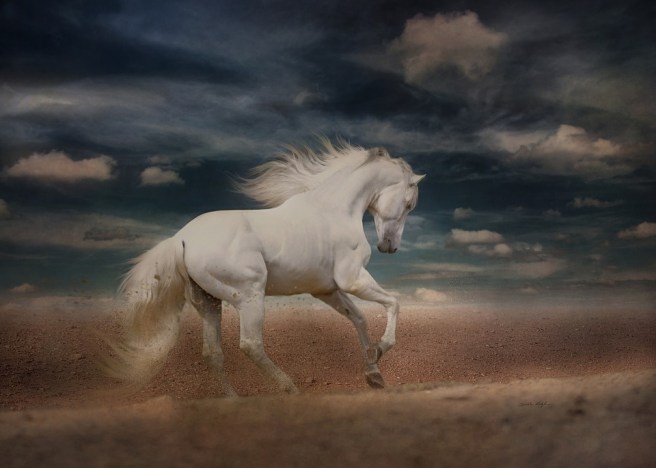
white-horse-4031101_960_720

While is no complete agreement on all 10 avatars, there is no doubt on who the last one is. Kalki, the rider of the white horse.

Kalki avatar, it is said, will manifest at a time when the world is in a crisis because of a wicked and tyrannical ruler. The coming of Kalki will lead to the destruction of evil and the earth will be rid of its suffering and sorrow. Kalki will rejuvenate existence by ending the darkest and most destructive period and usher in the Satya Yuga (Era of Truth).

Shiva is said to have given Kalki a sword and said : ‘I give you this sharp, strong sword and so please accept it. The handle of this sword is bedecked with jewels, and it is extremely powerful. The sword will help You to reduce the heavy burden of the earth.’

Does George RR Martin–or Weiss and Benioff considering we are referring to the last season of GOT–have any interest in/acquaintance with Hindu mythology?

If they did, I would say that Arya shows shades of Kalki! The Seven Kingdoms seem to be at the peak of wickedness. There is a going-off-the-rails ruler waiting to take over from a positively wicked one. So the time is right for an avatar. Arya now seems to be shunning violence. She seems to be in a phase where she may well make it her mission to destroy evil and restore good.

Like Kalki, her chosen weapon is a sword, given to her by a preceptor, Jon.

And the biggest sign of all– she now rides a white horse!

And more than anything else, should not the saviour, for once, be a woman! It will be good for at least one avatar to be a woman! And it will help GOT, which is being criticized for bringing down all strong women, or the good in strong women, in its last season.

So one more theory to add to the flurry of theories which are inundating us from all sides—Arya as Kalki!

–Meena


The Naming of Cyclones

T.S. Eliot said, about the naming of cats:

‘The Naming of Cats is a difficult matter,
It isn’t just one of your holiday games’

The naming of cyclones is surely at least as serious!

We have just been reckoning with the damage caused by Fani. Thanks to the excellent predictions and forecasts, as well as the concerted efforts of government authorities, damage has been minimized. Yet, lives have been lost and there is much rehabilitation to be done. We all need to do our bit.

But why was the cyclone named Fani? Why do cyclones have names at all? Doesn’t it sound a bit like trivializing a serious matter?

Well, no. Cyclones are given names to simplify communications and avoid confusion. It is important for forecasters to keep in touch with each other, and for governments to give information on cyclones to the general public. Since the storms can often last a week or longer, and more than one cyclone can be occurring in the same region at the same time, names can reduce the confusion about what storm is being described. The normal practice is that once storms produce sustained wind speeds of more than 34 knots, names are assigned from predetermined lists depending on which basin they originate.

Every region forms a committee of nations who are more prone to cyclones or hurricanes. For the Indian ocean region, Bangladesh, India, Maldives, Myanmar, Oman, Pakistan, Sri Lanka and Thailand form the Committee, and the governing body is the Regional Specialised Meteorological Centre (RCMC), New Delhi. This is the body which assigns names for cyclones originating in our region.

Each nation making up the Committee prepares a list of ten names which they think are suitable to be assigned to a cyclone. Out of each country-list, RSMC selects eight names and prepares eight lists which consist of the names approved by the governing body. The names of cyclones are not allocated in alphabetical order, but rather, the countries are arranged alphabetically, and the names selected from each country in the list, one by one.

Fani is a name contritued by Bangladesh. Names contributed by India are Jal, Agni, Vayu, Akash, Bijli, Lahar, Megh and Sagar.

Starting World War II till about 1979, cyclones were generally named after women. This practice was modified in 1979 by adding men’s names. Now names are by and large not personal names. Most are names of flowers, animals, birds, trees, or even foods, etc, while some are descriptive adjectives.

So at least in this matter, some amount of gender sensitivity has been brought in, and destructive forces are not tagged with exclusively feminine names!

–Meena

The Worshipful Bull

In Indian mythology, Nandi the bull is both the guardian of Mount Kailash, and the vehicle of Lord Shiva. The worship of Shiva and Nandi goes back to the time of the Indus Valley Civilization. The bull-seals found in Mohenjodaro and Harappa  have led some researchers to conclude that Nandi worship goes back many thousands of years.

A statue of a seated Nandi is often found in front of Shiva temples, facing the God. In metaphysical terms, Nandi represents the individual soul, looking to unite with the universal soul or Shiva. At a mundane level, people often use Nandi as a communication medium, whispering wishes into his ears, so that he may convey them to Shiva, who may listen to him more readily than to us!

Why suddenly this interest in Nandi? Because I was in Orissa this week, and did a three-hour road journey and also visited 5-6 villages.

Still doesn’t explain it?

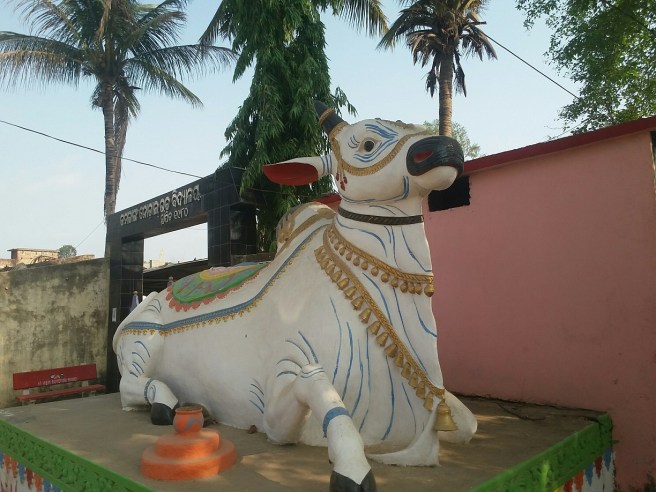
nandi

Well, it was the number of Nandi statues I saw in this time. Almost every hamlet and village had one. Pretty big and prominent. Sometimes the shrines they were in front of were smaller than the Nandis. And there were also some stand-alone Nandis! They were in all shapes and sizes.  A few small, most medium sized and a few really large. Some smiling, some serious, some with inscrutable expressions. Some puny and under-fed, some healthy. Some in proportion and some not-so.  But Nandi, after Nandi, after Nandi.

I have travelled to several states. I have seen ever-increasing number of stand-alone Hanuman statues; and several Shiva statues. But as far as I can recall, I have not come across so many Nandis. I am not sure why there should be so many in Orissa particularly, because traditionally, large Nandi statues are more prevalent in the South—Andhra Pradesh, Karnataka, Tamilnadu. But I do not recall that Nandi statues are found so commonly in these states.

The largest bull statue is in the Mahanadiswara Swamy temple in Kurnool, AP. It stands 15ft by 27 ft. This is followed by the bull in the Lepakshi Temple, also in AP. Other prominent Nandis are the ones at Chamundi Hills, Karnataka, Brahadishwara Temple, Tamilnadu, and of course, Banagalore’s own Bull Temple. Orissa does have one of the big 10 Nandis, at Bhanjanagar town.

But I think the state must beat all simply in the number of Nandis dotting the state scape. These are not old—would not think many are over a decade in age. It would indeed be interesting if someone could undertake a study to understand why there is such a proliferation in recent times. Wish it could be me, but sadly, I don’t think I can do it at the moment. So when I go back to Orissa, I will content myself with just looking out for them, counting them and clicking them

–Meena

When is a Flower not a Flower?

When it is a bougainvillea!

Yes, I learnt pretty late in life that what I thought were the petals, are actually bracts! And what pray are bracts? Well, seems bracts are modified leaves! They grow above all other leaves, but below the petals. And no, bracts are not to be confused with sepals, which are the green, leaf-like things which cover the petals when the flower is still in bud stage!

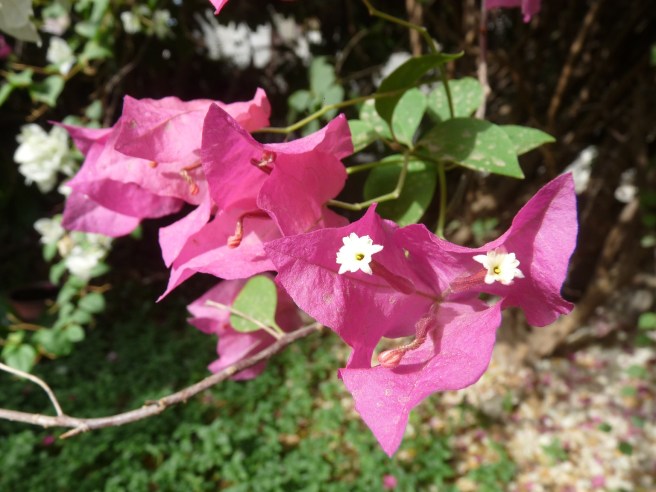
Confused? Well I was. But when I looked more closely at the bougainvillea, I got it. Look closely and you will see small white flowers at the centre of what you would a minute ago have called a pink flower. (There are three such small flowers within each set of bracts, though you cant quite see them in the pic.)

bougainvillae flower

Bracts are often brightly coloured and have evolved to attract flowers. Our friend the bougainvillea is a great example of this, with bracts of magenta, pink, yellow, white, orange and every other colour! Another flower that is not a flower you think, is the poinsettia. The bright coloured petals are bracts. In grasses, each floret is covered by two bracts, and each group of florets has another pair of bracts at its base! The dried bracts are the chaff we remove from the grain!

A seemingly simple cheerful plant, which happily blooms for us on road-medians, along compound walls, in gardens. Fairly easy to grow as long as it gets enough sun and we take care not to over-water. But I have found three levels of complexity:

  1. The spelling. I just cannot get it right without the spellcheck! Yes, I know it is named after a person. But please can we do something about it?
  2. This bract-petal confusion.
  3. The woman who discovered it, while disguised as a man and who never got the credit (see our post ‘Colour and Cheer’, 15 Nov, 2018).

Simple is the new Complex! Or do I mean Complex is the new Simple?

–Meena

Game of Thrones

The small screen is definitely dominated by GOT currently. Whether the much-awaited HBO release, or the Indian elections.

GOT-HBO is a debate at some level on the divine right of kings and queens; defining bloodlines and who has the right to inherit; and on the need for popular support even if one thinks one has the ‘divine right’.

Not unlike the Indian elections!

But that is not the substance of my Election Day piece.

What’s in a Word?

It really started with a confusion about the word ‘suffrage’. We learnt it by rote in middle school Civics, as in ‘India has Universal Adult Suffrage.’ Such a strange word. Seems more related to suffering than anything else. But surely that couldn’t be!

The origin of the word is not clear. To quote Merriam Webster dictionary, ‘suffrage has been used since the 14th century to mean “prayer” (especially a prayer requesting divine help or intercession). So how did “suffrage” come to mean “a vote” or “the right to vote”? To answer that, we must look to the word’s Latin ancestor, suffragium, which can be translated as “vote,” “support,” or “prayer.” That term produced descendants in a number of languages, and English picked up its senses of “suffrage” from two different places. We took the “prayer” sense from a Middle French suffragium offspring that emphasized the word’s spiritual aspects, and we elected to adopt the “voting” senses directly from the original Latin.’

Another theory says that the voting meaning comes from the second element frangere, and the notion is “use a broken piece of tile as a ballot”, and seems to go back to the 1530s. The meaning as in “political right to vote” in English is first found in the U.S. Constitution, 1787. (https: //www. etymonline.com/word/suffrage)

Making It Universal

Well, as our Civics books told us, India has Universal Adult Franchise. At 12 years of age, I did not understand how profound that was. Each and every citizen of the country who has crossed a certain age, irrespective of gender, education, caste, creed, religion, properly ownership, can vote. And this has been in force from our very first elections in 1951-52. Many countries of older democratic tradition came to adult suffrage only by slow and painful steps. For instance, in most countries, originally only land owners could vote. Universal suffrage came to South Africa only in 1993. Between the 1890s and 1960s, many state governments in the US insisted that voters pass a literacy tests before they could be allowed to vote—a ruse to exclude African-Americans and other racial minorities from voting.

The most vigorous battles of course were for Women’s Suffrage—fought by women on the streets of many countries including the UK and the US. In most countries, there was a lag of a generation between adult men getting the franchise, and women getting it.

Women in India got this automatically from 1950. But while we had the vote from the very first elections, there were many women who did not exercise this the first time around. Here are some very interesting insights from a piece in the Economic Times: ‘During the creation of the electoral roll, a number of women, nearly all in North India, wanted to be registered not under their own names, but as “wife of..” or “daughter of…”. This was the practice in their communities and when this issue first came up in provincial elections in the 1930s, colonial bureaucrats allowed this.  But now the officials of independent India refused. “The introduction of adult franchise is intended to confer on every adult, male or female, the right to participate in the establishment of a fully democratic system of Government,” the government of the United Provinces (now UP) wrote, emphasising the need that “no adult, male or female, is as far as possible left unrecorded in the electoral rolls”.

Many women could not vote in the first election: The Chief Election Commissioner of that time, Sukumar Sen, estimated that ‘out of a total of nearly 80 million women voters in the country, nearly 2.8 million failed to disclose their name, and the entries relating to them had to be deleted from the rolls. Sen decided that registrations would happen by the next elections. Votes for women, in their own identities as citizens of India, was a principle that could not be compromised.’  (https:// economictimes.indiatimes.com/news/politics-and-nation/on-the-centenary-of-womens-suffrage-a-look-at-how-india-achieved-electoral-equality/articleshow/63150595.cms).

Something to be said for the strength of conviction of the Chief Election Commissioner!

Voting Age

While most countries—over 100–have 18 as the minimum age for voting, there are some countries who hold the age as 16, and a few at 17. There are a handful of countries who have set the age at above 18. For example, South Korea’s legal voting age is 19 years; Nauru, Taiwan, and Bahrain hold it at 20 years; Oman, Samoa, Tokelau, Tonga, Singapore, Malaysia, Kuwait, Jersey, and Cameroon at 21. The United Arab Emirates has the oldest legal voting age in the world. Citizens can only vote when they attain the age of 25 or older.

Many may not remember, but in India, we started out with a voting age of 21. The Sixty-first Constitutional Amendment brought about in 1988, lowered the voting age from 21 years to 18 years.

Vote, vote thoughtfully, vote with the hope that exercising suffrage reduces suffering!

–Meena
The Lost Charm of Train Travel

A recent relatively short train journey was an unexpected eye opener. When we were young, travel meant long train journeys. This was a much-planned programme, and one of the highlights of a vacation whether it was the annual summer holiday at the family home, or a Diwali get-together at the home of a close relative.

It was a while since I had travelled by train. I was looking forward to re-experiencing the small things that had characterised those train journeys. One of these was the sampling of ‘speciality snacks’ of different stations. Almost every station traditionally had something sizzling—being deep fried in large cauldrons on the platform, and wrapped steaming hot in old newspaper or banana leaves, depending on the region. Between stations there was a constant stream of hawkers calling out their special wares—from masala peanuts to the fruit of the season to the ubiquitous “chai garam.” Another ritual while starting a journey was the buying of ‘filmy’ magazines and comics from the cluttered AH Wheeler stall—a treat that marked the mood of a textbook-free month.

Buoyed by these memories I embarked on my journey. The first disappointment was to not find a single newspaper vendor around. There was no AH Wheeler stall on our platform, and the one on the platform across was shut even though it was not so early in the morning. So no “time pass” magazines or newspapers. Disappointment two was the food scene. No sizzling pans and oily bhajiyas and puri bhaji. Every station had the same looking stalls with their array of packets of chips, chips, and chips and similar packaged snacks in the standard multiple ‘international’ flavours—ranging from schezwan to barbeque to French onion! Oh yes, they all had a small pile of cold stale bread pakodas and vada pao that no one seemed to want. What a homogenization of the rich, savoury and distinctive flavour of railway platform culture, and a sterile tribute to an age of rip, crunch, munch and throw-away culture.

In the train itself the story repeated itself. I think I learned a great deal of geography simply by looking the passing landscape, with my father pointing out to the different crops that were growing in the fields, the changing appearances of the people and the houses, flashes of birds, animals or trees as the train rushed by. This was supplemented by a railway timetable that listed the names of the stations en route, and comparing the arrival and departure time of our train with what was scheduled as per the time table. Even the names of different stations had their own stories and histories.  Till today, I can travel for days by road or rail happily gazing out of the window.

This time it was a bizarre sight to see every person in the compartment—old and young—glued to the small screens of mobile phones as the wonderful 70mm mega screen scenery flew by unnoticed. Children whined and complained of being “bored” when they tired of whatever it was they were watching on their phone, and were presented with yet another packet of chips or frooti drink; not one parent looked up to point to the window and say, “why don’t you look out?” I watched helpless and sad…What a sad waste of opportunities.

Perhaps the ultimate blow came when some of the passengers ordered food online, which was delivered at the notified station. One young woman stopped watching her third movie on her phone only long enough to alight at the next station to pick up her order of Domino’s pizza!

–Mamata


Did You Not Want to Ask…

A woman’s greatness is measured by the ‘sacrifices’ she makes. Has much changed?

As Women’s Day approaches, these unasked questions trouble me…

Sita:

A question I have asked myself

Did you not have the option

To leave the kingdom to your brothers

And come with me?

You left the kingdom to them once before

Oh, I remember!

That was your duty to your father.

Duty to a wife

Obviously does not come

Above duty to a kingdom.

Radha:

You vowed you loved me

But you knew you were never coming back

And you went ahead and married so many women

Did you ever look back?

Draupadi:

You fought for me and won me

But you didn’t utter a word

And went out of your way to not show special love for me

And why did I, such a confident princess

With a powerful father,

Accept this?

Was it that you felt inferior to me

And powerless.

And you wanted to prove you were powerful

By your treatment of me?

Parvati:

Your indifference

And I had to keep

Coaxing you

Sati always hovered over my head

Like Rebecca.

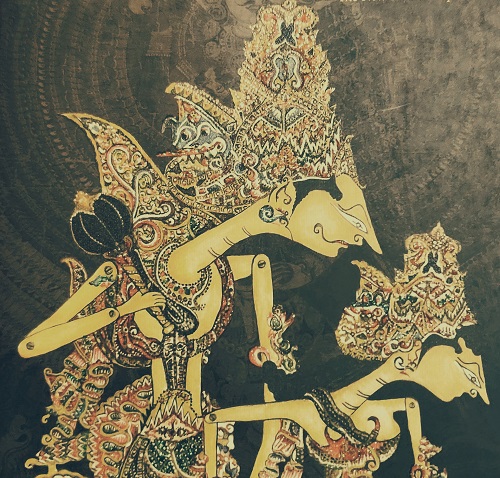
IMG_20190304_154701__01__01

–Meena

PS: Picture is the cover of DURYODHANA, By V. Raghunathan. Harper Collins. Illustrator: Nilofer Suleman

Caring and Sharing

The excitement began in the first week of March. What shall we do this year? Shall we have a theme? What about the lunch? Shall we order it or have a pIMG_20190302_112325.jpgot luck? Shall it be a particular cuisine or a celebration of diversity? And of course, it will be our Sari Day, but shall we have a colour code this year? Intercoms buzzed and Prepcoms were held.

It was the run up to Women’s Day at CEE! This was not the day to make a great political statement, nor a significant feminist event. It was simply a time to meet, eat, laugh and play together—a celebration of sisterhood.

For me this sisterhood was one of the many things that made CEE so special. What may have been the first link in the chain was a true “sense of belonging” to an organisation. But that was lengthened and strengthened by numerous bonds that brought the new and the old; the different tiers of formal designations, and the several generations that made up the ‘woman power’ of the institution.  It was the shared cups of tea and the lunch dabbas; it was the shared agonising over children, parents and in laws; it was the exchange of news and views, and the show-and-tell of things bought or made. This was a constant underground stream that flowed round the year, giving energy to our daily tasks at work. This seamless blending of many generations, and the mutual caring and sharing that made our lives so rich.

For us the Matriarchs, this sisterhood was the mainspring of our daily life. And we revelled in it as we scolded and moulded the fledglings; laughed and cried with our contemporaries; celebrated births and mourned the passings; bedecked ourselves for weddings, and planned office parties with much gusto. It was in many ways a time of innocence, a time when comfort and joy was derived from the feeling of going through life together. It was so much more than a coming together on a single day of the year.

“You are the sum total of everything you’ve ever seen, heard, eaten, smelled, been told, forgot – it’s all there. Everything influences each of us, and because of that I try to make sure that my experiences are positive.” Maya Angelou

In this week, we look back and remember with gratitude and love all the wonderful women that we had the fortune to have met and worked with, and who have enriched us in so many ways.

–Mamata and Meena


Streetwise

One of the most important parts of my day at work was the walk home at the end of the day. It was not a very long walk (under 15 minutes) and certainly not a route that offered great beauty of nature or landscape. For me, the walk was more than the act of getting from the physical space of work to that of home. It was an important ritual that helped in the transition from the mental space of ‘work’ to ‘home’. Through my three decades of work there were different transitions that took place. As a young mother, it was the bridge between leaving behind of the role of busy professional and bracing for an evening with the mental and physical energy required in parenting young children. As the children grew older, and one’s parents older still, it was the period of putting behind the challenges of the job to tackle the challenges of coping with geriatric health and care-taking issues. When both children and parents no longer needed the sort of support I could give, it was simply the luxury of going over the day—hours which had passed, and the few hours ahead. Walking thus was form of therapy for me.

I like walking. And I enjoy walking on busy streets. I like observing people and activities, and my walk home offered much. There were the familiar regulars—walkers like myself, and others that I would cross or pass on the way. Strangers at one level, but a familiar and comforting daily cast of characters—I used to imagine who they were, what they did, and what awaited them that evening. As someone aptly put it, “Simply by being outside on the street, people are inadvertently revealing their life histories in their bodies, in their steps, in the hunch of their shoulders, or set of their jaw.”

Walking thus, even as one is observing people there is an odd sense that you are invisible yourself! I was occasionally reminded of the fact that others may be “doing unto you what you do unto them” when someone I did not recognise would tell me “we don’t see you walking these days” or “I know where I have seen you—you walk everyday on that road.”

There were the little ‘milestones’ on the route–the small Hanuman temple at the corner, and the Momo mobile stall, and the busy tailor with his sewing machine right on the footpath; the pavement dwellers lounging on the battered tattered sofa that they had salvaged; the ‘party plot’, where in the wedding season one could see last night’s decorations being taken down in the morning while going to work, and new ones being put up in the evening for that night’s wedding.

There were the trees along the route, especially the huge mango tree—and always the eagerness to spot the first blossoms on it. The big open ground which hosted a variety of water birds when it filled with the monsoon water, and which hosted a variety of handloom and handicraft melas in the winter. There were the cows that crossed the road along with you, and the dangerously straying puppies in puppy season.

Of course there were no real footpaths or pavements! It was an exercise in agility and alertness—sidestepping the cowpats and litter; circumventing the potholes and muddy patches; dodging the scooters and cars that veered dangerously close, and finding the perfect moment to cross the road amid the chaos of the traffic. Whatever the challenges, the walk was always an adventure!

As one of my favourite authors Ruskin Bond puts it so well—“The adventure is not in arriving, it’s the on-the-way experience. It is not the expected; it’s the surprise. You are not choosing what you shall see in the world, but are giving the world an even chance to see you.”

–Mamata