Orange is the New…

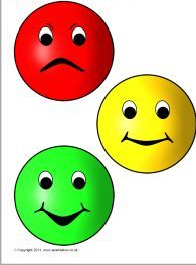
5218618B-E3FF-4DD6-8514-CF97668775D6In the case of demarcation of COVID zones in India, Orange is the New Freedom! Lucky enough to fall into this zone, I can now do some things I could not last week. But since my neighbouring zone 5 kms away is Red, there is nothing very exciting I can do. But I suppose it is all in the mind.

But as promised, this blog is not going to be Corona-obsessed. So moving on, it is about traffic lights—where the COVID classification zones in India seem to have had their origin.

Traffic lights were actually invented much before automobiles., to control the movement of horse carriages. (Tongas, camel carts etc. in India sometimes follow traffic lights and sometimes do not. I have never quite figured out if the same rules and fines apply to them as to cars and scooters. But maybe not, for after all, such things come under the Motor Vehicles Act!)

On Dec 10, 1868, the first traffic lights were installed outside the Houses of Parliament in London—red for ‘Stop’, and green for ‘Go’. The idea itself was borrowed from the railways, which had been using lights for its traffic control for quite some time.

The very first traffic lights were gas-fuelled, and were manually controlled by a policeman. But being gas-fuelled, though they prevented road accidents, there were incidences when the traffic lights themselves exploding. It is not known if this led to fatalities, but considering that horse-traffic accidents themselves may not have led to too many fatalities, it may have been a close-run competition.

The early 1900s saw the invention of automobiles and a significant uptick in road traffic, and the need for better systems of traffic management was becoming clear. It was in 1912 that an American policeman Lester Wire, came up with the idea of electric traffic lights, and the first one, based on his design, was installed in Cleveland, Ohio in 1914.

The very first electric traffic lights, like their gas-fuelled predecessors, had only the red and green. Some of them had a buzzer sound in place of the amber light to indicate that the signal was going to change soon.

It was in 1920 that another American policeman William Potts invented the first three-coloured traffic lights and Detroit became the first city to implement them.

But why Red, Green and Orange (or Amber)?

RED: This colour is probably used to symbolize STOP because in many cultures, red symbolizes danger. It makes a lot of sense scientifically also, because Red has the longest wavelength of any colour in the visible spectrum and hence can be seen from a greater distance than any other colour.

GREEN: Originally, in the railways, White was used for the all-clear signal, but train   mistook the light of the moon or stars for the “all clear”. This led to derailments and train collisions. And hence, a change was required from White. It seems that it was decided that now  Green (which till then used for ‘Caution’) would be used for GO. Also, the green wavelength is next to yellow on the visible spectrum, meaning it’s still easier to see than any colour other than red and yellow.

YELLOW/AMBER/ORANGE: When the Green switched over to mean GO, then it was decided that yellow would be used for caution. Also, yellow is very distinct from the other two colours and hence suitable.

Here is wishing all a rapid move to GREEN and SAFETY!

–Meena
 

Tuk Tuk

Tonk tonk tonk…it starts before dawn has broken. Even before the crows start their warm-up caw-caws, and the magpie robin tunes up to launch into its melodious repertoire. 

IMG_20200430_111905.jpg
Spot Tuk Tuk! 

A steady metronomic metallic sound—like the hammer of a coppersmith softly hitting the metal.  The Coppersmith of the avian world is awake and ready for another call-marathon.

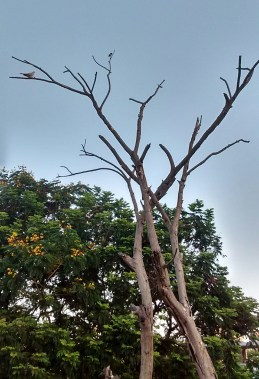
Last week when it first began calling, I rushed out to look for the source of the sound. It seemed to be all around—almost like sound-surround! But I know where look for it–the remains of the big rain tree that once overlooked my kitchen wash area. The tree died naturally last year, but its skeletal remains continue to invite so much other life–to perch, to play, and to pause awhile. This is the Coppersmith’s favourite post. And sure enough there it was—on the highest point of the tallest bare branch—a speck against the blue sky. Almost invisible, but certainly not inaudible. It puffed up its chest, and raising and bobbing its head from side to side (perhaps the secret of the sound surround!) called out like a muezzin from the minaret.

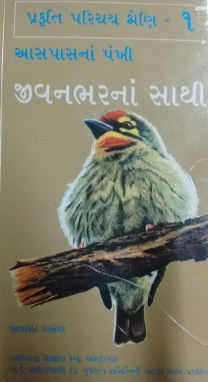
The Crimsonbreasted Barbet, as it is ornithologically called,

IMG_20200430_110942.jpg
Cover bird of my favourite bird book!

is a small bird with a loud call. It  is just a little bigger, but chunkier, than a sparrow, but certainly not as drab. It dons a striking combination of brilliant colours—grass-green top feathers and green-streaked yellowish underparts; a crimson forehead and patch on its breast; vibrant yellow throat, and concentric eye rings of red and yellow. It has distinctive whisker-like feathers around its stout black beak, and a short truncated tail.

My bird book tells me that this bird is mainly a fruit eater, and is commonly found wherever there are fruiting trees, especially fig or banyan. The closest trees around my house are Gulmohar and Copper pod, which are also in full bloom, but not with the fruits and berries that this bird likes so much. Perhaps it finds these in the park next door. Although it baffles me, given the very short breaks between the continuous metronomes, how it manages to partake of sufficient nourishment to sustain its energy to call non-stop.

As the sun climbs higher, other birds fall silent as they seek refuge from the heat in the foliage of trees and hedges. But not our relentless caller. Under the blazing sun, on a high bare treetop, it goes on and on. Funnily, nowhere could I find out why it calls—is it to attract a mate? Difficult to know as both male and female look alike! Is it to warn of predators and danger? But then, why call continuously? Or is it for the sheer joy of being alive and and sharing its song each day? I rather like to think of it this way!

Last evening during a lull, I scanned the tree and spotted it perched woodpecker-like, using its strong beak to excavate a hole in the dry branch. I discovered that it nests and roosts in these small holes.  I am glad though that it has chosen to make its look-out point, and perhaps its home, on our tree. It is nice to have a Tuk Tuk for a neighbour!

Tuk Tuk is one of the common Gujarati names for the Coppersmith.

–Mamata


What an Irony!

…Or contradictions in the time of Corona.

Confession. I belong to the age of dinosaurs! Not so old as to reminisce about the freedom struggle, and World War 2 (which my parents did), but old enough to remember one short war, night curfews and blackouts, and shortages. Old enough to remember a time when gymming, pubbing, clubbing, beauty and retail therapy were not considered to be critical to one’s physical and mental health. When staying indoors as a family was not unheard of, and what to do with one’s time was never a stress-inducing problem.

It is in the last month, as they say, “the world as we know it had changed.” Coronatimes newspapers, and especially the Lifestyle and Leisure supplements reveal that yes, the world has changed, but in different ways for different people. I cannot help but think back, and chuckle a bit at the contradictions!

Then and Now…

‘Staycations’ were the trendy way to spend your holidays; but now staying at home for free becomes ‘confinement’.

People went to expensive health spas for detox stints; now have DTs at home without their sustaining substances.

School vacations were a time of simple self-devised ‘time-pass’ activities (or lack of activities); not a time of huge stress for parents as to how to keep the children “engaged”.

Summer holidays were marked by hours spent playing cards, ludo and carom with relatives of all ages; now newspapers feature pictures of this as a wonderful sign of how indoor games lead to ‘family bonding’.

‘Social distancing’ was a cause for concern and counselling, as people addicted to virtual reality could not relate to real people; now when it becomes mandated, people want to break it.

Page 3 celebrities fill pages with pictures of “doing the dishes” or “playing with baby”; while numerous stories of unseen unsung heroes who are risk their own life to save others are inconspicuous among the headliners.

People have to be taught how to cover their faces when outdoors, something the two-wheeler female riders of Ahmedabad have been adept at for years.

Now Kitchen Hacks on innovative ways to make provisions last longer, and replacements for quinoa and parsley; when generations of homemakers have learnt and practised ‘living within their means’ with some saved for a rainy day.

While some eagerly await the resumption of Swiggy and home delivery from restaurants, many middle-class housewives wake up early every day to join the voluntary cooking efforts to feed the homeless and hungry.

Glossy pictures of designers displaying their designer masks; news items of hundreds of ordinary women sewing for hours to make and distribute masks made from old clothes.

Once people had to wear masks when the sky was grey and smoggy; now everyone has to wear masks when the sky is clear and blue.

Then, health and well-being pundits urged and cajoled people to get off the couches and walk; now people are risking fines and arrests to go out for a walk.

Now we need Life Coaches to tell us how to spend our day from the time we open our eyes to shut-eye time; then people did not have time nor leisure to need such coaching, but a lot of basic common sense to guide in how to live, and thrive.

Then we scoffed at mothers and grandmothers who judiciously planned, saved and put away things that “you never know when these may help”; now we remember with nostalgia and regret (or gratitude) that ‘old ladies’, old fashioned’ advice.

SARS CoV-2 did to CO2 levels what 25 Climate Change COPs could not do!

The virus of fake news spreads much faster than the Covid-19.


With gratitude and humility for those of us who are lucky to have the wherewithal to lead the life we do.

–Mamata


Walk Your Way to Health

A031C896-84DB-4EBA-BAE1-E567F0CAD18D

This week we marked World Health Day.

And walking is my trusted route to good health. It is the only exercise regimen that I have been able to stick to. And I have tried several:

  1. Swimming: Tried about 15 times, but could not manage to learn.
  2. Gymming: If it was not the traffic, it was complete mismatch with the age of the people around. Never feels good to up the average age of a room single-handedly.
  3. Cycling: Oh, the ups and the downs! My muscles ache and my breath doesn’t hold
  4. Exercising at home: I can find an excuse a day after the first three days, to not follow the regimen.

So walking it has been for the last 25 years and more—starting from long before the obsession with counting steps. About 50 minutes of brisk (hopefully) walking every day.

The Mayo Clinic assures me—and I believe them–that regular brisk walking can help me:

  • Maintain a healthy weight
  • Prevent or manage various conditions, including heart disease, high blood pressure and type 2 diabetes
  • Strengthen bones and muscles
  • Improve mood
  • Improve balance and coordination

And in these days of lockdown, it is still a possible form of exercise. It not only helps the body, but just the act of getting out of the house into the fresh air and seeing people even if only from afar, definitely contributes to well-being.

Maybe the lockdown will help walking become a lifelong habit for some. But for me, it was the peer pressure of ‘walking with a friend’ that worked. My friend Kiran and I decided at some stage to walk every morning at 6.15 a.m. on the IIM-A campus. The very thought that the other would be standing impatiently at the gate if one was late, was enough to get us out of bed and out the door most days. And if we did not, we had to be pretty inventive in coming up with excuses.

But for many years now, I have been walking by myself. And my trusty companion is my XONE music player. This is something I picked up at the Vizag airport over five years ago. This is a nifty little device—headphones with built in storage, with huge capacity and no wires. It seems to be developed in India. I think I have about 1500 songs stored. The battery lasts me a week on one charge. People who see me walking regularly jokingly ask if I have ears, as this is always glued to my ears.

So find a way to get yourself into the habit of walking, and find a way to stay hooked! While I may not go so far as to say ‘My God is the God of Walkers. If you walk hard enough, you probably don’t need any other god’ (Bruce Chatwin), I will swear by walking for a sense of all-around well-being.

–Meena


Pencil Day

Not many may have heard of it, but 30 March is observed as National Pencil day in the US. If you think of it, the humble pencil is an implement that needs to be celebrated. There is not a single child who has not begun its education without a pencil. Even with all the new and emerging means for ‘writing’ every teacher believes that the pencil is with what it all starts—working with pencils gives the child the motor coordination necessary for more advanced tasks.

Pencils started being used sometime in the mid-1500s, when a large deposit of graphite was discovered in Cumbria, England. The particular deposit of graphite was extremely pure and solid, and could easily be sawn into sticks, and people started to do so, using the sticks for writing. However, graphite being very soft, it needed some casing. Initially, the sticks of graphite were wrapped in thread or sheepskin. In the 1560s, a couple in Italy started hollowing out bits of wood and putting sticks of graphite into them. Shortly after, the idea of making two halves of a cylinder of wood and sandwiching the graphite seems to have dawned and so the pencil, as we know it, was born. Today pencils are made by mixing fine ground graphite and clay powder with water to form strings which are then placed in a kiln to harden, then dipped in oil or wax, which seeps into the tiny holes to make it smoother for writing. These are then encased in wooden cylinders.

So which of these landmarks does March 30 celebrate? None really, because all these specific dates are lost in history. March 30 of 1858 is the day on which Hymen Lipman of the USA received the first patent for attaching an eraser to the end of a pencil. And USA decided to mark this day in his honour as Pencil Day.

Apparently, the pencil business in India is controlled by four major players—Doms Industries which make Doms pencils; Hindustan Pencils, which makes the familiar Apsara and Natraj brands; Camlin (now Kokuyo Camlin) is another significant presence; and finally Maharashtra Pencils, which is the smallest of them. The market leader is Hindustan Pencils, which has 45 per cent of the market share. It produces about 8 million pencils a day!

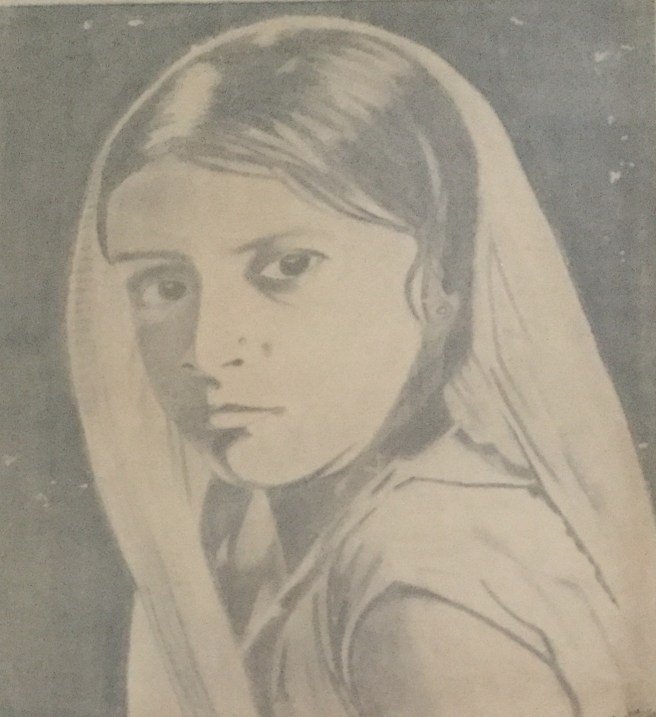
A2947853-F525-4B83-B57D-9C879A334925Pencil sketch, V. Raghunathan, using 3B and 4B pencils. 1980.
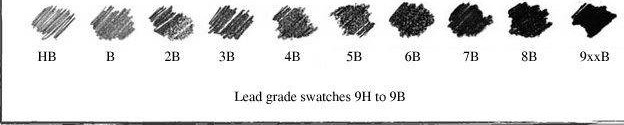
HB pencils were the pencils most of us used. In fact, anything else was left to the more ‘arty’ types. The notation ‘HB’ is a part of the European system of classification, using a continuum from “H” (for hardness) to “B” (for blackness), as well as “F” (for fine point). The system was developed in the early 20th century by Brookman, an English pencil maker. The US of course must be different from the rest of the world, and uses a numeric system of #1 to #4 to classify pencils.

A106B150-9534-4B3D-8270-9FC59A2A34E1

So on this Pencil Day, make sure to write a few lines with a pencil. Believe me, it is a very special feeling, and you will realize how much you miss it! Not only the hand-feel, may be it will bring back memories of school and childhood!

And to end, some Pencil Facts:

Chemistry was not very well developed in the 1500s when the graphite mine was discovered and the substance was thought to be lead. Hence it was called plumbago (Latin for “lead ore”), and even today, though pencils don’t have any lead, they are called lead pencils.

Every year, about 82,000 trees are cut down to make the close to 2 billion pencils manufactured worldwide. Each tree can yield about 1,70,000 pencils.

A typical pencil can draw a line about 55 km long.

–Meena


Ides to Ideas

Beware the Ides of March! Perhaps never in the living memory of humankind, has this dire and gloomy prophecy proved so true. It is in this month that the world has been brought to its knees by an invisible force that seems to have united all of humanity in facing a common enemy.

The world, and way of life as we know, have overnight, changed beyond our wildest imagination, and no soothsayer can foretell what lies ahead, in the near and distant future. From now on, the month of March will be marked as the month that changed the world.

But before all this began, March had been designated as the International Ideas Month.

Ideas–our brain is churning out ideas all the time; even though we may not consciously register these. From small ideas about routine matters, ideas.jpgto Eureka moments, ideas keep our little grey cells ticking away. Sometimes we let these slip away because we are preoccupied with what we feel are more serious or important matters, and sometimes because we feel that the ideas is too inane to pursue.

International Ideas Month is meant to celebrate the value of ideas. And an encouragement to get one’s ideas rolling—no matter how silly, or profound they may seem.

Ideas spring from imagination, and imagination is the single most useful tool mankind possesses. And yet in these times when even creativity is measured by its market price, or ideas that help make large profits; imagination is seen as the indulgence of children and dreamers, writers and painters.

In the words of American author Ursula K. Le Guin “Imagination is not a means of making money. It has no place in the vocabulary of profit-making. It is not a weapon, though all weapons originate from it, and their use, or non-use, depends on it, as with all tools and their uses. The imagination is an essential tool of the mind, a fundamental way of thinking, an indispensable means of becoming and remaining human. …Like any tool, the imagination requires that we first learn how to use it or, rather, that we unlearn how to squander it. Children have imagination to start with, but as we grow, we tend to put aside imagination as an indulgence. All human beings need exercises in imagination as they need exercise in all the basic skills of life, bodily and mental: for growth, for health, for competence, for joy. This need continues as long as the mind is alive.”

One way to nurture imagination is to give the time and space that ideas need to take root and grow. This garden cannot be meticulously planned, pruned and scheduled. Ideas turn up anytime, anywhere—on a morning walk, at the kitchen sink, in the shower, and in the middle of the night.

Because Ideas do not have a fixed time and place to appear, it is important not to let them slip away. Grab them, capture them on paper, take your time and mull over them, incubate them, or put them into practice right away!

The right time and space is now–when we are in a physical lockdown. While we cannot physically wander far and wide, when we seem to suddenly have time on our hands–What better time to unlock and unleash all those ideas that have been hibernating or aestivating in our minds.

Turn the Ides of March into the Ideas of March.

–Mamata


So Many Ways to Downtime!

A few days ago a friend said ‘What with everything closed for Corona, it is so dull and boring, wish we could just HIBERNATE.’ Probably a sensible thought, except that given the temperatures outside, it would be aestivation, rather than hibernation.

3-s2.0-B9780124095489111674-f11167-03-9780444637680AESTIVATION, lesser known cousin of hibernation, is ‘summer sleep’– a survival strategy used by many vertebrates and invertebrates to endure arid environmental conditions. Key features of aestivation, like hibernation (winter dormancy) include significant metabolic rate suppression, conservation of energy , altered nitrogen metabolism, and mechanisms to preserve and stabilize organs and cells over many weeks or months of dormancy. Even more than in hibernation, strategies to retain body water are important in aestivation, as dryness or aridity is the key trigger for the summer sleep.

A surprising number of animals aestivate—vertebrates such as lung fish, amphibians, reptiles, small mammals, and certain invertebrates such as molluscs. Bees, snails, earthworms, salamanders, frogs, earthworms, crocodiles, tortoise, etc. are examples of the aestivating animals. The duration of aestivation varies among species–some enter this state for a few months, others for a longer period.

Well, there are other kinds of ‘downtimes’ we can choose from too.

There is BRUMATION, which is the equivalent of hibernation for reptiles. Mammals hibernate and reptiles brumate, but there are other differences too. During hibernation, a mammal is sleeping and does not have to eat or drink. But brumation is not true sleep and the reptile still needs to drink water. A brumating reptile may have days where it will wake, show some activity, drink water, and then go back to its dormant state.

Or we can take the option of TORPOR, which involves lower body temperature, breathing rate, heart rate, and metabolic rate. But unlike hibernation, torpor is an involuntary state that an animal enters into as the conditions dictate. Also unlike hibernation, torpor lasts for short periods of time – sometimes just through the night or day depending upon the feeding pattern of the animal. During their active period of the day, these animals maintain a normal body temperature and physiological rates. But while they are inactive, they enter into a deeper sleep that allows them to conserve energy and survive the winter.

Or there is DIAPUASE, a form of developmental arrest in insects that is much like hibernation in higher animals. It enables insects and related arthropods to circumvent adverse seasons. Winter is most commonly avoided in colder areas, but diapause is also used to avoid hot, dry summers and periods of food shortage in the tropics.

Now, which one do you prefer?

–Meena


Colour Me Blue

As we celebrate Holi, the Festival of Colours, here is a piece on the hues that brighten our lives.

And, in keeping with the mood of International Women’s Day, it references M.S. Subbulakshmi, doyenne of Carnatic music, and a path breaker.

Happy Holi, Happy IWD!

Last week I was reading an old-fashioned novel, where the hero’s sidekick was wearing a taupe coloured suit. Not being quite sure what ‘taupe’ was, I looked it up, and learnt that it is a dark brown colour between brown and grey and that the name originates from the French taupe meaning mole (the animal).  The name originally referred to the average colour of the French mole, but since the 1940s, its usage has expanded and blurred to mean anything greyish brown or brownish grey.

Names of many colours are derived from nature. Fuchsia was named for the colour of the flowers on the fuchsia plant, itself named for Leonard Fuchs, a 16th-century botanist. The word orange comes from the Old French orange, from the old term for the fruit pomme d’orange. The French word, in turn, comes from the Italian arancia, based on Arabic nāranj, derived from the Sanskrit nāraṅga. An inter-connected world indeed!!!!

Teal is a bluegreen colour whose name comes from that of a bird—the common teal (Anas crecca)—which presents a similarly coloured stripe on its head.

‘Puce’ is also one of the nature-colour names, but with a particularly yucky background. Puce is the French word for flea. The colour is said to be the colour of bloodstains on linen or bedsheets, even after being laundered, from a flea’s droppings, or after a flea has been crushed. Strangely it was one of Marie Antoinette’s favourite colours!

People too have lent their names to colours.

‘Mountbatten Pink’ is a naval camouflage colour close to greyish mauve. It was first used by Lord Mountbatten during World War II. When he noticed a liner ship of the colour seeming to disappear from view in the early morning light, he felt it was a good colour for naval ships to render them difficult to see at dusk and dawn, and so started applying them to his naval ships.

‘Alice Blue’ is a pale shade of azure blue, much liked by Alice Roosevelt daughter of President Theodore Roosevelt, which sparked a fashion sensation in the United States.

MSBut for a South Indian like me, the most important person-colour association has of course to be ‘MS Blue’, said to be a favourite of legendary singer M.S. Subbalakshmi.  This colour became synonymous with her after she started wearing Kanchipuram silk saris of this shade at her concerts. These were specially made for her by Muthu Chettiar, a weaver from Madurai. The savvy businessman that he was, he carefully regulated supplies to ensure enduring demand from Madras high society ladies!  It has been clarified that MS Blue is not peacock blue but ‘mid-sea blue’.
Continuing on the theme of blue, the colour of 2020 (Yes, they announce a colour for every year! A good source of income for the interior design and fashion industries) is PANTONE 19-4052 Classic Blue whose properties include instilling ‘calm, confidence, and connection’. Additionally, it is claimed that ‘this enduring blue hue highlights our desire for a dependable and stable foundation on which to build as we cross the threshold into a new era’.

Another interesting fact I learnt was that research by several academics including linguists Brent Berlin and Paul Kay has revealed that if a language had only two terms for colours, they were always black and white; if there was a third, it was red; the fourth and fifth were always green and yellow (in either order); the sixth was blue; the seventh was brown; and so on.

–Meena

Swollen-headed

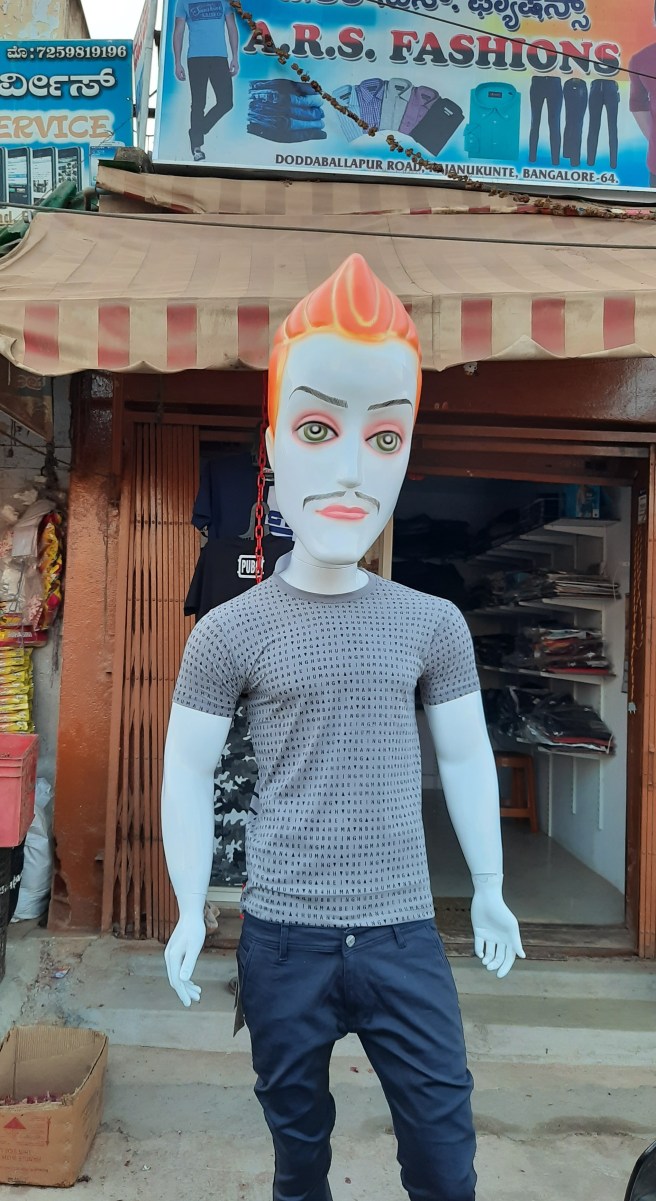
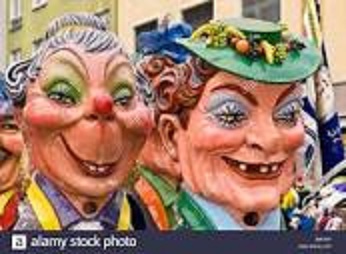
CBCA14C8-CCB2-4EE8-BE0A-E137CB978119At 11.11 by the clock, on the 11th of November every year (pretty palindromic, isn’t it?), at Mainz Germany, the Fools’ Constitution is proclaimed from the balcony of the Osteiner Hotel. This marks the start of the City’s Carnival, which is characterized by people wearing oversized papier-mache heads roaming around the crowds. It seems that this practice started about 80 years ago, but I could not find references as to why “schwellköpp” or ‘swollen-heads’ are an integral part of the festivities.
dolls 2

Equally mysterious to me is why shops these days have “schwellköpp” mannequins. I really can’t see why anyone would want to buy garments modelled by such weird looking dolls. I know it is all about attracting attention, but surely, there could be better ways to do this than having swollen-headed guys with multi-coloured hair? Fortunately, all the schwellkopp mannequins I have seen have been male. I fear female versions would be really too much.

The practice of using mannequins to model clothes goes back to 15th century France, but those were miniatures. The use of full size dummies started in the 18th century, and these were made of wicker. Later, mannequins were made of wire-work. In the mid-19th century,  papier-maiche dummies took over.  Today most of these figures are made of fibreglass or plastic.

Mannequins are also used by artists (lifeless figures hold a pose much longer than live models!). They have sundry other uses, for example in crash-testing and in testing defense equipment.

The use of these dolls in medical education dates back to the 17th century where ivory manikins were used by doctors as a teaching aids. Even today, medical simulation mannequins are used extensively in education and for teaching first aid.

I can only hope these mannequins are normal-headed. I would hate my doctor to have been trained on a schwellkopp!

–Meena

SLEEP OVER IT!

It’s the age of startups! Every day one hears of enterprising young 20-somethings making their first million with an innovative product or service that people today lap up with enthusiasm.

I recently read about a number of such ventures that are literally cashing in on sleep (or the lack thereof!) Online mattress brands! In these times when the millennials have too much stress, too little time, inability to get a good night’s sleep, but the ability to afford quick-fix solutions and products, there are smart operators who combine all this into successful commercial ventures. With inviting names like Wakefit, Wink and Nod, Sleepycat and Sunday Mattress, these offer “sleep solutions”. And attractive “offers” from free home delivery and installation, free trial and return, to “sleep internships”, and customised recommendations of the best fit based on an analysis of the customer’s age, height, weight and location!

ripImagine needing so much help to get a good night’s sleep! I have grown up in an age when mattresses had very different connotations. Mattresses were filled with cotton, and were usually of the same size and thickness. Often this cotton was carded by hand by itinerant carders who established camp at the house for a few days marked by the twang of their simple tools, and fluff-filled air. The cotton was filled in covers, stitched in with strong thread, and then beaten heartily with sticks to even out the lumps and bumps. All this done with dexterity and the long experience of a traditional occupation. With mechanisation, these occupations were replaced with neighbourhood shops where the same process was done by a simple machine. Now one took one’s old mattresses there to be opened and redone, with dire warnings that the cotton within was not to be mixed up with any other inferior variety!

This was an exercise carried out every few years. The annual exercise was the sunning of the mattresses. This was a traditional ritual, generally after the rainy season and before Diwali when the strong sun took away the dampness and made the cotton swell. The wonderful smell and feel of freshly-sunned mattresses was guaranteed to induce the cosiest slumber; without any ‘scientific’ testing to arrive at the perfect ergonomic formula.

Furthermore, in addition to supporting the large numbers of family members, most households had a stack of spare mattresses, and quilts. These were stored carefully; many traditional houses had a special space and arrangement for this. They were taken out when guests arrived, and when there were family gatherings like weddings. Over time, as families, and houses grew smaller, and people’s mobility increased, the stacks of mattresses decreased. Then the market began to offer ready-made mattresses, introducing other materials like foam and coir. It became easier to go to a shop and order the one best suited from the limited options available. The familiar childhood mattresses remained at the family home with the parents, to be slept on when visiting them. And as time moved on, and life got faster, the new breed of urban nomads had not the time nor space to go the shop to buy a mattress. Life became so stressed and so frenzied that sleep also became a sought-after commodity. And voila, the market was open for online sleep solutions!

I do appreciate the needs of the times, as well as admire the enterprise to meet the needs. But it also makes me grimace and smile! Belonging as I do to a generation of ‘home-made’ cotton mattresses, I have also inherited several of these. I try, in my own way, to follow some of the annual air-and-sun traditions. And I am grateful that I still get a good night’s sleep without any external help!

–Mamata