
A village in Andhra Pradesh has banned women from wearing nighties between 7 p.m. and 7 a.m.! Women who breach this ban are threatened with a fine of Rs. 2000. And as if this display of patriarchy is not bad enough, women who ‘rat’ on other women committing this crime will get an award of Rs. 1000. So patriarchy also actively pushes women to spy on and report on each other.
When the police reached there to investigate, women refused to lodge a complaint, and some said that the ban was a good idea, and that in fact women themselves had mooted it. So the women in the village are either willing victims, or so intimidated by the environment that they dare not speak up.
Either way, scary.
But that got me to thinking as to why the ‘nighty’ is so popular. It is obviously fulfilling a huge felt need. I suspect (based on completely random, non-scientific observations!), that this is particularly more so in South India. In the North, the salwar-kameez is available as an option for practical working clothes. Maybe older women in the South find the ‘nighty’ closer to the sari and more acceptable than the ‘Punjabi’. The nighty is often worn with a dupatta or towel draped over the shoulders for modesty. Be that as it may, it does seem women want an option to the sari. So to sum up my observations and inferences, the looked-for attire should:
- Be full length
- Be flowy
- Not expose any skin
- Have a drape for the upper body
- Be comfortable enough to spend the whole day in
- Be convenient to work in.
Based on these observations, I do think that a designer who comes out with elegant designs that meet these criteria, would find any number of takers. Surely, with such a huge market waiting, someone can take up this challenge and make a killing! The dresses can be designed in a variety of fabrics and to fit various budgets. And then they would not be ‘nighties’ but perfectly comfortable and nice-looking ‘day-wear’. No question that no one has a right to dictate what women wear. But it is also an opportunity to design something that meets their needs and is not make-do.
–Meena
PS: An appropriate protest might be for 90 or 900 or 9000 women to descend on the AP village in broad daylight, clad in Nighties.



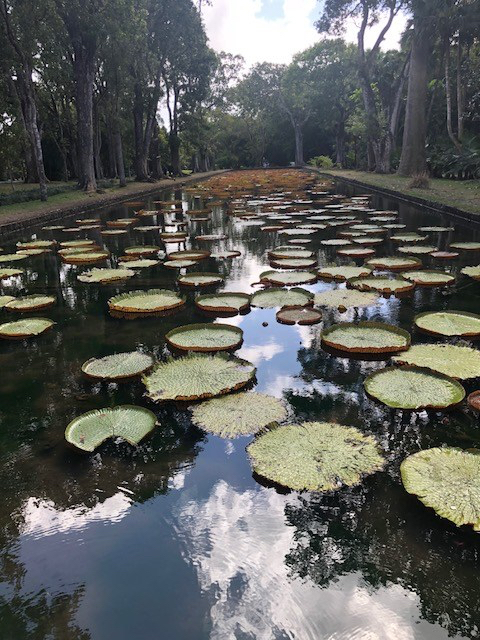 As botanic gardens go, the Sir Seewoosagu Ramgoolam Botanic Gardens in Mauritius are not large. 92 acres to Bangalore’s Lal Bagh of 240 acres to put it in perspective (but of course we need to factor in the size of the two countries!). We don’t need to dwell on the variety of flora, both endemic and exotic, on display there. Nor the few but interesting animals—specifically some deer and some huge tortoises. The only endemic Mauritian mammal, a bat, the
  a table. And on the table was a register. I sneaked a peak into the register. And this is what I saw: Several entries each day on the condition of the pond, the leaves, the flowers; the birds and insects seen. And a sketch of the pond, done at the same time every day, showing where flowers had bloomed and where there were buds. And it was not only the lily pond. There was a similar register at the lotus pond, and some other spots in the garden. As I flipped the pages, I could see that no day was missed, no entry casual
 Millennial Matriarchs