Stamp on Numbers

Actually, that should read ‘Stamps on Numbers’. But ‘Stamp on Numbers’ is something I would have liked to say to my Math teachers, so let me work it out my system!

Browsing through the books in the home bookshelf is an obsessive COVID activity with me, as with many others. In this exercise, I came across a book entitled ‘Wonder of Numbers’ by Clifford Pickover. While I am sure the book has lots to teach on mathematics, what I found most interesting was a snippet that the country of Nicaragua had, in 1971, issued a series of stamps called the “The 10 mathematical formulas which have changed the face of the world”. The ten selected formulae:

  • 1 + 1 = 2
  • Pythagorean law for right-angled triangles
  • Archimedes’ law of moments
  • Napier’s law of logarithms
  • Newton’s law of gravitation
  • Maxwell’s law of electromagnetism
  • de Broglie’s law of light waves
  • Tsiolkovskii’s law of rocket motion
  • Boltzmann’s law of entropy, and
  • Einstein’s law of relativity.  

The back of each stamp apparently has a small explanation of the formula. No one is quite sure how these particular formulae were selected, but what I found most fascinating was that a country would think of putting out such a series!

Delving a little more taught me that there were several hundreds of stamps across the world, devoted to mathematics and mathematicians.

Several countries have brought out stamps on Mathematics Education. https://mathematicalstamps.eu/news/100

Nicaragua, Iran and Mexico have brought out stamps on the theme of ‘Counting on Fingers’. There are several stamps which highlight calculating instruments like Pascal’s Mechanical Calculator, William Schickard’ calculating device, the Slide Rule, etc.

A number of stamps have featured statistical themes, such as a graph showing the Norwegian gross national product growth from 1876 to 1976, and one depicting the decline in malaria.

There have been many stamps devoted to games and pastimes based on mathematical reasoning. Chess and Go—a Chinese game—have quite a few each. But so do other lesser known ones–Senet an early form of backgammon; an Egyptian game from 1350 BC played by two players on a 3 x 10 board; the African game of eklan which consists of a board with 24 holes, arranged in concentric squares into which sticks are inserted etc.  Of course, the Rubik cube, invented by the Hungarian engineer Erno Rubik, a coloured cube whose six faces can be independently rotated so as to yield 43,252,003,274,489,856,000 different patterns, has a stamp or two.

The metric system was introduced in 1960 and gradually, most countries have adopted this system of weights and measures. There are quite a few ‘metrication stamps’ including:

  • a Brazilian metric ruler
  • a Romanian stamp demonstrating that a metre is one ten-millionth of the distance from the north pole to the equator
  • a stamp from Pakistan demonstrating the metric units of weight, capacity and length
  • two Australian cartoon stamps featuring the metric conversion of length and temperature
  • a Ghanaian stamp indicating that a metre of cloth is a little more than 3 feet 3 inches.

Since 1897, International Congresses of Mathematicians have been held at which thousands of mathematicians from around the world gather to learn about the latest developments in their subject. These meetings usually take place every four years. Several of these congresses have been commemorated by stamps.

India has a few mathematical stamps too. Aryabhatta, Ramanujam and DD Kosambi are celebrated on Indian stamps. Jantar Mantar, the remarkable observatory designed by mathematicians and astronomers figures on a stamp too. The decimal system which originated in India and is a fundamental contribution, is actually celebrated in a stamp brought out by Nepal through a depiction of an Ashoka Pillar from Lumbini, which portrays this.

My search engine wanderings led me to a world which I did not know existed, and from where I have gleaned most of this information. The world of people who love mathematics, stamps and mathematical stamps .

Some of these, which are also the sources of much of the above information:

https://mathematicalstamps.eu/news/100

http://users.wfu.edu/kuz/Stamps/stamppage.htm

Stamping through Mathematics. Robin J. Wilson. Springer.

Mathematics and science : an adventure in postage stamps. William L.Schaaf. Reston.

Have fun!

–Meena

Peanuts for Bulls

One of Bangalore’s landmarks is the Dodda Basavana Gudi (Big Bull Temple), which is situated–surprise, surprise, on Bull Temple Road, Basanvangudi, South Bengaluru. It was built by Kempe Gowda, the founder of Bangalore, around 1537. It is dedicated to Nandi, the vahana or mount of Lord Shiva, and the monolithic statue has a height of 4.6 metres and a length of 6.1 metres. This Nandi is probably the biggest in the world.

But where do the peanuts come in? Well, apparently, this was a prolific peanut-growing area many centuries ago. But year after year, a wild bull would rampage through the fields just when they were ready for harvest, and would destroy the crops. Over time, the problem grew so worrisome that the farmers were desperate. They vowed to build a temple dedicated to Nandi if only the bull would stop. They did so, and miraculously, the bull stopped its depredations.

A board at the temple has a slightly different version. According to this, one of the angry farmers whose peanut fields the bull was destroying, hit it with a club. The stunned bull sat down motionless and turned into stone. But then it started to grow and grow! The worried farmers prayed to Lord Shiva. A trident found near the feet of the bull was placed on its head, and at last it stopped growing. The grateful farmers then built a small temple, which was later enlarged by Kempe Gowda.

And in gratitude, farmers also decided to hold an annual peanut fair (Kadalekai Parase) in the area around the temple. It is held on the last Monday of the month of Karthik (that is next Monday, 14 December). Originally, farmers would make an annual visit to Bengaluru to sell their peanuts, but today most sellers here are traders who buy from the farmers and sell. Not only can groundnuts be bought and stored for the year, but peanut connoisseurs will  find a large variety of snacks to choose from–spiced, fried, boiled, roasted and sugar-coated groundnuts.

Not just a tasty snack, groundnuts are good as a source of protein. It is of course a major oil crop—in fact India’s most significant one. The green or dried leaves are used as cattle-feed. Being a leguminous crop, it does the soil good too, by fixing nitrogen. Approximately 85 lakh hectares of agricultural land in India are under groundnut cultivation and the annual production is about 7200 thousand tonnes.  

Well, COVID is bound to interfere with beautiful traditions like the peanut fair, but its importance in our lives will not wane. And hopefully Kadalekai Parase 2021 will give us all our nut-fix!

–Meena

See also: ‘The Worshipful Bull’, https://wordpress.com/post/millennialmatriarchs.com/823

When Social Responsibility was Risky Business!

Philanthropy has been garnering headlines in the world media for some years now, with the most successful entrepreneurs speaking more about their giving initiatives than their businesses. And it has indeed set off a virtuous cycle.  

But lest we think giving by industrialists is a new phenomenon …

In continuation of last week’s blog which marked 13 November (designated as World Kindness Day), and November 16 (International Day for Tolerance and Peace), here is a look at a few examples of Indian industrialists whose philanthropy exhibited a sense of enlightenment and responsibility that was path-breaking . The critical thing to remember is that most industrialists of the late 18th and the early 19th centuries saw building up India’s industry and infrastructure and supporting the freedom movement as their most critical social responsibilities. They were flying in the face of the Raj in doing this, and the Raj had the power to destroy them! But that did not stop them.

The Vision of Jamsetji Tata

Shri Jamsetji Tata was a pioneer in setting India on the path to industrial self-reliance. But it was not just about technology. His vision for the well-being of his workers was truly enlightened. Way back in the 1880s, he offered facilities like crèches for workers in his mills, as well as short working hours, properly ventilated workspaces, fire safety, etc. In 1886 he instituted a Pension Fund, and in 1895, began to pay accident compensation.

The story of Jamshedpur is another testimony to his vision. The work on this township for housing the workers of the Steel Mills was commenced in 1908. Shri Jamsetji dreamt of more than basic housing for his workers. He wanted to build a proper modern planned city. His instructions regarding the city were:  “Be sure to lay wide streets planted with shady trees, every other of a quick-growing variety. Be sure that there is plenty of space for lawns and gardens; reserve large areas for football, hockey and parks; earmark areas for Hindu temples, Muslim mosques and Christian churches.”

It was private philanthropy that led to the creation of institutions like the Indian Institute of Science (IISc), Bangalore and Tata Institute for Fundamental Research, Mumbai. It is said that Jamsetji mooted the idea of contributing to an institute like IISC as early as 1898, long before Carnegie’s endowment to set up a Technical School (today Carnegie Mellon University).

From Temples to Gods, to Temples of Education

Shri G.D. Birla was a strong supporter of Gandhiji and gave considerable resources to the freedom struggle. Many of us would have at some time or other visited a Birla Mandir–many a large town in India boasts one. Apart from this charitable activity of temple-building, a landmark contribution of Shri Birla is the creation of one of India’s best higher educational institutions—the Birla Institute of Technology. This was started as a school for G.D. Birla and R.D. Birla by their grandfather in 1901. It grew into a high school  in the 1920s. In the forties, the Birla Education Trust was founded and the institution went from strength to strength, adding degree and post-graduate courses in a variety of disciplines.  In 1964, taking advantage of a Ford Foundation grant, the institute formed a partnership with Massachusetts Institute of Technology (MIT), USA, and was well on the path to leading India’s achievements in technical education.

Gandhi Ashram is Saved!

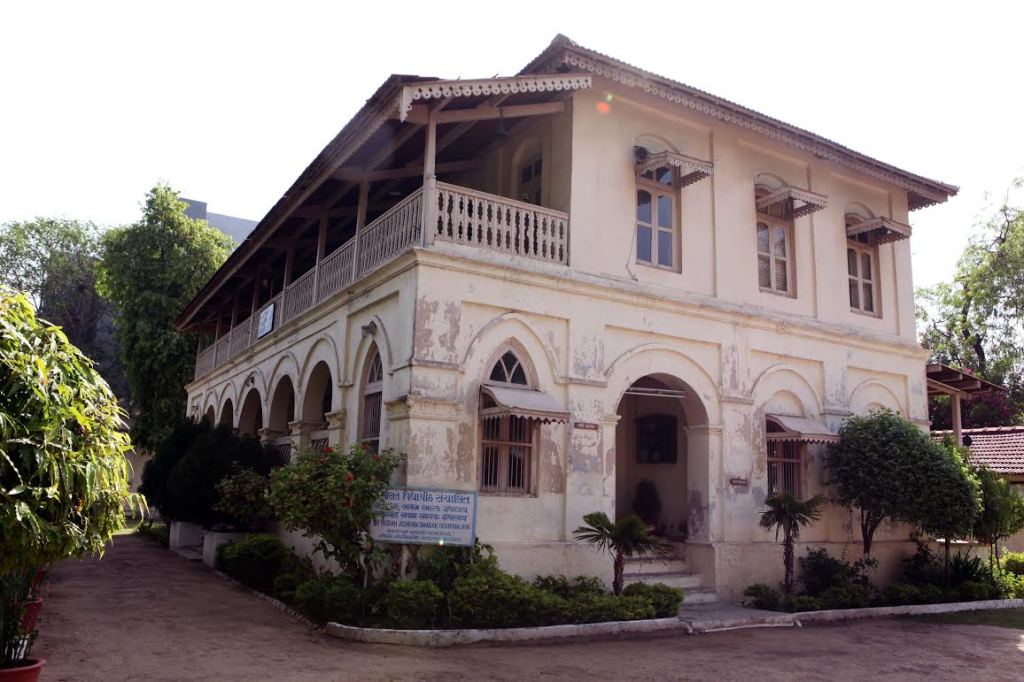
When Gandhiji  first came to Ahmedabad, he set up his Ashram at Kochrab. He invited a Dalit family– Dudabhai and Danibehn–to come and live at the Ashram. This led to considerable agitation among the Ashram’s neighbours as well as many funders, leading to a financial crisis, which forced Gandhiji to think of shifting the Ashram.

Kochrab Ashram

And then one day, in Gandhiji’s words: “A car drew up near our quarters and the horn was blown. The children came with the news. The sheth did not come in. I went out to see him. He placed in my hands currency notes to the value of Rs 13,000 and drove away. I had never expected this help, and what a novel way of rendering it!”

This gift saved the Ashram. It is well-known that the ‘Sheth’ was Shri Ambalal Sarabhai, one of the foremost industrialists of the time. However, neither he nor Gandhiji ever admitted this!

Jamnalal Bajaj: Exemplary Patriotism

Jamnalal Bajaj was considered Gandhiji’s fifth son, and adopted all his values—from Ahimsa to his dedication to the poor to his commitment to locally made goods and his patriotic spirit. He fought for admission of Harijans into temples, and in the face of strong objections, opened up his own family temple in Wardha—the first temple in the country to do this.

Shri Bajaj was an active member of the Congress Party, and gave up the Rai Bahadur title conferred on him by the British Government and joined the non-cooperation movement.


Importantly, Jamnalalji, in line with the trusteeship concept propounded by Gandhiji, felt that inherited wealth was a sacred trust to be used for the benefit of the people, and dedicated most of his wealth for the poor and under-privileged.

On the shoulders of giants….

–Meena

 www.tata.com

https://jamnalalbajajfoundation.org/jamnalal-bajaj/about

Toilet Travails

Last week we marked World Toilet Day. Continuing on the theme, I thought I would share some experiences of constructing and running urban public pay-and-use toilets. Never a dull moment in this game, I assure you. But the stories about operations I shall keep for another occasion. Here I would like to share some feedback from a survey we did of women in Hyderabad, as part of our planning exercise before we took up construction of toilets when the city decided, for the first time, to open up this activity in Public Private Partnership mode. The survey is over a decade old. But sadly, most of the challenges we found still probably stand.

Here are some of the findings from a survey of close to 400 women:

  • About a fourth of the respondents were not even aware that there are Pay-and-Use toilet facilities for women.
  • About half the respondents reported that they wait till they reach home even if they feel the need to use a toilet when they are out. 
  • Women in higher economic strata, non-working women and students use these facilities significantly less than women from lower economic strata and working women.
  • 64.2% of those respondents who used public convenience had a bad experience. The reported major reasons for the  ‘bad experience’ were:
ReasonPercentage
1. Unhygienic Conditions92.5
2. Insufficient water availability69.2
3. Bad smell62.8
4. Caretaker being male57
5. Joint infrastructure (both male and female facilities in one building, with a partition)53
6. Feeling of insecurity36.4

The respondents also made several valuable suggestions:

  • About 53% women suggested that there should be exclusive toilets for women.
  • Around 57% women opined that the caretaker of the public toilet should be properly trained and should be gentle, and he/she should be educated and middle-aged.
  • Respondents also expressed that the following facilities are needed by women in  public toilets; dustbins for disposable things; small shelves for women carrying things; mug and bucket provision; mirror; good lighting and alternative lighting arrangement in case of power fails.
  • Indian and western toilets both to be provided for convenience of various types of users.
  • Security is paramount.
  • Proper maintenance, cleaning at regular intervals and supervision.
  • In some cases, men are using the space around the toilets as the toilets! This not only leads to bad smell but also a feeling of embarrassment on the part of women who want to enter.
  • In many toilets, there is no proper indication for “gents” and “ladies”, which creates problem for women in using public toilets.

Public toilets are definitely more prevalent today than a decade ago. And the maintenance is not as bad as it was. But I think some of the survey findings and recommendations are still very relevant to those concerned about public sanitation, and about making the most basic of facilities accessible to one half of humanity!

–Meena

‘Down in the Dumps’ Day

No, let me hasten to clarify that there is no such Day. But there is indeed a World Toilet Day which is observed on 19th November every year, and ‘celebrates toilets and raises awareness of the 4.2 billion people living without access to safely managed sanitation’. The Day is about taking action to tackle the global sanitation crisis and achieve Sustainable Development Goal 6: Water and Sanitation for all by 2030.

Well, if we were to ‘celebrate toilets’ as urged in the mission, I would advocate for  a lovely little book called ‘Toilets of the World’ by Morna Gregory and Sian James, and published by Merrell Publishers.

The book begins with a very brief History of Toilets which is followed by a continent-wise round-up of interesting toilets. The beautiful colour plates are themselves an education of how creative photographers can make art out of not conventionally photogenic items!

Here are some interesting nuggets of information from the book.

  • The oldest known flush toilet is that of the palace of Knossos on the island of Crete, dating back to 1700 BC.
  • Solid waste generated by astronauts in space is compressed into round, flat discs and brought back to earth. NASA’s toilet engineers refer to them as ‘people patties’.
  • Toilets on board ships are referred to as ‘heads’.

And here are some toilets mentioned in the book which caught my attention for their ‘extreme’ qualities:

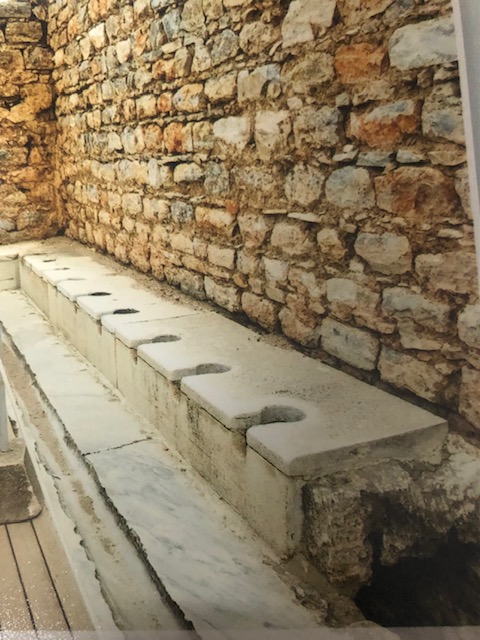
Public Toilet, Ephesus, Turkey. About 200 AD.

Keith Siding Road, Crandon Wisconcin: Someone as part of their garden decorations has put up an outhouse with the sign ‘Up North Rest Stop’. The door of the facility is open, and on the toilet sits a life-like lady in full view of the road, using the facilities!

Incahuasi Island, Bolivia: In the middle of 12000 sq. km. salt desert is a toilet carved from the trunk of dried cactus, with the needles removed to allow for comfortable seating.

30-Gold Store, Kowloon: This gold washroom put up in his shop by a Hong Kong jeweler is down in the Guinness Book of Records as the most expensive washroom. Fixtures, sinks, toilet brushes, toilet paper holders, all are made of gold.

Ancient Roman City, Ephesus, Turkey: Built around 200 AD, these communal pay-and-use marble latrines were for men only, and were a place for social gatherings and where many business deals were struck. Slaves used to come in early to literally warm the seats so that their masters did not feel the chill of the marble on their bottoms. There are many other yucky details, which I will refrain from sharing. (The picture is from an unforgettable family trip there.)

For more interesting information on toilets, the place to visit would of course be the unique Sulabh International Museum of Toilets at  New Delhi, which, to quote the museum website ‘has a rare collection of facts, pictures and objects detailing the historic evolution of toilets from 2500 BC to date. It provides a chronological account of developments relating to technology, toilet related social customs, toilet etiquettes, prevailing sanitary conditions and legislative efforts of different times. It has an extensive display of privies, chamber pots, toilet furniture, bidets and water closets in use from 1145 AD to the modern times. It also has a rare collection of beautiful poems related to toilet, their usage.’

In India, where close to half the population does not have a toilet at home, and where no ‘nudge’ or carrot or stick or government slogan seems to work towards reducing open defecation, every day has to be Toilet Day, and every person a Toilet Warrior!

Let’s get Vocal for Local Toilets!

–Meena

PS: I had borrowed this book from a dear friend David Foster and hope to meet him soon to return it.

PPS: Photo credit: Ashok Seshan

Reading ‘Judgmentally’

India has its fair share of Book Fests and Lit Fests. Some generic, some specific to a genre or a language. A well-known one among these is the Bangalore BizLitFest—as the name suggests, an event devoted to the Business Literature genre.

The 6th edition of this Fest, held online (of course) this year, concluded this weekend. While I have attended this Fest over the years, this time I had a special role—as one of the panel of judges to pick the best Business Book of the Year. This award was instituted in 2017, by the family of the universally-known academic Prof CK Prahalad (of ‘Bottom of Pyramid’ fame). The CK Prahalad Best Business Book Award is given to ‘the most original, impactful and thought-provoking business book written by an Indian author’.

It never ceases to amaze me how many contenders there are every year!  The competition process is a multistage one. Out of the business books published in the previous calendar year, a longlist of the top 25 is made based on ratings and reviews. Of these, the five which get the top ratings and number of reviews on Amazon, Goodreads and Flipkart in the first six months of the current  year are shortlisted. And a jury selects from among these, using two major criteria: Originality of theme, and second, Potential of the book as a game-changer, inspiration and influencer.

I was in the distinguished company of Prof Rishikesha Krishna (IIM-B), Manish Sabarwal (Teamlease), Narayan Ramachandran (formerly Morgan Stanley, writer, social entrepreneur) in the Jury Panel.

The five shortlisted books were:

Saying No to Jugaad: TN Hari, MS Subramanian

Bridgital Nation: N Chandrasekaran with Roopa Purushottaman

How I Almost Blew It: Sidharth Rao

The CEO Factory: Sudhir Sitapathy

Big Billion Startup: Mihir Dalal.

The unanimous winner was Mihir Dalal’s Big Billion Startup, the story of Flipkart.

For me, there were two levels of learning through the process:

Each book was a fascinating journey and provided enormous learning! Four of them were the story or stories of specific enterprises or entrepreneurs told so as to offer lessons to any manager or entrepreneur. Bridgital Nation was different in that it provided a broader framework of using IT to solve the nation’s problems.

At the second level, I realized that reading as a judge was a different ballgame from just reading. One has to read much more consciously, comparing and contrasting, articulating what works and what does not work. One has to be aware of content and style. Whether the ‘lessons’ are coming out clearly. And whether it will work for the audience it is meant for. While I have graded student essays and evaluated children’s fiction, judging business books was a new experience of reading ‘judgmentally’!

One comment I have on the books is that most mention dozens of names. While completely necessary to acknowledge and bring out the contribution (or otherwise) of all concerned in the making of the company, it is quite confusing for the reader who does not know any of these people. At times, I found myself going back and forth to figure out who a person was, more than even in a Russian novel!

All in all, a very interesting experience, and I thank BBLF for it.

Look forward to the next edition in Sept/Oct 2021!

–Meena

UN at 75: 24 October–UN Day

Way back when we were at school, there used to be a competition on UN Awareness for middle and high school students. I can’t recall much about it, but I do know a few basic things about the UN, which I am sure come from preparing for these tests. If I search hard enough, I may even find a certificate or two in my old papers.

No doubt the UN and the international order are in a shambles. To take just the example of the Corona crisis, the world should have been looking to the UN system and WHO in particular for balanced medical opinions, sage policy guidance, clear action guidelines, and strong leadership for international cooperation. We haven’t seen much of that.

But that is not to say that the UN does not have a major role to play. In fact, in an increasingly complex and interconnected world, it HAS to pull up its socks and take charge. And just to remind ourselves of the UN, its role and functions, here is a quick primer— I might have put together something like this to prepare for my competition tests all those decades ago.

Warning: Beyond the first 500 words, it is probably of interest only to those preparing for such exams!

The United Nations is an international organization founded in 1945, when representatives of 50 countries met in San Francisco at the United Nations Conference on International Organization, to draw up the United Nations Charter. This was signed on 26 June, 1945 by representatives of the 50 countries. Poland which was not present at the Conference, signed it later and became one of the original member states. The UN officially came into existence on 24 October 1945, when the Charter was ratified.

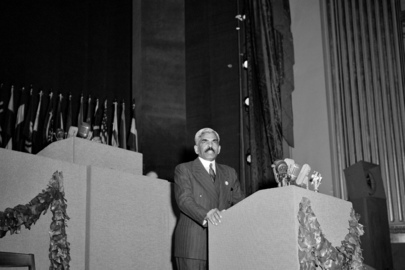
Interestingly, while in principle, only sovereign states can become UN members, four of the original members—India, Belarus, the Philippines and Ukraine– were not independent at the time of their admission. Giriaj Shankar Bajpai, the Indian Agent-General, signed the original Declaration by United Nations in 1942, while Sir A. Ramaswamy Mudaliar, who headed the Indian delegation to the Conference, signed the Charter itself on behalf of India.

Sir Ramaswamy Mudaliar addressing the UN

So technically, India was a founding member of the UN despite it being a British colony. Along with India, other British colonies Canada, South Africa, New Zealand and Australia were given independent seats in the United Nations General Assembly at that stage itself. The UN is currently made up of 193 Member States. 

The basic mandate of the UN is to:

  • Maintain International Peace and Security
  • Protect Human Rights
  • Deliver Humanitarian Aid
  • Promote Sustainable Development
  • Uphold International Law.

The main organs of the UN are the General Assembly, the Security Council, the Economic and Social Council, the Trusteeship Council, the International Court of Justice, and the UN Secretariat.  All of these were established when the UN was founded. In addition, it has many programmes, funds, and specialized agencies.

Here is a quick look at some UN agencies we often hear about. And some, frankly, that I never knew existed!

Programmes and Funds

UNDP: United Nations Development Programme works to eradicate poverty, reduce inequalities and build resilience so countries can sustain progress. UNDP plays a critical role in helping countries achieve the Sustainable Development Goals.

UNEP: United Nations Environment Programme acts as a catalyst, advocate, educator and facilitator to promote the wise use and sustainable development of the global environment.

UNFPA: United Nations Population Fund is the lead UN agency for delivering a world where every pregnancy is wanted, every birth is safe, and every young person’s potential is fulfilled.

UN-Habitat: United Nations Human Settlements Programme has the mission to promote socially and environmentally sustainable human settlements development and the achievement of adequate shelter for all.

UNICEF: Works to save children’s lives, to defend their rights, and to help them fulfil their potential, from early childhood through adolescence.

WFP: World Food Programme aims to eradicate hunger and malnutrition.  It is the world’s largest humanitarian agency. Every year, the programme feeds almost 80 million people in around 75 countries.

UN Specialized Agencies

FAO: Food and Agriculture Organization leads international efforts to fight hunger.

ICAO: International Civil Aviation Organization develops standards for global air transport and assists its 192 Member States in sharing the world’s skies to their socio-economic benefit.

IFAD: International Fund for Agricultural Development focusses exclusively on rural poverty reduction, working with poor rural populations in developing countries to eliminate poverty, hunger and malnutrition; raise their productivity and incomes; and improve the quality of their lives.

ILO: International Labor Organization promotes international labor rights by formulating international standards on the freedom to associate, collective bargaining, the abolition of forced labor, and equality of opportunity and treatment.

IMF: International Monetary Fund fosters economic growth and employment by providing temporary financial assistance to countries to help ease balance of payments adjustment and technical assistance.

IMO: International Maritime Organization has created a comprehensive shipping regulatory framework, addressing safety and environmental concerns, legal matters, technical cooperation, security, and efficiency.

ITU: International Telecommunication Union is a specialized agency for information and communication technologies. It is committed to connecting all the world’s people.

UNESCO: United Nations Educational, Scientific and Cultural Organization focuses on helping improve education worldwide to protecting important historical and cultural sites around the world.

UNIDO: United Nations Industrial Development Organization promotes industrial development for poverty reduction, inclusive globalization and environmental sustainability.

UNWTO: World Tourism Organization is responsible for the promotion of responsible, sustainable and universally accessible tourism.

UPU: Universal Postal Union is the primary forum for cooperation between postal sector players.

WHO: World Health Organization is the directing and coordinating authority on international health with the objective of attainment by all peoples of the highest possible level of health.

WIPO: World Intellectual Property Organization protects intellectual property throughout the world.

WMO: World Meteorological Organization facilitates the free international exchange of meteorological data and information and the furtherance of its use in aviation, shipping, security, and agriculture, etc.

World Bank: It focuses on poverty reduction and the improvement of living standards worldwide by providing low-interest loans, interest-free credit, and grants to developing countries for education, health, infrastructure, and communications, among other things. There are several specialized agencies as part of the World Bank Group.

Other Entities and Bodies

UNAIDS: Joint United Nations Programme on HIV/AIDS (UNAIDS) leads and inspires the world to achieve its shared vision of zero new HIV infections, zero discrimination and zero AIDS-related deaths.

UNHCR: United Nations High Commissioner for Refugees protects refugees worldwide and facilitates their return home or resettlement.

UNIDIR: United Nations Institute for Disarmament Research generates ideas and promotes action on disarmament and security.

UNITAR: United Nations Institute for Training and Research is a training arm of the United Nations System, and has the mandate to enhance the effectiveness of the UN through diplomatic training, and to increase the impact of national actions through public awareness-raising, education and training of public policy officials. 

UNOPS: United Nations Office for Project Services helps people build better lives and help countries achieve peace and sustainable development.

UNRWA: United Nations Relief and Works Agency for Palestine Refugees contributes to the welfare and human development of Palestine refugees.

UNSSC: United Nations System Staff College is the learning organization of the United Nations system. It designs and delivers learning programmes for staff of the UN system and its partners.

UNU: United Nations University has the mandate to conduct “research into the pressing global problems of human survival, development and welfare.”

UN Women: It merges and builds on the important work of four previously distinct parts of the UN system, which focus exclusively on gender equality and women’s empowerment.

Related Organizations

CTBTO: Preparatory Commission for the Comprehensive Nuclear-Test-Ban Treaty Organization promotes the Comprehensive Nuclear-Test-Ban Treaty and the build-up of the verification regime so that it is operational when the Treaty enters into force.

IAEA: International Atomic Energy Agency, is the world’s centre for cooperation in the nuclear field. The Agency works with its Member States and multiple partners worldwide to promote the safe, secure and peaceful use of nuclear technologies.

IOM: International Organization for Migration works to help ensure the orderly and humane management of migration, to promote international cooperation on migration issues, to assist in the search for practical solutions to migration problems and to provide humanitarian assistance to migrants in need, including refugees and internally displaced people.

OPCW: Organization for the Prohibition of Chemical Weapons is the implementing body of the Chemical Weapons Convention (CWC), which entered into force in 1997. OPCW Member States work together to achieve a world free of chemical weapons.

UNFCCC: UNFCCC Secretariat (UN Climate Change) was established in 1992 when countries adopted the United Nations Framework Convention on Climate Change (UNFCCC) and is tasked with supporting the global response to the threat of climate change.

WTO:  World Trade Organization is a forum for governments to negotiate trade agreements, and a place where member governments try to sort out the trade problems they face with each other.

ITC: International Trade Centre is the only development agency that is fully dedicated to supporting the internationalization of small and medium-sized enterprises (SMEs). 

–Meena

Main source: https://www.un.org

Beach Lore

The good news that newspapers brought us yesterday was that eight Indian beaches had qualified for the Blue Flag tag—an achievement indeed! This Certification is awarded by Foundation for Environmental Education (FEE), an NGO, and is a respected one, with stringent requirements. There are 33 criteria spanning environmental, educational, access and safety related parameters. Beaches tagged as Blue Flag provide clean and hygienic bathing water, along with basic infrastructure for tourists.

It is not impossible to spruce up for an inspection and get a certification or award. The challenge is make the improvement sustainable, and an inclusive shared vision with all stakeholders. Let us hope these eight beaches are able to do this and stay on the list, even as more join them in the years to come.

At any rate, it provides an opportunity to revise some beachy information:

A beach is a narrow, gently sloping strip of land that lies along the edge of an ocean, lake, or river (yes, technically, even the land around a lake or along a river is a beach!).

Beaches are made of materials such as sand, pebbles, rocks, and seashell fragments. Over the decades and centuries, forces of nature—water, wind, erosion, weathering—act on the cliffs, rocks and landforms at the edge of the waters, and break them down.  As tides come in, they deposit sediment which may have sand, shells, seaweed, and even marine organisms like crabs or sea anemones. When they go out, they take some sediment back with them.

Beaches are constantly changing. Tides and weather can alter beaches every day, bringing new materials and taking away others. There are seasonal variations too. In the winter, storm winds throw sand into the air. This can sometimes erode beaches and create sandbars. In the summer, waves retrieve sand from sandbars and build the beach back up again. These seasonal changes cause beaches to be wider and have a gentle slope in the summer, and be narrower and steeper in the winter.

At 7500 kms, India has the world’s seventh-longest coastline, with nine states and two union territories having coasts.

Apart from aesthetics, beaches are habitats for many, many species. The Olive Ridley coming to nest in the Gahirmatha beach of Orissa is a phenomenon that naturalists come from around the world to witness. In all, about 2,50,000 to 3,00,000 turtles nest here every year, in the space of about two weeks. Thousands of female turtles arrive each night to lay eggs. They make nest holes, lay 100-300 eggs, smooth the nests over, sometimes covering them with vegetation, and go back. Fifty days later, the eggs hatch, and millions of little turtles, each the size of a brooch, make their way into the ocean to start their lives.  

Our coasts and beaches are also witness to a hoary past: The rockcut temples of Elephanta date back to the 6th century AD. The temples of Mahabalipuram are almost as old—going back to the 7th century. The Konarak temple dates back to the 13th century, at which point it stood directly on the sea, though today the sea has moved about 3 km away. Dwarka is believed to have been the Krishna’s capital, and is said to stand on the site of five earlier cities. Fort Aguada, Goa, built in the 17th century has a unique lighthouse. Rameshwaram has the largest temple in India.

And of course, on April 5, 1930, Gandhiji and 78 satyagrahis reached the beach at Dandi on the coast of Gujarat to make salt and history.

So let’s protect our beaches! Let’s Blue Flag them all!

–Meena

Monumental Tragedy

Thanks to COVID and the search for not-too-popular sights, we ended up visiting the Chikkajala Fort last weekend. On the way to Bangalore Airport and not too far from my home, we have been meaning to go for a long time.

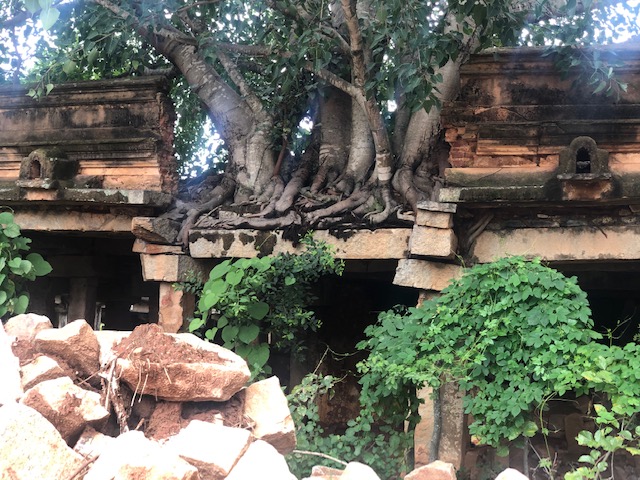
‘Fort’ is a misnomer today—what stands is a temple with what once must have been a beautiful, deep temple-tank in front of it, and a few long corridor-like stone structures. The site of Chikkajala is a prehistoric one apparently. It is likely there was a ‘vassal fort’ but it no longer stands. The estimates of the age of the temple and extant structures range from 300 to 950 years!

Apart from the general ravages of time and the overall neglect, apparently some parts of the structures were demolished for road widening after the new airport came up.

Whatever the reasons, it was sad!  To see a construction which must have a thing of beauty, lying in rack and ruin. The structure just falling down as it stands. Carvings defaced. Trees growing on and through the buildings. Cows grazing and leaving behind generous piles of cow dung. The temple tank completely overgrown with vegetation.  Plastic water bottles and discarded chips packets.

It was particularly poignant because only last week, Karnataka announced its Tourism Policy for 2020-25. The State aims to be among the top two tourist destinations in the country. I confess I have not read the 104-page document completely, but what I have read leaves me completely confused! While it talks at length of developing tourism infrastructure, ‘products and services’, I am amazed that it says nothing about the core of tourism—the sights that tourists go to see. What is to be done to preserve and enhance the condition of the cultural artefacts and natural heritage. Agreed, this is in the purview of other departments, but does a tourism policy not have to be in sync with these other departments, and should the synergies not be laid out as a part of the Policy?

The strategic intervention as mentioned by the Policy, and which seem to me to sadly lack so many, many critical elements, are:

  • Position Karnataka as a preferred tourism destination at state ,national and international levels
  • Facilitate improvement of Infrastructure, Tourism Products and Services
  • Streamline processes for obtaining approvals and clearances
  • Prioritise Human Resources Development & Capacity Enhancement
  • Promote ICT based initiatives for providing timely and reliable information services to tourists
  • Create institutional structures for effective implementation of the Policy
  • Provide attractive concessions and investment subsidies for various tourism

Admittedly I know nothing about Tourism or Tourism policy. But I do know when an ancient monument next to my house is falling to bits. I do see that a monument right on the main road to the airport can attract a lot of footfalls. I can gauge that it is about some money, but  much more about caring.

A small piece of heritage in a country which has so much that we can’t be bothered about any of it? A tiny blip in a list of monumental tragedies?

–Meena

PS: A lovely spider sighted in the ruins. About 5 inches across, it had spun a web which was about 4 ft across. Maybe Nephila pylipis, but I am not quite sure.

Photo credits: V. Raghunathan

Waiting for the Mahatma

This slim 1955 novel by R.K. Narayan is the best Gandhi Jayanti gift I could have given myself. It transported me to the days of the Independence struggle. The story itself is not really the crux of it, though it is a novel and there is a love story interwoven with the freedom movement.

So much time has passed since the time of the Mahatma that we cannot really fathom what it must have been to live in his time, to be inspired by him and be, even in the remotest way, a part of the freedom movement. And that is just what the book brought to me. That the most uneducated person in the remotest village in any corner of the country was somehow moved and fired by this figure called Gandhi. Whether the person fully understood what Gandhi stood for or what he wanted of them, still they were ready to believe in him, to dedicate themselves to his mission. In the tens of thousands they stood for hours in the sun for a glimpse of the Great Soul. In the thousands, they were ready to give up everything in life and go to jail for him. The book gives us a glimpse of the person behind the myth.

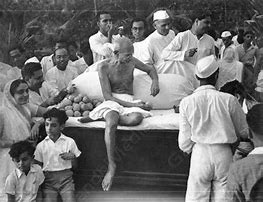
The incidents in the book obviously draw from many, many real happenings of those times. When I found the photograph of the Mahatma, children and fruits, it told me how authentic was the experience from which the book came. The book describes an incident when Gandhiji is taken to the house of the richest man in a town he is visiting, and all the elite are there, waiting for him to speak and to catch his attention. There are trays and trays piled with fruit. Not one of which he touches. Instead, he calls the children in the audience and distributes the fruit to them. While the adults are not thrilled, they still tolerate it. But they definitely are not happy when the Mahatma spots a little urchin in completely tattered clothes in the crowd, calls him up to the dais, seats him beside himself, plies him with fruit and has a full-fledged conversation.  And then decides to go and stay in the home of the urchin, who lives in the Cleaners’ Colony– the poorest, filthiest and unhealthiest part of town. In spite of the exhortations of all the bigwigs to stay in the house of the town’s wealthiest man where arrangements have been made, gently but uncompromisingly, Gandhi insists on going to the boy’s house, throwing the local elite and officials into a complete tizzy.

His uncompromising insistence on truth and ahimsa. His never sacrificing the means for the end. His belief in people, and at the same time, his being able to understand why they slip from the path. His interest in the minutest details of the lives of those around him. His prodigious correspondence—responding to each one of the letters he got. His sense of humour and unshakeable resolve. His sticking to his point without aggression. With this, he inspired a sub-continent and fought the mightiest empire of the time. With this he got us our freedom.

But we still make the Mahatma wait for us. Wait for us to live up to his ideals. Wait for us to be the nation he dreamt we would be.

How long will he have to wait?

–Meena