What Shall I Be?

In our experience of working with rural youth and those from smaller towns, we often found that when we asked them about their career aspirations, they would mention ‘engineer’, ‘teacher’, or ‘police’. With good reason, because these were among the few professionals they came across in their day to day lives. This gave us a good insight into the need for expanding horizons by introducing them to a variety of careers.  And it did make a difference. From forensic science to data science, from yoga teaching to wood-working, from optician to wildlife biologist—once the children knew about them, they were inspired to dream differently.
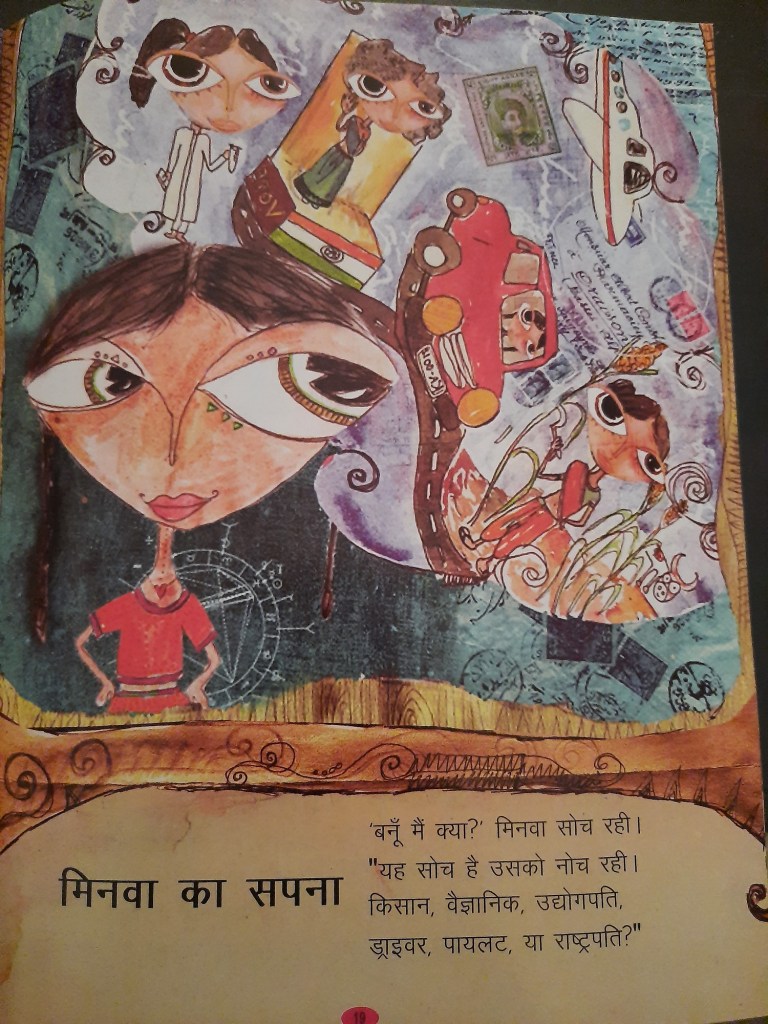
From Minva Aur Dumpua ke Karnaame, by V. Raghunathan, illustrated by Shilo Shiv Suleiman. Diamond Press

But never in my wildest dreams would I have thought to introduce some of the following careers to the young people. But maybe it’s time we get youth excited about some of them.

Given these COVID times, it would be good to inspire people to become aerobiologists–scientists who understand Aerobiology, the branch of biology which focusses on organic particles which are passively transported by the air, including bacterial viruses, fungal spores, pollen grains etc.! Or for that matter, to study Loimology, that is, gain knowledge of plagues and other pestilential diseases. Hygiology, the study of cleanliness could become big too

I would urge those interested in nature, wildlife or conservation to specialize in Caliology, or the study of bird’s nests– ‘calio’ comes from the Greek καλιά [kalia], a wooden dwelling, hut, or nest. Nidology means the same too, but the origin is from the Latin ‘nidus’ meaning nest. Or take up Myrmecology, the study of ants. Some could opt for Ophiology, the study of snakes.

Garbologists are going to become very important too—they study garbage, and hopefully will help to solve the world’s solid waste crisis. Given that our weather predictions are not too accurate with the monsoons more often missing than hitting on the given date, maybe more people should get into Anemology–the study of winds, and Brontology, the study of thunder. And we will always need people to take up Bromatology, the study of food. Bromotologists create new food products and also work to ensure food safety.

While I would urge young people to study Demology, that is, the study of human activities and social conditions, I would have to ensure they don’t confuse it with Demonology, the study of demons or beliefs about demons.

While not so disastrous a difference, I would still urge making the point that Mycology is the study of fungus, and Myology the study of muscles; Nephology the science of clouds, and Nephrology the study of kidneys; Pedology the study of soils, and Pedagogy the method and practice of teaching; Tribology the study of friction and wear between surfaces, and Trichology, the study of hair and its disorders.

And I would ask students to double check that they know what they are aspiring for when they decide to study Nosology—it is the study of diseases; or Trophology—it is the study of nutrition; Potamology the study of rivers; or Carpology the study fruits.

At any rate, no one can complain of lack of choices!

–Meena

Whatever you choose to be, whether a surgeon or a welder, make sure your skills are the best!

On the occasion of World Youth Skills Day, July 15.
Defence Science: Remembering Dr. DS Kothari on his Birth Anniversary, 6 July

‘Dr Daulat Singh Kothari, a theoretical physicist and Dean of the Faculty of Science of Delhi University, was appointed the first Scientific Adviser in July 1948, at the age of 42. He formed Defence Science Organisation by hand-picking scientists from the various universities in India who were proficient in aeronautics, electronics, chemistry, mathematics, nutrition, physics, psychology to start research work in ballistics, electronics, chemistry related to explosives, paints and corrosion, food preservation and nutrition, psychological fitness profile for selection of Service personnel, battlefield stress and physical fatigue. He made the Services conscious of the role a scientist could play in the solution of defence problems. Dr Kothari aimed to build a boundaryless learning organisation stripped of hierarchical trappings and with two-way communication between him and his scientists. The basic science laboratory raised by Dr Kothari provided the nucleus for the formation of the Defence Research and Development Organisation.’

–DRDO Website

The first Boss is the most formative influence on one’s career, work ethics and leadership style. And if he/she is a good boss, then they are almost Gods to impressionable young minds.

Dr. DS Kothari was my father’s first Boss. And was God to him.

Each line in the DRDO (Defense Research and Development Organization) write-up resonates with what I have heard about Dr. Kothari from my father.

DRDO was officialy established in 1958, but many constituent labs came into being before that. My father applied and was interviewed for the junior-most position in the Defence Science hierarchy around 1953. And who should be the head of the panel but Dr. DS! He sat through days and days of interviews in the midst of all his responsibilities as Scientific Advisor to Raksha Mantri. He saw this as his most important responsibility—hand-picking young scientists of promise from across the country to build a unique institution and an ambitious one for a newly independent India.   

The first problem he set my father and a few of that cohort was to work out the ideal thickness of rotis for high-altitude troops. The parameters to be optimized for a given weight of atta were time for the cook to roll out the roti, cooking time, and fuel consumption. And of course the rotis had to be edible! I think the realization that science could be brought to bear on such everyday problems was a lesson that scientists of that generation imbibed and made a way of life.

In 1955, PM Pandit Nehru set the scientists the task of studying the consequences of nuclear, thermonuclear and other weapons of mass destruction. Dr. DS had the major responsibility of bringing out the report, along with Dr. Homi Bhabha and Dr. Khanolkar. A small group of young Defence scientists—my father among them–was tasked to assist these stalwarts. Due to various reasons, it was Dr. Kothari who took up most of the burden of the work.

The 10-12 months were among the most hectic and most memorable ones of my father’s career. There was very little information on this subject in the public domain at that time, and India did not belong to any elite clubs which could get access to any classified information. Yet, in less than a year, the group brought out a data-rich 212-page report ‘Nuclear Explosions and Their Effects’ (subsequently published by the Publications Division). The book had a foreword by Pandit Nehru and was a seminal report at the time, not only in India but internationally.

The powers that be were also gracious in acknowledging the contribution not only of the leaders but also the young scientists.

But what is part of family history is something that captures Dr. Kothari’s essence. Apparently, at 4 pm on a Sunday afternoon, there was a knock on the door of my parents’ house. When they opened the door, there was Dr. DS himself! He had wanted to urgently discuss a point related to the book. In the days before home-telephones, he got his office to dig out my parents’ address, and rather than send someone to fetch my father, decided to come himself and save time.

My mother, till her last days, recalled this incident with not only awe, but also a feeling of being overwhelmed. A young girl newly arrived from Tamilnadu, with a very cranky baby on her hip. and no Hindi and only a smattering of English, she was confronted with having to entertain God himself! I think the sum total of furniture in the tiny house consisted of a few Godrej chairs, a study table and a cot. I don’t know if Dr. DS partook of anything, but I surely hope he asked for coffee rather than tea, because there would have been no tea leaves in a good South Indian household of that time. Nor would my mother have known how to brew a cup of tea. And steel tumblers and dawaras were the only serving utensils.

But Dr. DS, by family accounts was completely oblivious of all this. He came, made himself completely at home on the Godrej chair, stayed for almost an hour discussing what he had come to discuss, and then with blessings to my brother and a warm smile to my mother, was off.

All in a day’s work for him. But for us, family history for generations!

Dr DS Kothari: Scientist of international renown who worked with Dr. P Blackett in Cavendish Laboratory, Cambridge University, under the guidance of Lord Ernst Rutherford, the Father of Nuclear physics, and contributed immensely to the fields of statistical thermodynamics and Theory of White Dwarf Stars. Steering-hand of DRDO and the founder of many of the labs in the system. Played a key role in setting up UGC and NCERT, and was Chair of India’s first Education Commission.

–Meena

In memory of my father, Shri A. Nagaratnam, a physicist, who worked with DRDO for almost half a century. And my brother, Dr. N. Prabhakar, an aeronautical engineer, who also spent his entire career with the same organization, and was awarded a Padma Shri. They knew no other life, and were immensely proud to be a part of DRDO.

Small Is Not Yet Beautiful

June 27 was declared as World Micro, Small and Medium Enterprises (MSME) Day by the UN in 2017, to focus on the contribution of this sector to inclusive and sustainable development, both locally and globally. The importance of MSMEs is huge, but not fully registered in the mindsets of most people. Globally, they account for two-thirds of all jobs. In developing countries, 4 out of 5 new jobs in the formal sector were created by MSMEs. Many MSMEs in developing countries, especially the smallest, are often run by women.

There is no standard international definition of MSME. In India, as per changes brought in last year, the classification of units in the sectors is based on a composite of Investment in plant/machinery/ equipment as well as Annual Turnover.

ClassificationMicroSmallMedium
Manufacturing and Service rendering EnterprisesInvestment in Plant and Machinery or Equipment:
Not over Rs.1 crore; and Annual Turnover not over Rs. 5 crore
Investment in Plant and Machinery or Equipment:
Not over Rs.10 crore; and Annual Turnover not over Rs.50 crore
Investment in Plant and Machinery or Equipment:
Not over Rs.50 crore; and Annual Turnover not over Rs.  250 crore

For us, as for many other developing countries, this sector is critical in terms of contribution to employment and GDP. There are about 6 crore MSME units in India today, of which 99.4 per cent of are micro-enterprises, while 0.52 percent are medium, and 0.007 per cent, are medium enterprises. In other words, micro-enterprises dominate. MSMEs account for about 30% of GDP and about 48% of exports. They employ about 11 crore people. About 41% MSMEs are engaged in Manufacturing while 59% of them are in Service activities

The number of MSME units and the people employed have been growing for the last 4-5 years.

But the contribution to the GDP has been almost stagnant. This clearly speaks for the extremely low, and falling productivity of the sector. Studies estimate that Indian MSMEs have a productivity of at best 65% and at worst, 25% of such units in other countries.

This is compounded with the difficulties these units face in scaling up and accessing markets. And not to speak of the challenges of the external environment and regulatory environment challenges. The pandemic has devastated the sector. Not only have orders dried up, but even where there are orders, units have been hit with a reduction of workforce and huge challenges in procurement of raw materials.

In a scenario where jobs are getting scarcer and entrepreneurship is being seen as the answer, we obviously need to do many things at many levels. Speaking as someone engaged in the education and skilling sector, for me a major part of the solution has to do with Education and Training.

First and foremost, we need to get basic education right.  

And then, respect for and practice of vocational skills, as well as concepts like quality consciousness and systematic approach to doing any task have to be inculcated right from primary levels. These are not mindsets which can be added on at a later stage. They are very fundamental to a person’s make up, and influence how he/she performs any task in later life.

Skill training has to be much more rigorous than it is today. A student in Germany for instance, would spend about 2 to 3.5 years learning a skill, spending half the time in vocational school and half the time in a real factory, being systematically trained. We are ready to certify youth who go through a 3-month programme as skilled! And even pass-outs from ITI institutions or Polytechnics who spend a longer time, still have zero exposure to any real life workplace situation, and at best spend some time on old and outmoded machines. Not a recipe for productivity!

Third, MSME entrepreneurs need management education. Whether it is managing finances or people, production or marketing, each small entrepreneur seems to be making mistakes, discovering first principles, and reinventing the wheel. Surely not conducive to productivity. There are such initiatives, but they seldom reach the grassroots and the audience who really need these inputs.*

MSMEs have a huge role to play in inclusive development. They have the potential to impact the lives of the poorest, the most vulnerable through creation of local businesses. We need to act now!

–Meena

PS:  Those interested in MSMEs and Skilling should watch a webinar by National Skills Network on the subject.

  • * I am currently involved in a very interesting initiative of developing an ‘MBA’ programme for rural women entrepreneurs who are Std 8 pass and above. An initiative of Access Livelihoods supported by GIZ.

Indicator Tea

Those who have gone through high school science will remember lab-experiments involving indicators. Adding a drop of phenolphthalein and noting that critical point at which the colourless liquid in the flask turned a bright pink. Or when the litmus paper turned red or blue. Remember how critical it was for our grades to observe these colour changes correctly? As a B.Sc Chemistry student, indicators played a pretty large part in my life!

Those colour changes are what my experiences with butterfly-pea tea took me back to. This tea has been much in vogue for some time now. But keeping in character, I am of course about two years behind the trend.

This in spite of having the creeper literally at my doorstep. Planted there to supply flowers for my mother’s puja– the shankpushpi flower is specially a favorite of Lord Shiva–it has proven itself a hardy survivor of my spurts of inept gardening. It grows and flowers and flourishes. The indigo-blue flowers are equally beautiful on the plant and in the puja.

Clitoria ternatea commonly known as Asian pigeonwings, bluebellvine, blue pea, butterfly pea or  Darwin pea, is known for its blue flowers, though there is a less common white variant. In India, it is called shankpusham, girikarnika or aprajita.

Here it is used mainly for worship and to some extent in Ayurveda, mainly for de-stressing, and to boost memory and brain function.

The use in Southeast Asia is more varied. It is an integral part of many Thai, Malaysian and Burmese recipes as an ingredient and as a colouring agent, and is very widely used in Chinese medicines.

Which brings me to the visually-stunning butterfly-pea tea, which is a wildly popular drink in those countries (and now the world). Made by steeping a handful of flowers (fresh or dry) in hot water, the resulting tea is a lovely blue. Squeeze a lemon into it, and it turns pink or even violet—taking you right back to your school lab! It is basically the same phenomenon—a change in pH resulting in a change in colour.

Research on the use of Butterfly Pea in managing Alzheimer’s has been ongoing for some time now. The latest is a research study from National Centre for Biological Sciences, India, published in Journal of Medicinal Chemistry, which takes forward the hypothesis that extracts from this plant ‘can help in neuroprotection and prevent progressions that cause the ailment’.

So go ahead and plant a shankpushi in your garden or a pot—only making sure that it gets enough sun. It is not at all difficult to grow—my creeper sheds seeds all around, and each week, I find tens of little plants wanting to curl around the nearest support and climb. It will do well in most soils, even enriching them, as it is leguminous and will fix nitrogen. Apart from watering it once in a while, you don’t need to do much.

And in return, it will add beauty to your garden, adorn your puja room, help you make conversation-piece teas, salad additions and coloured rice. And hopefully also boost your brain-power. A winning proposition all around!

–Meena

Did I See What I Saw?

8.15 pm, June the 9th, 2021. Bangalore.

I was looking out at the madhu-malti (Combretum indicum; English names: Chinese Honeysuckle or Rangoon Creeper) in my garden.

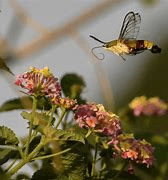
And I saw an amazing sight. An aerial creature hovering and sucking nectar from the flowers. It darted away and was back for another 10-15 second go at the flowers. And again and again and again. And the movements were accompanied by a whirring sound.

Smaller than any bird I have seen, and with gauzy wings, it was much larger than any bee or wasp. To me, at first sight it looked like a giant wasp. But a wasp that was behaving like a sunbird or a humming bird. So then I wondered whether it was some sort of sunbird. But I didn’t feel comfortable with either explanation.

I rushed to get my phone. The creature was a fast-darting type; my phone does not have a great camera; the light was bad; last but not the least, I am a terrible photographer. I clicked away, knowing full-well that there would be nothing out of the exercise other than some dark blurs. And I was right.

I called Raghu. He came a few minutes later. Just caught a few glimpses of the creature. Not enough for him to make any conjectures apart from that it was a larger-than-ordinary flying creature. It did not hover when he came. The saga ended when it vanished into the dark. Raghu said it was just a moth and it was my hyperactive imagination which had seen it hovering and sucking.

I could not let this insult pass. I went to good old Google. And have concluded that what I saw was a Hummingbird Moth, probably a Hummingbird Hawkmoth (genus Macroglossum). But which one, I cannot tell.

Kitching, Kendrick and Smetacek in their enumeration ‘ A List Of Hawkmoth Species (Lepidoptera: Sphingidae) Of India, Nepal, Bhutan And Sri Lanka, Including Their Common Names’ list about 20 Hummingbird Hawkmoths which may be sighted across this area. The common names run an interesting gamut, from Black-Based Hummingbird Hawkmoth to Burnt-Spot Hummingbird Hawkmoth to Obscure Hummingbird Hawkmoth.

Obviously not the pic I took!

What is this creature which looks like a bird and acts like a bird, but is an insect? An evolutionary phenomenon called convergent evolution or homoplasy explains this resemblance. In homoplasy, two creatures from different families and orders develop similar forms which serve the same functions. Basically, Hummingbird Moths mimic hummingbirds because it gives them some advantages. What could these advantages be? Scientists opine that looking like a bird may help them for two major reasons: first, these moths are diurnal, and this makes them more vulnerable to predators. They are also pretty colourful, which adds to the vulnerability. So looking like a bird may fool predators, and give them an edge.

These moths, like hummingbirds, have extremely strong wings to enable them to hover and sip. Hummingbirds beat their wing over 80 times a second. While the moths are not quite as fast, the speed is enough to keep them suspended over the flower for several seconds at a time. They have very long proboscis, which enable to suck the nectar.

Good to know. But can I be sure that what I saw was a Hummingbird Hawkmoth?

No. While Hummingbird Hawkmoths have been sighted in Bangalore, they are supposed to be seen in South India in the winter. But this sighting was in June.

And emphatically, all HHs unlike most other moths, are diurnal creatures. They are supposed to be active in the daytime, especially when it is sunny and bright. But this sighting was at 8.15 p.m.

These moths are supposed to come back at the same time to the same place, day after day. But alas, not in my case. I have been watching the madhu-malti for the last few days not only between 8 and 8.30 p.m., but on and off through the day, with nary a sight.

So did I see what I saw?

–Meena

On the Wing, By the Thousands

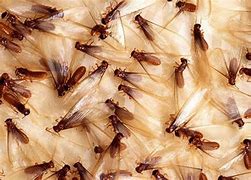
It has been raining on and off for a week and more here. But yesterday, as I took a walk after the rain, I saw swarms and swarms of winged termites circling the lampposts. Even as hundreds swarmed, as many fell on the ground, lost their wings and started crawling around, hopeful of mating.

But in reality, most became a high-protein meal for the frogs that were out by the dozens, hopping and mating all over the paths. And should some land on a wall, there were the lizards, ready to give chase and swallow them up.

It was a full-on display of with predator-prey drama. An amazing sight.

It often rains, but it is not every day that these creatures swarm. What triggers this? When do they swarm? Why do they swarm?

Swarming termites, also called alates, swarm when their original colony has reached a certain capacity level and is ready to expand. This usually happens once a year. All colonies in an area swarm at around the same time, which explains why one sees the phenomenon of thousands of them out in a small window of a few days.

The swarms have both males and females. They live close to the soil and when conditions are right, they take to the wing.  Their sole job is to reproduce and set up new colonies, so once they are airborne, they find a potential mate, shed their wings, fall to the ground and mate. They then find a new place to start a nest.

The swarming usually happens on a day following a rain shower, when the skies are overcast, and the wind speed is about 9.5 kmph. Alates wait for the rains to have moistened the soil well, as damp soil makes it easy for the couples to build their nests, and survival rates are higher when there is more humidity. But even in the best conditions, survival rates are only about 0.5 per cent, which explains why there must be so many swarmers!

Humans being conditioned to think of other creatures from their point of view, and term termites as pests. But termites have a huge role to play in nature. They are nature’s best recyclers. Termites feed on cellulose and hence break down dead plants and put nutrients back into the soil. They burrow and aerate the soil, allowing rainwater to trickle in and enable the mixing of nutrients. Their sticky excretions hold the soil together, preventing soil erosion. Without all this, the cycle of life would not go on.

We marked Environment Day last week. A good time to remind ourselves of the role of every living creature in the complex web of life, and that they were not put there to be of use to us. Each has a purpose and meaning, beyond their roles in our puny lives!

Having said that, we can still smile as we read Ogden Nash’s verse:

Some primal termite knocked on wood
And tasted it, and found it good!
And that is why your Cousin May
Fell through the parlor floor today.

–Meena

The Future of Education

A year ago, when we were just beginning to understand the impact of Corona and lockdowns on our lives, my colleagues and I had a brainstorming, and jotted down what we saw as the impacts of these on school-age children. These included:

  • Loss in educational achievements due to long break
  • Increasing inequity in educational inputs– limited access of Govt School children to e-learning
  • Challenges in parental support to facilitate learning at home
  • Inadequate interaction with other children /adult
  • Difficulties in adjusting to new teaching methods/ technologies/ new curriculu
  • Inadequate educational inputs, resources
  • No exposure to outdoors, play, co-curricular activities
  • No outlet for energy
  • Less structure, discipline
  • Lower nutrition due to disruptions to mid-day meals
  • Challenges to govt. school infra of social distancing norms, sanitation, water
  • Pressure on Govt. Schools due to reverse migration, and shifting from private to govt. schools due to fall in income.
  • Timely availability of textbooks, coping with new timelines
  • Pressure of change in Academic year, exam patterns
  • Increased dropouts for various reasons, increase in child labour, child marriages etc.
  • Fear, anxiety
  • Parents stressed with loss of incomes, confinement etc.
  • Lowered access to healthcare.

In the year that we have gone through, not many satisfactory responses to these challenges have been found.

The pandemic is forcing us to focus on the short term, on questions like:

To open schools, or not to open schools?

To start classes, or not to start classes?

To conduct exams, or not to conduct exams?

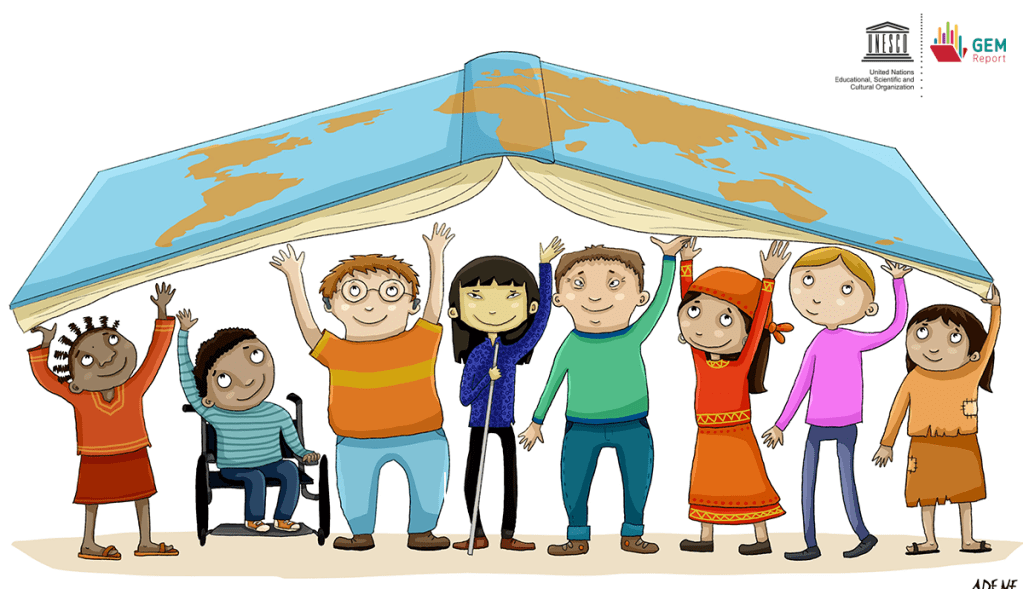
But the responsibility of policy-makers is to go beyond, and think about the future shape of education, and to re-imagine it for the new world. This is where the UNESCO titled ‘Education in a post-COVID world: Nine ideas for public action’ will be useful. While it not a kunji  to give short answers to profoundly important questions about the future of education, it does give some useful frameworks to think about these questions. The nine ideas it propounds are:

‘1. Commit to strengthen education as a common good. Education is a bulwark against inequalities.

2. Expand the definition of the right to education so that it addresses the importance of connectivity and access to knowledge and information.

3. Value the teaching profession and teacher collaboration. Encourage conditions that give frontline educators autonomy and flexibility to act collaboratively.

4. Promote student, youth and children’s participation and rights. Prioritize the participation of students and young people broadly in the co-construction of desirable change.

5. Protect the social spaces provided by schools as we transform education. The school as a physical space is indispensable. Traditional classroom organization must give way to a variety of ways of ‘doing school’ but the school as a separate space-time of collective living, specific and different from other spaces of learning must be preserved.

6. Make free and open source technologies available to teachers and students. Education cannot thrive with ready-made content built outside of the pedagogical space and outside of human relationships between teachers and students. Nor can education be dependent on digital platforms controlled by private companies.

7. Ensure scientific literacy within the curriculum.

8. Protect domestic and international financing of public education. The pandemic has the power to undermine several decades of advances.

9. Advance global solidarity to end current levels of inequality.’

Excerpted from: https://en.unesco.org/sites/default/files/education_in_a_post-covid-world 

The world has changed. Crisis has to be turned to opportunity. We have to start to re-imagine the Future of Education–now.

–Meena

RIP Sundarlal Bahugunaji, Sentinel of the Slopes

The story of the Chipko Movement was one of the examples that was held up to the youth of the ‘70s and ‘80s, to inspire them towards caring for the environment, and to urge them towards peaceful activism.

Deeply rooted in the Gandhian philosophy and the Sarvodaya movement, Sundarlal Bahugunaji and Chandiprasad Bhatji were at the forefront of this, one of the first people’s movements in the country which saw the connection between the degradation of the environment and the well-being and livelihoods of people.

For decades, Bahugunaji had been working in the Tehri Garwhal area of what would become the state of Uttarakhand, organzing people along Sarovdaya lines, addressing issues of livelihoods, women empowerment and ecological protection.

These years of work prepared the ground for what would become the Chipko Movement.

The story begins in the monsoon of 1970. The Alaknanda, along with other Himalayan rivers was in flood and swept down the valley, leaving behind a wake of destruction. The people in the area could clearly see that the extent of the havoc was linked to the destruction of the thick forests that had once covered the mountain-sides. For many years now, trees were being cut by contractors, and the wood taken away to the cities. This left the slopes exposed, unstable and vulnerable to floods like this. Not only that, while the contractors were allowed to cut wood, the communities who had lived in and around the forest for generations and depended on them for food, fuel, medicine, timber  and other forest produce, were denied these. The forests were originally of oak, and the people knew these trees and used them in a number of ways. But now, contactors were not only destroying the oak forests, but they were also replacing them with chir pine which was not suited to the area, nor useful to the people, but whose wood was prized commercially. All this led to an increasing sense of frustration in the people.

The spark was lit on a March morning in 1973. A group of people from a sports-goods factory in Allahabad reached Gopeshwar village in Chamoli District. They had come to cut ash trees for the manufacture of cricket bats.

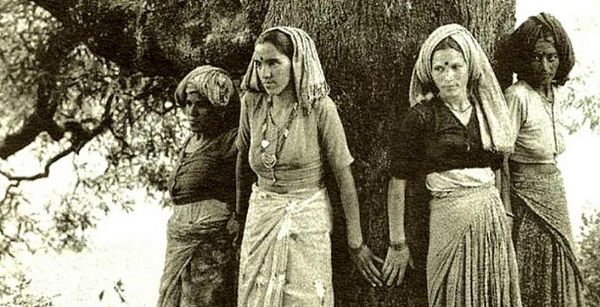
The villagers were in no mood to let these people cut their trees. They requested the axemen to go back, but they were under orders to cut the trees, and so refused. The villagers spontaneously decided that they were not going to let a single tree be touched even at the cost of their own lives, and rushed forward shouting ‘Chipko, chipko’ (roughly, ‘hug the trees’). They clung to the trees. The axemen, not knowing what to do, returned without cutting a single tree.

It was a battle won, but the war continued. Two months later, the contractors got permission from the local forest officer to cut the trees in a forest near the village of Rampur Phata, about 60 km away.

News of this reached Gopeshwar. The people were incensed. The entire village—men, women, old and young—set off in a procession to Phata. They carried drums and trumpets and banners with messages like ‘Chop me, not the tree’. The marched to Phata, singing and shouting slogans. People from other villages along the way joined them, and ‘Chipko’ was on everyone’s lips.

The huge procession reached Phata. The axemen were once again forced to flee by a peaceful crowd ready to give up their lives for the tree.

Confidence grew in the communities that they could protect their forests and environment.

But the contractors were worried. They were plotting and planning. Once, when they knew that the menfolk of Reni village would be away, they sent their men to the forests there. But the news of this reached the village, and a procession of women and children led by the fearless Gaura Devi walked towards the forests. At first the contractor’s men were not worried, as they thought here was not much the women could do. But they were wrong! Gaura Devi made it very clear that they would hug the trees and not let them touch a single one. ‘Shoot us first. Shoot us, only then can you cut this forest which is like a mother to us.’

Once again the axemen had to return empty-handed.

Not only did the women make the tree-cutters exit this once. They saw that the men had to cross a path to reach the forests. But this path on the steep mountain route had caved in during a landslide. A cement slab had been placed across it to allow people to cross from one side to the other. This was the only access to the forest. The women had a brainwave. With a strong stick and their combined strength, they managed to push the slab into the deep gorge below. The path could no longer be crossed!

And so the Chipko movement took root, impacting not only that area, but the environmental consciousness of the country and the world.

And this is the legacy left to us by Sundarlal Bahugunaji. The troubling question is whether we are living up to it.

–Meena

Of Logs and Constants…

I grew up believing that there were three pillars on which every middle-class household was built: a dictionary, an atlas, and the Clark’s table!

Our household dictionary was a Chambers with a hoary history (see https://millennialmatriarchs.com/2021/04/13/silver-tongued-orator-of-the-british-empire/). My father would often read out to us, and such occasions were always punctuated with me or my brother being asked to go and fetch the dictionary when we came across a difficult word. I am not sure why we did not bring the dictionary along with the story book, in the first place. It might have saved the interruptions. But I don’t recall we ever did that.

One of the tasks my father set us was to open the dictionary as close to the word being searched as possible. He maintained that one should be so familiar with the dictionary that we should have a good feel of where a word would be. For instance, if the word we wanted to look up was ‘signet’, at first go we were expected to open the book somewhere between ‘se..’ and ‘so..’. And as we progressed, within a few pages of the word.

The newspaper was generally the trigger for referring to the Atlas. I was a reluctant and late newspaper reader. And I think my father’s well-intentioned efforts to ask me to find obscure places and landmarks mentioned in the day’s news as part of the exercise only intimidated me and put me off newspapers even more. Political maps were a little more comprehensible than the physical maps, but neither was my comfort zone.

The Clarks Table was the third pillar. This was called for at frequent intervals when my father needed to look up any constant, any formula, any log. Being a small book, it had the tendency to get mislaid, unlike the dictionary or atlas which had their own set places. So as I recall, I spent more time looking for the Clarks Table, than into it. As we grew up and were doing our homework, if the Clarks Table was on the study table, it seemed to reassure our parents that we were seriously at work. It being the era before parents got too hands-on with regard to studies, it was a useful ploy!

Of the three, the Clarks Table was the least ubiquitous, probably confined to families who had serious science students. But my father would be sad when he came across any household which did not have all three. I have no idea what kind of conversations could possibly take place during social home-calls (frequent when we were young), which would veer around to the need for calling for the Clarks, but they did seem to happen. Because my father would often return from a friend’s house clearly saddened by the fact that there were households which did not have all these books. It was not that he was being judgmental, but he felt in his heart the disappointment that some people were being deprived of access to true knowledge!

And I let him down! Soon after we got married, my father visited us in Ahmedabad. He was there to present a paper at a scientific conference and was going over some calculations. At around 7 o’clock in the evening, he asked me for a Clark’s. And I did not have one! He was fairly taken aback, though he sought bravely to mask his disappointment. Not only had I let him down, but Raghu, a serious academic not caring to have the Tables in the house (never mind that Raghu was a professor of Finance, not math or science)!  We went out and bought one the very next day, but alas, we could never quite make up!

I am sadly not able to find out much about the history of the Clark’s Table. Apart from the fact that it is now published by Pearson, and edited by Tennent, and that it ‘..contains tables with information about topics like squares, square roots…, and all the necessary data for reference purpose for science students’.  I am not able to find any clue as to who the meticulous Mr. Clark was, and how the book was put together and when. And who is Mr. Tennent who has edited this? I am sure there must be lots of interesting stories about all this, but no information is available to the casual reader.

I would surmise from the fact that the older editions were brought out by a Scottish publishing firm called Oliver and Boyd, that Mr. Clark was Scottish. The firm was established in 1807 or 1808, and started by publishing books for young people, as well as abridged histories and songbooks. When the next generation took over from the founders, they established themselves very strongly in educational publishing, especially medical textbooks, and had a strong presence in British colonies. The firm wound up in 1990.

I suppose that in today’s world, we don’t need such reference books anymore. But being old-fashioned and with the conditioning I have, it remains a constant in my life that good education stands on the foundation of three books I can touch and feel!

–Meena

Living the Senior Life…

It starts with your mornings…

When you are in your teens and twenties, its all about lotions and potions.

Then, somewhere in your thirties you figure that you must have soaked almonds every morning. So there is one little bowl that makes its appearance on the kitchen platform–on the evenings you remember to soak them. And then of course, simultaneously you start warm water with lemon and a dash for honey. These two things before morning coffee become the routine.

But then the 40s and the 50s happen.

And you slowly add:

  • Maybe methi seeds
  • Maybe garlic
  • Maybe wheatgrass powder
  • Maybe chia or sabza seeds
  • Maybe karela juice
  • Maybe ghia juice
  • Maybe moringa powder
  • …….

Till your kitchen platform groans under the weight of all the little bowls of assorted items soaked every night.

And you set your alarm earlier and earlier, so you take each of these (which is supposed to be taken on an empty stomach), with at least 15 minute intervals.

And then you re-do your lighting..

Lighting in the house of course had to be yellow. How show-roomish and horrible were white tubes! A complete no-no.

And then comes a time, when room by room, socket by socket, you retro-fit with white tubes of the highest wattage you can get. Till only the drawing room and the dining room are left with their soft, subtle yellow lights.

And even then, you give up reading the comics page in the papers because you can’t make out the words for the smudges.

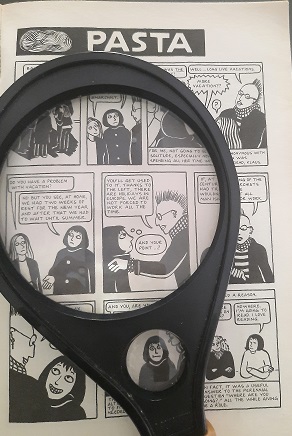
And when someone speaks of Graphic Novels, you quietly go and Google what on earth that is. And then, when you read rave reviews of one, debate within yourself if you should attempt to read it, and not fully convinced, still procure a copy. To find that even under the newly-installed white lights, you have to read the 374-page novel with a magnifying glass.  (I did it! The novel was ‘Persepolis’ by Marjane Satrapi. Well worth it, but I don’t think I can read another one unless they come out with a large-print edition!)

And then your exercise routines and paraphernalia change…

From worrying about the best cross-trainer and home gym equipment, you are looking for the best knee-braces and neck-collars.

And you set up a hunt for your grandkid’s discarded Montessori toys which helped them develop fine-motor skills at two years old, to keep your arthritic fingers limber at 60 years old.

When you start up an elaborate yoga and stretching routine—only to find that the asanas recommended for your weak knees, are contra-indicated for your cervical spondylosis.

And your routine adds on more and more exercises for newly emerging stiff joints and aches and pains, till it seems to take up almost half the day!

And you sadly realize

That from lotions and potions

It is now all about decoctions and concoctions.

And though you may have avoided Morning Sickness

There is no way you can avoid Morning Stiffness.

Such is the Senior Life!

–Meena