Tippy-tippy Tap…

The last few weeks have been a time of looking closely at flowers, and marvelling at their variety. I observed about 12 types of pink flowers, about 8-10 types of orange flowers, about 5-6 red, a few yellow ones, a few white ones and two types each of purple flowers and blue flowers–all in my colony. 

So of course the question came to my mind: Was this the typical distribution of flower colours? Was pink the predominant colour, followed by orange and red? And so started my search to find out a little more about this.

First and foremost, what gives flowers their colours? Colours mainly come from the presence of pigments in the chromoplasts or cell vacuoles of floral tissues.  The most common pigments in flowers come in the form of anthocyanins which range in colour from white to red to blue to yellow to purple and to even black and brown. The other major group are the carotenoids, which provide the yellow colours, along with some oranges and reds. While many flowers get their colours from either anthocyanins or carotenoids, there are some that can get their colours from a combination of the two. Other classes of pigments, but of less importance in relation to flower pigmentation, are chlorophylls (greens), quinones (occasional reds and yellows), and betalain alkaloids (giving yellow, red and purple). 

Coming back to which is the most common flower colour, all my web- searching only told me that there was no definitive answer! To begin with, we don’t even know how many flowering plants there are. And of the flowers we know and have catalogued, colour data are seldom maintained. There is no repository of flower colour information. There is no database which documents flower colours, let alone rank them.

There are many good reasons that make it difficult to document these colours. There is no absolute measure. Colours look different in different lights, at different times of the day. Each person perceives colour differently—what looks orange to me look yellow to you. And we all describe them differently—I may say violet for a colour and you may say mauve.

Moreover, colours vary from genus to genus, and even within a species. A plant growing in one area (say, the plains) can have flowers  that are very different from the same plant growing elsewhere (say in higher altitudes). The colours of flowers depend very much on the growing conditions—soil, sunlight etc. So they may change somewhat with season too.

Recent research suggests that factors like ozone depletion and global warming have caused flowers to change their colours over time. For instance, of the 42 species studied in that research, UV-pigmentation in flowers increased at a rate of 2% per year from 1941 to 2017.
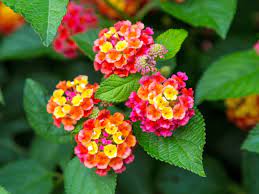
lantana
Lantana is one of the flowers which changes colour on pollination

Flowers also use colours as signalling mechanisms. Some flowers change their colour once they are pollinated, so that bees do not come back to them, but rather go to unpollinated flowers. (Eminent teacher, Prof. Mohan Ram, who developed a generation of botanists, ecologists and environmentalists, taught us this during a memorable nature walk.) Some flowers change their colour with age.

But here are some speculations about flower colours:

Counter-intuitively, some people believe green may actually be the most common flower colour–many plants, including most trees, bear flowers in various shades of green. This may be followed by white, yellow, blue and the reds in that order.  Brown is not uncommon either. But all scientists and naturalists emphasize that these are only guesses.

So don’t worry too much about how many. Just enjoy the flowers and their colours!

–Meena
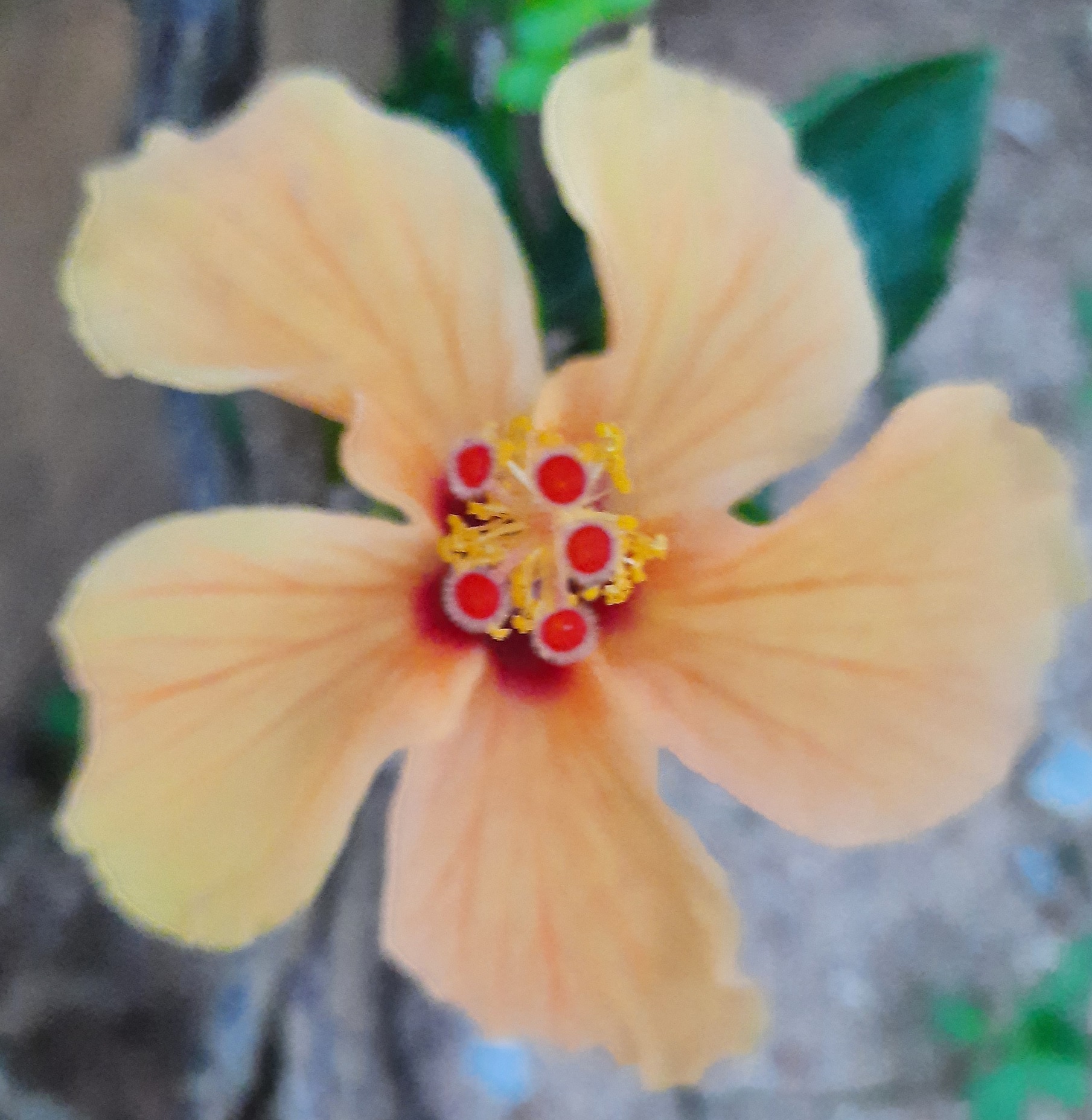
The Versatile Shoe Flower

Within urban myths (defined by the Collins Dictionary as ‘a story, esp one with a shocking or amusing ending, related as having actually happened, usually to someone vaguely connected with the teller’), there should be a special category for ‘school myths and beliefs’  which could be defined as ‘stories and other things believed by a generation or generations of school children’.

One such myth subscribed to fervently by our generation was that if pencil shavings were soaked in milk, left in the moonlight, and some incantations recited over them, they would turn into erasers. Hundreds of children tried this, but since the incantations were not known to anyone in our circles, we attributed our failures to the lack of this knowledge.

The other widely held belief was that we could polish our leather shoes to wonderous lustre with the shoe flower or hibiscus. This was a very convenient belief to hold, as we thus avoided putting in 10 minutes hard work a day with brush and polish, and getting all messy. On the way to school, we would grab some red hibiscus flowers which were ubiquitous, and just before assembly, surreptitiously give our shoes a wipe-around. When the shoes were still kind of wet with the juice from the flowers, they looked ok, but I was never sure if they actually did anything.

Hibiscus

But unlike other urban myths, maybe this one has some basis in fact. The hibiscus is called shoe flower because in Malaysia and Indonesia, the flower petals were used to produce a black dye for shoe polishing.

Hibiscus belongs to the genus Malvaceae of the mallow family. There are many hundred species, and the genus is native to warm temperate, subtropical and tropical  regions throughout the world. 

In fact, the hibiscus is an extremely versatile flower. It is used extensively in pujas, and having a bush in the garden assures the devout that they will have flowers throughout the year.

And then of course, its use as a hair tonic. Remember the jabakusum hair oil? The jabakusum or javakusum in fact is a name for hibiscus. It was C.K. Sen, a vaidya from a family of Ayurvedic practitioners, who took this oil commercial. He formed a company C.K.Sen & Co Ltd in 1878, with Jabakusum Taila as the first product. It became an instant hit. Its inherent qualities were assisted by smart marketing—it was positioned as ‘The Royal Toilette’ and ‘By the appointment to the Princess of India’ (no one seems to have asked who that would be!). It was the first hair oil brand in Asia to have a commercial film ad.

Even today, some people dry the flowers and steep them in coconut oil and use it for their hair. The leaves and flowers are also used as the base of hair packs and shampoos.

The humble hibiscus has several medicinal uses as well—it is a laxative as well as a diuretic. It is used to treat colds, fluid retention, stomach irritation and a number of other ailments.  There are claims that it may help to reduce high blood pressure and cholesterol.  Hibiscus tea, made by steeping the flowers in hot water for five minutes is a popular drink and home remedy.

In the Philippines, children use the flower to make bubbles. The flowers and leaves are crushed until the sticky juices come out. Hollow sticks or straws are dipped into this and bubbles are blown. 

The hibiscus flower is worn by girls in Tahiti and Hawaii. Traditionally, if the flower is worn behind the left ear, the woman is in a committed relationship. If the flower is worn on the right, she is single.

The hibiscus is a national symbol of Haiti, and the national flower of many countries including the Solomon Islands and Niue, South Korea, Malaysia and Hawaii.

With all this, we seem to tend to take the hibiscus for granted just because it is so common and easy to grow. I never knew of a hibiscus which did not take wherever it was planted. Even a ten-thumbs like me can plant and see a hibiscus bush flower.

Hibiscus come in various colours, with red, pink, white, yellow, orange, multicoloured ones being most common. There are even purple hibiscus. In many cases, the colour of the flowers of a hibiscus bush will change with changes in temperature, hours of daylight etc. For instance, the hotter it gets, the brighter the orange and yellow flowers bloom.

There is something special in the bush outside your house. Marvel at it!

–Meena

A Day for Sea Monkeys

My generation grew up reading comics usually borrowed from lending libraries. Foreign comics were very expensive and there were few parents in our circles who allowed us to buy them often. Maybe once or twice a year.

These precious comics therefore, were read and re-read and savored cover to cover. The last few pages would often carry ads for a fascinating variety of knick-knacks and gimcracks, of which the most fascinating were the quirkily illustrated ads for ‘Sea monkeys.’ Just add the contents of the package to a tank of clean water the ads promised, and lo and behold, in a few seconds or minutes (I forget which), your tank would have these fascinating little creatures swimming around.

Digging a little deeper, I found that in fact sea-monkeys are in a way manmade creatures. They were ‘invented’ in the 1950s and are a hybrid breed of brine shrimp  (Artemia NYOS, a hybrid of Artemia salina) created artificially by a person called Harold von Braunhut. Traditionally used as fish food, von Braunhut felt that brine shrimp could easily be maintained in home aquaria, and used to foster a love of nature among children and help them observe nature. He set about experimenting and found a way through which his hybrid shrimp could be preserved in dry conditions, and brought back to life when they came in contact with water. He patented the process, which is still a secret today. Sea monkeys are translucent and breathe through their feathery feet. They start life with one eye, and then in the course of time, develop two more. Von Braunhut named them ‘sea monkeys’ because of their monkey-like tails. Initially, these creatures lived only for a month or so, but with the help of marine-biology experts, he was able to create creatures which live up to two years.

Von Braunhut introduced them commercially in 1960 under the name ‘Instant Life’.

But marketing the concept and the product was not easy. No toy shops or pet shops would stock them. So von Braunhut came out with the idea of advertising them in comic books, to be bought directly from the company. Sales took off and never looked back! Generations of children in the US have kept sea-monkeys and become acquainted with the wonders of nature through observing them, caring for them and nurturing them. They are still very much an in-demand product.

Sea monkeys did not just find their way into homes and hearts. 400 million of them accompanied astronaut John Glenn to space. Sea monkeys even had their own TV show in the ‘90s revolving around the adventures of three microscopic sea monkeys which are enlarged to human size by a Professor. They have also featured in several TV shows and movies including The Simpsons. Needless to say, there are also several internet fora which discuss these creatures. Sea monkeys have their own Day too—May 16th is marked as National Sea Monkey Day in the US.

Sea monkeys continue to be ‘manufactured’ and sold, and are quite popular even today. They are available on the company site http://www.sea-monkeys.com/, as well as on Amazon, including in India. I am not sure if they are still advertised in comics though!

I have to confess that in my confused mind, for a long time I thought sea-monkeys and seahorses were the same. It was only many, many years later that I realized they were completely different. Sea horses are more bonafide– any of about 50 species of marine fishes allied to pipefishes.

Happy belated Sea Monkey Day!

–Meena

Image: Shutterstock

Of Fireflies and Glowworms

When we were young, we used to see fireflies in the garden a few weeks in a year. What a magical experience it was! Like the stars had come down to visit us.

After that, I did not see them for many decades. Either I did not live in the right place, or I was not lucky enough to spot them in the short window that they glowed. But in the last few years, since we moved to Bangalore, I have been sighting a few. Year after year, the same two spots in our community hosted them—shrubby areas on the periphery. This year, for some reason, I am seeing many more . Each spot has only a couple, but from two, the number of spots has risen to six or so. That definitely sounds like good news!

But what are fireflies? Sorry if this takes the magic and romance away, but they are a type of beetle!  There are over 2,000 species of firefly spread across the world on every continent except Antarctica. However, in India, we have only eight. They are generally seen in the pre-monsoon season.

Why do fireflies twinkle? As is usually the reason for most beauty in the natural world, it is to attract a mate and reproduce! Fireflies use flashes as mating signals and the flashes we see are generally from males looking for females. They flash a specific pattern while they fly. If a female waiting in the greenery nearby is in the mood, she responds back with a flash. They will continue this flashy exchange till the male locates the female and they mate. Each species has its own pattern so that males and females of the same species can identify each other.

And how do they twinkle? Through a phenomenon called bioluminescence. At the risk of taking away even more romance, it is when two chemicals found in their bodies, luciferin and luciferase, lead to a reaction in the presence of oxygen, adenosine triphosphate  and other compounds, that they twinkle. The light they produce is called ‘cold light’– that is no heat is produced during the reaction. Which is a good thing, as otherwise not only would it waste energy, but also burn the poor creature.

This year was a lucky year, as I am seeing so many fireflies. Firefly populations are rapidly decreasing because of habitat degradation, light pollution, pesticide use, poor water quality, climate change, invasive species, and over-collection. In India, pesticide use may be the most significant cause of the falling numbers.

I was lucky enough to see another ‘glowing phenomenon’ — the glow worms of New Zealand. Of all my nature-travel experiences, I would count this as THE top! In an experience like no other, boats take groups of tourists through a waterway in an intricate web of caves. It gets darker and darker, till you are in the darkest-dark you will ever experience. The boat-captain guides the boat by pulling along ropes tied on the sides of the cave. Just as you start to wonder whether the sight you will see is worth the risk of being toppled into a water course of unknown depth in pitch dark which will make rescue impossible, you are rewarded with flashes of light which grow in intensity as you proceed. And then you know it is worth it as you see constellations of twinkling glow worms on the roof and sides of the cave!

These are glow worms—again, not actually worms, but in the case of those found in Australia and New Zealand, the larvae of fungus gnats, an insect that looks like a mosquito. Their bioluminescence works much the same way as that of fireflies, and they emit light from an organ near their tails that is similar to a human kidney. However, in their case, the glow is mainly used to attract prey. Smaller insects and flies are drawn to the light and fly towards it.

These special sparklers and their habitats are fragile. We don’t know what human actions can push them over the brink. We need to take care that our carelessness does not take the glow from our lives.

-Meena

Gandhi and the Environment: A Tribute for World Environment Day

Mrs. Indira Gandhi was the only Head of State at the United Nations Conference on the Human Environment held at Stockholm in 1972, apart from the host Prime Minister Olaf Palme, who was the host. The speech she gave at the Conference, linking human development, poverty and peace to environmental conservation is definitely one of the first steps towards the articulation of sustainable development. i.e., ‘meeting the needs of present generations without compromising the ability of future generations to meet their own needs’.

But long before this Gandhi, there was another Gandhi who was calling the world’s attention to these issues. Who else but Mahatma Gandhi!

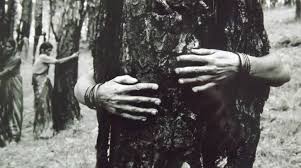
chipko
Hug the Trees!

Gandhiji may not have articulated his thoughts on the environment in terms that we use today. But his whole philosophy was deeply rooted in concepts of what we now call sustainability: taking only what one needs from the environment, simplifying wants, equity, non-violence towards all life forms, and a caution against mindless pursuit of ‘development’. Many environmental movements like Chipko or Narmada Bachao Andolan are in fact inspired by Gandhiji.

On the occasion of Stockholm+50 and WED, here are some quotations from the Mahatma, which mark him as a very early spokesperson for environment and sustainable development.

‘I suggest that we are thieves in a way. If I take anything that I do not need for my immediate use, and keep it, I thieve it from someone else. I venture to suggest that it is the fundamental law of Nature, without exception, that Nature produces enough for our wants from day-to-day, and if only everybody took enough for himself and nothing more, there would be no pauperism in the world, there would be no man dying of starvation in the world.’

Speech on ‘Ashram Vows’ at YMCA, Madras. 16 Feb, 1916. CWMG Vol 13, 230-231.

‘Earth provides enough to satisfy every man’s need, but not every man’s greed.’

Quotation popularized by Gandhi.

‘We cannot have ecological movement unless the principle of non-violence becomes central to the ethics of human nature.’

Mohan-mala. A Gandhian Rosary. Ahmedabad. Navajivan Publishing House. 1997. 93-94.

‘God forbid that India should ever take to industrialization after the manner of the West. The economic imperialism of a single island kingdom (England) is today keeping the world in chains. If an entire nation of 300 million took to similar economic exploitation, it would strip the world bare like locusts.’

Young India. 12 Dec 1928. CWMG Vol. 38. 243.

If it is man’s privilege to be independent, it is equally his duty to be inter-dependent.

http://www.selfimprovementpath.com.mahatmagandhi.

‘In the modern rush, the chief use we have for our rivers is to empty our gutters in them and navigate our cargo vessels, and in the process make them dirtier still.’

Young India, 23 December, 1926.

‘Civilization, in the real sense of the term, consists not in the multiplication, but in the deliberate and voluntary reduction of wants.’

Yeravada Mandir. Navjivan Publishing House, Ahmedabad.  

‘We cannot have ecological movement unless the principle of non-violences becomes central to the ethics of human nature.’

Mohan-mala. A Gandhian Rosary. Navjivan Publishing House.

–Meena

Credit: Centre for Environment Education put together a collection of Gandhiji’s thoughts to mark the 10th anniversary of the Earth Charter, in a publication called ‘Earth Charter & Gandhi: Towards a Sustainable World.’ Compiled by Karikeya Sarabhai, Meena Raghunathan, Amishal Modi. These quotations are taken from there.

Pithy Craft

A ‘pithy comment’ is one which is terse and full of substance and meaning. The origin of the word pithy is from the Old English piþa “central cylinder of the stems of plants,” and therefore signifying “essential part, quintessence, condensed substance.”

Here is a tale of a pithy craft (not an official term!). This is the pith-work done using the innards of Aeschynomene Indica or Aeschynomene Aspera , a herbaceous plant of the bean family which grows in marshy waterlogged areas which is the basis of a craft both in South and East India. Shola pith as it is called, is the inside of the plant, and ranges from soft, smooth, white (good quality) to hard, brittle, reddish (poor quality).

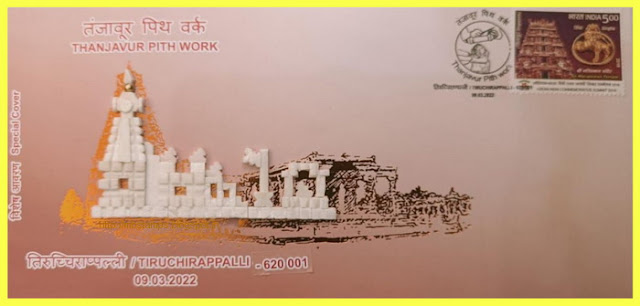
In South India, this craft-form is traditionally practiced in the Tanjore area. The most popular products are replicas of the Brihadeshvara Temple, Tanjore, the Meenakshi Temple of Madurai, the Malai Kovil of Trichy, etc. Taj Mahals and churches are popular too. While the proportions of the temple pieces would vary with the architecture of the original, typically, a pith-piece may be about 6”x10” wide and about 6-8” in height. They used to be a fairly common decorative item in Tamil homes a generation ago.

The pieces are made by first removing the outer brown skin of the plant by cutting it off with a sharp knife. The inner soft white portion of the stem is used to make the art pieces. The pith, known in Tamil as Netti, is cut into fine pieces of different designs and shapes as per the design, using a long knife for basic carving, and a tiny carving knife for detailing.  The carved pieces of pith are stuck together with adhesive to create the products, based on blue prints of the design or photos.  The completed piece is stuck on a piece of plywood and covered in a glass case.

netti work
Commemorating the Craft

Thanjavur Netti work has Geographical Indicator tagging. GI tagging is a sign used on products that have a specific geographical origin and possess qualities or a reputation that are due to that origin. The application for GI for Netti Work was filed by the Tamil Nadu Handicrafts Development Corporation (Poompuhar) in 2013, but the process of awarding the tag took seven years and came through only in 2020.

Pith work is popular in West Bengal and Orissa too. Bengali brides and grooms wear elaborate head-gear made from pith. Durga Puja pandals have pith idols, backdrops and decorations. Ornaments and dresses for idols are often made of pith. Shola is also used by the puppeteers of Nadia district, West Bengal to make traditional string puppets. 

The use of shola is widespread in Orissa and ranges from the headgear worn by Lord Jagannath and his siblings during the Rathayatra, to symbolic boats made for Boita Bandana or the Bali Yatra festivals.

The difference between pith-work of the South and East seems to be that the temple-pieces and idols made in the South are items which are made to last for years and decades, whereas  the decorations and other items made in the East are more ephemeral in nature.

As with traditional crafts and materials, of course there are any number of stories and myths about shola. Here is one: Lord Shiva, as he was making his preparations for his wedding with Parvati, asked Vishwakarma, the divine architect and master-craftsman, to make him a pure white crown and garland for the occasion. But Vishwarma could not deliver. So Shiva plucked a lock of his hair and threw it into a pond. Lo and behold, there sprang up a special type of reed.  But Vishwakarma could not figure out how to fashion the crown and garland from the reed. Shiva then plucked out a hair from his arm and threw it into the pond. This transformed into a young man, who was smart enough and skilled enough to use the pure-white pith of the reed to make the required crown and garland.  Shiva named the youth ‘malakar’ or the garland maker, a name that traditional shola craftsmen of the East are still known by. (Shiva must have been in a benign mood indeed, for Vishwakarma  to have come out of the incident unharmed. I would have expected a pile of ashes!).

Incidentally, the pith helmets beloved to the British Empire has its origins in traditional Filipino sun hats. Though referred to as pith helmets, they may be made of pith, cork, bamboo, rattan etc.  These made their appearance in India in the 1840s, and were extensively used in military campaigns thereafter. They evolved into a distinctive shape which came to be known as the British Colonial pattern.

I have no idea what set off this pithy-wandering in my mind. We did have a Trichy Malai Kottai Temple netti piece in our house when I was growing up, and maybe I saw the story of GI tag for netti work. At any rate, an interesting meander!

–Meena

The Whispered Wisdom of Podcasts

I am slow to adopt most things new. And so it was with podcasts. I was pretty skeptical of the audio medium as a means of learning. Being fully old school, for me, the ‘read word’ was the major source of both learning and recreation.

My conversion to podcasts is fairly recent. The audio system that I was using during my walks to listen to music on broke down, and that was when I decided to explore podcasts. And what a world it has opened up to me! Not just walks, but also car-rides and flights have become much more enriching. But I have to admit, while my default state is to sit around the house with a book in my hands, I am not as yet able to sit around with a podcast plugged into my ears. I feel kind of guilty and unemployed. But I am sure the day will come…

While the raw beginnings of podcasting are traced back to the ‘90s, the medium really came into its own in the mid-2000s. The first steps were laid in 2004, by Adam Curry  a former MTV video jockey, along with a software developer Dave Winer, when they coded a program known as iPodder. This made it possible to download internet radio broadcasts to iPods. Within a year, commercial companies realized the potential and with Apple as the first mover with iTunes 4.9, started to offer support for podcasts. Politicians were not far behind—George Bush became the first President to have a weekly podcast as early as 2005. The speed with which the innovation caught on can be gauged by the fact that   “Podcast” was declared “Word of the Year” by the New Oxford American Dictionary.

Today tech-savvy India has the third-largest podcast listenership in the world. At  57.6 million listeners, it is behind only China and the US, and growing at a rapid 30+%.

I listen of course to the usual suspects, from Stuff You Should Know, to Ted Talks Daily, to BIC Talks, to The History of India Podcasts, to No Stupid Questions, and 99% Invisible.

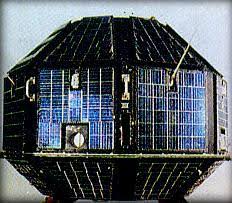
Aryabhatta, India’s first Satellite

But the podcast that moved me most, which inspired and fired me was MISSION ISRO. This series traces the history of India’s space programme, essentially through the work of Dr.Homi Bhabha and Dr.Vikram Sarabhai. These two men had not only the vision, but the scientific stature, the international standing and the conviction to overcome all barriers to make this dream a reality. How they convinced the decision-makers in the country that a newly-independent country like India, which was struggling to even feed its people, needed to invest in space, and how they convinced the world that India had the capacity to make this work, is a fascinating tale.  And the vision of the then-PM, Shri Jawaharlal Nehru, who believed in the use of science and technology for national development is what made this possible. The clarity of the philosophy of the Indian space programme set by the founding fathers—that it was not for warfare and aggression, but rather, to bring development to the remotest corners of India and to the poorest—is what sets our space programme apart even today.

The refusal of Dr. Sarabhai and Dr. Bhabha and their teams to be deterred by any obstacles– whether lack of equipment, permissions, know-how—is awe-inspiring. The innovative ways they found to get around challenges, to make do with the resources they had, to find supporters and partners, in order to accomplish Mission Impossible brings home the lesson that a clarity of purpose and the belief that it can be achieved will move mountains.

Researched and scripted by Archana Nathan, produced by Gaurav Vaz, Harsha Bogle’s voice brings the podcast to life. The enormous effort in getting interviews with key people who were involved in the space programme and hearing them relate the stories of those times is amazing. And hearing Dr. Vikram Sarabhai’s voice sent goose bumps down my spine!

Don’t miss it. It gives us an understanding of our history and achievements from times which today are dismissed so easily. It gives us an understanding of what visionary nation-building is and the mettle that visionary nation-builders are made of.

–Meena

Statues for Cities

Lock from collection of V. Raghunathan

The Manneken Pis or little pissing man, is arguably the most-visited public statue in the world. The symbol of Belgium and Brussels, this 2-foot bronze statue has, for some reason, caught the imagination of the world and is the center of attraction for the thousands of tourists who visit the ciy. The statue, which pisses into a fountain, has been stolen about seven times, often having to be restored at the end of such misadventures. What stands at the site which we visit– the junction of the Rue du Chêne/Eikstraat and Rue de l’Étuve/Stoofstraa– is not the original   by the sculptor Jérôme Duquesnoy the Elder and put in place in 1618 or 1619. The original (with all the restorations) is kept in the Brussels City Museum and the  statue we see is a replica which dates from 1965. The statue has around 1000 costumes, and his dress is changed very few days, according to a published schedule. There is no doubt the little boy adds a lot to the revenue of his host city!

There are several, several public sculptures across the world, which characterize the city they stand in, or give it character, including:

Fearless Girl probably the best known of contemporary public statues, this 4’2” little girl stands defiantly, arms akimbo, across from New York’s Stock Exchange Building. A fitting symbol of women empowerment, the chutzpah of the girl does not even need the slogan below which says ‘Know the power of women in leadership. SHE makes a difference.’ Her stance and expression say it all!

Singing Ringing Tree, a 10-foot-tall sculpture made of galvanized steel  pipes which resembles a tree and is placed in such a way that when the wind moves through it, a song is produced. Located in the Pennine hill range, England, the sculpture was designed by Mike Tonkin and Anna Liu.

Bridge Over Tree located in New York’s Brooklyn Bridge Park, is made up of a 91-foot-long bridge and a set of stairs at the sculpture’s midpoint. The stairs go over a small evergreen tree, and visitors are forced to interact and cooperate as they pass over it. It was designed by the artist Siah Armajani.

Ayrton Senna  in Barcelona, Spain commemorates  Formula-1 driver Ayrton Senna who was killed during a 1994 race in Italy. Created by Paul Oz, the statue was unveiled on May 8, 2019, the 25th anniversary of Senna’s death.

My city, Bangalore, has its share of public installations too. They run the gamut from whimsical to arty to cute to ghastly.

Lock 1
Lock from collection of V. Raghunathan

Here are a few:

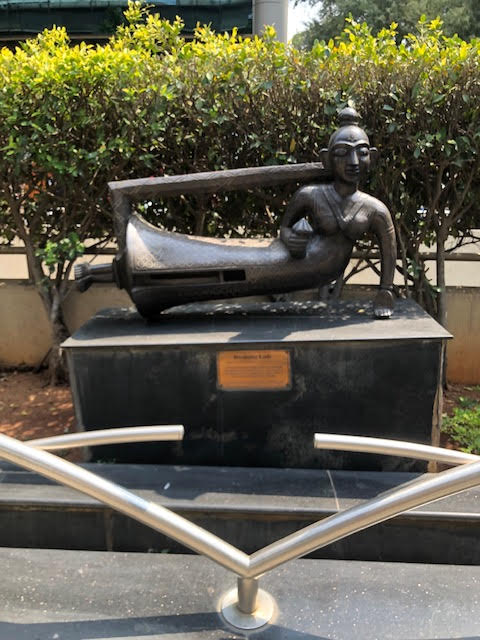
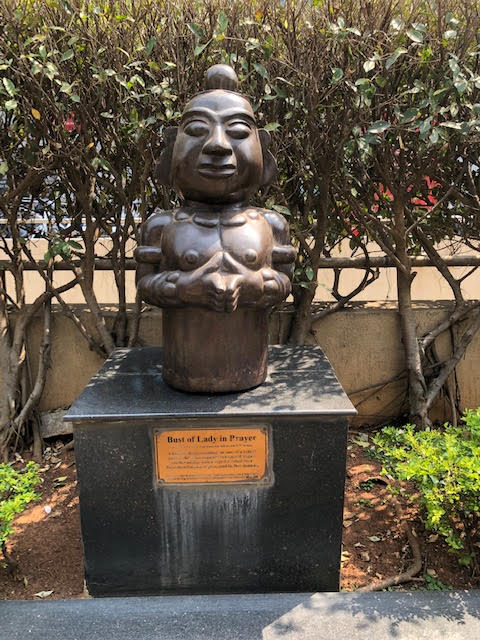
On the perimeter of the Kotak Mahindra Bank’s main office overlooking MG Road stand seven bronze re-creations of ancient Indian locks, complete with their intricate carved details. An unusual subject for street art, it makes sense as locks and banks both stand for safety and security. With the metro line passing overhead and the heavy traffic, the visibility of these is also not as good as it could be. Maybe raising the height of the pedestals would give the commuters a pleasant sight.

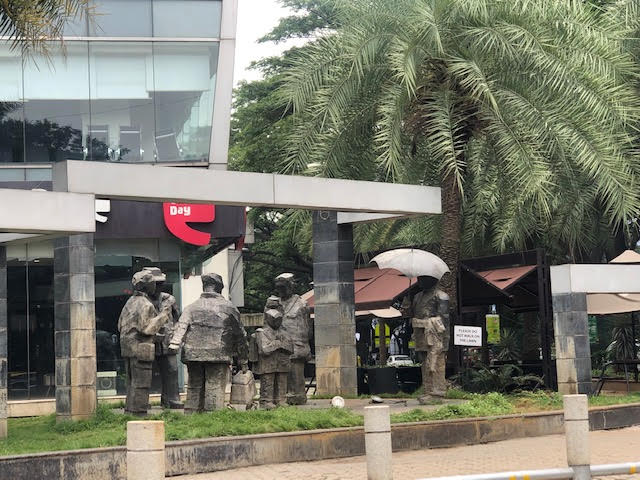
Commissioned by Café Coffee Day and set up outside their outlet on Lavelle Road, this is an arrangement of five men and a small boy. One man holds and umbrella, a second carries and briefcase, a third holds a cup of coffee. There is a fountain too, which drenches the sculptures when it is on.  Very squat, it is not always visible to commuters on this busy road, but surely gives a lot of character to the square.

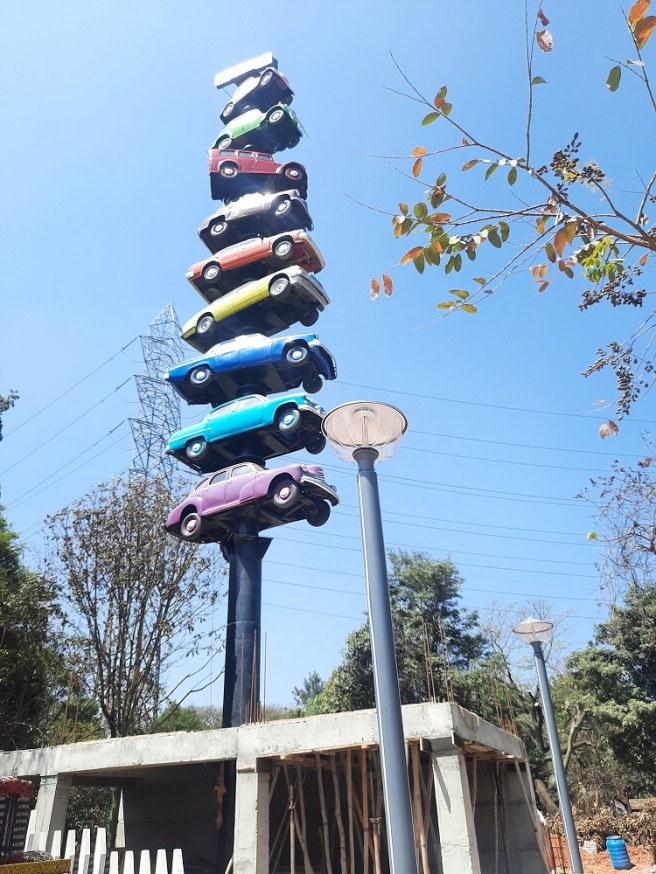
The recently commissioned installation of cars (appropriately dubbed ‘car-kebab’ by a friend) at Yelahanka is a stack of several colourful old cars. An small amphitheatre has been built opposite. Though one is not quite sure why this installation here, or whether there is a risk of rusting and bending if there are strong rains and winds , there is no doubt it adds a pop of colour.

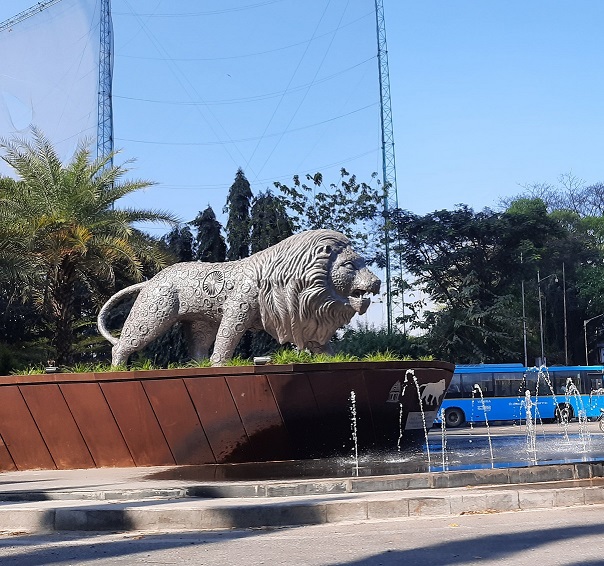
But sadly, the statue put up by BBMP (Bruhat Bengaluru Mahanagara Palike) at the prominent Windsor Manor Circle, which is part of a major beautification drive and supposed to symbolize ‘Make in India’, is not something that is going to put Bangalore on the map of cities with statues to boast about. It is a poorly executed lion which 22 feet in length, 10 feet in height and weighs 1,000 kg. It appears to be made of cogs and gears, and stands on a rotating elliptical platform (which some say is the Titanic!). Lights and water fountains play around it. If ever there was a piece of ugly municipal art, But unfortunately it is this.

But let us not lose hope! Who knows what tomorrow will bring?

–Meena

The Meandering Beetle

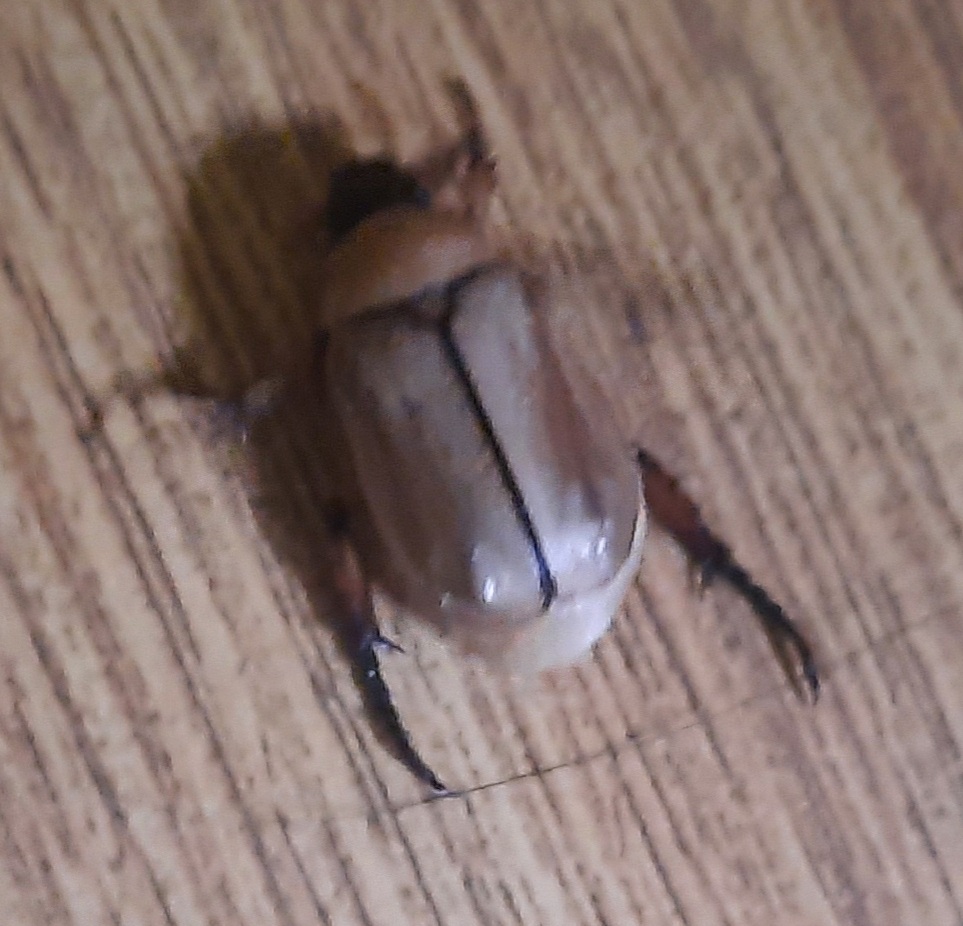
Sometime late last night, a beetle seems to have flown into my bedroom. I found it this morning, clinging stubbornly to my pillow. When I tried to push it away, it landed on the floor and walked around coolly, till I caught it up in a piece of paper and released it outside.

beetle
The Beetle Visitor (My phone did not get the colour right!)

Not a very unusual happening, except this beetle was one I had never seen before– about 2 cms in length, and a very pale colour, almost a dirty yellow.  I have seen large beetles but not one this large inside a home or building. The beetles that usually visit are black or brown or green or purplish, unlike the pale colour of this one. And my beetle was not iridescent, as beetles often are. But it did have the hooked strong legs that make it pretty unpleasant when a beetle lands on you!

But then beetles form the largest order among insects, with over 4 lakh species of them around. So coming across a new one is not unexpected. Nor is coming across one that is 2 cms long—after all, beetles can range in size from the barely visible, to large tropical species that are the size of a human hand. 

But what are beetles? Obviously a type of insect, but what distinguishes them is that their front pair of wings is hardened into wing-cases or elytra, which cover and protect the hind wings and abdomen. They belong to the order Coleoptera, in the superorder Endopterygota.

Coming to the iridescence of beetles and other insects, some are and some are not. But why are they iridescent?  Apparently, it helps in camouflage. It seems counter-intuitive, but field experiments found that birds found and ate 85% of non-iridescent baits, but only 60% of iridescent ones!

The most interesting of the beetles are the dung beetles, of which there are about 30,000 species. Basically, dung beetles fly around looking for the dung of herbivores, which has a lot of undigested and semi-digested stuff, which the beetles suck up as a great source of nutrition. There are three types of dung beetles: rollers, tunnelers, and dwellers. Rollers makes balls of bits of dung, roll it away, and bury it. The balls they make are either used by the female to lay her eggs in or as food for the adults to eat. Tunnelers dig into a pat of dung, and lay their eggs in these holes. Dwellers stay on top of the dung pat and lay their eggs, live there and raise the young. Thought most depend on herbivore dung, there are a few species which feed on carnivore dung.

Dung beetles, Scarabaeus sacer  fascinated the ancient Egyptians to the extent that they worshipped them. They believed the  dung beetle kept the Earth revolving like a giant ball of dung.

Another type of beetles which are general favourites are the Ladybirds. Farmers have special reasons to love them, as they eat aphids and other plant pests. One ladybug can eat up to 5000 aphids in a lifetime!

But sadly, a half-hour of googling through various identification sites hasn’t helped me identify my particular beetle-visitor. Google Lens helpfully tells me it a Christmas Beetle, but that seems unlikely because those are native to Australia, and my sighting was in Bangalore.

Well, the search will continue.

–Meena

Seeds to Secure the Future

Every day at CEE (Centre for Environment Education) was an education one way or the other. One fascinating tour that I recall was to visit NGOs working in projects related to biodiversity and climate change as part of a national scheme that CEE was coordinating.

I was supposed to cover Chhattisgarh as part of this. My most memorable visit was to an NGO that was collecting local varieties of rice and cataloguing them.  It was a small project, maybe only a few lakhs. The NGO had collected rice samples, stuck them to sheets of chart paper and meticulously written down details that they had gathered from the farmers about the cultivation, characteristics, uses etc.  Like a school project, but preserving invaluable genetic resources and information. What a variety of rice—different shapes, different sizes; some fronds long and wavy, others densely packed. And for the first time I saw purple and black rice! And the enthusiastic NGO staff explained the traditional use of each type of rice.

 It was an eye-opener.

I knew that Chhattisgarh was known as the Rice Bowl of India and had over 20,000 rice varieties. But seeing those modest tin trunks with the samples of rice carefully stored brought this home to me in a way that no amount of reading could have. And with it, the realization that we were fast losing so many varieties–and not only of rice but every crop. And not only in India, but worldwide.

Seeds for Food Security

There are many factors responsible for this—unsustainable agricultural practices; industrialization; the focus on a few varieties of crops which are commercially attractive to the exclusion of others; urbanization, etc. According  to UN FAO (Food and Agriculture Organization), while over  6,000 plant species have been cultivated for food worldwide, only nine account for the majority of total crop production.With climate change, the need to preserve these varieties is even more urgent than ever before. The varieties that we cultivate today may no longer be viable tomorrow. And we may have to fall back on this preserved crop diversity to feed the world.

The small NGO that I saw in Chhattisgarh was a key in the whole chain. Several NGOs  in India have been working towards preserving crop diversity for decades—from Beej Bachao Andolan which started in the Tehri Garhwal, to Vrihi seed bank in East India, to the Navadanya movement.

The international community has set up such seed banks at large scale to preserve and conserve seed varieties. There are over 1700 such banks, the biggest of which is the Seed Vault at Svalbard, Norway. This has the largest collection of the world’s crop diversity. It stores duplicates of seed samples from the world’s crop collections and hence is a back-up in case anything were to happen to any collection anywhere. The geographical location of the Vault ensures the best possible chance for the survival of the seeds— low temperatures, permafrost and thick rock protect the seed samples and ensure they will remain frozen even without power. Deep inside the Arctic Circle, the location is very remote, but still accessible. It is well above sea level, and safe from flooding even in the worst climate change scenario. The vault is 100 metres into the mountain. It can store 4.5 million varieties of crops, with about 500 seeds per variety.  As of now, there are more than 10,00,000 samples in the Vault, originating from almost every part of the world.

India too has commissioned an impressive seed preservation facility. In fact, it is the second largest in the world. The stone and wood paneled vault is located in Chang La Pass, Ladakh, and is a joint initiative of the Defence Institute of High Altitude Research and the National Bureau of Plant Genetic Resources. In this facility, seeds are sealed in specially made three-ply foil packages, placed inside black boxes and stored on shelves. It currently holds olver 10,000 seed samples, and has plans to grow by inviting the international community it use it.

The loss of agricultural biodiversity is less focussed on than the challenges to wild biodiversity. But it can be as
devastating. Feeding the world will be impossible if we don’t act to conserve this now! As per FAO, since the 1900s, some 75 per cent of agricultural plant genetic diversity has already been lost. Seed banks, from local to international,
is one of the ways to do this. Kudos to the farmers, communities, NGOs and institutions which are doing this!

–Meena