Desperately Seeking Women-Power

The Global Gender Gap Report 2023 is out, and the news is not good for us in India. Well, if you are an untiring optimist who insists on seeing a glass with some drops of water in it as half-full, you will stop me and scold me. For after all, India’s ranking in the list of 146 countries which have been studied, has gone up 8 places, so that we stand at 127th, up from 135th last year.  

But for me, as I go through the report, I don’t know see how we can take any comfort from this. Even if we are to view ourselves in a comparative light, we need to pause and consider that Nicaragua and Namibia rank at 7th and 8th, compared to our 127!

The report measures gender gap on four major dimensions:  Economic Opportunities, Education, Health, and Political Leadership.

The first bucket, to quote the report ‘contains three concepts: the (labour) participation gap, the remuneration gap and the advancement gap’. The second bucket of Educational Attainment ‘captures the gap between women’s and men’s current access to education through the enrolment ratios of women to men in primary-, secondary- and tertiary-level education’. The Health and Survival sub-index provides an overview of the differences between women’s and men’s health by looking at sex ratio at birth, and the gap between women’s and men’s healthy life expectancy. The last bucket of Political Empowerment measures the gap between men and women at the highest level of political decision-making through the ratio of women to men in ministerial positions, and the ratio of women to men in parliamentary positions.
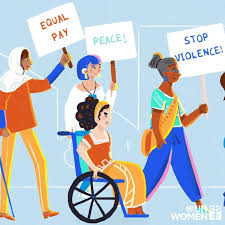
Courtsey UN Women Insta

If we look at India in terms of these dimensions, less than 30 per cent of women participate in the labour market. Women make up 89 per cent of workers in informal sector, which means they are probably underpaid, do not have job security or any other benefits, and work in unsafe, unhealthy and unregulated conditions. Less than 2 per cent firms in India have female majority ownership, and less than 9 per cent have females in top management positions.

Close to 30 per cent women report having faced gender violence in their lives.

We rank 117th in terms of percentage of women in Parliament and 132nd in terms of women in ministerial positions.

That is underwhelming in terms of performance and overwhelming in terms of the task ahead. A practical way to start may be by looking at the factors that are measured to arrive at the rankings. This can probably help a government, an organization and a community and a family work out specific plans and targets.

To get into the details of the employment and economic opportunities segment, the factors include:  labour-force participation (including unemployment and working conditions); workforce participation across industries; representation of women in senior leadership; gender gaps in labour markets of the future (including STEM and AI related occupations); gender gaps in skill of the future.

What might that mean for a government? Well, maybe setting targets or incentives/disincentives for public and private sector for employment of women? Importantly government must ensure workplaces, public spaces and transport safe, so that women are able to travel and work without fear. To a large extent, government does walk the talk on gender positions? Many of our Ministries and Departments are headed by women-bureaucrats; the largest public sector bank has been headed by a woman; we have women heading government research labs and scientific institutions, playing a part in our space and nuclear programmes, now full-fledged in the armed forces, etc. But doing this even more aggressively will set an example to the private sector.

What might that mean for a corporation? That they move forward from celebrating Women’s Day to taking a hard look at their policies, systems and culture to see how they can become truly inclusive employers.

What might it mean for educational and training institutions: That they don’t, by action or inaction, deny girls opportunities; that they counsel and encourage them to take up STEM courses and careers.

What does it mean for communities? That they examine their conscious and sub-conscious biases, and understand how these affect their actions; that they make the community safe for girls and women.

And most importantly, what does it mean for a family? That they don’t discriminate against girl-children; that they provide them opportunities; that they don’t belittle their aspirations and abilities; that they don’t deny them their rights; that they help them fight their battles and give them a winner’s mindset.

It’s a long, hard journey. If we aspire to be at least in the top half rather than the bottom half of the ranking,the journey has to begin with every individual—in our hearts, minds and actions, today.

–Meena

https://www.weforum.org/reports/global-gender-gap-report-2023
A Windy Day

Is it windy outside? Not really! Then why this piece? Well, it is in anticipation of Global Wind Day, a worldwide event that is marked annually on 15 June. It is ‘ a day for discovering wind energy, its power and the possibilities it holds to reshape our energy systems, decarbonise our economies and boost jobs and growth.’

Fair enough!  Today, winds are gaining huge importance because of their potential to add to the basket of energy sources—a clean energy source that will help mitigate climate change challenges. It is because of this promise that wind power has grown rapidly since 2000, Global installed wind generation capacity has increased by a factor of about 100 in the past two decades. In 2021, the total wind generation capacity globally was 830 Giga Watts. India is proudly at Number 4 position in the world, with an installed capacity of 40+ GW. And there is still a long way to go, with estimated potential for wind in India being 200 GW.

Just to double back, what is wind? Put simply, it is the the movement of air relative to the surface of the Earth. Winds play a significant role in determining and controlling climate and weather.

And how is electricity produced from winds? Basically, it is by converting the kinetic energy of air in motion into electricity. Wind rotates rotor blades of a turbine, which converts kinetic energy into rotational energy. This rotational energy is transferred by a shaft to the generator, thereby producing electrical energy.

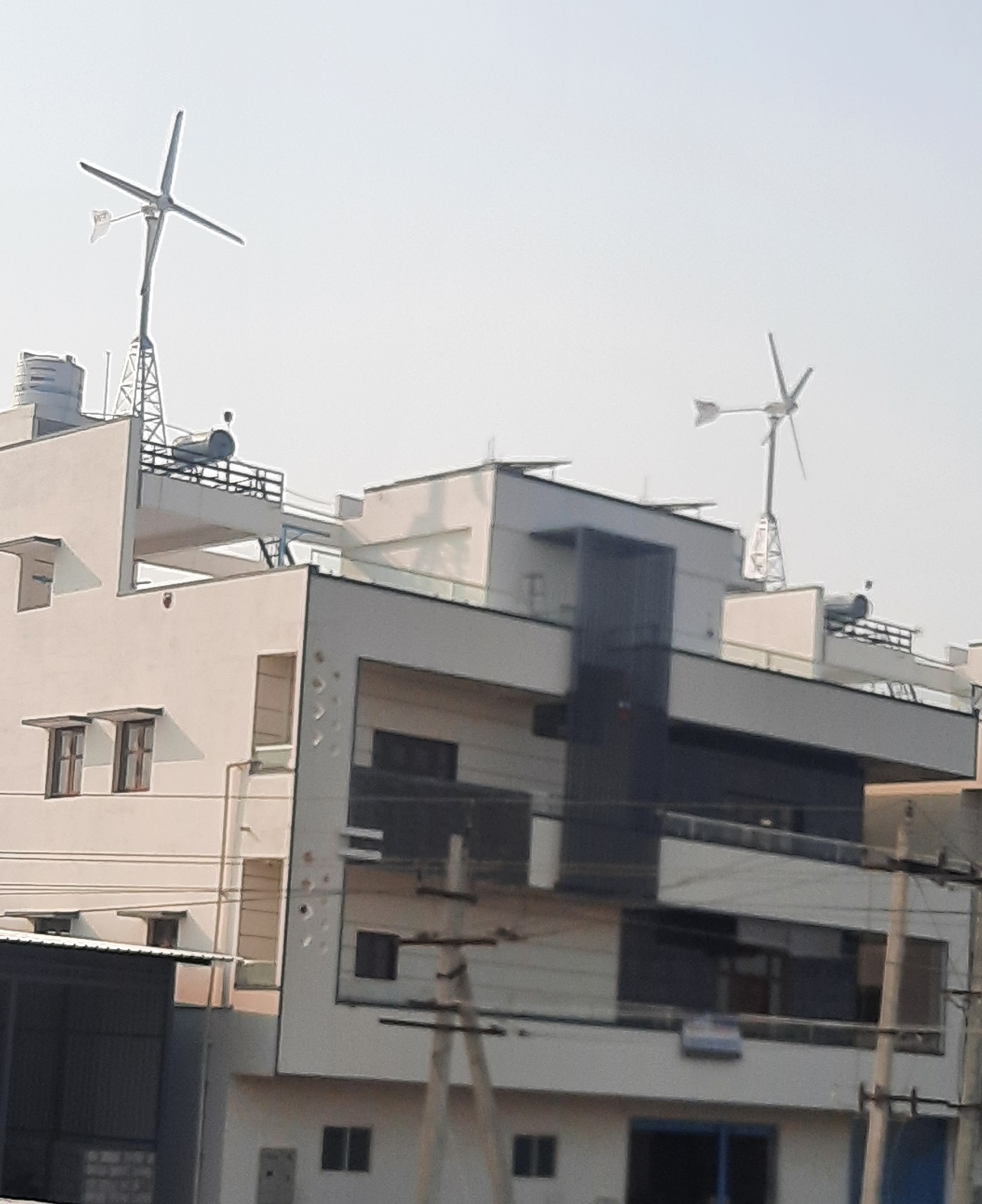
Windmills
Domestic windmills are not common but I saw this somewhere near Mandya, Karnataka

So yes, wind is a harbinger of hope for the future.  Though maybe not without its own issues. Wind energy can obviously be produced only where the winds are strong and fairly sustained through the year—and there are not too many places like that in the world. Through the day and through the year, wind intensity changes, so that wind energy is not generated throughout—it is an intermittent source.  And of course, winds can be unpredictable, so the generation cannot be assured.  Wind turbines are noisy and also change the landscape drastically. Wind energy potential is highest in remote places, which makes investment in transmission lines and related equipment essential. They also have impacts on local biodiversity and even migratory birds. While the cost of producing wind energy has come down in the last few years, and it is a competitive source, technology and R&D have to progress further so that costs may be brought down.

India has committed to producing 140 GW of wind energy as part of its climate ambitions.

But for us in India, winds are not important just for their energy potential.  Lives and livelihoods here have always centered around the monsoon winds—which bring or don’t bring us our rains. The monsoon–a periodic wind in the Indian Ocean and southern Asia—is our lifeline. The summer monsoon usually happens between April and September and bring us our heavy rains. The winter monsoon, which lasts from October to April don’t bring much rain as far as India is concerned. The English word monsoon comes from the Portuguese monção, but ultimately from the Arabic  (mawsim, “season”). 

So all the more reason to understand the role of winds in our lives, and mark Global Wind Day!

And a fun fact to end with:

Ramakkalmedu, also called God’s Own Hill-station, in Idukki district, Kerala, is the windiest place in India and one of the windiest places in Asia. Throughout the year the wind speed here is around 35 km/hr. Located at a height of about 3500 feet, the place is home to–what else–a wind energy farm with a capacity of 12.5 MW!

–Meena

Don’t Stick Out!

That is surely the mantra of the Stick Insect! Known for one of the most effective camouflage strategies in Nature, the stick insect resembles the twigs among which it lives. It belongs to the order Phasmatodea, which includes the other master camouflaguer, the leaf insect. In fact, the name Phasmatodea derives from the Greek word phasma, meaning an apparition, phantom, or ghost.

The order Phasmatodea has over 3000 species in all—but how can one be sure, when many of them may be so well-hidden that they are impossible to detect!  India has about 150 of these species. These creatures are related to grasshoppers, crickets, and mantises.

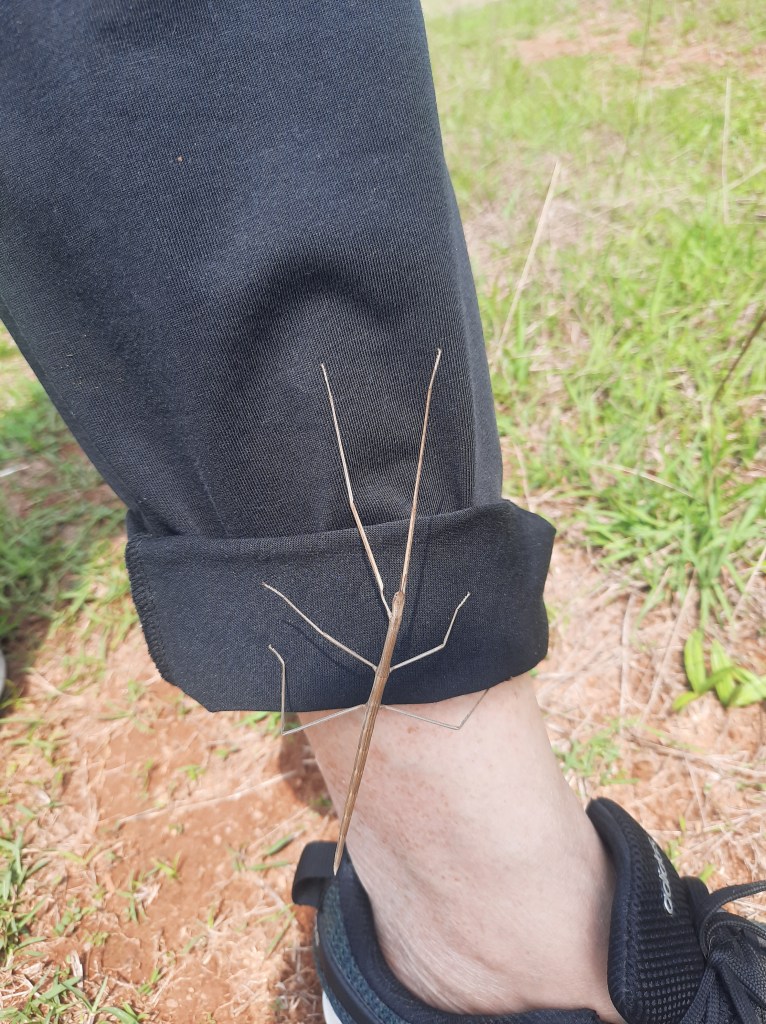
We were recently in the Western Ghats, where we encountered a beautiful Stick Insect. About 6 inches in length from the forward-legs to the tip of the body, it rode on a friend’s leg for a part of our walk through the wilderness.  Going by stick insect standards, it was a only a moderately sized one, given that these insects range in length from the half-inch-long Timema cristinae of North America, to the 13-inch-long Phobaeticus kirbyi of Borneo. The latter measures over 21 inches with its legs outstretched, making it one of the world’s longest insects. Female stick insects are normally larger than their male counterparts. They are usually brown, green, or black, but some are brightly-coloured or striped. Some have wings. All continents except Antarctica have stick insects, though they are most abundant in the tropics.

The stick insect, also called the walking stick, spends most of its time up on trees, munching on leaves. When it senses a predator such as a bird approaching, it practically freezes, blending with the twigs and branches around it. In fact, studies suggest that some species have honed the ability to mimic the motion of twigs swaying in the wind to deceive even particularly observant predators. Stick insects are largely nocturnal and spend most of their days lying motionless on or under plants, and only coming out at night to feed. Unfortunately, the stick insects’ defences are not effective against bats which hunt by echo-location rather than sight, and these may be their most dangerous predators.

Even though their camouflage is extremely effective against most predators, they have several other tricks up their sleeves. Some species have evolved to release foul-smelling chemicals to deter predators, while others can secrete a liquid that temporarily blinds their enemies.  Even if a predator spots a stick insect, it usually grabs a leg, which is the most prominent part of the insect. But that doesn’t bother our insect too much, because many of the species can detach the leg and scramble away—only to grow back the lost limb later.

And these master-tendencies start even at the egg stage! The females of some species lay eggs that look like plant seeds. This puts off carnivorous insects from eating the eggs!

Some of the stick insect species are today endangered, and the numbers of some are falling—thanks largely to habitat destruction and pesticide use. Another threat to these gentle insects is collection for the pet trade. Carausius morosus, the ‘common’ or ‘Indian’ or ‘laboratory’ stick insect, which has its origins in India, is one of the species of Phasmatodea often kept as pets by schools and individuals.

Alas, however well a creature has evolved to protect itself against natural threats, there is little protection against humans!

–Meena

.

The Ship has Sailed

Last week I was reminiscing on my parents’ sojourn in London, and the similarities it held with the sojourn of an ex-PM (Dr. Manmohan Singh) and his family in the UK, around the same time.

Surprisingly, the similarities did not end there. Both families made their way back by sea, on the SS Chusan, a ship of the P&O Company (but at different times).

These days, one thinks of sea-travel in terms of expensive luxurious cruises. But I suspect that in the early ‘60s, it may have been comparative in price to the cost of air-tickets, with the added advantage that it was a great 2-week holiday, with the novelty of the shipboard experience and the possibility of seeing a few new countries on the way.

And indeed the shipboard experience was something that was special. As the book ‘Strictly Personal’ by Damam Singh, a memoir of the lives of Dr. Manmohan Singh and Mrs. Gurcharan Singh says, ‘The SS Chusan offered virtually all the comforts of the cruise. The ship had 464 first-class and 541 tourist class cabins that had only recently been fitted with air-conditioning.’

Of course the first days were horrific with sea sickness for some of the passengers, but the organized fun and frolic was something my parents had probably never experienced before. (I too was there, as evidenced by photographs, but can remember nothing!).  My brother however remembered a penny being pulled out his ear by a magician who was part of the shows put up for kids. There were a variety of shows, music, dancing and games for all age groups. For all of us, as for Mrs. Gurcharan Singh ‘it was like a fifteen-day carnival.’

Many aspects of shipboard life were very formal. For instance, children were not allowed into the dining rooms.  Dr. Manmohan Singh recalls: ’At mealtimes, we could not take Kiki into the dining room. We had to leave her in the nursery, and she used to cry and cry.’ I was quite a happy child, so my parents did not have this problem.

SS Chusan
Being coached by my brother on the deck to run a race!

The SS Chusan was rather a special ship. It was the last and largest ship built for the P&O Company’s Far Eastern Service. It was eqipped with the latest (for the time!) marine technology, and was the first ocean-going passenger ship to be fitted with anti-roll stabilizers (imagine how many more people would have been sea-sick without that!). She was launched in 1949, and was decommissioned in 1973.

Incidentally, P&O stands for ‘The Peninsular and Oriental Steam Navigation Company’, which originally started in 1840. It is, even today, Britain’s biggest cruise line. But today, it declares that ‘We are a holiday company’—as different as can be from the services of yore used by middle-class professionals to commute from UK to India!

And if you have wondered why the names of ships are prefixed with some cryptic letters, well, these indicate the purpose or distinguishing characteristic of the boat. ‘SS’ stands for Steam Ship, or in more recent times, for ‘Single-screw ship’ which refers to the method of propulsion of the ship. Other prefixes include: FB for Fishing Boat; TS for Training Ship; RMS for Royal Mail Ship; MV for Merchant Ship; RV for Research Vehicle, etc.

I still wonder at the shared experiences of Indian families who went to the UK in the early ‘60s. Alas, there was no social media which could have helped them connect and share their experiences, learn from each other and make life a bit easier.

If that had been, who knows, we might have been old family friends of the ex-PM!

–Meena

A ‘Strictly Personal’ Common Experience

Recently I was reading ‘Strictly Personal’ an account of the lives of Dr. Manmohan Singh and Mrs. Gurcharan Singh, by their daughter Daman Singh.

The-then Mr. Manmohan Singh went to Oxford in the early ‘60s. He was joined in a few months by his wife and daughter. He was there for about 2 years. He was there to do his Ph.D

My father went to London in the early ‘60s, He was joined in a few months by his wife and children. He was there for about 2 years. He was deputed there by the Defence Research and Development Organization to train at the Royal Marsden Hospital, towards helping in the operationalization of the Institute of Nuclear Medicine and Allied Sciences (INMAS), which was to be involved in nuclear medicine research, and response to nuclear accidents and explosions.

What amazed me was the commonality between the experience that the book talks about, and the stories which are a part of my family history.

First and foremost, the travails of living on a very limited budget. It was literally hand-to-mouth! My mother recalls that at times, there were not enough pennies to put into the home-heater, and we all spent the day huddled in our woollies. The free milk that my brother and I were eligible for as children was a major saviour. It was not that the pay and allowances were so bad (they were not generous, but adequate). It was that they simply did not come for the first 3 months, till the bureaucratic wheels started moving. And even after, the money came in by fits and starts. One incident which was etched deep into my parents’ memories was a visit to Veerasway, UK’s oldest Indian restaurant. Yearning for other-than-home Indian food, they, with the two of us in tow, ventured in one day. Only to beat a hasty retreat on learning that the cover charge was £ 1 per head!

The book quotes Mrs, Singh as saying ‘We were quite hard up. I don’t know how many pounds a week we got. We had to survive within that. It was not a great, handsome scholarship.’

To the question ‘did you wear Western clothes?’ Mrs. Singh responds ‘No, no, no, never.’ But at least she may have worn salwar kameez. My poor mother stuck to saries through the freezing windy days, walking through hail and snow to the shops or to drop or pick up my brother from the school bus. I fully attribute her getting arthritis by the age of 35 to this exposure to the terrible cold and wet.

Food may have been a bigger problem for my strictly vegetarian family. My mother, on one of her initial trips to the super market, brought home margarine, which an English friend had suggested as a cheaper substitute for butter. It was only after her return home that she read the packaging and realized it was made from pork fat. The trauma stayed with her for life!

The Singhs lived in Oxford. Apart from one trip to London and one to Stratford-upon-Avon, they saw nothing of England. Maybe to that extent we were luckier. Living in London, we at least got to see the sights there—the few family pics taken with my father’s precious camera bought there show us at Trafalgar Square, outside the Buckingham Palace, the Tower, Westminster Abbey etc. The penguin show and the Chimpanzees’ Tea Party (discontinued in the ‘70s) were the highlights of the zoo visit.

The SInghs did not have a TV, and went to a neighbour’s to watch. We did have a television and the show that my parents talked about, which still sticks in my memory is ‘Saturday Night at the London Palladium’, a long-running variety show.

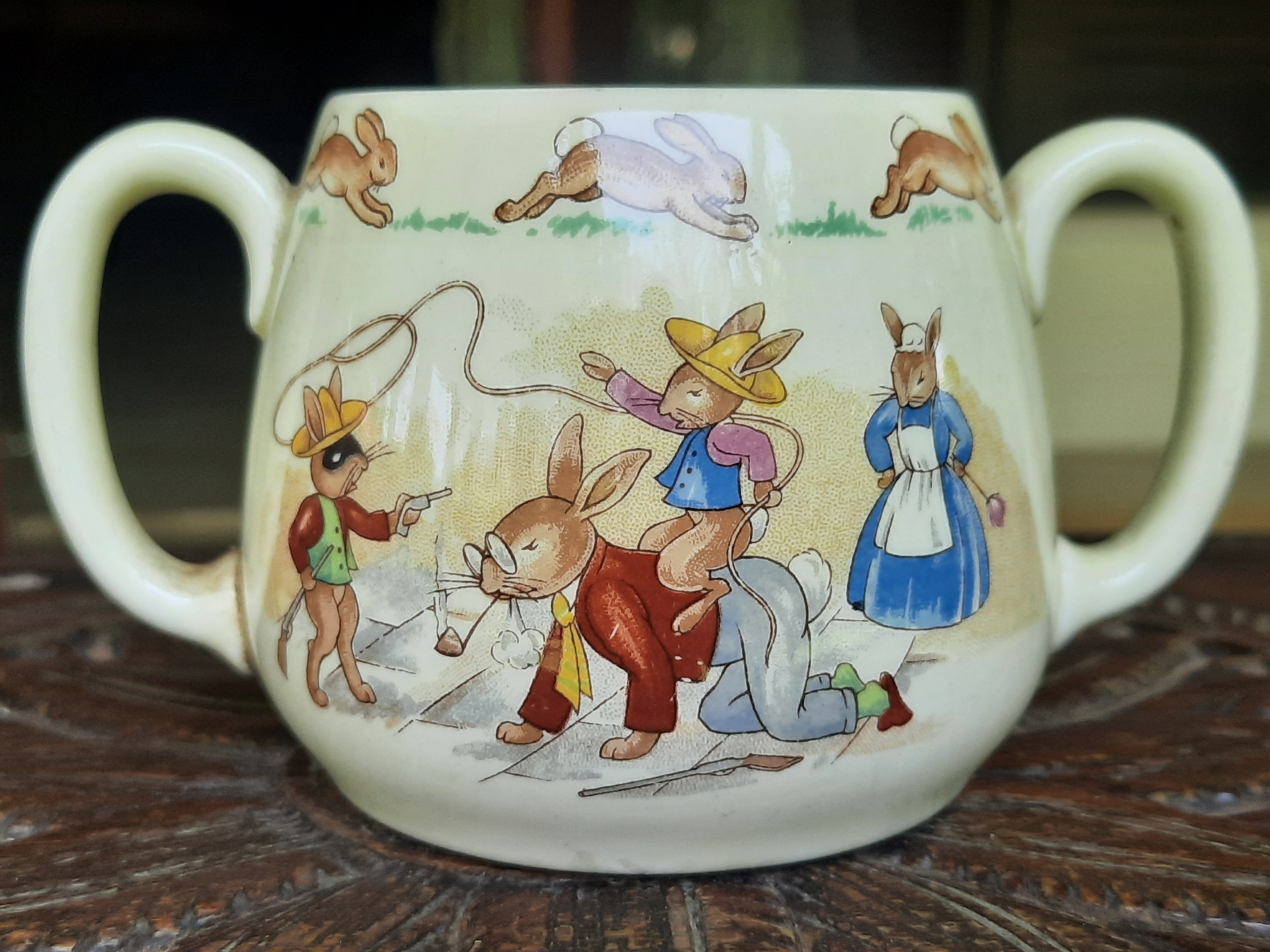
Peter Rabbit Milk Mug
My Peter Rabbit Milk Mug: A Precious Relic

Equally, the things they chose to buy and bring back. Both Mrs. Singh and my mother brought back Baby Belling ovens—a part of British history. The Belling company was established in 1912 and manufactured electric heaters. The first complete domestic electric cooker was made in 1919 and the first Baby Belling oven was manufactured in 1929. The company still exists but is not the gold standard for ovens that it obviously was in mid twentieth century. The other significant item to accompany the Singhs back were three saucepans. In my parents’ case, it was a mixie—a Braun Liquidizer, if I recall. This was my mother’s most precious possession. In fact, when a mischievous visiting child was on the verge of pushing it over, she caught the machine, and her hand was badly slashed, requiring stiches! Mrs. Singh’s oven served her for 3 decades, as did my mother’s mixie!

I think this would be the story of all professionals who went to the UK in those days. But interesting to see that a PM’s family and mine were in the same straits! (We were in other similar ‘straits’, more about which next week.)

In today’s world, all this sounds so strange! Life is so international today, our exposure is great, that nothing really comes as a surprise even when we go to the farthest part of the world. Purchasing power is not a problem, except maybe when there are threats of taxing international credit card payments. Not only are we more international in our eating, Indian food of every variety is available everywhere.

But how did they handle it back then—landing in a country familiar only through books, with few support systems or networks, with little money, inadequate warm clothes, unfamiliar food. They were certainly adventurous, maybe much more than we are today!

–Meena

The Long Cold Drink

While the summer has been relatively mild, there is still that hot day when after a foray outdoors, one would give anything for a long, cold drink.

But which one?

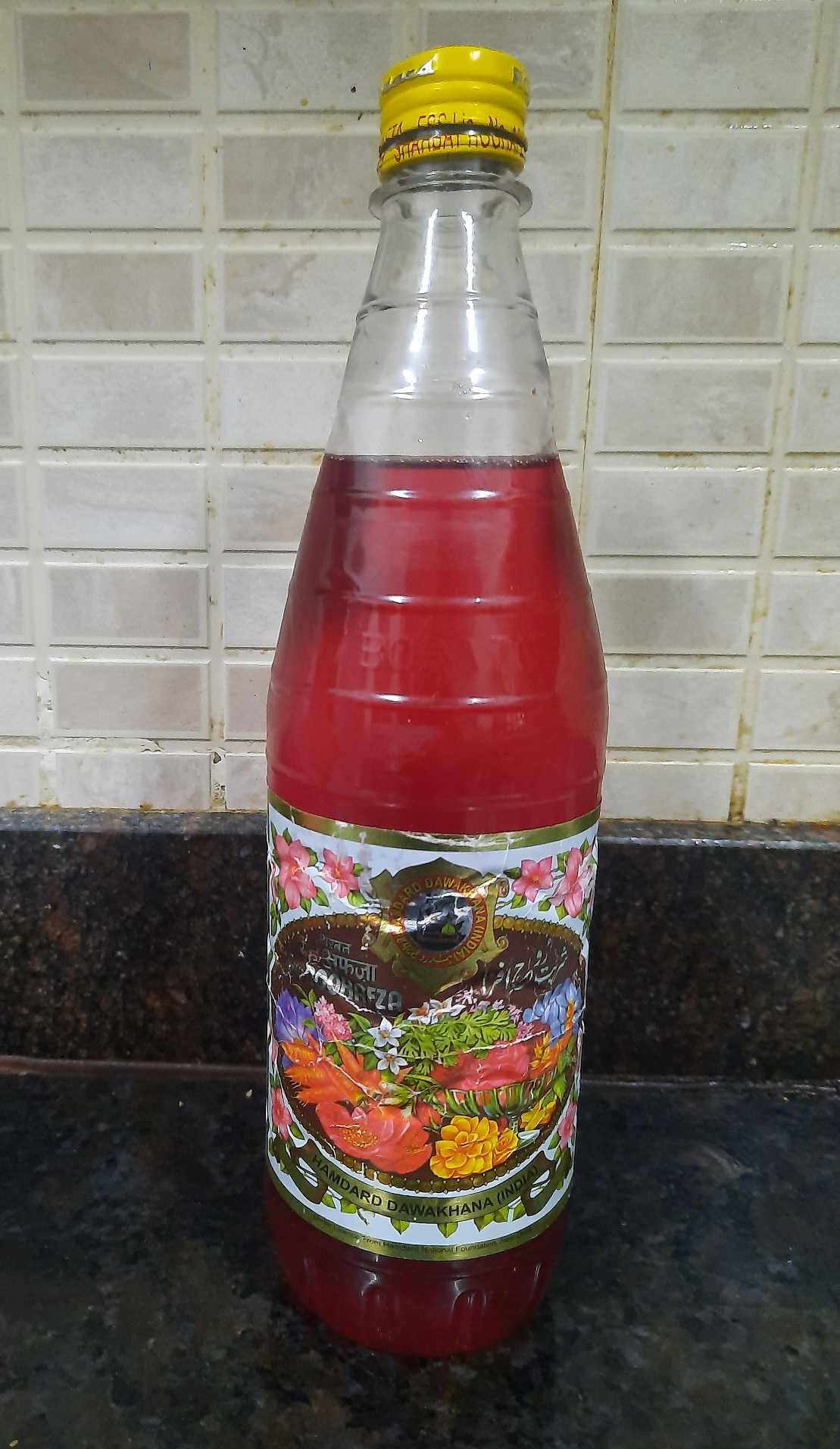
Rooh Afza

A sharbat? Often called the world’s first soft drink (there are references from as far back as the 12th century), the sharbat probably has its origins in Persia. At least the word itself does, and means a sugar and water drink. It is made by combining fruit juices or extracts from flowers or herbs with sugar and water. India’s favourite sharbat is of course Rooh Afza which means ‘refresher of the soul’. It was formulated in 1906 by Hakim Hafiz Abdul Majeed based on a Unani formula, and contains cooling ingredients like rose. Manufactured by Hamdard (in India, Pakistan and Bangladesh!), this is had with either water or milk, and also poured on falooda and other summer-special sweets.

If you are in Tamilnadu, you can also sample a sharbat unique to those parts—the nanaari sharbat. This is made from the nannari root (Indian Sarsaparilla) which is an Ayurvedic herb. This too is supposed to have cooling properties and helps to prevent dehydration. It is not a taste everyone likes, but for those who do, it is summer’s nectar.

Or how about a squash? Kissan orange squash used to be the staple of our childhoods, a treat that usually was served when guests came around. Also available was lemon squash, and I think pineapple. Basically, a squash is a non-alcoholic drink, made from fruit juice (usually citrus fruits), water and sugar. Sometimes, food colouring and flavouring are added. Squashes are mixed with water or soda before drinking, or even with alcoholic beverages to make cocktails.

Kissan also used to have a lime cordial drink, which for some reason was more rarely bought by my mother. So of course it was something we all hankered after! But now I learn that there is no difference at all between the two! The term squash is used more in the UK, and cordial in the US. However, cordial can sometimes be used to denote an alcoholic beverage like a liqueur, while a squash is always non-alcoholic.

But as age catches up, sharbats and squashers which are super-high on sugar are something that one has to keep away from.

Well, juices I suppose can take their place. Juice can be freshly squeezed or out of bottles or cans. The latter variety may just be the juice canned in liquid form, or made from concentrate. Juice from concentrates is made from fresh fruits, only the water is removed from the fruit pulp. It is easier to transport, and when it reaches its destination, it is reconstituted with the same amount of water that was removed, and canned.

‘To juice or not to juice’ is an eternal controversy. Medical opinion holds that juicing is no healthier than eating whole fruits or veggies, as it is not easier to absorb nutrients from juices than the whole fruits. It is also not significantly less healthy, as most of the vitamins, minerals and plant chemicals come into the juice as well. The only loss may be of fiber, which is lost in the process. So you can guiltlessly drink juice and count it against your fruit/veggie quota, and feel cooler (pun intended) in the process.

And of course the ever-favourite desi options, of which lassi and buttermilk or chaas lead the pack. Lassi, popular in the North, is thick and hearty, and made by blending yogurt with sugar, flavourings, nuts etc. There is also of course the salted version. The ‘malai marke’ version can be a meal in itself!

The ‘chaash’ or ‘mooru’ popular in the West and South is the liquid left after churning butter. It is light and invariably salted, and seasoned with cumin, curry leaves, hing etc. It can be consumed by the gallons!

Nimbu shikanji is Indianized lemonade. It is like a lemonade but with the mandatory addition of shikanji masala which has roasted cumin powder, chaat masala, etc.

Then there is the Aam Panna made from raw green mangoes, sugar, and spices. Again a bit dicey for the amount of sugar needed (and no, substitutes don’t taste as good!).

Another delecious drink is panagam, popular in Tamilnadu. Made of jaggery and lemon juice, and seasoned with cardomom, it is traditionally made for Rama Navami. Sadly, it is forgotten for the rest of summer.

And how can I end without a reference to jigarthanda, the drink of the city of my birth, Madurai? It means something like ‘cool heart’ and obviously is an import from the North. It is made of milk, almond gum, sarsaparilla root,  sugar and ice cream.  Madurai has much to offer visitors, from temples to bazaars. But a visit, especially in summer, would not be complete without a jigarthanda from one of several stalls, all of which of course claim to be the ‘original’!

Whatever your choice, stay cool!

–Meena

No Regrets

What is regret? ‘A feeling of sadness, repentance, or disappointment over an occurrence or something that one has done or failed to do’, the dictionary tells us.

All of us have felt/feel/will feel regret. But few of us pause to think about it. Daniel Pink is one person who did. And came out with the book ‘The Power of Regret: How Looking Backward Moves Us Forward’ a New York Times bestseller, like four of his previous books.

Pink did a survey covering over 16,000 people from across more than 100 countries, and created a database of their top-most regrets.

And found a pattern. All regrets fell into one of four categories:

‘1. Foundation Regrets. These regrets stem from failures to be responsible, hard working, or prudent.  They are typically articulated as ‘If only I had done the work’ or ‘If only I had been a little more careful.’ Finance and health related regrets mainly fall in this category.

2. Boldness Regrets. The survey found that most people regret inaction–about double the number of people regret not taking action, rather than taking one. This is about the chances or opportunities that one missed taking. For instance, not taking that admission in a foreign university, not starting a business, not buying that dream house, or marrying a true love. These regrets sound like ‘If only I had taken that chance.’

3. Connection Regrets. These regrets happen when we don’t keep in touch or are on bad terms with people who matter to us, and make up the largest category. If the thought ‘If only I had reached out’ is on your mind, you are suffering this type of regret.

4. Moral Regrets. This category of regrets had the smallest number of responses but were probably the most painful to the person concerned. These regrets are about making the less ethical choice when faced with a decision. This is the type of regret when you agonize: ‘If only I had done the right thing.’’

I did try to think through my regrets, and can’t say I have been able to find one that is out of these four categories!

Pink also suggests some ways we can overcome these regrets, and as importantly, learn and build on them. Some of these suggestions include:

·      Apologize, try to make amends and repair the damage.

·      It is sometimes not too late, so take action now. For instance, if you regret that you did not pursue your passion for music in your youth, maybe it is not too late even now.

·      Find the silver lining, ie., try to think of how the situation may have turned out worse than the current situation.

·      Distance yourself—one has to let go of what is done and over and cannot be undone. No point in agonizing over it forever. We have to find ways to cut off.

·      Self-compassion, ie., not flogging oneself forever for something.

The most important thing however, is to consciously revisit one’s regrets and analyse them and use them as a basis when making significant decisions in the present and future. This can probably improve the quality of our decisions.

The survey of regrets is open, and one can both take the survey and visit the database. If anyone needs convincing on the commonality of the human experience, a browse through the database will do it!

And to end, a poem on regret by Robert Burns, which is profound lesson on how to live so we don’t regret the world we are passing on to the next generation:

To a Mouse, On Turning Her up in Her Nest with the Plough

I’m truly sorry man’s dominion,
Has broken nature’s social union,
An’ justifies that ill opinion,
Which makes thee startle
At me, thy poor, earth-born companion,
An’ fellow-mortal …

November 1785.

–Meena

Focus on Citizen Science

April is marked as Citizen Science Month—not in India, but in the US. But it can only be to the good to take best practices from anywhere at all, and adapt them for our use, right? And an acceleration of the citizen science movement is something that is definitely a crying need in our country!

What is citizen science? The term probably appeared first in 1989, in an issue of the MIT Technology Review 1989, but till today, there is apparently no consensus on a single definition–one paper cites 34! But a working definition we could go by is the one given by the National Geographic Society: ‘Citizen science is the practice of public participation and collaboration in scientific research to increase scientific knowledge.’ The benefits of such initiatives are manifold: large public participation in scientific pursuits; raising scientific awareness and knowledge; democratization of science; ability to pull in indigenous and community knowledge, etc. In fact, without wide-spread involvement of a large number of people, many projects would be very difficult to do—nationwide bird counts, butterfly counts, monitoring water quality across large areas, weather monitoring, space watch, etc. 

India has its share of action on this front. The Indian Biodiversity Portal launched in 2008 is a prime example. It ‘aims to aggregate data through public participation and provide open and free access to biodiversity information’ and invites the public to participate in gathering and documenting such knowledge. It currently has 1.54 million observations on 58.3 thousand species. It is an invaluable resource, which would have been difficult to put together without the participation from people across the country.

Another interesting initiative is by the CitSci (Citizen Science for Biodiversity) India–they organize an annual Citizen Science of Biodiversity Conference. Their site also shares useful information on on-going biodiversity and conservation related citizen science projects undertaken by a host of NGOs, like the Citizen Sparrow initiative, which is ‘a public participatory project to which all members of the public are invited to contribute. ‘

It is not just conservation. There are projects in various other scientific research areas as well. The Pune Knowledge Cluster develops research projects where citizens from all walks for life can participate to help analyse big data from various scientific streams including astronomy. Yet another organization in this area is the Centre for Citizen Science (a Pune based organization with the explicit objective of promoting citizen science) whose ‘Project Meghdoot’ aims to study the phenomenon for monsoon across the country.

River Quality Monitoring, CEE
River Quality Monitoring, CEE (Joy of Learning II)

Nor is this a recent phenomenon. I recall in the 1990s, when I was working at Centre for Environment Education (CEE), we had a project wherein school children, as part of the Ganga Pollution Awareness programme, were monitoring and reporting the water quality in the river in their stretch. Similarly, we had green-cover mapping and biodiversity census by college students in Karnataka, which was then correlated to remote sensing data.

The initiatives for spreading scientific knowledge, a necessary precursor of citizen science, have a hoary history in India, and several institutions have been committed to doing this for decades now. Two of the oldest are VASCSC and KSSP. Dr. Vikram Sarabhai, in the ‘60s, created an institution, today called the Vikram A. Sarabhai Community Science Centre (VASCSC), one of whose objectives is to encourage scientific thinking. The Kerala Sastra Sahitya Parishad (KSSP) is a People’s Science Movement of Kerala, India, founded in 1962 has over 1200 units spread all over Kerala.

In fact, the recognition of the importance of science for national development is enshrined in the Constitution as a Fundamental Duty of every citizen! This section explicitly states that ‘It shall be the duty of every citizen of India.. to develop the scientific temper, humanism and the spirit of inquiry and reform.’

From here to citizen science should not be too long a distance to traverse. But it questionable if we have even achieved the scientific temper, so earnestly endorsed by Pandit Nehru as ‘the scientific approach, the adventurous and yet critical temper of science, the search for truth and new knowledge, the refusal to accept anything without testing and trial, the capacity to change previous conclusions in the face of new evidence, the reliance on observed fact and not on pre-conceived theory, the hard discipline of the mind—all this is necessary, not merely for the application of science but for life itself and the solution of its many problems.’

Even with such strong foundations and a bunch of dedicated organizations, neither scientific temper nor citizen science is very widespread in India today. While there is much talk of the importance of STEM, it is yet a theoretical approach aimed at cracking exams, and not an effort to inculcate scientific thinking and the spirit of science as a part of how we live, think and take decisions.

Maybe we should pause to ponder on this now—because it is Citizen Science Month somewhere in the world!

–Meena

For anyone who wants to explore the subject more, ‘Citizen Science in India: Introduction, Challenges and Way Forward’, a paper by Suryesh Namdeo and Moumita Koley provides a contemporary overview of the subject.

Not quite the Big Top, But a Circus Nevertheless

Growing up, the circus was definitely a major event in our lives. Every two or three years, a circus would come to town, and we would be taken to see it. Mothers used this as major leverage as in: ‘study for your tests and get a good score, otherwise no circus’; ‘you keep staying out beyond 6.30, and no circus for you’, etc.

After a gap of about four and a half decades, last week I went to the circus again.

So much had changed. And so much was the same.

What had changed? Well to begin with, the circus was no longer in a tent. That itself was a shock, because down the centuries, at least starting 1825, when Joshuah Purdy first used a large tent for his circus, the circus has been synonymous with the ‘big top’, which symbolized the big round tent in which circuses were staged. The circus I went to was staged in a closed auditorium!

The setting itself obviously gave rise to changes in the acts and the format. There was no longer space for simultaneous acts which added to the melee and the excitement—remember the elephants in the inner ring, as acrobats rode unicycles in the next ring, and clowns ran around hitting each other in the outermost one?

And which really struck awe in us, like the trapeze or the intrepid motorcyclists in the dome of death were not possible in the confined space.

There were two welcome changes.  There were no animal acts. While the central government released a notification in 1998 barring bears, monkeys, tigers, panthers, and lions from being exhibited or trained as performing animals, there were some exceptions made. A more total ban started being imposed in 2013. We also used to see child acrobats in those days, which again was banned around the same time.

Another major difference was the quality of the costumes. Gone the tawdry and shabby clothes. Today the clothes were slick and tastefully designed.

But the core had not changed! The excitement of the children which is the spirit and soul of the circus was intact. They were totally absorbed in whatever went on in the stage, oohing and ahhing at the stunts and tricks. They were glamour-struck with the performers and vying with each other to reach out and touch them. They were laughing at and with the clowns. They were dancing in the aisles with the music. The bottom line is that children don’t change!
And the size of the audience was heartening too. The circus was running in town for 15 days, with three shows per day. The show we went to easily had an audience of about 500. The circus obviously is able to compete quite effectively with more modern means of entertainment.

It gave hope that the circus is alive and well. After all, the circus has pretty old roots in India. Giuseppe Chiarini brought the Royal Italian Circus to India and put up shows for the first time in Bombay in 1879. It is said that the Rajah of Kurduwadi along with his riding master Vishnupant Chatre had gone to see the circus. Chiarini in a conversation told the Rajah that no Indian would be able to put up a circus comparable to his even in a year’s time. Chatre, who did a lot tricks with horses, took up the challenge and succeeded, and the Great Indian Circus was born. Chatre did equestrian performances while his wife was a trapeze artist at the circus. Chatre toured around India with the circus. On these travels, he reached Thalassery (Tellicherry) in Kerala with the circus, where he met Keeleri Kunhikannan a martial arts and gymnastics teacher. Chatre knew that the trend elsewhere in the world was the increasing mix of gymnastic and acrobatic acts in the circus. So he asked Kunhikannan to train acrobats for his circus, which the master began to do in 1888. At the turn of the centry, Kunhikannan opened a full-scale circus school in Chirakkara, a village near Kollam, which gave rise to several great circus performers and entrepreneurs.

And so the show goes on! In fact, a new circus school opened in Pondicherry as recently as 2012. This is run by Kalou Achaia who has trained as a circus artist around the world. The school attracts a large number of students.

A good thought on World Circus Day marked on the third Saturday of every April, to celebrate circus creators, performers, and artists.

–Meena

PS: Thank you Rambo Circus, for giving the childern a taste of the circus!

Communications Research: Pioneering Work of Dr. Binod Agrawal in SITE

Last week, another of our gurus passed away. Dr. Binod C. Agrawal wore many hats in his life, and it is impossible in a short piece to do justice to his work . But we knew him as a kind and generous mentor, who never stinted in sharing his time, advice, wisdom and wit with the young rookie educators we were when we first met him.

He was then at the Development Communications Education Unit of ISRO. In the communications sector, he was legendary. He had after all been part of the historic SITE (Satellite Instructional Television Experiment), termed by some as the greatest communication experiment in history. SITE was an experimental satellite communications project designed jointly by NASA and the Indian Space Research Organization (ISRO) which made available informational television programmes to rural India. It broadcast programmes to over 2500 villages across 6 states in India, in 1975-76. Dr. Vikram Sarabhai’s dream of India using technology to reach the most deprived was the basis of the experiment.

Everything about the project was unique—the vision, the audacity of the dream, the technological challenges, the operational challenges, and the challenge of making a difference to people’s life.

The last is where Dr. BA’s contribution came in. The contours of the programme were clear. It would broadcast (a) educational television (ETV) school children in the age group of 5-12 years and (b) instructional television (ITV) for adult audiences, primarily designed for neo-literates and illiterates. ETV programme was focussed to make education more interesting, creative, purposive and stimulating and also to create an awareness in the changing society. The ITV for adult viewers was to cover incidents of national importance, improved practices in agriculture, health, hygiene, family planning, nutrition, etc. and some recreation programmes.  

The purpose of the project was to provide information that was useful, relevant and actionable by the target audiences—the people in these most remote, deprived villages. But what did the people there need and want to know? This was the first question that Dr BA and others in the team had to grapple with. What were the information gaps? Without a proper understanding of that, the programme would not really be useful. Hitherto, such studies used to depend essentially on survey methods. Dr. BA, with his background in anthropology, for the first time deployed qualitative studies, to supplement and complement traditional methods. Through innovative research design and large field teams spending time in the target villages, SITE programming could answer the real questions and concerns that people had.

Dr. BA’s work did not stop there. At the instance of the Planning Commission, the impact of SITE was thoroughly evaluated—through a Bench-Mark Survey during July, 1975, a Concurrent Observation, and Repeat Survey in 1976. He was involved in these as well.

The evaluation validated the needs assessment done by the communications research team. 78% of the development programmes were rated as good and over 90% as relevant to the local situations. About three-fourth of the respondents felt that the development programmes were, on the whole, useful and conformed to the local conditions. Over one-fourth of the viewers could acquire detailed knowledge of the new practices shown on the television.

Dr. Agrawal’s contribution to communications research through his involvement with SITE and agriculture research before that, is summed up in a paper by his long-time associates Dr. Arbind Sinha and Dr. Sudhakar Rao: ‘..it is Binod C. Agrawal, trained in cultural anthropology, who devoted his time for conducting communication research using anthropological methods at the Indian Agriculture Research Institute, New Delhi during the early 1970s. A major boost to this field came with his engagement with the now iconic Satellite Instructional Television Experiment (SITE) of Indian Space Research Organization (ISRO) in the mid-1970s..that has brought anthropology in close relationship with development and communication, especially, in the rural context. It helped make communication an integral part of the discipline of anthropology.’

Dr. Binod Agrawal

Dr. BA was not one to sit in an office and design research protocols. How deeply he and his team were involved in the field during SITE can be gauged from a report by the Resident Representative of NASA in India, Dr. Howard Galloway: ‘Just checked with Dr. Binod Agrawal, Chief of the Research and Evaluation Cell (REC). He gave me the following information. All of his staff take evaluation very seriously. When their DRS has trouble, they get immediate help. Example: Recently Dr. Binod was in a village when the TV cut off. Within five minutes his staff had borrowed a motor bike and set off for the subcluster maintenance center (SCM). Returning shortly, he brought the needed part and put the set back into operation. Because it is so much effort for a service man to get to the village to replace a fuse as a circuit card, the REC staff has relieved his burden. They carry fuses and set right the TV sets at once. On his recent trip, Binod saw a villager from a nearby village come furiously pedalling to an REC village, His TV was out. The REC staffer, riding on the back of the bike, went to the sick set, replaced the fuse and restored peace in the village.

It was this commitment and passion shared by the SITE team which made the project an international landmark in space experiments. Talking to Dr. BA more than a decade after these experiences, we could still feel the excitement.

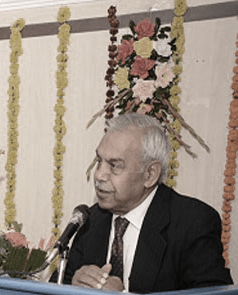
Dr. Agrawal was Founder Director of Mudra Institute of Communications Ahmedabad (MICA), which is one of the most respected communications institutions in the country. He was also Founder Vice Chancellor of Himgiri Zee University, and till recently Professor of Eminence and Director General TALEEM Research Foundation.

He taught so many of us so much.
May his soul rest in peace.

–Meena

To Shruti, his daughter who was a dear colleague.

And thanks to Dr. Arbind Sinha his colleague and another doyen in the world of development communications, for the chat which helped develop this article.