Living On…

August is a Month of Days! Well, I know all months are made up of days, but August is made up of many significant Days—from Independence Day to International Youth Day to Quit India Movement Day to World Mosquito Day, to….

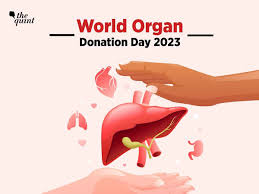
In the process, even media seems to get overwhelmed and is not cover many of the issues adequately.  One such day is World Organ Donation Day, marked globally on 13 August every year, to raise awareness on the need for organ donations, and to clear misconceptions around the issue.

For a quick overview: There are two major types of donations– deceased donation which is the process of giving an organ or a part of an organ after death, for the purpose of transplantation to another person; and living donation, wherein a donor can give part of certain organs to another person. (The other two types of organ donations are Vascularized Composite Allografts (VCAs) which involves the transplantation of multiple structures including skin, bone, muscles, nerves, connective tissue etc.; and Paediatric donations.)

In India, Deceased Organ Donation is usually done only from a person who has been declared brain-stem dead by a team of authorized doctors at a hospital. A person is said to be brain-stem dead when there is an irreversible loss of consciousness, absence of brain stem reflexes and irreversible loss of the capacity to breathe. These are often accident victims and others who have suffered fatal injuries to the head or have had brain haemorrhage. Organ donations after cardiac death are rare in our country. 

Sadly, the deceased donation rate in India is dismally low—it stands at under one donor per million population, and no upward trend has been seen for a decade now. It is estimated that 20 people die each day in our country waiting for an organ donation. Experts estimate that 65 donations per million population are needed to fill the gap.

Considering that we won’t need our organs after death, it would seem that this would be the easiest kind of donation! But in a country where charity and giving are a deep-rooted part of the culture, organ donation meets many barriers. A study published in a prominent medical journal regarding reasons why the figure is so low in India says: ‘Lack of awareness (80.1%), religious beliefs and superstitions (63.4%), and lack of faith in the healthcare system (40.3%) were cited as the three most probable reasons for poor deceased organ donation rates in India. Fear of disfigurement (29.5%), lack of government sponsored incentives (27.6%), fear of procedural delays (27%), and inappropriate counselling for deceased donation (26.4%) were also commonly cited reasons for poor organ donation rate.’ (J Clin Exp Hepatol. 2016 Jun; 6(2): 81–86.).

From the above, it seems that creating awareness and proper counselling are the urgent needs. Most of us don’t know that one deceased organ donor can save up to eight lives. He or she can contribute two kidneys to two people; two lungs to two people; one liver which can be divided among two people; one pancreas and one heart which can save one life each. Apart from this, eyes can give sight and donated tissue can help as many as 75 people. Increasing awareness and appealing to the inherent giving instinct could be critical factor in increasing donations. This is borne out by the fact that in the study mentioned above, people said that the ‘the thought of saving someone’s life’, as well as a ‘feeling of improved sense of humanity’ were motivators for such donations.

You can register your intent to donate organs with the National Organ & Tissue Transplant Organisation (NOTTO). Such a pledge does not carry legal weight as the consent of family is necessary for the donation of organs of deceased people, but it is a clear signal of the wish of the deceased. And if during life the donor discusses his or her wish with family members, they will surely do it, in respect of the loved one’s last wishes. Afterall, what can be more satisfying that their loved one lives on!

So go ahead and visit https://notto.mohfw.gov.in/ today!

–Meena

Jumbo Symbol

As we celebrate our 76th Independence Day, here is a look at a creature which is inextricably tied to the image of India—the elephant.

Though the tiger is our national animal, and lions stand proud on our national symbol, it is the elephant which is associated in popular imagination with India. Elepehants have traditionally been associated with the wealth, grandeur and ceremony of kingly India. Even today, people from foreign lands imagine elephants strolling the streets of the country.

A constant and less-than-flattering reference is to the Indian economy as an elephant. To quote former RBI Governor Dr. Duvvuri Subbarao, ‘In development economics parlance, the East Asian economies — Taiwan, Korea, Singapore, Hong Kong — are referred to as the tigers. The next generation of fast growing Asian economies — Thailand, Philippines, Malaysia, Indonesia — are referred to as the cubs. China is called the dragon. All these countries delivered a growth miracle in the last 40 years. ‘

‘India is referred to as an elephant because it is a strong animal with enormous potential but it moves at a lumbering pace. The hope is that it will start dancing and deliver the next growth miracle.’ (Knowledge at Wharton).

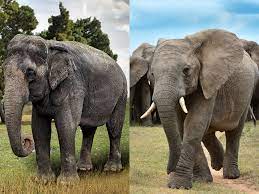
But coming back the elephant itself. Though elephants are so central to the imagination of India, ironically, one sees the image of the African elephant all around—from ads celebrating India and Indian products, to calendar art, to even textbooks and school charts.

The two are different at a very fundamental biological level. Asian elephants belong to the genus Elephas, species maximus, and African elephants to the genus Loxodonta, species africana. The two cannot interbreed and produce viable offspring.

Elephant
Coutesy: Britannica

Physically, the African elephant is significantly taller and heavier than our Asian ones. Another obvious difference is that Asian elephants have small ears, while their African cousins have much larger ears, which cover their shoulders. All African elephants have tusks, while only male Asian elephants have tusks. (Artists seem to like depicting large ears and longs tusks on all the elephants they draw, which may be the reasons for the predominant image of African eles even in our media!). The trunk of the Asian elephant has one finger at the tip, while the African elephant has two fingers– this means that the way they pick up things is different—our elephants will curve their trunk around the object, while the African jumbo will hold the object between its two ‘fingers’, much as we would hold something between finger and thumb. Our elephants have two humps on the forehead, while African eles have one.

Importantly, Asian elephants are tameable, while African elephants are not. This is why in India, elephants have played such a large part in our lives—whether in religious ceremonies, in cultural processions, as royal symbols, as transport or war animals.  

Thought still on the endangered list, conservation efforts seem to be paying off in India, with numbers reportedly on the rise, standing at about 28,000 this year, and elephant-bearing states vying with each other to report higher numbers. Project Elephant, launched in 1992, was critical in focussing attention on conservation of elephants and their habitats. Now, it has been merged with Project Tiger, based on the thinking that both animals inhabit the same habitats in some places. Only the future will tell if this is a good move, given that different issues confront the two majestic animals in different locations, and the move may take away the focussed attention on each of these.

On the economic front, bodies like the World Economic Forum think that ‘India’s economy is an elephant that is starting to run.’

As we wish our elephants to do well on World Elephant Day (August 12), we also hope, on Independence Day, that the Indian economy does well and all Indians attain a better quality of life.

Happy Independence Day!

–Meena

Deadly Fat Sticks

I saw a reference, in a book I was reading recently, to Trichirapalli Cigars. That really intrigued me. For me, Trichy was a place one used to go to as a child to visit aunts and uncles. And of course, a morning was set aside for a visit to the famous Rockfort Ganesha temple. The temple is built on what may be the oldest rock on earth, and we needed to climb 344 steps to reach it—which we as kids did most enthusiastically. And while the elders devoutly visited the Pillayar and Shiva shrines, we kids played around the temple courtyard and passages. Another must-do on such trips was a visit to the amazing Kallanai Dam built by the Chola king Karikalan around the 2nd Century AD, and a picnic on the banks of the Kaveri.

And never in all those years, and all the years following, had I ever heard of cigars originating from there. But apparently, it is quite a thing! Not that one wants any place to be famous for cigars, but I thought that I must at least learn a little about this, since I have memories of the town with which it is associated.

To start at the beginning, a cigar is defined as a roll of tobacco, wrapped in a leaf of tobacco (or in a substance which contains tobacco). This is what sets it apart from cigarettes, which are made of tobacco rolled in paper or a substance that does not contain tobacco. Cigars are expensive—one reason is that the wrapper leaves need to be of a special quality– strong, elastic, silky in texture, and of even colour. They must have a pleasant flavour and good burning properties. Even the filling used for cigars is often a blend of various types of special tobaccos. And cigars are usually hand-rolled, which makes the process expensive. The shape and size of cigars also determine the price, as does the age—if the tobacco used in a cigar has been aged, or the cigar itself has been aged, it will cost more. And then there are ‘special edition’ cigars which are collectors’ items.

If tobacco-leaf wrapped cigars are at the highest end of the spectrum, tendu-leaf wrapped bidis are at the lowest!

While Cuban Cigars are the best-known, apparently Trichirapalli i Cigars are pretty famous too! Apparently, these were among the major exports to Britain in Victorian times. In fact they were supposed to be the cigars of choice for Churchill when access to Cuban cigars was cut. Churchill even appointed a CCA (Churchill’s Cigar Assistant), a cigar taster for the PM! His job was to ensure uninterrupted supplies of the best Trichirapalli cigars to Churchill. So well-known were these cigars, that Sherlock Holmes mentions them in his famous story “Study in Scarlet”, and Hitchcock also referenced them in one of his films.

What is unique about these cigars is the process employed in processing the leaves. Rather than ageing the leaves as is usually done, in Trichy, they ferment them in toddy water or in distilled fruit juice (orange, apple, pineapple, grape) with added jaggery and honey. This gives them a very distinctive flavour.

Cigars may be expensive, and perceived as fancy and high-class. But they are just as deadly as their humbler cousins–cigarettes or bidis. They contain the same addictive, toxic and carcinogenic compounds found in cigarettes and are not a safe alternative.

And in some countries like the US, cigars are becoming popular with younger people. This is because flavoured cigars like cherry or cocoa or liquorice are available, unlike in the case of cigarettes, where flavours are not permitted. Moreover, the fact that cigars are often sold as single sticks make them more accessible. In fact, a recent survey among middle and high school students who used cigars in the past 30 days, 44.4% reported using a flavoured cigar during that time. The cigar industry seems to be deliberately targeting younger people. A cause for worry indeed!

Cigar-trivia is fine, but ALL smoking and ALL tobacco products are bad!

–Meena

Raiders of the Lock Art

Art thefts make the headlines fairly frequently (as do movies and OTT series on the theme). They have a long history—the first art heist probably dates back to 1473 when Polish pirates boarded a ship and stole  Hans Memling’s a painting called ‘The Last Judgement’. They took it back to their country, where even today, it is displayed at the National Museum in Gdańsk. Italy has, since the 15th century been trying to get the painting back!

Patriotism and national feeling were also behind the theft of the Mona Lisa in 1911 from the Louvre. Vincento Peruggia, a handyman at the Museum, along with two compatriots, spent the night in a closet there, and quietly walked away with the painting in the morning. Peruggia thought that the painting was an important part of Italy’s heritage stolen by Bonaparte, and wanted to get it back to the homeland. He hid the painting for over two years, trying all the while to sell it to a buyer who would help in the repatriation. It was no easy task, because the theft had gained international notoriety and everyone was on the lookout for the painting. Finally, after 28 months, a dealer whom Peruggia approached called the police, and the painting was recovered and Peruggia jailed. In fact, it is this theft which is supposed to have catapulted the Mona Lisa to the fame and popularity it enjoys today—few had really bothered about it before this incident.

The biggest art heist in terms of monetary value is the theft of several paintings of incalculable value from the   Stewart Gardner Museum, Boston. The stolen works, still missing, include a Vermeer, a Rembrandt, and a Monet among others, and are valued at about $500 million.  

Another art-theft that caught the popular attention was the one where the thief was dubbed ‘Spiderman’. Vjeran Tomic entered the Musée d’Art Moderne de la Ville in Paris several times without being noticed, by spraying acid on a window. On the final visit, he stole several artworks, including a Picasso and a Modigliani. He was finally caught.

The point of art thefts is a little difficult to decipher, because the stolen works are usually well-known and even if there are people willing to buy them, they can hardly be displayed, as they would soon be recognized.  Of course there are some people who steal art for ‘noble’ reasons, like Peruggia who wanted to restore his country’s heritage. Or there may be others who are happy to pay in the millions and billions, and take enormous risks to enjoy the paintings in very private situations. Or maybe just the idea of outwitting complex security measures gives some a kick.

At least paintings are not too large and heavy, especially if the thief at some stage takes them out of the frame, and are therefore relatively easy to move and hide.

But that cannot be said of stolen public art. One of the most famous of such thefts is that of a Barbara Hepworth sculputre, Two Forms (Divided Circle), from its plinth in South London’s Dulwich Park. The bronze standing at 93 x 89 x 23 inches was installed in the Park in 1970, and disappeared overnight on 19–20 December 2011. While the art piece was valued at about £500,000, the thieves probably stole it to sell as scrap—for which they would likely have got £750!

Lock
The Lock standing proud before it was stolen

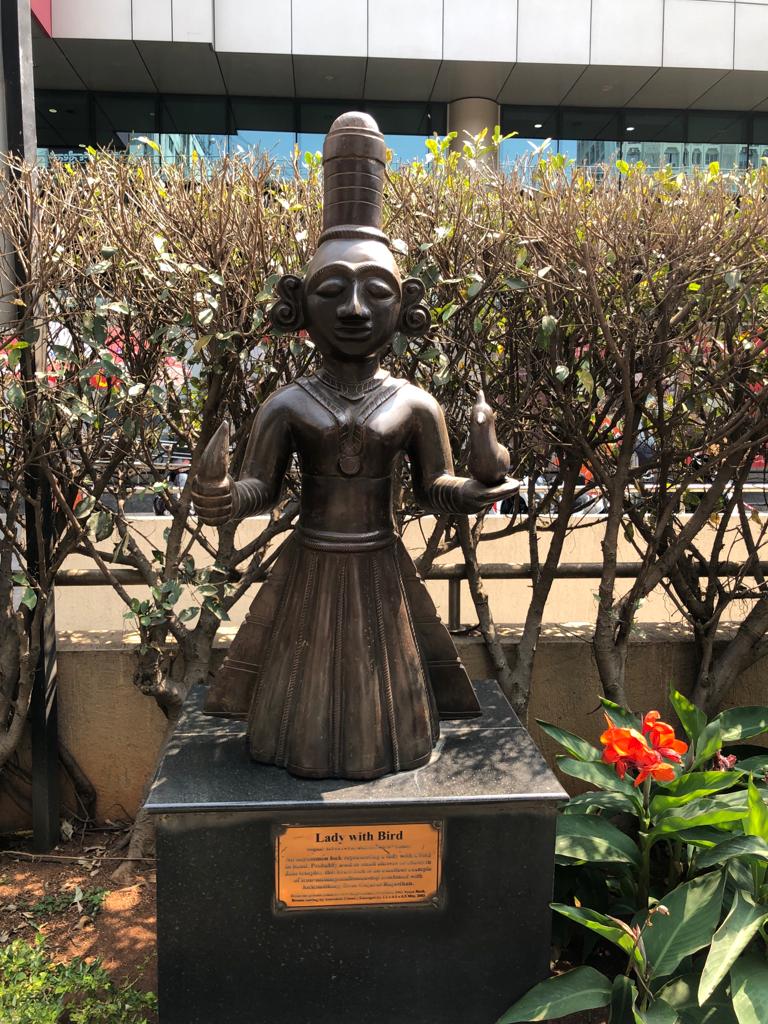
Not at this scale, but our own Bangalore (and we personally) suffered such a loss last month. Raghu is an avid collector of locks, and seven of the locks from his personal collection were blown up in bronze, and placed on the kerbside of a large bank located on MG Road. The idea was to add an element of aesthetics and interest which could be viewed and enjoyed by all passers-by. Alas, on a night in June, one of the seven bronzes disappeared! And will probably be sold for scrap. A loss to the Bank, to us who love and cherish the locks, and to the general public.

Many curators and security specialists have thought through how thefts of public art can be prevented. Stephen Feeke, curator at the New Art Centre,  a gallery and sculpture park in Wiltshire, offers common sense solutions—for instance, flood-lighting to deter thieves and vandals;  securely gating and fencing the perimeter; and blocking access for vehicles, as a bronze sculpture is far too heavy to carry off without a car. Others suggest high-tech measures like using forensic coding that might allow the metal to be traced.

But many are united in that there must be an outcry and voices must speak out against these thefts, which are not only a personal loss to the owners, but a loss for the public for whom this may be the most accessible form of art.

Lady Lock did not have Lady Luck on her side the night she was stolen, but let’s hope our cities do more for their public art.

–Meena

Another World Youth Skills Day…

In 2018, the proportion of India’s working-age population started growing larger than its dependant population (children below 14 and above 65 years of age). This bulge in the working-age population, called the demographic dividend is going to last till 2055—a total of 37 years.

World Youth Skills Day

But such a large population of young people is productive only if they are educated and skilled so that they realize their potential and contribute to the nation’s growth.

The harsh reality is that only about one in five Indians in the labour force is “skilled” as per the Human Development Report (HDR) Report 2020. India is 129th among 162 countries for which this data is available.

If the absolute numbers are a matter of concern, for me, the less-obvious ‘quality of skills’ is even more of concern.

Let’s look at a few indicators of how effective skill training programmes in India may be. With regard to many skills, a school dropout can be certified at Level 3 or 4 through a 3-month training programme. In the formal skill structure, which is the ITI and Polytechnic systems, the length of programmes is more respectable, but the courses and curricula are outdated by about five decades—some of these institutions still offer programmes in Stenography! The faculty may never have set foot in an industry, and the equipment, even if it is functional and not rusting, has not been in use in the real-world for at least 20 years. And the youth themselves, during their time in these institutions may never work on an industry shop-floor, or even visit a factory.

If skill is ‘the ability to do something well’ how do we expect youth passing out of such systems to do anything useful, least of all ‘well’?

Contrast this to Germany, which is one of the leaders in skill training. They base their skill training on the dual system which works because of the cooperation between Medium and Small Scale Enterprises, and vocational training institutes. Trainees in the dual system typically spend part of each week at a vocational school and the other part at a company. Dual training usually lasts two to three-and-a-half years. It is basically a combination of theory and training implanted in a real work setting. It is an integral part of the education system and is driven by industry and trade unions, who constantly upgrade and modify training modules and job roles. These occupations are certified by either a chamber of commerce or crafts or trades. About 70% of German youth go through this skilling system.

Whether is the length of the training, the rigour, the exposure and hands-on work in industry, or the up-datedness of the curriculum based on industry needs, where is the comparison between skilling in such a system and skilling in India? We can talk about the importance we place on skilling, tout the numbers (the National Skill Development Corporation website says 1,10,34,285 candidates have been certified through the flagship short-term training programmes), and the institutional structure and industry-involvement mechanisms we have put in place.

But to quote a 2019 ILO report on India,

‘Since 2013 … despite ongoing reforms promoting skills development, VET has not kept pace with general education, and its share of upper secondary education fell to 2.7 per cent in 2016. Moreover, VET does not respond to the training needs of young women. Only 17 per cent of VET students were girls in 2016, down from 20 per cent in 2000 (UIS, 2018). Non-formal and informal VET programmes do not reach a large proportion of India’s young people. Survey data collected in 2017 indicate that only 5 per cent of young people aged 14–18 were taking any type of vocational training, whether formal or not. And 59 per cent of those receiving training were taking courses shorter than six months.’

This should not be news to any of us. Each of us has experienced how difficult it is to find a plumber, electrician, carpenter or welder, leave alone one who knows their job, can problem-solve; one who turns up on time; one who works cleanly and cleans up their mess.

We are five years into our demographic window. And still have not put in place a critical building block, viz skilling. How can we hope to fulfil our dreams, aspirations and ambitions if we don’t bring about DRASTIC changes and SOON? We need to take an honest look at where we stand, admit we are not on the right track, and go back to the drawing board.  

July 15 is marked as World Youth Skills Day.  We in India too marked this last week. But Skill Days will come and go. When will our youth be able to access high quality skills?

–Meena

Homes for Hippos

Hippos hit the news every now and then. And in the past weeks, they have been a topic of some discussion in India, thanks to a request from the Colombian Government for us to provide a home to some of the ‘cocaine hippos’ that have become feral there. Actually, it is quite unfair to call them ‘cocaine hippos’—it is not like they snort cocaine. Their ‘fault’ is that they (or their parents/grand-parents) were owned by the infamous cocaine smuggler Pablo Escobar.

Pablo Escobar was a Colombian druglord, who was called the ‘King of Cocaine’, due to his monopoly of the cocaine trade into the US. He was the founder of the Medellin Cartel, and the wealthiest criminal ever, with his wealth being estimated at $ 30 billion in 1993, when he was killed at the age of 44, by the Colombian National Police.

Every aspect of Escobar’s life was larger-than-life. Like the emperors of old, he set up a menagerie at Hacienda Napoles, his huge ranch east of Medellin, and kept giraffes, elephants, ostriches, and other exotic species there. Four hippos—three males and one female–were part of this menagerie.

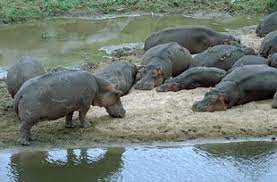
When he was killed, authorities did not quite know what to do with these animals, and just left them in the estate—where not unexpectedly, they multiplied. In about 25 years, there were close to a 100 individuals (the number may stand at over 150 today). A single hippo can eat over 35 kg of grass and other green plant material in a day, posing a threat to local biodiversity. Being large and heavy animals, they stomp the ground and compact it as they move over the same area day after day. They defecate in the water, and end up polluting rivers and water bodies.

Hippos
Pic: Encyclopedia Britannica

Efforts to curb the population explosion have not met with success. About 15 years ago, the local government tried culling the animals, but this led to protests across Colombia and was thankfully stopped. A sterilization programme is in place, but the hippos breed faster than local experts can find, catch and castrate them (We can’t even manage it with stray dogs, what to talk of hippos!).

Hence the plan to ship the hippos to various countries which are ready to receive them. Mexico has agreed to take 10 of them. Colombia has approached India to house 60 of the animals at the ‘Greens Zoological Rescue and Rehabilitation Kingdom (GZRRC)’, being created by Reliance Industries in Jamnagar, Gujarat. The plan has not met with enthusiasm by any wildlife expert. Housing them in zoos is an expensive proposition.  Hippos are native to Sub-Saharan Africa, not India, and definitely cannot be released into the wild. (However, based on a small fragmented tooth unearthed in Madhya Pradesh, researchers claim that India was home to hippopotami nearly 5.9 million to 9,000 years ago. The hypothesis is that they entered Eurasia from Africa, and then diversified in South Asia before going extinct. But even if they ever were native here, they haven’t been for many millennia.)

There is no doubt Colombia has a problem. Apart from destroying vegetation and biodiversity, hippos are also a threat to humans. They are known to be very aggressive, and can chase people on land, as well as capsize boats in the water. They sometimes raid fields and come into conflict with humans.

And it is also true that a safe home must be found for the hippos—they are only living their life as they were meant to. How can they help it if someone uprooted them from their home and brought them to a new continent?

But bringing them to India definitely does not sound like a good idea. The recent import of cheetahs should serve as a cautionary tale. We need to protect our biodiversity and trying to introduce non-native (at least in human memory) species is not going to help either our diversity or the introduced species.

–Meena

Gracious, graceful, generous: Shobita Punja

Those are my memories of Shobita Punja, who passed away last week. She joined the Governing Council of Centre for Environment Education (CEE) when I was a rookie-professional there. And from then on, for the decades that followed, we would have the privilege of meeting with her twice a year when she came for the meetings, and then again at workshops and seminars. And over the years, she went from advisor to friend.

Shobita Punja
Shobita Punja. Photo: Jaipur Virasat Foundation.

And in every interaction, she was indeed gracious and generous—taking the time to talk to each one of us, enquiring about our projects, and giving her inputs gently and generously. Most conversations gave us a new perspective to the way we were looking at things.

And of course she was graceful. Her lovely cotton saries; her low, loose bun; her warm smile.

We all wished we could be half as erudite and elegant as her. Or even a quarter would do!

When we first met, she was heading the Centre for Cultural Resources and Training (CCRT), and they were bringing out innovative teaching materials to ignite the love of our history and culture in school kids, and supporting that with teacher training to ensure that the material was used in the right way in the schools. There was much to learn and share, for she was doing for the cultural environment what we at CEE were doing mainly for the natural environment. Both CEE and CCRT were pioneers in introducing experiential learning pedagogies, in getting children to look up from textbooks at the real world, and in trying to question and contextualize their experiences; analyze and synthesize their learnings. And these were revolutionary thoughts for the ‘80s! (Today, the ideas are not new, but how effectively they are put into practice in their real spirit is still a question mark).

 She was truly a pioneer! She did her BA in Art History when it was definitely not seen as a subject with any great career openings, at least not in our part of the world.  This was followed by a Master’s in Ancient History from JNU and another Master’s in Art Education from Stanford. She was awarded a Ph.D. for her contribution to Art Education.

From CCRT, Shobita moved to INTACH, and established a Heritage Education and Communication Service there. She was the moving force behind the restoration of the Chowmohalla Palace and Museum at Hyderabad. As an erstwhile resident of that historical city, I can aver to how authentically it was done and how proudly we used to be to show it off to our visitors. The restoration won the coveted UNESCO Asia-Pacific Heritage Award, apart from many other accolades. Chowmohallah after its restoration was the site for many beautiful music and dance performances, made even more beautiful by the settings. Shobita was also behind the restoration of the Jai Vilas Palace Museum, Jaipur and Reis Magos Fort, Goa.

She was a prolific writer, with over 20 books to her credit, ranging from one as recent as the 2023 co-authored ‘A New History of India: From Its Origins to the Twenty First Century’, through scholarly books on Khajuraho and Banaras, to children’s books including ‘Listen to the Animals’ A Fabulous Collection Of Takes For Children,Illustrated by Mario Miranda.

But maybe her most seminal work was her first book, ‘Illustrated Guide to Museums of India’. Nothing like this had been done before for our heritage collections, and it set a benchmark. What is wonderful is that it is available to all free online, thanks to the UNESCO archives. All you have to do is click on: https://archive.org/details/in.gov.ignca.84193/page/n17/mode/2up.

Shobita, you have left us, but your contributions and the memories of your grace and presence will live on!

May your soul Rest in Peace.

–Meena

Desperately Seeking Women-Power

The Global Gender Gap Report 2023 is out, and the news is not good for us in India. Well, if you are an untiring optimist who insists on seeing a glass with some drops of water in it as half-full, you will stop me and scold me. For after all, India’s ranking in the list of 146 countries which have been studied, has gone up 8 places, so that we stand at 127th, up from 135th last year.  

But for me, as I go through the report, I don’t know see how we can take any comfort from this. Even if we are to view ourselves in a comparative light, we need to pause and consider that Nicaragua and Namibia rank at 7th and 8th, compared to our 127!

The report measures gender gap on four major dimensions:  Economic Opportunities, Education, Health, and Political Leadership.

The first bucket, to quote the report ‘contains three concepts: the (labour) participation gap, the remuneration gap and the advancement gap’. The second bucket of Educational Attainment ‘captures the gap between women’s and men’s current access to education through the enrolment ratios of women to men in primary-, secondary- and tertiary-level education’. The Health and Survival sub-index provides an overview of the differences between women’s and men’s health by looking at sex ratio at birth, and the gap between women’s and men’s healthy life expectancy. The last bucket of Political Empowerment measures the gap between men and women at the highest level of political decision-making through the ratio of women to men in ministerial positions, and the ratio of women to men in parliamentary positions.

Courtsey UN Women Insta

If we look at India in terms of these dimensions, less than 30 per cent of women participate in the labour market. Women make up 89 per cent of workers in informal sector, which means they are probably underpaid, do not have job security or any other benefits, and work in unsafe, unhealthy and unregulated conditions. Less than 2 per cent firms in India have female majority ownership, and less than 9 per cent have females in top management positions.

Close to 30 per cent women report having faced gender violence in their lives.

We rank 117th in terms of percentage of women in Parliament and 132nd in terms of women in ministerial positions.

That is underwhelming in terms of performance and overwhelming in terms of the task ahead. A practical way to start may be by looking at the factors that are measured to arrive at the rankings. This can probably help a government, an organization and a community and a family work out specific plans and targets.

To get into the details of the employment and economic opportunities segment, the factors include:  labour-force participation (including unemployment and working conditions); workforce participation across industries; representation of women in senior leadership; gender gaps in labour markets of the future (including STEM and AI related occupations); gender gaps in skill of the future.

What might that mean for a government? Well, maybe setting targets or incentives/disincentives for public and private sector for employment of women? Importantly government must ensure workplaces, public spaces and transport safe, so that women are able to travel and work without fear. To a large extent, government does walk the talk on gender positions? Many of our Ministries and Departments are headed by women-bureaucrats; the largest public sector bank has been headed by a woman; we have women heading government research labs and scientific institutions, playing a part in our space and nuclear programmes, now full-fledged in the armed forces, etc. But doing this even more aggressively will set an example to the private sector.

What might that mean for a corporation? That they move forward from celebrating Women’s Day to taking a hard look at their policies, systems and culture to see how they can become truly inclusive employers.

What might it mean for educational and training institutions: That they don’t, by action or inaction, deny girls opportunities; that they counsel and encourage them to take up STEM courses and careers.

What does it mean for communities? That they examine their conscious and sub-conscious biases, and understand how these affect their actions; that they make the community safe for girls and women.

And most importantly, what does it mean for a family? That they don’t discriminate against girl-children; that they provide them opportunities; that they don’t belittle their aspirations and abilities; that they don’t deny them their rights; that they help them fight their battles and give them a winner’s mindset.

It’s a long, hard journey. If we aspire to be at least in the top half rather than the bottom half of the ranking,the journey has to begin with every individual—in our hearts, minds and actions, today.

–Meena

https://www.weforum.org/reports/global-gender-gap-report-2023

A Windy Day

Is it windy outside? Not really! Then why this piece? Well, it is in anticipation of Global Wind Day, a worldwide event that is marked annually on 15 June. It is ‘ a day for discovering wind energy, its power and the possibilities it holds to reshape our energy systems, decarbonise our economies and boost jobs and growth.’

Fair enough!  Today, winds are gaining huge importance because of their potential to add to the basket of energy sources—a clean energy source that will help mitigate climate change challenges. It is because of this promise that wind power has grown rapidly since 2000, Global installed wind generation capacity has increased by a factor of about 100 in the past two decades. In 2021, the total wind generation capacity globally was 830 Giga Watts. India is proudly at Number 4 position in the world, with an installed capacity of 40+ GW. And there is still a long way to go, with estimated potential for wind in India being 200 GW.

Just to double back, what is wind? Put simply, it is the the movement of air relative to the surface of the Earth. Winds play a significant role in determining and controlling climate and weather.

And how is electricity produced from winds? Basically, it is by converting the kinetic energy of air in motion into electricity. Wind rotates rotor blades of a turbine, which converts kinetic energy into rotational energy. This rotational energy is transferred by a shaft to the generator, thereby producing electrical energy.

Windmills
Domestic windmills are not common but I saw this somewhere near Mandya, Karnataka

So yes, wind is a harbinger of hope for the future.  Though maybe not without its own issues. Wind energy can obviously be produced only where the winds are strong and fairly sustained through the year—and there are not too many places like that in the world. Through the day and through the year, wind intensity changes, so that wind energy is not generated throughout—it is an intermittent source.  And of course, winds can be unpredictable, so the generation cannot be assured.  Wind turbines are noisy and also change the landscape drastically. Wind energy potential is highest in remote places, which makes investment in transmission lines and related equipment essential. They also have impacts on local biodiversity and even migratory birds. While the cost of producing wind energy has come down in the last few years, and it is a competitive source, technology and R&D have to progress further so that costs may be brought down.

India has committed to producing 140 GW of wind energy as part of its climate ambitions.

But for us in India, winds are not important just for their energy potential.  Lives and livelihoods here have always centered around the monsoon winds—which bring or don’t bring us our rains. The monsoon–a periodic wind in the Indian Ocean and southern Asia—is our lifeline. The summer monsoon usually happens between April and September and bring us our heavy rains. The winter monsoon, which lasts from October to April don’t bring much rain as far as India is concerned. The English word monsoon comes from the Portuguese monção, but ultimately from the Arabic  (mawsim, “season”). 

So all the more reason to understand the role of winds in our lives, and mark Global Wind Day!

And a fun fact to end with:

Ramakkalmedu, also called God’s Own Hill-station, in Idukki district, Kerala, is the windiest place in India and one of the windiest places in Asia. Throughout the year the wind speed here is around 35 km/hr. Located at a height of about 3500 feet, the place is home to–what else–a wind energy farm with a capacity of 12.5 MW!

–Meena

Don’t Stick Out!

That is surely the mantra of the Stick Insect! Known for one of the most effective camouflage strategies in Nature, the stick insect resembles the twigs among which it lives. It belongs to the order Phasmatodea, which includes the other master camouflaguer, the leaf insect. In fact, the name Phasmatodea derives from the Greek word phasma, meaning an apparition, phantom, or ghost.

The order Phasmatodea has over 3000 species in all—but how can one be sure, when many of them may be so well-hidden that they are impossible to detect!  India has about 150 of these species. These creatures are related to grasshoppers, crickets, and mantises.

We were recently in the Western Ghats, where we encountered a beautiful Stick Insect. About 6 inches in length from the forward-legs to the tip of the body, it rode on a friend’s leg for a part of our walk through the wilderness.  Going by stick insect standards, it was a only a moderately sized one, given that these insects range in length from the half-inch-long Timema cristinae of North America, to the 13-inch-long Phobaeticus kirbyi of Borneo. The latter measures over 21 inches with its legs outstretched, making it one of the world’s longest insects. Female stick insects are normally larger than their male counterparts. They are usually brown, green, or black, but some are brightly-coloured or striped. Some have wings. All continents except Antarctica have stick insects, though they are most abundant in the tropics.

The stick insect, also called the walking stick, spends most of its time up on trees, munching on leaves. When it senses a predator such as a bird approaching, it practically freezes, blending with the twigs and branches around it. In fact, studies suggest that some species have honed the ability to mimic the motion of twigs swaying in the wind to deceive even particularly observant predators. Stick insects are largely nocturnal and spend most of their days lying motionless on or under plants, and only coming out at night to feed. Unfortunately, the stick insects’ defences are not effective against bats which hunt by echo-location rather than sight, and these may be their most dangerous predators.

Even though their camouflage is extremely effective against most predators, they have several other tricks up their sleeves. Some species have evolved to release foul-smelling chemicals to deter predators, while others can secrete a liquid that temporarily blinds their enemies.  Even if a predator spots a stick insect, it usually grabs a leg, which is the most prominent part of the insect. But that doesn’t bother our insect too much, because many of the species can detach the leg and scramble away—only to grow back the lost limb later.

And these master-tendencies start even at the egg stage! The females of some species lay eggs that look like plant seeds. This puts off carnivorous insects from eating the eggs!

Some of the stick insect species are today endangered, and the numbers of some are falling—thanks largely to habitat destruction and pesticide use. Another threat to these gentle insects is collection for the pet trade. Carausius morosus, the ‘common’ or ‘Indian’ or ‘laboratory’ stick insect, which has its origins in India, is one of the species of Phasmatodea often kept as pets by schools and individuals.

Alas, however well a creature has evolved to protect itself against natural threats, there is little protection against humans!

–Meena

.