Getting Serious about Play!

Last week, we talked about the International Dolls’ Museum in Delhi.  And we lamented about its not keeping up with the times and re-inventing itself.

A model from which it could draw inspiration is The Strong National Museum of Play, Rochester, New York, USA. It was established in 1969 based on the collection of one individual, Margaret Woodbury Strong, who by that point in time has collected over 27,000 dolls. Like Shankar who set up the Dolls’ Museum, she started by exhibiting parts of her collection and later added two wings to her palatial house to exhibit to select visitors. Over time, she started thinking about setting up a museum for the public.   Margaret Strong died in 1969, leaving her collection and her wealth for a museum, which was finally opened to the public in 1982.

The Museum’s display of the collection of dolls is only a small part of what it does. It is ‘a highly interactive, collections-based museum, devoted to the history and exploration of play’ and sees itself as ‘the ultimate play destination of all ages’. To meet this mission, it has interactive exhibits in a space of 1,50,000 sft, online exhibits, the World Video Game Hall of Fame, a Play Lab which is a maker-space, and a Skyline Climb. The Strong Museum takes the effort to ensure that the experiences are accessible for people of all abilities. Many of the exhibits on the online museum are viewable to all of us on Google Arts and Crafts.

A very interesting initiative of the Museum is the National Toy Hall of Fame. Every year, the Hall of Fame recognizes and inducts toys that have ‘inspired creative play and enjoyed popularity over a sustained period’. The public (I think only those who live in America) are invited to nominate their favorite toys based on the following criteria:

  • ‘Icon-status: the toy is widely recognized, respected, and remembered.
  • Longevity: the toy is more than a passing fad and has enjoyed popularity over multiple generations.
  • Discovery: the toy fosters learning, creativity, or discovery through play.
  • Innovation: the toy profoundly changed play or toy design. A toy may be inducted on the basis of this criterion without necessarily having met all of the first three.’

What a wonderful way to engage with the community at large! The toys in the Hall of Fame include everyday objects, like sand which is one of the most popular materials for children to play with; blankets which children can make into anything from tents to disguises; to cardboard boxes which as we know are more interesting to kids than the most expensive toy packed inside. The list of course includes items created to be played with—from balls, playing cards, rubber ducks, girl-dolls, hoola-hoops, jump-ropes and  jigsaw puzzles to Rubik’s Cube and Nintendo.

Games and toys

The Museum has the core philosophy that ‘Play sharpens minds and boosts creativity. When children play, they learn to solve problems, make decisions, express ideas and recognize boundaries’, the Museum focuses attention on educators, with special grade-related exhibits and lesson-plans for teachers.

The Museum plays a very serious role in research too. The Strong’s Brian Sutton-Smith Library and Archives of Play is devoted to the intellectual, social, and cultural history of play and is a 230,000-volume research library and archives of primary and secondary sources, including scholarly works, professional journals, periodicals, trade catalogues, children’s books, comic books, manuscripts, personal papers, business records, and more.

Another important collection is The International Centre for the History of Electronic Games which has 60,000 artefacts and thousands of archival material on the history of video games.

A third collection is The National Archives of Game Show History which ‘preserves the history of game shows—from the earliest panel shows and quiz scandals, to the games and puzzles of the 1970s, to the big money network series and the classic games now in primetime’.

So efforts on every front to be relevant to a wide audience, and to keep up with the times.

A lesson or two or three, our museums can learn?

–Meena

A Prime Minister, A Cartoonist, and A Dolls’ Museum : Marking Children’s Day

We celebrate November 14th, the birth anniversary of our first Prime Minister Pandit Jawaharlal Nehru, as Children’s Day. This is because not only did he love children, but children loved him right back! They called him ‘Chacha’—a name that stuck even with adults.

Nehru understood children and the need for loving and carefully nurturing them, as also their importance to the future of the nation.  ‘Children are like buds in a garden and should be carefully and lovingly nurtured as they are the future of the nation and citizens of tomorrow. The children of today will make the citizens of tomorrow. The way we bring them up will determine the future of the country’ he said. He also had a clear vision on the purpose and role of education: ‘The object of education is to produce a desire to serve the community as a whole and to apply the knowledge gained not only for personal but for public welfare.’

A contemporary who also loved and valued children was Shankaran Pillai, India’s first political cartoonist. Shankar, as he was called, and Nehru, enjoyed a great friendship, though the cartoonist featured the PM in over 4000 cartoons, many of which were merciless. Nehru was a tall leader—not only could he laugh at himself but he also appreciated the need to do this: ‘It is good to have the veil of our conceit torn occasionally’. He urged the cartoonist on, saying ‘Don’t spare me Shankar.’ Nehru even used to enclose Shankar’s cartoons in his letters to his daughter Indira Gandhi when he was in prison.  

Those were different times, those were different people!

Shankar founded the Children’s Book Trust (CBT) in 1957 to ‘to promote the production of well written, well illustrated and well designed books for children.’ CBT has been bringing out high-quality books in English and Indian languages and these are highly subsidized, to make them widely accessible. In 1968, CBT started a magazine called Children’s World. An International Children’s Competition for Painting and Writing has been on-going since 1951. These were pioneering initiatives.

Shankars Dolls Museum

But maybe the most innovative idea was The Shankar’s International Dolls Museum, which has now grown into one of the largest collections of costume dolls anywhere in the world, housing over 7500 dolls from 85+ countries. And it all started with a single doll—sometime in the ‘fifties, the Hungarian Ambassador gave Shankar a typical doll from his country, to give away as one of the prizes in the International Children’s Competition. So fascinated did Shankar become with this doll that he started collecting costume-dolls whenever he travelled.

He did not just do this for his own enjoyment. He often held exhibitions so that children of all strata could see and enjoy them. Pandit Nehru and Indira Gandhi visited one such event, and Indira Gandhi suggested then that Shankar should set up a permanent museum of these dolls. The idea slowly crystallized, and the Museum was inaugurated in 1965. The building where it was housed was appropriately named Nehru House. Nehru gifted a large number of dolls to the Museum and these were the core around which the collection was built. Subsequent PMs as well as Ambassadors and visiting dignitaries from various countries also added special and unique dolls from their nations.  And thereby, a landmark institution was created.

While these were pioneering ideas in their times, the question that needs to be asked is how can the Museum be made relevant for today? How can modern understanding of museums and collections be brought in to revitalize the display and hold the attention of today’s children? The collection is unique ,and the rich collection of artefacts would be a dream for many a researcher to delve into –how can that be facilitated?

We are sitting on a treasure-trove. If we respect the legacy left by Pandit Nehru and Shankar, we have a duty to use this better.

Happy Children’s Day!

–Meena

Pic from https://www.childrensbooktrust.com/dollsmuseum.html

Fun and Games

Play is something the young of many species indulge in. Play is of course a part of the life of young humans, but we also see puppies, kittens, the young of many mammals and even some birds play.

The study of play is however, a serious matter, as can be seen from this definition: ’ play is repeated, seemingly non-functional behavior differing from more adaptive versions structurally, contextually, or developmentally, and initiated when the animal is in a relaxed, un-stimulating, or low stress setting’ (Burghardt, 2014).

If that sounds a bit complex, here is a breakdown of the behaviours associated with play, i.e. play should

‘*be incompletely functional in the context in which it appears;

*be spontaneous, pleasurable, rewarding, or voluntary;

*be different from other more serious behaviors in form (for example, be exaggerated) or timing (for example, occur early in life, before the more serious version is needed);

* be repeated, but not in abnormal and unvarying stereotypic form (for example, rocking or pacing); and

* be initiated in the absence of severe stress.’

Till a few decades ago, it used to be believed that only the young of warm-blooded animals and birds played. But research is showing that many other creatures play too, including the young of some fish, frogs, lizards, turtles and even Komodo dragons. Coming from a human perspective, we may not recognize this as play. But going by the definition and framework above, many of the activities of the young of these species fall in the category.

Play is of critical importance in the development of all species who indulge in it. In the case of human children, it helps in the development of cognitive, physical, social, and emotional well-being. It helps children learn about themselves and the world, and through play they learn many life-skills like confidence, resilience, cooperation, team spirit, coping with challenging situations etc.

Play itself can be of different types: Physical Play, which helps in physical development and skills like coordination; Social Play which helps children develop the skills of how to interact with others, taking turns, cooperation, etc.; Constructive Play, wherein children create things—arts and crafts including drawing, painting, building things, etc.; Fantasy Play, that is using the imagination to create situations and enacting parts; and Games with Rules, which helps the child develop cognitively and learn how to follow instructions and rules.

If the topic of the conversation is play, can toys be far behind? Toys too date back to ancient times– archaeologists excavating the ancient city of Kültepe Kaniş-Karum in Turkey discovered a 4,000 year old ceramic rattle, which is believed to be the oldest children’s toy yet uncovered.

Toys
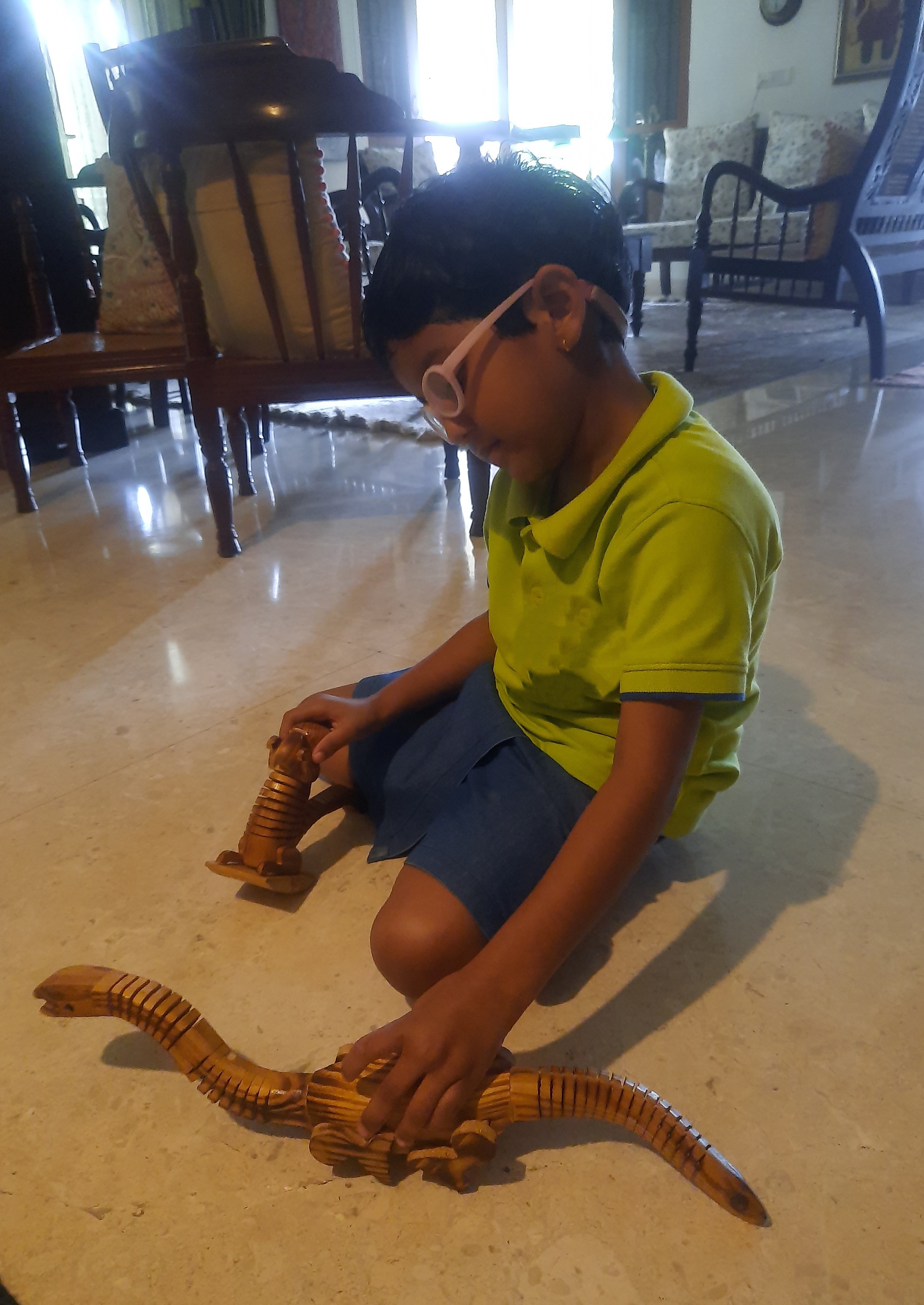
Photocredit: Harini M.

Today toys and games are a highly sophisticated market with several categories including puzzles, dolls, soft toys, fidget toys, modelling clay and related products, movable vehicles, construction toys, constructed toys, board games etc. 

It is also a huge market–in 2022, this market generated total revenue of US$122.90 billion. India is a tiny part of this—with the Indian toys market size reaching $ 1.5 billion last year, with barely $ 1.14 per capita spend on toys. Which means most of our children don’t have access to toys, or have too few toys—which is definitely disadvantages their development. Not that I am saying that store-bought toys are the only way to go. We know that children show enormous ingenuity in making anything into a toy–kitchen vessels, sticks and stones, boxes and cartons. And creative parents and teachers can make toys at no or low-cost. (For ideas, you can visit https://arvindguptatoys.com/, the website of Padma Shri awardee Shri Arvind Gupta, who has spent his life developing and advocating for the use of no- and low-cost toys with educational value). But having said that, I do believe that every child has the right to a new, shiny toy once in a while. So not only must we manufacture more toys, but low-cost, innovative ones which don’t compormise on safety.

Equally important are innovative ideas like toy libraries so each child does not have to buy every toy and less-advantaged children can get access too; toy hospitals so toys can be mended and their life extended;  and NGOs which collect, refurbish and re-distribute toys. Another complex challenge is how to keep toys from reaching solid waste dumps—how to recycle them safely and cost-effectively?

So toys may be fun and games, but it’s definitely not all child’s ply!

–Meena

PS: The image is from a storybook Harini and I created using toys as charecters. ‘My Sunday with Daadu and Deedu’ available on Amazon. The Telugu version by Manchi Pustakam is available on their site.


Of Ghosts and More: A Random Walk on Halloween

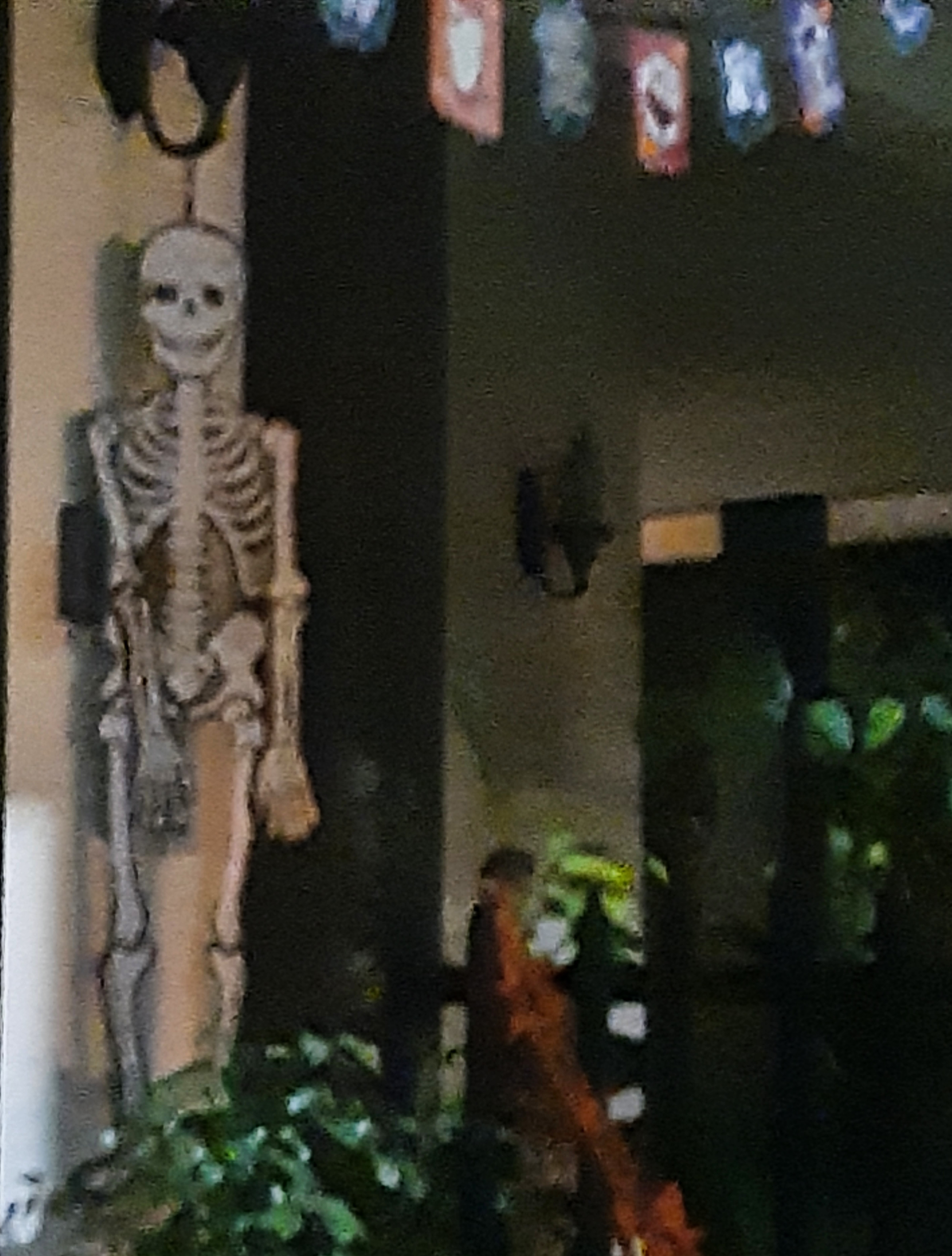
It is Halloween today—a holiday that in the past decade or so has gained great popularity in India too.  The name ‘Halloween’ is linked to the Christian festival of ‘All Hallows’ or ‘All saints’ which falls on November 1. It was originally a day on which the church commemorated the lives of saints and martyrs. As time went along, it added on other connotations, such as praying for souls that were believed to be not yet in heaven or making offerings to the dead.

But what is the origin of Halloween as we celebrate it today? Well, it stems from an old belief that the spirits of the dead would roam the earth until All Saints Day, and that on Halloween they would take their last chance to have revenge on people they had a grouse against. That’s the reason why people dress up—in order to disguise themselves so the spirits would not recognise them!

Halloween

Of course, now in this as in many other festivals, it is commercial interests which drive the occasion, with costumes, masks, spooky decorations etc. becoming the theme for retail stores and festival sales.

Down history, the belief in ghosts and spirits has pervaded every culture—probably in an attempt to explain death, as well as phenomena which were not easily explainable by science. Witches, ghouls and other scary creatures exist in every country but they take different locale-specific manifestations.

In an interesting attempt to map the geography of these creatures, TheToyZone has developed what it calls a Boogeyman map. They see bogeymen as ’ frightening figures found all over the world, where they’re available to enforce discipline at a moment’s notice’—in other words, mainly a means of scaring small children into behaving themselves. The whimsically illustrated map shows over a hundred such fearsome creatures, with bat wings, reptilian bodies,  ghostly tattered robes, fire-breathing creatures and googly red eyes dominating.

As it is an attempt to cover the whole world, one can forgive the map for showing only one such creature from India—the bhoot. But the richness of the Indian ‘horror’ imagination can be estimated from ‘Assamese Demonology’ a 1905 book by scholar and researcher Benudhar. This classifies ghosts, demons and spirits of Assam into several categories., and the list includes ‘aquatic spirits like baank, dote, jakh, datial, jankakharia, jal-sai, jal-narayan and jal-konwar; sylvan spirits like chamon, burha-dangoriya, alakhani, pixach, daini, peret, bhoot, khetor, markuchia, prasuta, kandh, bira, parooa, khabish and thalgiri; celestial spirits like jam, bih-karam, kalika, deo, lakhimi, apeswari and bijuli; and subterranean spirits like gooloi’. And this is just one state!

Ghosts and spirits obviously don’t exist. Then why do so many people believe they have seen them? Science offers several explanations including sleep paralysis, hallucinations, pareidolia or inattentional blindness. 

Sleep paralysis is “like dreaming with your eyes open. Baland Jalal, nueroscientist explains it thus: ‘Our most vivid, lifelike dreams happen during a certain stage of sleep. It’s called rapid eye movement, or REM, sleep. In this stage, your eyes dart around under their closed lids. Though your eyes move, the rest of your body can’t. It’s paralyzed. Your brain usually turns this paralysis off before you wake up. But in sleep paralysis, you wake up while it’s still happening.’

Hallucinations: A hallucination is a false perception of objects or events involving the senses: sight, sound, smell, touch and taste. Hallucinations seem real, but they’re not. 

Pareidolia: This is a brain phenomenon in which a person sees or hears something significant in a random image or pattern. Pareidolia is what causes peoples to see faces in inanimate objects, i.e., faces in clouds, or the form of Gods on a tree bark etc. 

Inattentional blindness: This is the failure to notice unexpected objects or events when attention is focused elsewhere. 

But it is always a battle between the rational and the irrational, and belief in spirits and the like is not likely to go away in a hurry.

So we might as well let our children enjoy scaring themselves and over-dosing on sugar!

Happy Halloween.

–Meena

You’ve Got Mail!

On October 9th, the world marked World Post Day, to commemorate the establishment of the Universal Postal Union in Bern, Switzerland on this day in 1874. Designated by the UN , ‘the purpose of World Post Day is to create awareness of the role of the postal sector in people’s and businesses’ everyday lives and its contribution to the social and economic development of countries.’ Emphasizing the importance of postal services, the UN says, ‘Post offices play a crucial role in fostering cohesive, inclusive, connected communities. Presently, over five million postal employees are entrusted with a variety of essential and personal items, from messages, gifts and goods, to money and medicines.’

India’s history of postal services long precedes 1874, with the East India Company opening its first post office in 1727. This was essentially used for the company’s own posts. The postal services were later taken over by the British Government and the services opened to the public. Many of the princely states as well as the Portuguese, Dutch and other colonial powers also ran their own postal services.

Taj Westend Postbox
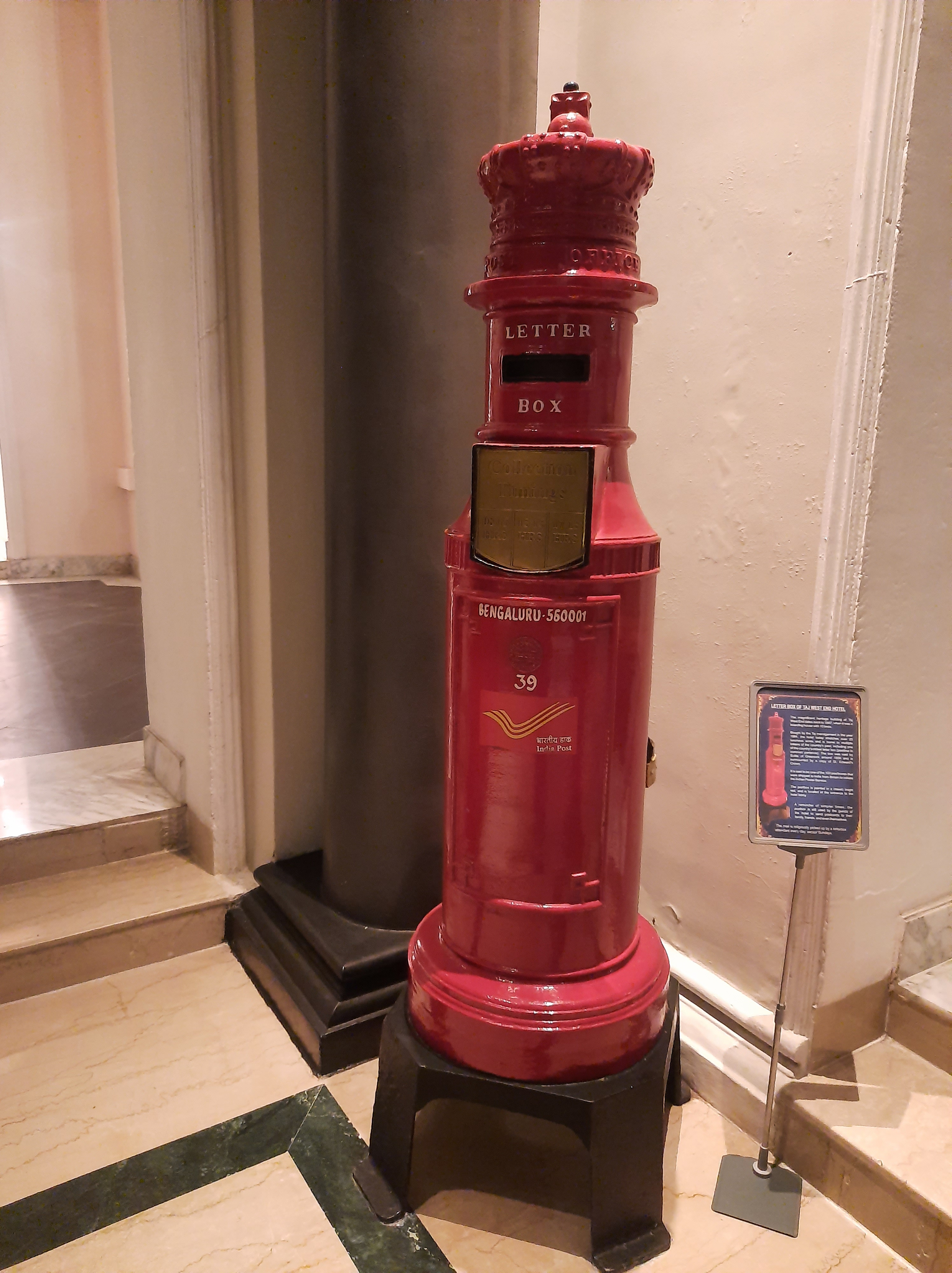
India’s oldest functional post box at Taj Westend, Bangalore. Still cleared everyday except Sundays and holidays!

For many people today, posts and post offices don’t seem very relevant. I visit the post office more for investing money in some of schemes offered by them—they are safe and offer a decent interest rate. I haven’t posted a letter in decades, and in fact am suspicious of the few post boxes I see—are they ever cleared, I wonder. I do receive magazines and bulk posts, which are obviously not posted but given in at the post office. The one service I do occasionally use is the Speed Post service—takes about as long as non-premium couriers, and costs a lot less (to the extent that some courier companies use speed-post services to get their packages over the long distance, while they just do the collection and final delivery!).

But the postal service is obviously still very important in our country, going by the numbers. Even today, we have over 1, 55,000 post offices, and Inda’s Dept. of Posts has the most widely distributed postal network in the world. Close to 13.5 crore registered posts and over 30 crore speed posts have traversed the country during the year.

But the non-postal services of the post offices seems even more significant. They act as Aadhar updation centres, as Passport Seva kendras, as a means of paying utility bills and for distribution of direct benefit transfers. Apart of course from the various savings schemes and banking activities.

Yeoman service indeed.

But that is not to say that there is not tremendous scope for improvement, which is obvious even to the layest of lay-people. For instance, I subscribe for a weekly magazine, but I am lucky if I get 3 of 4 issues in any given month. And even then, the deliveries are bunched up—the postman may deliver 2 or 3 together because he can’t be bothered to come every week. So obviously some lacuna in monitoring systems.

And often I end up opting for couriers rather than speed-post for various reasons. The courier will come to my doorstep to pick up the package. And then there are the other flexibilities—speed posts will be accepted and delivered during working hours, on working days. But my packages get ready at the 12th hour, and the post offices shut by then. And so couriers are the only way to go.

And a visit to the post office is an activity for which you need to set aside at least a couple of hours.  Forms for any of the schemes are to be filled manually, and take 10-15 minutes to fill. Nor are they very clear, which means they often have to be re-done. The IPPB app is confusing and takes getting used to. The password expires ever so often and constantly needs to be reset. (That being said, I sincerely appreciate the patience of the postal staff in dealing with the dozens of people and scores of questions. )

India’s postal services definitely need to be re-imagined for tomorrow. We are the technology capital of the world, but it does not seem that adequate thought has gone into using technology in this sector.

But the amazing network created into the remotest parts of the country has the potential for providing the backbone for citizen services that can touch everyone, especially those in under-served areas.

So with three cheers for India Post!

–Meena

With Gratitude for Every Morsel of Food…

The recurrent theme in the last few days has been FOOD.

First, the passing away of Dr. MS Swaminathan, the father of India’s Green Revolution at the age of 98. Today, we have forgotten the first few decades after Independence, when hunger was a reality for many in our country. At Independence, hardly 15 percent of agriculture was under irrigation. The food grain production was 50.8 million tonnes. Agricultural methods, tools and equipment, were centuries if not millennia old, and were grossly insufficient to feed the country’s growing population. On top of that, the vagaries of nature, which saw floods and droughts disrupting cultivation. Food insecurity and shortages were common, and two severe droughts 1964–65 and 1965–66 led to major food shortages and famines. We were dependent on food imports to feed our people, and many people doubted the survival of us as a nation, when we could not even fulfil this basic need.

It is this dismal scenario that pushed people to look for solutions that would make us food secure and food sufficient. And the hero of the hour was Dr. MS Swaminathan. Swaminathan, a student of zoology, who was a witness to the tragedy of the Bengal Famine of 1943 and frequent food shortages, decided to devote his life to improving this situation. And that is what he went on to do just this. He joined the Indian Agricultural Research Institute soon after Independence, and from there went on to do research and post-doctoral work in the subject. At IARI, he learnt about the work of Dr. Norman Borlaug in Mexico, where he had developed a dwarf variety of wheat which yielded more grain, and at the same time had stalks strong enough to hold the weight of the grains. Dr MS saw this as a beacon of hope and worked with Dr. Borlaug to develop improved crop varieties suitable for India. He also worked on fertilizers suitable for our conditions, as well as more efficient farming techniques. This laid the foundation for our Green Revolution, and paved the way for India not only to becoming self-sufficient in food, but becoming a grain basket for the world. Today, our food grain production is estimated at a record 330.5 million tonnes (MT).

The Green Revolution though the saviour, was however not without its flip-side. It needed increased amounts of chemical pesticides and fertilizers thus reducing the soil fertility and quality in the medium term; these crops needed more water; and it led to monocultures based on specific crops and varieties, leading to erosion of agri-biodiversity. Dr. Swaminathan recognized these issues, and for many years led the movement for what he termed ‘the Evergreen Revolution’ which focussed on more environmentally sustainable ways of increasing productivity of the land.

As a part of Centre for Environment Education, we were fortunate to have opportunities to meet and interact with this giant. He came to our campus maybe a few times a year, as Chairman of our sister-institution VIKSAT, and also as guide and mentor to many of our projects and initiatives. I had the good luck to work under his guidance when CEE was putting together Government of India’s official submissions to the World Summit on Sustainable Development, and he was one of the advisors to the process.

And coming to the other food-related events:

Oct 2 marks the birthday of Gandhiji, who believed that farmers, farming and rural India had to be at the core of any development in India. He summed it up with his statement: “To forget how to dig the earth and tend the soil is to forget ourselves. “

It also marks the birth anniversary of Lal Bahadur Shastri, our second Prime Minister, who gave the nation the slogan ‘Jai Jawan, Jai Kisan’, seeing soldiers and farmers at the same level when it comes to ensuring the nation’s security.

And Sept 29 also marks the observance of UN’s International Day of Awareness of Food Loss and Waste. The goal of this day is to raise awareness on the importance of the problem and its possible solutions, and to promote global efforts and collective action towards meeting

And Sept 29 also marks the observance of UN’s International Day of Awareness of Food Loss and Waste. The goal of this day is to raise awareness on the importance of the problem and its possible solutions, and to promote global efforts and collective action towards meeting Sustainable Development Goal Target 12.3, which aims to halve per capita global food waste at the retail and consumer level by 2030, and reduce food losses along the food production and supply chains.

No more appropriate time to ponder on our relationship to food, those who produce it, and how we interact with it. And lets not forget: the prevalence of undernourishment–the share of people who lack regular access to sufficient calories– is increasing, with as many as 828 million people undernourished in 2021.

With gratitude to all the farmers and farm workers; the policy-makers who understand their importance and respect them for their contribution; those who work on the science of it; and those who cook it.

We owe every mouthful to you all. And may we never forget it.

–Meena

Cough, cough…

For the past few weeks, I was plagued by a cough. I am assured by sources that it is very good for me to cough—for instance, the Cleveland Clinic says ‘A cough is a natural reflex that is your body’s way of removing irritants from your upper (throat) and lower (lungs) airways. A cough helps your body heal and protect itself.’

I am yet to be convinced!

There are apparently many ways of classifying coughs.  One is related to how long they last. Acute coughs are those which start suddenly and last a few weeks. Sub-acute ones follow infections, and last for a month or two. Chronic coughs persist longer than 2 months. And Refractory coughs are chronic coughs which don’t respond to treatment.

Another way of classifying them is in terms of whether or not they produce mucous. Dry coughs are those which do not. Productive or wet coughs bring up phlegm or mucous.

Some coughs come on at night, and are called nocturnal or night-time coughs. Others are day-time coughs.

Some types of coughs produce distinctive sounds and indicate the underlying condition: e.g., the whooping cough where the cough sounds like a ‘whoop’ is a specific infection. A barking cough may be an indicator of croup. And when coughing is accompanied by wheezing, it may be associated with some infections or with asthma.

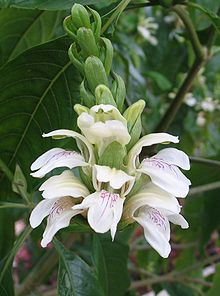
Vaska plant
Vasaka plant, native to the Indian subcontinent, forms a basis for many cough syrups

And what about treatments? Well, you can take a cough syrup, a lozenge or rub on something.

Of cough syrups also, there are different types: Suppressants or antitussives do their job by blocking your cough reflex. These are for dry coughs and that itch in the throat. Then there are Expectorants, which thin mucous and phlegm, making it easier for them to be coughed out.  There are also combination cough syrups which typically combine expectorants with decongestants and an antihistamine.

Rub-ons or topical applications include trusted household names like Amrutanjan.which has a nature-based cold relief balm. Such products usually have menthol and camphor, and applying them to the throat offers a soothing sensation in the area and relieves some of the associated pain. 

Cough drops are the tablets we keep in our mouth, which soothe our throats and give us relief from coughing. These are used to temporarily help relieve symptoms such as sore throat, throat irritation, or cough. They work by providing a cooling feeling and increasing saliva in the mouth. Home remedy equivalents are sucking on cloves or cardamoms.

There are research studies which show that actually, not many of these store-bought medications really work any better than home remedies. The good old haldi-doodh (now fashionably called Golden Latte) is a tried and tested way to soothe the throat. A kada or decoction of tulsi, black pepper, cloves and assorted spices is often effective. Ginger tea with lemon is a sure winner.

Gargling is also an effective way to manage coughs. A salt water gargle creates a sort of osmosis effect and the salt concentration draws fluids and bacteria from the mouth, Salt water gargles neutralize swelling, and pain, and help soothe the throat region. The salt water breaks up mucus and irritants in the throat. Gargling with a salt water mixture also helps neutralize the throat acids, which helps to suppress bacterial growth.

Steam inhalations help too–they help to soothe and open their nasal passages when they have a cold or sinus infection. The warm, moist air is thought to loosen mucus and relieve symptoms.

I hope you don’t have a cough. But if you do, you are probably in good company—in the US, it is apparently the top reason people see a doctor – over 30 million visits a year.

–Meena

Celebrating Vishwakarma, Master-Craftsman

Vishwakarma Jayanthi is marked every year on Kanya Sankaranthi, which falls this year on September 17th. As per legend, Vishwakarma was a master architect and craftsman. The son of Brahma, he is supposed to have been the engineer for the creation of the world. He is also said to have built Lanka, Hastinapur and Dwarka.

Vishwakarma plays a pivotal role in the two great epics, Mahabharat and Ramayana. In the Mahabharat, the Pandavas retained him to plan and build their new capital of Indraprastha, which evoked the wonder and envy of all the other kings. One of the triggers for the Mahabharat war however was this amazing architecture. The pools of water looked like floors, and floors looked like water-bodies. Duryodhana mistaking a pool for a floor, slipped ignominiously and fell, evoking the mirth of the onlookers. He took particular exception to Draupadi’s laughing and commenting at his plight, and this was almost the last straw contributing to the breakdown of relations between the Pandavas and the Kauravas.

Vishwakarma’s work also features as a turning point in the other epic Ramayana. He is said to have built Pushpaka Vimana the flying chariot. It was built originally for Brahma, who at some stage gifted it to Kubera, the God of Wealth. But Ravana, Kubera’s half brother, stole the flying chariot, and used it for the infamous abduction of Sita. The Vimana however was also part of happy times, ferrying Ram and Sita back to India after the victory over Ravana. Ram later returned the vehicle to Kubera.

Vishwakarma has his equivalents in Greek and Roman mythology. The god Hephaestus was blacksmith to the Gods of Olympus, and made all their weapons of the gods in Olympus. He used to be worshipped in the manufacturing and industrial centres of Greece. Vulcan was the Roman God of fire and forge as well as fire and volcanoes. He was the patron of artisans and smiths, and there were several shrines dedicated to him. Vishwakarma like his peers also designed weapons, including Krisha’s Sudharshan Chakra and Indra’s Vajra.

We in India continue to remember and commemorate Vishwakarma. Vishwakarma Jayanthi is a special day for engineers, architects, mechanics, craftsmen, welders etc., and it is marked with pujas in factories and industrial estates. The prayers are for increased mastery and success in their field, as well as for safety.

As an ancient culture, excellence in engineering and the crafts were so revered that not only was there a God for this, but his achievements were enumerated and remembered. We still remember him and worship him. But ironically, we don’t seem to value the excellence he stands for. Our towns and cities are unplanned chaos—surely not Indraprastha or Hastinpur were.

In India, barely one in five persons at the workplace is skilled. We stand at 129 out of 162 countries ranked. As someone who has been involved in skill training, I am aware of some of the challenges in this sector. Critical among these are that skills except those related to IT and computers are not aspirational. To get a young person excited about being a master-electrician, master-plumber, master-anything that needs working with hands is next to impossible. In our culture, manual skills are not valued and respected—plumbers and masons feature way down in the social hierarchy. Nor are they paid in accordance to the value they bring. And sadly, career pathways don’t lead them very far.  

Nor is the skill-training we provide of very high quality, such as will lead them to excellence in their vocations. Most skill training is outdated and out of sync with what industry needs. Our ITI and other skilling institutions are bureaucratic set-ups, far behind where they should be. The faculty has no real experience on the shop floor. Nor do most students ever go into a factory or workplace during their education.

For a country which marks Vishwakarma Jayanthi with widespread events, we don’t seem to really value skills or our skilled craftspeople. Until that changes, there does not seem much point in observing yet another day.

–Meena

Be a Sport

Last week on 29th August, we marked National Sports Day in India. August 29 is the birth anniversary of the legendary hockey player Major Dhyan Chand, and there could be no more fitting day than this to mark our commitment to sports.

sports

I know little about sports. Just enough to wish that we could do a little better on the world scene; just enough to wish young people across the country could access good sports facilities and meet their potential; just enough to wish that there was not so much bureaucracy, bias and barriers in sports.

On the occasion, I thought I would look at where we stood viz a viz other countries in sports. The Olympic tally and other such statistics are of course known to all. But during my exploration I found very interesting statistics on a site* which evaluated countries on their ‘sportiness’. That looked interesting, so I got to exploring it. I would not have thought I would find India anywhere in the top-half of the table. To my amazement, I found we ranked 16th out of 134 countries, with a total score of 48.66/100, compared to top-ranking Germany’s 72.4%.

While the initial reaction was to celebrate, somehow it didn’t sound quite right. So I looked a little more closely at the data behind the ranking. The methodology considers 10 parameters to arrive at the results. These are:

  • Olympic medals
  • Winter Olympic medals
  • Elite sports ranking
  • Sports participation rate
  • Gym membership per 100k population
  • Health and fitness mentioned as hobby
  • Playing sport mentioned as a hobby
  • Watching sports mentioned as a hobby
  • Fitness apps
  • Fitness spends

I can pick a lot of holes in the methodology. The foremost is the choice of parameters which explains why India could be ranked so high–you will understand what I mean when we break down our standings in each parameter:

We stand 48th place in Olympics medals.

We have won no medals in the Winter Olympics. (Of course we can question this as a criterion, given that hotter countries do not have the same opportunities as colder ones in these sports).

We rank 37th in elite sports ranking.

Our sports participation rate is a dismal 13%, among the lowest of all the countries in the study.

Our gym memberships also rank among the lowest in the table. (Again, it may not be a fair measure given the lower incomes in developing countries and hence lesser ability to spend on this.)

How then when we score so low on these parameters, do we rank a high 17th?

The factors that follow will explain the anomaly:

A whopping 43% per cent cite health and fitness as their hobby, way higher than the sportiest nation Germany. Only Sweden, Austria and South Africa rank higher than us. Well, one can claim anything. And these are just what people say in a survey, without any proof of what they do in this regard.

Intriguingly, 35% say that they play sports as a hobby, just 2 per cent lower than top-ranking Germany. Now, from my lived experience, I would never suspect that there were so many people in our country who played for a hobby. Given the statistics on sports participation, as well as lack of sports facilities, who and where are all these people who claim to be playing? Did the survey reach out to rural areas, or was it confined to a few cities? What age groups did it consider?

The parameter of how many people watch sports as a hobby is much more believable—we stand among the top 3 or 4 in the table with a whopping 48 per cent of Indians being serious sports-watchers. This is one of the major factors which tilts the results in our favour.

So in sports as in many other facets, we are ‘watchers’ rather than ‘doers’. Yes, if we were to go by TRPs of cricket match telecasts, sure India should count as a seriously sporty nation. But when it comes to taking sports seriously, or even to making health, fitness, sports and games a part of our culture and lifestyles, there is such a distance to walk.

So a good time to think about what it would take to really make us a sporting nation.

And also a lesson to closely look behind rankings and gradings before jumping to conclusions!

–Meena

PS: Confession: I don’t play sports at all. But I do walk and cycle regularly. Forgive me, I am a product of my generation.

*(https://us.myprotein.com/thezone/motivation/which-are-the-worlds-sportiest-countries/)

The Best Kind of Nut is a Coconut

When there are myths and stories about the origins of an animal, tree, bird or anything in nature, we can be sure that the particular thing has played a huge part in human lives and society down the ages. The coconut is one such. There are stories from across the world about the origins of the coconut. Even in India, there are at least 4-5 popular stories about this. Not to mention stories from West Africa, China, Malaysia, etc.

Coconuts are an integral part of our lives in India—from the morning chutney for the idli, to the oil we swear by for hair growth, the refreshing and safe drink we give convalescents, to the coir mattresses we sleep on—they touch our lives in so many ways. Coconuts are a must for a visit to a temple, for a housewarming, a puja, or to launch a new vehicle.  

Coconut Day

I didn’t know till recently that there was a World Coconut Day, marked on Sept 2nd every year. Nor did I know that there was something as grand and formal as The International Coconut Community (ICC), an intergovernmental organization of coconut producing countries organized in 1969 under the aegis of the United Nations Economic and Social Commission for Asia and the Pacific (UN-ESCAP). Their mission is to ‘To promote, coordinate and harmonize all activities of the coconut industry which sustains the lives of millions of small farmers.as well as those engaged in production, processing and marketing of coconut products.’ The ICC Secretariat is located in Jakarta, Indonesia and is headed by an Executive Director. The ICC has 20 member-countries from Asia, the Pacific, Africa, South America and the Caribbean’s. India is of course one of them.

World Coconut Day commemorates the foundation of Asian and Pacific Coconut Community (APCC), an intergovernmental organization of coconut producing countries.

The coconut certainly deserves all this. It is a tree which provides food, fuel, medicine, cosmetics, building materials, and much more. In the South Seas, there is a saying that ‘he who plants a coconut tree plants food and drink, vessels and clothing, a heat source, habitation for himself, and a heritage for his children’. Importantly, it forms part of the livelihood basket of lakhs of small landholders—98 per cent of coconut holdings are with small and marginal farmers.

India is among the largest producers of coconuts in the world with Tamil Nadu, Kerala, Karnataka and Andhra Pradesh being the major contributors. We produce over 19 million nuts a year, accounting for over 31 per cent of the world’s production. We also account for 66 per cent of the world’s exports, and send our coconuts to over 140 countries.

There is also R&D going on into development of a range of new coconut-based medical products. In the world of healthcare, a number of products from sterilizing agents to fungicides to anti-itch products are being developed. The fashion industry too has taken to developing new products based on coconuts. There is also considerable research in the direction of developing several food-related products like coconut skimmed milk, coconut milk powder, coconut cream, coconut vinegar, coconut jaggery and palm sugar, and we may expect to see many such new products hitting the market soon. There is also on-going effort to make coconut shell charcoal and activated carbon.

So let’s join in the celebration of the ubiquitous coconut that we take so much for granted. Drink tender coconut-water, eat a coconut burfi, make a curry with a coconut gravy, or throw a coconut themed party. Just a way to say thank you to a tree that gives us so much—health, beauty, taste, shelter, sound sleep, and importantly, livelihoods to so many!

–Meena