Valentine’s-Galantine’s

Media are frantically trying to sell us everything from roses to chocolates to romantic dinner. ‘Tis the season—the Valentine season. The origins of Valentine’s Day as a day to celebrate romantic love go back a long time.  But the commercialization is a phenomenon of the last century.

Fortunately, at least in India, the sellers have not fully caught on that it is actually Valentine’s Week celebrated from 7 February to 14 February, with the seven days including  Rose Day, Propose Day, Chocolate Day, Teddy Day, Promise Day, Hug Day, Kiss Day, and finally, Valentine’s Day.

The origins of Valentine’s Day may lay in the Roman festival of Lupercalia which used to fall around the same time–essentially a spring festival which included fertility rites. A 5th century pope banned the celebration of Lupercalia, but it came back with renewed vigour in the 14th century and has been celebrated since then.

There have been many St. Valentines down history, and it is not quite clear after whom the festival is named. From a priest who was martyred about 270 CE by the emperor Claudius? According to legend, this priest who was incarcerated by the Romans, was friendly with his jailer’s young daughter, whose blindness he is said to have cured, and subsequently wrote her a letter which he signed off with “from your Valentine”. Or was it St. Valentine of Terni? Or a St. Valentine who defied the emperor’s orders and secretly married couples to spare the husbands from war?

At any rate, the festival is now celebrated world-wide on the 14th of Feb as a day of love.
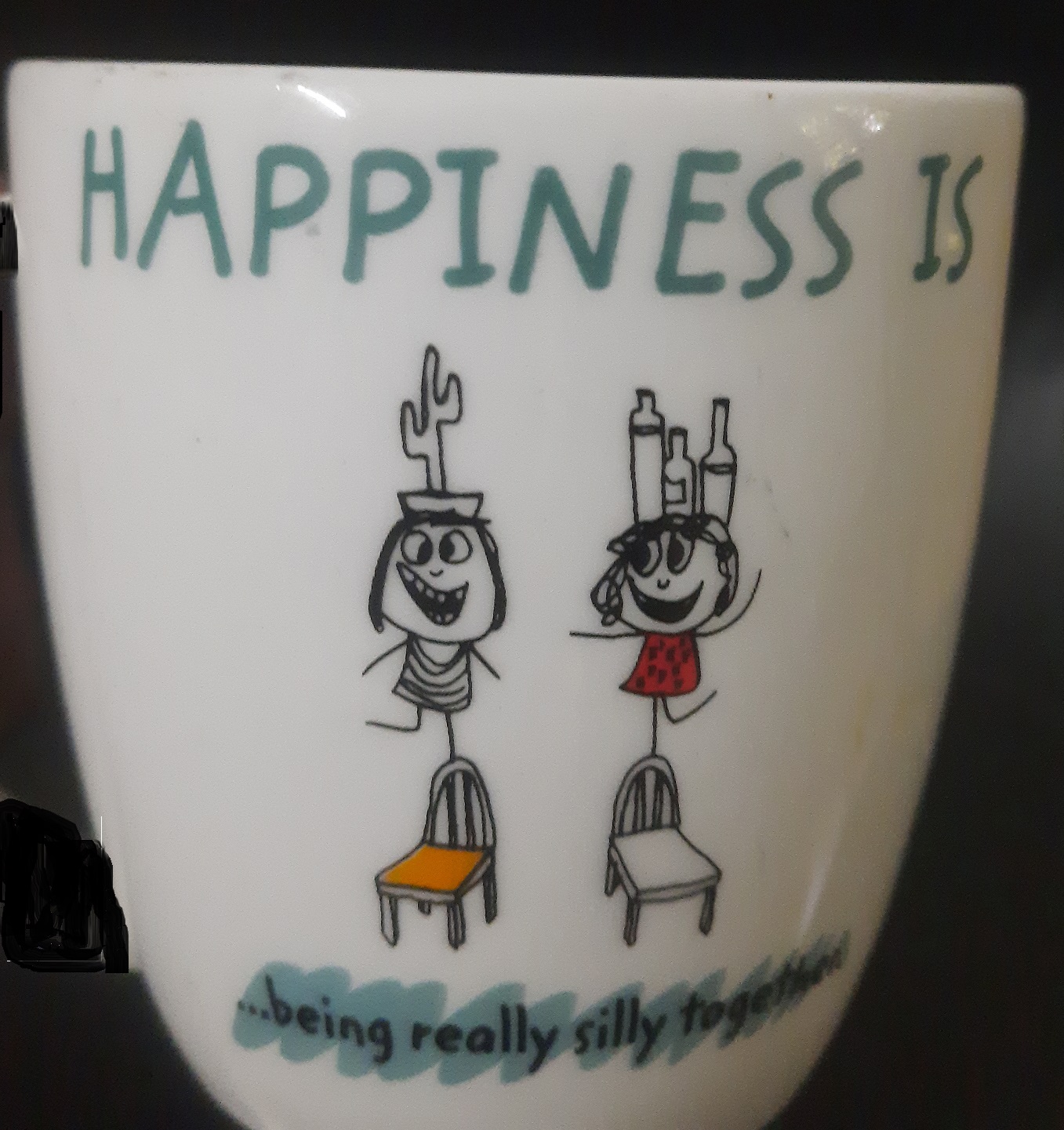
But another day which is of fairly recent origin, and celebrated on 13th Feb is Galantine’s Day. It is like Valentine’s Day, but for girl-pals! It celebrates the bonds between best friends, sisters, moms, grandmoms….

The origins of this one are quite clear—it all started with the comedy show ‘Parks and Recreation’. Leslie Knope, played by Amy Poehler used the term in the second season of the show in 2010. She kind of makes up this day and says ‘What is Galentine’s Day? Oh, it’s only the best day of the year. Every February 13th, my lady friends and I leave our husbands and our boyfriends at home, and we just come and kick it… ladies celebrating ladies.”

Guys of course don’t need to feel left out. After all, the term ‘bromance’ is much better known than Galentine’s Day. It was coined sometime in the 1990s, by Dave Carnie, the editor of the skateboard magazines Big Brother, in reference to the close bond that develops between skaters who spend a lot of time together.

Bromance is a portmanteau word, made up of bro (or brother) and romance  A bromance is officially defined as ‘a very close and non-sexual relationship between two or more men’. It is distinguished from normal friendship by a particularly high level of emotional intimacy.

Here is to Galentine’s Day! May we celebrate it in the true spirit of friendship and bonding, and not let it go the commercial way of Valentine’s Day.

With a shout out to all my girl-pals!

–Meena

PS: www.millennialmatriarchs is a Galentine initiative!
On A Musical Note: Of Earworms and Mondegreens

Who hasn’t, at some time or the other, had a song or piece of music stuck in their heads, which just won’t go away! You get up in the morning, and suddenly you find yourself humming a tune. It follows you around the house, to the office, on the drive back home. It serenades you inside your head through dinner. And sometimes it is still there when you wake up in the morning!

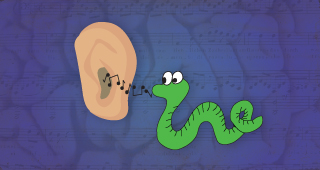
This is what is called an earworm. Extremely irritating, but nothing to worry about. It happens to most of us at some time in life. A recent study of American college students found that 97% had experienced an earworm in the past month. Other studies have found similar results.

And don’t worry how long an earworm troubles you. Though the typical length is 10 to 30 minutes, research shows that for about 20% folks, the earworm lasts an hour or more. And some unlucky folks have been stuck with one for a year or even longer!

The term earworm comes from the German “ohrwurm,” which  is defined as a “cognitive itch” or “the inability to dislodge a song and prevent it from repeating itself in one’s head”. Several terms have been coined for this, including stuck song syndrome, sticky music, musical imagery repetition, intrusive musical imagery etc. The semi-official term is ‘involuntary musical imagery’, or INMI.

It has been a serious area of study since 1885, and scientists hope to get insights into the functioning of the brain. Several major universities have been undertaking studies into the phenomenon.

Sufferers try various ways to get rid of an earworm– by thinking of another song, singing the earworm song all the way through to its end, or taking up other tasks that require focussed concentration. But trying to get rid of an earworm may be counter-productive. One study has found that the harder people fight to quiet an earworm, the longer it tends to harass them!

Something that is not irritating to you, but may be to others if you sing, is a mondegreen. A mondegreen is a word or phrase in a song or poem that you get wrong–the result of mishearing something recited or sung. Incorrectly heard lyrics are called mondegreens.

The origin of the word itself is from an instance of such mishearing. In a column by journalist Sylvia Wright in the 1950s, she wrote about a Scottish folksong The Bonny Earl of Morray that she had listened to. Wright misheard the lyric “Oh, they have slain the Earl o’ Morray and laid him on the green” as “Oh, they have slain the Earl o’ Morray and Lady Mondegreen.” And ever since, such mishearings have been referred to as mondegreens!

The scientific explanation goes as follows: Hearing is a two-step process. First sound waves make their way through the ear and into the auditory cortex of the brain. On receiving the signal, the brain tries to make sense of the noise.  Mondegreens occur when, somewhere between the sound and the sense-making, communication breaks down. You hear the same sound as another person, but your brain doesn’t interpret it the same way.

Sometimes we may just mishear something because it is noisy, the phone signal is weak, or there are other extraneous factors. Or it may be because the speaker is speaking in an unfamiliar accent or is mumbling.  So the sound becomes ambiguous and our brain tries its best to resolve the ambiguity—and gets it wrong.

Another common cause of mondegreens is the oronym–word strings in which the sounds can be logically divided in different ways. This is similar to what we call sandhi vichhed in Sanskrit—the process of analysing and separating compound words into their component parts. Oronyms result in a wrong parsing of sounds when context or prior knowledge is missing.

Yet another reason could be letters and letter combinations which sound alike, and without a context, we can go wrong, and one sound can be mistaken for the other. An example often given to illustrate this is, :“There’s a bathroom on the right” being heard as “there’s a bad moon on the rise”.

When we hear a sound, a number of related words are activated all at once in our heads. These words could be those that sound the same, or have component parts that are the same. Our brain then chooses the one that makes the most sense. In this choosing, we are more likely to select a word or phrase that we’re more familiar with. An oft cited example is that if you’re a member of a boat crew, you’re far more likely to select “row” instead of “roe” from an ambiguous sentence. If you’re a chef, the opposite is likely.

Some mondegreens become the word!  For instance, the word orange was such a widespread mispronunciation of “a naranj” (from Persian and Sanskrit), that it became the official name of the fruit! One can think of any number of place-names which the English mangled, for instance!

Bollywood songs of course have their share of mondegreens. Though not systematically documented, some common ones identified include:

From the song Hawa Hawai (Mr. India):Bijli girane mai hoon aayi’ being heard as ‘Bijli ki rani mai hoon aayi’; and from the song Banno (Tanu weds Mannu) ‘Banno tera swagger laage sexy’ being heard as ‘Banno tera sweater laage sexy’.

Raghu has these examples from his childhood (which he attributes to the poor sound quality of radio transmissions of those times):

Hearing ‘Yeh manzar dekh kar jaana’ (from the film Around the World) as ‘Yeh mandir dekh ke kar jaana’ (could be a jingle for a recent event!); and ‘Ahsan tera hoga mujh par’ (from the film Junglee)  as ‘Ahsan tera ho gaa mujh par’!

The only request: If you have a mondegreen, don’t sing the song aloud. You may give someone a more than usually horrible earworm!

–Meena


Oh Sh*t!

The last few weeks have been peppered with cleaning cat-poop of the lawn. A particular cat has taken to using our garden as its favoured toilet. Now we are spraying the lawn with a suspension of coffee grounds and haven’t had an episode in the last few days. Fingers crossed.

But the whole trauma got me thinking about poop in general.

And I realized how many words there were for this. In fact, the number of synonyms for faeces is proof of human fascination for the subject.

There is wide variety of terms for poop, and though some of them are interchangeable, there are also very specific ones– for certain types of animals or species or used in certain circumstances. Here are some of them so our vocabulary in this area can go beyond shit and crap!

Faeces is the most generic term, and the word comes from the Latin word faex, meaning “dregs”. Excrement, Excreta and Stool are also fairly generic and mean the solid wast released solid waste from the bowels of a person or animal. bowels of a person or animal Ordure too is similar—the solid waste solid from the bowels of people or animals.  

Here is a look at a few other terms:

Droppings: Faeces of animals.

Dung: Solid waste from animals, especially cattle and horses

Scat: Animal faeces, particularly of wild carnivores

Spraint:  This is the dung of otters.

Fras: These are the droppings/faeces of insect larvae

Manure: Manure is organic matter that is used as fertilizer in agriculture. Most manure consists of animal faeces but may also include compost and green.

Guano: This is accumulated excrement and remains of birds, bats, and seals, valued as fertilizer. 

Worm casts: These are the excrement of worms. Earthworm casts are prized as fertilizer.

Fecal Pellets: An organic excrement, mainly of invertebrates.

Fewmets: In hunting terminology, these are the droppings of deer and other quarry animals by which a hunter identifies his targets. Another term used in hunting is Spoor which can indicate a track, a trail, a scent, or droppings especially of a wild animal

Fewments: For science fiction fans, this is the term for dragon droppings!

Coprolite: Fossilised faeces of animals that lived millions of years ago.

Paleofaeces: Ancient faeces, often found as part of archaeological excavations or surveys.

Rabbits, hares and related species produce two types of fecal pellets: hard ones, which are the real poop; and soft ones or cecotropes, which are partially digested food which they eject, and eat again!

In medicine and biology, scatology or coprology is the study of faeces.

poop
Looking forward to reading this fascinating picture book for adults!

The study of such excrement is of course of use to doctors in the diagnosis of various medical conditions. It is also of great importance in obtaining an understanding of wildlife behavior, and the environment as a whole. Scat analysis can yield useful information on animal populations and their distribution across a habitat, how many males and females there are, what they are eating, their health condition and from all these, information on the health of the habitat itself can be deduced. Scat analysis is sometimes faster, easier and cheaper than many other means of studying animal populations, and it is possible to get a lot of information about animals non-invasively.  It is also possible to extract DNA from poop and this has helped identify species characteristics.

So it’s not just 4-year olds who have a fascination for this subject. Many adults make it their life’s work, and their chosen tool in getting to know more about the world!

–Meena

Sun, Giver of Light and Life

Makar Sankaranthi is linked to the solar calendar, and marks the beginning of the annual  transit of the Sun from the Southern Hemisphere to the Northern Hemisphere. Sankaranthi is also called ‘Uttarayan’—deriving from ‘uttar’—North, and ‘aayan’—movement.  The Sun moves from the Tropic of Cancer to the Tropic of Capricorn that day.

Makar Sankaranthi is celebrated across the country, but in different ways. In Tamilnadu, it is a harvest festival, and three days of Pongal celebrations mark worship of the sun, the rain and cattle—all fundamental to agricultural economies. It is a wonderful occasion to remind ourselves of how much we owe Nature, and that without the energy of the Sun, we can do nothing. ‘Pongal’ itself means overflowing, and the pot with rice, jaggery and milk is allowed to overflow to calls of ‘pongal-o-pongal’—welcoming abundance in the coming year.

The fundamental importance of the Sun has been recognized by many ancient cultures, and in many of them, kings ruled by the power of the sun and claimed descent from the sun.

In ancient Egypt, the sun god Re was dominant among the higher gods. The sun was not one entity– he sets out on his journey in the East as the young god Kheper; he appears at noon in the zenith as the full-grown sun, Re; and by the evening, when he is in the West he is in the shape of the old sun god, Atum.  When the Pharaoh Akhnaton (husband of the famed Queen Nefertiti) reformed Egyptian religion somewhere around 1350 BC, he took Sun worship to the next level by making it the official religion and the sun’s qualities as creator and nourisher of the Earth and its inhabitants were worshipped.

As far as Roman history is concerned, sun worship became fairly important in the later period.

Both Sumerian and Akkadian religions put sun worship at the centre of their belief system, and in Iran, sun festivals were celebrated as a heritage from pre-Islamic times.

In North America, the Plains Indians followed a solar cult with the Sun Dance as an important ritual. In South America, especially Mexico and Peru, sun worship was widely prevalent.  The ruler of Peru was believed to an incarnation of the sun god, Inti. The Aztecs worshipped Huitzilopochtli, the Sun God who was one of their most powerful and most revered gods. In fact, Aztec people considered themselves to be ‘the people of the sun’.

The sun goddess Amaterasu  played an important role in ancient Japanese mythology and was considered to be the supreme ruler of the world and the guiding deity for the imperial rulers. 

Sankaranthi
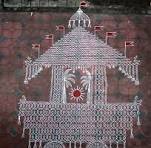
Sun Chariot Kolam

In many of these ancient traditions, the Sun God rides in a chariot drawn by horses. In Hindu mythology too, he rides chariot drawn by seven horses—which are said to stand for the seven colours of visible light or the seven days of the week. There are different versions of the names of the seven horses. In some traditions, they are named after the seven meters of Sanskrit poetry: Gayatri, Brihati, Ushnih, Jagati, Trishtubha, Anushtubha and Pankti. In others, they are called Jaya, Vijaya, Ajaya, Jitapraṇa, Jitasrama, Manojava and Jitakrodha , which are different phases of light transmission through the length of the day.

The most traditional rangoli or kolam made in Tamilnadu for Pongal is the Ratham or Sun’s chariot. While there are 5×5 dot ratham kolams for amateurs, these designs can become incredibly complex and set off a competitive spirit across streets!

So let us rejoice in the spirit of Sankaranthi, and pray for abundance, peace and prosperity in the coming year!

–Meena

PS: The beautiful kolam is from the Net. I can claim no credit!

Kuldhara: Ghosts of the Past, Vandals of the Present

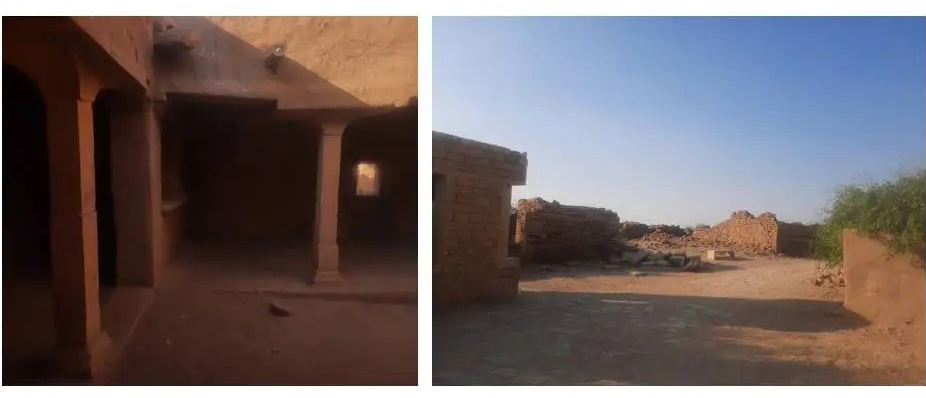
Kuldhara is on the tourist map of Jaisalmer district. On the way to Sam where the desert starts, is this ‘ghost town’ abandoned by its inhabitants about 200 years ago. The history of the town goes back to the 13th century when it was first settled by Paliwals, people from Pali district. Over the centuries, it grew into a prosperous place, with about 400 houses and over 1500 inhabitants at the peak. It had a pond, Udhansar, excavated by one of the first inhabitants, and at least one temple dedicated to Vishnu, as well as several wells and a step-well. It is actually a planned city, with proper layouts and a place for everything.

Till it was suddenly abandoned. It is not clear why the inhabitants left, but many reasons are given. Was it dwindling water supplies? Was it an earthquake? Or, more dramatically, was it the unwanted pursuit of one of the beautiful girls of the town by a local minister?

Well, whatever the reason or combination of them, it is a fact that people started leaving the place, probably not fleeing overnight as the tourist guides will tell you, but probably in trickles.

The mud-brick houses, temple and various other structures still stand in fairly good condition. Local legend of course goes that the township is haunted, and visitors are assured it is a dangerous place at night! The legend also says that the Paliwals while leaving the place, placed a curse on it, saying that anyone who tried to occupy it would meet dire consequences. All this led to its attracting tourists.

Kuldhara

The Rajasthan government decided to develop this as a tourist site around 2015. This is definitely a strategic move, given that it is just 18 kms away from Jaisalmer, and makes for a comfortable half-day trip, and it had already gained notoriety for its ghosts.

It is well-maintained by the Archeological Survey of India. There are of course guides. And importantly, fairly clean toilets. To this day, the neighbouring villages insist the gates be closed in the evening, so the Kuldhara ghosts don’t wander into their houses!

Of course, a lot more could be done—more signage, re-creation of a typical house, visualization of the town as it must have originally been, a more serious delve into the reasons for its abandonment, etc.

All of this will hopefully be done by the authorities in due course.

But an extremely disturbing incident that happened last week brings to fore the need for us as citizens and tourists to be more responsible. Newspapers report on a video that went viral. The video shows two tourists holding hands and kicking down the ancient brick wall of one the houses in Kuldhara. They were apparently doing this for putting up the video on social media.

The police are waiting for a formal complaint to be filed before taking action. Hopefully, this will be done fairly soon and action will be taken. The penalty for those who deface structures of national and historical importance has fortunately been enhanced in 2010 vide an amendment to the Ancient Monuments and Archaeological Sites and Remains Act. Now, such vandals will have to face imprisonment up to 2 years and/or a fine of up to Rs. 1 lakh.

Sadly, very few cases actually come to the stage where the punishment is given. Often, even the FIR is not registered—though in this case, the police seem to be ready to do this.

Kuldhara is just the latest example—from tourists knocking down pillars at Hampi to graffiti in Golconda, we have a long sad story of vandalism at cultural heritage sites.  If our monuments are to have a chance, punishment in these cases needs to swift, exemplary and well-publicized. Maybe there needs to be a sign outside the monument as to how someone tried to vandalize and what punishment they got!

And of course our educational institutions need to instill respect for our cultural and natural heritage, and strongly din home the need to take the greatest care of them.

The responsibility rests with each and every one of us.

­­–Meena

Ring in the New!

Welcoming the new year with the ringing of bells is an old tradition, immortalized by the lines from the familiar lines by Alfred Lord Tennyson.

‘Ring out the old, ring in the new,

Ring, happy bells, across the snow;

The year is going, let him go;

Ring out the false, ring in the true.’

Down the ages and across the world, bells have played an important role—from summoning people to a gathering place, to a role in religious rituals, to announcing danger, to attracting attention. And importantly, to summon children to school, and provide them joyful reprieve at the end of classes! I am talking of course of traditional metal bells which are rung manually.  These traditional bells are ‘melodic percussive musical instruments usually made of metal (bronze, copper, or tin) but sometimes made of glass, wood, clay, or horn. When a bell is struck by a clapper (an interior object) or an exterior mallet or hammer, the bell, constructed of solid, resonant material, vibrates and produces a sonorous ringing sound’. Each bell is unique, depending on the material it is made of, how thick it is and its size and shape. Based on these factors, it resonates at certain harmonic frequencies and pitches. 

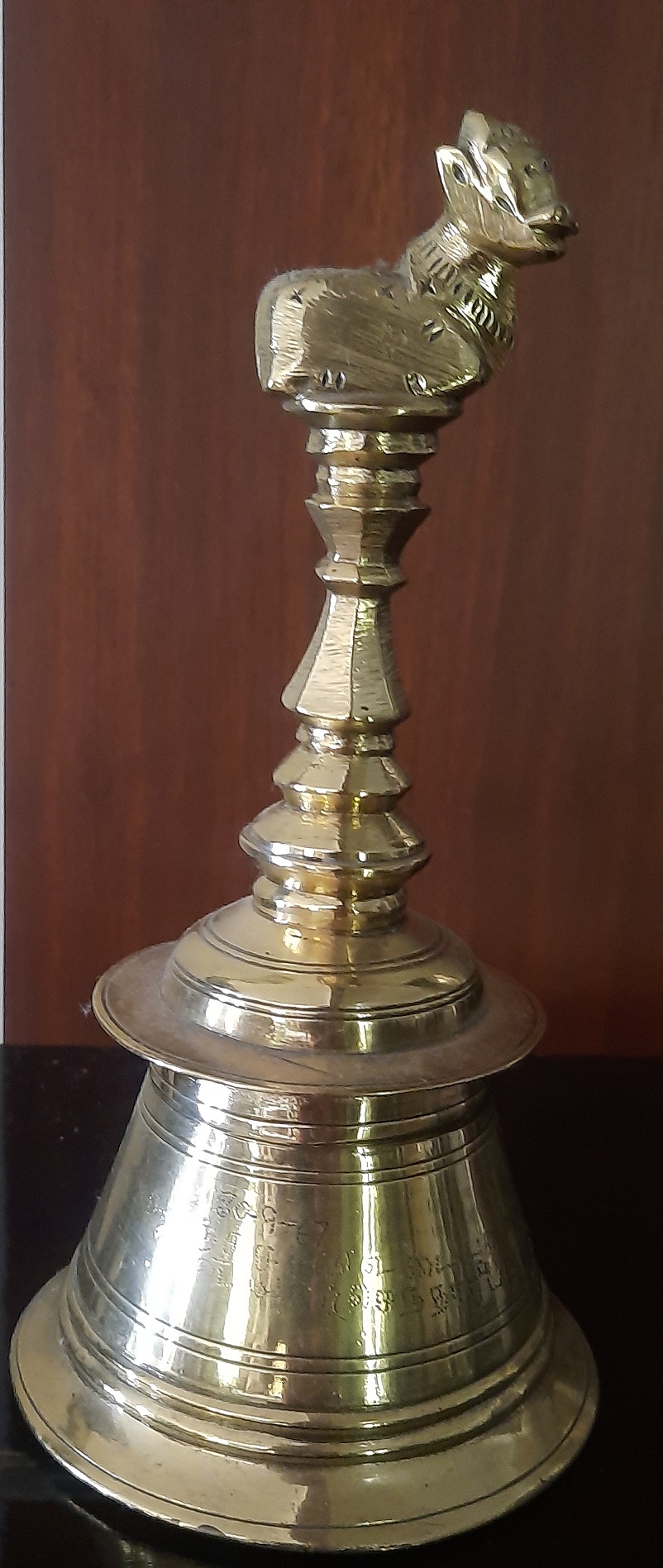
bell

A bell is usually suspended from a yoke– a cross piece that allows the bell to hang freely. The top of the bell is known as the crown and the middle portion is called the waist. The lower open section is known as the mouth, and the lower edge of the bell is called a lip. The part of the bell which is struck with a clapper is the thickest part of it, and is called the sound bow. Some bells are rung with clappers, a metal sphere that swings inside the bell Others are struck with a mallet or stick externally.

Gungroos represent a variation. Rather than being bell-shaped, they are orbs, with a few openings, which have small metal balls or even tiny stones enclosed within, which rattle and produce a tinkling sound.

With new technologies and means of communications, traditional bells and the traditional role of bells is diminishing. But interest in these bells and bell-ringing is alive. Many thousands of people around the world practice bell-ringing as hobby!

In fact, January 1 is observed as Bell Ringing in some countries. Many universities in the UK have bell-ringing clubs. When you join such a club, you first have to master the technique of pulling the rope attached to the clapper in a rhythmic way. Once you have mastered this, you can start “change ringing”–rhythmically ringing in a descending scale and then changing the order in which the bells ring in various different ways. Team bell-ringing is an activity which requires immense amount of coordination, and is a competitive event!

Bell Ringing Day not only sets out to encourage bell-ringers, but also to focus attention on the need to restore and maintain bells.

Our temples have beautiful bells which devotees ring as they go in. Most homes have small bells, and pujas are accompanied by the chiming of bells. Dancers wear ghungroos or rows of bells on their ankles. Cows are adorned with bells which chime as they move.

A cheery note to begin the year!

Happy New Year, and may the chiming of bells bring in good tidings!

Peace on earth, and goodwill to all.

–Meena

It’s Still Christmas!

We are somewhere in the first quarter of the Twelvetide—the 12 days following Christmas. In the old days, December 25 was only the beginning of Christmas which started on that day, and went on till January 6th, which was considered by some to be more important than Christmas day itself! The 12 days mark the journey of the Magi, the three wise men, who set out to see the Baby Jesus on seeing the star, and ends at the feast of Epiphany, on Jan 6th, when they actually met Him.

The Christmas song ‘The Twelve Days of Christmas’ has always intrigued me as I could never make head or tail of the strange array of gifts given on each day. And I am sure that many others are confused as well. But things started falling into place after I realized that each gift was symbolic of something in Christian belief or ritual, and is linked to Twelvetide. And what exactly are these gifts?

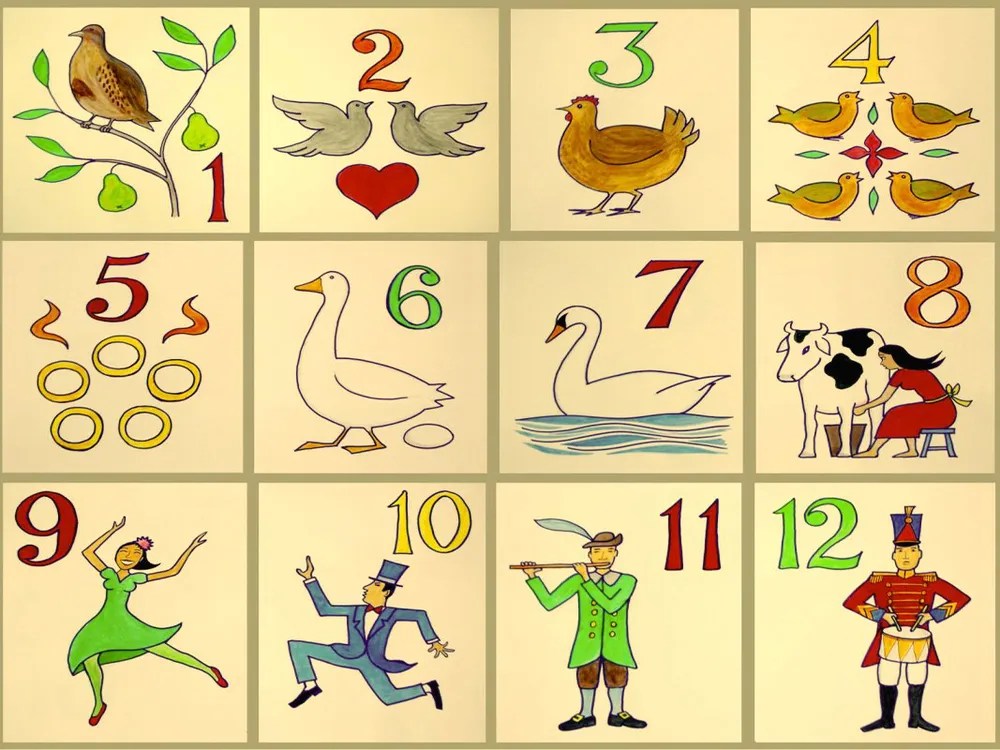
On the first day, someone’s true love gives her a partridge in a pear tree. Apparently, this symbolizes Jesus Christ himself.

12 days of Christmas

The second day brings a gift of 2 turtle doves—which stand for the Old and New Testaments.

The 3 French hens of Day 3 are the virtues of faith, hope and charity.

Particularly confusing are the gifts of the fourth day—viz, 4 calling birds. What on earth are calling birds? Well, opinion is divided. They could be blackbirds or starlings or crows! But the number 4 stands for the 4 gospels.

The 5 golden rings of the fifth day are a more conventional gift and stand of the five books of the Old Testament.

6 geese-a-laying symbolize the 6 days of creation, and this, in some weird way, seems to make some sense!

The day after that brings 7 swans-a-swimming. These stand for the seven sacraments recognized by the Catholic Church —Baptism, Eucharist, Confirmation, Reconciliation, Anointing of the sick, Marriage and Holy orders.

The intriguing 8 maids-a-milking symbolize the eight beatitudes or the sacred blessings which mark the opening of the Sermon on the Mount.

Continuing with pretty ladies, the next day brings 9 ladies dancing, which are the nine fruits of the Holy Spirit, namely love, joy, peace, forbearance, kindness, goodness, faithfulness, gentleness and self-control.

The nimbleness of the ladies is matched by 10 lords-a-leaping who come along on the tenth day. These symbolize the Ten Commandments.

The 11th day brings along accompaniments for the dancers and prancers in the shape of 11 pipers piping, who represent the 11 faithful apostles. I do feel the pipers could have come ahead of the ladies dancing.

And the last noisy day brings along 12 drummers drumming—symbolizing the 12 points of the apostle’s, i.e., the 12 points of faith that Christians believe in.

This carol was first published in 1780, but is believed to be much older.

Someone has gone to the trouble of calculating the cost of these gifts and has estimated the total for 2022 at a whopping $45,523.27. And this is when each gift is counted only once (i.e., assuming that the second day brings only the 2 turtle doves, and not another partridge in a pear tree).

Here is to the continuing spirit of Christmas—peace and joy to all our fellow-people!

–Meena

‘Tis the Season to Rejoice. And Make Santas!

With a 5-year old to entertain, I am always looking for suitable activities. And Christmas brings not only joy but a host of Santa crafts too. Like Ganesh, Santa lends himself to being rendered in paper, board, foil, plastacine, with balloons, with cotton wool….you name it. The ability to cut out circle-ish shapes is the main criterion for being able to undertake Santa-crafts. My house is currently filled with good, bad and indifferent renditions of Santa!

Santa

As a corollary, I was curious to learn about Santa sculptures. I did not recall seeing any statues of this beloved character. And they seem to be surprisingly few in number—or at least, they don’t seem to be well documented.

But there is one very well-known sculpture—famous in some eyes, infamous in others!

This is the piece by the American artist Paul McCarthy. Always controversial, McCarthy works in several media—performance, sculpture, painting, installation and ‘painting in action’. He is an analyst and commenter on mass media, consumerism, contemporary society and the hypocrisy, double standards and repression of American society. His objective is to showcase everyday activities and the mess they create.

In 2001, the city of Rotterdam commissioned McCarthy to create a Santa to be placed at the prominent Schouwburgplein square near De Doelen, the city’s orchestra building. He was paid 180,000 euros, a very reasonable amount for a large sculpture by such a prominent artist.

McCarthy delivered the bronze sculpture—and controversy started. Santa was supposedly holding a pine tree in his hand. But many saw the object in his hand as having sexual overtones, and the statue gained the nickname of Butt Plug Gnome.

There were protests by the people of Rotterdam who refused to allow the sculpture to be installed in Schouwburgplein. City officials then tried to install it in Rotterdam’s main shopping street, but this plan also met with resistance. It was four years before McCarthy’s sculpture was set up and unveiled in the city’s Museum Park. It stayed at that spot for three years. However, thanks to general discontent about its highly-visible location, it was moved to a less prominent location within the Museum Park itself.

It was only on November 28, 2008 that the sculpture, which was intended by the artist to critique the consumer culture that surrounds Christmas,  and  is supposed to depict the king of instant satisfaction, symbol of consumer enjoyment, found a permanent home in the Eendrachtsplein Square in Rotterdam.

Another well-known statue of Santa which again has a complicated story is in Turkey. The original Santa was St. Nicholas who was born in 270 AD, in Patara, a small town in Antalya province in modern-day Turkey. He accepted the Christian faith and became the bishop of the nearby town of Demre. The story goes that he used to be so upset by poverty and unhappiness that he used all his wealth to combat it. He dropped bags gold coins down chimneys and gave nuts and fruit to good children, and often helped to look after the sick and elderly—one can see the linkages with activities associated with present-day Santa. Various generations of Santa statues stood in Demre for many years.  But in 2008, the then-standing statue was removed during some construction work by city officials, and has not been replaced despite protests. Authorities say they will re-install the statue when they find an appropriate spot for it!

Nearer home, there are less controversial, though also less permanent Santas. India’s well-known sand artist Sudharshan Patnaik has made sand sculptures of the beloved figure for the holiday season over the last few years.  Last year he created a giant 1.5 tonnes , 60-feet wide sand-and-tomato Santa Claus on Gopalpur Beach. Before this, during Covid in December 2020, he created a giant three-dimensional sand installation of two Santas holding a mask, carrying the message of wearing masks.

May this holiday season bring peace, health and happiness to all!

Meena


Forts, forts, forts…

A visit to Rajasthan leaves one with a head swimming with visions of elephants and camels, turbans and bandhini saries, sweets and more sweets .  And of course forts and palaces. I spent last week at Rajasthan, and so obviously these grandiose structures are very much on my mind.

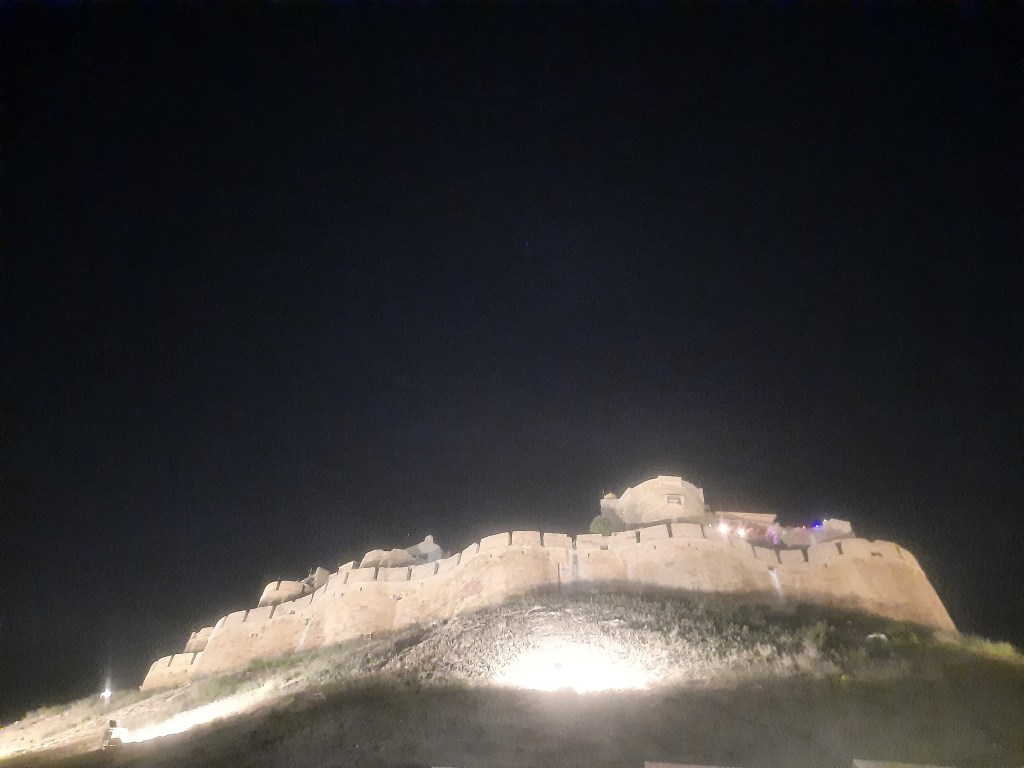
Jaisalmer Fort by Night

Which got me wandering: what are forts vs. fortresses vs. castles vs. palaces,? Well, here we go:

A fort is not a residence, but rather a military fortification. These structures were built specifically for war situations, and used to defend specific territories. A fortress is similar, but it is a larger fortified area than a fort.

A palace is primarily a residential place, occupied by royalty, heads of state, or very rich and important people. They are not fortified against attacks, but rather designed for comfort and elegance, and are often status symbols. 

Castles are large residences or a group of large buildings that have been constructed with strong walls to protect against attacks. Basically, castles are fortified residences. 

Apparently, there are about a thousand forts in India. Going strictly by the book, most forts in India are either fortresses or castles. But the British when classifying them, used the conventional British system and called them all forts.  The oldest surviving fort is thought to be the Qila Mubarak in Bathinda, Punjab, whose origins go back to the period 90-110 AD. This Qila was built by Raja Deb, a Rajput king.

That is a pretty ancient fort! But the thinking about forts goes back to even earlier times. Kautilya, the man who wrote prodigiously on all aspects of governing kingdoms, as far as the 3rd Century BC, had discussed various types of forts and fortifications.

‘On all the four quarters of the boundaries of the kingdom, defensive fortifications against an enemy in war shall be constructed on grounds best fitted for the purpose: a water-fortification (audaka) such as an island in the midst of a river, or a plain surrounded by low ground; a mountainous fortification (párvata) such as a rocky tract or a cave; a desert (dhánvana) such as a wild tract devoid of water and overgrown with thicket growing in barren soil; or a forest fortification (vanadurga) full of wagtail (khajana), water and thickets.’ he says in Book II of the Arthashastra in a section which elaborates “The Duties of Government Superintendents”. He goes into great detail not only about the construction of the fort, ramparts, towers, turrets, gates  and staircases, but even to the extent of specifying the width of various types of roads within the forts which would make for easy movement in war and peace. He details out how the spaces within the fort should be planned, and where which facility should be set up.`

However strongly fortified a fort, the danger of sieges was always present. It was for this reason that Chanakya laid down that: ‘There shall be a water-well for every ten houses. Oils, grains, sugar, salt, medicinal articles, dry or fresh vegetables, meadow grass, dried flesh, haystock, firewood, metals, skins, charcoal, tendons (snáyu), poison, horns, bamboo, fibrous garments, strong timber, weapons, armour, and stones shall also be stored (in the fort) in such quantities as can be enjoyed for years together without feeling any want. Of such collection, old things shall be replaced by new ones when received.’

Well, I suppose all this detailing could possibly have been done by any conscientious bureaucrat. What really gives the Chanakya twist to the discussion on forts is Book XIII, “Strategic Means to Capture a Fortress”. It mentions such tactics as: Sowing the Seeds Of Dissension; Enticement Of Kings By Secret Contrivances; The Work Of Spies in a Siege; The Operation of a Siege; etc.!

Wow! India not only has the most amazing forts, it probably has the oldest document guiding their conception!

–Meena

Cufflinks are a Man’s Best Friend

It seems a little unfair to insist that only women crave for diamonds and gold and jewelry. Down the ages, men have worn a lot of jewelry—one only has to look at paintings and pictures not only of Indian Kings and nobles, but of rich people from around the world. If the Koh-i-noor is on the crown of the Queen of England, the Cullinan (the largest gem quality diamond ever found on earth)  is on the scepter of the King of England, and Cullinan II, the second largest diamond, is on his imperial state crown.

Today, male jewelry is back with a bang. One only has to look at rappers and their gold chains. Closer home, apart from being a means of self-expression, it is both a way to show off wealth, as well as to appease the gods. The popularity of the navaratna ring, which is supposed to cure all ailments, bring wealth and good fortune, is more often seen on men than women. As also rudraksha bracelets and chains.

Of course it’s not all about flashy chunky stuff which sometimes runs into kilos (think Bappi Lahiri). There is also well-designed, subtle stuff.

From crowns to chains to jeweled collars, to bracelets, pendants, brooches, ear rings, to ankle adornments, there have been male versions of almost every piece of jewelry.

However, cufflinks are fairly unique in that they are quintessentially male jewelry rarely worn by women.  There has always been a need for some device to fasten shirt cuffs. In the 13th century, men used ribbons to do this. It was in the early 17th century that cufflinks as we know them today started to emerge. King Charles II popularized them, but they still remained very expensive items which were handmade, and therefore confined to people who could afford them.

It was only in 1876 that George Krementz, a German immigrant, adapted the manufacturing process used to make bullets to make cufflinks, and started mass production. And from that point on, they gained wide usage and popularity.

A cufflink has three parts:

The front face – the top of the cufflink, which is the decorative part, with a design, gemstone, or any other attractive design.

The post – the part that goes through the cuff holes and is attached to the toggle.

The toggle – the bottom part of the cufflink, which locks the link in place and prevents the cufflink from slipping out of the cuff holes

Cufflinks

While a cufflink may be a cufflink to many of us, apparently there are several types:

Whale Back cufflinks have a straight post, a flat head, and a tail shaped like a “whale” flips completely flat against the post.

Fixed back or fixed stud cufflinks do not have any moveable hardware. This means putting them in requires that they are manually secured by pushing the backing through the buttonhole. 

Bullet back cufflinks have a metal bar that attaches to the bridge of the cufflinks. This metal bar, which has a bullet aesthetic, rotates 90 degrees.

Chain link cufflinks are made of two usually identical faces attached by a chain.

Stud or button cufflinks look and work like studs.

Ball return cufflinks are those whose rear features a largish ball, attached to the decorative face by either a chain or curved post.

Locking Dual-Action cufflinks are secured shut with a mechanism similar to that of a wristwatch.

Silk Knot cufflinks are made entirely from silk, with two identical knots attached to a cord.

As I look around me, fewer and fewer men seem to be wearning cufflinks, something I felt sad about, because this is definitely an elegant addition to men’s attire. But a report on the cufflinks market says that the market is at $1.52 billion, and predicted to grow at 5.9% over the next few years. So maybe their demise is not so imminent after all!

Predictably, China is the biggest exporter, but surprisingly, India is one of the importers!

I shall surely look out more carefully to spot cufflinks around me!

–Meena

Trendhim.com; Nextmsc.com