While I soak in the sunshine on a pleasantly cool Ahmedabad winter day I read that the big Arctic chill has hit North America and Europe. It’s cold, cold, cold! News reports show how the blanket of snow has brought life to a standstill, and people are being interviewed to share how they are coping.
I remember a poem that wonders how the Snow itself must feel.
SNOW PILE
Snow on top
must feel chilly
the cold moonlight piercing it.
Snow on the bottom
must feel burdened
by the hundreds who tread on it.
Snow in the middle
must feel lonely
with neither earth nor sky to look at.
The poem was written in the 1920s by a young Japanese poet Misuzu Kaneko. “Teru” as she was called, was born in 1903 in a family of booksellers in a small fishing village in western Japan. The book-loving child was encouraged to study by her mother and grandmother, and she stayed in school until she was 18, a rare achievement for Japanese girls at the time. She began writing poetry at age 20, and signed her work “Misuzu”, in an allusion to classical Japanese literature meaning “where the bamboo is reaped.”
In her poetry, Misuzu would share her sense of curiosity and wonder–What does snow feel in a drift? Where does day end and night begin? Why don’t adults ask the questions children do? “To Misuzu, everything was alive and had its own feelings—plants, rocks, even telephone poles! She felt the loneliness of whale calves orphaned after a hunt. She felt the night-time chill of cicadas who had shed their old shells. And she felt the tearful sadness of a flower wet with dew.”
Sadly her personal life was tragic and she committed suicide when she was only 27 years old. Kaneko and her work were forgotten for the next 50 years. The only known copy of her poems had been destroyed during the bombing of Tokyo in WWII. The bookstore where she once worked was long gone. No one seemed to know if she had any surviving family. It is only in the 1980s that another Japanese poet Setsuo Yazaki, recovered her poetry manuscripts and these were published.
Today, almost a 100 years later, Kaneko’s poems remain as fresh and moving with their innocent sense of wonder.
I wonder why
the rain that falls from black clouds
shines like silver.
I wonder why
the silkworm that eats green mulberry leaves
is so white.
I wonder why
the moonflower that no one tends
blooms on its own.
I wonder why
everyone I ask
about these things
laughs and says, “That’s just how it is.”
If only we could all retain that magical sense of wonder rather than simply accepting “That’s just how it is.”
2019 has been declared as The International Year of Indigenous Languages (IYIL2019) by UNESCO. The official launch of IYIL was held on 28 January 2019. The aim of IYIL is to “draw attention to the critical loss of indigenous languages and the urgent need to preserve, revitalize and promote indigenous languages around the world”.
Of the 6000-7000 languages in the world today, about 97% of the world’s population speaks only 4 % of these languages, while only 3% of the world speak 96% of all remaining languages. A great majority of those languages are spoken mainly by indigenous peoples.
India is one of four countries, along with Nigeria, Indonesia and Papua New Guinea, with the largest number of living languages. A mammoth project to conduct a comprehensive survey of Indian languages was launched in 2010. Initiated by Prof. G.N. Devy, founder of the Bhasha Research and Publication Centre in Vadodara, and undertaken by a large team of scholars, the project called the People’s Linguistic Survey Of India (PLSI) set out to document and preserve 780 languages which are being spoken in India today. These are being published in the multi-volume People’s Linguistic Survey of India, towards providing an overview of the extant and dying languages of India, as evolved till 2011, and as perceived by their speakers. The volumes chronicle the evolution of these languages in all their socio-political and linguistic dimensions, and encapsulate the worldview of their speakers. PLSI proposes to complete its task of publishing 92 volumes by 2020.
In the last couple of years, I have had the enriching opportunity to learn about some of the indigenous people of the north east of India and a glimpse of not just the incredibly rich traditions of textiles in the region, but equally the close ties between language of the people and the language of their textiles. Not only does every tribe have their own dialect, but each dialect has wonderfully nuanced words to describe every textile that they weave, and even every motif that is woven on these.
Names of textiles of the tribes have references to the history and geography of the tribe, as well as names that literally relate to colour, size, on which part of the body they are worn, as well as referring to age and status of the wearer. There are specific shawls for elder men or women, for those who have special social status (as in the Naga the Feast of Merit shawl), for a new bride to wear to her marital home, and for covering the deceased.
As Ganesh Devy puts it “in every manner without any exception, the language we learn or use is the absolute condition of our narrative of the world and the way we see the world.”
Of the numerous examples of this, is that of a textile of the Bodo Kachari tr
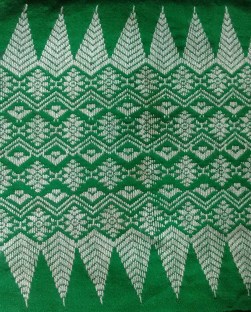
Aronai with Hawjagor pattern
ibe of Assam.The multi-use decorative textile called Aronai is characterised by a zig-zag motif called Hawjagor (hill pattern) in the Bodo dialect. This pattern is inspired by the hills which form an important part of the history as well as the geography of the Bodo people who settled by the foothills, on the north bank of the Brahmaputra in Assam.
It is in the names of motifs that women weave onto the textiles that the symbiosis between life, nature and culture is most evident. The names not just reflect how nature inspires form, but also reveal a keen eye for subtle detail and the richness of language to reflect this.
A common triangular motif on wrap skirts of the women of a small Naga tribe is called impeak bam. The word Impeak translates to ‘stretching out/extending/ spreading out’ and bam means ‘wings’; and the motif symbolises a flying Hornbill. While a similar but smaller triangular motif is named to mean the wings of the bird called a Swift.
Some of the motifs of the Liangmai Naga tribe in Manipur are named literally to represent elements such as fish bone (kakhara thua), cow’s teeth (kabuihu), and ripples in a lake (kazai kapai). There is even a woven line stitch line called matiang kang meaning ‘group of ants.’ These are only the tip of the iceberg of detail, as it were.
One of the traditional shawls of a small Naga tribe of the Manipur Naga Hills has a motif called inchitatpi that translates to ‘head of a long worm’ found in the woods. Another has a pattern representing cucumber seed called angi thei ru. Getting into even more minute detail, another tribe has a popular motif called aphinamik which literally means the ‘eye of a dove’.
There are patterns representing frog’s feet called sangkang nou ban and grasshoppers’ egg called changkow gum, and even a stitch called kabi n’dui where kabi translates to ‘good’ and ndui translates to ‘egg’, relating to the arrangement of eggs on a paddy plant!
What evocative words and how beautifully they capture richness of life lived in synergy with one’s environment. These are only a tiny sprinkling of the vocabulary of a tiny segment of indigenous people and languages.
Sadly with ‘modernisation’ comes homogenisation. A lot of the local weaving traditions are being replaced with mass-produced machine-made garments, and with it are lost not just the textiles and motifs but also the language that represented these.
According to UNESCO, approximately 600 languages have disappeared in the last century, and they continue to disappear at a rate of one language every two weeks. Up to 90 perccent of the world’s languages are likely to disappear before the end of this century if current trends are allowed to continue.
And Ganesh Devy expresses the Domino Effect that this has—“When a language dies, its speakers decide to migrate. First, they migrate to another language and then they physically start migrating to another region. The second thing that happens is that their traditional livelihood patterns go down. They may have some special skills and that disappears. Thirdly, a unique way of looking at the world disappears.”
I was introduced to Ruskin Bond over 30 years ago by Uncle Ken and Rusty. These were the characters in the first books that I translated. I so enjoyed the madcap adventures of the eccentric Uncle Ken and the restless school boy Rusty, not just for the stories but for the simple style of writing and the lovely use of language. As a translator it was a challenge to try to retain the spirit and the form in another language.
Following this introduction I continued to follow Ruskin Bond on his wanderings and meanderings through his essays and columns. Here was someone who was not only sensitive to, and entranced by every minute detail of nature, but one who could share this evocatively through words.
When Ruskin Bond’s autobiography was published just over a year ago, I was curious and eager to fill in the blanks and to know more about Ruskin the person. I recently read the book called Lone Fox Dancing: My Autobiography. In it saw how many parts of his own life have been woven in his writings. Ruskin’s story is simply told and flows gently through eight decades, capturing flavours of the life of the angrez and the Anglo-Indians from the colonial times, through the Second World War, India’s partition and the birth and development of the new republic.
Ruskin writes about family and friends, travels and travails, painting word pictures that make one feel as if one is leafing through a real photo album. As he wrote “That’s what life is really like—episodic, full of highs and lows and some fairly dull troughs in between. Life is not a novel, it does not have the organisation of a novel. People are not characters in a play; they refuse to conform to the exigencies of a plot or a set of scenes. Some people become an integral part of our lives; others are ships that pass in the night. Short stories, in fact.”
For me there were “Eureka” moments when one recognized the people who became memorable characters in many of his stories. I marveled at the memory that could conjure up images from sixty-seventy years ago, but I also learnt the value of keeping a journal, something that Ruskin has done since his school days.
Above all, what the book reiterated was the celebration of solitude. Ruskin Bond is not a recluse nor one who shuns human contact. As a boy he writes that he was lonely, “loneliness that was not of my seeking. The solitude I sought. And found.” This solitude he found in nature, nature is the companion that has sustained and energized him over eighty years, and with it, the magic of the words to share the joy with others.
This morning’s Google Doodle triggered the trip back in time. I was intrigued by the doodle of what looked like Indian spices, and an unknown face and name– Sake Dean Mahomed. Clicking on, I discovered not just the interesting life and times of this man, but also a link to mine own days of yore!
Sake Dean Mahomed was a man of many talents and accomplishments—author, entrepreneur, restaurateur, and pioneer masseur and spa owner! He was the first Indian author to publish a book in English; to establish, the first Indian restaurant in Britain named the Hindostanee Coffee House, and the first to introduce Indian style champi or massage in Brighton!
Brighton! The name took me back to my own Brighton (or fringe thereof) year, many moons ago. It was to the University of Sussex that I headed for my second Master’s degree—a small progressive campus nestled amidst the rolling Sussex Downs. That was a special year—opening of new windows, explorations and discoveries, and above all the starting of the bonds of friendship that have not only lasted, but strengthened over the decades. Cocooned as we were in the routine of the campus, the highlight of the week was a trip into Brighton, the nearest town, which was about 6 km away.
In the initial months we did the necessary “must see” sights—the Pavilion, the pier, the crescents, and the Baths. But then, our weekly trip into town consisted of what we then considered Splurge Saturday! In our early twenties, and with a very shoestring student budget, this meant taking the bus into town, a window-shopping walk around, finding something interesting and cheap to eat, and finally a movie! And, then the last bus back to campus with a sense of a day well spent! Simple joys, multiplied many times over by the excitement of the Friday evening pre-planning (where to eat, what to see that week), and the exuberant spirit of pure friendship and sharing.
Today I learnt, that more than a century and half before I explored and discovered Brighton, Sake Dean Mahomed (a Person of Indian Origin!) set up in Brighton, Mahomed’s Baths, which became known for its champi or massage followed by a steaming bath of Indian herbs and oils. Mahomed’s Baths gave a new twist to the early 19th century trend for seaside spa treatments, and it was hugely successful. Mahomed became known as “Dr Brighton”. Hospitals referred patients to him and he was appointed as ‘shampooing surgeon’ to both King George IV and William IV.
Incidentally, I also found out that the word “shampoo” did not take on its modern meaning of washing the hair until the 1860s, but as early as 1838, Mahomed wrote about Shampooing or benefits resulting from the use of the Indian Medicated Bath. I suspect this was simply an anglicised version of good old champi!
I must admit that I had no clue about Mahomed nor his famous baths while I was in Brighton. But thank you Google doodle and Dr Brighton for taking me back to Brighton today!
One of my all-time favourite authors has been Lewis Carrol with his Alice’s Adventures in Wonderland, Through the Looking-Glass, and The Hunting of the Snark. More than the story it has been the language that always amused and fascinated me. The made-up, nonsensical sounding words like slithy and mimsy, frabjous and galumph were such fun to read aloud, and try to use in other contexts, even though one did not exactly know what they meant. Alice herself was equally confused on this count, and in the story she approaches Humpty Dumpty and asks him to elucidate the meaning of the some of these. Humpty Dumpty replies: “Well, ‘slithy’ means ‘lithe and slimy’. ‘Lithe’ is the same as ‘active’. You see it’s like a portmanteau–there are two meanings packed up into one word.” Humpty Dumpty uses the analogy of a portmanteau–the French word for a dual-compartment suitcase to explain that these are words that contain aspects of two distinct words fused into one new word. So ‘mimsy’ is a blending of flimsy and miserable, and ‘frabjous’ is a blend of either fabulous and joyous, or fair and joyous, while ‘galumph’ comes from a blend of ‘triumph’ and ‘gallop’.
And so it is that Humpty Dumpty introduced the concept and term Portmanteau words to describe a word that is formed by combining two different terms to create a new entity.
Today Portmanteau words have become so much a part of our vocabulary that we do not realise that they are blended and coined words. We use words like smog (smoke+fog), motel (motor+hotel), modem (modulation+demodulation), motorcade (motor+cavalcade), netizen (internet + citizen), and even internet (international+network), as if they have always been there.
Portmanteau words are a great favourite with the entertainment industry—from Cineplex, infotainment and infomercial, to Bollywood; from Brangelina to our own Nickyanka; from celebutant(e) to chillax we even have emoticons and fanzines that coin and create a whole new vocabulary!
People no longer rough it out, they go glamping (glamour+camping), and bigger than big is ginormous (giant+enormous)! There are some who suffer from affluenza (affluence+influenza), while others are beset with anticipointment (anticipation+disappointment), and both may end up as chocoholics (or workaholics)!? (There is even a word for !?–interrobang (interrogative+bang).
If we stop and think about the words that we use and see every day we would be surprised to find how many of these are Portmanteau words. And while we imagine that we are so trendy to be coining words like BREXIT, and yes, even BLOG, let us remember that Humpty Dumpty thought of it first in 1871!
In school, one of the standard writing exercises in our language classes was to write a letter to the editor of a newspaper. We were encouraged to think about issues—from local to global—and express our considered opinion on the same in the letter. It was also an exercise in the proper form of address, the clear enunciation of views, and discipline of expressing what we had to say in limited words.
It was not only the writing, but also the reading of letters to editors in newspapers that was an integral part of the morning newspaper reading ritual. Over the years, it was comforting to know that the right hand column on the middle page of my newspaper would carry the day’s letters. Over time, one became familiar with some of the ‘regular’ writers, and were amused, appalled, or in silent agreement with the views expressed.
In recent times this part of the daily newspaper has been disappearing in many papers. In the age of social media, people express their views instantly, in the required number of characters. The almost knee-jerk reaction to happenings invokes an equally instant avalanche of responses. And, then, a new day begins with a fresh news-storm as it were.
Long before all this, it was a tradition of newspapers around the world to carry their readers’ opinions, thoughts, questions, and outrage on the news of the day. What is it that motivates people to write these letters? Letter writers do not receive material compensation for their efforts, but do enjoy rewards such as publicity, or satisfaction from directly or indirectly influencing public discourse. And most newspapers still honour and respect this sharing from their readers by giving them the space to be seen and heard.
Newspapers like the New York Times and the Washington Post receive thousands of letters to the editor every year. Letter writers respond to news articles and opinions, and often take the newspaper to task for how it operates. At the end of the year the Washington Post puts up on its website a selection of the novel, thoughtful and funny insights that readers submitted that year, sorted by the date they appeared in print and subject matter.
Other newspapers are also encouraging of the art of writing to newspapers. As the associate editor of an Irish newspaper puts it, “In a world where social commentary is now almost free of any kind of professional oversight — or curating, to use today’s vernacular — the letters columns of mature, honest newspapers are, as they ever were, a reliable weather vane of how a society feels on certain issues. They are a kind of a social pulse giving an insight into the health–in the broadest terms–of the nation. They are direct, from-the-heart commentary.”
The power of “Dear Sir”…is evident in the case of the letter to the Times from a seven-year old girl from the Isle of Man. It read ‘Sir, Yours faithfully, Caroline Sophia Kerenhappuch Parkes.’ The brief epistle was intended to inform readers of her unusual name Kerenhappuch which had been mentioned in a letter the previous week on the subject of uncommon 19th century names.
I for one do look forward to seeing the column back in all newspapers.
Many years ago, I visited a Native American Museum. There I saw a long scroll, with a series of pictures. Though they were all done in the same style, and at first glance looked like one piece, but upon looking closely, they seemed to be several pieces, done at different times and by different hands.
We were told that these scrolls were living history books. Some of the tribes used this technique to document their life and times. The tribe/community would sit together at the end of each year, and collectively decide on what was the most significant event that had taken place that year. The event could be anything—from an epidemic, to a victory over another tribe, to a bear attack on one of the members. And they would then add it on to the scroll. And so it went on, from year to year, generation to generation.
What a beautiful and democratic way to record history. Collective decision making. Having to prioritize the ONE important thing. And then recording it in pictures, as a continuum with the previous years! What a chronicle!
We thought we too should put on record what was the important event in our life in the year gone by. For the MM, surely it was the blog!
What did it do for us?
Got us back into writing regularly
Brought us the discipline of putting out three pieces a week
Gave us a platform to muse, to share, to vent and to celebrate.
It was an opportunity to learn, research, reflect, and travel down memory lane.
Helped us look at things around us differently…exploring and discovering much to write about.
Forced us to learn new skills—even getting on to WordPress was major step forward for the tech-shy MMs!
Made us more conscious of the power of pictures, above and beyond the power of words.
And the greatest gift, brought us new ‘virtual friends’, our readers!
So thank you from the Millennial Matriarchs, to each one of you—the regular readers, the occasional readers, the one-time readers, and the readers-to-be!
We wish you a Happy, Healthy, Enriching and Satisfying 2019!
“It was late in December…
I felt the beat of my mind go
Drifting into time passages
Years go falling in the fading light
Time passages
The years run too short and the days too fast…”
Remembering, this morning, the words from Al Stewart, one of my favourite singers in the nineteen eighties, and wondering where the years have flown… As most of us will be doing this week, looking back, and perhaps wishing we had had more of that elusive TIME…here is something to pause and ponder over.
“Without time nothing is possible. Everything requires time. Time is the only permanent and absolute ruler in the universe. But she is a scrupulously fair ruler. She treats every living person exactly alike each day. Time is one great leveller. Everyone has the same amount of time to spend every day.
The next time you feel you haven’t the time to do what you really want to do it may be worthwhile for you to remember that you have as much time as anyone else—twenty-four hours a day. How you spend the twenty-four hours is up to you.” (William J. Reilly)
Before we turn the page, and greet a new year with renewed resolutions, remember…
source: Google
Busy is a decision…you don’t have to find the time to do things—you make the time to do things.
As an “arts” student with two “science type” sisters I was always somewhat awed by the way they used to reel off the scientific names of plants, animals, and later in medicine. The names sounded like tongue twisters and I was most impressed at how they managed to remember these.
In a later avatar as environmental educator, I myself had to explore and discover the until-then mysterious realm of taxonomy and nomenclature. Over time I found that I was myself as easily saying Azadirachta indica and Phyllanthus emblica instead of neem and amla!
As an explorer of words I found it equally, if not more, fascinating to find out just how and why the flora and fauna got their scientific names. It appears that the first person to name, describe, and put an example of the species into a museum gets to name it. The name only gets changed if scientists learn something about the species evolutionary history to make them change the name.
How does this work? The International Commission on Zoological Nomenclature (ICZN) founded in 1895, provides the standard framework, and regulates a uniform system of zoological nomenclature ensuring that every animal has a unique and universally accepted scientific name. As long as it is within the guidelines of the International Code of Zoological Nomenclature and with no offensive wording, we can even have insects and butterflies named after our favourite teacher or parent! There are similar commissions for other areas like Botany and Entomology.
Since the scientist who discovers a species gets the right to name it, some scientists try to follow the traditional practice of incorporating an organism’s characteristics into its name, others give up and try something else. Scientists may be serious people, engaged in the pursuit of objective truth. But when it comes to naming species, they often let their hair down. There are species named for body parts and bodily functions, for celebrities, painters and writers, for cartoon characters and favourite sports. There are the literal as in Egretta egrettoides (literally, “egret that looks like an egret.”) There are creatures from Aa to Zyzzyx. There are the palindromic names Ababa and Xela alex.
Here are some really fun ones!
Aha ha:An Australian wasp named by entomologist Arnold Menke The story goes, Menke was in a debate with another research group over the validity of the species, and when he finally provided the definitive evidence, he exclaimed, “Aha ha!”
Ba humbugi: When scientists discovered this snail on the remote Pacific island, they opted to name him after the crankiest man in literature, Ebeneezer Scrooge whose trademark sneer was “Bah humbug”.
Ittibitium: Bittium is well-known genus of small sea snails and mollusks that are found all across the globe. So what name did scientists choose when they discovered a genus of mollusks even tinier than these? Ittibitium!
Ekrixinatosaurus calvo named “explosion-born lizard”because its bones were discovered during construction-related blasting.
Kamera lens: Although its discovery goes back to 1773, little was known about this single celled organism until 1991 when scientists must have thought, “Hey, we should use a camera lens to see this species better.”
It’s not scientists who have all the fun! Sometimes the naming rights for a new species are auctioned for a cause. Most recently the naming rights for a newly-discovered 10 cm amphibian were auctioned to raise money for the Rainforest Trust. The slippery little creature, found in the rainforests of Panama is blind, and likes to bury its head in the ground. Aidan Bell, co-founder of EnviroBuild, a sustainable building company, paid $25,000 for the right to name the creature after no other than President Donald Trump!
And what was his choice? Dermophis donaldtrumpi!
“Burrowing [his] head underground helps Trump when avoiding scientific consensus on anthropomorphic climate change […] Dermophis donaldtrumpi is particularly susceptible to the impacts of climate change and is therefore in danger of becoming extinct as a direct result of its namesake’s climate policies.”
The scientists who made the discovery have agreed to use the name Dermophis donaldtrumpi when they officially publish the discovery in scientific literature.


 Millennial Matriarchs