Much in Little

It is almost six months since the world as we knew it, changed. For many, this period of lockdown has also been one of unlocking some simple joys of life and living.
IMG_20200626_093148.jpg

A reprieve from the frenetic activities of modern life has given Nature a new lease of life. And humans, from behind their glass windows, are discovering the wonders of the world that we share with millions of other living beings. People are noticing plants, birds and insects in their immediate surroundings; they are hearing bird song and rain symphonies which had been drowned out by incessant urban cacophony and pollution. Locked inside, humans are rediscovering nature.

Humans are also rediscovering that it is possible, even satisfying, to live with what one has; that life can go on without 24/7 doings and happenings, extravagant shopping sprees, dining out, and other self-indulgences. That the quality of life is not dependent entirely on the quantum of material resources.

But this is not the first time in history. Almost 200 years ago Henry David Thoreau took a break from the often numbing routine of daily life which was driven by the need to earn a living. As he put it “the mass of men lead lives of quiet desperation.” He wondered, “Was it possible to lead a different kind of life?”

Thoreau spent two years, two months and two days living by himself in a basic wooden cabin that he built himself, on the shore of Walden Pond, near Concord, Massachusetts in America. He wanted to answer for himself the question “how simple can a life be and still be a good one?”, and to illustrate his belief of “much in little.”

As he wrote, “I went to the woods because I wished to live deliberately, to front only the essential facts of life, and see if I could not learn what it had to teach, and not, when I came to die, discover that I had not lived. I did not wish to live what was not life, living is so dear; nor did I wish to practice resignation, unless it was quite necessary.”

Even while at Walden Pond, Thoreau did not live a life of seclusion. He had visitors, and walked to the nearby village often. His experiment was more to prove that one does not have to go far in any physical sense to “get away from it all.”

During this period in 1845-46, he observed, enjoyed and recorded his observations of the natural world around him. These were to be published as Walden, one of his best known works. It also earned him the moniker Father of Environmentalism.

Thoreau was however much more than a nature writer. He wore many hats–social reformer, naturalist, philosopher, transcendentalist, scientist, and conscientious objector.

Born on July 12, 1817 in New England, USA in a middle class family, he graduated from Harvard following which he spent some years teaching in school, and also working in his father’s pencil factory. The young Thoreau was greatly influenced by Ralph Waldo Emerson who became his close friend and mentor. He began to publish essays that reflected his deeply-felt political views which were considered radical in those times. He was an outspoken abolitionist and was arrested (and jailed for one day) for resisting to pay poll tax to a government that supported slavery. This experience led him to write one of his best-known and most influential essays titled Civil Disobedience. He made a strong case for acting on one’s individual conscience and not blindly following laws and government policy. “The only obligation which I have a right to assume is to do at any time what I think right,” he wrote.

Thoreau’s non-violent approach to social and political resistance greatly influenced Mahatma Gandhi who adopted many of his thoughts while developing his concept of Satyagraha.

Following his Walden experiment Thoreau wrote extensively, although a lot of his writing was published and became well-known only after he died. He continued his daily afternoon walks in the Concord woods and kept a journal of his nature observations and ideas. He travelled and lectured, living on a modest income, till he died of tuberculosis in 1862, at the age of 45.

Thoreau, a man of simple tastes and high thinking, was indeed an original thinker of his times. The lesson he taught himself and that he tried to teach others, was summed up in the word “simplify”. That meant simplify the outer circumstances of your life, simplify your needs and your ambitions; learn to delight in simple pleasures which the world of nature affords. It meant also scorn public opinion, refuse to accept the common definition of success, refuse to be moved by the judgement of others. And unlike most who advocate such attitudes, he put them into practice.

A few years ago on a trip to the United States I had the opportunity to retrace Thoreau’s footsteps on a walk around Walden Pond, and see the modest shack where he penned his notes on nature. At that time I knew him mainly as an evocative nature writer. Today I find that his philosophy of life and living is more relevant than perhaps ever before. And Walden is so much more than a nature lover’s diary—it is an inspiring guide to changing the way we view ourselves and the life we want to live, especially in these times when we are feeling lost, and the times that will follow.

Our life is frittered away by detail. Simplify, simplify. Henry David Thoreau

–Mamata
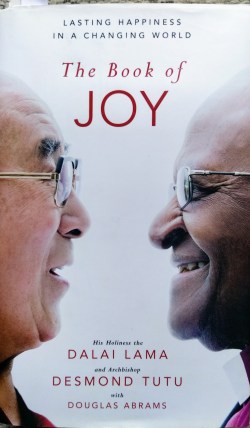
The Book of Joy

This week, 6 July, marked the 85th birthday of His Holiness the Dalai Lama. Five years ago, in 2015, to celebrate the Dalai Lama’s 80th birthday, a unique meeting took place. The Dalai Lama’s close friend the Archbishop Desmond Tutu came to Dharamshala to visit his “kindred spirit”. Both great spiritual masters and moral leaders of our time, and Nobel Prize winners, the two spent a week together—sharing their thoughts and vision, exchanging memories, and reveling in the simple joys of being together, laughing, and teasing each other.

Interestingly, four years before this meeting, when Desmond Tutu turned 80, a similar meeting between the two had been planned in Cape Town, South Africa. But the Dalai Lama was denied a visa by the South African government, bowing to pressure from the Chinese government.IMG_20200709_102817_BURST1.jpg

The Dharamshala meeting was, thus, more than special, and its purpose even more so. They took this rare occasion as a chance to sit down together, and evaluate one of life’s most important questions: how do we find joy in the face of life’s inevitable suffering? The outcome was The Book of Joy.

As the facilitator of the dialogues, and editor of the book, Douglas Abrams explains, ‘From the beginning the book was envisioned as a three-layer birthday cake: their own stories and teachings about joy, the most recent findings in the science of deep happiness, and the daily practices that anchor their own emotional and spiritual lives.’

The book documents the interactions between the two great minds through daily dialogues  over seven days, starting with identifying the obstacles to joy: fear, stress, anxiety, anger, sadness, grief, loneliness, envy, suffering and adversity, illness and fear of death.

From there the dialogues move on to explore the paths to experiencing Joy. Both the great minds emphasise that joy and happiness are by-products that spring from one’s attitudes and actions, and the cultivation of certain qualities.

What are these positive qualities that allow us to experience more joy? Four are qualities of the mind: perspective, humility, humour and acceptance. Four are qualities of the heart: forgiveness, gratitude, compassion mind: and generosity. These are the eight pillars of Joy. Each of these is discussed at length in the book.

Five years ago, the two gurus talked about the untold horrors, tragedies and suffering that the world was facing, and how to find joy whilst accepting, and yet transcending these. Today, in addition to these, the world is facing an all-encompassing and overwhelming new challenge. More than ever before, their words of wisdom may be the one’s to guide humanity through the pandemic that has been the greatest equaliser of all.

Perhaps the key to coping with the immense stress, anxiety, frustration and anger that all of us are facing during this period is Perspective. I cannot help but share some excerpts which are so relevant today.

“Yes there are many things that can depress us. But there are also are very many things that are fantastic about our world. Unfortunately the media do not report on this because they are not seen as news. …When bad things happen they become news, and it is easy to feel that our basic human nature is to kill or rape, or to be corrupt. Then we can feel that there is no hope for the future. …No doubt there are very negative things, but at the same time there are many more positive things happening in our world. We must have a sense of proportion and a wider perspective. Then we will not feel despair when we see sad things.”

“For every event in life there are many different angles. When you look at the same event from a wider perspective, your sense of worry and anxiety reduces, and you have greater joy. …If you look from one angle, you feel, Oh how bad, how sad. But if you look from another angle at the same tragedy, that same event, you see it gives me new opportunities.”

“The wider perspective leads to serenity and equanimity. It does not mean that we do not have the strength to confront a problem, but we can confront it with creativity and compassion rather than reactivity and rigidity. We are able to recognise that we do not control all aspects of any situation. This leads to a greater sense of humility, humour and acceptance.”

“The way we see the world is the way we experience the world. Changing the way we see the world in turn changes the way we feel and the way we act, which changes the world itself. A healthy perspective is really the foundation of joy and happiness.”

The book records the thoughts of the two thinkers not just through their words but also by their body language—the mischievous tugging and patting of arms, the heartfelt clasping of fingers, the respectful folding of hands and bowing, and above all the twinkling of eyes and the easy laughter of two dear friends sharing jokes, and enjoying their pudding! No wonder they are they are also known for being among the most infectiously happy people on the planet!

I myself have felt engulfed in this childlike exuberance and humour both times that I have had the privilege of attending a talk by the Dalai Lama, even as one of an audience of hundreds.

The Book of Joy has been on my bookshelf the last couple of years, but I was not in the right frame of mind to start reading it.  It is only last week that I felt the urge to read it.  I intensely related to it, and it put a lot of things in perspective.  Every word in the book is thought-provoking and profound. I know that I will go back to these again and again. Perhaps there is a time and place for everything indeed.

But, there is always time and space for Joy.

–Mamata


A Requiem for Lost Libraries

Right through the last three months of lockdown the one ‘unlocking’ that I was looking forward to, was that of my local British library. The once-a-month visit to the library was an outing that I enjoyed, with its comfortable ritual of collecting the books to return; the short trip to reach the library; the leisurely browsing of shelves to select the next batch to issue, and the spending of some quiet time among fellow readers perusing the newspapers and magazines.

A couple of weeks ago I got a mail that this library was shutting down it physical space and transactions, and turning completely digital. Among the many changes that the world is seeing, and will see, in the age of Corona, this was one of the most upsetting changes for me.

As I have often shared in these columns (lately A Browser Laments) libraries and bookshops have sustained the bibliophile in me all through my life. These have been integral parts of my learning and becoming, and much more than a collection of books. As E B White, described much more eloquently than I can:

library shelves.jpg

“A library is many things. It’s a place to go, to get in out of the rain. It’s a place to go if you want to sit and think. But particularly it is a place where books live, and where you can get in touch with other people, and other thoughts, through books… A library is a good place to go when you feel bewildered or undecided, for there, in a book, you may have your questions answered. Books are good company, in sad times and happy times, for books are people — people who have managed to stay alive by hiding between the covers of a book.”

A library is not only a sanctuary, it is also an invitation to explorations that lead to serendipitous discoveries of new authors and titles. It is a place where the solid physicality of books creates the intellectual space to freely roam across historical ages, geographical boundaries, and labels of colour, language and identity.

The library has been the mainstay, the beacon, the support, and the sustenance for readers through history. Yet today, libraries themselves are in danger of becoming history. We are told that the library is being reinvented in the face of budget cuts, new technology, and changing needs. The age of internet has brought unimagined sources of information and knowledge at our fingertips. There is an increasing transformation to digital libraries.  To ‘browse’ has taken on an entirely new connotation.  The voyage of discovery is now marked by keywords–we reach for what we know to reach for. More than anything else this has transformed the library experience which was marked by a special sense of community into an individual and isolated exercise.

I mourn for these losses, as I apprehensively search for replacements.

–Mamata

How to be a Parent

The last three months of lockdowns across the world have, among other things, put the spotlight on parenting. With children and parents in continuous and close confinement, both have been tearing their hair out in frustration. The challenge of keeping children ‘occupied’; the careful negotiation of time and space that respects personal and physical boundaries; the sharing of responsibilities amidst the constantly looming uncertainty of when and where the virus could strike, has put everyone on tenterhooks.

This has led to a proliferation of Advice Columns. From counsellors to therapists, psychologists to agony aunts, there seems to be an overdose on ‘good parenting’ tips. In our zeal to do the best for our children we sometimes tend to forget the most basic and simple guidelines that are based on the fundamental premise of mutual respect.

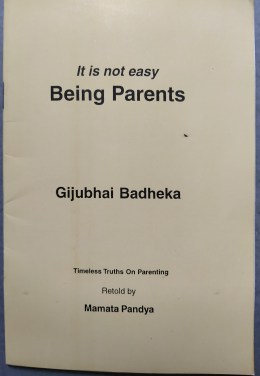
These were offered almost a hundred years ago by Gijubhai Badheka one of the pioneers of the Montessori system of education in India, lifelong advocate of children and their rights, and creator of some of the best loved and popular children’s literature in Gujarati.  Gijubhai believed that every child has its own distinct personality. We as adults need to recognise and respect this. He urged parents to convert to the faith of trust, respect, freedom and love for children. Starting with these five fundamental tenets.

If You Really Want ToIMG_20200625_114247.jpg

If you would like to do just one thing for children…

What could you do?

Do not hit children.


If you would like to do two things; what could you do?

Do not scold children

Do not insult them.


If you would like to do three things; what could you do?

Do not scare children

Do not bribe them to do something

Do not overindulge them.


If you would like to do four things for children; what would these be?

Do not preach to children

Do not blow hot and cold

Do not keep finding fault

Do not exercise authority all the time.


If you are keen to do five things; what will you do?

Do not do whatever the child demands; teach it to do for itself.

Let the child do what it desires to do.

Do not take a child’s work lightly.

Do not interfere into a child’s work.

Do not take away a child’s work.

In a world that has changed dramatically in the last 100 years, these timeless tenets remain as, if not more, true today.

Gijubhai Badheka passed away on 23 June in 1939, at the early age of 54 years leaving behind a prodigious legacy of writing for children, parents and teachers.

Gijubhai was my grandfather. In my small way, I try to carry forward his legacy by sharing and translating his works from the original Gujarati into English.

–Mamata


Just Deserts

I love deserts. Of all the ecosystems and landscapes, I have always felt the closest affinity to the desert. While I have trekked among hills and mountains, and have enjoyed the sea and seashore, it is the desert that makes me feel at once ‘at home’ as it were.

My introduction to the desert dates back many decades.

IMG_20200618_110730
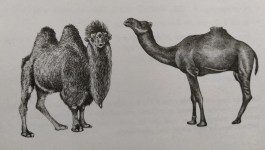
Illustration CEE’s NatureScope India  Discovering Deserts 

As a young trekker I was a member of a group called the Delhi Mountaineering Association. One year, the mountaineers decide to descend from the mountains and explore a new terrain and undertake something that was hitherto unexplored. The result was the Desert Expedition—the first-ever attempt (then) to cross the Thar desert in Rajasthan on foot. Eight strangers (5 men and 3 women, including yours truly), sharing a common urge to explore and discover, came together to embark on a two-week journey that touched each of us in so many different ways, and left behind indelible memories.

The walk commenced from the little village of Sam, about 44 km from Jaisalmer. This is where I had my first sight of the dunes rising from a sea of sand in the morning sunlight–a curious composite of the ripples of the ocean with the majesty of the mountains. And from here walked, our motley band of adventurers; day after sunny day, dusty winds, clinging bhurats (prickly thorns). From the sand, through the unending vista of flat arid miles stretching to the horizon, stopping to quench our parched throats with mathira the juicy wild melons, and communing with our accompanying camels. The utterly comforting feel of sleeping on the sand, under the canopy of the Milky Way, lulled by the unbroken sounds of silence. A unique bonding over seven days and 190 km (every inch traversed on blistered feet!), that left me deeply in love with the desert.

While I have not been able to go the desert as often as I would like to, serendipitously the desert has made its way into my life from time to time.

I am often reminded by my erstwhile boss that the only credentials that started me on my career as an environmental educator, was the fact that I had been on that desert expedition! My work in environment led me to study and understand (rather than only experience) the different ecosystems. When I had the opportunity to develop a teaching-learning manual on Deserts, I plumbed the depths of literature on the subject and was awestruck by the fascinating facets, incredible adaptations, and the innumerable strands that weave together create a vibrant ecosystem in a seemingly lifeless terrain. What was once intuitive was bolstered with intellect.

More serendipity! A collaborative project with Abu Dhabi, and an equally ardent desert lover transported me (after so many years) into a desert again—the Arabian Desert, also known as the Empty Quarter (Rub Al Khali in Arabic). Being amid the immense dunes and endless stretches of sand, was like homecoming. I would never have imagined this, all those years ago in the Thar.

And then, a trip to Ladakh to experience the cold desert—that I had only written about till then. So different–the starkness, the skies, the silence, and the sheer scale, and yet similar.  Nowhere but in the desert have I felt this with such intensity.

My heart lies in the desert. Sadly I may not be able to recreate these experiences if I tried now. The once remote sand dunes of Sam are now a tourist hot spot. The dunes and dune life of Rub al Khali are being decimated by the sport craze for off-road vehicles zooming across the sand. The fragile cold desert ecosystem of Ladakh is being snowed under with overtourism. Deserts are disappearing, and no ‘development’ scheme can ever recreate them.

–Mamata

Ironically while the real deserts are under threat, human activity is leading to transforming non-desert areas into arid lifeless regions through the process of desertification.  June 17 is observed as The World Day to Combat Desertification and Drought to promote public awareness of international efforts to combat desertification.


Online Nature?

As the global pandemic continues to keep children indoors in many parts of the world, there is a continuing barrage of information on how to keep them ‘meaningfully engaged’. And heading the list is online activities–the one-size-fits-all solution. It started with online classes and assignments to help complete the academic year and requirements. This grew to include online ‘activities’ with students following virtual instructions to make and do things. And then, on to stories being told through a face and voice on a one-way screen.  And now, invitations to discover Nature online.

This in itself seems to be a contradiction in terms. EspeciallIMG_20200611_093510y for an environmental educator whose work and mantra for over three decades had been ‘connecting children with nature’. Environmental education as we believed was learning in the environment, learning through the environment, and for the environment. More than anything else, this was true for nature education. Based on this conviction we worked with passion and imagination to create hands-on teaching-learning experiences–from stepping outside the classroom to observe a single tree, to a camping experience of immersion in natural surroundings. These were experiences that engaged not just the head, but all the five senses—seeing, hearing, smelling, tasting and feeling—and thence the heart. We believed that it was the heart and not the head which would create a new generation of sensitive, informed and able champions of the environment.
As Rachel Carson beautifully put it, “For a child…, it is not half so important to know as to feel. If facts are the seeds that later produce knowledge and wisdom, then the emotions and impressions of the senses are the fertile soil in which the seeds must grow”.

But this was a Sisyphean task. Even while people like us were advocating the ‘take children outdoors’ experience, children everywhere were beginning to stay indoors more and more, due to a variety of reasons. The seriousness of the situation was highlighted in a book titled Last Child in the Woods: Saving Our Children From Nature-Deficit Disorder. Published in 2005, the author Richard Louv expressed his apprehension at the growing phenomenon of alienation from Nature, and coined the term Nature-Deficit Disorder.

NDD was then an unwanted side-effect of the electronic age and a plugged-in-culture. Today, this is threatening to be a major fallout of an unfamiliar and unprecedented global pandemic. As our children remain cloistered in what we hope is a safe environment, our lives are slowly been taken over by technology.

Much can be taught and learnt online. But Nature? Will the most beautiful pictures and inspiring speakers be able to match the intangibles of a personal experience? Will a set of neatly-framed images on a flat screen be able to create an experience that engages all the senses? Will it have any room for the magic of “feeling”? Will it create the child-nature connection that is a fundamental element of a children’s cognitive development, as well as its psychological and physical health.

What will be the psychological, physical and cognitive costs of this technology-supported human alienation from nature, particularly for children in their vulnerable developing years?

When some day in the not too distant future we emerge from our sanitised cocoons, blinking our eyes in the sunshine, let us remember again that real and not virtual Nature is the best teacher.

“It is a wholesome and necessary thing for us to turn again to the earth in the contemplation of her beauties to know of wonder and humility.” Rachel Carson

–Mamata


A Browser Laments

Browser

*a person who looks casually through publications or at goods for sale

*a software application used to locate, retrieve and display content on the World Wide Web, including web pages, images, video and other files

*an animal which feeds mainly on high-growing vegetation

I fall firmly in the first category. I am an old-fashioned browser of books. For me, the two pleasures greater than actually buying a book are the delicious anticipation of a visit to a bookstore or library, and the time spent there browsing the books on display before making a selection.

Fortunately, as I see it now, I grew up in a time when physical books, and places where books were kept were an integral part of life. Birthday and other presents for oneself and others were always books. Going to a bookstore was the most pleasurable pastime, initially accompanied by parents and later, with friends or by oneself. A library membership card was a precious possession. And having the time to spend just wandering around and looking through the books on the shelves was the ultimate indulgence.

This has remained true for me through all the phases of my life. The childhood summer vacation treat of visiting the small bookshop in our hometown to choose from the few English language books, or the hole-in-the-wall neighbourhood lending library which provided a selection of well-thumbed Mills and Boons. The membership of the Children’s Book Trust library with its colourful colours and cool interior where one discovered Shankar and Children’s World (that I later wrote for myself); and later that of the American Library where one was introduced to contemporary authors and literature. My years as a high school and college student in Delhi were highlighted by long stopovers at the legendary Galgotia and Sons in Connaught Place with its high ceilings, dusty tomes and old-fashioned shelves (replaced in the last decade by the brightly lit steel and glass façade of H&M). And later, by the just-must-go-to bookstores in Khan Market and South Extension which exuded a comforting familiarity even as stores on both sides became more and more glitzy.

One did not go walk in and out of these shops, or librarIMG_20200609_102020ies, just to pick up a book. One went to feast on the shelves lined with books, to run one’s eye across and up and down, pulling out a familiar name, or a new unfamiliar one; to peruse the blurbs on the cover to get a taste of what was within. One went in, sometimes with the certainty of coming out with a specific title, but equally the expectation of discovering new authors, or new works by familiar authors. It was the exploration that was the real fun, not so much the final selection.

And then, there were the book fairs and book sales. A veritable paradise for a bibliophile like me. The joys of wandering in Pragati Maidan in the mild winter sun, rubbing shoulders with hundreds of fellow book browsers created a sense of community like no other. Here the excitement of exploration and discovery was multiplied many times. Even today, in another time and place, I get the same frisson of excitement when I read of a bumper book sale. It is hard work, sorting through literally mounds of pre-owned books, sweating in the airless hall; but worth it all to stagger out with a sackful of bargain books. And the ultimate thrill of uncovering some classic authors and titles at a throwaway price. The right rewards of patient browsing.

Sadly over the last decade bookstores are closing everywhere. People now ‘browse’ the internet, and order books online. Why, they no longer need physical books as they can store a thousand on a slim Kindle. Now the last straw—social distancing. No crowds, no touch, no wander—no browse. Read what you get on your Smart phone. What a loss; what we are missing! What will a future without book browsing be like? What will it mean for humankind?

“And if anyone wants to try to enclose in a small space, in a single house or a single room, the history of the human spirit and to make it his own, he can only do this in the form of a collection of books.” Herman Hesse

–Mamata

Family Foibles

‘Family’ has been a keyword that has defined the last two months which have been unusual and unprecedented in so many ways. Everyone seems to have rediscovered the joys of family. Celebs have shared how they are spending quality time with ‘loved ones’. Noble thoughts have been expressed on the comfort and warmth of family. Wise sayings on the value of family have been mined and brought to light.

Coincidentally even two international days that celebrate family, both proclaimed by the UN General Assembly, have fallen within this period. May 15 was International Family Day, marked every year to stress the importance of family. 1 June is designated as the Global Day of Parents, to recognize that the family has the primary responsibility for the nurturing and protection of children and emphasizing the critical role of parents in the rearing of children.

As they say, you can choose your friends but you can’t choose your family. Which means, whether you like it or not, you are stuck with them!  And truth be told, today families in close confinement and forced proximity are perhaps somewhat at the end of the tethers of togetherness.

As the lockdown across the world begin to ease, I can’t resist being a bit irreverent and sharing some random ‘alternate’ thoughts on family from some of my favourite authors.

Fifty years ago Erma Bombeck described what seems to be uncannily accurate today: “No one, not even a man and woman, can endure two weeks of complete togetherness—especially when they are married. Thus being confined with two or three children in an area no larger than a sandbox often has the appeal of being locked in a bus-station rest room over the weekend.”

And the fall out of family in lockdown can have many dimensions!

“Family is just accident…They don’t mean to get on your nerves. They don’t even mean to be your family, they just are”.  Marsha Norman

“A family is a unit composed not only of children but of men, women, an occasional animal, and the common cold”.  Ogden Nash

“Children aren’t happy without something to ignore, and that’s what parents were created for”. Ogden Nash

“Families are like fudge – mostly sweet, with a few nuts”.  Les Dawson

“The reason grandparents and grandchildren get along so well is that they have a common enemy.” Sam Levenson

“Mothers are the necessity of invention.” Bill Watterson

“When our relatives are at home, we have to think of all their good points or it would be impossible to endure them.” George Bernard Shaw

“The family. We are a strange little band of characters trudging through life sharing diseases and toothpaste, coveting one another’s deserts, hiding shampoo, borrowing money, locking each other out of our rooms, …and trying to figure out the common thread that bound us all together”. Erma Bombeck

Love them or hate them, we can’t do without them!

“Mma Ramotswe found it difficult to imagine what it would be like to have no people. There were, she knew, those who had no others in this life, who had no uncles, or aunts, or distant cousins of any degree; people who were just themselves. Many white people were like that, for some unfathomable reason; they did not seem to want to have people and were happy to be just themselves. How lonely they must be — like spacemen deep in space, floating in darkness, but without even that silver, unfurling cord that linked the astronauts to their little metal womb of oxygen and warmth”. Alexander McCall Smith

A family is like an orange, a ball composed of distinct segments, separable yet held together by some intangible but universal bonds.  Savour the flavour!

–Mamata


Virtually Missing

Six years ago, what now seems to be another time and another place, I transitioned from full-time paid employment to ‘independent freelance worker from home’. Today WFH is the new buzzword! For someone who had gotten up and out to go to work for over three decades this was a big change. The most obvious was the change in the mental and physical routine. Rushing back and forth between work and home, often hugely stressful, one developed the skills of keeping the domestic and professional arenas distinct, while still maintaining a suitable balance between the two. My new phase of WFH demanded equal skills to keep the two domains separate within the same physical setting. Over time, with some practical planning, some experimentation, some creativity, and a sense of mission I got myself into a suitable groove. Today when I see a barrage of ‘tips and hacks’ on WFH, I cannot help but be amused, with a sense of ‘been there, done that.’

What is new for me however, is the technological take-over. And here I feel “Haven’t been there, don’t want to do that.” Neither my long professional Work From Office life nor my WFH years have been entirely ‘remote working’ experiences in any way. They were not marked by day after day of zoom rooms and virtual meetings. My teaching-learning experiences have not been ‘online’ through artificial screens. My conferences have not been video-linked. My DIY instructions have not been over YouTube. My news has not come from the mobile phone, and my entertainment has not been watching plays, films and concerts on my laptop. I have (barring the last two months) regularly browsed for books in a physical library or bookstore.

For this I am so very grateful; and about this I am now greatly concerned. What is life going to be like in the days to come?IMG_20200526_112241 How much will be lost in terms of simple human contact? When I see members of zoom rooms, each with their own coffee mugs in their own physical rooms; when I see news anchors casually sipping from teacups as they analyse another day of gloom and doom, I can almost taste the consistently  undrinkable tea that I sipped with my colleagues, rubbing shoulders across a small office table. This is what I most acutely missed, and continue to do, in my WFH life.

Two years ago in this space, I described this simple but invaluable ritual thus:

‘Twice a day, as the footsteps heralded the bearer of the teas, it was literally and (later) figuratively ‘pens down’. Time to cluster around, a time for sharing—news and views, happenings and unhappenings (propah English not mandatory, and language khichdi quite delicious!), cribbings and crabbings–and above all, energising. There were snacks too—“hey taste what I baked yesterday,” “oh great, banana chips all the way from home state”, “guess what, I discovered this new naasta shop with 50 flavours of khakhra….”

Tea table became the venue for easing in the newcomers; teasing and ribbing the old-timers; there were no hierarchies and no bosses. The agenda was whatever the mood of the table—sharing, admonishing, admiring, agonising and venting, and yes, laughing a lot.

It was an important support system in so many ways. After just 15 minutes, one returned to one’s desk feeling much better. You weren’t the only one who struggled to keep going as you juggled work and home; your child’s behaviour was not as worrisome as you imagined it was; and yes, in-laws happened to the best of us!’

The world going the way it is, such memories will remain just that—ancient history of another era. This is only one of the many simple joys of physical interaction with fellow humans that we took for granted. Others included the delicious anticipation of meeting friends for coffee; choosing the restaurant for the next birthday lunch; dressing up for an evening of theatre or music; wandering and jostling in a crowded market, and walking amidst fellow human beings on a busy street.

For many like me, the new normal is sadly so abnormal. To live in a virtual world is bereft of meaning, of everything that makes us what we are and what keeps us going. They say that people will get used to this. They say that we must adapt or perish. I am not sure how much I can adapt, so perish I must!

–Mamata


Turtle Man

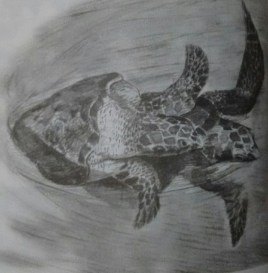
This is a week of Days—international days to mark events, or create awareness about different themes and issues. 22 May is the International Day for Biological Diversity, and 23 May celebrates Turtles–one of the millions of species

IMG_20200521_113758
Illustration CEE’s NatureScope India Turtles in Trouble 

that are part of the incredible tapestry of biodiversity.

This took me to revisit some of the teaching-learning material on these themes that we developed in CEE, among them, an Educator’s Manual on Turtles. Going through it I rediscovered the inspiring story of Archie Carr–the Turtle Man.

Archie Fairly Carr Jr., was an American zoologist whose studies unraveled many mysteries about giant sea turtles, and whose writings and conservation efforts have helped to save sea turtles from near extinction.

Archie Carr was born on June 16, 1909, in Alabama, where his father was a Presbyterian minister and his mother a piano teacher. It was his father who instilled in him his love for nature. The backyard of their home was filled with cages of snakes, frogs, lizards, and turtles that the young Archie collected. As a child he also developed a keen ear for language and music. In later years he further developed these language skills which led him to master several languages, and his work in collecting dialects from the Caribbean area and east Africa where he travelled and worked.

Archie Carr originally went to the University of Florida to study English but was diverted to biology by a professor who recognised the young student’s love for nature. In 1937 he became the first to be granted a PhD in zoology by the University.  And it was his alma mater that became his lifelong academic home; he was associated with the University for more than fifty years.

Carr was a true, and early, ecologist of his times. While his early training was in taxonomy and evolutionary biology, he combined this with his wide knowledge of zoology, botany, soils, geology, history, and cultural anthropology, and he showed his students the need to weave together all of these disciplines to begin to understand the subject matter of ecology. This breadth of understanding and perspective also permeated his writings which beautifully combined the different strands.

Above all, Archie Carr was a great biologist. His early descriptive studies of turtles set the standard of quality in the field of natural history. He published his first paper on sea turtles in 1942, but it was not until he wrote his classic Handbook of Turtles (1952) that he began to focus his research on sea turtles.  He described his early discoveries about the plight of sea turtles in his book The Windward Road particularly in his chapter The Passing of the Fleet, which was a call to arms and resulted in global efforts to conserve sea turtles from extinction

As he focused on sea turtles, Carr moved toward ecology and behaviour, although his work always retained a taxonomic and evolutionary perspective. His decades-long research at the research station at Tortuguero in Costa Rica, enabled him to initiate one of the longest lasting and most intensive studies of an animal population that has ever been done. Almost all of these studies have significance for conservation; Archie Carr was a conservation biologist long before the field was recognized.

Carr’s book The Windward Road published in 1959 deeply touched a newspaperman Joshua Powers. He sent copies of the book to twenty friends with an invitation to join a new organisation called The Brotherhood of the Green Turtle; this grew into The Caribbean Conservation Corporation, and later the Sea Turtle Conservancy, which became an international force for the preservation of sea turtles.

Like many of his generation Carr was at one time an avid hunter, but he gave this up after his travels in Africa. This change he described in his book Ulendo: Travels of a Naturalist in and out of Africa, in 1964. And also, like many hunters turned conservationists, such as Jim Corbett in India, Carr wrote extensively and evocatively about wildlife and nature. ”It was the lion song, and I sat quiet to learn it, as you learn the trill of a tree toad, or how an alligator goes. And though there may have been little real song in the sound, it came in strong and lonely through the whisper of the mist; and to me, at the time, it seemed to tell of an age being lost forever.

He was far from the stereotype of a ‘scientist’ whose highly technical and academic language could be understood only be a select band of fellow scientists. He combined his original academic interest in English, and his love for the language, with his passion for biology by writing 11 books, several of which won top awards were a model of authoritative yet lively scientific writing.

His colleagues remember him for his sense of humour that often included practical jokes, and which peeped through his writing. I like the look of frogs, and their outlook, and especially the way they get together in wet places on warm nights and sing about sex”.

His wife once jokingly told him “You’ve done a lot for turtles.” To which he replied “They’ve done a lot for me too.”

Professor Carr, died at his home on May 21, 1987. At the time of his death, he was the world’s leading authority on sea turtles.

The world that Archie Carr explored and wrote about has changed a lot today. Yet the sea turtles remain, thanks to the painstaking pioneering work,  passion and life-long mission of this brilliant scientist and inspiring human being.

Today is a good day to remember his words, “For most of the wild things on earth, the future must depend on the conscience of mankind.

–Mamata