April Blooms

In the month of April, as our Indian spring advances into the long and blazing hot summer, we have been witness to a variety of showers. These are the copious shedding of flowers from the profusely blooming trees that, in a beautiful sequence of blossoming, are heralding the change in seasons.
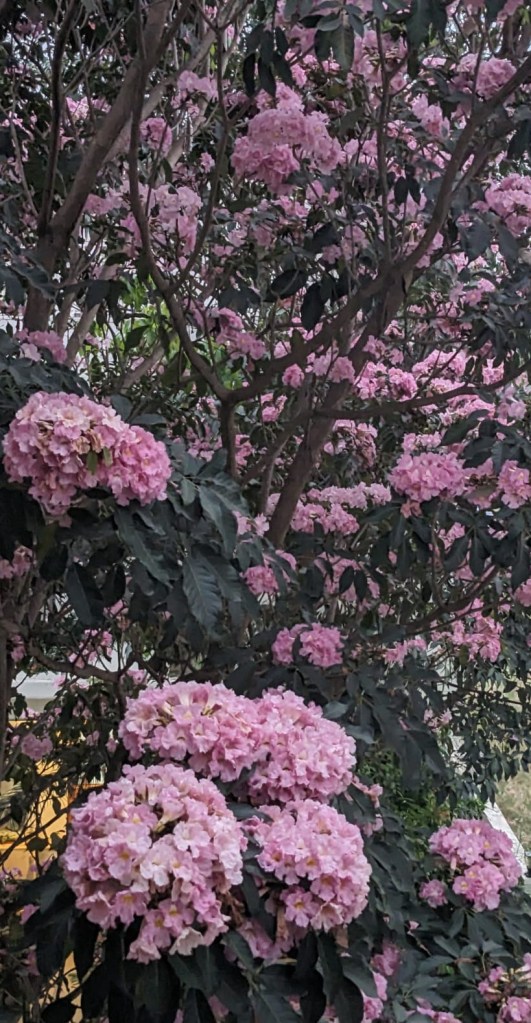
The first colours to touch the magnificent canvas were the exquisite pink-mauve hues of the Tabebuia rosea tree. This is the Rosy trumpet or Tecoma pink tree which is appropriately called Basant Rani (Queen of Spring) in Hindi. Almost overnight, the nearly leafless tree exploded into a profusion of pinkish- white trumpet-like flowers that literally wrapped the tree in a frothy cloud. Cities like Bangalore reveled in the sight of the avenues of these rosy ranis, while in my city we had to make do with a chance sighting of one of the few and scattered specimens of Tabebuia. I had the privilege of enjoying this beautiful sight of the single tree on my morning walk route. The glory was short-lived. Almost as quickly as it burst into blossom, the tree shed its flowers, overnight carpeting the area under the canopy with the delicate and faded flowers. One morning we were feasting on the full canopy, and the next morning there was nothing left on the tree but bare branches. The first delicate hues had been transferred to the canvas of summer.
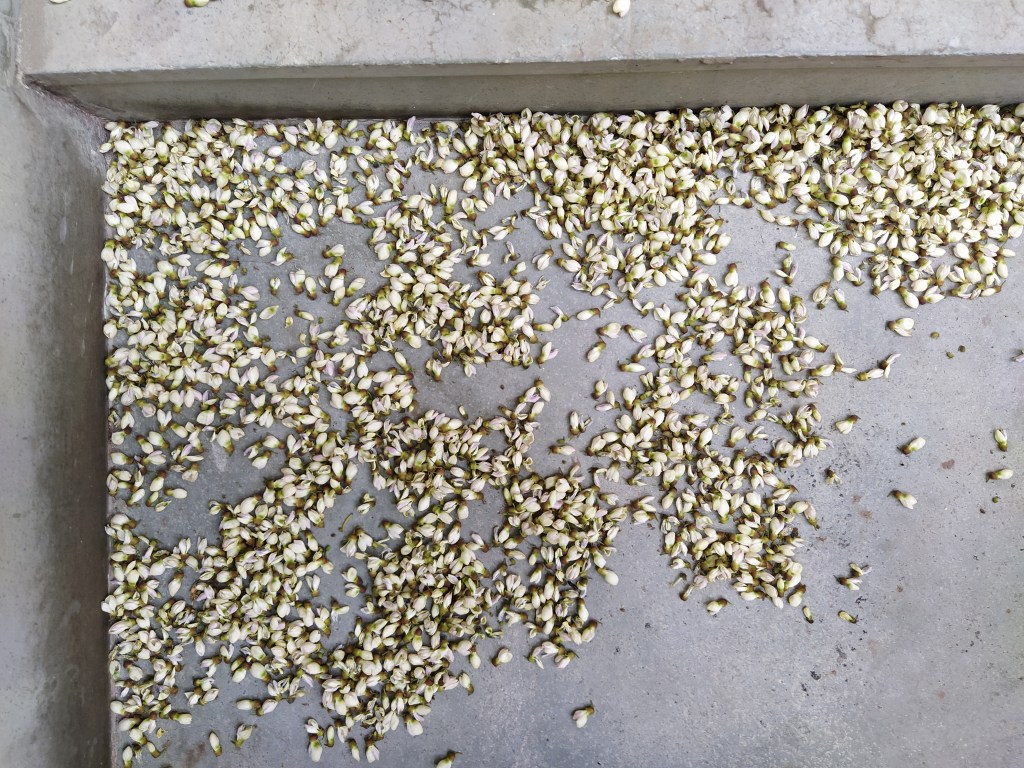
It was time to add more shades to the palette. It was the turn of the tiny eggshell-white neem flowers, and the slighter larger ivory karanj flowers to make their appearance. These emerged coyly amid the fresh foliage on their parent plants. The incredible shades of green, that defied definition or description, merged flawlessly with the blossoms. But while the leaves clung on firmly, the flowers, having played their brief but vital part in interaction with the birds and bees who thronged to feast on the nectar, began their graceful descent from the canopies, and carpeted the ground below. The neem flowers merged with the soil silently and unobtrusively. The karanj flowers made their presence felt with a crunch crunch sound when trod upon. The white faded from the canvas, even as the leaves took on deeper and darker shades of green.

As the summer sun gets stronger and the heat builds up, it is time for the palette to become more vibrant and vivid.  
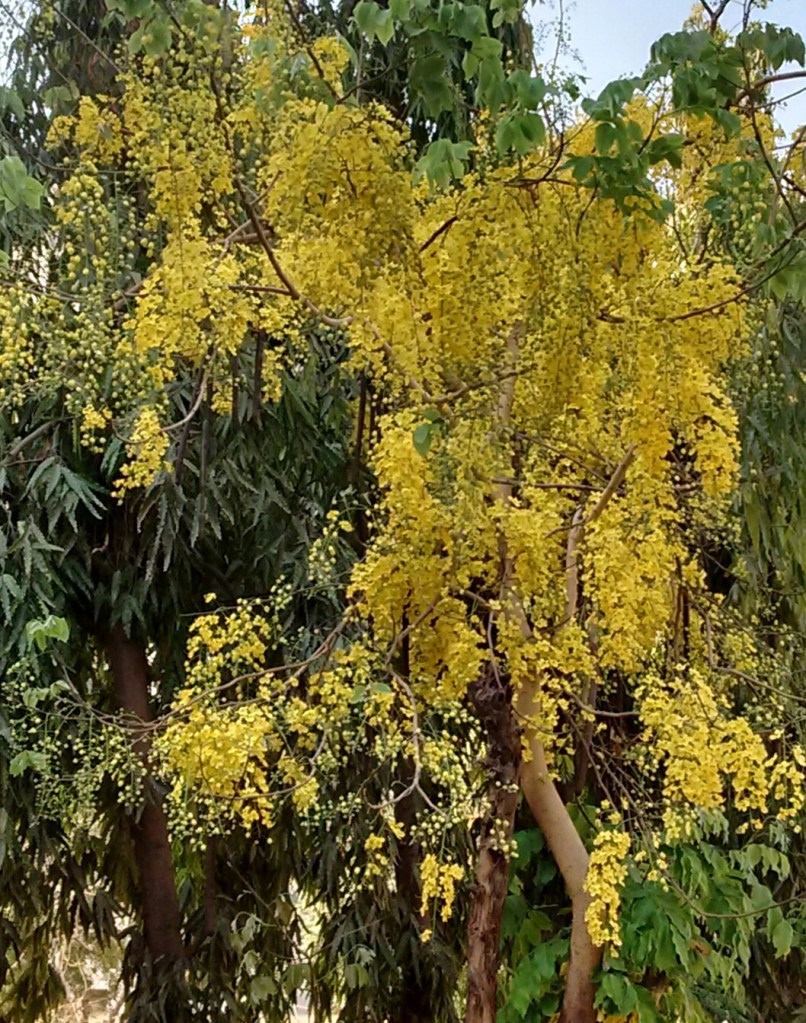
The first splash of colour is golden yellow. The Indian laburnum or Golden Shower tree is in bloom. Its masses of yellow blossoms cascade from the tree like waterfalls of molten gold. This usually nondescript tree starts with sprouting green-copper coloured leaves which are soon all but hidden in the mass of sprays of golden flowers.  In the scorching sun, the blooming flowers are a magnet for a wide range of insects and birds which are important pollinating agents. The splash of gold shines and shimmers for a few weeks, but as the heat intensifies, the gold seems to gradually lose its gloss, and the hanging blossoms gently float to the ground to further fade as they prepare to merge with the earth.

As one yellow begins to fade, the palette is already being prepared with a more vibrant shade of yellow. It is time for the Copper Pod tree to enter the stage. With its wide spreading crown of many branches already covered in rich dark green feathery leaves, the contrast made by its turmeric yellow flowers is stunning against the pre-dawn grey sky. Unlike the flowers of the laburnum that cascade downwards in long clusters, the flowers of this tree bloom as dense bunches on long upright stalks at the ends of the branches. Individual flowers are small and delicate and have brown lines at the base of the petals.

It is these flowers that give the tree its other names like Yellow Flamboyant or Yellow Flame tree. It is also often called Peltophorum which is part of its botanical name Peltophorum pterocarpum. The name Copper Pod is derived from its fruit pods which are coppery brown at first and later become dark brown. The pods are 5-10 cm long and 2.5 cm broad with one or two seeds within. The shield-shaped pods give it yet another name of Rusty Shield bearer.
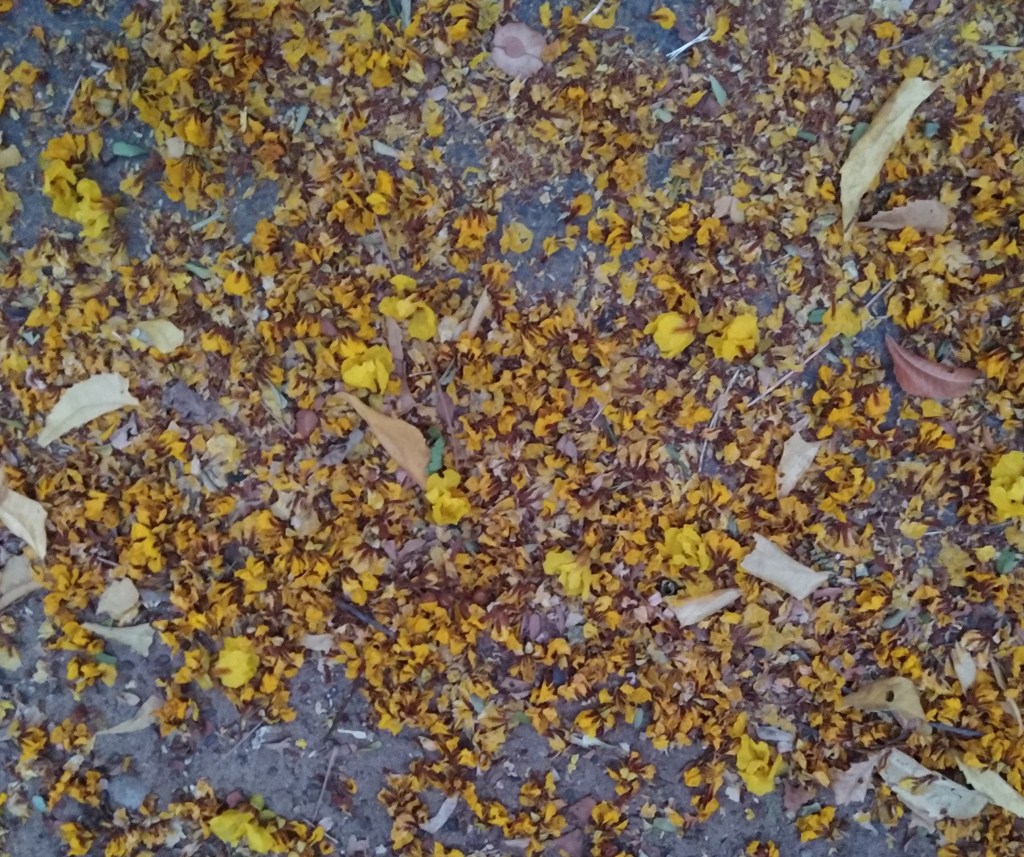
By whatever name we may choose to call it, this flamboyant tree is a great favourite for a wide variety of birds who use its abundant canopy for nesting, and who fill the air with an orchestra of calls with the break of dawn. They are joined by the silent activity of bats, squirrels and garden lizards who go about their business in the company of their feathered friends.  

Even as the old flowers turn into pods, new flowers continue to bloom, as well as shed. The fallen flowers form a molten pool at its base. Unlike the laburnum, the flowers do not fade as they dry, and continue to attract attention even after they have left their lush green abode and travelled down to the earth.

With the swirling, sweeping brush strokes continuing to fill the canvas, it is time for the palette to ready the rich oranges and reds that will put the crowning strokes. The Gulmohar is ready to take the stage.

An elegant wide-spreading tree with delicate, fern-like leaves explodes in a riot of flame-red flowers. It really looks as if the tree is afire. Up close, each flower is made up of four spoon-shaped spreading petals which are a combination of scarlet and orange-red, and one upright petal which is marked with yellow and white. The flowers blend gracefully with the foliage making a breath-taking sight that stands out not only against the lightening early morning and darkening late evening sky, but equally in the yellow-white haze of the midday sun. The flowers drift to the ground, not as the downpours of the other trees, but sprinkle the earth with a delicate pattern in shades of crimson and scarlet.
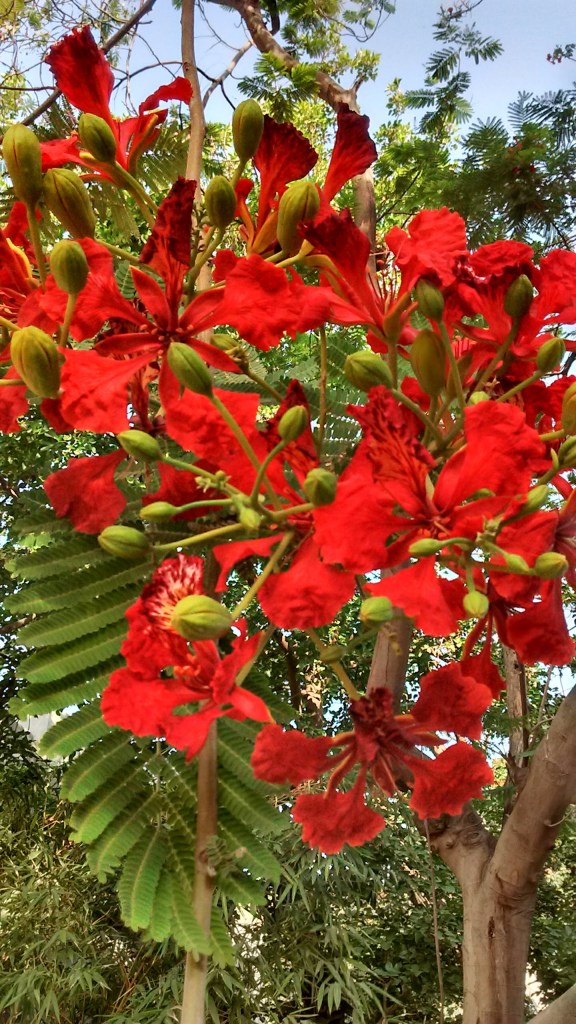
Nature’s palette has artfully mixed and matched hues and shades, light and shadow, form and function. The Indian summer masterpiece is complete!

–Mamata

Purnima Devi: Saviour of the Storks

Purnima was only five years old when she had to go and live with her grandmother. The little girl missed her parents and siblings, but her grandmother who had a small farm on the banks of the Brahmaputra river in Assam started taking her to the nearby paddy fields and water bodies, and showing her and telling her about the different birds that could be seen in large numbers. She also taught her traditional bird songs that described not only the beauty but the importance of birds in people’s lives and culture.

The seeds that were planted in those fields took deep roots. Purnima not only fell in love with birds, but would also go on to devote her professional life to studying and protecting birds. After her Master’s degree in Zoology, Purnima decided that she wanted to focus on a bird species that she had grown up seeing, but whose numbers seemed to be on the decline. This was the Greater adjutant storks—large majestic birds named for their stiff-legged, almost military gait. These carnivorous birds are “cleaners of the ecosystem” and play a significant role in the food chain in terms of nutrient cycling and ecosystem regulation,

Purnima started her doctoral research on Greater Adjutants in 2007. As she studied their nesting behaviour, Purnima realized that the birds needed tall trees where they could make their platform nests. But with rapid disappearance of natural forests and wetlands, these birds had to seek nesting trees wherever they could find them. The only remaining large trees were in the villages, close to the homes of villagers. But these birds were far from welcome there.

Hargila (which means ‘bone swallower’) as the storks are locally called are scavengers and bring bones and dead animals to their nests, these often drop to the ground. Along with the birds’ foul-smelling droppings, these birds are not the most pleasant of neighbours to have. Villagers even cut down huge old trees in their backyards to prevent these birds from nesting. The birds were also perceived as bad omens or disease carriers. With the declining natural tree cover, and the hostility of the villagers, the survival of Adjutant storks was in jeopardy.

In 2007, while she was still a researcher, Purnima was present when a large tree was cut down, bringing down the nest along with nine chicks. Her attempts to explain to the villagers about the ecological significance of such scavenger birds, were met with ridicule by the local people. One local resident even scoffed her saying that she should work in his house to clean up the storks’ stinking messes. Rather than being put off by this, Purnima chose to abandon her academic research and to focus instead on working with the local communities to change their perceptions towards this bird.

Purnima decided to start by reaching out to the women, who did not often have a voice, but who could potentially influence the entire family. Her first step was to gain access to the nests which were often in trees on family land. This was initially by getting close to the individual women who were the homemakers. Purnima then started to get the women together through common events such as cooking competitions. She began by appealing to their maternal instincts by stressing the importance of safe nesting sites for the birds, while also discussing their ecological importance. She told them that when our children are young they also make a mess at home, but we still love and protect them. More and more women started coming to these meetings, and joined in the efforts to protect nesting sites and rehabilitate chicks that had fallen from the nests. They organised ‘baby showers’ to celebrate newly-hatched chicks; they revived the traditional songs, poems, festivals and plays that featured these birds.

Purnima realized that for sustained community engagement they needed to take ownership. She helped to provide the women with weaving looms and yarn so that they could create and sell textiles with motifs of the hargila. This initiative provided livelihood options, supported women to become entrepreneurs, and boosted their sense of pride and ownership, as well as raising the profile of the stork. Today the “Hargila Army” consists of over 10,000 women. The Hargila army members call their leader Purnima hargila baideu, or stork sister. The power of community conservation is evident. This has also led to the involvement of the local government departments to recognize, and in some ways support the community efforts.

Since Purnima Devi Burman started her conservation programme, the number of nests in the three villages of Kamrup district in Assam, where she first started her efforts have risen from 28 to more than 250, making this the largest breeding colony of Greater adjutant storks in the world. In 2017, Barman began building tall bamboo nesting platforms for the endangered birds to hatch their eggs. Her efforts were rewarded a couple of years later when the first Greater adjutant stork chicks were hatched on these experimental platforms.

Safeguarding single nests is not enough, the storks’ habitats also need to be restored. The Hargila Army has helped communities to plant tens of thousands of saplings near stork nesting trees and wetland areas in the hope they will support future stork populations.

The Greater adjutant stork is the second-rarest stork species in the world. It is also listed as ‘Endangered’ as per the IUCN Red List which notes that there are only about 1200 of these storks remaining in the world. The dramatic decline in their population has been partly driven by the destruction of their natural habitats, especially wetlands, and the ruthless destruction of their nesting trees. Assam in India is home to the largest population (around 1000) of these birds. This is in no small measure due to the efforts of Purnima Devi Burman and her Hargila Army. 

Purnima Devi’s efforts have also received wider recognition. She has received several awards. She was the recipient of the 2022 UNEP Award for Champion of the Earth for Entrepreneurial Vision. The annual awards are the highest environmental honour that the UNEP confers on individuals and organisations whose actions have a “transformative impact” on the environment.

Purnima Devi was recognized for “pioneering conservation work that empowered thousands of women, creating entrepreneurs and improving livelihoods while bringing the Greater adjutant stork back from the brink of extinction. Her work has shown that conflict between humans and wildlife can be resolved to the benefit of all. By highlighting the damaging impact that the loss of wetlands has had on the species who feed and breed on them, she reminds us of the importance of protecting and restoring ecosystems.”

As we mark Earth Day on 22 April, this is a good time to celebrate such Champions of the Earth who have made it their life’s mission to Protect and Conserve.

–Mamata

There’s a Word For It!

I recently read a book by Jhumpa Lahiri. She is perhaps best known for her novel The Namesake which was also made into a film. This book, titled In Other Words, is very different in that it is not fiction but rather an autobiographical work that describes the author’s determination, and process, of not just learning a new language—Italian–but writing a book directly in this acquired language. The English version is a translation (not by her) of the original in Italian.

One of the key observations and learnings from this process is the realization that every language has so many nuances that are closely linked with the culture and history of its land, that on many occasions it is almost impossible to find a satisfactory equivalent, let alone a appropriate ‘translation’ of the word. She describes her experiences of actually conversing with local people, even after having academically ‘mastered’ Italian, and the nervous jitters it caused her. It would be interesting to know if the Italians have a specific word for this feeling. Well, the Japanese do! Yoko meshi is a Japanese word that describes just this feeling! 

As someone who does some basic translation I too often find that Indian languages have such a gamut of words that so aptly describe such nuances. In the English language these are often simply clubbed into a single word; a word that is unable to capture the spontaneous response or image that the word evokes in the original language.

This is true of all languages and cultures. It is great fun and invigorating to come across such words. Here is a sample from my collection!

Honnomushi is the Japanese word for ‘bookworm’ and its literal translation is found in English as well as other languages. But what about the bookworms who accumulate books with all good intentions of reading them some day? Well the Japanese have a word for that too–Tsundoku.

Tsundoku. The word literally means ‘reading pile’. It derives from a combination of tsunde-oku (to let things pile up) and dokusho (to read books). It generally refers to the tendency to buy books and let them pile up around the house unread. It can also refer to the stacks themselves. The word carries no pejorative sense in Japanese. Rather it connotes a cheerful whimsy: wobbly towers of unread books, each containing an unknown world. I am happy that now my stash of books “saved for a rainy day” has a respectable name!

Aspaldiko. Besides the joy and comfort of books, it is friends that make life worth living. While there are some that we meet regularly, there are some who one cannot meet as often. Meeting an old friend after a long time has a special excitement and delight. Well the Basque people have a word exactly for that feeling. Aspaldiko. It refers to the joy of catching up with someone you haven’t seen in a long time. A perfect word to the next time one reconnects with an old friend!

Tartle. There is the aspaldiko of meeting up with that special friend. But another way of meeting up is the organized ‘class reunion’. Meeting with literally ‘old’ faces, decades after one last saw each other, has its moments of embarrassment. The face is sort of familiar but the name that matches the face eludes, at the precise moment when you meet face-to-face. More red faces when you don’t know how to introduce the same to your spouse or children. Well the Scots have just the word for this—Tartle! This sums up the embarrassment and panic you feel when you forget someone’s name before introducing them. The word even comes handy to excuse your apparent rudeness. All you need to say is “Sorry for my tartle!”

Shemomedjamo. Reunions are also an occasion to eat, drink and be merry. As the feasting continues, you know when you’re really full, but your meal is just so delicious, you can’t stop eating it. The Georgians have a word for this mixture of gluttony and gastronomic distress. Shemomedjamo. This word means, “I accidentally ate the whole thing.”

Pelinti. In the process of getting to the stage of Shemomedjamo, you reach out for that slice of freshly arrived pizza. The melted cheese is irresistible. You bite into the piece and that tanatalizing cheese immediately sticks to your palate causing sheer agony. You frantically move the piece in your mouth hoping for some relief. While this may render you temporarily speechless, in Ghana they have a word for just this moment. Pelinti! You can scream Pelinti as you move the hot food around in your mouth in a desperate attempt to cool it before swallowing.

Abbiocco. You have feasted to the point of overeating, and perhaps had occasion to scream “pelinti”. The belly is happy and the senses replete. Conversation slowly ebbs, and it’s time for the next scene in the play. Most of us know that this calls for a siesta! Well the Italians also have a perfect word for this–abbiocco, literally meaning to collapse with exhaustion, but more effectively used to denote the slothful feeling of the need to lie down after heavy eating and drinking.

Lagom. While many cultures celebrate the joys of indulgences and their languages have appropriate words to define these excesses, the Swedes are more restrained, with a more functional approach to living. And reflecting the same approach is a single word Lagom. The word describes a general contentment with the “enoughness” of what’s presented to you in the moment. Lagom means not too much and not too little. It asks us to create balance in our lives by taking everything in moderation, avoiding both excess and deprivation.

Well it’s each to their own formula of a good life! Provided that one can have brief moments of Gigil. This giggly-sounding word comes from the Tagalog language of the Philippines. Gigil as defined is more than joy, and not quite pure excitement, but somewhere in the middle of joy, excitement, and a giddy heart-warming feeling. It is such moments that keep us alive.

Have a good life!

–Mamata

Say Sorry!

There is an old rhyme that begins with: For the want of a nail…and ends with (through the domino effect) …a kingdom was lost. In recent days, there has been a situation where: For the want of an apology….a Parliament was adjourned. This was caused by the obdurate demand for an apology by one side in confrontation, with the equally intransigent refusal to apologize by the other. 

Saying “sorry” is probably the simplest and oldest form of an apology. An apology is defined as a regretful acknowledgement of an offence or failure. In an age where increasingly the ‘self’ rules the stage, where a sense of entitlement dominates much of human engagement, and where aggression and intimidation are a part of day-to-day life, this kind of acknowledgement is sometimes perceived as a form of cowardice or a sign of a non-confrontational (passive) person. This avoidance or denial of acknowledgement of wrong may spark off immediate confrontations that may spiral out of control, or a festering of resentment that plants the seed of future ‘revenge’. This holds true for individuals, communities and even countries.

Karina Schumann, an Associate Professor of psychology at the University of Pittsburgh has been researching and writing about factors that help people successfully manage their conflicts and respond to challenging social interactions in pro-social ways. Her work focusses on apologies as a key factor in this area. It looks at different kinds of apologies from inter-personal one-on-one apologies, to institutional apologies, to public apologies, particularly by politicians.

In the case of interpersonal conflicts Dr Schumann’s research indicates that a common response that we have when we’ve done something wrong is, ‘this does not feel good to us, we want to push away blame from ourselves’. And we can do this in a variety of ways. We blame the other person, we blame the situation, we think about all the extenuating circumstances that affect our behaviour, or we minimize the consequences of our actions for that other person.

Often apologies take the approach that “Well if you are offended, I’m sorry.” This implies somewhere that while the offender is expressing remorse or sympathy for the fact that the recipient felt bad, he or she is not really taking responsibility or accountability for the offense. This is a way of justifying our actions while morally disengaging ourselves. This kind of apology, in some ways, tries to shift the blame onto the victim. The apologies on social media during the MeToo movement are examples of this kind of apology. One key factor for this attitude is the lack of empathy with the person one has offended.

A sincere apology does not make justifications for the behaviour the person is apologizing for, and does not blame the victim. The person offering the apology does not excuse their own behaviour. An acceptance of responsibility is core to an apology.

Public apologies happen on the public stage, often delivered in some sort of official way, like a government apologizing on an official stage for a historical injustice. Sometimes corporations might put out a statement of apology to their consumers or clients. Sometimes celebrities apologize, and politicians apologize for their own misdemeanours. These are sometimes issued through an official press conference or via Twitter or YouTube. These apologies are issued in a reactive way. Research indicates that people are generally sceptical about such apologies. It is assumed that they are being offered for strategic reasons as opposed to sincere reasons, or that the public figures were pressured into it, and they have ulterior motives. To come across as meaningful, the quality of public apologies must meet a higher bar than an interpersonal apology.

Whether personal or public, to be genuinely accepted an apology must communicate empathy and concern. It is not enough to say “I am sorry”. The messages that should come across are: “I care about you. I care about our relationship. I want to make this better”. They should send a signal: “We care about this. This matters. We are committed to doing better.”

An apology can be the first step in initiating the process of forgiveness.

A beautiful passage from one of my favourite authors Alexander McCall Smith tells us how:

Forgiveness is at the heart of the way we live our lives–or should be. So when we teach our children about the things they ought to know about the world—about how not to touch fire, about how to wash their hands, or put on their shoes—all these things, we should also remember to teach them about forgiveness. We must teach them that when another person wrongs us—hurts us perhaps—we should not strike back, but should be ready to forgive. We must teach them that if we do not forgive them, then we run the risk of being eaten up with hatred inside, and that hatred is like acid, that it will grow and gnaw away. That is why forgiveness must be taught at the beginning, when we are teaching them about these first things.

Today, more than ever before, the world is in desperate need of empathy and forgiveness. The seeds need to be sown early, and nurtured with compassion.

–Mamata

I am a Book: Read Me

Many of us (from an earlier “fairy tale” generation) grew up with stories of the Ugly Duckling, The Emperor’s New Clothes, The Princess and the Pea, Thumbelina and many more. These were originally written by the famous Danish writer Hans Christian Anderson. A prolific writer of plays, travelogues, novels, and poems, he is best remembered for his literary fairy tales which have been translated into more than 125 languages.

Hans Christian Anderson was born on 2 April 1805. Two hundred years later, with the new trends in children’s literature, the author and his genre of children’s literature may not be as well known, or widely read. However his lasting contribution to children’s literature is celebrated by marking his birthday as International Children’s Book Day, to inspire a love of reading and to call attention to children’s books.

Celebrated on April 2every year, this is a day that celebrates children literature in all of its forms and acknowledges the writers which create it. It is an event that is sponsored by the International Board on Books for Young People (IBBY), a non-profit agency that was created in 1952. The organization represents an international network of people from all over the world who are committed to bringing books and children together. In 1967, this body created International Children’s Book Day to promote the six key areas deemed important by them:

To promote international understanding through children’s books; to give children everywhere the opportunity to have access to books with high literary and artistic standards; to encourage the publication and distribution of quality children’s books, especially in developing countries; to provide support and training for those involved with children and children’s literature; to stimulate research and scholarly works in the field of children’s literature, and to protect and uphold the Rights of the Child according to the UN Convention on the Rights of the Child.

Each year a different National Section of IBBY has the opportunity to be the international sponsor of ICBD. It decides upon a theme and invites a prominent author from the host country to write a message to the children of the world and a well-known illustrator to design a poster that sends a message to all the children of the world.

This year IBBY Greece is the official sponsor of the International Day of Children’s Books. The chosen theme is ‘I am a book, read me’. The theme celebrates the power of children’s books in promoting values of equality, diversity and inclusion, as well as connecting people through tolerance and understanding. Greek author Vagelis Iliopoulos and illustrator Photini Stephanidi have collaborated to create a poem and poster that remind us of these messages.

I am a book, read me

 I am a book.

You are a book.

We are all books.

My soul is the story I tell.

Every book tells its own story.

We can look quite different –

some big, some small,

some colourful, some black and white,

some with a few pages, some with many.

We may say similar or completely different things,

but that’s our beauty.

It would be boring to be all the same.

Each of us is unique.

And each of us has the right to be respected,

to be read without prejudice,

to be given space in your library.

You may have opinions about me.

You may choose to question or comment on what you read.

You can put me back in the library

or hold me close and travel with me a long way.  

 But never let someone throw me away

or send me to another shelf.       

Never ask for my destruction, nor allow anyone else to do.

And if a book ever comes from another shelf,

because someone or something drove it away,

make room.

It fits next to you.

Try to feel as it feels.

Understand it. Protect it.

You may be in its place tomorrow.

 Because you are a book too.

We all are books.

Come on, say it loud so everyone can hear you.

“I am a book, read me.”   

When a child opens a book for the first time, magic happens. Children’s books are doorways to delight, information, engagement and entertainment. Books open numerous windows to the rich diversity and different perspectives in their own unique way. Stories allow them to see through different eyes, and create empathy. Books help them understand that no matter who we are, or what our experiences may be, we are not alone in the world. They expand the child’s universe beyond time and place. They inspire new ways to think and new ideas; they spark imagination. Books give children an opportunity to experience something in their imaginations before it happens to them in real life.

As author Rebecca Solnit beautifully puts it: In some books you meet one remarkable person; in others a whole group or even a culture. Some books are medicine, bitter but clarifying. Some books are puzzles, mazes, tangles, jungles. Some long books are journeys, and at the end you are not the same person you were at the beginning.

In a time when even very young children are exposed to, and subsequently get hooked on to the seductive allure of digital media, it is all the more urgent and critical to remind ourselves of the unmatched power of physical books and storytelling.  Walt Disney said, “There is more treasure in books than in all the pirate’s loot on Treasure Island”. This Sunday, whether we are a grandparent, parent, sibling, friend or neighbour, we can all start by sharing these treasures with a child.

–Mamata

Shinrin-yoku: Forest Bathing

International Day of Forests is marked on 21 March every year to highlight the importance and significance of forests and raise awareness about forest restoration. Much has been written about the ecosystem services that forests provide. They purify the water, clean the air, protect the soil, help sequester carbon to fight climate change, and provide food and medicines. Healthy forests are vital for all aspects of a healthy planet, from livelihoods and nutrition to biodiversity and the environment.

Every year the United Nations declares a theme for the International Day of Forests that addresses one of these many aspects of the important role of forests. The theme for 2023 is Forests and Health. This highlights the many connections between human health and forests—from providing food and other life-sustaining resources, including life-saving medicines. 

The contribution of forests on physical health have been well documented, but perhaps not as well-known are the therapeutic effects on mental health. This area has been the field of study of Dr Qing Li who has researched and documented what intuition and common sense have long believed: that being among trees is healthy; it can have positive effects on sleep, energy levels, immune function, and cardiovascular and metabolic health.

This research is well known in Japan and the idea has become popular under the name Shinrin-yoku or Forest bathing.  Forest Bathing is described as the art of plunging oneself in nature to revitalise and enliven the mind, body, energy and to trigger the therapeutic elements of nature.

Forest bathing or therapy originated in Japan in 1980s. Dr. Qing Li is considered to be the founder of this therapy. Dr Qing Li was born in a small village in China and grew up surrounded by nature. He came to Japan in 1988 to study advanced medicine where he was focusing on the effects of environmental chemicals, stress, and lifestyle on immune function and human health. During this period he spent a week camping on a thickly wooded island with his friends. This visit had a profound impact on him, not just personally, but also changing the direction of his professional life.

Experiencing the feeling of well-being amidst the trees, and since it is well-known that stress inhibits immune function, Dr Qing Li developed the hypothesis that immersion in the forest may have a beneficial effect on the immune system by reducing stress. He tested this hypothesis by conducting many experiments on patients with physical as well as mental health issues. He looked at the effects of walking in forests and of phytoncides (the scents that trees give off) on immune cells, stress hormones, blood pressure and heart rate. He compared the effects on mood and mental state (anxiety, depression, anger, fatigue, and confusion) of walking in forests versus walking on treeless city streets.

He focussed his research on what he calls ‘forest medicine’. As he describes this: Some people study medicine, some people study forests; I study forest medicine to find out all the ways in which walking in the forest can improve our well-being.

Forest medicine which encompasses the effects of forest environments on human health is recognized as a new interdisciplinary science, belonging to the categories of alternative medicine, environmental medicine, and preventive medicine.

The terms Shinrin-yoku (literally Forest (Shinrin) bathing (yoku) in English) were first defined in a paper he wrote in 2007.

In his research, Qing Li has found that forest bathing had a healing effect on the mind as well as the body. It reduced blood pressure, reduced stress, improved mood, increased ability to focus, even in children with ADHD, accelerated recovery from surgery or illness, increased energy level, improved sleep, boosted immune system functioning, with an increase in the count of the body’s Natural Killer (NK) cells.

As an outcome of Dr Qing Li’s research, the government of Japan established Shinrin-yoku as a formal practice. This was not only to encourage city-dwelling people to connect with nature. The idea was also part of a campaign to protect the forests: If people were encouraged to visit forests for their health, they would be more likely to want to protect and look after them. The Japanese government invested a lot of money in forest bathing with the goals of protecting the forests, promoting human health, and preventing lifestyle-related diseases.

So what exactly is Forest bathing? This is not exercise, or hiking, or jogging. It is simply being in nature, moving slowly, and connecting with it through all our senses: sight (colours), hearing (forest sounds), taste (fruits and herbs), smell (fragrances from different plants) and touch (feeling textures of leaves and barks). So Shinrin-yokuis the entire experience of immersion in the forest atmosphere, or taking in the forest through all our senses.

The idea behind Shinrin-yoku is very simple: it is the belief that if a person visits a natural area and explores it in a relaxed way, they can achieve physical and mental benefits that are healthy and restorative. It is a form of preventative health care that can be incorporated in nature settings anywhere. You don’t necessarily have to travel to a forest to experience the effects of Shinrin-yoku. Even half an hour in a small park can work its magic. As Dr Li reminds us:

The best way to deal with stress at work is to go for a forest bath. I go for shinrin-yoku every lunchtime. You don’t need a forest; any small green space will do. Leave your cup of coffee and your phone behind and just walk slowly. You don’t need to exercise, you just need to open your senses to nature. It will improve your mood, reduce tension and anxiety, and help you focus and concentrate for the rest of the day.

Today, world over, we have become an increasingly urban and indoor species, focussing solely on screens for a large part of our waking hours. All aspects of our life and lifestyles have led to an escalation of stress, anxiety and depression. Before we sink further into these morasses, let’s take a few minutes to heal ourselves in nature.   

Forests and Health: the theme of International Day of Forests this year is best captured in the words of the guru of Shinrin-yoku:

Forests reduce our stress, boost our immune system and help us to live longer, better and happier lives. Our health and the health of the forest go hand in hand. When trees die, we die. If our forests are unhealthy, then so are we. You can’t have a healthy population without healthy forests.

–Mamata

Surprise Sighting: Indian Grey Hornbill

As part of a recent project I have been reading about the different species of hornbills in Arunachal Pradesh. These birds are characterized by their magnificent beaks and colourful plumage, with variations among the different species. Living right across the country in the arid city of Ahmedabad, far away from the verdant forests of Northeast India, it was a delightful surprise to spot a pair of hornbills amongst a cluster of trees amidst the concrete jungle. These were not the eye-catching ones but their less conspicuous cousins, the Indian grey hornbills.

Among all the hornbill species in India, the Indian grey hornbill is the most widely distributed and can be found across most parts of the subcontinent. Unlike the other forest-loving hornbills this species prefers dry plains, foothills, and open habitats. It can be seen in deciduous forests, orchards, thorny scrub jungles, gardens, and, as it did for me, even surprise with sightings in the middle of a busy city. 

Hornbills belong to the family Bucerotidae, characterised by the casque or protuberance on their beaks. These birds are usually large, with a long and downward curving beak sporting an elaborate casque, and colourful bare skin around the head

The Indian grey hornbill (Ocyceros birostris) belongs to the genus Ocyceros, which literally means ‘pointed horn’. The species name birostris means ‘two beaks’. This hornbill has a long, curved ivory-coloured beak that blackish at the base, and has a sharp, narrow protruding casque. Male and female birds look very similar, though the female is slightly smaller and has a less prominent casque. These hornbills are also smaller than the other hornbill species, growing up to half a metre in length.

Unlike the other colourful hornbill species found in India, the Indian grey hornbill, as its name indicates, is not brightly coloured. Instead, it has an ashy, silvery-grey body, with long tail feathers that end in a band of white. Adults have red eyes and the skin around the eyes is grey, while juveniles have brown-orange eyes with reddish-orange skin around; and beautiful eyelashes.

The Indian grey hornbill is primarily an arboreal bird. It flies with a rapid beating of its wings followed by a short glide. The pale edges on the wings and tail, and its long central tail feathers are noticeable when it is in flight. As they fly they give a series of short “kek-kek-kek” calls, and when they perch on trees they make a high-pitched squealing sound. The birds are usually seen in pairs or small groups. They feed mainly in canopies, but descend to the ground only to dust bathe, pick up mud pellets to seal their nest cavity, to pick up fallen fruit, or to hunt insects or reptiles.

The birds are fruit lovers, with fleshy figs and berries topping their list. They also feed on jamun, ber and neem fruits. A fruiting ficus tree is a popular partying spot for small flocks of grey hornbills. This love for fruits makes these birds important seed dispersers. Their diet also includes insects, reptiles, frogs and mice which they actively hunt. Some even feed on poisonous animals such as scorpions and snakes.

It is this adaptability in diet, as compared with other hornbills that are specialist feeders, that has enabled the Indian grey hornbill to inhabit a variety of landscapes, even close to human habitation.

The fruit-eating habit of hornbills is an important contributor to seed dispersal. Seed dispersal is vital as it ensures the propagation of trees. It also enables the trees to occupy new areas, thereby increasing green cover.

Hornbills are among the very few birds that can feed on fruits with large seeds. They digest only the fleshy parts of fruits that they swallow and then regurgitate the seeds, spitting them out, or defecating the seeds intact. As the hornbill flies from tree to tree, or during the nesting season flies back and forth over long distances to search for and carry food for its mate, the regurgitated cleaned seeds are dropped far and wide, enabling them to grow into trees far from the original trees from which they originated.  

Thus hornbills are important in keeping the forest alive. If we lose hornbills, many forest trees that depend on them to spread their seeds may eventually disappear from the forest too. Hornbills symbolise not only the health of a forest, but also a key to their continued survival.

All hornbills are cavity nesters. While they cannot build their own nests or dig cavities, they use existing holes in a variety of trees to make their nest. What makes all hornbills distinct is their unique nesting behaviour. The process begins during a month-long courtship when the male presents the female with food. As they embark on playful behaviour the pair also check out tree cavities to select their nesting site. Having done this, the two prepare the nest by cleaning it, creating the wall lining, and undertaking repair work. Once the nest is ready, the female prepares to confine herself in the nest while the male continues to prove his ability to provide for her needs by bringing food and nesting material. The female then seals the nest entrance with her own faeces, food and bark fragments, and mud pellets brought by the male. Only her beak protrudes out from the sealed nest. This helps to protect the eggs and chicks from predators. She lays her clutch of between two and five eggs and incubates them for over 20 days. Throughout this period the male diligently flies back and forth, feeding his mate through her protruding beak. While confined in the cavity the female moults all her feathers. The mother emerges from the nest shortly before the chicks themselves are ready to fly, and the chicks once again seal the nest from the inside, even as they continue to be fed. Now both the parents share in providing food and caring for the chicks. One of Nature’s many marvellous examples of nurturing the young.

This unique nesting habit of hornbills has also, in recent times, become a threat to the very existence of all species of hornbills. The fact that they use the same nests over the years makes it imperative to protect that their nesting trees, and the habitats where they grow. In the forests of northeast India the one of the biggest threats to these birds has been the destruction of this habitat by fragmentation, deforestation and clearance of forest regions for agriculture and dams. 

As the forests are being denuded, the hornbills are losing not just places to nest and breed; the loss of native trees also affects their diet, posing a significant threat to their survival.

A unique community-based initiative to protect nesting trees of hornbills is the Hornbill Nest Adoption Programme spearheaded by the Nyishi tribe in the Pakke Tiger Reserve in Arunachal Pradesh. The tribe which traditionally hunted hornbills for their casque which were a symbol of their tribal identity have become active partners in protecting and conserving the hornbill nesting areas. The programme invites donors across the world to become ‘hornbill parents’ by adopting hornbill nests. The donations help pay salaries to the local community nest protectors who patrol the area, and ensure that the habitat continues to invite these birds. What an appropriate way to celebrate a bird that is, in its unique way, a diligent nest protector and parent.

–Mamata

Early Feminist: Mary Wollstonecraft

Earlier this week Meena wrote about the characteristics of ‘good girls’ that include: fear of disappointing others, fear of speaking out for fear of hurting others, need to always excel, avoid conflict, obey rules.

Good girls make up the majority in every generation. And certainly they are no less in any way than the others. But it is the few in each generation, who due to a combination of inbuilt traits, circumstances, passion and perseverance defy these norms. It is these path breakers who open up previously untrodden terrain, and clear the path for their contemporaries, and the generation to follow.

Today it is fashionable to be a ‘feminist’ and women are fighting for “more”. More avenues for better education and employment, more freedom of choice, more say in their own life and matters. This is a good time to remember that this “more” is a luxury compared with a generation of women who did not even have “basic” access to any of these things. And that it is women who have fought hard battles to achieve what we take for granted today.

Mary Wollstonecraft was one of these women.

Mary Wollstonecraft was born April 27, 1759, in London in a family that had once been prosperous but had been reduced in circumstances. While her elder brother, and the favoured child received a proper ‘gentleman’s education’, Mary had only a basic formal education when she learned to read and write. This was probably the root of her life-long battle for equal educational opportunities for women. In the meanwhile Mary taught herself a number of languages and spent considerable time exploring a library that one of her friends had. Through these friends, she met Fanny Blood, two years older and skilled at sewing, painting, and the piano. She inspired Mary to take initiative in cultivating her mind.

The financial situation of her family necessitated that Mary find some form of employment. In those days, opportunities for girls from this background were limited to teaching, needlecraft, and being a lady’s companion. At 19 Mary got a job as a live-in helper for a wealthy widow. She could not take it for more than a year. Her independent mind and belief in a girl’s right to a good education led her to found a small girl’s school in London in 1784, with her sister Eliza and friend Fanny Blood. The school closed two years later but this period served as the starting point for Mary’s radical ideas about the necessary equality of female and male education, and belief that the government was responsible for making this happen. She expressed these strong views in her book Thoughts on the Education of Daughters which was published by the radical publisher Joseph Johnson in 1786.

In the meanwhile Mary also made the radical decision to support herself as a professional writer, something very few women of the time could do without an aristocratic sponsor. Settling in London to pursue this new career, she did translations from French and German, read widely, and wrote reviews. She became a regular contributor to Johnson’s new literary magazine, the Analytical Review . During this period she was also introduced to such radical freethinkers as Thomas Paine and William Godwin, and she thrived in this intellectual circle.

In Western Europe during the late 18th century, single women had little protection under the law and married women lost their legal identity. Women couldn’t retain a lawyer, sign a contract, inherit property, vote, or have rights over their children. Mary’s career choice, and especially her decision to write about political and philosophical issues, was not merely unconventional, it was perceived as ‘unwomanly’ and ‘unnatural’. But as she reflected “I am then going to be the first of a new genus”. It was a harsh struggle every step of the way, but Mary continued to pursue her beliefs, and further develop her ideas. Based on her own experience of denial of education, and building upon the thinking in her earlier book, Mary argued that the educational system deliberately trained women to be frivolous and incapable and that if girls were allowed the same advantages as boys, women would be not only exceptional wives and mothers but individuals who could contribute better to society. She declared that both women and men were human beings endowed with inalienable rights to life, liberty, and the pursuit of happiness. To suggest women were equal to men was close to blasphemy at the time.

Mary grew up in England during the Enlightenment, an intellectual period that advocated for the use of reason to obtain objective truths. It is this very advocacy for reason that was the guiding principle for her book A Vindication of the Rights of Woman, published in 1792. The book argued that because women share the gift of reason and have the same innate human value as men, both women and men should be educated rationally, allowed to exercise their natural abilities, and held to the same reasonable standards of behaviour. In order to contribute at the same level as men, women must be educated equally to men. If women were not afforded this opportunity, social and intellectual progress would come to a halt. As she wrote in the introduction to the book: My main argument is built on this simple principle, that if she be not prepared by education to become the companion of man, she will stop the progress of knowledge and virtue. 

The trailblazing book went a step ahead of education for girls. It argued that girls and boys should be co-educated, and that women and men should share parental responsibilities. It also insisted that women should be free to enter business, pursue professional careers, and vote if they wished.

A Vindication of the Rights of Woman sold out within a year, and Johnson issued a second edition. An American edition and translations into French and German followed.

Mary Wollstonecraft’s personal life was equally unconventional for the time. While in France she fell in love with an unscrupulous American businessman and had a child with him. He abandoned both mother and child. Mary was heartbroken and even attempted suicide. Later she was in a relationship with William Godwin and when she was carrying his child, the two married but maintained separate domestic establishments. On 30 August 1797 Mary went into labour and after about 18 hours she gave birth to a daughter, also named Mary. Thereafter she had postpartum complications, and died eleven days later at the age of 38.

Her daughter, who grew up to be Mary Shelley the author of the book Frankenstein, never knew her mother in life, but only through her writing. Mary Wollstonecraft had been working on a novel when she died. In this she wrote, almost as if addressing her daughter: Always appear what you are, and you will not pass through existence without enjoying its genuine blessings, love and respect.

Mary Wollstonecraft lived boldly, and died young. But her ideas went way beyond her own time and life. They planted the seed which eventually led to the Suffrage Movement in the early 20th century. Her book A Vindication of the Rights of Woman is considered the earliest and most important treatise advocating equality for women. This essay is often seen a classic of rationalist feminism that laid the foundation of modern women’s rights movements in the Western world.

–Mamata

It Begins With an Idea

It began with an idea. Meena mailed to say “why don’t we start a blog?” I was all agog, but cautious. “A blog? What do we know about blogging?”  We were two people who shied away from anything “too techy”, and equally from opening up our thoughts and broadcasting them far and wide. How would we deal with a new medium of communication, and more important, what would we communicate? And why would anyone be interested in what we had to say? But somewhere the spark was kindled. After all we had been writing partners for decades. We had written as part of our work as environmental educators, then, while we had some freedom about how to write something, the “what to write” was often a given. But that had been a while ago.

“Let’s think about it” I countered. “We need time to get our act together, as they say.” But Meena said, “No if we procrastinate, it won’t happen. It is Women’s Day next week, a perfect day to launch into a new space for a new time”. And before we could retreat, the die was cast. And so it was that the Millennial Matriarchs joined the blogosphere!

With the flurry of writing and posting our first pieces, came the panic. We had, in our enthusiasm, decided that each of us would write two pieces a week. But before we wrote anything, we needed to have something to write about! There began the continuous challenge of getting “ideas” for what to write about.

That took us back to the very notion of an idea. There are plural definitions of idea: Any conception existing in the mind as a result of mental understanding, awareness, or activity. A thought, conception, or notion. An impression. An opinion, view, or belief. A plan of action; an intention. A groundless supposition or fantasy.

These opened up a broader canvas for us. This was reflected in the sub title: Musings on Life and Times: Views, Reviews, Previews, Interviews…and Advice.

Indeed that became our guiding spirit, week after week. We discovered, day-after-day that ideas for writing lurked everywhere—newspaper items, things around us, books that we read, people we met, places we visited, conversations we had, birds and animals, changing seasons, history, folklore, festivals, and sometimes just a flight of fantasy! These had always been there, now we were more finely tuned to the potential and possibilities of pulling these out, looking deeper into them, making connections, and putting these in words. And every time this happened, it was an Aha Moment!

An idea comes, and you see it, and you hear it, and you know it…Ideas are beautiful gifts. And if you catch an idea that you love, that’s a beautiful day. And you write that idea down so you won’t forget it. And that idea that you caught might just be a fragment of the whole. Thinking about that small fragment will bring in more, and they’ll come in and they’ll hook on. And more and more come in, and pretty soon you might have a script. (David Lynch)

 We were looking at the world around us with a different lens. Even as the seasons changed, or we heard about an encounter or event, we were subconsciously filing away the raw material. The great fun then was the process of researching the topic or theme, compiling possibly useful information and then, making the connections. These were skills to be developed and honed. 

A book titled A Technique for Producing Ideas by James Webb Young published in 1939 discussed how the highest importance in the production of ideas involves developing a habit of mind which leads to a search for relationships between facts.  

Every really good creative person…whom I have ever known has always had two noticeable characteristics. First, there was no subject under the sun in which he could not easily get interested — from, say, Egyptian burial customs to modern art. Every facet of life had fascination for him. Second, he was an extensive browser in all sorts of fields of information.

Gathering raw material in a real way is not as simple as it sounds. It is such a terrible chore that we are constantly trying to dodge it. The time that ought to be spent in material gathering is spent in wool gathering. Instead of working systematically at the job of gathering raw material we sit around hoping for inspiration to strike us. When we do that we are trying to get the mind to take the fourth step in the idea-producing process while we dodge the preceding steps.

The book lays down some principles: The first principle is that an idea is nothing more nor less than a new combination of old elements. The second important principle involved is that the capacity to bring old elements into new combinations depends largely on the ability to see relationships. To some minds each fact is a separate bit of knowledge. To others it is a link in a chain of knowledge. It has relationships and similarities. It is not so much a fact as it is an illustration of a general law applying to a whole series of facts.

What you do is to take the different bits of material which you have gathered and feel them all over, as it were, with the tentacles of the mind. You take one fact, turn it this way and that, look at it in different lights, and feel for the meaning of it. You bring two facts together and see how they fit. What you are seeking now is the relationship, a synthesis where everything will come together in a neat combination, like a jig-saw puzzle.

In many ways this process has gradually become a habit of mind for us. It has fine-tuned our antennae to try and catch any “idea” that can transform into a piece, and to put it through the permutations and combinations, to twirl the bits in the kaleidoscope as we watch them form and re-form new patterns and. Oliver Wendell Holmes said: A mind once stretched by a new idea never regains its original dimension. We are grateful for this opportunity to continuously explore and discover, and, we hope, to share some of that excitement.

This week, as we complete five uninterrupted years of Millennial Matriarchs (two pieces every week) we feel that we are at the third stage of what Arthur C. Clark wrote: New ideas pass through three periods: 1) It can’t be done. 2) It probably can be done, but it’s not worth doing. 3) I knew it was a good idea all along!

But even a good idea cannot survive in a vacuum. The writer cannot do it alone. The unread story is not a story; it is little black marks on wood pulp. The reader, reading it, makes it alive: a live thing, a story. (Ursula K le Guinn)

This is with gratitude to all our readers who have been gracious enough to join us on our journey, and who have shared our ideas.  

P.S. Coincidentally, while we began this blog as a celebration to mark International Women’s Day on 8 March, we find that this month is significant for another reason. March is celebrated as International Ideas Month! This month is all about realizing the value of an idea, no matter how fantastical or far-fetched it may seem at first. As the founders urge: If there is something you have been mulling over for a while, an idea you have not really thought of making it a reality, then this month is the time to get it rolling!

–Mamata and Meena

Nothing to Sniff At

One of the numerous lingering impacts side effects of the not too-long abated COVID pandemic was the loss of the sense of smell for many people. For those who escaped this side effect it was difficult to imagine how people who could not smell anything may be feeling. For those who were affected, it must have been a really unnerving sensation.

The sense of smell, or olfaction, is the special sense through which smells are perceived. While impairments of the sense of sight or hearing are more apparent in the person with the disability and more evident to others, an olfactory dysfunction affects the person very personally, and less is less noticeable to others.

One of the side effects of losing one’s sense of smell is the losing also the sense of taste or gustation. These two senses are closely interconnected. In fact our sense of smell is responsible for about 80% of what we taste.

Both are chemical senses. The perception of a smell occurs when substances in the air pass through the nose and stimulate the olfactory (smell) nerve. The experience of taste, or gustation, occurs when the taste buds in the mouth respond to substances dissolved in saliva. Without our sense of smell, our sense of taste is limited to only five distinct sensations: sweet, salty, sour, bitter, and the newly discovered ‘umami’ or savoury sensation. But what we call ‘taste’ is actually ‘flavour’–a combination of smell, taste, spiciness, temperature and texture. Much of the flavour of food comes from smell. Thus both the senses–taste and smell–contribute to the experience of flavour. When we are unable to smell we lose much of our ability to experience flavour. Most of us have experienced that when we have a cold and our nose is blocked most foods taste bland. But not many of us have consciously registered that when we are hungry our sense of smell becomes stronger! Think of how all the aromas emanating from a kitchen or bakery start making our mouth water!!

So how exactly does humans’ sense of smell work? This is where the nose and the brain work together. Inside the nostrils are tiny cells, called olfactory neurons, that have long cable-like connections that send electrical messages to a spot at the front of the brain, known as the olfactory bulb. Each olfactory neuron connects with a different neuron in the olfactory bulb, which then sends this information to other areas of the brain. When odours or distinctive smells enter the nose, they travel to the top of the nasal cavity to the olfactory cleft where the nerves for smell are located. The combination of activated neurons generates all the unique smells that we as humans can detect.

The way the brain deals with smells is very different to how it deals with other senses, such as seeing and hearing. For example, we can identify the different instruments playing in a band, or the different shapes and colours in a painting. But it is very hard for us to tell the individual parts of a smell mixture

The brain does more than help us smell, it triggers memories associated with the smell. This is how sometimes a particular fragrance immediately conjures up memories of a person who one associates with that fragrance, or a food smell brings back memories of childhood kitchens and food lovingly cooked and served in the family. Some smells may also trigger sad or unpleasant memories that one thought had been pushed away in the farthest recesses. As Helen Keller said: Smell is a potent wizard that transports you across thousands of miles and all the years you have lived. 

The sense of smell is not just about enjoying the flavours of food or relishing memories evoked by fragrances and odours. This sense is important for our well being. Smell helps us to distinguish good from bad odours. Often we smell stored food to know whether it has “gone bad”. Food that smells over fermented or not as it should is a warning that it may be harmful if ingested. The smell of a “dead rat” (literally) or rotting matter alerts us to the state of hygiene in a particular location. The smell from a gas leak or “something burning” is an early warning system of potential danger.

While we take these smelling tests as a normal part of our daily life, the inability to use smell as an early detection aid can be dangerous for those who lack the sense of smell.

In fact this lack is a medical condition called ‘anosmia’. The term refers to the inability to perceive odour or a lack of functioning sense of smell. Anosmia can be caused by a wide range of factors. The most common reasons are due to upper respiratory or sinus/nasal infections or viral diseases. The condition may be temporary or permanent depending on its cause.

While anosmia is the complete loss of sense of smell, other types of smell dysfunction include: hyposmia, which is the partial loss of the sense of smell; parosmia, which is when the perception of smells becomes distorted, so pleasant smells start to seem unpleasant, or an odour appears to change intensity; and phantosmia, which is when a person believes that they can smell something, but it is not actually there.

Compared with other disabilities, anosmia is a condition that is relatively undiscussed. This leaves a lot of people who are affected by it feeling isolated and lost. This was exactly what Daniel Schein an American, who suffered from congenital anosmia felt. Growing up with anosmia, I never knew anyone else with the disorder and it was just something I accepted and lived with. But I soon learned that there were many people all over the world in the same situation and different groups doing important research. I started Anosmia Awareness as a way to bring together everyone interested in anosmia, encourage research and spread awareness.

Daniel Schein’s awareness campaign was formalized through the launch of an Anosmia Awareness Day in 2012. Now an annual event, the day is marked on 27 February every year. Daniel also runs the website anosmiaawareness.org which is a valuable resource for those who are keen to know more about the condition.

The day was not well-publicized initially. However the movement got a boost when a UK-based charity called Fifth Sense joined in supporting the cause. Today this group is dedicated to support and advice people with smell and taste-related disorders, and to making this day an international reminder of the gift that we often take for granted.  

–Mamata