Window to the World: National Geographic

They were probably our first glimpse of the wonders of the natural world. As children we eagerly awaited the arrival of the yellow cover magazines with their breathtaking pictures. My father, a lover of maps found a wealth of meticulous cartography in the maps that often accompanied the magazines. The glossy pages with fantastic photographs were the hallmark of the National Geographic Magazine. The magazine has maintained the same level of excellence for the last 136 years!
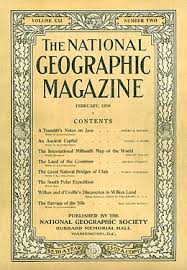
This month marks the important milestones that led to the launch of this enduring visual record of the world. This began with the founding of the National Geographic Society. The journey started in early January 1888 when a small group of gentlemen prominent in the scientific and intellectual circles of Washington DC received an invitation that read: Dear Sir: You are invited to be present at a meeting to be held in the Assembly Hall of the Cosmos Club, Friday evening, January 13, at 8 o’clock, for the purpose of considering the advisability of organizing a society for the increase and diffusion of geographic knowledge.

On the given date, 33 gentlemen who were sufficiently intrigued by the invitation to brave the fog and rain, gathered at the Cosmos Club. The guiding spirit leading the discussion was Boston lawyer Gardiner Greene Hubbard, supported by explorers John Wesley Powell and Adolphus Greely, as well as geographer Henry Gannett. The topic of discussion was the organization of a society for the increase and diffusion of geographic knowledge. One week later on 20 January the second meeting had twice the original number of participants, who agreed to incorporate themselves as a geographical society, and just one week later the Certificate of Incorporation of the National Geographic Society was formally signed on 27 January 1888. Interestingly, the average age of the founding group was around 40 years, and half of these were in their late 20s to 30s, several working for the US Geological Survey or the US Coast and Geodetic Survey. And, they were all male. Ironically, only one member was a journalist, and there is no photograph of any of the three occasions that led to the birth of the iconic magazine. National Geographic Magazine started publication in October 1888 as the official journal of the National Geographic Society.

The original issues were all text articles. The magazine began the transition from a text-oriented publication to including pictorial content with its January 1905 issue which had several full-page pictures of Tibet. By 1908 more than half the magazine’s pages were photographs.  

One of the founding objectives of the non-profit Society was to fund science and exploration across the planet. The first scientific expedition supported by the Society was to survey and map the Mount St. Elias region in North America, which led to the discovery of Mount Logan, Canada’s highest peak. Initiated in 1890, and led by explorer Israel Russell, this marked the beginning of thousands of explorer-led National Geographic expeditions. Significant among the early expeditions supported by the National Geographic Society were Robert Peary’s which was the first to reach the North Pole in 1909, and expeditions (1912-1915) to excavate Machu Pichu the lost city of the Incas in the Peruvian Andes. Since the first expedition, the Society has provided more than 15,000 grants to explorers to work across the world.

The earliest natural-colour underwater pictures were taken by the National Geographic staff photographers in 1926. The magazine continued to bring to the readers hidden deep sea treasures with a series of articles by Jacques-Yves Cousteau in the mid-1950s, including the deepest undersea photos from 25,000 under the sea in 1956. From deep sea to outer space, the National Geographic Society flag was carried by John Glenn on the first US orbital space fight in June 1962; and it reached the moon with the Apollo 11 astronauts in July 1969. The exploration of forest ecosystems also got Society support, with funding to Jane Goodall and Dian Fossey’s intensive work with chimpanzees and mountain gorillas in the African jungles. Over the decades, the Society has continued to support explorations in varied ecosystems, and in all spheres from ocean depths to outer space. The discoveries of these incredible missions are shared through the National Geographic Magazine, opening windows and vistas to millions of armchair travellers across the globe. The excellence of standards of journalism and photography are backed with the passion and commitment of documenting the wonders of history, science, anthropology and nature, while also bringing to the fore serious environmental and human rights issues.
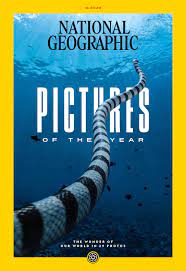
The National Geographic Magazine has continued to inspire generations for over a century, reaching out to 60 million readers worldwide each month, including 40 local-language editions. Keeping step with changing times and technology, in January 2001 National Geographic Channel was launched on cable and satellite television in the United States. The channel has expanded the scope of visual storytelling. Nat Geo continues to provide new digital experiences to find new ways of documenting the world and allowing readers to interact with content. In a rapidly changing world, the Society has stayed true to its original mission ‘to pursue and celebrate exploration, scientific excellence, education, and unforgettable storytelling’. National Geographic has remained a vibrant, relevant, world-class brand at the forefront of exploration and knowledge. However, the changing times are making their mark felt even here. Until 2015, the magazine was completely owned and managed by the National Geographic Society. Since 2019 the Walt Disney Company has taken over controlling interest. In June 2023, National geographic announced that it will focus on digital publication and subscribers. The magazine also laid off all of its staff writers, shifting to an entirely freelance-based writing model. Starting 2024, the hard copy will no longer be available on newsstands, while old subscribers will receive hard copies till their subscription runs.

Truly the end of an era. And a time to revisit the family collection of National Geographic Magazines (dating back to the mid-1950s) and enjoy the nostalgic savour of rediscovering the wonders of the world.   

–Mamata
Fireworks: Sound and Light Show

If bells are the traditional symbols that ring out the old, and ring in the new, perhaps the other thing that, across the world, opens the New Year with the dazzle of light and sound, is firecrackers. From the first display that lights up the sky in New Zealand, till 12 hours later, the sparkle that ushers in a new year in South America, firecrackers are almost a universal symbol of celebration of special occasions.

The history of fireworks goes back almost 2000 years ago, and the story of the first combination of crackle and bang, began almost as an accident. People in China used to throw bamboo stalks into the fire; the overheating of hollow air pockets in the bamboo would cause them to explode with a bang. The Chinese believed that this bang would ward off evil spirits. These are believed to be the first natural crackers. The human intervention began when, as the story goes, a Chinese alchemist mixed three common kitchen ingredients: sulfur, charcoal and potassium nitrate (saltpeter, a food preservative) and heated these over the fire, to make black flaky powder that ignited with a loud bang. The local people called this fascinating black powder huo yao (fire chemical). This was the first crude formulation of what came to be known to the rest of the world as ‘gunpowder’. People began to experiment further with the use of this powder. It was inserted into hollow bamboo tubes which were thrown into the fire. The ignited powder produced gases that caused so much pressure to build up in the tube that it blasted open with a loud bang. The first basic manmade ‘firecracker’ was born. In time the bamboo stalks were replaced with paper tubes, and instead of throwing the tubes into the fire, people added fuses made from tissue paper so that these could be lit from the outside.  

Firecrackers became an integral part of all Chinese celebrations—festivals, weddings and religious rituals. In the meanwhile the Chinese also realized that the black powder could be put to other, less ceremonial, uses. They attached the firecrackers to arrows that they shot at their enemies. Thus began the use of gunpowder in warfare that continues, in more sophisticated forms, to this day.

The knowledge of fireworks using gunpowder began to travel westwards with traders and travelers. It is believed that Marco Polo, one on of his many trips to China brought back this invention to the Middle East, from where the European crusaders brought it to Europe. An English scholar Roger Bacon is believed to be the first European to have analyzed the black powder from China, as he was intrigued why the mixture of ingredients exploded rather than burned. He also recognized that this quality of the powder could potentially be very dangerous, so he wrote the formula in secret code, to keep it secret as long as possible. Despite Bacon’s best efforts, Europeans discovered the formula, and a variety of weapons using gunpowder were developed. By the sixteenth century gunpowder completely transformed the nature of medieval warfare where chain armour and castle moats could not withstand the power and penetration of muskets and cannons.

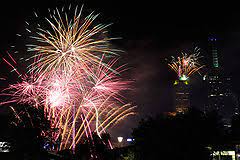
While firepower was being used to develop weapons for warfare, the sound of fireworks began to become part of celebrations and festivals in Europe by the fifteenth century. It is the Italians who added the spectacle of light and colour by developing aerial shells that launched upwards and exploded into a fountain of colour lighting up the night sky. For nearly 2000 years the early colours were produced were yellows and oranges. It was only in the nineteenth century that the technology was developed that could produce reds, greens and blues to firework displays. In the meanwhile European rulers widely used displays of fireworks to “enchant their subjects and illuminate their castles on important occasions.”    

Early settlers to The New World carried with them their love of fireworks as they settled into what became the United States of America. Fireworks displays were part of the very first American Independence Day. Even today the Fourth of July fireworks tradition remains an integral part of the celebrations.

Today firework displays are a part of celebrations in almost every country and culture across the world. What appears to be a dazzle of colour, light and sound is in fact, a precise packaging of chemistry and engineering. Each modern firework consists of a tube that contains gunpowder (called an aerial shell), and dozens of small pods about 3-4 cm in diameter (each called a star). These stars hold a combination of fuel, an oxidizing agent, a binder, and metal salts or metal oxides for colour.

A firework also has a fuse that is lit to ignite the gunpowder. Each star makes one dot in the fireworks explosion. When the colorants are heated, their atoms absorb energy and then produce light as they lose excess energy. Different chemicals produce different amounts of energy, creating different colours. For example: Blues are made with copper-chloride compounds. Reds are made with strontium salts, strontium carbonate and lithium salts. Purple is made with a mix of blue-producing copper compounds and red-producing strontium compounds. Orange is created with calcium salts and calcium chloride. Green is made with barium chloride and other barium compounds. 

From alchemy to chemistry, the dazzle and fascination of pyrotechnics has travelled across centuries and continents to become a symbol of celebration. In India, despite concerns of the adverse impacts of the noise and smoke on health and the environment, and in spite of legal restrictions, crackers are getting louder and smokier, even as the sparkling lights in the night sky take our breath away. As the reverberations of the New Year fireworks linger in the air, the wedding season lies ahead, and also cricket matches and other celebrations that ensure that the crackle never fades.   

–Mamata

War and Peace

What can one say about the year that is winding to a close? Sadly, despite many stories of achievements and accomplishments across the world, and even into space, perhaps the images that will haunt us the most will be those of the ravages of war. A frightening reminder of human’s inhumanity to humans. While the voices of the war-mongers are louder and more strident, there are, in every time and generation a few who gently, but passionately, fight the non-violent battles for peace.

One among these was Daisaku Ikeda, the Buddhist philosopher, educator, author, poet, and above all, peace-builder. Ikeda was born in Tokyo, Japan, on January 2, 1928, the fifth of eight children, to a family of seaweed farmers. He grew up in a period when Japan was in an authoritarian and militaristic phase of expansion, and heading towards World War II. As a teenager Ikeda was witness to the devastation and suffering of the war, including the death of his elder brother in action. The young Ikeda was deeply disturbed by the seemingly meaningless human conflict.

At the age of 19, Ikeda met Josei Tado, an educator, pacifist and leader of the Soka Gakka, a Japanese Buddhist religious movement based on the teachings of the 13th-century Japanese priest Nichiren. Toda had been imprisoned during the war together with his mentor Tsunesaburo Makiguchi. Both had held firm to their religious convictions in the face of oppression by the military authorities who had imposed the Shinto ideology as a means of sanctifying their war of aggression. Makiguchi had died in prison, and Toda had resolved to stand up to the militarist regime. This greatly impressed Ikeda who was drawn to the Buddhist philosophy of peace and non-violence. The seeds of Ikeda’s passion for peace were firmly sown.

Toda was engaged in the process of rebuilding the Soka Gakkai which had been all but destroyed as a result of wartime persecution. The young Ikeda shared Toda’s conviction that the philosophy of Nichiren Buddhism, with its focus on the limitless potential of the individual, cultivated through an inner-directed revolution, could help revive society in the devastation of post-war Japan.

Ikeda accepted Toda as his mentor, and the next ten years became as he described, ‘the defining experience of his life and the source of everything he later did and became.’ Toda died in 1958, and in May 1960, Ikeda succeeded him as president of the Soka Gakkai. He was 32 years old. In 1975, Ikeda became the founding president of Soka Gakkai International (SGI), which grew into a global network that brings people of goodwill and conscience together. Under his leadership, the movement began an era of innovation and expansion, becoming actively engaged in initiatives promoting peace, culture, human rights, sustainability and education worldwide. He established the Soka (value-creation) schools system, a non-denominational educational system based on an ideal of fostering each student’s unique creative potential and cultivating an ethos of peace, social contribution and global citizenship.

Ikeda’s philosophy is grounded in Buddhist humanism; the central value being the fundamental dignity of life, which is the key to lasting peace and human happiness. In his view, global peace relies ultimately on a self-directed transformation within the life of the individual, rather than on societal or structural reforms alone.

From a healed, peaceful heart, humility is born; from humility, a willingness to listen to others is born; from a willingness to listen to others, mutual understanding is born; and from mutual understanding, a peaceful society will be born. Nonviolence is the highest form of humility; it is supreme courage.

Ikeda also firmly believed that the foundation of peace lay in dialogue. Dialogue and education for peace can help free our hearts from the impulse toward intolerance and the rejection of others. People need to be made conscious of a very simple reality: we have no choice but to share this planet, this small blue sphere floating in the vast reaches of space, with all of our fellow “passengers.”

Dialogue and the promotion of cultural exchange became the basis of his efforts to build trust and foster friendship in contexts of historical division and conflict. In order to discover common ground and identify ways of tackling the complex problems facing humanity, Ikeda pursued dialogue with individuals from diverse backgrounds—prominent figures from around the world in the humanities, politics, faith traditions, culture, education and various academic fields. Over 80 of these dialogues have been published in book form. Through his writings and actions Ikeda became a pioneering practitioner of the concept of ‘a culture of peace’.

Ikeda also founded a number of independent, non-profit research institutes to promote peace through cross-cultural, interdisciplinary collaboration: the Boston Research Center for the 21st Century (renamed Ikeda Center for Peace, Learning, and Dialogue in 2009), the Toda Institute for Global Peace and Policy Research (renamed Toda Peace Institute in 2017) and the Institute of Oriental Philosophy. The Min-On Concert Association and the Tokyo Fuji Art Museum promote mutual understanding and friendship between different cultures through the arts.

Ikeda was a multi-faceted personality—philosopher, educator, writer and peace-builder. But all his endeavours were rooted in his strong faith in the positive potential inherent in the life of every person. Ikeda was convinced that peace is ultimately inseparable from enabling the flourishing of each person’s individuality. A great inner revolution in just a single individual will help achieve a change in the destiny of a nation and, further, will enable a change in the destiny of all humankind.

For Ikeda, peace was far more than the mere absence of war. He saw this as a set of conditions in which cultural differences are embraced and appreciated and in which dialogue is firmly established as the means of choice for resolving conflict. In the end, peace will not be realized by politicians signing treaties. True and lasting peace will only be realized by forging life-to-life bonds of trust and friendship among the world’s people. Human solidarity is built by opening our hearts to each other. This is the power of dialogue.

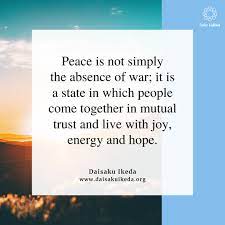
Daisaku Ikeda passed away on 18 November 2023, at the age of 95 years. As another war rages on, the world is in dire need of the wisdom of men such as him, to remind us again and again of the futility of violence. Peace is not simply the absence of war; it is a state in which people come together in mutual trust and live with joy, energy and hope. This is the polar opposite of war―where people live plagued by hatred and the fear of death.

With hope and a prayer that the year ahead may lead humanity from war to peace.

Peace is not found somewhere far away. Peace is found where there is caring. Peace is found when you bring joy to your mother instead of suffering. Peace is found when you reach out and make an effort to understand and embrace someone who is different from you. Daisaku Ikeda

–Mamata

Santa the Traveller

Tis the season to be jolly, and the jollity is best symbolized by the iconic Santa Claus. As Meena wrote this week, the legend of Santa dates back to fourth century AD. A bishop named Nicholas, in what is now modern-day Turkey, became known for his kindness and generosity to the deprived and needy. He was later canonised, and St Nicholas became one of the most popular saints in Christianity. He also became the patron saint of many European countries. Every year he was honoured during the Feast of Sint Nicholas where parents would leave gifts for their children who believed that he had paid them a visit during the night. The Dutch version of the saint rode a donkey and wore a tall pointy Bishop’s hat. On St. Nicholas Day a person dressed up as the saint went from house to house with a servant, either rewarding or punishing children depending on the work they had done. The good students got a gift meant to resemble a sack of gold, while the bad ones got lumps of coal.

The story of St Nicholas evolved over the years, with local embellishments, in different countries of Europe. In some parts of 16th and 17th century Europe, St. Nicholas was depicted as someone who handed out apples, nuts and baked goods, symbols of a bountiful harvest. In France and England, books became the gift of choice as more people became literate.  Gradually, small jewellery, wine and luxury foods became gifts of choice as well.

There were similar figures and Christmas traditions in many parts of Europe. Christkind or Kris Kringle meaning ‘Christ Child’, an angel like figure who often accompanied St. Nicholas was believed to deliver presents to well-behaved Swiss and German children. In Scandinavia, a jolly elf named Jultomten was thought to deliver gifts in a sleigh drawn by goats. English legend explains that Father Christmas visits each home on Christmas Eve to fill children’s stockings with holiday treats. Père Noël is responsible for filling the shoes of French children. In Italy, there is a story of a woman called La Befana, a kindly witch who rides a broomstick down the chimneys of Italian homes to deliver toys into the stockings of lucky children.

It is only in 1664 that the legend of Saint Nicholas crossed the Atlantic, to the Dutch settlement of New Amsterdam, what is today New York City. For the next 200 years the legend of Sint Nikolas or Sinter Klaas (in adaptation) was preserved and protected by the Dutch settlers in America, along with his tradition of giving gifts.

In 1822 a poem, inspired by the Dutch legend, and originally titled A Visit From St Nicholas was published, which provided a more graphic description, (adapted to the new country and culture) of Santa Claus. The adaptation also included the pronunciation of the name in the New York accent, where Sinter Claus became Santa Claus. This poem by Clement Clark Moore, retitled as The Night Before Christmas became a classic. It is upon this, that the image of Santa as we know him today became firmly established.

To promote the tradition of gift giving, stores in America began to advertise Christmas shopping in 1820, and by the 1840s, newspapers were creating separate sections for holiday advertisements, which often featured images of the newly-popular Santa Claus. They also added to the attraction by introducing “live” Santas who would meet children and encourage them to share their “wish list’ for presents.  

Santa thus found a new identity in America. In 1863 a young artist Thomas Nast was commissioned to draw a picture of Santa Claus bringing gifts to the troops fighting in the American Civil War. He drew upon Clement’s description to depict a roly-poly, white bearded, cheerful figure in red clothes, to boost the troop morale.

Perhaps the large-scale commercialization of Santa as a ‘sales agent’ began in the 1920s with Coca Cola first using the red clad Nast figure to advertise Coke. In 1931 the company commissioned an advertising agency to create special Christmas sales campaigns using the Santa image. Santa was the key figure in Coca Cola advertising up to 1964. He appeared in magazines, on billboards, and shop counters, encouraging Americans to see Coke as the solution to “a thirst for all seasons.” By the 1950s Santa Claus became a popular endorser of a wide range of consumer products.

Today Santa Claus has once more crossed the Atlantic to become a global icon of contemporary commercial culture. St. Nicolas has indeed travelled a long way from being a kindly benefactor of the needy, to the ubiquitous jolly Santa Claus selling every dream and product imaginable—while the promoters jingle all the way to the bank.

This is a good time to remind ourselves that Christmas is a season of giving, before it became a season of acquiring and owning more and more. Merry Christmas and warm greetings of the festive season.

–Mamata

Nan Shepherd and The Living Mountain

George Mallory, when he was asked why he wanted to climb Mount Everest, is said to have replied: “Because it’s there”. Mallory was the only climber to take part in three of the British pioneering expeditions to climb Mount Everest in the 1920s. Mountains have always “been there” and have over centuries, challenged humans to ascend and ‘conquer’ them. Hundreds of books have been written about mountains, mostly by men. The books are characterised by the language of conquest and victory, and propelled by the goal of reaching the summit.

In the period when men were racing to scale and conquer the highest peaks, was a young woman who perceived, and described, mountains not in terms of heights but in terms of depths. This was Nan Shepherd, not only an explorer of mountains, but also one of the great early 20th century writers of nature, landscape and the Scottish mountains that she so loved.

 Anna (she called herself Nan) Shepherd was born in February 1893 near Aberdeen on the North East coast of Scotland. Not long after she was born her family moved to Cults (now a suburb of Aberdeen). The hills of Deeside close by, were her natural playground, and her love for walking in the hills was encouraged by her father who was a keen hill walker. Nan was also an avid reader, and at the age of fourteen started filling notebooks with quotations and citations from her readings. She attended Aberdeen High School for Girls and studied at Aberdeen University, graduating with an MA in 1915. She went on to teach English literature at the Aberdeen Training Centre for Teachers (later the College of Education). She remained there for the next forty-one years, until her retirement in 1956, having become known as an inspiring teacher with a feminist slant to her work. Although she did travel extensively, she continued to live in her childhood home until she died in 1981.

Having explored the local hills almost from the time that she could walk, Nan ventured further afield, to the Cairngorms. These formidable mountains to the west of Aberdeen, are amongst the wildest landscapes in the British Isles. This was in June 1928, Nan was 35 years old. This first experience of the mountains was the start of a passion that came to define both her life and her writing. From then on, she would head for the Cairngorms whenever her job would allow, often alone, or occasionally with friends and fellow walkers.

For Nan, who conquered all six of the major peaks in the Cairngorms while still a young woman the goal was never to reach the summit of a mountain: it was not climbing up that excited her so much as “clambering down,” discovering all the hidden parts of the mountain that only an attentive walker would notice. It was this perspective of ‘looking within’ both at the mountain, and herself, that inspired Nan to also write copiously during the period between 1928 and 1933. During this time, she published three novels: The Quarry Wood, The Weatherhouse, and A Pass in the Grampians. As she said: “It simply must be written”. Shepherd drew inspiration from the places and people she knew well, setting her stories in the North East of Scotland, with a focus on country communities and the harsh way of life imposed by the landscape. Above all, what shone through was her deep love for the Scottish mountains and her knowledge of these through walking. 

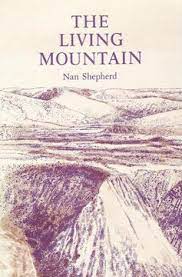
While Nan published these books, the book that was most inspired by these mountains, and her most inspirational piece of writing, was called The Living Mountain. The book, written in 1940, describes Nan’s explorations, as a walker and as a writer, of the Cairngorm Mountains. Nan sent her manuscript to a novelist and publisher friend Neil Gunn who appreciated it, but felt that it was not fit for publication unless she added photographs and a map. Nan put away the manuscript in a drawer and there it remained for over 30 years. It was finally published by the Aberdeen University Press in 1977.

The publication of The Living Mountain revealed Nan as one of the earliest ‘Nature writers’ who brilliantly captured the Cairngorms in their various seasonal moods. Her descriptions emerged out of her own immersion in the experience of walking in every kind of weather, swimming in the lochs, dipping in the streams, and camping under the sky. It also showed her incisive eye for detail, and her profound understanding not only of the geography and geology of the mountains, but equally of the living elements that made it a vibrant ecosystem. Long before ecology became a buzzword, Nan was acutely aware of the interconnections. 

Shepherd was interested in the ‘essential nature’ of the mountain: in understanding it from all angles and in all seasons. She viewed the mountains not as looming objects of sublime terror, but as acquaintances. She wrote: Often the mountain gives itself most completely when I have no destination but have gone out merely to be with the mountain as one visits a friend, with no intention but to be with him.

The poetic descriptions of the routes are so vivid that the readers can literally walk these with Nan. But Nan Shepherd’s writing is not simply a description, it is equally an introspection. While most mountaineers think in terms of peaks, plateaus and cliffs, Nan looks within, “into” cracks in rocks, and the depths of lochs and rivers. Her prose is philosophical and often meditative: One does not look upwards to spectacular peaks but downwards from the peaks to spectacular chasms, for a mountain has an inside.

Although it was written nearly a century ago, The Living Mountain is today acclaimed as “one of the most brilliant works of modern landscape literature”. It is a lyrical memoir that combines field notes, natural history, and oral history. One of its most profound tenets is that we should not walk “up” a mountain but “into” mountains, thus exploring ourselves as well as them.

December 11 is celebrated as International Mountain Day. The theme for this year is Restoring Mountain Ecosystems. Nan Shepherd’s The Living Mountain is a reminder that healthy mountain ecosystems can restore us: in body and spirit.

–Mamata

Words Over the Years

It is the time of the year when important dictionaries of the English language have just announced their Word of the Year 2023.

Collins Dictionary has picked AI (Artificial Intelligence) the term that describes ‘the modelling of human mental functions by computer programmes’. In other words, a computer system that has some of the qualities that the human brain has, such as the ability to produce language in a way that seems human.

The Cambridge Dictionary has chosen Hallucinate which has traditionally been defined as“To seem to see, hear, feel, or smell something that does not exist, usually because of a health condition or because you have taken a drug.” But is now expanded to include: ‘When an artificial intelligence (AI) hallucinates, it produces false intelligence’.

The Merriam-Webster dictionary’s Word of the Year is Authentic. Authentic has a number of meanings including “not false or imitation,” or “true to one’s own personality, spirit, or character”. It is a synonym of real and actual. It is perhaps an appropriate antidote in an age of Fake News.

To have been selected as Word of the Year means that a word has great resonance for the year in which it was chosen. These are terms that describe the prevailing trends, moods (including anxieties), attitudes, and cultural climate of our time.

Indeed these three words succinctly sum up the year which has been headlined by AI and its potential, including the dangers of false intelligence and fake news, and the growing need to have ‘authentic’ reliable information to draw upon in such times.

The Dictionaries follow a rigorous process leading to the choice. It includes research by hundreds of lexicographers, and now, evidence gathered from millions of new and emerging words of current English from web-based publications, as well as referring to dictionaries themselves, using sophisticated software.

Thus do dictionaries grow, adding words and usages as they emerge in response to changing times and modes of expression. We often forget that the process of creating a dictionary from scratch was, in its time, a complex and gargantuan task, which took years of painstaking manual and mental labour.

The first fully-developed representative of the monolingual dictionary in English is believed to be Robert Cawdrey’s Table Alphabeticall, first printed in 1604. Its first edition had 2543 headwords for which Cawdrey provided a brief definition. While small and unsophisticated by today’s standards, the Table was the largest dictionary of its type at the time.

As the century rolled by, there was a growing feeling that the English language “needed improvement” and that it lacked standardisation. From the mid-17th century many literary figures proposed ideas and schemes for improving the English language, but none really came to fruition. Until Samuel Johnson, an English poet, satirist, critic, lexicographer embarked upon his Plan of a Dictionary of the English Language.

Johnson had several issues with the English language as it was at the time. As he wrote, he had found the language to be ‘copious without order, and energetick without rules’. In his view, English was in desperate need of some discipline: ‘wherever I turned my view … there was perplexity to be disentangled, and confusion to be regulated’.

A group of London booksellers first commissioned Johnson’s dictionary, as they hoped that a book of this kind would help stabilise the rules governing the English language. The booksellers’ interest was purely commercial. They were aware that this kind of work would be popular with the general public, but as such a project would be long and risky, a number of booksellers formed temporary partnerships, thereby sharing the costs as well as the risks. Also the copyright belonged to the publisher, so aside from a one-time payment to the author for commissioning the work, the publishers could enjoy the massive profits from the sales.  

In 1746 Johnson entered into an agreement with the booksellers to write an English dictionary, and began work the same year with only six assistants to aid him. A year later he published a plan for the dictionary in which he outlined his reasons for undertaking the project and explained exactly how he intended to compile his work. Johnson projected that the scheme would take about three years, but he seriously underestimated the scale of the work involved. In the end it took him three times this length of time to write over 40,000 definitions and select nearly 114,000 illustrative quotations from every field of learning and literature. Each word was defined in detail, the definitions illustrated with quotations covering every branch of learning. Johnson’s was the first dictionary to use citations for the words it listed. He sourced books stretching back to the 16th century, and used quotations from Shakespeare, Spenser and other literary sources. This was with his intention to acquaint users with the classic literary greats. Johnson was the first English lexicographer to use citations in this way, a method that greatly influenced the style of future dictionaries.

In the process of compiling the dictionary, Johnson recognised that language is impossible to fix because of its constantly changing nature, and that his role was to record the language of the day, rather than to form it.

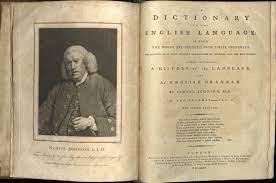
First published in two large volumes in 1755, the book’s full title was A dictionary of the English Language: in which the words are deduced from their originals, and illustrated in their different significations by examples from the best writers. To which are prefixed, a history of the language, and an English grammar. It became popularly known as Johnson’s Dictionary.

The dictionary was a huge scholarly achievement, a more extensive and complex dictionary than any of its predecessors. The closest to compare was the French Dictionnaire which had taken 55 years to compile and required the dedication of 40 scholars. Still, Johnson’s dictionary was far from comprehensive, even by mid-eighteenth-century standards. It contains 42,773 entries, but there were almost 250,000 words in the English language, even during Johnson’s time.

Even as new words are added to the number of dictionaries today, and some of these are crowned as words of the year, here is an educational, and entertaining peek at some of the entries from Johnson’s dictionary. Starting with how he defines himself!

Lexicographer: A writer of dictionaries; a harmless drudge that busies himself in tracing the original, and detailing the signification of words. A paltry, dirty, sorry wretch.

Cough: A convulsion of the lungs, vellicated by some sharp serosity.

Distiller: One who makes and sells pernicious and inflammatory spirits.

Dull: Not exhilaterating (sic); not delightful; as, to make dictionaries is dull work.

Excise: A hateful tax levied upon commodities, and adjudged not by the common judges of property, but wretches hired by those to whom excise is paid.

Far-fetch: A deep stratagem. A ludicrous word.

Jobbernowl: Loggerhead; blockhead.

Kickshaw: A dish so changed by the cookery that it can scarcely be known.

Network: Any thing reticulated or decussated, at equal distances, with interstices between the intersections. (See how he defined ‘reticulated,’ below.)

Oats: A grain, which in England is generally given to horses, but in Scotland appears to support the people.

Patron: One who countenances, supports or protects. Commonly a wretch who supports with insolence, and is paid with flattery.

Politician: 1. One versed in the arts of government; one skilled in politicks. 2. A man of artifice; one of deep contrivance.

Reticulated: Made of network; formed with interstitial vacuities.

To worm: To deprive a dog of something, nobody knows what, under his tongue, which is said to prevent him, nobody knows why, from running mad.

Samuel Johnson, was in fact much more than a lexicographer; he was a prodigious writer who published periodicals, plays, poems, biographies and a novel, as well as a celebrated humourist.

–Mamata

Be a Sport!

This month games have been in the news. From cricket dominating the headlines, to Meena’s pieces on the importance of play for the all-round development of children. Toys are perhaps the first objects that children interact with as they learn how to ‘play’. Beginning with supporting the development of psycho-motor skills, toys also encourage imagination and creativity.  As the child explores and discovers, in its own way, the toy becomes way more than what it was formally designed for. Toys can become the central characters in a gamut of games and make-belief adventures. The child’s interactions with toys also begin to lay the foundation of the sense of ownership (“my doll, my truck”), which also lends itself to possessiveness when the same toy is ‘snatched’ ‘begged’ or ‘coveted’ by another child. 

It is at this early stage then, that the field of games introduces other instincts such as ownership and competiveness, often leading to conflict. This is where the concepts of ‘sportsmanship’ are also planted (or not planted), well before the child graduates from toys and imaginary play to more formal games, and then on to sports.  

A game is described as a physical or mental recreational activity involving one or more players, defined by a goal that the players try to reach, and some set of rules to play it.

A sport is a physical activity carried out under an agreed set of rules, with a recreational purpose: for competition or self-enjoyment, or a combination of these.

The two terms have also spawned two related terms—sportsmanship and gamesmanship.

Gamesmanship refers to the strategic manipulation of the rules and the spirit of the game to gain an advantage over opponents. While not necessarily breaking the rules, players who engage in gamesmanship employ tactics that push the boundaries of fairness. This may include exploiting loopholes, distracting opponents, engaging in unsportsmanlike conduct, or using psychological tactics to gain an edge. While gamesmanship may be within the confines of the rules, it can undermine the principles of fair play and the spirit of the game.

Sportsmanship refers to the values and behaviours exhibited by the players that uphold the spirit of fairness, self-control, respect for rules, opponents and authority, and integrity. Sportsmanship fosters positive relationships among players, promotes teamwork and healthy competition, encourages accepting victories and defeats with grace, and thereby enhances the sports experience.

Poor sportsmanship, while not exactly using manipulative tactics, includes unethical behaviour such as intentionally injuring opponents, taunting or insulting players, or disrespecting officials and fans. 

We teach children the importance of sports, but sadly do not pay enough attention to also inculcating the values of sportsmanship from an early age.  We send them to coaching classes to hone their skills in a sport—from tennis to football to hockey. Large academies are set up that identify budding players and rigorously mould them to become “champions.” These instil in the young minds the yen to be winners always, to be the best, the fastest, and the strongest at all times. They also laden them with highest of expectations. The aspiring champions carry on their young shoulders the burden to always meet these expectations, at any cost, including personal burn-out and breakdowns.

This expectation balloons manifold in the eyes of spectators of team games. It manifests itself in the fanatic fandom of a favourite team. This is what buoys the playing teams and fuels the culture, and indeed, the enormous business of spectator sports. Support and encouragement of one’s favoured team is necessary, even desirable in sports. But when this balloon bursts, leading to a mass wave of intense negative feeling, it is certainly not sportsmanship. What we have forgotten in our love for ‘our team’ is that it is more than one team that makes a sport a sport, that that it calls for dignity and grace to acknowledge that we cannot always be the winner.

Participation in sports develops important skills, but this needs to be combined with developing the values and behaviour of sportsmanship. Even as we coach our young minds and bodies to excel in sports, it is important to remember that they also need coaching in sportsmanship. This involves engaging also with their hearts and emotions. It means emphasising respect for the opposing team in every circumstance—win, lose or draw, on or off the field. It means extending goodwill not only to one’s own team mates and coaches, as well as the others who support the players in many ways, including the spectators.  

While healthy competition is an important ingredient of a competitive sport, unsportsmanlike conduct cannot justify the end—winning at any cost. Competing with honour and fairness need not be a dampener to the skills and excellence of players. Rather a game well played to the best abilities of both teams enhances not only the quality of the game, but the ambience within which it is played. 

As the curtains fall on the mega spectacle of World Cup cricket, let us remind our children (and indeed ourselves) that the true spirit of sportsmanship means that it doesn’t matter what the outcome of the game is, it is not just about winning or losing; it is also about empathy, about the person or people you are competing against; they deserve to be shown the same respect you would show them outside of sport. Sportsmanship centres on three vital life-skill components of Respect, Losing with Dignity, and Winning with Humility. Let this principle be the guiding factor in the long game of life, as in the many games that we play in many fields.

Be a sport! May the best one win!

–Mamata

A Cry for Children

This week Meena wrote about Children’s Day in India which is celebrated on 14 November each year, marking the birth anniversary of Jawaharlal Nehru. It is in this same week that another children’s day is celebrated. This is Universal Children’s Day which is celebrated on 20 November every year to mark the date when the United Nations General Assembly adopted, in 1989, the Convention on the Rights of the Child.  

There had been previous discussions about children in the international community. Declarations on the rights of the child had been adopted by both the League of Nations (1924) and the United Nations (1959). Also, specific provisions concerning children had been incorporated in a number of human rights and humanitarian law treaties. However amidst global reports of children bearing the brunt of grave injustice in many forms–from health and nutrition, to abuse and exploitation, it was felt that there was a need for a comprehensive statement on children’s rights which would be binding under international law.

In response to this the UN initiated a process of consultation which led to the drafting of a comprehensive document keeping the child as the focus in all realms—civil, political, economic, social and cultural. The Convention on the Rights of the Child was adopted by the UN General Assembly on 20 November 1989 and entered into force in September 1990.The Convention is the most rapidly ratified human rights treaty in history; more countries have ratified the Convention than any other human rights treaty in history. Three countries, the United States, South Sudan, and Somalia, have not ratified the Convention.

The Convention outlines in 41 articles the human rights to be respected and protected for every child under the age of eighteen years.

The articles can be grouped under four broad themes:

Survival rights: include the child’s right to life and the needs that are most basic to existence, such as nutrition, shelter, an adequate living standard, and access to medical services.

Development rights: include the right to education, play, leisure, cultural activities, access to information, and freedom of thought, conscience and religion. The term ‘development’ includes not only physical health, but also mental, emotional, cognitive, social and cultural development.

Protection rights: ensure children are safeguarded against all forms of abuse, neglect and exploitation, including special care for refugee children; safeguards for children in the criminal justice system; protection for children in employment; protection and rehabilitation for children who have suffered exploitation or abuse of any kind.

Participation rights: encompass children’s freedom to express opinions, to have a say in matters affecting their own lives, to join associations and to assemble peacefully. Children have the right to be heard and to have their views taken seriously, including in any judicial or administrative proceedings affecting them. As their capacities develop, children should have increasing opportunity to participate in the activities of society, in preparation for adulthood.

The Convention establishes in international law that States Parties must ensure that all children – without discrimination in any form – benefit from special protection measures and assistance; have access to services such as education and health care; can develop their personalities, abilities and talents to the fullest potential; grow up in an environment of happiness, love and understanding; and are informed about and participate in, achieving their rights in an accessible and active manner.

Even as the world will be reminded of the Convention on the Rights of the Child this week, this year is tragically one where these very rights are being destroyed minute by minute. More than one hundred children are killed every day in the ongoing war in Gaza and the West Bank. Thousands more are believed to be buried under the rubble of entire townships razed to the ground. Hundreds are dying in hospitals which are being ruthlessly attacked from the air and ground, including premature babies who have not even yet had a chance to take a breath on their own.

Never before in history have so many children faced the horrors of relentless violence, hunger, thirst, displacement, and so many as yet untold terrors. What will be the future of those who do survive this new holocaust?

Which of the Rights listed above will we have the courage to place before them? How can the world appease them, and our own consciences, with a flourish of the Convention on the Rights of the Child?  

In the words of Ghassan Kanafani, eminent Palestinian activist, essayist, novelist, who was killed by a car bomb in 1972 at the age of 36 years.

I wish children didn’t die.

I wish they would be temporarily elevated to the skies until the war ends.

Then they would return home safe, and when their parents would ask them: “where were you?”

They would say: “we were playing in the clouds.

How much longer? How much further?

–Mamata

Story in a Teacup: Wagh Bakri Chai

In Gujarat tea is literally ‘the cup that cheers’ at any time of the day or night. From the age-old kitlis the small roadside tea stalls where the sweet milky chai is constantly boiling on the hissing kerosene stove, to the upmarket ‘tea lounges’ where the menu offers a range of fancy artisanal teas, people of all ages and walks of life hang out. Tea is the essential companion to the range of farsans (savoury snacks) that are the identifying hallmarks of Gujarati food.  

While Gujarat is geographically almost across the country from the tea producing states in the east and south, it is probably the biggest consumer of tea leaves. The large-scale sale of tea leaves in the region began with the crossing of continents by a Gujarati entrepreneur Narandas Desai. The company he founded was to grow into one of the largest tea companies in India—Wagh Bakri chai.

The story begins in 1892 when Narandas Desai crossed the ocean to South Africa with the dream to start a business. He took on lease 500 acres of tea estates near Durban, and threw himself with focus and passion into learning the intricacies of cultivating and producing tea, as well as the business of selling it. While he was there he came in touch with Gandhiji who was beginning his own journey of learning to live and work on foreign soil. The two mutually respected each other’s work, values, and personal and professional ethics. They also equally faced the challenges of racial discrimination, which eventually led them both to return to their home country.

Narandas Desai returned to Gujarat in 1915, leaving behind a successful tea business. He came home with very little material wealth, but carrying a prized letter from Gandhi which stated: “I knew Mr Narandas Desai in South Africa, where he was for a number of years a successful tea planter”. He also carried in him the strong Gandhian ethic of hard work and honesty, as well as a sound knowledge of teas and the tea business.

After working briefly at a tea estate in Maharashtra, Narandas moved to Gujarat. He took a loan to establish, in 1919, the Gujarat Tea Depot, the first store in Ahmedabad to sell wholesale loose tea. The original clientele were workers in Ahmedabad’s many textile mills. The tea was procured from estates in different parts of the country; Narandas, from his South Africa experience had learnt how difficult it was to own and run a tea estate. As business grew, Narandas began sourcing and blending better varieties of tea leaves, and expanding his clientele.

In 1934, for the first time, the Gujarat Tea Depot, started selling tea under its own brand. The name selected for the brand was Wagh (tiger) Bakri (goat). The twinning of two disparate characters was intended to represent social equality—tiger representing the upper class and goat representing the lower classes. This was visually represented by a picture of a tiger and a goat drinking tea from the same cup. Here too Gandhi’s influence was visible. The company was not only a swadeshi one, its logo also indicated the support of the movement against caste-based discrimination. The unusual logo became an icon for the company’s ethos, and continues to be so even today.  

Narandas Desai’s three sons Ramdas, Ochavlal amd Kantilal joined their father in managing the growing business. The company also started an office in Kolkata to oversee and check the purchase of tea at auction centres there. Till 1980 Gujarat Tea Depot continued to sell tea in wholesale, as well as retail through 7 retail outlets. But by that time they also foresaw the burgeoning market for packaged teas. In response, the group launched Gujarat Tea Processors and Packers Ltd. in 1980, introducing packaged tea. Initially people were sceptical and hesitant to buy packaged tea as they were used to feeling and smelling loose tea leaves before buying. 

In the early 1990s, the company decided to introduce the concept of tea bags. This again, was uncharted territory. In a culture where boiling tea thoroughly was the norm, the idea of instant ‘dip dip’ tea was alien. Wagh Bakri took the risk and imported state-of -the-art tea bag machines from Argentina. The introduction of tea bags marked a paradigm shift in the tea scene.

The company continued to experiment and innovate, introducing new dimensions and products to the tea drinkers. All the generations of the Desais engaged totally in carrying Narandas’s vision to new heights and breadths, introducing new varieties into the packaged tea market. Through the journey they continued to adhere to their founder’s strong commitment to quality and affordability, targeting “decent profits, but not profit maximisation at any cost to company image and standing”. Even in the face of stiff market competition and many financial pressures, their product range has always carried an economically-friendly price tag. 

But before the product reaches the shop shelves, it is preceded by a great deal of research and evaluation. The research includes understanding the specific tastes of the region where the product is to be introduced. It even includes a study of the local water and milk commonly used for brewing the tea. Every region, if not every home, has its own preferences and tea-brewing processes. The Wagh Bakri team invests a great deal in understanding the preferences of its consumers and putting together suitable blends.

The ultimate test is the tea tasting in which the company’s directors are personally involved. The company’s headquarters in Ahmedabad has a large Tea Tasting Department. Tea samples procured from auctions of different estates, saucers of milky teas blended according to the quality of local water and milk, and weighing scales are systematically arranged. The company’s directors personally taste each sample and rate it according to colour, strength, taste and briskness. On some days 400-500 samples of tea are tasted. There is no compromise on taste and quality. Little wonder then that 50 per cent of the tea consumed in Gujarat is from Wagh Bakri.

While continuing to cater to the traditional tastes, the company is also aware that with international exposure, the younger generation is open to more flavours and trends. In response the company has launched a wide range of offerings from Oolong tea to Matcha tea. It was also the first to offer suitable settings to savour these gourmet teas by setting up Tea Lounges in Ahmedabad in 2006, and later in a few other cities.

The corporate office of Wagh Bakri was inaugurated in 2006. A fitting tribute to the founder whose vision, dedication and trust guided the company for over a century. While largely confined to Gujarat for nearly a century, the company started selling its tea in other states as well between 2003 and 2009. Wagh Bakri is not pan-Indian in its sales, but even with the limited states that it sells in, it is the third largest tea brand in India. It also has an international presence. As its directors believe, it is more than a tea company, it is a creator of connections and a nurturer of relationships.

Wagh Bakri’s executive director, and one of its key tea tasters, Parag Desai recently passed away at the age of 49, after a brain haemorrhage caused by a freak accident. A sad loss for the Wagh Bakri family of tea drinkers across the world. 

–Mamata

Pothole Patcher: Ememem

This morning’s newspaper tells me that the city Municipal Corporation is on the move to fill up potholes in the city’s roads as a Diwali gift to citizens. While this is indeed a noble announcement, it is a bit ironic as the sorry state of the roads needs much more than a superficial patching up of random ruts and depressions on the road, with more of the substandard material and workmanship that causes the potholes in the first place. In fact on many roads across the city, there are more ragged and rough patches than there are even surfaces. These make headlines a couple of times a year, especially during the monsoon when there are accidents, sometimes serious, caused by two-wheelers and pedestrians slipping and falling into waterlogged potholes. Potholes are not only dangerous, they are also a major source of frustration and inconvenience for commuters. This receives a few days of media coverage where questions of quality and responsibility are raised, and a few contractors are taken to task and fined, before returning to ‘business as usual.’

While I had not given it any thought, for the first time I wondered why these depressions are called ‘potholes’? The origin of the word is not clear. From the purely linguistic angle it could be the literal meaning of the word ‘pot’ that meant a ‘deep hole’, or referred to deep cooking vessels; and the word ‘hole’ being self-explanatory. There is a more interesting version. In 15th and 16th century England wagons and coaches with heavy wooden wheels were the main form of transportation. As they traversed the roads, the wheels gouged deep ruts in the soil. Pottery makers would take advantage of these ruts to dig deeper to reach the clay deposits beneath to make their clay pots. Those driving wagons and coaches over those roads knew who and what caused these holes, and referred to them as ‘potholes’.

Whatever the origins of the word, potholes are a feature of roads in almost all parts of the world. Potholes are caused by a variety of factors, including poor quality of construction materials and labour, lack of proper maintenance and repair, heavy rainfall, and high traffic volume. In cold climates the expansion by freezing of water that has seeped into the crevasses and depressions in the road surface also causes cracks which expand to become ruts and potholes.

Civic authorities in cities around the world do their bit to repair potholes, and are usually far behind in their reach. However, there is one man in Europe who has taken it upon himself to turn potholes into works of art!

While the artist’s work is in the public domain, the artist himself remains anonymous and enigmatic. His true name or identity are not known. He simply goes by the name Ememem. He gave himself this name as he felt that it sounded like his moped does when he sets off for his pothole repair mission. He does not give interviews, nor allow himself to be photographed; he prefers his work, rather than himself, to be seen, as he feels that he is not good at social interactions.

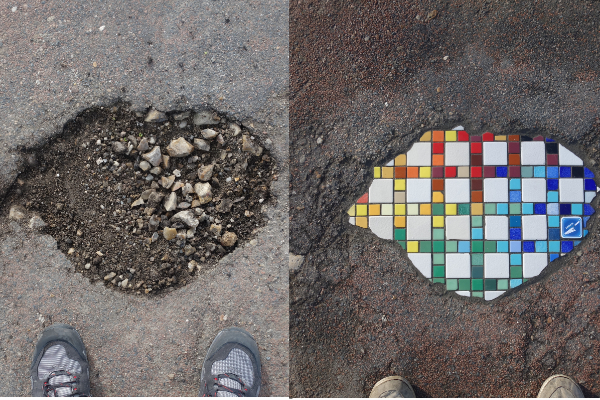
What he does interact with, are the roads that he walks along, absorbing the noises of city life as he looks, and absorbs. What grabs his attention are potholes on the roads. As he claims ‘some of these vibrate and some don’t.’ When he comes across a pothole that “speaks to him” he takes stock of its size and shape. This inspires him to put together pieces of colourful tiles, majolica (glazed earthenware with bright metallic oxides), and ceramics (mainly from waste material) to create artworks that fill or repair the pothole. For obvious reasons, (including that what he does is not strictly legal), he works at night when the roads are relatively less busy, and so that he can work without interruption, or identification. The on-site exercise is preceded by a study of his ‘canvas’, as he describes potholes, cutting the tiles to perfectly fit the space while creating an artwork, and using quick-drying glue to paste them in place. His pothole ‘makeover’ could take from one hour to six hours depending on the condition of the hole, the weather, and the time it takes for the creation to dry.

Ememem has coined the word ‘flacking’ to describe his technique. It is derived from the French word flaque which means puddle. The term is also used used figuratively to refer to an area that looks entirely different from its surrounding. And Ememem’s vibrant colourful designs certainly stand out in stretches of dull grey pavements.

Street art, a form of artwork that is displayed in public on surrounding buildings, streets, trains and other publicly viewed surfaces, is today regarded as one of the largest art movements. Much of this art (which includes graffiti) often reflects social and political issues. It is often also regarded as a form of vandalism.

Ememem does not see himself as an artist with a particular message, or a mission to change the world. Rather he says that his art focuses on the ‘art of healing the street’. He feels that he could just as well be called ‘bitumen mender’ or ‘poet of the asphalt’. In his hometown Lyon, Ememem is described as a “pavement surgeon” who heals fractures in the streets and gives them a new look. Fortunately the civic authorities in most of the places where his ‘operations’ take place let the art remain, to be appreciated by both the residents as well as visitors.

Today his healing works can be seen not only in France, but in many European cities including Paris, Barcelona, Madrid, Milan, and Oslo and Aberdeen.  He continues to keep his identity a secret, but displays his work on Instagram where he has a huge following.

As we prepare for Diwali with the beautiful floor art of rangoli, would it not be magical to wake up to see Ememem’s colourful mosaics brightening up our roads? One can only dream!

–Mamata