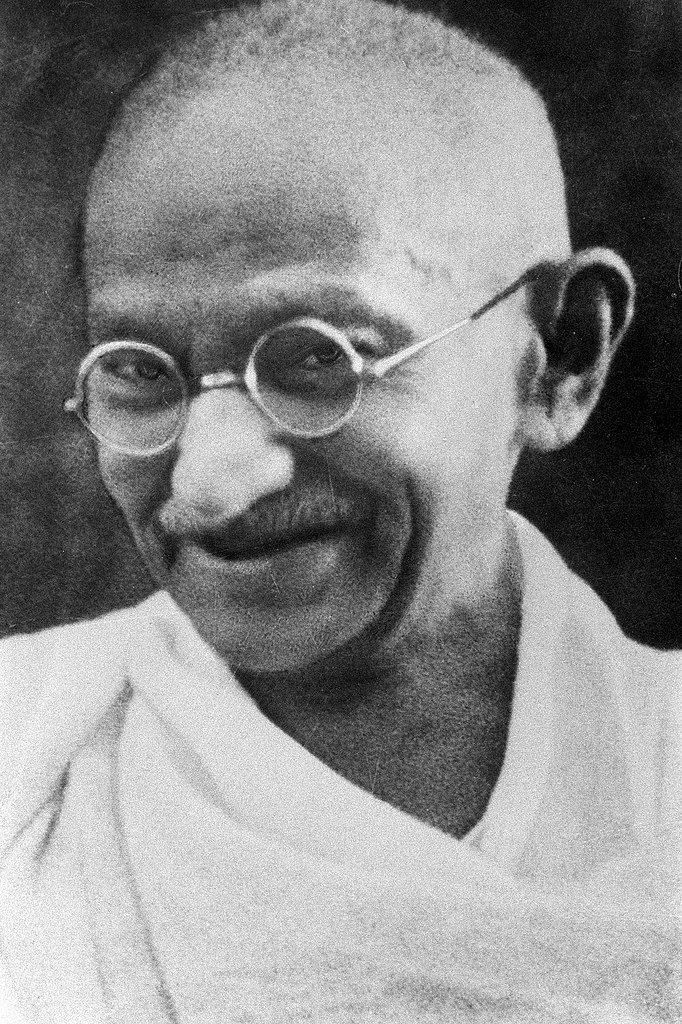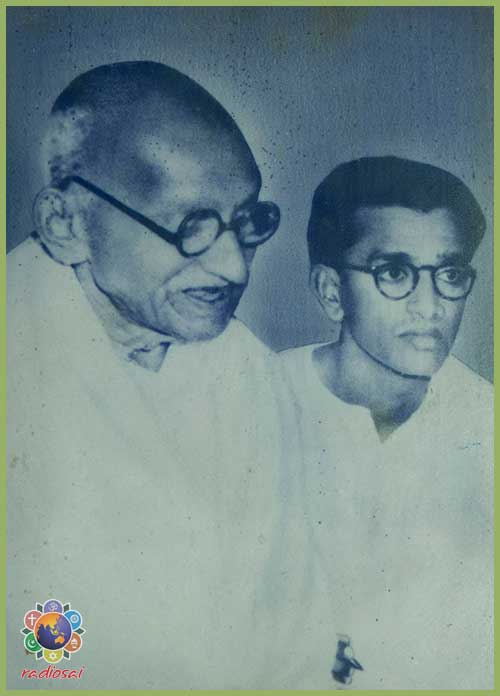
Rabindranath Tagore was the one who gave Gandhiji the title of Mahatma. Gandhi in turn called him ‘Gurudev’ in reverence to his wisdom and his learning, and saw him as a teacher to humanity.

Musings on Life and Times: Views, Reviews, Previews, Interviews..and Advice

India is currently in the process of introducing the New Educational Policy (NEP 2020). Exercises are ongoing to develop the curricula and frameworks for education at all levels, starting from Early Childhood Care and Education (ECCE). As per the Policy document: The overall aim of ECCE will be to attain optimal outcomes in the domains of physical and motor development, cognitive development, socio-emotional-ethical development, cultural/artistic development, and the development of communication and early language, literacy, and numeracy.
This vision for laying the strongest foundation for lifelong learning has its seeds in the thoughts and writing of many educationists and thinkers. It has a deep resonance with Gandhiji’s thoughts on education. In 1937, at a conference in Wardha, Maharashtra, Mahatma Gandhi seeded an important idea to revamp the educational system through Nai Talim or Basic Education.

Gandhiji’s vision was that this new paradigm of education should prepare the young learners to become morally sound, individually independents, socially constructive, economically productive and responsible future citizens. The foundation for this was to be laid in early childhood. Gandhiji believed that education should develop all the capacities of the child so that he becomes a complete human being. “By education I mean all-round drawing out of the best in child’s and man’s body, mind and spirit. Literacy is neither the beginning nor the end of education. This is only a means through which man or woman can be educated.
In Gandhiji’s educational thoughts the integrated development of the personality of child is more important than mere literacy or knowledge of different subjects. Thus his vision was of life-centred as well as child-centred education. Besides learning of three R’s–Reading, Writing and Arithmetic in school, he insisted on development of the three H’s–Hand, Heart and Head.
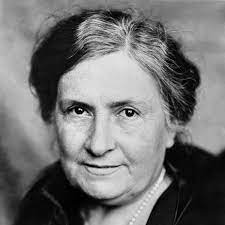
While these thoughts took formal shape in the form of Nai Taleem in 1937, they had long been brewing in his mind. Over the years he was also assimilating the writing and educational philosophies of other thinkers and practitioners of alternate and innovative systems of teaching and learning. One of these was Madam Montessori.
The two had already met in spirit before they met in person. Gandhiji was in London to attend the Round Table Conference in October 1931. Maria Montessori was at the time holding one of the International Training Courses for teachers. Common friends brought them together. At their first meeting which was around 9 October 1931, the interaction was recorded thus:

Gandhi greeting her said: “We are members of the same family”.
“I bring you the greetings of children” said Madam Montessori.
Gandhiji said: “If you have children I have children too. Friends in India ask me to imitate you. I say to them, no, I should not imitate you but should assimilate you and the fundamental truth underlying your method.”
Madam Montessori: “As I am asking my children to assimilate the heart of Gandhi. I know that feeling for me over there in your part of the world is deeper than here.”
Gandhiji: “Yes, you have the largest number of adherents in India outside Europe.”
On 28 October 1931 Gandhi gave a speech at the Montessori Training College in London wherein he traced his own Montessori journey.
Madam you have overwhelmed me with your words. [Madam Montessori had welcomed Gandhiji as “a soul rather than a man”.]
It was in 1915 when I reached India, that I first became acquainted with your activities. It was in a place called Amreli that I found there was a little school being conducted after the Montessori system. Your name had preceded that first acquaintance. I found no difficulty in finding out at once that this school was not carrying out the spirit of your teaching; the letter was there. But while there was an honest—more or less honest—effort being made, I saw too that there was a great deal of tinsel about it.
I came in touch, then with more such schools, and the more I came in touch, the more I began to understand that the foundation was good and splendid, if the children could be taught through the laws of nature—nature consistent with human dignity, not nature that governs the beast.
…I see the same thing here, and it was a matter of inexpressible joy to me that from childhood the children were brought to understand the virtue of silence. It and how in ,response to a whisper from their teacher, the children came forward one after another, in pin-drop silence. It gave me great joy to see all the beautiful rhythmic movements and as I was watching those movements of the children, my whole heart went out to the millions of the children of the semi-starved villages of India, and I asked myself as my heart went out even to those children, “Is it possible for me to give them these lessons and the training that are being given under your system, to those children?
It was this first meeting that inspired Mahatma Gandhi to visit Montessori schools in Rome on his way back. He declared there, his interest in promoting them in India. The two continued to be in touch. Just after the outbreak of the Second World War in 1939 when Maria Montessori came to India, Gandhiji was one of the first to send her message of welcome. They met and corresponded during the nearly 10 years that Montessori lived and worked in India. After Italy’s entry into the World War, restrictions were imposed on Montessori as she was being considered as an enemy-alien. Gandhiji expressed sympathy, and regret even, though he was under restrictions himself.
In March 1940 when Madam Montessori was in Ahmedabad she inaugurated the Bal Mandir (kindergarten) in the Sabarmati Ashram campus. Thus the long friendship between two visionaries took concrete form.
As we mark Maria Montessori’s birth anniversary on 31 August, it is a good time to revisit the close links between her and the Mahatma. In these turbulent times, we urgently need to remember their strong belief that to have real peace, we must begin with the children.
If we are to teach real peace in this world, and if we are to carry on a real war against war, we shall have to begin with the children. MK Gandhi
Averting war is the work of politicians; establishing peace is the work of education. Maria Montessori
–Mamata
This week as the Indian national flag flew proudly across the land, it was also a time when we were reminded of the fact that the right to fly this flag was won through a long struggle in which millions of people played their part, big or small.
Going back to the midnight session on 14 August 1947 which marked the birth of a free India. As the session was about to conclude, a lady member of the House came up to the podium in the Central Hall. She handed over the tricolour to the Chairman and announced “It is in the fitness of things that this first flag that will fly over this august House should be a gift from the women of India”.
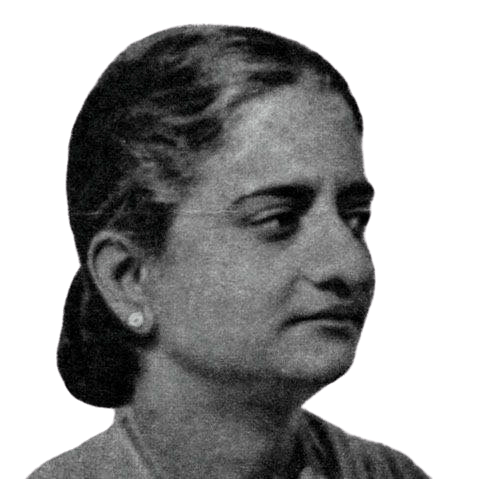
This lady was Hansa Mehta who was not just a representative of the Indian women, but a champion for universal women’s rights, all her life.
Hansa was born on 3 July 1897 in an affluent and cultured family in Gujarat. Her father was a professor of philosophy at Baroda College and later served as the Dewan of the states of Baroda and Bikaner. Her grandfather Nandshankar Mehta was a social reformer and well known author.
As a student in Baroda Hansa was influenced by the progressive thoughts of the Maharaja of Baroda Sayajirao Gaekwad III, and the philosophy of Aurobindo Ghosh. After graduating with honours in philosophy from Baroda, she left for England to pursue further studies in sociology and philosophy. She also travelled to the United States as an exchange student, and was keenly interested in understanding how their educational system worked. While in England she got to know Sarojini Naidu and Rajkumari Amrit Kaur who planted in her the early seeds of nationalism.
The spark was truly ignited when after her return to India, it was once again Sarojini Naidu who introduced Hansa to Mahatma Gandhi. It was 1922, and Gandhi was locked in Sabarmati Jail in Ahmedabad. Hansa was, as she, recalled “visibly moved” by this meeting. This also proved to be the turning point that launched Hansa into the freedom struggle. She got actively involved in the Non-Cooperation and Swadeshi movements, organising protests, and boycotts of foreign goods, and courting arrest.
Her decision to marry Jivraj Mehta, the then Chief Medical Officer of Baroda, met with opposition from her family and community as the groom was from another community. But she received strong support from the Maharaja of Baroda Sayajirao Gaekwad III. The couple moved to Bombay where Hansa continued her active involvement with the freedom struggle.
On Bapu’s advice, on 1 May 1930, Hansa led the first batch of the Desh Sevika Sangh in a satyagraha which involved picketing foreign cloth and liquor shops. Her organisational skills led to her appointment as President of the Bombay Congress Committee. Hansa was arrested and sentenced to three months in prison. She was released along with the other political prisoners under the Gandhi-Irwin Pact signed on March 5, 1931. In 1932 Hansa and her husband, who was not actively engaged in political life, were once again arrested and detained.
Following her release, she got deeply involved in the political processes which would go on to define the future of Indian polity.
She contested and won the first provincial elections from the Bombay Legislative Council seat in 1937. This was significant because she refused to contest from a reserved seat and was elected as a general category candidate. She remained on the Council till 1949. With her entry into mainstream politics Hansa also began to get closely involved with the All India Women’s Conference, and became its President in 1946. Her progressive vision for women’s empowerment in all fields, starting from education, was reflected in all the work of this organisation.
She became President of the Conference in 1946. In this role she piloted the drafting of the Indian Women’s Charter of Rights and Duties—which became a manifesto for women’s equality. Embodying the spirit of progressive politics, the charter sought among other things equality with men in terms of pay, civil rights, access to health and education, distribution of property, and fair marriage laws.
The next significant milestone was Hansa’s election to India’s Constituent Assembly in 1946. She was one of fifteen women in the Assembly. Rubbing shoulders with other founding fathers, with the shared vision for a new India, Hansa infused the deliberations with her own passion, vision and championing of women’s rights and justice. While the world over suffragettes were fighting for women’s equality, Hansa Mehta was ensuring that India’s constitutional document ensured that women were equal partners. Even as she fought for her own countrywomen, Hansa got the opportunity to carry her mission to an international arena.

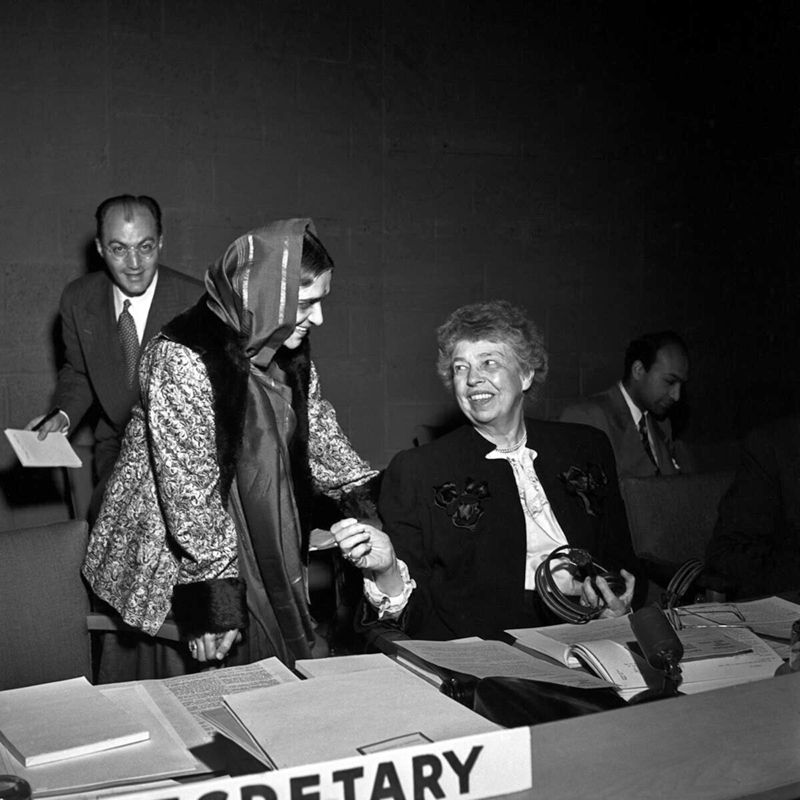
Around this time Hansa was appointed as an Indian delegate to the United Nations Commission on Human Rights. She found serving on the Commission as Vice-Chair to the Chair Eleanor Roosevelt, the first lady of the United States. During the discussion on the document that we know today as the Universal Declaration of Human Rights, it was suggested that the opening words of the first Article should read “All men are born free”. It was the Indian delegate Hansa Mehta who registered strong protest at the wording. Hansa argued that this could later be read to exclude women, and suggested that the word ‘men’ should be changed to ‘persons’ or ‘human beings’. The proposal was seconded by Eleanor Roosevelt. The suggestion was put to vote and was finally enshrined in the document thus: All human beings are born free and equal in dignity and rights. They are endowed with reason and conscience and should act towards one another in a spirit of brotherhood.
Thus Hansa put her indelible mark on what is, even today, a milestone document in the history of human rights. Her legacy is not forgotten. In 2015, the Secretary General of the United Nations, Ban Ki-Moon reminded that “The world can thank a daughter of India, Dr Hansa Mehta, for replacing the phrase in the UDHR”.
Hansa Mehta continued her advocacy of women’s education and rights, even as she herself went to attain many “firsts”. She became India’s first woman Vice Chancellor with her appointment at the SNDT University in Bombay. In 1949 she was appointed as the Vice Chancellor of the newly established Baroda University, the first woman to head a co-educational university. She was a prolific writer, and researched and published over twenty books, many focussing on women and children. She was awarded the Padma Bhushan in 1959. She passed away in 1995.
‘Feminist’, ‘Activist’, ‘Reformist’—Hansa Mehta was all these well before the labels became fashionable. A woman ahead of her time, who spent her life fighting for many freedoms, for the cause of her fellow women.
–Mamata
One of the criticisms against academic institutions is that they are far removed from every day realities and seldom contribute in solving real-life challenges.
The Jawaja project undertaken by IIM Ahmedabad in partnership with the National Institute of Design (NID), Ahmedabad is an early exception.
It was in 1975 that Ravi Mathai, IIM-A’s legendary first fulltime director, set out on a journey to see how corporate management principles could be used to solve the major problem facing India-poverty. Ravi had stepped down as Director and could now devote time to such a project.
The decision was taken to work in Jawaja, a drought-prone district of Rajasthan, consisting of about 200 villages and 80,000 population. There seemed very little scope for development there, given the arid landscape and lack of water and other physical resources. But Prof Ravi Matthai had a different perspective, because he saw people as the biggest resource.
As they understood the area better, they found that the area had a 300-year tradition of leather-craft. The communities there were also skilled at weaving. And so they decided to build on these skills to develop sustainable livelihoods for the communities there. Prof. Mathai roped in NID to join hands with IIM-A, to work on livelihoods and empowerment of the communities in Jawaja. He and Ashoke Chatterjee, his counterpart in NID, started the journey which involved many faculty from both institutes.
The idea was to connect artisans with contemporary disciplines of management and design, and knowledge institutions which had this knowhow. There were some important basic principles underpinning the effort. The first and foremost was that the relationship was one of mutual respect and learning—after all, even as the communities learnt new skills, the faculty of the institutions were learning how their knowledge could be put to use in solving social problems. Another important aspect was to see how much of the value chain could be controlled by the artisans and communities themselves, so that their incomes could be enhanced. The idea was to innovate and design new products which would have new markets, so that the traditional value chains could be broken and the craftspeople could play a greater role in more areas. The focus was also on working in groups, to give greater resilience and strength to the efforts.

The process was by design a gradual one, moving from basic products which did not need very high quality—e.g, leather school bags and woven floor mats, to higher value ones like office supplies, more trendy bags, and high-end furnishings.
The challenges were of course many. Apart from the need to design new products which would use the old skills, technologies and equipment, another major concern was quality control.
With regard to production of new designs, a train-the trainer model was envisaged, which did not work quite as planned. With regard to quality control, the idea was that it would initially be done by external experts, and would then be taken over by the crafts groups themselves. This again went slower than foreseen. Funds and resources for developing new products and for procurement of raw material were always a constraint.
But the enduring success of the bold experiment is seen even today at several levels.
The first was the creation of self-reliant institution of crafts people– the Artisans’ Alliance of Jawaja and its associations. These started to manage all links of the value chain in Jawaja, from raw material procurement, finances, bank dealings, design and technology know how, and marketing processes. These are still active today and continue to innovate, produce and market these products which are highly valued.
The second is the impact of the project on the larger development scene. It was the learning from running this grassroots education and empowerment project that the idea of setting up a specialized institution for education in rural management came up, and the Institute of Rural Management (IRMA), Anand, was born. This was given shape by Prof Ravi Mathai and two other professors who had been with IIM-A—Dr.Kamala Chowdhary and Dr.Michael Halse.
The Jawaja experiment widespread legacy is that it influenced development sector thinking on how to approach community-based livelihood interventions in a spirit of mutual respect and learning.
It is an initiative which needs to be much more widely known, understood and discussed.
–Meena
It is in this week, 80 years ago, that Gandhi’s call for Quit India reverberated through the length and breadth of the country, and struck a chord in the heart of old and young. People everywhere gave up their all to heed Gandhi’s call of “Do or Die” as they joined protests against the British government, boycott of foreign goods, and demonstrations in support of swadeshi goods. Last week we remembered a young girl Kanaklata Barua from Assam, who gave her life for the tricolour.
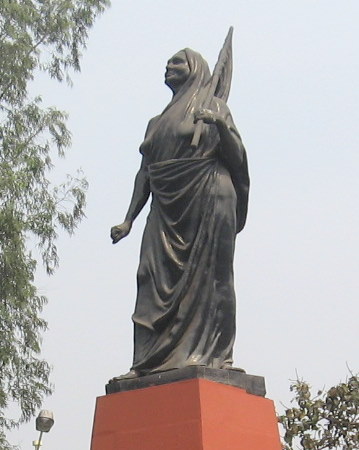
The movement was not confined to the young. People from every walk of life, and of every age threw themselves into the nationalist cause with fervour, undaunted by the challenges, and the risk to their own life. One of these was a poor, uneducated woman from Bengal who lived, and died, for a dream of a free India. This is the story of Matangini Hazra.

Matangini was born in 1870, a girl child in a very poor family in Hogla village near Tamluk in Midnapore district in what was then the Bengal Presidency. Her family could not afford to send the child to school, and she remained unlettered all her life. The family circumstances also led to her being married off early to a sixty-year old widower. The child bride became a widow herself by the time she was eighteen. Thereafter, Matangini returned to her parent’s village but chose to live separately. Over the next few years she spent most of her time helping people in her community.
The turn of the century also brought a turn in the life of the young widow. The nationalist movement was gaining momentum; the idea of engaging in a cause that transcended her own village and community attracted the interest and attention of Matangini. She began to participate in local events of protest. Even as she continued her work with local community, she was following the growing movement for independence across the country.
Years passed, as Matangini grew older, but still full of spirit and passion for the cause. On 19 December 1929, the Indian National Congress passed the historic ‘Purna Swaraj’ (total independence) resolution at its Lahore session. A public declaration was made on 26 January 1930 – a day which the Congress Party urged Indians to celebrate as ‘Purna Swaraj’ or ‘Total Independence’ Day.
The Purna Swaraj declaration was followed by the announcement of the Civil Disobedience movement which was led by Mahatma Gandhi. Protesting against the taxation on salt production, Mahatma Gandhi led his followers on a 26-day Dandi March which lasted from 12 March 1930 to 6 April 1930.
On 26 January 1932, the menfolk of Matangini’s village took out a procession to create awareness about the non-cooperation movement, and the political situation in the country. As they passed by her hut, Matangini felt herself being irresistibly drawn into the heart of the action. She joined the procession and marched with the young men, chanting slogans against the British. She was 62 years old, small, and frail in health, but strong in resolve; and she vowed to proactively fight the struggle for independence.
She later participated in the movement for the abolition of the chowkidari tax, a tax collected from villagers to fund a small police force in their areas. This was not only unfair, but the police troops were also used as spies against the villagers by the British Government
During a march towards the court building, to protest against the Governor’s harsh decision to punish all agitators, Matangini was arrested again and made to serve a six-month prison term at Baharampur jail.
In 1933, the then Governor of Bengal Sir John Anderson came to Tamluk to address a gathering. There was tight security everywhere but Matangini managed to reach the dais and stage a black-flag demonstration. She was sentenced to six months rigorous imprisonment. While she was incarcerated, she came in contact with other political prisoners and used this opportunity to learn more about the movement and Gandhi. She was strongly drawn to Gandhi’s ideas and committed to following these in practise. After being released she became an active member of the local unit of the Indian National Congress. She took to regular spinning of khadi on her own charkha, even as her eyesight was failing and her health was deteriorating.
In an incident during the same period, the story goes, that one summer afternoon Matangini was part of a freedom march in the district capital. The marchers reached the residence of the Governor who was standing on his balcony and observing the demonstration while his soldiers cordoned off the immediate area. Matangini, who was leading the protesters managed to break the cordon, and holding aloft the freedom flag rushed ahead shouting Go Back. She was beaten up by British police for this daring act, and was severely injured.
Even as her age increased year by year, so did her rebellious acts. So closely did she associate with Gandhi and his movement that she began to be locally called Gandhi Budi or ‘old lady Gandhi’.
Her feisty spirit and commitment to the cause culminated with the tidal wave of Quit India that was sweeping India. On 29 September 1942, Gandhi Budi led a procession of about 6,000 protesters, mainly women, heading for the Tamluk police station. The plan was to take over the police station from British authorities, and establish home rule in the small town.
Just as the team reached the outskirts of the town, the British police arrived and ordered the marchers to disband, or else be penalised for violating Article 144 (Unlawful Assembly) of the Indian Penal Code. There was chaos. The police tried to stop the march by threatening to shoot at the advancing crowd. Matangini appealed to the police force to refrain from shooting at the protestors. But the police were in no mood to listen. Even after they started to fire, Matangini continued to advance alone, holding aloft the tricolour. The police bullets hit her three times. Injured on the forehead and both hands, Matangini continued to struggle onwards, uttering Vande Mataram and not letting the tricolour fall. She continued marching till she collapsed and died.
Matangini Hazra was 72 years old. She lived a life of dedication to service, and died a hero’s death in the service of the cause of freedom.
–Mamata
I
We are all aware of how central khadi was to our struggle for independence. It was not only about defying the British and refusing to buy their imported cloth, but a potent symbol that it was not mere freedom from colonial rule that was critical, but also economic independence—a means of livelihood for millions of people of the country. In the words of Divya Joshi: ‘Gandhiji presented khadi as a symbol of nationalism, equality and self-reliance. It was his belief that reconstruction of the society and effective Satyagraha against the foreign rule can be possible only through khadi….The spinning wheel was at one time the symbol of India’s poverty and backwardness. Gandhiji turned it into a symbol of self-reliance and non-violence.’

But India is not the only country where spinning and weaving of textiles were a core part of a movement for independence. Another large British colony also used this as a weapon. This was the USA!
Britain saw its colonies including the American territories, as suppliers of raw material, insisted that they export all cotton to it, and buy all finished cloth from it. And of course it imposed huge taxes on all these products including fabric.
In defiance, the people in the American colonies started spinning their own cloth, and the spinning wheel because as important a symbol of patriotism in Americanin the 1760s and 1770s as the charkha was to the become in the 20th century in India.
Women were at the forefront of the spinning movement in the American War of Independence, and created their own homespun cloth to disrupt the British monopoly. Fabric made this way was called “homespun.” Wearing homespun was a symbol of patriotism.
In certain areas like New England, women showed their protest by going to ‘spinning bees’ where they would set up spinning wheels and keep each other company while they spun yarn. And these were not isolated events—for instance, in a single area, from Harpswell, Maine to Huntington, Long Island, over 60 spinning meetings were held over 32 months starting in March 1768.
The Daughters of Liberty, a group of political dissidents who got together to fight for liberty, were at the forefront of these spinning bees. They organized boycotts of British goods, especially tea, and they manufactured replacement products, especially cloth.
As in India, spinning was at the centre of a lot of publicity and was a rallying point for the freedom fighters. Newspapers reported elaborately on the smallest cloth-making development to amplify the message. Spinning schools were set up and awards were offered for the person who wove the most cloth. Old and young learnt to spin—it is reported that a 70-year-old woman in Newport, R.I., learnt to spin for the first time during the movement. Competitions were held—‘in 1769, two Connecticut women held an all-day spinning contest in which the winner spun seven skeins and two knots of fine linen yarn, just a little more than her competitor’.
The boycott of imported fabric and other goods from tea to molasses, worked, and it is estimated by some sources that the value of imported goods from Great Britain to the US fell by half in 1769 over the previous year, from 420,000 to 208,000 pounds.
So ‘swadeshi’ proved a potent war cry against imperial colonizers halfway across the world!
As it did in India almost 150 years later–rallying self-confidence, morale, giving a sense of identify.
Happy Independence Day!
Buying one pair of Khadi clothes a year can contribute to livelihoods for our millions of weavers. And they need it more than ever now, as the spinning of the national flag, which was their monopoly, has been taken away.
–Meena
Here is a mantra, a short one that I give to you. You may imprint it on your hearts and let every breath of yours give expression to it. The mantra is ‘Do or Die.’ We shall either free India or die in the attempt; we shall not live to see the perpetuation of our slavery. Every true Congressman or woman will join the struggle with inflexible determination not to remain alive to see the country in bondage and slavery.
These words spoken by Gandhi on 8 August 1942 launched the Quit India movement. Although Gandhi and many other leaders were arrested within hours of his speech, with the expectation that without their leadership the resistance movement would be rudderless, the effect was the opposite. Thousands of Indians, young and old, heeded this call and plunged into the movement, each contributing in their own way.
This mantra shared by Gandhiji at the Gowalia Tank Maidan Park in Bombay echoed across the country. Its reverberations reached the eastern corner of India, to Assam, and lit a spark in the heart and mind of a young girl named Kanaklata.
Kanaklata Barua was born on 22 December 1924 in Barangabari village of Gohpur, now in the Sonitpur district in Assam. Her mother died when Kanaklata was only five years old, and the young child developed a sense of responsibility much beyond her tender age. Her father remarried but he also died when she was thirteen. With added household responsibilities, and caring for her siblings, Kanaklata had to drop out of school and could not continue her studies after third standard.
Even as she was growing up in her village in Assam, the sparks of the nationwide freedom movement were spreading across the length and breadth of the country. The non-cooperation movement was gaining strength. The movement reached a climax with Gandhi’s call for “Do or Die”, and the wave of the Quit India Movement surged to new heights.
In Assam too there were widespread protests against British rule, and young and old joined in. Initially the protests were peaceful, but the British arrested all the Congress leaders of the state, and stepped up their brutal repression of the people. This only strengthened the opposition, and engendered underground conspiracies to fight the British. Among these was the setting up of a suicide squad which engaged in subversive activities like derailing and burning trains, attacking army outposts and snapping communication channels.

Seventeen-year-old Kanaklata was inspired and fired by the cause, and eager to contribute. Her dream was to join the Azad Hind Fauj, but as she was still a minor, she was not permitted to do so. Undeterred, she volunteered to join Mrityu Bahini–a suicide squad. For this too she was technically underage, but her determination and passion for the freedom movement was considered suitable for granting her membership. Subsequently she became the leader of the women’s cadre of the Mrityu Bahini.
The then president of the local Congress committee, Kushal Konwar was an ardent believer of non-violence proposed by Gandhi. He was falsely accused by the British for derailing a train which killed many British soldiers, and he was hanged. After the martyrdom of Kushal Konwar, the revolutionary camp of Gohpur division, under the leadership of Jyoti Prasad Agarwala, decided to mark their protest by removing the British flag and unfurling the National Flag at the local police station.
On 20 September 1942, Kanaklata led the procession of members of the Mrityu Bahini, walking proudly with the national flag in her hand, and with cries of Vande Mataram. The officer-in-charge of the police station was anticipating this. He warned the procession not to proceed further. He threatened that the police were duty-bound to start firing if the protesters advanced. Kanaklata responded by saying that he could do his duty while she carried on with her duty.
The procession carried on towards the police station; Kanaklata was leading, with the tricolour held aloft in her hands. As they neared, the police fired. Kanaklata fell to the bullet, with the flag still firmly held up. Before the flag could touch the ground it was taken by Mukunda Kakoti, another member from the group. He too was felled by a police bullet. Two young lives, snuffed out even before they attained adulthood. Kanaklata was not yet eighteen years old, and did not live to see the independent India of her dreams.
Their martyrdom did not go in vain. Even as their comrades were breathing their last, the others in the group did not let the tricolour down. They picked it up and with cries of Vande Mataram, the flag was eventually unfurled at the police station. One of the millions of small but significant gestures that added nail after nail to the coffin of the end of British rule in India.
While Kanaklata’s tale is not well known, it has at least been told. This month as we remember the many struggles and sacrifices that contributed to the unique non-violent movement that led India to become Independent, let us also pay tribute to the many unsung heroes and heroines who gave their all, even their life, for this cause.
And as we swell with pride to see the Indian tricolour fly freely and fearlessly, let us not forget the brave young woman “Birbala” Kanaklata Barua who gave her life for it.
–Mamata

The first week of July is celebrated in India as Van Mahotsav or Forest Festival. It is marked by the planting of thousands of trees, through community events. It is a reminder of the critical role that vegetation plays in the conservation of water and soil, and thus of life itself. This week brings to mind the story of another greening movement that was the brainchild, and life-long passion, of an incredible woman named Wangari Maathai.
Wangari Muta Maathai was born in Nyeri, a rural area in the central highlands of Kenya in 1940. Her parents were farmers, and she was the third of six children. Wangari’s childhood was spent in the outdoors, playing in the fig trees and the stream around her home, and helping her mother collect firewood for the household. She always saw herself as “a child of the soil”, growing up with her mother’s belief that trees were ‘God’ and should be respected accordingly, something she made the foundation of her life’s work.
Wangari started her education at St. Cecilia Intermediary, a local mission school. She was always a star student; she won a scholarship to study biology at Mount St. Scholastica College in the United States, and graduated in 1964. She went on to earn a Master of Science degree from the University of Pittsburgh. But as she wrote in her memoir Unbowed: The spirit of freedom and possibility that America nurtured in me made me want to foster the same in Kenya, and it was in this spirit that I returned home.
After she returned to Kenya, Wangari continued her studies and obtained a doctorate in veterinary anatomy at the University of Nairobi, becoming the first African woman in East or Central Africa to hold such a degree. She then joined the university as an associate professor, and went on to become chairwoman of its veterinary anatomy department in the 1970s.
Wangari was however more than just an academic. She was very aware of the changes in her native country’s landscape stemming from the legacy of the British rule—massive deforestation and overexploitation of resources. As a member of the National Council of Women of Kenya (NCWK), she was also becoming engaged with women’s issues. She heard, and saw, rural women who were facing immense hardship due to water sources drying up, and degradation of the soil; women who had to walk miles each day in search of firewood to cook their meals.
By then I understood the connection between the tree and water, so it did not surprise me that when the fig tree was cut down, the stream where I had played with the tadpoles had dried up. I profoundly appreciated the wisdom of my people, and how generations of women had passed on to their daughters the cultural tradition of leaving the fig trees in place. I was expected to pass it on to my children, too.
Wangari remembered her mother’s words about trees. She realised that the only way to prevent the further deterioration of the land was to plant trees. Now, it is one thing to understand the issues. It is quite another to do something about them. But I have always been interested in finding solutions….It just came to me: ‘Why not plant trees’? She first approached foresters to urge for more intense and extensive tree planting. But they derided her by saying what could a veterinary scientist know about plants and plantation? Wangari was undeterred. She decided to go directly to the local women and started explaining to them about the links between tree cover, soil and water conservation, and availability of firewood to cook nutritious meals for the family. She urged that women themselves should take on the mission of planting trees.
Wangari set the example by starting a small tree nursery in her backyard and giving women saplings to plant. As I told the foresters, and the women, you don’t need a diploma to plant a tree. After the women had planted seedlings on their farms, I suggested that they go to surrounding areas and convince others to plant trees. This was a breakthrough, because it was now communities empowering one another for their own needs and benefit.
This simple formula was to snowball into one of the largest grassroots tree planting movement—Kenya’s Green Belt Movement. Wangari’s approach was practical, holistic and deeply ecological—the tree roots helped bind the soil, halting erosion and retaining ground water when it rained. This water replenished the streams needed for cultivation of food crops. The trees also provided food, fodder, and fuel which were the mainstay of the communities. Initially the government did not pay much attention to these nurseries, but as thousands of nurseries began to be created the Government began to see the potential threat that such mobilization could pose to the status quo and vested interests, and it began to harass the Green Belters. By then the movement had attained its own momentum and mobilized thousands of women and men to plant tens of millions of trees across the country. The movement also did more than get women to plant trees; it empowered them to stand up for themselves even in the face of domineering husbands and village chiefs, as well as political and social pressures.
As the movement grew, Wangari Maathai was also becoming more convinced in her understanding that environmental changes alone were not sustainable unless they were linked to issues of governance, peace, and human rights. She used the movement to also address abuse of power like land-grabbing, and human rights issues like illegal detention of political opponents. This led the Green Belt Movement to be labelled as ‘subversive’ during the 1980s.
Wangari felt that these issues could not be fought only through activism. She herself entered the political fray. She was elected as an MP in 2002, and also served as an assistant minister in the Ministry of Environment and Natural Resources. She used her position to fight for women’s rights, democratic processes, and questioned corruption and abuse of power. This also led her to be seen as a threat to the powers that be; she was threatened, harassed, beaten and even jailed. In 2008 she was pushed out of government.
In the meanwhile Wangari Maathai and her Green Belt Movement were attracting international attention. She travelled across the world campaigning for change; urging action to be taken on environmental justice, climate change, and championing the cause of participatory democracy, good governance and women’s rights. Her key message was: It is the people who must save the environment. It is the people who must make their leaders change. And we cannot be intimidated. So we must stand up for what we believe in. Meanwhile in Kenya, the Green Belt Movement continued to grow and spread with over 6000 grassroots nurseries and tens of millions of trees planted across Kenya.
In 2004, Wangari Maathai was awarded the Nobel Peace Prize, becoming the first African woman to be awarded the Prize.
In presenting her with the Peace Prize, the Nobel committee hailed her for taking “a holistic approach to sustainable development that embraces democracy, human rights and women’s rights in particular” and for serving “as inspiration for many in the fight for democratic rights.”
Wangari Maathai passed away in 2011. Even her last wish to be buried in a casket made of hyacinth, papyrus, and bamboo, echoed her life’s mission to save trees. Mama Miti or ‘ mother of trees’ as she was fondly called in Swahili left behind an inspiring legacy of millions of trees that sustain their land, planted and nurtured by the thousands of women whose lives she touched, and changed in many ways. She exemplifies how one woman can be a powerful force for change.
–Mamata
.
Mrs. Indira Gandhi was the only Head of State at the United Nations Conference on the Human Environment held at Stockholm in 1972, apart from the host Prime Minister Olaf Palme, who was the host. The speech she gave at the Conference, linking human development, poverty and peace to environmental conservation is definitely one of the first steps towards the articulation of sustainable development. i.e., ‘meeting the needs of present generations without compromising the ability of future generations to meet their own needs’.
But long before this Gandhi, there was another Gandhi who was calling the world’s attention to these issues. Who else but Mahatma Gandhi!

Gandhiji may not have articulated his thoughts on the environment in terms that we use today. But his whole philosophy was deeply rooted in concepts of what we now call sustainability: taking only what one needs from the environment, simplifying wants, equity, non-violence towards all life forms, and a caution against mindless pursuit of ‘development’. Many environmental movements like Chipko or Narmada Bachao Andolan are in fact inspired by Gandhiji.
On the occasion of Stockholm+50 and WED, here are some quotations from the Mahatma, which mark him as a very early spokesperson for environment and sustainable development.
‘I suggest that we are thieves in a way. If I take anything that I do not need for my immediate use, and keep it, I thieve it from someone else. I venture to suggest that it is the fundamental law of Nature, without exception, that Nature produces enough for our wants from day-to-day, and if only everybody took enough for himself and nothing more, there would be no pauperism in the world, there would be no man dying of starvation in the world.’
Speech on ‘Ashram Vows’ at YMCA, Madras. 16 Feb, 1916. CWMG Vol 13, 230-231.
‘Earth provides enough to satisfy every man’s need, but not every man’s greed.’
Quotation popularized by Gandhi.
‘We cannot have ecological movement unless the principle of non-violence becomes central to the ethics of human nature.’
Mohan-mala. A Gandhian Rosary. Ahmedabad. Navajivan Publishing House. 1997. 93-94.
‘God forbid that India should ever take to industrialization after the manner of the West. The economic imperialism of a single island kingdom (England) is today keeping the world in chains. If an entire nation of 300 million took to similar economic exploitation, it would strip the world bare like locusts.’
Young India. 12 Dec 1928. CWMG Vol. 38. 243.
If it is man’s privilege to be independent, it is equally his duty to be inter-dependent.
http://www.selfimprovementpath.com.mahatmagandhi.
‘In the modern rush, the chief use we have for our rivers is to empty our gutters in them and navigate our cargo vessels, and in the process make them dirtier still.’
Young India, 23 December, 1926.
‘Civilization, in the real sense of the term, consists not in the multiplication, but in the deliberate and voluntary reduction of wants.’
Yeravada Mandir. Navjivan Publishing House, Ahmedabad.
‘We cannot have ecological movement unless the principle of non-violences becomes central to the ethics of human nature.’
Mohan-mala. A Gandhian Rosary. Navjivan Publishing House.
–Meena
Credit: Centre for Environment Education put together a collection of Gandhiji’s thoughts to mark the 10th anniversary of the Earth Charter, in a publication called ‘Earth Charter & Gandhi: Towards a Sustainable World.’ Compiled by Karikeya Sarabhai, Meena Raghunathan, Amishal Modi. These quotations are taken from there.
I am slow to adopt most things new. And so it was with podcasts. I was pretty skeptical of the audio medium as a means of learning. Being fully old school, for me, the ‘read word’ was the major source of both learning and recreation.
My conversion to podcasts is fairly recent. The audio system that I was using during my walks to listen to music on broke down, and that was when I decided to explore podcasts. And what a world it has opened up to me! Not just walks, but also car-rides and flights have become much more enriching. But I have to admit, while my default state is to sit around the house with a book in my hands, I am not as yet able to sit around with a podcast plugged into my ears. I feel kind of guilty and unemployed. But I am sure the day will come…
While the raw beginnings of podcasting are traced back to the ‘90s, the medium really came into its own in the mid-2000s. The first steps were laid in 2004, by Adam Curry a former MTV video jockey, along with a software developer Dave Winer, when they coded a program known as iPodder. This made it possible to download internet radio broadcasts to iPods. Within a year, commercial companies realized the potential and with Apple as the first mover with iTunes 4.9, started to offer support for podcasts. Politicians were not far behind—George Bush became the first President to have a weekly podcast as early as 2005. The speed with which the innovation caught on can be gauged by the fact that “Podcast” was declared “Word of the Year” by the New Oxford American Dictionary.
Today tech-savvy India has the third-largest podcast listenership in the world. At 57.6 million listeners, it is behind only China and the US, and growing at a rapid 30+%.
I listen of course to the usual suspects, from Stuff You Should Know, to Ted Talks Daily, to BIC Talks, to The History of India Podcasts, to No Stupid Questions, and 99% Invisible.

But the podcast that moved me most, which inspired and fired me was MISSION ISRO. This series traces the history of India’s space programme, essentially through the work of Dr.Homi Bhabha and Dr.Vikram Sarabhai. These two men had not only the vision, but the scientific stature, the international standing and the conviction to overcome all barriers to make this dream a reality. How they convinced the decision-makers in the country that a newly-independent country like India, which was struggling to even feed its people, needed to invest in space, and how they convinced the world that India had the capacity to make this work, is a fascinating tale. And the vision of the then-PM, Shri Jawaharlal Nehru, who believed in the use of science and technology for national development is what made this possible. The clarity of the philosophy of the Indian space programme set by the founding fathers—that it was not for warfare and aggression, but rather, to bring development to the remotest corners of India and to the poorest—is what sets our space programme apart even today.
The refusal of Dr. Sarabhai and Dr. Bhabha and their teams to be deterred by any obstacles– whether lack of equipment, permissions, know-how—is awe-inspiring. The innovative ways they found to get around challenges, to make do with the resources they had, to find supporters and partners, in order to accomplish Mission Impossible brings home the lesson that a clarity of purpose and the belief that it can be achieved will move mountains.
Researched and scripted by Archana Nathan, produced by Gaurav Vaz, Harsha Bogle’s voice brings the podcast to life. The enormous effort in getting interviews with key people who were involved in the space programme and hearing them relate the stories of those times is amazing. And hearing Dr. Vikram Sarabhai’s voice sent goose bumps down my spine!
Don’t miss it. It gives us an understanding of our history and achievements from times which today are dismissed so easily. It gives us an understanding of what visionary nation-building is and the mettle that visionary nation-builders are made of.
–Meena