Lady With the Lens: Homai Vyarawalla

The past few weeks, as India goes through its massive election exercise, the newspapers have been carrying iconic photographs that show glimpses from past elections. For many of us who are firmly part of the ‘morning newspaper’ generation, these black and white images bring back memories of what feels like another age. These pictures capture not only candid shots that evoke nostalgia, but are also telling stories of different life and times. The people behind most of these have been photojournalists. Photojournalists are described as visual storytellers who use photography to document and report on news events, current affairs, and human interest stories. While their camera lens captures, and freezes a particular moment, it is the record of these intrepid storytellers that make history.

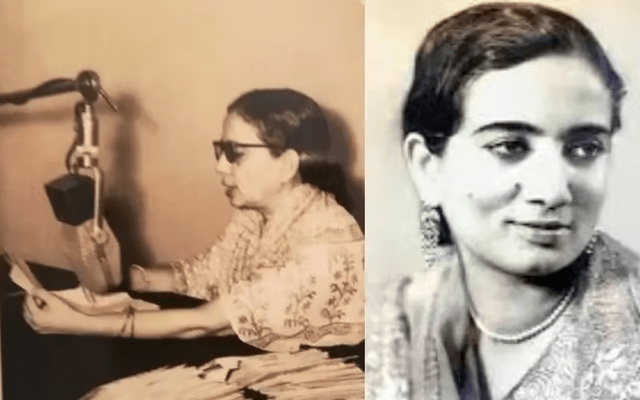
A recent exhibition of one of India’s most renowned photojournalists, Raghu Rai presents some pages from this history. But this also reminds one of another name that made her own history. This is Homai Vyarawalla, India’s first woman photojournalist.

Homai Vyarawalla was born on 9 December 1913 in Navsari in Gujarat, in a Parsi family. She had a peripatetic childhood as her father was an actor with a traveling theatre group. The family eventually settled in Mumbai where Homai enrolled in the JJ School of Arts. When she was in her early teens Homai met Manekshaw Vyarawalla, a freelance photographer who first introduced her to photography. The two initially shared a Rollieflex camera, and developed their own films in a dark bathroom. Homai started taking pictures of her friends as she starting learning the ropes. Manekshaw submitted some of her photographs of a local picnic to The Bombay Chronicle for which he then worked, and these were published. Homai began to get some photographic assignments; however some of her works was published under Manekshaw’s name, as a woman photographer was not something people respected professionally. She began to draw more attention after her photographs of life in Mumbai were published in The Illustrated Weekly of India magazine. Later Homai also used the pseudonym Dalda 13 (DALD from the number plate of her car, and 13 which she believed was her lucky number!). Homai and Manekshaw were married in 1941.

With the outbreak of World War II, the British Information Services (BIS) relocated to India, and were recruiting photographers on the ground. The Vyarawallas were recommended for the job by the then editor of the Illustrated Weekly. The couple moved to Delhi in 1942, with Homai joining as a full-time employee, with freedom to also take on freelance projects. Homai’s art school training in visual composition added to her skills as a photographer. She worked for the BIS as an official press photographer till 1951, and as a freelancer till 1970. Always humble and polite, clad in a khadi sari and carrying a Rollieflex camera, Homai was indeed an unusual sight on the streets of Delhi.

Homai began covering not only events and ceremonies at the British High Commission, but also chronicling significant moments in the transitional phase from the end of the British Raj to India becoming an independent nation. Some of these events included the swearing in of Lord Mountbatten as the first Governor General of India in 1947, the first Republic Day Parade in 1950, visit of Jacqueline Kennedy’s visit to India in 1962. She covered Mahatma Gandhi’s funeral in 1948 but was regretful till the end of her life at having missed his last prayer meeting when he was assassinated.

Besides events, Homai’s camera captured nuances of faces and expressions of a host of personalities that shaped the 20th century. From Lord Mountbatten to Queen Elizabeth, Krushchev to Nixon, Sardar Patel to Dr Ambedkar, Mahatma Gandhi to Indira Gandhi, visiting personalities and their hosts were frozen for posterity in Homai’s frames. Jawaharlal Nehru was a favourite subject of Homai’s. Homai was still the rarity in India—a female photojournalist, and her work did not get the kind of attention that the work of a contemporary, Margaret Bourke-White, did for her pictures of Gandhiji.

Homai herself did not seek the limelight, she preferred that her photographs spoke for themselves. And indeed these pictures that span the first three decades of an Independent India continue to tell the stories that defined that era. In fact Homai never travelled out of India. Her first trip to the USA and UK  was when she accompanied her biographer on a speaking tour, at the age of 95 years.

Homai’s husband Manekshaw passed away in 1979. Losing her companion of forty years, Homai also gave up photography totally. She spent the last two decades of her life in Vadodara, leading a simple, quiet, secluded life until she passed away on 15 January 2012, at the age of 98. Homai was the recipients of several awards including the Padma Vibhushan in 2011. Homai gave away her entire collection of prints, negatives, cameras and other memorabilia to the Alkai Foundation for the Arts, on permanent loan for safekeeping and documentation.

As Raghu Rai said in a recent interview “If responsible journalism is the first draft of history, then photojournalism is the first evidence of that history being lived.” Homai Vyarawalla will always remain a preeminent chronicler of that history.

–Mamata

Feisty Fighter: Jayaben Desai

In the last few months there has been a lot of news about Junior and Senior doctors in the UK going on strike to draw attention to their demands. There are often pictures of the picketing medicos. These include a large number of Asian and other ‘non-white’ faces. Today the non-English population makes up a large portion of the work force in the UK. While there is a continuing stream of migrants making their way to the UK for higher education, and often continuing to work after their studies, there is an equal number of second generation immigrants who have made UK their home over the last century. These are the descendants of the first immigrants who laid the path for the future of this generation.

There are numerous stories of these early immigrants who arrived in a totally alien, and often hostile, environment but who by dint of hard work, struggle, and ambition fought all the odds. One such feisty lady is still remembered for breaking many barriers.

Jayaben Desai began her life in Gujarat in India, where she was born on 2 April 1933. She moved to Tanganyika after her marriage to Suryakant Desai a tyre-factory manager. There she led a comfortable life as part of the large community of British subjects of Indian origin who had long settled in East Africa. In the 1960s the situation changed with many of the newly-independent countries in East Africa moving towards “Africanisation’ policies which led to declining economic opportunities and security for the East African Asians. Many of these chose to move. As British passport holders they headed for Britain. Jayaben and her husband joined this exodus.

Life in Britain was very different. The new migrants did not enjoy the economic and social status that they had done in East Africa. Despite being British citizens they had to struggle at every step to establish new lives and livelihoods in an unwelcoming environment. Most of them were educated and professionally qualified, but in England they were compelled to take whatever work they could get; most of which was unskilled labour with poor wages. They faced a great deal of discrimination, racism and prejudice in every aspect of life.

As one of these women recalled: “There was no question of whether you wanted to or not – you had to work, so you did. And wherever you found work, you had to take it. It wasn’t that you were educated, so you only wanted certain kind of jobs – we had to work in factories and that’s how we brought up our children. …We used to have people working for us, and now we had to work for others. That’s life. …Of course I felt sad.”

Jayaben started part-time work as a sewing machinist in a sweatshop, while bringing up her two young children. She then moved to work at the Grunwick film processing factory in North-West London. Grunwick employed a large number of Asian women who were perceived as being hard working and submissive. The factory paid low wages, and was run in an atmosphere of fear and control, with workers being humiliated in many ways.

The simmering unrest began to surface when the managers sacked a young Indian worker, and three colleagues walked out in solidarity with him.  Soon after, on Friday 20 August 1976, Jayaben Desai was confronted with a short-notice demand for overtime.  She refused. The manager derogatively called her and her fellow workers “chattering monkeys”. She responded by telling the manager: “What you are running here is not a factory, it is a zoo.  There are many types of animals in a zoo.  Some are monkeys who dance to your tune, others are lions who can bite your head off.  We are those lions, Mr Manager.” 

Jayaben and almost 100 other workers spontaneously walked out in protest. Thus far, previous strikes by black and Asian workers had not received the support of  trade unions. But the Grunwick strikers were supported by the Brent Trades Council; they were encouraged to form a union and received strike pay. Thus the strike was significant because it got trade union recognition, and also demonstrated the greatest solidarity So between the white and coloured working class.  As Jayaben stressed during the strike, ‘We will not back down now.  We want to bring this factory to a standstill.  Our fight is for all our rights, and for our dignity.  We hope all trade unionists will stand by us.’  

Jayaben, and the striking workers travelled across England and addressed workers in other factories and workplaces about their fight, and this managed to persuade trade unionists from far and wide to come to their aid. By June 1977, as support for the strikers grew, the size of the mass pickets increased from a few hundred to several thousands. The strike began in 1976 and continued for two long years until 1978. This was possible, as the strikers received strike pay from the trade unions, which was comparable to the low pay they received at Grunwick. It was highly unusual for that time for unions to support ethnic minority groups and migrant workers. But the response rattled the Labour government who put pressure on the Trade Unions leadership to withdraw support. This did not deter the strikers led by Jayaben who started a hunger strike in November 1977.  But even this action could not change the unions’ mind, and so they had to call off the strike. The strike came to an end without the workers getting their jobs back. However, one of its outcomes was the introduction of some concessions relating to existing and future workers’ pay and pensions.

As she later recalled: “Because of us, the people who stayed in Grunwick got a much better deal. When the factory moved, the van used to come to their home and pick them up because it was difficult for them to get to the new place. Can you imagine that? And they get a pension today! And we get nothing. That was because of us, because of our struggle.”

Despite its eventual failure, the Grunwick strike became a symbol for its demonstration of determination and solidarity. As Jayaben said: “The strike is not so much about pay, it is a strike about human dignity.” It is remembered for the way in which thousands of workers, black and white, men and women, united to defend the rights of migrant women workers. The feisty Jayaben who had catalysed the movement also changed the stereotype of South Asian women as being passive and submissive.

In recognition of her contribution to the struggle for workers’ rights, Jayaben Desai was awarded with a gold medal by the GMB trade union in 2007. She retained her indomitable spirit until she passed away at the age of 77, in December 2010.

–Mamata

A DAY TO REFLECT

It is March 8, and the newspaper pages are dominated by a plethora of “offers” especially for women. There is much on offer–from designer clothes to jewelry, from cosmetics and ‘make-overs’, to a day of indulgence at a spa or fancy restaurant, and even special health check-ups, all cleverly designed to “celebrate the woman in you!” This day follows on the heels of Valentines/Galentines Day which was all about ‘sugar and spice and all that’s nice’ to make every woman feel special. Tucked away between the gloss and glamour, are stories of ‘women of substance’ and women achievers who overcame many odds to get where they are today. These women certainly inspire a few, but they are quite out-shadowed by the ‘influencers’ with their countless followers.

In all the razzmatazz, not much is remembered about the origins and intent of the day that is today marked as International Women’s Day. The day, ironically had socialist origins and then became a marker of the movement for women’s rights to equality and dignity.

In its official history, the spark was ignited by a march in New York City on February 28 1908 by thousands of women garment workers who were striking to protest poor working conditions and wages. The march was spearheaded by the Socialist Party. However the history of the struggle for women’s rights can be traced further back to 1848 when two American women ‘activists’ Elizabeth Cady Stanton and Lucretia Mott who were attending the World’s Anti-Slavery Convention in London, were outraged at the denial of official recognition to several women delegates because of their sex. On return to America they organized the nation’s first women’s rights convention in New York. The resulting Declaration of Sentiments and Resolutions which detailed the inferior status of women, demanded civil, social, political and religious rights for women. This triggered the American women’s rights movement.

The concept of a day to register women’s voices crossed the Atlantic and reached Europe around 1911. Clara Zetkin, a German communist and advocate for women’s rights, including the right to vote, proposed that the day become an international event at an International Conference of Working Women in Copenhagen in 1910. She believed that if women across the world were synchronised in pressing for their demands, then their collective voice would be too hard to ignore. Her proposal was unanimously backed by the 100 women from 17 countries who were at the conference. The first International Women’s Day was celebrated in 1911, in Austria, Denmark, Germany and Switzerland with rallies campaigning for women’s rights to work, vote, be trained, to hold public office and end discrimination. At the time, celebration was not tied to a particular date.

It was in 1917, that on the last Sunday of February, Russian women, led by Alexandra Kollontai, began a strike for “Bread and Peace” in response to the death of over 2 million Russian soldiers in World War 1. Opposed by political leaders, the women continued to strike until four days later the Tsar was forced to abdicate. As a direct consequence of the marches and demands for universal suffrage in which thousands took part, the provisional Government granted women the right to vote in 1917. Thus Russian women got the right to vote a year before Britain and three years before the United States. Interestingly it was New Zealand that was the first country to grant women the right to vote in 1893.

The date the women’s strike in Russian commenced was Sunday February 23 as per the Julian calendar then in use in Russia. This day matched March 8 on the Gregorian calendar in use elsewhere. And thus the date became associated as a milestone marker in the movement for women’s rights.

In the years that followed, different countries embarked on different paths towards granting women their rightful rights, starting from the right to vote, and embracing equality of access to other opportunities and avenues for growth and development. Ironically, this day is not highlighted in the United States, because of its associations with its Socialist roots and later with communist Russia. However the United States marks the entire month of March as Women’s History Day.

It is only in 1975 that the United Nations marked International Women’s Day for the first time. In December 1977, the General Assembly adopted a resolution proclaiming a United Nations Day for Women’s Rights and International Peace to be observed on any day of the year by Member States, in accordance with their historical and national traditions.

Today, more than a century after the day was marked, there have been many more milestones in the journey of women for their rightful status in all spheres of life—personal, professional, social and political. Every generation has had its challenges and these have thrown up the challengers who have often made it their life mission to carry forward the torch. We have often written about these feisty women in this space.

At the same time, even as women are breaking new glass ceilings, it is still a far cry from becoming ‘a woman’s world’. Women and children are bearing the brunt of war in many parts of the world; women are the most directly affected by the ravages that climate change is wreaking across the globe; women in many countries are at the receiving end of extremist religious beliefs, and women are still fighting for the right to make their own decisions about their own bodies, and minds. There are many new avenues and media to reach out, raise voices, and come together. The same media have the potential to become toxic, to denigrate, to divide and even to destroy. 

Perhaps today is a good day to reflect on this, even as we reminiscence about the women who have made our road to this point less rocky, who have led the first ascents to the seemingly inaccessible peaks, women who have led quiet revolutions at home, in the work place and in society. Let these true women of substance be our role models and inspirations, not just today but every day.

For the Matriarchs, this day marks the starting point of our own journey of sharing thoughts, angst, wild ideas, and laughter. It has been five years of a beautiful celebration with friends, known and unknown. We are truly grateful, and celebrate all our fellow travellers.

–Mamata and Meena

In the century since it was first established, International Women’s Day has come to be marked just as frequently with celebration as it is with protest, but the day’s legacy remains steeped in the struggle for women’s rights — an element that has gained renewed relevance in recent months, particularly as the #MeToo movement has taken on global dimensions.

Image: UN.org

Fighting the Disease, Fighting the Stigma: Marking Leprosy Day

Humanity spent a few years in fear of Covid. A few decades were spent in fear of AIDS. But millennia have been spent in fear of leprosy.

Leprosy is oft-mentioned in texts of yore. In Hindu mythology, it is often the result of a curse. Samba, son of Krishna and Jambavati, was cursed with the disease by his own father for constantly harassing his stepmothers (even otherwise, he seems to have been a pretty painful character). Later, when Krishna learnt that Samba was himself led into the misdemeanor by Narada, he wanted to take back the curse, but could not. Krishna advised Samba to pray to the Sun God for a cure. Samba did so—in fact, the Sun Temple at Konark and Multan (the temple does not exist and its exact location is unknown, but may have been in present-day Pakistan) are supposed to have been built by him. As a result of his devotions, he was cured.

The tale of Reunka is a fairly typical misogynistic one. She was the devoted wife of Sage Jamadagni, cursed with leprosy by her husband for a momentary lapse—for a moment being attracted to the Gandharva King. She was advised to bathe in Jogala Bhavi a nearby lake, and was cured. But sadly, when she returned home, her husband was still furious, and commanded his sons to kill her. The first four refused and were cursed by their father to die, but the fifth, Parashuram (yes, he who was an Avatar), obeyed his father. Jamadagni, pleased with Parashuram, granted him a boon. Good sense prevailed and Parashuram begged for the revival of his mother and brothers. A repentant Jamadagni is supposed to have foresworn anger, and lived happily with his wife ever after.

Leprosy also plays a key role in the Mahabharatha. Shantanu, father of Bhisma, Chitrangada and Vishitravirya came to the throne because his elder brother Devapi had leprosy. If it had not been for Shantanu’s attraction first to Ganga and then to Satyavati, the Mahabharat war may never have taken place.

Islamic and Biblical references to leprosy also abound, and Jesus is supposed to have cured the disease with his touch.

Through the ages, leprosy was feared as a curse of the Gods, and the only salvation was a boon from them. The social ostracism and rejection by friends and family was as much a suffering as the disease itself.

Gandhiji Leprosy
Gandhiji viewing what is presumed to be Mycobacterium leprae

In the last few centuries, many brave souls have worked hard for the relief of these sufferings. Gandhiji was at the forefront of the fight against the fear of leprosy. Pictures of him tending to Shri Parchure Sastry, a learned man whom Gandhiji respected very much, are often seen. Sastry even made his home in Sewagram with the agreement of all the Ashram inmates.

Vinobha Bhave was another Gandhian leader who worked in this field. He and Manoharji Diwan established Kushthadham (Leprosy Centre) at Dattapur in 1936.

And of course, the selfless work of Baba Amte and his wife Sadhantai, is legendary. He was a Gandhian and active in the freedom struggle. But how he came to leprosy work is interesting. He encountered a leprosy patient one day, and it is the fear and revulsion he felt that led to deep introspection, and the decision to devote his life to this work. He not only wanted to help the patients, but also create a society free of “Mental Leprosy”, ie., the fear and misunderstandings associated with disease. He founded three ashrams for patients and devoted his life to them. The Gandhi Peace Prize and the Ramon Magsaysay award were only a few recognitions of his service.

Dr. Noshir Antia is another individual who contributed enormously to the rehabilitation of leprosy patients. He is known as the father of Plastic Surgery in India and established the first department in the country devoted to this—the Tata Department of Plastic Surgery at the J.J. Hospital in Mumbai. . His interest in this subject began when he saw the disfigurement of leprosy patients, and started to pioneer surgical techniques for correcting these. Apart from surgery, he also started research facilities to study the disease and fought against the discrimination against the sufferers of this disease, and for their rehabilitation. Dr. Antia passed away in 2007, but his legacy continues not only through the generations of doctors and surgeons trained by him, but also through the NGO he founded—the Foundation for Research in Community Health

World Leprosy Day is observed on the last Sunday of January. In India, with a slight tweak, and to mark Gandhiji’s contribution in this field, it is observed on 30 January, coinciding with his death anniversary.   

The theme for the day this year is “Beat Leprosy” which calls attention to the dual objectives of the day: to eradicate the stigma associated with leprosy and to promote the dignity of people affected by the disease.

As Vinobhaji put it, the critical thing is to beat mental leprosy—the fear of leprosy. And our experience of recent diseases has shown us that fear is not the way to react to any disease. Scientific understanding and empathy are!

–Meena

Two books which may be of interest:

‘Autobiography of a Doctor’ is Noshir Antia’s tale of his life.

‘Covenant of Water’ by Verghese Abraham has leprosy, its treatment and the social discrimination as an important theme.

Window to the World: National Geographic

They were probably our first glimpse of the wonders of the natural world. As children we eagerly awaited the arrival of the yellow cover magazines with their breathtaking pictures. My father, a lover of maps found a wealth of meticulous cartography in the maps that often accompanied the magazines. The glossy pages with fantastic photographs were the hallmark of the National Geographic Magazine. The magazine has maintained the same level of excellence for the last 136 years!

This month marks the important milestones that led to the launch of this enduring visual record of the world. This began with the founding of the National Geographic Society. The journey started in early January 1888 when a small group of gentlemen prominent in the scientific and intellectual circles of Washington DC received an invitation that read: Dear Sir: You are invited to be present at a meeting to be held in the Assembly Hall of the Cosmos Club, Friday evening, January 13, at 8 o’clock, for the purpose of considering the advisability of organizing a society for the increase and diffusion of geographic knowledge.

On the given date, 33 gentlemen who were sufficiently intrigued by the invitation to brave the fog and rain, gathered at the Cosmos Club. The guiding spirit leading the discussion was Boston lawyer Gardiner Greene Hubbard, supported by explorers John Wesley Powell and Adolphus Greely, as well as geographer Henry Gannett. The topic of discussion was the organization of a society for the increase and diffusion of geographic knowledge. One week later on 20 January the second meeting had twice the original number of participants, who agreed to incorporate themselves as a geographical society, and just one week later the Certificate of Incorporation of the National Geographic Society was formally signed on 27 January 1888. Interestingly, the average age of the founding group was around 40 years, and half of these were in their late 20s to 30s, several working for the US Geological Survey or the US Coast and Geodetic Survey. And, they were all male. Ironically, only one member was a journalist, and there is no photograph of any of the three occasions that led to the birth of the iconic magazine. National Geographic Magazine started publication in October 1888 as the official journal of the National Geographic Society.

The original issues were all text articles. The magazine began the transition from a text-oriented publication to including pictorial content with its January 1905 issue which had several full-page pictures of Tibet. By 1908 more than half the magazine’s pages were photographs.  

One of the founding objectives of the non-profit Society was to fund science and exploration across the planet. The first scientific expedition supported by the Society was to survey and map the Mount St. Elias region in North America, which led to the discovery of Mount Logan, Canada’s highest peak. Initiated in 1890, and led by explorer Israel Russell, this marked the beginning of thousands of explorer-led National Geographic expeditions. Significant among the early expeditions supported by the National Geographic Society were Robert Peary’s which was the first to reach the North Pole in 1909, and expeditions (1912-1915) to excavate Machu Pichu the lost city of the Incas in the Peruvian Andes. Since the first expedition, the Society has provided more than 15,000 grants to explorers to work across the world.

The earliest natural-colour underwater pictures were taken by the National Geographic staff photographers in 1926. The magazine continued to bring to the readers hidden deep sea treasures with a series of articles by Jacques-Yves Cousteau in the mid-1950s, including the deepest undersea photos from 25,000 under the sea in 1956. From deep sea to outer space, the National Geographic Society flag was carried by John Glenn on the first US orbital space fight in June 1962; and it reached the moon with the Apollo 11 astronauts in July 1969. The exploration of forest ecosystems also got Society support, with funding to Jane Goodall and Dian Fossey’s intensive work with chimpanzees and mountain gorillas in the African jungles. Over the decades, the Society has continued to support explorations in varied ecosystems, and in all spheres from ocean depths to outer space. The discoveries of these incredible missions are shared through the National Geographic Magazine, opening windows and vistas to millions of armchair travellers across the globe. The excellence of standards of journalism and photography are backed with the passion and commitment of documenting the wonders of history, science, anthropology and nature, while also bringing to the fore serious environmental and human rights issues.

The National Geographic Magazine has continued to inspire generations for over a century, reaching out to 60 million readers worldwide each month, including 40 local-language editions. Keeping step with changing times and technology, in January 2001 National Geographic Channel was launched on cable and satellite television in the United States. The channel has expanded the scope of visual storytelling. Nat Geo continues to provide new digital experiences to find new ways of documenting the world and allowing readers to interact with content. In a rapidly changing world, the Society has stayed true to its original mission ‘to pursue and celebrate exploration, scientific excellence, education, and unforgettable storytelling’. National Geographic has remained a vibrant, relevant, world-class brand at the forefront of exploration and knowledge. However, the changing times are making their mark felt even here. Until 2015, the magazine was completely owned and managed by the National Geographic Society. Since 2019 the Walt Disney Company has taken over controlling interest. In June 2023, National geographic announced that it will focus on digital publication and subscribers. The magazine also laid off all of its staff writers, shifting to an entirely freelance-based writing model. Starting 2024, the hard copy will no longer be available on newsstands, while old subscribers will receive hard copies till their subscription runs.

Truly the end of an era. And a time to revisit the family collection of National Geographic Magazines (dating back to the mid-1950s) and enjoy the nostalgic savour of rediscovering the wonders of the world.   

–Mamata

War and Peace

What can one say about the year that is winding to a close? Sadly, despite many stories of achievements and accomplishments across the world, and even into space, perhaps the images that will haunt us the most will be those of the ravages of war. A frightening reminder of human’s inhumanity to humans. While the voices of the war-mongers are louder and more strident, there are, in every time and generation a few who gently, but passionately, fight the non-violent battles for peace.

One among these was Daisaku Ikeda, the Buddhist philosopher, educator, author, poet, and above all, peace-builder. Ikeda was born in Tokyo, Japan, on January 2, 1928, the fifth of eight children, to a family of seaweed farmers. He grew up in a period when Japan was in an authoritarian and militaristic phase of expansion, and heading towards World War II. As a teenager Ikeda was witness to the devastation and suffering of the war, including the death of his elder brother in action. The young Ikeda was deeply disturbed by the seemingly meaningless human conflict.

At the age of 19, Ikeda met Josei Tado, an educator, pacifist and leader of the Soka Gakka, a Japanese Buddhist religious movement based on the teachings of the 13th-century Japanese priest Nichiren. Toda had been imprisoned during the war together with his mentor Tsunesaburo Makiguchi. Both had held firm to their religious convictions in the face of oppression by the military authorities who had imposed the Shinto ideology as a means of sanctifying their war of aggression. Makiguchi had died in prison, and Toda had resolved to stand up to the militarist regime. This greatly impressed Ikeda who was drawn to the Buddhist philosophy of peace and non-violence. The seeds of Ikeda’s passion for peace were firmly sown.

Toda was engaged in the process of rebuilding the Soka Gakkai which had been all but destroyed as a result of wartime persecution. The young Ikeda shared Toda’s conviction that the philosophy of Nichiren Buddhism, with its focus on the limitless potential of the individual, cultivated through an inner-directed revolution, could help revive society in the devastation of post-war Japan.

Ikeda accepted Toda as his mentor, and the next ten years became as he described, ‘the defining experience of his life and the source of everything he later did and became.’ Toda died in 1958, and in May 1960, Ikeda succeeded him as president of the Soka Gakkai. He was 32 years old. In 1975, Ikeda became the founding president of Soka Gakkai International (SGI), which grew into a global network that brings people of goodwill and conscience together. Under his leadership, the movement began an era of innovation and expansion, becoming actively engaged in initiatives promoting peace, culture, human rights, sustainability and education worldwide. He established the Soka (value-creation) schools system, a non-denominational educational system based on an ideal of fostering each student’s unique creative potential and cultivating an ethos of peace, social contribution and global citizenship.

Ikeda’s philosophy is grounded in Buddhist humanism; the central value being the fundamental dignity of life, which is the key to lasting peace and human happiness. In his view, global peace relies ultimately on a self-directed transformation within the life of the individual, rather than on societal or structural reforms alone.

From a healed, peaceful heart, humility is born; from humility, a willingness to listen to others is born; from a willingness to listen to others, mutual understanding is born; and from mutual understanding, a peaceful society will be born. Nonviolence is the highest form of humility; it is supreme courage.

Ikeda also firmly believed that the foundation of peace lay in dialogue. Dialogue and education for peace can help free our hearts from the impulse toward intolerance and the rejection of others. People need to be made conscious of a very simple reality: we have no choice but to share this planet, this small blue sphere floating in the vast reaches of space, with all of our fellow “passengers.”

Dialogue and the promotion of cultural exchange became the basis of his efforts to build trust and foster friendship in contexts of historical division and conflict. In order to discover common ground and identify ways of tackling the complex problems facing humanity, Ikeda pursued dialogue with individuals from diverse backgrounds—prominent figures from around the world in the humanities, politics, faith traditions, culture, education and various academic fields. Over 80 of these dialogues have been published in book form. Through his writings and actions Ikeda became a pioneering practitioner of the concept of ‘a culture of peace’.

Ikeda also founded a number of independent, non-profit research institutes to promote peace through cross-cultural, interdisciplinary collaboration: the Boston Research Center for the 21st Century (renamed Ikeda Center for Peace, Learning, and Dialogue in 2009), the Toda Institute for Global Peace and Policy Research (renamed Toda Peace Institute in 2017) and the Institute of Oriental Philosophy. The Min-On Concert Association and the Tokyo Fuji Art Museum promote mutual understanding and friendship between different cultures through the arts.

Ikeda was a multi-faceted personality—philosopher, educator, writer and peace-builder. But all his endeavours were rooted in his strong faith in the positive potential inherent in the life of every person. Ikeda was convinced that peace is ultimately inseparable from enabling the flourishing of each person’s individuality. A great inner revolution in just a single individual will help achieve a change in the destiny of a nation and, further, will enable a change in the destiny of all humankind.

For Ikeda, peace was far more than the mere absence of war. He saw this as a set of conditions in which cultural differences are embraced and appreciated and in which dialogue is firmly established as the means of choice for resolving conflict. In the end, peace will not be realized by politicians signing treaties. True and lasting peace will only be realized by forging life-to-life bonds of trust and friendship among the world’s people. Human solidarity is built by opening our hearts to each other. This is the power of dialogue.

Daisaku Ikeda passed away on 18 November 2023, at the age of 95 years. As another war rages on, the world is in dire need of the wisdom of men such as him, to remind us again and again of the futility of violence. Peace is not simply the absence of war; it is a state in which people come together in mutual trust and live with joy, energy and hope. This is the polar opposite of war―where people live plagued by hatred and the fear of death.

With hope and a prayer that the year ahead may lead humanity from war to peace.

Peace is not found somewhere far away. Peace is found where there is caring. Peace is found when you bring joy to your mother instead of suffering. Peace is found when you reach out and make an effort to understand and embrace someone who is different from you. Daisaku Ikeda

–Mamata

Forts, forts, forts…

A visit to Rajasthan leaves one with a head swimming with visions of elephants and camels, turbans and bandhini saries, sweets and more sweets .  And of course forts and palaces. I spent last week at Rajasthan, and so obviously these grandiose structures are very much on my mind.

Jaisalmer Fort by Night

Which got me wandering: what are forts vs. fortresses vs. castles vs. palaces,? Well, here we go:

A fort is not a residence, but rather a military fortification. These structures were built specifically for war situations, and used to defend specific territories. A fortress is similar, but it is a larger fortified area than a fort.

A palace is primarily a residential place, occupied by royalty, heads of state, or very rich and important people. They are not fortified against attacks, but rather designed for comfort and elegance, and are often status symbols. 

Castles are large residences or a group of large buildings that have been constructed with strong walls to protect against attacks. Basically, castles are fortified residences. 

Apparently, there are about a thousand forts in India. Going strictly by the book, most forts in India are either fortresses or castles. But the British when classifying them, used the conventional British system and called them all forts.  The oldest surviving fort is thought to be the Qila Mubarak in Bathinda, Punjab, whose origins go back to the period 90-110 AD. This Qila was built by Raja Deb, a Rajput king.

That is a pretty ancient fort! But the thinking about forts goes back to even earlier times. Kautilya, the man who wrote prodigiously on all aspects of governing kingdoms, as far as the 3rd Century BC, had discussed various types of forts and fortifications.

‘On all the four quarters of the boundaries of the kingdom, defensive fortifications against an enemy in war shall be constructed on grounds best fitted for the purpose: a water-fortification (audaka) such as an island in the midst of a river, or a plain surrounded by low ground; a mountainous fortification (párvata) such as a rocky tract or a cave; a desert (dhánvana) such as a wild tract devoid of water and overgrown with thicket growing in barren soil; or a forest fortification (vanadurga) full of wagtail (khajana), water and thickets.’ he says in Book II of the Arthashastra in a section which elaborates “The Duties of Government Superintendents”. He goes into great detail not only about the construction of the fort, ramparts, towers, turrets, gates  and staircases, but even to the extent of specifying the width of various types of roads within the forts which would make for easy movement in war and peace. He details out how the spaces within the fort should be planned, and where which facility should be set up.`

However strongly fortified a fort, the danger of sieges was always present. It was for this reason that Chanakya laid down that: ‘There shall be a water-well for every ten houses. Oils, grains, sugar, salt, medicinal articles, dry or fresh vegetables, meadow grass, dried flesh, haystock, firewood, metals, skins, charcoal, tendons (snáyu), poison, horns, bamboo, fibrous garments, strong timber, weapons, armour, and stones shall also be stored (in the fort) in such quantities as can be enjoyed for years together without feeling any want. Of such collection, old things shall be replaced by new ones when received.’

Well, I suppose all this detailing could possibly have been done by any conscientious bureaucrat. What really gives the Chanakya twist to the discussion on forts is Book XIII, “Strategic Means to Capture a Fortress”. It mentions such tactics as: Sowing the Seeds Of Dissension; Enticement Of Kings By Secret Contrivances; The Work Of Spies in a Siege; The Operation of a Siege; etc.!

Wow! India not only has the most amazing forts, it probably has the oldest document guiding their conception!

–Meena

Nan Shepherd and The Living Mountain

George Mallory, when he was asked why he wanted to climb Mount Everest, is said to have replied: “Because it’s there”. Mallory was the only climber to take part in three of the British pioneering expeditions to climb Mount Everest in the 1920s. Mountains have always “been there” and have over centuries, challenged humans to ascend and ‘conquer’ them. Hundreds of books have been written about mountains, mostly by men. The books are characterised by the language of conquest and victory, and propelled by the goal of reaching the summit.

In the period when men were racing to scale and conquer the highest peaks, was a young woman who perceived, and described, mountains not in terms of heights but in terms of depths. This was Nan Shepherd, not only an explorer of mountains, but also one of the great early 20th century writers of nature, landscape and the Scottish mountains that she so loved.

 Anna (she called herself Nan) Shepherd was born in February 1893 near Aberdeen on the North East coast of Scotland. Not long after she was born her family moved to Cults (now a suburb of Aberdeen). The hills of Deeside close by, were her natural playground, and her love for walking in the hills was encouraged by her father who was a keen hill walker. Nan was also an avid reader, and at the age of fourteen started filling notebooks with quotations and citations from her readings. She attended Aberdeen High School for Girls and studied at Aberdeen University, graduating with an MA in 1915. She went on to teach English literature at the Aberdeen Training Centre for Teachers (later the College of Education). She remained there for the next forty-one years, until her retirement in 1956, having become known as an inspiring teacher with a feminist slant to her work. Although she did travel extensively, she continued to live in her childhood home until she died in 1981.

Having explored the local hills almost from the time that she could walk, Nan ventured further afield, to the Cairngorms. These formidable mountains to the west of Aberdeen, are amongst the wildest landscapes in the British Isles. This was in June 1928, Nan was 35 years old. This first experience of the mountains was the start of a passion that came to define both her life and her writing. From then on, she would head for the Cairngorms whenever her job would allow, often alone, or occasionally with friends and fellow walkers.

For Nan, who conquered all six of the major peaks in the Cairngorms while still a young woman the goal was never to reach the summit of a mountain: it was not climbing up that excited her so much as “clambering down,” discovering all the hidden parts of the mountain that only an attentive walker would notice. It was this perspective of ‘looking within’ both at the mountain, and herself, that inspired Nan to also write copiously during the period between 1928 and 1933. During this time, she published three novels: The Quarry Wood, The Weatherhouse, and A Pass in the Grampians. As she said: “It simply must be written”. Shepherd drew inspiration from the places and people she knew well, setting her stories in the North East of Scotland, with a focus on country communities and the harsh way of life imposed by the landscape. Above all, what shone through was her deep love for the Scottish mountains and her knowledge of these through walking. 

While Nan published these books, the book that was most inspired by these mountains, and her most inspirational piece of writing, was called The Living Mountain. The book, written in 1940, describes Nan’s explorations, as a walker and as a writer, of the Cairngorm Mountains. Nan sent her manuscript to a novelist and publisher friend Neil Gunn who appreciated it, but felt that it was not fit for publication unless she added photographs and a map. Nan put away the manuscript in a drawer and there it remained for over 30 years. It was finally published by the Aberdeen University Press in 1977.

The publication of The Living Mountain revealed Nan as one of the earliest ‘Nature writers’ who brilliantly captured the Cairngorms in their various seasonal moods. Her descriptions emerged out of her own immersion in the experience of walking in every kind of weather, swimming in the lochs, dipping in the streams, and camping under the sky. It also showed her incisive eye for detail, and her profound understanding not only of the geography and geology of the mountains, but equally of the living elements that made it a vibrant ecosystem. Long before ecology became a buzzword, Nan was acutely aware of the interconnections. 

Shepherd was interested in the ‘essential nature’ of the mountain: in understanding it from all angles and in all seasons. She viewed the mountains not as looming objects of sublime terror, but as acquaintances. She wrote: Often the mountain gives itself most completely when I have no destination but have gone out merely to be with the mountain as one visits a friend, with no intention but to be with him.

The poetic descriptions of the routes are so vivid that the readers can literally walk these with Nan. But Nan Shepherd’s writing is not simply a description, it is equally an introspection. While most mountaineers think in terms of peaks, plateaus and cliffs, Nan looks within, “into” cracks in rocks, and the depths of lochs and rivers. Her prose is philosophical and often meditative: One does not look upwards to spectacular peaks but downwards from the peaks to spectacular chasms, for a mountain has an inside.

Although it was written nearly a century ago, The Living Mountain is today acclaimed as “one of the most brilliant works of modern landscape literature”. It is a lyrical memoir that combines field notes, natural history, and oral history. One of its most profound tenets is that we should not walk “up” a mountain but “into” mountains, thus exploring ourselves as well as them.

December 11 is celebrated as International Mountain Day. The theme for this year is Restoring Mountain Ecosystems. Nan Shepherd’s The Living Mountain is a reminder that healthy mountain ecosystems can restore us: in body and spirit.

–Mamata

Getting Serious about Play!

Last week, we talked about the International Dolls’ Museum in Delhi.  And we lamented about its not keeping up with the times and re-inventing itself.

A model from which it could draw inspiration is The Strong National Museum of Play, Rochester, New York, USA. It was established in 1969 based on the collection of one individual, Margaret Woodbury Strong, who by that point in time has collected over 27,000 dolls. Like Shankar who set up the Dolls’ Museum, she started by exhibiting parts of her collection and later added two wings to her palatial house to exhibit to select visitors. Over time, she started thinking about setting up a museum for the public.   Margaret Strong died in 1969, leaving her collection and her wealth for a museum, which was finally opened to the public in 1982.

The Museum’s display of the collection of dolls is only a small part of what it does. It is ‘a highly interactive, collections-based museum, devoted to the history and exploration of play’ and sees itself as ‘the ultimate play destination of all ages’. To meet this mission, it has interactive exhibits in a space of 1,50,000 sft, online exhibits, the World Video Game Hall of Fame, a Play Lab which is a maker-space, and a Skyline Climb. The Strong Museum takes the effort to ensure that the experiences are accessible for people of all abilities. Many of the exhibits on the online museum are viewable to all of us on Google Arts and Crafts.

A very interesting initiative of the Museum is the National Toy Hall of Fame. Every year, the Hall of Fame recognizes and inducts toys that have ‘inspired creative play and enjoyed popularity over a sustained period’. The public (I think only those who live in America) are invited to nominate their favorite toys based on the following criteria:

  • ‘Icon-status: the toy is widely recognized, respected, and remembered.
  • Longevity: the toy is more than a passing fad and has enjoyed popularity over multiple generations.
  • Discovery: the toy fosters learning, creativity, or discovery through play.
  • Innovation: the toy profoundly changed play or toy design. A toy may be inducted on the basis of this criterion without necessarily having met all of the first three.’

What a wonderful way to engage with the community at large! The toys in the Hall of Fame include everyday objects, like sand which is one of the most popular materials for children to play with; blankets which children can make into anything from tents to disguises; to cardboard boxes which as we know are more interesting to kids than the most expensive toy packed inside. The list of course includes items created to be played with—from balls, playing cards, rubber ducks, girl-dolls, hoola-hoops, jump-ropes and  jigsaw puzzles to Rubik’s Cube and Nintendo.

Games and toys

The Museum has the core philosophy that ‘Play sharpens minds and boosts creativity. When children play, they learn to solve problems, make decisions, express ideas and recognize boundaries’, the Museum focuses attention on educators, with special grade-related exhibits and lesson-plans for teachers.

The Museum plays a very serious role in research too. The Strong’s Brian Sutton-Smith Library and Archives of Play is devoted to the intellectual, social, and cultural history of play and is a 230,000-volume research library and archives of primary and secondary sources, including scholarly works, professional journals, periodicals, trade catalogues, children’s books, comic books, manuscripts, personal papers, business records, and more.

Another important collection is The International Centre for the History of Electronic Games which has 60,000 artefacts and thousands of archival material on the history of video games.

A third collection is The National Archives of Game Show History which ‘preserves the history of game shows—from the earliest panel shows and quiz scandals, to the games and puzzles of the 1970s, to the big money network series and the classic games now in primetime’.

So efforts on every front to be relevant to a wide audience, and to keep up with the times.

A lesson or two or three, our museums can learn?

–Meena

A Prime Minister, A Cartoonist, and A Dolls’ Museum : Marking Children’s Day

We celebrate November 14th, the birth anniversary of our first Prime Minister Pandit Jawaharlal Nehru, as Children’s Day. This is because not only did he love children, but children loved him right back! They called him ‘Chacha’—a name that stuck even with adults.

Nehru understood children and the need for loving and carefully nurturing them, as also their importance to the future of the nation.  ‘Children are like buds in a garden and should be carefully and lovingly nurtured as they are the future of the nation and citizens of tomorrow. The children of today will make the citizens of tomorrow. The way we bring them up will determine the future of the country’ he said. He also had a clear vision on the purpose and role of education: ‘The object of education is to produce a desire to serve the community as a whole and to apply the knowledge gained not only for personal but for public welfare.’

A contemporary who also loved and valued children was Shankaran Pillai, India’s first political cartoonist. Shankar, as he was called, and Nehru, enjoyed a great friendship, though the cartoonist featured the PM in over 4000 cartoons, many of which were merciless. Nehru was a tall leader—not only could he laugh at himself but he also appreciated the need to do this: ‘It is good to have the veil of our conceit torn occasionally’. He urged the cartoonist on, saying ‘Don’t spare me Shankar.’ Nehru even used to enclose Shankar’s cartoons in his letters to his daughter Indira Gandhi when he was in prison.  

Those were different times, those were different people!

Shankar founded the Children’s Book Trust (CBT) in 1957 to ‘to promote the production of well written, well illustrated and well designed books for children.’ CBT has been bringing out high-quality books in English and Indian languages and these are highly subsidized, to make them widely accessible. In 1968, CBT started a magazine called Children’s World. An International Children’s Competition for Painting and Writing has been on-going since 1951. These were pioneering initiatives.

Shankars Dolls Museum

But maybe the most innovative idea was The Shankar’s International Dolls Museum, which has now grown into one of the largest collections of costume dolls anywhere in the world, housing over 7500 dolls from 85+ countries. And it all started with a single doll—sometime in the ‘fifties, the Hungarian Ambassador gave Shankar a typical doll from his country, to give away as one of the prizes in the International Children’s Competition. So fascinated did Shankar become with this doll that he started collecting costume-dolls whenever he travelled.

He did not just do this for his own enjoyment. He often held exhibitions so that children of all strata could see and enjoy them. Pandit Nehru and Indira Gandhi visited one such event, and Indira Gandhi suggested then that Shankar should set up a permanent museum of these dolls. The idea slowly crystallized, and the Museum was inaugurated in 1965. The building where it was housed was appropriately named Nehru House. Nehru gifted a large number of dolls to the Museum and these were the core around which the collection was built. Subsequent PMs as well as Ambassadors and visiting dignitaries from various countries also added special and unique dolls from their nations.  And thereby, a landmark institution was created.

While these were pioneering ideas in their times, the question that needs to be asked is how can the Museum be made relevant for today? How can modern understanding of museums and collections be brought in to revitalize the display and hold the attention of today’s children? The collection is unique ,and the rich collection of artefacts would be a dream for many a researcher to delve into –how can that be facilitated?

We are sitting on a treasure-trove. If we respect the legacy left by Pandit Nehru and Shankar, we have a duty to use this better.

Happy Children’s Day!

–Meena

Pic from https://www.childrensbooktrust.com/dollsmuseum.html