Weaving Beautiful Tales

25 years ago, our friend Darshan Shah began a journey—a journey called Weavers Studio, a business set up with the aim of supporting and contemporising textile-based handcrafts in India. Today, as it celebrates its Silver Jubilee, it is an iconic brand.

5970DF55-0BE0-459B-8797-8F2BBB91E826

But even more important than Darshan’s success as an entrepreneur, may be her contribution to the knowledge and skill revival in India’s textile traditions, and the promotion of arts and crafts. Weaver Studio Archives are one of the finest collection of old Indian textiles, housing over 1200 rare and old samples. Their Centre for the Arts promotes performing and non-performing arts, and presents over a 100 events every year.

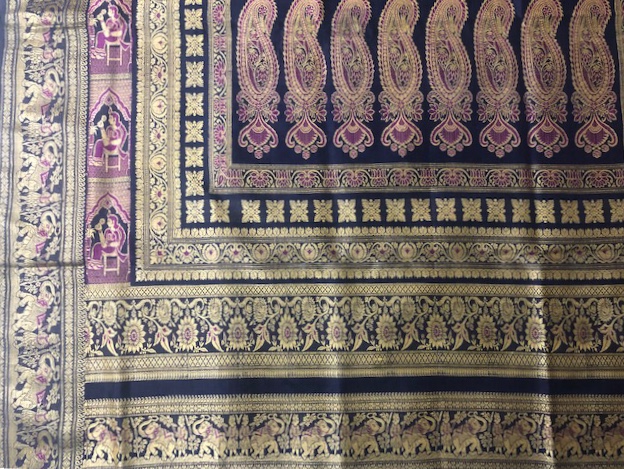
One of the significant contributions of Weavers Studio has been to the revival of interest in Baluchari.  Baluchari saris (and shawls and textiles) take their name from the village of Baluchar, from the Murshidabad region of Bengal. The village itself no longer exists. Probably washed away in some flood at some time. The weaving of these special saris is thought to have flourished in the 18th and 19th centuries, and was generally done on silk, though cotton Balucharis were also woven. They are known to have been exhibited in the 1886 Colonial and Indian Exhibition in London.

The distinguishing feature of Baluchari is the quirkiness of the motifs. Imagine having a hookah-smoking sahib reclining in an armchair on your pallu! Or an elephant bearing an Englishman and his wife walking across it. Or men on a steamer floating across it. Or a courtesan in a dance pose. You could also have scenes from Ramayana or Mahabharata of course.

Balucharis are fun, quirky and works of art. They are an invaluable part of our craft and textile tradition. Buy a Baluchari, own a treasure!

I am the proud possessor of a Baluchari which I bought in a Bengal State Emporium about 25 years ago (in pic). But it was a rare and lucky find, because when I went out again looking for another such, I could, for almost two decades not find one.

–Meena


True Grit

Winter is the season of Doctor’s conferences in my city, when super specialists of many branches of medicine meet to discuss professional research and new developments. Among these are many women who are working shoulder-to-shoulder with their male counterparts. It is difficult to imagine that just over 150 years ago, a woman doctor was unheard and undreamt of. This reminder was strongly communicated in a recent performance that traced the life of India’s first female doctor–Anandibai Joshi.

Anandibai Joshi is known to be the first woman of Indian origin to graduate with a degree in medicine in the US.  Her story of grit and determination is an inspiration, and a trailblazer.

Born in 1865 as Yamuna, the third unwanted daughter, she was married off at the age of nine to a widower postal clerk 20 years her senior. Her husband Gopalrao took charge of her life by first changing her name to Anandi; but also encouraged her to study, which was unusual for that time. Anandi was a bright and curious girl-child, balancing between her innocence, her thirst for learning and her expected chores and role as ‘wife’. She became a mother at the age of 14, but lost her 10-day old child due to lack of medical care and facilities. Traumatised by this event, she began to dream the undreamable– to become a doctor so that she can help other women like herself. In a time when a girl going to school was spat at, and looked upon with intense disapproval, Anandi was supported to some extent by her husband.

Even more unusual is the story of how she reached America. A letter written by Gopalrao to an American missionary asking if Anandi could study medicine in America, was published in some American magazines, where a woman called Theodicia Carpenter read it and wrote to the young girl with an offer of a home and support if she were to go to New York. Against opposition from all quarters in India, Anandi embarked upon this journey into the unknown, reaching New York after an arduous two-month ship voyage. Once she reached, with support from her mentor Theodicia, Anandi Gopal Joshi applied to the Women’s Medical College of Pennsylvania and was granted admission at the age of 19. Medical school and life in an alien land was extremely difficult; but Anandi met the challenges head on—the extreme cold weather (she changed her attire from the traditional nine-yard sari to the six-yard one), the food (at one point she became so nutritionally deficient she had to start eating eggs), very poor health, loneliness, hostile classmates and neighbours, and nasty letters from her suspicious husband. Anandi persevered towards her goal and got through medical school, graduating in 1886. She returned to India the same year and was appointed as the physician-in-charge at the Albert Edward Hospital in the then princely state of Kohlapur (in present day Maharashtra).

Tragically, before she could finally make her childhood dream come true, by practising as a doctor, Dr Anandi Joshi died of TB in 1887, just over a month before her 22nd birthday. As per her wish, her ashes were sent to Theodicia Carpenter, who placed them in her family cemetery in Poughkeepsie, New York.

The true-grit story of Yamuna/Anandi was brought to life in a solo performance by Manasi Prabhakar Joshi. Titled Dr Anandibai this powerfully transposed the story of the path breaker in the context of the challenges that women face even today—reminding us that while on the one hand much has changed, on the other, much remains the same. Anandibai’s story continues to remain an inspiration and a beacon.

–Mamata


Audio Books

A recent article titled Human Library immediately grabbed my attention. Being always drawn to anything related to books and libraries I was curious to know what this was. Turns out that this was literally a library where people instead of books are issued out! I was intrigued—What, How and Why?

At a Human Library event, the “books” are people with special experiences; “readers” can choose from various “titles” and then “borrow” them. The procedure is similar to that of a regular library.  At the main desk there is a list of “books” available and each “reader” is given a Human Library card by one of the librarians. They then choose a “book”, sometimes with the help of an official matchmaker or library assistant. The reader and the book then move to a space where there are numerous tables and chairs; this is where a safe and respectful conversation begins, and lasts for up to half an hour. The “reader” reads the “book” by asking the “book” questions about their personal situation. The “book”, as well as answering pertinent questions, has the option not to answer and also to ask their own questions.

The most interesting aspect of this library is the choice of “books”. In keeping with its fundamental premise which is ‘to build a positive framework for conversations that can challenge stereotypes and prejudices through dialogue’, the Human Library encourages people to challenge their own preconceived notions—to truly get to know, and learn from, someone they might otherwise make a snap judgement about. As the website says “Don’t judge a book by its cover.”

Most of the stories that the “books” tell have to do with some kind of stereotype or stigmatized topic. For example in the Human Library UK  “The titles celebrate diversity and promote equality by deliberately acknowledging differences, lifestyles, ethnicities, faiths, disabilities, abilities and characteristics that may be stigmatised in the hope it might provoke an assumption or even prejudice in readers.”

While new to me, it turns out that the concept of human libraries is not that new. The Human Library is an international organization and movement that first started in Copenhagen, Denmark in 2000. It was “a place where difficult questions are expected, appreciated and answered.” Its objective was to address people’s prejudices by helping them to talk to those they would not normally meet, and to initiate conversations between people of different orientations, backgrounds and religions, by urging participants to listen to each other’s life experiences.

It began with an event which was open eight hours a day for four days straight and featured over fifty different “titles”. More than a thousand readers took advantage leaving books, librarians, organisers and readers stunned at the impact of the Human Library.

Today the movement has become an international phenomenon with “libraries” in more than 70 countries. In India there are Human Libraries in several cities including Hyderabad, Bengaluru, Delhi, Mumbai, Kolkata, Chennai, and spreading.

What an amazing and inspiring movement! For me the term ‘audio books’ has acquired a unique human dimension.

–Mamata


Festival of Farming

20181117_120113_resizedThe annual Krishi Mela is an event Bangaloreans look forward to. Organized in November every year, the 3-day Mela showcases the latest in agriculture and livestock related developments—from technologies, to equipment and tools, to new varieties of seeds, to green farming.

First a word about the Gandhi Krishi Vignana Kendra (GKVK), the venue of the mela. This amazing 1300+ acre campus has a hoary history. More than a century ago in 1899, Her Excellency Maharani Vani Vilasa, Regent of Mysore donated 30 acres of land for an Experimental Agricultural Station at Hebbal, which initiated research projects related to agriculture. In 1963, the Government of Mysore decided to establish University of Agricultural Sciences (UAS) along the lines of Land Grant College system of USA and passed the University of Agricultural Sciences Bill. It granted 1300 acres to the GKVK Campus.

UAS was inaugurated by Dr Zakir Hussain, then Vice President of India, on 21st Aug 1964. Speaking at the event, he set the institute a lofty mandate: “By bringing about significant improvement in every phase of rural life, by much needed change in methods of production, by influencing the whole outlook of the rural community and rural home, by giving them a new vision and new hope, this university will be able to make great contribution to national welfare”.

The Krishi Mela sees visitation in the lakhs—from farmers to students to urbanites interested in agriculture, it is a joyous (though somewhat hot and tiring) occasion.

For farmers, it is an opportunity to see the latest advancements in the field of agriculture; to interact with agro-business companies and see demonstrations of agricultural implements; to get advice from university researchers on best methods of farming for a particular crop; and be exposed to practices like biological control of insects, organic farming in polyhouses, setting up biogas plants and extracting biodiesel.

For a layperson like me, it is an occasion to buy seeds and gardening implements; get some advice on how to look after plants; get to know something about the complexities of farming; marvel at things like a 70 kg bunch of bananas and a magnificent Gir bull; and gawk at sights like a drone which can be used for spraying pesticides. Also to partake of a traditional lunch (Menu: ragi muddu, palya, rice-rasam, curd-rice and a sweet) at Rs.50!

For me, the best thing about bringing such a mela into the heart of a city like Bangalore is the value it has as a reminder to us of who feeds us, and the challenges they face to do so!

Colour and Cheer


P1130289 (1).JPGRight through the long and dusty summer months when all the other plants drooped and dried, it was the riot of pink and white bougainvillae in my little garden that bestowed colour and cheer to the sweltering days.

I have always enjoyed the sight of the colourful mass, and took it pretty much for granted until I read an interesting story about how the plant was discovered. In 1766 the French government had commissioned French Navy admiral and explorer Louis Antoine de Bougainville to sail around the world, to find new territories for France. Accompanying him on this voyage of circumnavigation was Philibert Commerson a botanist, whose brief was to collect hitherto unknown plants from the different continents and countries during the voyage. It is Commerson who is thought to be the first European to describe the plant we know of as bougainvillae.

Recently, the story of the discovery of bougainvillea has been revised. It turns out that Commerson did go on the voyage and was the botanist. But he was accompanied by his housekeeper and lover, Jeanne Baret. The French navy absolutely and explicitly prohibited women on naval vessels. Nevertheless, Baret disguised herself as a man and not only sailed with Commerson, she was with him while he was exploring plants in the new lands where the ship docked. As Commerson was frequently unwell, it was Baret who did most of the plant collecting, and she is believed to have discovered many of the plants which are attributed as being Commerson’s discoveries.

It is now believed that it was probably Baret who found bougainvillea at the very beginning of the trip, in Rio de Janiero. Impressed by the bright blossoms, Commerson named them Bougainvillea after the admiral. Baret also thus became the first woman known to have circumnavigated the globe. Interestingly the surviving journals of the expedition barely mention her, probably due to the fear of the consequences of admitting that the “no women!” rule had been broken.

Since the introduction of the first two species to Europe in the late 1700s, Bougainvillea have made their home all around the tropical world. They are drought-, salt- and wind-resistant, but require hot climate and hours of full sun. They will grow as shrubs, or vines, or even low ground covers and are found in many colours. Currently, there are over 300 varieties of bougainvillea around the world, and since many of the hybrids have been crossed over several generations, it is now difficult to identify their respective origins. Botanists, however, have traced back most of today’s rich variety of bougainvillea back to only three of the original eighteen South American species identified.

While the Bougainvillea is popularly known as an ornamental plant, the people of the Amazon region had long used bougainvillea as a medicinal herb, and it is only more recently that it medicinal values are being recognised by other schools of medicine.

There is definitely more to the bougainvillea than colour and cheer!

P1130286 (1).JPG
 It’s not the flowers that make this plant so colourful, it’s actually the bracts or modified leaves that surround the tiny white flowers. 

–Mamata


Nobel Paths

October is the month when the Nobel Prizes for the year are announced. The months preceding the announcements are full of expectation and speculation about who the winners would be, especially in the case of the Nobel Peace Prize.

While the Nobel Peace Prize is one of the most prestigious and honoured awards, it is ironic that the man after whom the prizes are named was an eccentric Swedish chemist, engineer and industrialist, who after a long study of explosives, produced the first dynamite, which was then labelled Nobel’s Safety Powder. He also went on to make other advanced explosives and detonators. These inventions made him a very rich man.

Interestingly, Nobel was essentially a pacifist who hoped that the destructive powers of his inventions would help bring an end to wars. This was reflected in his will which he made two weeks before he died, donating most of his wealth for the setting up of  a Trust to establish five world-wide prizes for peace, physics, chemistry, physiology or medicine, and literature. His family contested the will and his selected award committee also refused to carry out his wishes. It was five years before the first Nobel was awarded.

The general principles governing the awards were also laid down in his will and are followed to this day.

The process leading up to the selection starts almost a year before the actual announcement when the invitations are sent out to those competent under the Nobel statutes to do so, for nomination of candidates. Proposed names need to reach the proper Nobel Committee in writing before February 1st of the year of the awards, following which the Committees consider the nominations—the deliberations and voting are secret at all stages.

As stipulated in Alfred Nobel’s will  which was opened after his death in 1896, the Nobel Prizes in Physics, Chemistry, Physiology or Medicine and Literature are awarded in Stockholm, Sweden, while the Nobel Peace Prize is awarded in Oslo, Norway.

Since 1901, the Nobel Prizes have been presented to the Laureates at ceremonies on 10 December, the anniversary of Alfred Nobel’s death. The ceremonial presentations for physics, chemistry, physiology or medicine, literature and economics have been taking place at the Stockholm Concert Hall (Stockholms Konserthus) since 1926; and that for the Peace Prize takes place in Oslo. From 1947 till 1990, the setting was the auditorium of the University of Oslo; in 1990 the event moved to the Oslo City Hall.

By happenstance, a few years ago, I had the opportunity to attend another awards ceremony (not quite Nobel!) in the Stockholm Concert Hall. It was an awe-inspiring experience. And earlier this year my daughter attended a function in the Oslo City Hall!

If not Nobel Laureates ourselves, we can at least lay claim to have followed the footsteps of the great and the Nobel, on the hallowed carpets where the exalted ones have tread!

IMG_20180619_205027544 (1).jpg
Oslo City Hall

–Mamata


My Tribute to Mother India

‘Mother India’ considered one of Bollywood’s classics, was released 61 years ago today (Oct 25). It was India’s first entry for the Oscars.

I saw the film when I was in my twenties, probably on Doordarshan. I remember thinking it was over-dramatic, over-emotional, over-the-top. It just seemed too much–one woman facing one tragedy after the other; struggling every day, every month; everyone out to exploit her. And still holding nobly to her values.

30 years have taught me quite a few lessons. One of them is that there is a Mother India in every street, in every lane.

This was brought home to me poignantly only last week, when I had occasion to spend a lot of time with the lady who takes care of our office. At personal inconvenience, she was going out of her way to help me in my time of need. The time we spent together gave me insights into her life.

Born in a family of agricultural labourers, she dropped out of school at 10, to take care of younger siblings. At 12, she joined her mother in the fields. Her father died of cancer, and things got even worse. She did any work she could get—from labour on construction sites, to digging wells, to everything in between.

At about 17 or 18, she was married off. Her mother was told that the groom was on the verge of getting a permanent government job, and she would live a life of comfort. The husband was semi-handicapped, but more devastating to her, completely lazy and good-for-nothing. As a three-month bride, she started work as a domestic help.

Life went its usual course. A son came along, on whom she pinned all her hopes. The husband worked at casual jobs about 10 days a month. The other 20 days, he lazed around the house. She slaved from 5 a.m. to 6 p.m. every day of the month, at multiple jobs, to put the son through a good school, and he got his polytechnic diploma.

She thought her troubles were almost over. The son, rather than find a job, announced he wanted to get into engineering through lateral entry. She was thrilled—an engineer in the family. She worked harder than ever, as the husband lazed, and the son bought himself a motor cycle and fancy phone in keeping with his status as an engineering student.

One year went by and then tragedy struck. She found that her son, not being able to cope with his studies, had quietly dropped out of college without even telling her; that he was using the money she was giving him for fees and expenses, on feeding his bike with petrol and hanging out with friends.

With the help of relatives, friends, and well-wishers all around, the son has been coaxed, cajoled, threatened and re-admitted into college. Several fingers are crossed. Who knows what he will do?

I have worked with the mother for four years now. It seems impossible to believe, but she has never taken a day off. She is there half an hour before us, and stays half an hour after the last of us leaves, to clean and close up. I have never known her not to smile. I have never known her to take any shortcuts. I have never known her to ask for money. I have never known her to not sympathize and offer a cup of tea if I complain of headache. I have never known her being backward in helping any of us. I have never known her to be less than dignified or gracious.

I have known this Mother India. Look around. I would wager that a woman you meet today will be a Mother India. The sheet anchor of her family and community. Acting with integrity and dignity in every situation. Holding up her bit of the sky with a smile, in the face of every hurdle life throws her way.

I salute the makers of ‘Mother India’. They say art is about capturing universal truths and presenting them in the idiom of the times. And now, when I have seen something of the world, I believe this is so, and that there is nothing over-blown about Mother India.

I salute the Mother India in every woman around me.

–Meena

PS: I lost my mother last week. And I salute her cheerfulness, her courage, her love, her compassion, and the joy she spread around her through her long life.


A Tribute to Wildlife Researchers

Ravi Chellam, as a student and then faculty of Wildlife Research Institute of India, did his research on Gir lions. His work on understanding the lions, their threats, and the work he did for recommending an alternative habitat, were a huge contribution. This piece is a tribute at a time when his recommendations should be taken very seriously. Equally it is a tribute to so many other wildlife researchers from WII and other institutions, whose courage and commitment have helped preserve our biodiversity.

The following pieces are excerpts from Ravi’s piece ‘A Roaring Career’ in a publication titled ‘Walking The Wild Path’.

On the excitement of wildlife research:

‘A radio-collar is a piece of wildlife research equipment, which consists of a radio transmitter that is mounted on a collar made of some tough material.  The transmitter constantly emits signals, which enables the researcher to track and locate the animal that is carrying it.  The collar is for fixing the transmitter on the animal.  A very wide variety of organisms have been studies by this method of radio-telemetry, ranging from whales, elephants, lions, tigers, snakes, to even very small birds like the hummingbird.

Shortly, we heard the regular rustling of the leaf litter, a clear indication that a large animal was approaching us.  A large male lion emerged out of the shadows of the forest and it immediately saw the tethered buffalo.  It looked around, as if to check that there were no human being around and then rushed to kill the buffalo bait.  As the lion locked its jaws around the neck of the buffalo, it presented a clear and close enough target for Dr. Johnsingh.  The dart went into the rump of the lion.  Startled by the loud report of rifle, the lion left the bait and walked away into the forest.

We waited for about ten minutes, to allow time for the drug to take effect.  Then I cautiously led the search team to locate the darted lion.  It had not gone very far.  It was lying on the ground, barely one hundred meters from the bait.  I threw a level of immobilisation.  The lion responded by slowly lifting its head, and it was evident that the drug had taken its effect; but to safely work with the animal, we needed to give it an additional top up dose.  I crept up to the lion with two of my assistants and we soon physically restrained the drugged animal by sitting on its head and rump.  This enabled the delivery of the additional dose of drug by means of an injection.

Once the lion was completely immobilised, we fixed the radio-collar around its neck, took the required measurements of the lion’s body, treated the minor external injuries, weighed it and then left it in a cool place to recover.  I sat at the safe distance to monitor its recovery.’

And, on the vulnerability of the Gir lions:

‘Based on the results of my doctoral research I surveyed potential lion habitats to locate a suitable site for the translocation.  In January 1995, I submitted my report to the Government of India and since then efforts are underway to manage the forests of Kuno-Palpur in Madhya Pradesh for making them suitable for lions.

If this translocation effort is undertaken and succeeds, it will be a majof step in ensuring the log-term conservation of the lions and a major personal achievement for me.  Translocating large carnivores and ensuring their successful establishment in a new habitat is not an easy task.  People resident in the forest and the adjoining areas will always be worried about their personal safety and that of their livestock when a population of large carnivores is established.

Additionally, great care needs to be taken to ensure that the animals are captured and transported without causing any physical injury to them.  There are also many political angles to be considered.  This is in a way part of the challenge of doing wildlife conservation.’

From ‘Walking the Wild Path’. Mamata Pandya, Meena Raghunathan (eds). Center for Environment Education. Ahmedabad. 1999.


Time and Tide…

Time was of utmost value to Mahatma Gandhi. His day was meticulously scheduled, and every minute counted. A typical day when he was in the Ashram would be like this.

4.00 a.m. Get up from bed

4.20 Morning community prayers

5.00-6.10 Exercise and bath followed by study

6.10-6.30 Breakfast

6.30-7.00 Women’s education classes followed by prayer

7.00-10.30 Physical labour, activities and chores in the Ashram (latrine cleaning, helping in the kitchen, spinning)

10.45-11.15 Lunch

11.15-12 noon Rest

12.00-4.30 p.m. Physical labour, classes

4.30-5.30 Reading, meeting people

5.30-6.00 Evening meal

6.00-7.00 Meeting people

7.00-7.30 Prayer

7.30-9.00 Study, correspondence, meeting people

9.00 Go to bed

On Mondays he would maintain silence and complete all his pending work.

Bapu’s trusty personal time-keeper for years was a silver Zenith pocket watch with an alarm function. The watch had been gifted to him by young Indira Gandhi. For a man with few personal possessions this watch became his constant companion. To his great regret, it was stolen from him during a train journey to Kanpur in May 1947. Gandhi wrote in a letter “I may add that the one that was stolen had radium disc as yours has and had also a contrivance for alarm. It was a gift to me. But the cost then was over Rs 40/-. It was a Zenith watch.”

Interestingly, the watch was returned to him six months later by the thief who begged him for forgiveness. Shortly before his death, Gandhi passed on this legendary watch to his granddaughter and assistant, Abha.

The watch subsequently came into the hands of private collectors abroad. In 2009 it came up for auction as part of a lot of the Mahatma’s former belongings including his famous round spectacles, a bowl and dish as well as a pair of leather sandals. It was reported that these were bought by an Indian billionaire and returned to the country of their origin. From the Mahatma to Mallya…how time flies!

–Mamata


My Gandhi Year

One of the first assignments that marked my transition from Environmental Educator to Editor-at-Large as it were, was to work on redoing an exhibition gallery at the Sabarmati Ashram in Ahmedabad. The Gallery aptly called My Life is My Message was a chronological walk-through of Gandhiji’s life. I had, long ago read Gandhi’s Autobiography or The Story of My Experiments with Truth. As a student of political science, I had also studied Gandhi’s role in making an independent India. Now I was excited to be a part of this project because I felt it would give me a better understanding of the entire life and thought of Mahatma Gandhi.

And it was indeed a year when I discovered the many many facets of Mohandas Karamchand Gandhi!

These facets were revealed in Gandhi’s own words through the incredible collection of over 34,000 letters, articles and speeches, which have been complied in 100 volumes titled Collected Works of Mahatma Gandhi (CWMG). They have also been published in Hindi as Sampurna Gandhi Vanghmay and Gujarati as Gandhijino Akshardeh.

As fascinating as the contents, is the process that culminated in the volumes.

The mammoth project on translating and compiling all of Gandhi’s writings and speeches covering the period from 1884-1948, and almost 60 years of very active public life, in South Africa, England and India, was launched in 1956 by the Government of India under the supervision of a one-time advisory board formed of Gandhi’s closest associates. Most of the works were collected between 1960 and 1994 under the chief editor the late K. Swaminathan—who started the project when he himself was 64 years old. He continued on the project till he lost his eyesight when he was in his early 90s. The English CWMG project closed in 1994 with the publication of the 100th volume.

Gandhi wrote and spoke in three languages—English, Gujarati and Hindi. So the project involved not just collecting but also translating from the original to the other two languages. The compilation was to be published in all three languages. For each individual version there was a 25-35 member team including proof readers, translators and editors carefully handpicked for their knowledge of world literature, world religions and world history besides their professional expertise. They took around 40 years to translate the collected material.

The arrangement of materials is chronological with all items of a particular date, whether article, speech or letter being placed together. This gives the reader a picture of how Gandhi functioned and how he dealt with issues as they came up—dealing on the same day with matters of great public importance as well as concerning himself with intimate personal problems of individuals.

It is also astounding to find what a prolific writer Gandhi was, and how much writing he could manage in a tightly-packed day. For a great period of his life he did not take the assistance of any stenographer or typist and used to write in his own hand. When he was physically unable to write with his right hand he trained himself to write also with his left hand.

The 100 volumes of the English edition run into more than 50,000 pages; and CWMG has long been recognised as one of the finest examples of editorial and translation work undertaken anywhere in the world.

I had the incredible experience of working with the tireless and dedicated team in the Archives at Sabarmati Ashram, to track what Gandhi did, said and wrote day after day, through the original editions of the CWMG. To flip through the fragile yellowing pages and to read about the amazing variety of topics that Gandhi could think over, and write about, on any single day was uplifting and at the same time humbling. (We who feel so smug at turning out a 500 word piece in a day!).

It was the year I discovered Gandhi—a friend to children and the challenger to the Raj; the gentle nurse and the Satyagraha planner; the nature cure experimenter and the shrewd negotiator….and so much more.

Today this awe-inspiring treasure is available at the touch of a button through the Gandhi Heritage Portal—a digital platform that hosts the all the works of Gandhi, writings on Gandhi by other authors including books, tributes, journals and other media such as videos, photos, among others in 28 different languages from across the globe.

This in itself is a project that is as big in scale as the original compilation. Take a look at the world’s largest digital repository on Mahatma Gandhi www.gandhiheritageportal.org

–Mamata