The Ultimate Flower-Clock

Wouldn’t it be beyond-beautiful if we had a clock which did not tell time by mundane numbers and needles, but by a particular flower blooming? Imagine if you peeped out of the window and you could look at this clock, and tell if it was 12 noon, or 1 pm or 2 pm by the flower that was blooming!

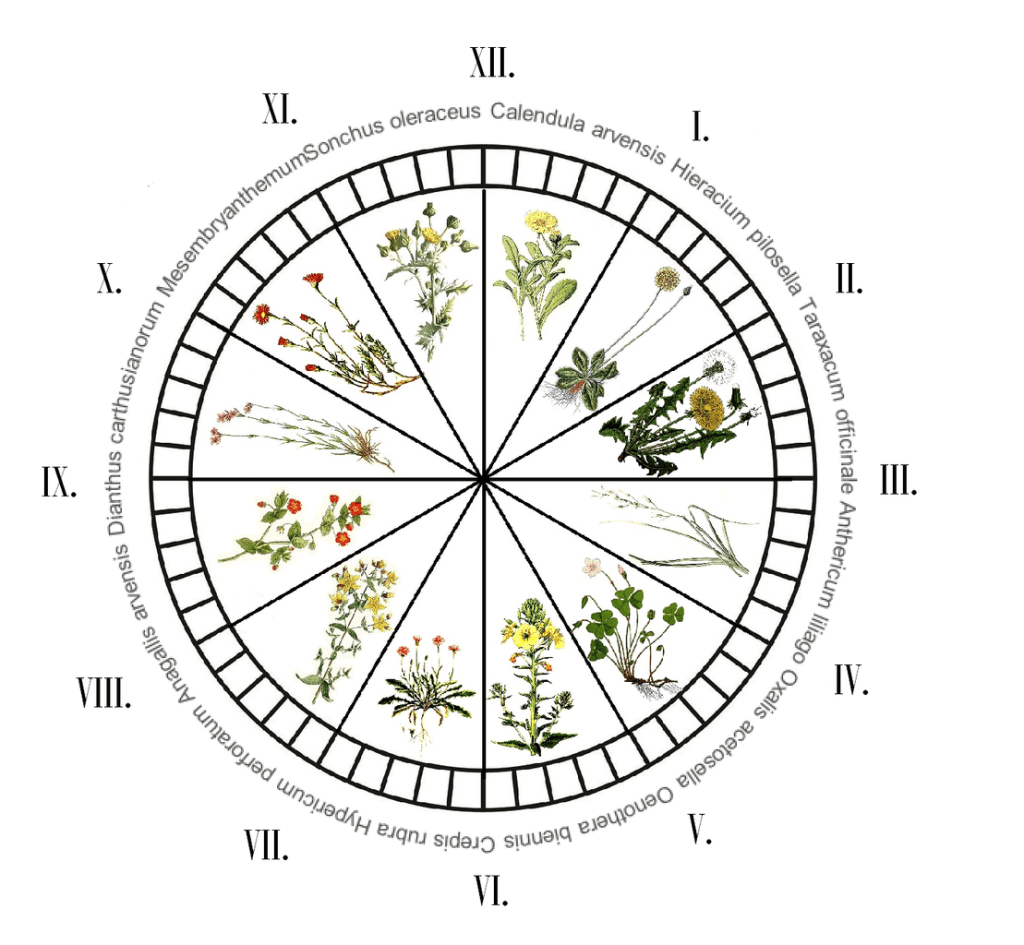
This was the kind of clock that Carl Linnaeus dreamed of.  Linnaeus’s flower clock or Horologica Floræ is a garden-plan thought up by Linnaeus that would take advantage of plants that open or close their flowers at particular times of the day, to accurately indicate the time.

As most of us would remember from school-biology, Linnaeus was the Swedish naturalist who laid down the principles for defining genera and species of organisms, and created a uniform system for naming them (the binomial nomenclature). His book, Systema Naturae (The System of Nature) consisted of only 11 pages but laid the foundations of taxonomy. It presented a hierarchical classification or taxonomy, of the three kingdoms of nature: stones, plants, and animals. Each kingdom was subdivided into classes, orders, genera, species, and varieties. All modern classification systems in biology have their roots in the Linnaean classification system which is based on similarities—for instance, Linnaeus grouped together organisms that shared obvious physical traits, such as number of legs or shape of leaves.

The Linnaean system of classification consists of a hierarchy of groupings, called taxa (singular, taxon). Taxa range from the kingdom to the species. The kingdom is the largest and most inclusive grouping. It consists of organisms that share just a few basic similarities. Examples are the plant and animal kingdoms. Then come the phylum, then the class, order, family, genus, and finally the species–the smallest and most exclusive grouping. It consists of organisms that are similar enough to produce fertile offspring together.

Linnaeus greatest contribution to science was his method of naming species. This method, called binomial nomenclature, gives each species a unique, two-word Latin name consisting of the genus name and the species name. An example is Homo sapiens, the two-word Latin name for humans, literally meaning “wise human.”

But if Linnaeus saw order in the natural world around him, he saw beauty too. In around 1748 he started thinking about the flower-clock. It builds on the fact that there are species of plants that open or close their flowers at set times of day. In his publication Philosophia Botanica, he gives 46 examples of flowering plants that are open during particular parts of the day. He brought together 43 of these under the heading Horologium Florae, or Floral Clock, arranging them in a time sequence from 3 am to 8 pm. The time at which each flower opens and closes is given in whole and half hours.

To give you a glimpse, here are a few rows from Linnaeus’ table:

Botanical nameCommon nameOpening timeClosing time
    
Tragopogon pratensisGoat’s-Beard3 a.m.
Cichorium intybus L.Chicory4–5 a.m.
Reichardia tingitana (L.) RothFalse Sow thistleby 6 a.m.10 a.m.
Taraxacum officinale WeberDandelion5 a.m.8–9 a.m.
Crepis alpina L.Hawk’s beard5 a.m.11 a.m.
Hieracium umbellatum L.Hawkweed6 a.m.5 p.m.

Though Linnaeus worked for years on this, the observations and hence selection and organization of flowers were not complete.  Linnaueus’ son Carl the Younger was given the task for completing the table so that the clock could be built. Unfortunately, Linnaeus the Younger’s floral clock was never completed, and his observations on the opening and closing of flower have not been found among his surviving papers.

Alas, no one has actually built such a clock, and it is not even clear that it is possible.  There are many practical issues to overcome. For instance, it would only function for part of the year since plants don’t flower through the year; the time shown would be indicative at best since blooming times are in a range and would vary with specifics like weather and other atmospheric conditions; many of the plants that Linnaeus observed and selected were wildflowers from Sweden and may not be found in other places, or would behave differently in other places. And then, the clock may not work at all in some seasons, if there are not enough flowers which bloom then.

Well, in this digital age, there are some ingenious people who have created an app based on the idea. They have selected 24 flowers, one for each hour that would normally flower at that time of the day or night. Floræ – Linnaeus’ flower clock app is free on appstore for Apple and iPhone.

So maybe we have make do with that, till some genious actually builds the Horologica Floræ to blow our minds!

–Meena

https://www.countrylife.co.uk/nature/curious-questions-what-is-linnaeuss-flower-clock-259032

Wikipedia

Wikimeida Commons (Picutre)

A Brush With History

A survey in America in 2003 asked people which of the following inventions would be the hardest to live without: the automobile, the personal computer, the cell phone, the microwave, and the toothbrush. The more recent inventions trailed the list; the century-old automobile came in second, and the five-century-old toothbrush came in first!

This week Meena took a walk through the history of walking sticks. Continuing a look at things that aid, and starting at the head rather than the legs, here’s looking back at the object that we start and end our day with—the toothbrush!

But cleaning teeth did not wait till the discovery of the toothbrush. From the earliest times, people used to chew on a piece of twig until it softened and became frayed. This process helped to not only reach crevices where particles hid, but also released juices in the mouth which performed the task that toothpastes do now (not to mention the regular work out for the jaws!) Twigs from aromatic shrubs or trees were also built-in mouth freshening!  Even today neem and babool twigs continue to be used by many. While one end of the twig was frayed by chewing, the other end could be niftily carved into a toothpick to pick at the more stubborn bits wedged between the teeth.  

Such tooth cleaning tools date back to 3500-3000 BC, to early Babylonians and Egyptians. Toothsticks these have been discovered as part of burial artifacts in Egyptian tombs, to enable the departed persons tooth cleaning routine even in the afterlife.

Different cultures had other cleaning techniques. Some used a rag dipped in sulfur oil or a saline solution to wipe teeth. Another practice was to just rub baking soda (sodium bicarbonate is still an ingredient in toothpastes) directly onto the teeth.

The transition from a ‘make your own bristles by chewing’ implement to the toothbrush in its early form as we know it is believed to be the invention of the Chinese in the 15th century. Using a piece of bone or bamboo, they attached, at right angles to this, stiff coarse bristles from the back of a hog’s neck, and voila! You could reach the difficult to reach crevices in the mouth, and also actually brush your teeth rather than chew with them.  

News of this nifty device reached Europe via commercial travellers during the middle ages. But it was difficult to replicate because the Siberian hog’s hair which was ideally stiff and coarse was not available; and the horsehair used as a substitute was not stiff enough.

The story goes that an Englishman named William Addis who was jailed for inciting a riot spent his time in prison experimenting with alternatives to cleaning teeth by the prevalent method of rubbing them with a rag covered in soot and salt. Addis carved a handle out of a small bone, drilled holes into it, and inserted tufts of boar bristles which were held in place by glue. He had found his replacement for the soot and rag!

After his release Addis began importing coarse boar bristles from the cold climates of Siberia and northern China. His design and the combination proved so successful that, in 1780 he founded a company called Addis to mass produce these brushes, and became a very wealthy man. The company continues to be in the brush business till today.

The expanding market gave rise to innovations in design and material. The single or double row of bristles gave way to a three-row brush with serrated bristles, and Meyer Rhein patented this design in 1844. The Chinese civil war in the latter 1800s, and later the Japanese invasion of China made it increasingly difficult to procure the boar bristles. The invention of a nylon, new synthetic material in the mid-1930s provided a timely alternative to natural bristles. This invention began a new phase in the history of the toothbrush with Dr West’s Miracle Tuft Toothbrush in 1938, the first such toothbrush with nylon bristles. And the rest, as they say is history.

While the material of the handle and the bristles continues to be plastic and nylon, today toothbrushes come in a mouth-boggling range of shapes and sizes. Handles that are straight, angled, and contoured with a variety of grips; and bristles ranging from hard to extra-soft offer something to fit every tooth. While the fundamentals of their design have not changed since the time of the Egyptians and Babylonians, today toothbrushes, like all products are marketed with labels such as ‘ergonomically designed’ to ‘dentist endorsed’.  

Even more heavily dentist-endorsed are the mouth-watering choices in toothpastes. We have come a long way from sooty rags as mouth-cleaning agents. It is believed that mouth cleaning and freshening agents were in use even before the invention of toothbrushes. Ancient Egyptians, Greeks, Romans, as well as people in China and India used a variety of ingredients to keep teeth and gums clean, as well as for whitening teeth and freshening breath. These included powdered charcoal and bark, as well as a powder of ox hooves, ashes and burnt eggshells which added abrasiveness. The Chinese added mouth-freshening components such as ginseng, herbs, mints and salt.

Before the 1850s these mouth cleaners were in powder form. Early versions of these in paste form contained soap, and in the 1850s chalk was included in the composition. During the 1850s, a new toothpaste in a jar called a Crème Dentifrice was developed; in 1873 Colgate started the mass production of toothpaste in jars. The late 1880s saw another breakthrough in toothpaste manufacturing with the invention of toothpaste tubes; making it easier to carry, and to use.  Colgate introduced its toothpaste in a tube similar to modern-day toothpaste tubes in the 1890s. Today toothpaste is always associated with the tube.

The formula of toothpaste underwent changes over time. Soap, which was initially used in toothpaste, was later replaced by other ingredients like sodium lauryl sulphate (which continues to be an ingredient in most toothpastes). This transition led to gentler toothpaste options and a wider variety of flavours.

In the second half of the twentieth century modern toothpastes were developed to help prevent or treat specific diseases and conditions such as tooth sensitivity. Fluoride toothpastes to help prevent decay were introduced in 1914. Toothpastes with very low abrasiveness were also developed, and helped prevent the problems caused by overzealous brushing. Each of these is heavily advertised and endorsed by professional ‘oral health specialists’. The new trend in toothpastes is the return to natural organic ingredients to replace the chemical components. Perhaps a return to its origins, albeit in ‘brand’-new avatars!

–Mamata

Ruby Bridges Walk

Last week my grandnephew went on a Ruby Bridges Walk with his schoolmates in California. The seven-year old also gave a stirring little speech about why Ruby Bridges was special. This was the first time that I was hearing about Ruby Bridges and I was immediately curious to know more. As I discovered, her story is indeed inspiring.

Ruby Bridges was only six years old when she made history as the first Black child to enter an all-white school in the southern state of New Orleans in America. This was not as far back as the 19th century but as recent as 1960. America was far from being an integrated society. There was blatant racism and discrimination based on the colour of the skin, and segregation, both by law and custom was the norm. Both socially and politically, African Americans were relegated to the status of second-class citizens. Restaurants, schools, businesses and other parts of the community especially in the Southern states were segregated at that time.

In 1954, as an outcome of the Brown vs. Board of Education case, the Supreme Court ruled that separating children in public schools on the basis of race was unconstitutional. This milestone decision signalled the end of legalized racial segregation in the schools of the United States. However, the implementation of this was not as smooth; states struggled to put integration into practice.

Ruby Bridges was born on September 8, 1954, the year of this landmark ruling. Her parents were at the time working as sharecroppers in Tylertown, Mississippi. Two years later her family moved to New Orleans in Louisiana for better prospects. When Ruby started kindergarten the state still had segregated schools; the school board and the state’s lawmakers defied the court order and resisted school desegregation, until a federal court ordered Louisiana to desegregate and ruled that schools were to allow both Black and white students to attend.

The city of New Orleans responded by creating entrance exams for African American students to see whether they could compete academically. Ruby was one of the only six students (all girls) who passed the test, and was eligible to attend the so-far all-white William Franz Elementary School. Of the other five eligible children two families opted to keep their children at their old school, and three were transferred to another school. Ruby was the only one to be joining William Frantz School. Her parents needed to take a big decision, knowing that it would be difficult in many ways. Ruby’s father was hesitant to send his daughter, but her mother believed that it was important for the family to take that step — not just for Ruby herself, but for the children who would come after her. Also she was keen that Ruby should get the educational opportunities that generations of her family had been denied.

A judicial order dictated that New Orleans schools be integrated by November 14, 1960, so that would be six-year-old Ruby’s first day at school. Many years later Ruby recalled how, on that day, her mother dressed her in a new outfit and told her to behave herself, and not to be afraid. She told her that there would be a lot of people outside, but that she would accompany her to school. As it turned out, the scene was a lot different. There were crowds of people all the way to school, shouting insults and throwing things, to protest against the integration. Young Ruby innocently thought that this was not unusual, as she was familiar with the crowds and noise that marked the Mardi Gras festival in New Orleans. But this was not a festive crowd. The threat was so acute that four federal marshals had to escort Ruby and her mother to school, not just on November 14, but every day of the school year. The atmosphere in the school remained largely hostile. Angry white parents protested and some even withdrew their children from the school. Several teachers also resigned as they refused to teach Black students. For a six-year old going to a strange school accompanied by officers of the law, Ruby showed remarkable courage, marching like a little soldier.

Ruby was the only student in her class for the whole school year, she ate lunch alone and had no friends. But she never gave up attending school, and never missed a day. She was lucky to have Barbara Henry, who had recently moved from Boston, to be her teacher. She took classes as if she were talking to a whole class, and remained Ruby’s friend, support and mentor all through this year. When Ruby returned the next year for second grade, more African-American students had joined the school. Ruby was the pioneer who single-handedly paved the way for this.

The family too had to bear the consequences. Her father lost his job as a gas station attendant, and her sharecropping grandparents were turned off their land. Even the grocery store where the family shopped turned them away. But inspired by their daughter’s courage and perseverance, the family retained its dignity even in the face of such blatant discrimination.

Ruby Bridges continued to study at the William Frantz School until she graduated. She was followed by more Black children whose path was clearer and less difficult than hers had been. After graduation Ruby became a travel agent and had the opportunity to travel widely. She also raised a family of four sons. She continues to support her old school, helping with creating new programmes and championing its causes in all ways. Following severe damage in the 2005 Hurricane Katrina she got the school placed on the National Register of Historic Places, which guaranteed its restoration and preservation.

Ruby had not realized, at the age of six years that she was a path-breaker who helped break many barriers; but she grew up to be a life-long activist for racial equality. Over time she became an icon for desegregation. In 1999 she established the Ruby Bridges Foundation which stands for the “values, tolerance, respect, and appreciation of all differences”. She wrote about her early experiences in a book Through My Eyes. She was awarded the Presidential Citizens Medal in 2001. Even today, Ruby Bridges continues to strive for an end to racism.

A few years ago students in California who heard her story felt that there needed to be a way to commemorate Ruby’s pioneering efforts. They proposed this to the State legislature which decided that the state of California would mark November 14 as Ruby Bridges Walk to School Day every year. Thus this day is an annual day of dialogue where students discuss and take part in their own forms of activism to end racism and all forms of bullying. India celebrates Children’s Day on 14 November. Perhaps Ruby’s story is a reminder that many forms of discrimination and bullying affect our children even today. 20 November is also an important date as it is the date in 1959 when the UN General Assembly adopted the Declaration of the Rights of the Child. It is also the date when the UN General Assembly adopted the Convention on the Rights of the Child in 1989. A good week to remember Ruby Bridges’ assertion that “All of us are standing on someone else’s shoulders. Someone else that opened the door and paved the way. And so, we have to understand that we cannot give up the fight, whether we see the fruits of our labor or not. You have a responsibility to open the door to keep this moving forward”.

Thank you Manzil for introducing me to Ruby Bridges!

–Mamata

A Day for Donkeys: Vautha Fair

For an animal that is usually the brunt of jokes, or the joker on the animal pack, this is the one occasion when the donkey is in the limelight. The Donkey Fair revolves around donkeys, and marks an important event in the local calendar of Gujarat. Held annually at Vautha, the fair goes back hundreds of years, and even today attracts large crowds.

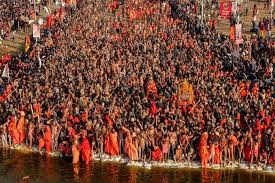
The event occurs on the full-moon night of the lunar month of Kartik (October-November), which begins after Diwali. Kartik Purnima is considered as an auspicious day and is celebrated by different communities in India in different ways. A common ritual is taking a holy bath in a river. As per Hindu mythology, it is believed that this is the day on which Hindu Gods came down to earth to take a dip in a river, and even today, those who take holy dips in rivers receive the blessings of all gods, and their sins are washed away.

One such site is at Vautha in Gujarat, located near Dholka, about 50 km from  Ahmedabad. Vautha is located at the confluence of the rivers Sabarmati and Vatrak. The confluence is also called sapta sangam, which means the meeting of seven rivers. It is at Vautha that the Vatrak river merges with the smaller rivers Meshwo, Hathmati, Shedhi, Majum and Khari with the Vautha, which in turn merges with the Sabarmati.

The history of the fair goes back almost five hundred years. There are many local legends associated with it. One legend attributes the fair’s origins to the time when the sage Vashishta is believed to have performed a yagna at the confluence of the rivers. Another one claims that Vautha is one of the sites that the Pandavas stopped by at during their exile.

Legend also has it that Kartikeya or Kartik, the son of Lord Shiva and the Goddess Parvati visited this site on this full moon night. To mark this, an annual fair dedicated to Kartikeya is held on Kartik Purnima. Thousands of pilgrims from all castes and communities and professions throng here for a holy dip, and the festive atmosphere is highlighted by a fair.

The fair is a vibrant event with numerous stalls selling local food, handicrafts, and lots of other attractive ware. It is enlivened by music and local theatre performances and folk dances. There are rides and varied exciting activities. This is a major social and cultural event that villagers from far and near look forward to all year.

What makes this fair unique is that this is the major animal trading fair in Gujarat where the main animals traded are donkeys, although there is also some trade in camels, horses and goats. It is believed that this is an auspicious time for buying and selling animals.

Farmers and traders from all over India bring donkeys to the fair. The animals are painted with coloured patterns and make for an attractive sight. However the buying and selling is serious business. Donkeys are closely examined to verify breed, build, fitness and health. Scrutiny of the teeth is an important part of the process. There is usually an auction to boost to competition and the prices which can range from 7,000 to 17,000 rupees or more.  

Several different breeds of donkeys make their way to this auction. Each has its own characteristics and uses. Halari donkeys from Saurashtra are white in colour and of docile temperament. They are used as pack animal during pastoralist migration, being able to walk 30-40 km a day; and also to pull carts. Kuchchhi donkeys from Kuchchh are grey, white, brown or black in colour. They are sturdy and can carry 80-100 kg and pull 200-300 kg on carts. They are used as pack animals during migration, and also for weed removal on farms. Sindhi donkeys from Barmer and Jaisalmer districts of Rajasthan are brown in colour can carry 1000-1500 kg and are used as pack animals to transport water, soil, earthenware, construction material, and fodder; as well as for pulling carts and for ploughing by small and marginal farmers. There are also donkeys from Marwad as well as other local breeds from other parts of India.

While thousands of donkeys continue to be brought and traded at this largest donkey fair, studies indicate that there is a steady decline in the donkey population in India. Increasing mechanization has replaced the need for donkeys for transporting material and as pack animals. This is also a factor for replacing donkeys in farm work. Traditional donkey-raising and herding families are moving to new occupations as demand for donkeys is going down, and the cost of maintaining the animals rises. There are also no specific government schemes or policies that promote the animal or its welfare. Donkeys are being abandoned when they are too old or feeble for hard labour. Even in Ladakh which has a tradition of donkey rearing, there is a decreasing role for donkeys in local occupations and uses. A donkey conservation park has been opened here in collaboration with communities where stray or abandoned donkeys are kept with dignity.   

In the meanwhile the donkeys still have their day at Vautha. And this year it falls on 15 November.

–Mamata

A Pre-Titanic Disaster: SS Vaitarna

112 years after the tragedy, April 15 is still marked as the day the RMS Titanic sank. This is remembered as the biggest maritime disaster of all times. The largest and most luxurious ship in the world at the time, The Titanic was also one of the most technologically advanced for its time; its 16 watertight compartments were believed to make the ship unsinkable. But just four days into its maiden voyage, the Titanic struck an iceberg near Newfoundland, Canada, damaging its watertight compartments. Only hours after the collision the ship sank, taking 1500 passengers with her.  

SS Vaitarna

Not many are aware that twenty years before this tragedy, another ship had mysteriously vanished, taking along with her, more than a thousand people. And this little known event occurred along the coast of Gujarat in India on 8 November 1888.

The ship was SS Vaitarna, one of the earliest steamships operating on the west coast of India. It was named after the Vaitarna River which flows north of Mumbai, but was built by the Grangemouth Dockyard Co. Ltd in Scotland. It took three years to build. The 170 feet long steamer had three floors and 25 cabins. Its value was estimated to be 10,000 pounds, and it was insured for 4,500 pounds. Its maiden voyage from Scotland involved sailing around Africa to Karachi its first destination.

The Vaitarna was owned by A.J. Shepherd & Co. in Bombay. The captain of the ship was Haji Cassum, a zamindar from Kuchchh who owned large tracts of land around Mumbai.

The ship started sailing in 1885 and was used mainly for carrying cargo and passengers between the Mandvi port in Kuchchh and Bombay. Vaitarna was far from the luxury liner that the Titanic would be two decades later. But it had something that was a great novelty for the time—electricity! The ship was lit with electric bulbs, long before external lighting was made mandatory for safe navigation at sea. This was such a unique feature that the local people dubbed the ship Vijli (the Gujarati word for electricity or lightning). The lighted ship attracted scores of visitors when it used to come to Mumbai; sightseers were charged two rupees for the viewing.

Vijli regularly plied between Mandvi in Kuchchh and Bombay, ferrying passengers and goods. It took 30 hours to cover the distance, and the passenger fare was eight rupees.

On 8 November 1888, the ship was anchored at Mandvi port. At noon that day it set sail for Dwarka with 520 passengers on board. About 200 more passengers are believed to have boarded at Dwarka before the ship left for Porbandar. But as the weather was turning stormy the ship did not stop at Porbandar but headed directly for Bombay. The storm gained strength and the seas were choppy. That evening the ship was seeing off the coast of Mangrol, but that was the last sighting. Vijli never reached Mumbai. The next day SS Vaitarna was declared missing with all the passengers on board. The passengers included 13 wedding parties and a number of students who were on their way to Mumbai to appear for their matriculation exams.

While it is known that there were at least 700 passengers, plus about 40 crew members, the exact number of casualties could never be ascertained. It was common practice for ships to load far beyond their normal capacity. It has been speculated that ship could have been carrying as many as 1200 passengers.

No wreck of the ship nor remains of the passengers were ever found. Unlike the Titanic, SS Vaitarna had no survivors. The first attempt to locate the remains were by the ship SS Savitri. Its captain Mahomedbhoy Dawood, had been a friend of Haji Cassum for many years; he knew Cassum to be a careful navigator.

The cause of the wreck has also remained a mystery. A Marine Court of Inquiry was set up by the Bombay Presidency to investigate. It pointed out that the ship did not have enough lifeboats, and was not adequately equipped with safety measures. Generally the ships in this region were not designed to ply on stormy seas. They would travel along the coast from port to port during the non-monsoon seasons, and would remain moored in harbour during the rainy season. But November is not the monsoon season in the Arabian Sea.  

However another report by the then government of India claimed that the ship was in good condition and all its machinery was in good order, and that it was fully equipped and sufficiently manned. It would have taken a cyclonic storm to capsize it.

Whatever the cause, the effect was the total and complete disappearance of SS Vaitarna. However this disaster led to the realization about the need for relaying early credible forecasts about storms and led to several reforms in India’s shipbuilding and navigation systems.

No compensation was given to the families of the missing passengers. After the initial attempts at searching for the wreckage, the curtains were drawn. While the sinking of the Titanic continues to evoke interest and discussion even a century later, this early, and just as tragic, shipwreck has almost been forgotten in the annals of shipping history. The Lloyd’s Register of London recorded only one word against SS Vaitarna: Missing. 

The Vaitarna tragedy however became a part of the lore of Saurashtra. Even today stories and songs commemorate Vijli and her captain Haji Cassum.

–Mamata

The Women Who Gave the World Windshield Wipers

Imagine if you had to put your hand out and try to clean your windshield to get a clearer view. Or maybe even get out of the car to do it! Well, this was what was happening in the early part of the 20th century.

It was a woman’s eye which caught the problem, and after some thought and work, came out with a solution. And it was another woman who worked on it further.

It all started with a trolley-car ride in New York in 1902. Mary Anderson was visiting New York from Alabama on a frosty day in winter, and was in a trolley car when she noticed that the driver was struggling to see what was outside. He would frequently thrust his head out of the window, put his hand out and wipe the windshield, but it was not really effective. He sometimes even had to stop the vehicle, get down and clean.

To Mary, this seemed really a terrible way of doing things. She wanted a solution whereby the driver could clean the windshield form inside. Her brain got working on the problem. When she was back in Alabama, she worked on various possibilities, and finally came out with a design consisting of a lever inside the vehicle that controlled a spring-loaded arm with a rubber blade. The lever had a counterweight so that the wiper would remain in contact with the window, and would move the blade across the windshield, removing rain or snow. The device could be easily removed if desired after the winter was over.

She wrote up a detailed description, and hired a designer to create a prototype. She even got a local company produce a working model! She applied for a patent, and on November 10, 1903 was granted her first patent for an automatic car window cleaning device controlled from inside the car, called the windshield wiper. The patent for the Window Cleaning Device was granted for 17 years.

In the meantime, another woman came along to develop on this idea. This was In 1917, when Charlotte Bridgewood patented the “electric storm windshield cleaner,” the first automatic wiper system that used rollers instead of blades. She was an automobile enthusiast who wanted to improve Mary Anderson’s manual windshield wipers. She went on to develop the automatic windshield wipers that she called “Electric Storm Windshield Cleaner”. She patented these first electrically powered windshield wiper in 1917, improving previous manually-operated wipers.

Sadly, neither woman profited from their ingenuity. Mary could not find anyone who would manufacture it for her. Moreover, when she patented in 1903, there was no very large demand yet, as personal automobiles were yet to take off. Her patent expired in 1920, just as cars were getting popular. Her invention had obviously been before its time.

In Charlotte’s case, the wipers used rollers rather than blades and therefore did not catch on.

In both cases, their being women was probably a huge reason!

This was not an isolated achievement in case of either woman. Mary was a well-regarded real-estate developer. She successfully ran a cattle ranch and vineyard in Fresno, California. 

Charlotte was a Canadian vaudeville performer and inventor of the turn signal, traffic light, and brake light. She was president of the Bridgwood Manufacturing Company

In 1922, Cadillac became the first car company to include windshield wipers as standard equipment. Today, almost all motor vehicles, including cars, trucks, buses, train locomotives, and watercraft with a cabin—and even some aircraft—are equipped with one or more such wipers, as a legal requirement.

On the 121st anniversery of Mary’s patent, we thank you Mary Anderson and Charlotte Bridgewood for your path-breaking work. You may not have profited, but you continue to inspire all inventors, and especially women!

–Meena

The Moving Finger…

Last week was devoted to calligraphy, which we are assured by practitioners, is not handwriting at all. Rather, they aver, it is an art form.

Calligraphers are few and far between. But each and every one of us is a hand-writer. Children start doodling and scribbling by the age of two, and most write the alphabet before they are four. It might be one of the most universal of skills! And an essential one too, because research suggests that writing by hand enhances learning and memory. Brain patterns established during handwriting are important for memory formation and learning new information. And of course it improves fine motor skills. So hand writing practice is pretty important even for children who are digital natives and may not use the skill very much as grown-ups.

There are 12 characteristics on which quality of handwriting is evaluated: line quality, spacing, size consistency, pen lifts, connecting strokes, complete letters, cursive vs. print, pen pressure, slant, baselines, embellishments, and placements.

But it is a fact that the quality of penmanship has gone down with time. As we use the skill less, we get worse at it. In fact, there are times when I can’t decipher my own scribbled notes. Reports and records based on these notes are my only forays into fiction!

Which is why it is probably important to highlight and celebrate this skill.

In the US, they observe National Handwriting Day on January 23rd. Why this date? Well, it is the birthday of John Hancock, the first signatory of the Declaration of Independence. Among the 56 signatures on the document, his large, flamboyant signature stood out. In fact, so prominent was it that “John Hancock” is an informal synonym for signature in the US!

The Day started to be observed in 1977, when educators were already beginning to feel that the art of handwriting was getting lost. The Writing Instrument Manufacturers Association came forward to do something about this (and of course at the same time, increase sales of pens, pencils, paper and writing instruments). They initiated National Handwriting Day.

(Incidentally, though we use handwriting and penmanship interchangeably, they are not quite the same. Handwriting is the act of writing out full words or sentences by hand on paper. Words may be written either legibly or illegibly. Penmanship is the art or skill of having excellent writing, and good penmanship makes the process of reading written work much easier.)

Lately, something called the World Handwriting Contest has been initiated. Each year, the World Handwriting Contest opens for entries between January 1 and June 30. There are eight age categories, starting from Children below age 7, right through –Teens, Teens, Adults and Seniors (age 65 up). And it is open to anyone, anywhere.

There are two styles for which prizes are given:

Functional Handwriting which strives for legibility, speed, and fluency without aiming at artistic effect. For this category, the judges will further separate entries as cursive, which joins 50% or more of its letters or manuscript printing, which joins fewer than half of its letters; and
Artistic handwriting which uses a monoline or calligraphy marker, pen, or brush along with decorative strokes, flourishes, and/or combinations of shading, hairlines and/or thick and thin strokes to create an artistic effect.

NRI domination over the Spelling Bee contests is well accepted. People of Asian origin now seem to dominate among winners of the Handwriting competition too, with Indians and Indian-origin names finding frequent mention (with stiff competition from Bangladesh!). Among Indians, Salil Jha of Bhopal has won a prize (above 65 category). Roslin Richard of Bangalore is first place winner in the Adult Category; Feba Sara Saji of Kerala is a winner in the Teens category. Keep it up people! May the moving finger keep writing beautifully!

–Meena

Food Historian: KT Achaya

Several years ago, a dear friend gifted me a book on food. Not because I am a great foodie myself, but because I love probing into the ‘why’ and ‘how’ of things, and this book did the same. Whenever I write a piece about food, I invariably dip into this trusty resource. This is a book called A Historical Dictionary of Indian Food   by KT Achaya. 

The painstaking and well-researched book traces the origins and pathways of food, and food ingredients that are so much a part of our cuisines. KT Achaya was a scientist with deep interest in the humanities as well the fine arts. He was also fluent in a number of Indian languages which gave him access to diverse original sources. From ancient Sanskrit manuscripts, archaeological evidence, to a wide range of scientific as well as historical documents, KT Achaya compiled facts about countless ingredients as well as dishes that threw up fascinating nuggets of information, and sometimes also ruffled feathers (e.g. idlis did not originate in India!)

Recently I read another book which talked about Achaya the man himself. That was an interesting story in itself, and gave life to the name that I had only associated with my food dictionary. I discovered that Achaya spent his entire professional life as highly respected scientist working with compounds and formulae, before his avatar as a food historian.

KT Achaya was born on 6 October 1923 at Kollegal in Karnataka. His father was a sericulturist who managed a silk farm run by the government of India. Achaya graduated from Madras University with chemistry honours. He also got his MSc degree from the same after pursuing his research at the Indian Institute of Science in Bangalore. A government scholarship took him to the University of Liverpool for his doctoral studies. His research focused on the chemistry of cow and buffalo ghee, and was academically well received. In 1948 he published his first book, Indian Dairy Products co-authored with K. S. Rangappa. This is still considered one of the most important books in the field.

Achaya returned to India in 1949. In 1950 he was selected to help establish an institute under the auspices of the Indian Council of Scientific and Industrial Research (CSIR). Originally named Regional Research Laboratory, this is now the Indian Institute of Chemical Technology, Hyderabad. Achaya went on to spend 22 years at the Institute, engaged in ground-breaking research and publishing academic papers that garnered international recognition.

In 1971, Achaya became the executive director of the Protein Foods and Nutrition Development Association of India in Mumbai. Here he hoped to develop products that were high in nutrition, easy to consume, and inexpensive. The project did not succeed commercially, but the book on nutrition that he wrote during this period, Your Food and You, became popular and was translated into several Indian languages. Subsequently Achaya moved to Mysore to be close to Coorg where his origins lay.

He retired in 1983. It is during this period that Achaya began to write articles on the history of Indian food for the Science Age journal. It is these that grew in scope and range, ultimately being published as books, the first of which was Indian Food: A Historical Companion described as an ‘incomparable classic on Indian food’. He went on to publish several other books including A Historical Dictionary of Indian Food and The Food Industries of British India.

Achaya described himself as a “cowboy” because he had worked so long in the chemistry of dairy products and milk production. His later research later turned to oils and oil production, nutrition, and food technology. In fact Achaya was much more–a Renaissance man in an age of specialisation. He was not only interested in, but knowledgeable about western and Indian classical music, photography, art, cinema, books, sports, and of course food. He was an innovative cook himself; experimenting with different kinds of cuisine, and equally interested in understanding more about the ingredients he used for the different dishes, and leading him on the trails to track their origins and history.  

First published in 1994, Indian Food: A Historical Companion marked a new phase in food writing in English in India. There were, at the time, books on food in Indian languages. S. Meenakshi Ammal’s Samaithu Paar in Tamil (the English translation of which was also gifted to me by the same friend!) was a classic that was passed down through generations. The early English language books were by people like Tarla Dalal. But these were simply ‘recipe’ books. Achaya’s was a totally different genre. These were the first compendiums of their kind. They were scholarly, encyclopaedic, and often not relieved by photographs, and even, recipes. 

The years that followed saw a spurt in interest in food history. Today there are many books which trace the history of food in different ways. Many of these document traditional family recipes and place these in a social, historical and geographical context. Some of these combine history, anecdotes and photographs, along with interesting layouts and illustrations. Then came the internet where recipes from the local to the global, from the simplest to the gourmet are available at ones fingertips.

Be that as it may, for a pre-internet generation there is something special about browsing through a recipe book. I myself have a kitchen shelf with a variety of recipe books, collected over the years; some of which I dip into to refresh a memory, or to explore a change in the regular menu. Achaya’s books evoke not only a sense of exploration and discovery, but also a deep respect for the scholarship and passion of a single man.

–Mamata

Frozen Poetry: The Art of Calligraphy

Though the term ‘calligraphy’ is Greek for ‘beautiful writing’, as the art form evolved, the word has taken on a larger meaning. 

Today, people think of calligraphy as:

‘… the art of forming beautiful symbols by hand and arranging them well.’
or
‘…a set of skills and techniques for positioning and inscribing words so they show integrity, harmony, some sort of ancestry, rhythm and creative fire.’

Calligraphers don’t like you to equate the form to ornamental decorated letters or to the use of letters as ornaments, insisting it is about symbols themselves being beautifully formed and arranged.

They say at some level, it is not handwriting at all, because the primary goals of handwriting are to be quickly and easily written and accurately read. In fact, beauty, personality and artistic impact are nowhere near as important in handwriting as clarity and speed (I wish someone had told my primary school teachers that!).

Calligraphy, they say, is ‘writing as an art form’ and not ‘artistic-looking handwriting’. So while handwriting aims to be read, calligraphy aims to produce an ‘art’ reaction.

Calligraphy is ‘a skill which involves touch, pressure, hand movement, unity, and that elusive quality we term “beauty.’ (V. Studley).

The art originated in ancient China, where characters were initially carved onto materials like animal bones and tortoise shells. Over time, this practice evolved into using ink brushes and writing on paper. From China, it moved to neighbouring countries, and slowly Westwards. The ancient Romans used reed or quill pens dipped in ink to write on long rolls of paper, while Christian churches later adopted western calligraphy to reproduce Biblical texts. Arabic calligraphy based on Arabic letters is also very well-developed, and an important part of art and architecture.

The tools used in calligraphy are all-important. While initially, the Chinese artists used ink brushes, the Romans started using reed or quill pens. Calligraphy was revolutionized with the invention of the steel nib. Different types of steel nibs—e.g., those with pointed tips and those with flat, broad edges being used for different calligraphy styles.

Calligrapher PP Raju’s work–both spiritual and meditative

The symbol of Indian Rupee adopted in 2010 is a great example of calligraphy. The symbol is an amalgam of Devanagari “Ra” and the Roman Capital “R”. It was conceptualised and designed by Udaya Kumar, an alumnus of the IDC School of Design of IIT Bombay.

The reason for this meander down calligraphy-lane is because only last week, Kochi hosted the second edition of the International Calligraphy Festival of Kerala (ICFK). The festival was organized by the Kerala Lalitha Kala Academy and the Thiruvananthapuram-based Kachatathapa Foundation, which is led by renowned calligraphy artist Narayana Bhattathiri. It brought together calligraphers from South Korea, France and Vietnam with Indian calligraphy experts like Achyut Palav, often referred to as the patriarch of Indian calligraphy, and D. Udaya Kumar, the creator of the Indian Rupee symbol. It was a priceless learning opportunity for students, teachers, advertising artists, art lovers and art enthusiasts from fine arts colleges, design institutes and design colleges in Kerala.

Apart from lectures, demonstrations and discussions on the subject, there were a range of activities including workshops, live demonstrations, an international calligraphy exhibition, and calligraphy quizzes.

What a beautiful event that must have been, for as someone said ‘Calligraphy is a kind of music not for the ears, but for the eyes.’

–Meena

Measuring Mount Everest: Radhanath Sikdar

Recently there was news that the world’s tallest mountain, Mount Everest is growing taller! While the rate of growth (0.2-0.5 mm per year) may not be significant given the total height of the mountain, it is a subject of study and research. The process behind this growth is called isostatic rebound, where land rises when heavy material like rock or ice is removed. In this case this is happening as a nearby river is eroding and causing the land under Mount Everest to push up, thereby increasing its height.

The height of Mount Everest has always been in the news, from the time that its height was measured for the first time, providing proof that it was the tallest peak on earth. Thereby hangs a long tale.

In 1802 the East India Company who were then ruling India instituted an ambitious project to scientifically survey the entire Indian subcontinent. The survey, originally started in Scotland, was brought to India as a geographical survey of the conquered territory after the British defeated Tipu Sultan.

The Great Trigonometrical Survey (GTS), as it was called, was expected to take five years. It ended up taking seventy years!

From 1923 the Survey was being supervised by Sir George Everest. In 1927 Andrew Scott Waugh, who had joined the Bengal Engineers, a regiment of the East India Company army, was appointed as a cadet in the Company, and he was assigned to the Great Trigonometrical Survey in 1832. By the late 1830s, when the Great Trigonometrical Survey reached the Himalayan region, Andrew Waugh had become Superintendent of the Great Trigonometrical Survey of India. The surveying of Everest was carried out under his supervision.

In 1831, George Everest, who had become the Surveyor General of India, was looking for a mathematician who had specialised in Spherical Trigonometry, to be a part of the GTS. A professor at what was then Hindu College (now Presidency College) suggested the name of his 19-year old student Radhanath Sikdar.

Radhanath had been a student at what was then the Hindu School of Calcutta for seven years. He had supported himself on scholarships, and his mathematical abilities did not go unnoticed. George Everest appointed the young Radhanath as a ‘computer’ in the newly established computing office. This was an era when a computer did not refer to a machine, but to the people who did complex calculations. Radhanath’s skills in this were far superior to those of his colleagues. He did not just use the established methods but invented his own formulas and applications to accurately measure different factors. He was described as a ‘hardy, energetic young man, ready to undergo any fatigue, and acquire a practical knowledge of all parts of his profession’. The young Radhanath became a favourite of George Everest.

Radhanath was sent to Mussourie where the main office of GTS was based, and it is here that he spent the next 15 years. His regular job began in 1832 as a sub-assistant. His salary was Rs 107 per month, comprising a pay of Rs 50, tent allowance of Rs 40 and horse allowance of Rs 17. In 1838, when his monthly salary was Rs 173, Sikdar expressed a wish to leave GTS for a profitable post as ‘teacher to a public institution’. Everest made a strong plea to the government to grant Radhanath Sikdar a substantial increase as an inducement to stay. As a result he was given an increment of Rs 100.

Everest retired in 1843 and was succeeded by Colonel Andrew Scott Waugh. Eight years later, in 1851, Radhanath was promoted to the position of Chief Computer and transferred to Calcutta.

This is when Radhanath started measuring the snow-capped mountains in Darjeeling. Foreigners were not allowed in Nepal so observations were taken from the Terai on the Indian side. Till then, Kanchenjunga was believed to be the highest mountain in the world. But during this survey the team noted that a mountain, then called Peak B, appeared to be higher. As calculations continued, the mountain was renamed Peak XV. The mountain had local names, it was known as Chomolungma in Tibet, Chomolangma by the Sherpas of Nepal and Qomolangma in China. But it had not yet featured on the international scene.

In 1852, the chief computer Radhanath Sikdar, through a series of calculations was able to establish that this peak was indeed higher than Kanchenjunga, making it the highest mountain in the world. He gave proof of this to his boss Andrew Scott Waugh who had succeeded George Everest as both Surveyor General of India, and Superintendent of the Great Trigonometrical Survey of India. Waugh waited four years to confirm and reconfirm the information. This was officially announced in March 1856. He also proposed that the highest peak be named after his mentor Sir George Mallory. And thus what could have been Mount Sikdar became Mount Everest!

Radhanath Sikdar’s many years of path breaking ‘computing’ and his tallest discovery were eclipsed by the ruling powers of the day. However, Radhanath continued his passion and pursuit of mathematics, even after he retired from the Survey in 1862. He joined as mathematics teacher at what later became the Scottish Church College. He, along with a friend, also founded Masik Patrika, a Bengali journal aimed at promoting education and women’s empowerment. Radhanath Sikdar passed away in May 1870.

On 27 June 2004 the Department of Posts issued a commemorative stamp featuring Radhanath Sikdar and Nain Singh Rawat a legendary the Indian explorer who surveyed the vast unexplored expanses of Tibet in the late 19th century.

–Mamata