Family Foibles

‘Family’ has been a keyword that has defined the last two months which have been unusual and unprecedented in so many ways. Everyone seems to have rediscovered the joys of family. Celebs have shared how they are spending quality time with ‘loved ones’. Noble thoughts have been expressed on the comfort and warmth of family. Wise sayings on the value of family have been mined and brought to light.

Coincidentally even two international days that celebrate family, both proclaimed by the UN General Assembly, have fallen within this period. May 15 was International Family Day, marked every year to stress the importance of family. 1 June is designated as the Global Day of Parents, to recognize that the family has the primary responsibility for the nurturing and protection of children and emphasizing the critical role of parents in the rearing of children.

As they say, you can choose your friends but you can’t choose your family. Which means, whether you like it or not, you are stuck with them!  And truth be told, today families in close confinement and forced proximity are perhaps somewhat at the end of the tethers of togetherness.

As the lockdown across the world begin to ease, I can’t resist being a bit irreverent and sharing some random ‘alternate’ thoughts on family from some of my favourite authors.

Fifty years ago Erma Bombeck described what seems to be uncannily accurate today: “No one, not even a man and woman, can endure two weeks of complete togetherness—especially when they are married. Thus being confined with two or three children in an area no larger than a sandbox often has the appeal of being locked in a bus-station rest room over the weekend.”

And the fall out of family in lockdown can have many dimensions!

“Family is just accident…They don’t mean to get on your nerves. They don’t even mean to be your family, they just are”.  Marsha Norman

“A family is a unit composed not only of children but of men, women, an occasional animal, and the common cold”.  Ogden Nash

“Children aren’t happy without something to ignore, and that’s what parents were created for”. Ogden Nash

“Families are like fudge – mostly sweet, with a few nuts”.  Les Dawson

“The reason grandparents and grandchildren get along so well is that they have a common enemy.” Sam Levenson

“Mothers are the necessity of invention.” Bill Watterson

“When our relatives are at home, we have to think of all their good points or it would be impossible to endure them.” George Bernard Shaw

“The family. We are a strange little band of characters trudging through life sharing diseases and toothpaste, coveting one another’s deserts, hiding shampoo, borrowing money, locking each other out of our rooms, …and trying to figure out the common thread that bound us all together”. Erma Bombeck

Love them or hate them, we can’t do without them!

“Mma Ramotswe found it difficult to imagine what it would be like to have no people. There were, she knew, those who had no others in this life, who had no uncles, or aunts, or distant cousins of any degree; people who were just themselves. Many white people were like that, for some unfathomable reason; they did not seem to want to have people and were happy to be just themselves. How lonely they must be — like spacemen deep in space, floating in darkness, but without even that silver, unfurling cord that linked the astronauts to their little metal womb of oxygen and warmth”. Alexander McCall Smith

A family is like an orange, a ball composed of distinct segments, separable yet held together by some intangible but universal bonds.  Savour the flavour!

–Mamata


Virtually Missing

Six years ago, what now seems to be another time and another place, I transitioned from full-time paid employment to ‘independent freelance worker from home’. Today WFH is the new buzzword! For someone who had gotten up and out to go to work for over three decades this was a big change. The most obvious was the change in the mental and physical routine. Rushing back and forth between work and home, often hugely stressful, one developed the skills of keeping the domestic and professional arenas distinct, while still maintaining a suitable balance between the two. My new phase of WFH demanded equal skills to keep the two domains separate within the same physical setting. Over time, with some practical planning, some experimentation, some creativity, and a sense of mission I got myself into a suitable groove. Today when I see a barrage of ‘tips and hacks’ on WFH, I cannot help but be amused, with a sense of ‘been there, done that.’

What is new for me however, is the technological take-over. And here I feel “Haven’t been there, don’t want to do that.” Neither my long professional Work From Office life nor my WFH years have been entirely ‘remote working’ experiences in any way. They were not marked by day after day of zoom rooms and virtual meetings. My teaching-learning experiences have not been ‘online’ through artificial screens. My conferences have not been video-linked. My DIY instructions have not been over YouTube. My news has not come from the mobile phone, and my entertainment has not been watching plays, films and concerts on my laptop. I have (barring the last two months) regularly browsed for books in a physical library or bookstore.

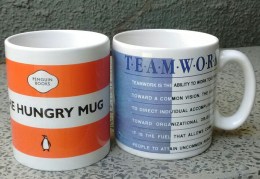
For this I am so very grateful; and about this I am now greatly concerned. What is life going to be like in the days to come?IMG_20200526_112241 How much will be lost in terms of simple human contact? When I see members of zoom rooms, each with their own coffee mugs in their own physical rooms; when I see news anchors casually sipping from teacups as they analyse another day of gloom and doom, I can almost taste the consistently  undrinkable tea that I sipped with my colleagues, rubbing shoulders across a small office table. This is what I most acutely missed, and continue to do, in my WFH life.

Two years ago in this space, I described this simple but invaluable ritual thus:

‘Twice a day, as the footsteps heralded the bearer of the teas, it was literally and (later) figuratively ‘pens down’. Time to cluster around, a time for sharing—news and views, happenings and unhappenings (propah English not mandatory, and language khichdi quite delicious!), cribbings and crabbings–and above all, energising. There were snacks too—“hey taste what I baked yesterday,” “oh great, banana chips all the way from home state”, “guess what, I discovered this new naasta shop with 50 flavours of khakhra….”

Tea table became the venue for easing in the newcomers; teasing and ribbing the old-timers; there were no hierarchies and no bosses. The agenda was whatever the mood of the table—sharing, admonishing, admiring, agonising and venting, and yes, laughing a lot.

It was an important support system in so many ways. After just 15 minutes, one returned to one’s desk feeling much better. You weren’t the only one who struggled to keep going as you juggled work and home; your child’s behaviour was not as worrisome as you imagined it was; and yes, in-laws happened to the best of us!’

The world going the way it is, such memories will remain just that—ancient history of another era. This is only one of the many simple joys of physical interaction with fellow humans that we took for granted. Others included the delicious anticipation of meeting friends for coffee; choosing the restaurant for the next birthday lunch; dressing up for an evening of theatre or music; wandering and jostling in a crowded market, and walking amidst fellow human beings on a busy street.

For many like me, the new normal is sadly so abnormal. To live in a virtual world is bereft of meaning, of everything that makes us what we are and what keeps us going. They say that people will get used to this. They say that we must adapt or perish. I am not sure how much I can adapt, so perish I must!

–Mamata


Earth Spring

22 April 1970 saw what, at the time, was perhaps the planet’s largest civic event. Millions of American citizens took to the streets, college campuses and hundreds of cities to protest environmental ignorance and demand a new way forward for our planet.
“Earth Day” as this event was dubbed, was a unified response to the numerous environmental crises that engulfed the world in the 1960s—oil spills, smog, polluted rivers, and newly exposed dangers of pesticides.

2020 marks 50 years since what was considered to be the trigger that launched the modern environmental movement. In the five decades since, much has transpired and much has changed for, and on, planet earth. Despite all the noble intentions, movements and efforts (which I have also been a part of for three decades), the planet seems to have been damaged beyond limits, plummeting in recent times into an uncontrollable downward spiral. Poisoned waters, toxic air, melting ice, disappearing forests and vanishing wildlife have become so much a part of the daily news that we have become inured. Worst still, we continue to pretend that all will be well—after all man is the master of technology, and we will find the answers.

It has taken 50 years for Earth to have gotten a respite from human interference. Ironically, this has been given by an invisible, seemingly indestructible microbe.

Almost a hundred years ago, pioneering environmental philosopher John Muir wrote “The universe would be incomplete without man; but it would also be incomplete without the smallest transmicroscopic creature that dwells beyond our conceitful eyes and knowledge…”

In the three months since this ‘creature’ has sent us scurrying for shelter, and changed the world as we know it, the earth is changing too. It is coming back to life.

The theme for this year’s Earth Day was Climate Action and events were planned to draw attention to the critical need to take action to combat climate change. Ironically, what a hundred conferences did not do for climate change, is happening today simply without human activity.

When I read about the revised suggested activities for a house-bound Earth Day it made me wonder though! All the activities were digital– webinars, online learning, nature videos, teach-ins and make-ins, and more. Everything that called for virtual interaction through digital media. What a paradox! What a missed opportunity to open windows and minds to the world outside. Some thoughts on this.

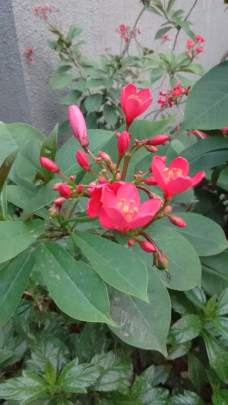
A lot is being written and shared about windows and balconies. WIMG_20200306_071238550 (1).jpghile these are great to reach out to other humans, they are also a wonderful opportunity to be inside looking out, at nature. One does not have to be in the countryside to see Nature. Even in the midst of the urban jungle, look from the same balcony or window, and you will discover—a bird, a butterfly a bumblebee, a spider. A patch of sky and a puff of cloud. The branches of a tree with fresh green leaves, a bird call, a shaft of sunlight on a wall, or the stars on a clear night.
One doesn’t have to be outdoors to do one’s bit for Earth day. Just making time to stop and stare is as much a contribution as a ‘run for earth marathon’.

And why make Earth Day just a one-day celebration? Even in 1970, the entire month was marked by events and it came to be called Earth Spring.

In these unusual times, let us be grateful for Nature which is never in ‘shutdown’! Come let us celebrate every moment, every day of our Earth Spring.

–Mamata


The Kardashian of Trees

Heroing and highlighting individual trees is a great way of drawing attention to trees in general, and to reinforce the value of nature, wildlife and biodiversity.

An example of a successful initiative in this direction is the  European Tree of the Year contest started in 2011, inspired by an older competition which originated in the Czech Republic in the late nineties. According to the Czech Environmental Partnership Foundation which started it all: ‘Tree of the Year is a contest looking for a tree with a story. The aim of the contest is to empower people and get local communities involved in the environmental and local heritage protection. We believe that by gathering around a tree, people are more likely to take action again in the future for other environmental causes and for the wellbeing of the community.’

The process of selecting the European Tree of the Year starts with a well set-out voting process at the national level of the participating countries (16 this year), and ends with a finale consisting of online voting to select from among the national winners.

Now the competition is moving to other parts of the world: In 2016, Sri Lanka started the Asian Tree of the Year, with India, Nepal, Malaysia and Singapore joining in soon after. Canada, Australia and Russia have also held national competitions, though not on an annual basis.

Beautiful old trees, with history and cultural connections to the community have found their spot under the sun through this process, and also generated a lot of public interest, involvement and learning.

Sounds good! But what has all this to do with the title?

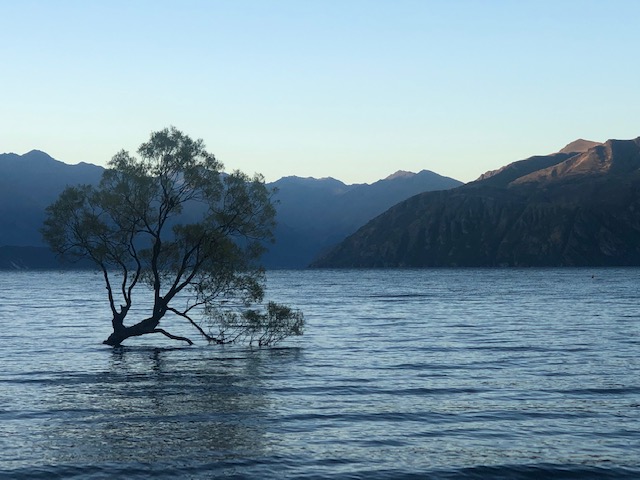
CF37A480-1747-49E9-9F79-48FCA5BAC580The connection is a tree that is reputed to be the most instagrammed tree in New Zealand, almost a symbol of NZ tourism. On a recent trip there, we were urged to set aside time to see the tree, specifically around sunset. So we worked around our program to ensure we got to the spot—a stretch of a beach—well ahead. We drove past a few times, keenly looking at the beach. We could see some people, but nothing special in the way of trees. We asked natives and tourists alike, and they all pointed us to the same area which our GPS had shown us, and which we had passed, looking in vain for a landmark. We decided to make our way down to the beach anyway. Lo and behold, there were many, many people there, jostling for some spot (we could not figure out what the spot was for), all setting up professional looking camera equipment. It came to a pass when we had to ask a friendly-looking lady what everyone was waiting to photograph, where the famous tree was, and what it was about. She kindly pointed to this spindly willow tree, standing a few feet into the waters of the beautiful Wanaka Lake, against a beautiful background of majestic mountains. But the tree itself? In my mind, this will forever define and exemplify ‘under-whelming’. ‘Why is the tree famous’, we asked many around us in bewilderment. While there was some story of how it was part of a fence and had survived in the water for several years, the general consensus was that it was famous because it was famous! So famous , it even has its own insta handle #ThatWanakaTree.
Does the title begin to make sense?

But yes, surely is a lesson to countries like ours, where we have such unimaginable treasures of cultural and natural heritage, but simply are not able to create anywhere near a proportionate buzz!

–Meena


What an Irony!

…Or contradictions in the time of Corona.

Confession. I belong to the age of dinosaurs! Not so old as to reminisce about the freedom struggle, and World War 2 (which my parents did), but old enough to remember one short war, night curfews and blackouts, and shortages. Old enough to remember a time when gymming, pubbing, clubbing, beauty and retail therapy were not considered to be critical to one’s physical and mental health. When staying indoors as a family was not unheard of, and what to do with one’s time was never a stress-inducing problem.

It is in the last month, as they say, “the world as we know it had changed.” Coronatimes newspapers, and especially the Lifestyle and Leisure supplements reveal that yes, the world has changed, but in different ways for different people. I cannot help but think back, and chuckle a bit at the contradictions!

Then and Now…

‘Staycations’ were the trendy way to spend your holidays; but now staying at home for free becomes ‘confinement’.

People went to expensive health spas for detox stints; now have DTs at home without their sustaining substances.

School vacations were a time of simple self-devised ‘time-pass’ activities (or lack of activities); not a time of huge stress for parents as to how to keep the children “engaged”.

Summer holidays were marked by hours spent playing cards, ludo and carom with relatives of all ages; now newspapers feature pictures of this as a wonderful sign of how indoor games lead to ‘family bonding’.

‘Social distancing’ was a cause for concern and counselling, as people addicted to virtual reality could not relate to real people; now when it becomes mandated, people want to break it.

Page 3 celebrities fill pages with pictures of “doing the dishes” or “playing with baby”; while numerous stories of unseen unsung heroes who are risk their own life to save others are inconspicuous among the headliners.

People have to be taught how to cover their faces when outdoors, something the two-wheeler female riders of Ahmedabad have been adept at for years.

Now Kitchen Hacks on innovative ways to make provisions last longer, and replacements for quinoa and parsley; when generations of homemakers have learnt and practised ‘living within their means’ with some saved for a rainy day.

While some eagerly await the resumption of Swiggy and home delivery from restaurants, many middle-class housewives wake up early every day to join the voluntary cooking efforts to feed the homeless and hungry.

Glossy pictures of designers displaying their designer masks; news items of hundreds of ordinary women sewing for hours to make and distribute masks made from old clothes.

Once people had to wear masks when the sky was grey and smoggy; now everyone has to wear masks when the sky is clear and blue.

Then, health and well-being pundits urged and cajoled people to get off the couches and walk; now people are risking fines and arrests to go out for a walk.

Now we need Life Coaches to tell us how to spend our day from the time we open our eyes to shut-eye time; then people did not have time nor leisure to need such coaching, but a lot of basic common sense to guide in how to live, and thrive.

Then we scoffed at mothers and grandmothers who judiciously planned, saved and put away things that “you never know when these may help”; now we remember with nostalgia and regret (or gratitude) that ‘old ladies’, old fashioned’ advice.

SARS CoV-2 did to CO2 levels what 25 Climate Change COPs could not do!

The virus of fake news spreads much faster than the Covid-19.


With gratitude and humility for those of us who are lucky to have the wherewithal to lead the life we do.

–Mamata


Friends in Need

“They are friends waiting for us any time we want them, and they will always speak honestly to us about what really matters. They are the perfect cure for loneliness. They can be our very closest friends.” They are books, wrote Swiss-born British philosopher and essayist Alain de Botton, in a letter to children.

Today is the day to celebrate this timeless friendship. April 2 is International Children’s Book Day, a worldwide celebration to highlight children’s literature and encourage the love of reading among children. This date marks the birthdICBD.jpgay of Hans Christian Anderson one of the best known children’s writer who was born on 2 April 1805 in Denmark.

The celebration of this day began in 1967, initiated by the International Board on Books for Young People, or IBBY. Each year a different National Section of IBBY has the opportunity to be the international sponsor of ICBD. The hosting country picks the theme for the year and invites a prominent author from that country to write a message to the children of the world and a well-known illustrator to design a poster.

This year, IBBY Slovenia is hosting this day, and the theme is “A Hunger for Words.” Slovenian writer Peter Svetina has written the message for this theme. Sharing a few lines: “Words in poetry and in stories are food. Not food for the body, not food that can fill up your stomach. But food for the spirit and food for the soul.”

In the days of lockdowns when parents around the world are despairing, and desperate to “keep children occupied” why not open up a menu of books, to explore and discover, to taste and savour, and to assuage the hunger of a restless mind. This will plant the seeds of the magic of stories that will grow with them as friends, and sustain their spirit through the many unknowns that lie ahead.

Equally relevant, and perhaps one that presaged the year to come, was the theme for 2019 which was Books Help Slow Us Down. Lithuania was the host, and Kęstutis Kasparavičius the Lithuanian writer wrote this inspiring message.

“It seems that books have this wonderful quality – they help us slow down. As soon as you open a book and delve into its tranquil depths, you no longer fear that things will whizz by at a maddening speed while you see nothing. All of a sudden, you come to believe you don’t have to dash off like a bat out of hell to do some urgent work of little importance. In books, things happen quietly and in a precisely arranged order. Maybe because their pages are numbered, maybe because the pages rustle gently and soothingly as you leaf through them. In books, events of the past calmly meet events that are yet to come. …Someone who enjoys reading – be it a child or adult – is much more interesting than someone who doesn’t care for books, who is always racing against the clock, who never has time to sit down, who fails to notice much of what surrounds them. …Books help us not to rush, books teach us to notice things, and books invite us or even make us sit down for a while.”

Around the world, for perhaps the first time, we have been forced to slow down, to sit down for a while (and wonder what to do with ourselves). What better time to use this opportunity to revisit our old friends—books– that were part of our young and innocent days. And what could be more joyful than rediscovering these in the company of children? A beautiful way to celebrate this special day!

–Mamata

Ides to Ideas

Beware the Ides of March! Perhaps never in the living memory of humankind, has this dire and gloomy prophecy proved so true. It is in this month that the world has been brought to its knees by an invisible force that seems to have united all of humanity in facing a common enemy.

The world, and way of life as we know, have overnight, changed beyond our wildest imagination, and no soothsayer can foretell what lies ahead, in the near and distant future. From now on, the month of March will be marked as the month that changed the world.

But before all this began, March had been designated as the International Ideas Month.

Ideas–our brain is churning out ideas all the time; even though we may not consciously register these. From small ideas about routine matters, ideas.jpgto Eureka moments, ideas keep our little grey cells ticking away. Sometimes we let these slip away because we are preoccupied with what we feel are more serious or important matters, and sometimes because we feel that the ideas is too inane to pursue.

International Ideas Month is meant to celebrate the value of ideas. And an encouragement to get one’s ideas rolling—no matter how silly, or profound they may seem.

Ideas spring from imagination, and imagination is the single most useful tool mankind possesses. And yet in these times when even creativity is measured by its market price, or ideas that help make large profits; imagination is seen as the indulgence of children and dreamers, writers and painters.

In the words of American author Ursula K. Le Guin “Imagination is not a means of making money. It has no place in the vocabulary of profit-making. It is not a weapon, though all weapons originate from it, and their use, or non-use, depends on it, as with all tools and their uses. The imagination is an essential tool of the mind, a fundamental way of thinking, an indispensable means of becoming and remaining human. …Like any tool, the imagination requires that we first learn how to use it or, rather, that we unlearn how to squander it. Children have imagination to start with, but as we grow, we tend to put aside imagination as an indulgence. All human beings need exercises in imagination as they need exercise in all the basic skills of life, bodily and mental: for growth, for health, for competence, for joy. This need continues as long as the mind is alive.”

One way to nurture imagination is to give the time and space that ideas need to take root and grow. This garden cannot be meticulously planned, pruned and scheduled. Ideas turn up anytime, anywhere—on a morning walk, at the kitchen sink, in the shower, and in the middle of the night.

Because Ideas do not have a fixed time and place to appear, it is important not to let them slip away. Grab them, capture them on paper, take your time and mull over them, incubate them, or put them into practice right away!

The right time and space is now–when we are in a physical lockdown. While we cannot physically wander far and wide, when we seem to suddenly have time on our hands–What better time to unlock and unleash all those ideas that have been hibernating or aestivating in our minds.

Turn the Ides of March into the Ideas of March.

–Mamata


Colour Me Blue

As we celebrate Holi, the Festival of Colours, here is a piece on the hues that brighten our lives.

And, in keeping with the mood of International Women’s Day, it references M.S. Subbulakshmi, doyenne of Carnatic music, and a path breaker.

Happy Holi, Happy IWD!

Last week I was reading an old-fashioned novel, where the hero’s sidekick was wearing a taupe coloured suit. Not being quite sure what ‘taupe’ was, I looked it up, and learnt that it is a dark brown colour between brown and grey and that the name originates from the French taupe meaning mole (the animal).  The name originally referred to the average colour of the French mole, but since the 1940s, its usage has expanded and blurred to mean anything greyish brown or brownish grey.

Names of many colours are derived from nature. Fuchsia was named for the colour of the flowers on the fuchsia plant, itself named for Leonard Fuchs, a 16th-century botanist. The word orange comes from the Old French orange, from the old term for the fruit pomme d’orange. The French word, in turn, comes from the Italian arancia, based on Arabic nāranj, derived from the Sanskrit nāraṅga. An inter-connected world indeed!!!!

Teal is a bluegreen colour whose name comes from that of a bird—the common teal (Anas crecca)—which presents a similarly coloured stripe on its head.

‘Puce’ is also one of the nature-colour names, but with a particularly yucky background. Puce is the French word for flea. The colour is said to be the colour of bloodstains on linen or bedsheets, even after being laundered, from a flea’s droppings, or after a flea has been crushed. Strangely it was one of Marie Antoinette’s favourite colours!

People too have lent their names to colours.

‘Mountbatten Pink’ is a naval camouflage colour close to greyish mauve. It was first used by Lord Mountbatten during World War II. When he noticed a liner ship of the colour seeming to disappear from view in the early morning light, he felt it was a good colour for naval ships to render them difficult to see at dusk and dawn, and so started applying them to his naval ships.

‘Alice Blue’ is a pale shade of azure blue, much liked by Alice Roosevelt daughter of President Theodore Roosevelt, which sparked a fashion sensation in the United States.

MSBut for a South Indian like me, the most important person-colour association has of course to be ‘MS Blue’, said to be a favourite of legendary singer M.S. Subbalakshmi.  This colour became synonymous with her after she started wearing Kanchipuram silk saris of this shade at her concerts. These were specially made for her by Muthu Chettiar, a weaver from Madurai. The savvy businessman that he was, he carefully regulated supplies to ensure enduring demand from Madras high society ladies!  It has been clarified that MS Blue is not peacock blue but ‘mid-sea blue’.

Continuing on the theme of blue, the colour of 2020 (Yes, they announce a colour for every year! A good source of income for the interior design and fashion industries) is PANTONE 19-4052 Classic Blue whose properties include instilling ‘calm, confidence, and connection’. Additionally, it is claimed that ‘this enduring blue hue highlights our desire for a dependable and stable foundation on which to build as we cross the threshold into a new era’.

Another interesting fact I learnt was that research by several academics including linguists Brent Berlin and Paul Kay has revealed that if a language had only two terms for colours, they were always black and white; if there was a third, it was red; the fourth and fifth were always green and yellow (in either order); the sixth was blue; the seventh was brown; and so on.

–Meena

Fatso

Fatso! The word always reminds of the storybooks we read in which the

garfield fat.jpg
Source: Pintrest.com

chubby baby with pink cheeks grew into a rotund schoolboy or roly-poly schoolgirl who was the butt of many jokes and cruel teasing. For many children who were actually on the plump side, it was a real-life experience that followed them through the years of teenage and adulthood. Fat characters depicted in books, movies and television are usually the bumbling comic ones, designed to raise a laugh. The simple three letter word ‘fat’ is, more often than not, used as an adjective that is derisive and pejorative.

The history of the word in the English language reveals that this was not always the case. In the late 1300s, fertile and abundant land was described as ‘fat land.’ In the 1600s, a wealthy or affluent person was described as a ‘fat’ person. This was a period when the general population suffered from poverty and food shortages, and anyone with excess body fat was recognised as being prosperous. Paintings of the Renaissance period in Europe depicted full-figured people. This was also the case in several other parts of the world, including India, where chubbiness was extolled when admiring “healthy” babies, and a skinny child would always be asked “does your mother not give you food?” In women of a marriageable age, a well-rounded body structure was desirable as it was considered suitable for future child bearing.

Changing times brought changing trends. In the 19th and 20th centuries, in the West, technology and industry made food production more stable, cheaper, and more widely available; it also introduced the wave of processed food. This, along with a rise in the overall standard of living, and more sedentary lifestyles, created new concerns, and perceptions, about weight. By the 1940–50s, ‘thinness’ became the new ideal for health and beauty. As early as March 1954, Life magazine featured an article, “The Plague of Overweight,” which characterized obesity as “the most serious health problem today.” “The uncompromising truth,” it went on, “is that obesity is caused by gluttony.” At that time, around three percent of Americans were considered obese. In 2015-2016 the prevalence of obesity in American adults was 39.8%. Today India is one of the countries in which obesity has reached almost epidemic proportions.

As medical science produces numerous reports on the health impacts of obesity, the popular culture has climbed on to the merry-go-round slogan of ‘fat is evil’. This has manifested itself in wave after wave of money-minting slimming coaches, new-fangled fad diets, and lose-weight mantras.

The social fall-out of this has been the culture of ‘fat shaming.’ Responses to this have been varied. The 1960s saw the rise of the movement of ‘body positivity’ to raise awareness of the barriers faced by fat people and highlighted the need for human rights for bigger bodies. As far back as 1969, a civil rights organisation was founded in the United States, The National Association of Advance Fat Acceptance (NAAFA) which works to eliminate discrimination based on body size, through advocacy, public education and support.

Today there is a Fat Acceptance Movement, with Fat Activists, which is working to challenge bias against fat people and end discrimination against them, especially in work places.

At the other end of the cultural spectrum, in several parts of the world, “fat is indeed beautiful.” Heavier girls and women are viewed as beautiful, wealthy and socially-accepted.  As they believe, if you are fat, people respect you; people honour you. Wherever you go, they say, “Your husband feed you fine.” In Mauritania, it is believed that a woman’s size indicates the amount of space she occupies in her husband’s heart!

Even today, in many tribes in Africa, a woman’s attractiveness is measured by her obesity, and a young woman is prepared for marriage in ways guaranteed to ˜fatten her up.” Traditionally brides-to-be would be confined to a hut where they would be fed and fed and fed on high calorie foods until they achieved the desirable size and shape.  Even today, in some places women go to fattening centres, just as in others they go on a slimming programme, before their wedding.

The Fat vs Healthy debate rages on. Every day, through every media, we are besieged by confusing and contradictory messages. Beneath all this, science seems to suggest that that body size is the result of a complex web of factors, including social and economic influences, genetics, food production and availability, urban design, land use, and advertising.

Fatso, or beanpole, beauty, it seems, is in the eyes of the beholder!

–Mamata