It is the season of colours. In Nature this is when blossoms and blooms announce the arrival of spring. The birds flaunt their plumage to attract their mates. It is colours that make this statement with an astounding variety of shades, from the flamboyant to the nuanced.
Colours are also significant in the world of humans. They express our moods, and our preferences. They indicate our race, nationality, or our sexuality. They inspire, as well as give form to our art, our textiles, and our cuisines. Each colour is unique in itself, but it is when colours come together that the real magic happens.
Sadly it is when colours begin to define race and politics that the magic turns murky. It is when national colours become the label of “friend” or “enemy”, and when the colour of the skin assumes pejorative tones that colours begin to create dangerous schisms and chasms. This when humans become so blinkered that colours begin to assume divisive identities; that colours increasingly create silos within which monochromatic sentiments fester until they explode in violence and war.
These ruminations were triggered by a poem that I came across. The words are simple, but the thoughts profound.
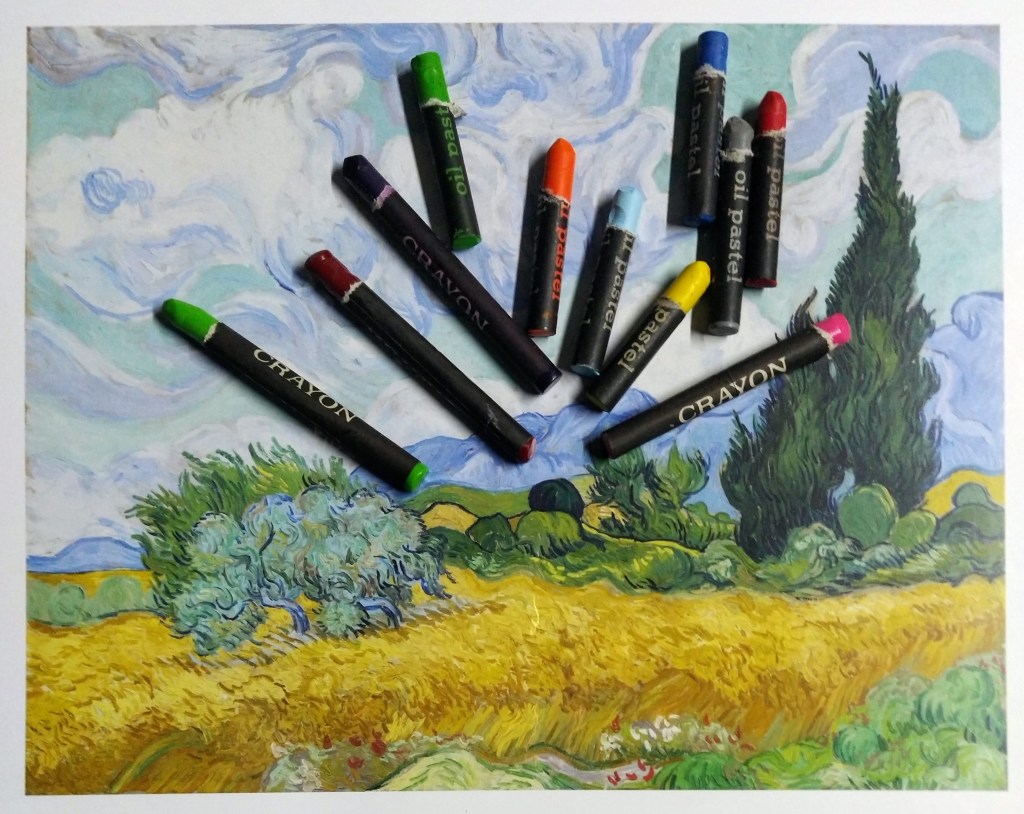
CRAYONS
While walking into a toy store
The day before today
I came upon a crayon box
With many things to say.
“I don’t like Red!” said Orange.
And Green said “Nor do I”.
“And no one here likes Yellow.
But no one knows just why.”
“We are a box of crayons
That does not get along.”
Said Blue to all the others,
“Something here is wrong.”
Well I bought that box of crayons
And I took it home with me.
And I laid out all the crayons
So the crayons could all see.
They watched me as I coloured
With Red and Blue and Green.
And Black and White and Orange
And every colour in between.
They watched as Green became the grass
And Blue became the sky.
The yellow sun was shining bright
On white clouds drifting by.
Colours changing as they touched,
Becoming something new.
They watched me as I coloured
They watched till I was through.
And when I finally finished,
I began to walk away.
And as I did the crayon box.
Had something more to say.
“I do like Red” said Orange
And Green said “So do I!”
“And Blue, you were terrific.
So high up in the sky!”
“We are a box of crayons
Each of us unique.
But when we are together
The picture is complete.”
Today as we celebrate Holi, the festival of colours, let the colours unite us in our revelries, in their true spirit. Let colours become all-inclusive rather than exclusive. Let the many different shades and tints come together to weave a magnificent and rich multi-hued tapestry. Let us remember that within every colour lies a story, and stories are the binding agent of cultures.
Novelty or mimetic architecture is a type of architecture in which buildings are given unusual shapes for purposes such as to convey a message about what they represent, or to copy other famous buildings. They ‘mimic the purpose or function of the building or the product they are associated with.’ They are structures built with the intention that they be used. (They are different from architectural follies which are unusable, ornamental structures often in strange forms.)
While the style started in the US somewhere in the 1930s, India is quite a leading light. Any respectable ’10 most..’ or ’15 most..’ in the world of mimetic architecture lists would include three buildings from India: the Chowdiah Memorial Hall, Bangalore; the Fish Building Hyderabad; and the Lotus Temple, New Delhi. So maybe we should quickly recap what these are.
The Chowdiah Memorial Hall is a major cultural Centre in Bangalore. It is shaped like a violin to commemorate Thirumakudalu Chowdiah, the violin maestro. The building, designed by Mr. SN Murthy, was completed in 1980. It is shaped like a huge seven-stringed violin, and has all a violin’s essential elements, like the strings, keys, the bridge and the bow.
The Fish Building, Hyderabad, inaugurated in 2021, houses the offices of the National Fisheries Development Board. It is a 4-storey building which incorporates elements of the fish-form, like two circular windows as eyes. The building stands on pale blue pillars and is lighted by blueish lights in the night, to give the impression of a fish swimming in water. Designed by Narasimham Associates (as far as I can make out!), it is said to be inspired by Frank Gehry’s ‘Fish’ sculpture located in Barcelona.
The Lotus Temple, a temple of the Bahai faith, was designed by the Iranian Faribroz Sahba, and was dedicated in 1986. It is a major tourist attraction of New Delhi. Made of 27 free-standing marble-clad petals, it is a pretty green building too, with 120 kW of its 500 kW electricity requirement coming from solar power generated by solar panels on the building. It also houses a greenhouse to study indigenous plants and flowers that can be grown in the area.
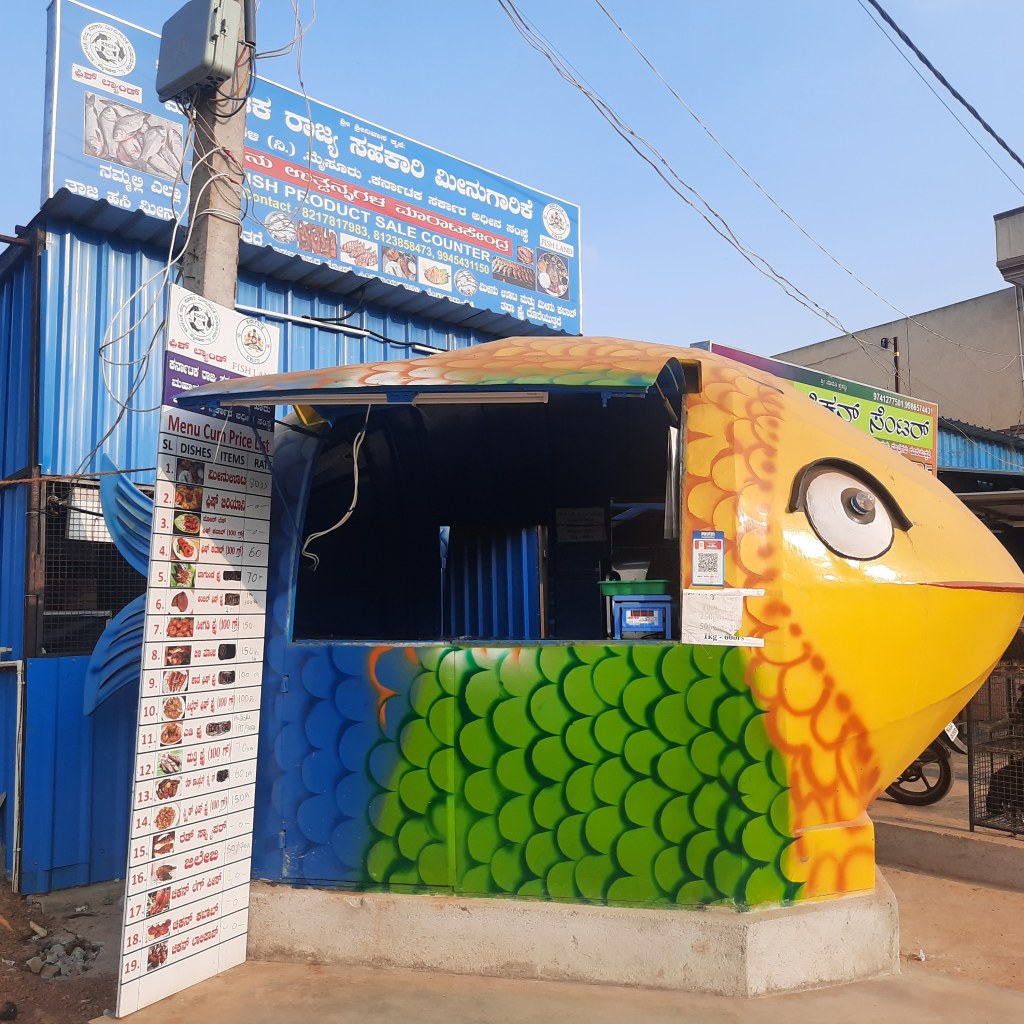
All this build-up to announce that my own nick of the world (truly a backwater by the name of Rajanakunte, in ‘who-lives-there North Bangalore’) now boasts a fish-shop in the shape of a fish! The proprietor proudly told us that it is the first such in Bangalore city itself, though Mysuru has one! While not commenting on the aesthetics of fish-buildings, either this one or the larger sibling in Hyderabad, my yellow, green and blue fish does add quite a pop to the Yelahanka area which is anyway quite rich in street art.
Other examples of mimetic architecture in India are of course the variously-shaped water tanks in many pockets across the country. It is not uncommon to catch glimpses of water-pots, aeroplanes, cars, tablas etc. atop houses. It seems to be like an endemic—there are concentrations of such water tanks in a given stretch, and taper off in the length of 5 km or so. The other prevalent example of mimetic architecture is police stations, with several of them being shaped like helmets!
There is a whole world of mimetic buildings waiting to be explored, including: The Big Basket, Ohio, the headquarters of the Longaberger Company, an American manufacturer of handcrafted maple wood baskets; Haines Shoe House, Pennsylvania, the house of successful shoe salesman Mahlon Haines designed like one of his work boots; and the Dancing House Hotel, Prague designed as a tribute to the famous dancers, Fred Astaire and Ginger Rogers.
As you browse the web to locate these, do also look around. Who knows what is waiting to be discovered next door!
Last week was Sankranti and all eyes were turned to the skies as the colourful kites soared and dipped, drifted and sailed with the breeze. Also in the sky were the avian kites, riding the thermals. From time immemorial, humans have gazed up and dreamed of soaring the skies too. The same week there was a news item about a young Belgian-British teenager who flew her single-seater Shark ultralight plane around the world in 150 days. 19 year old Zara Rutherford thus became the youngest woman to circumnavigate the world solo. One of the objectives of her mission, she says was to infuse young women and girls worldwide with the spirit of aviation.
In the day and age when women are soaring high in all spheres, it is interesting that she feels that more women need to take to the skies. And even more interesting that India has a fair share of women, who have made their dreams of flying come true, not only today, but almost hundred years ago.
Google Doodle honouring Sarla Thukral on her 107th birthday on 8 August 2021
Sarla Thukral was the first Indian woman to fly an aircraft. Born in 1914 in Delhi, she later moved to Lahore, in what was then British India. At the age of 16 she married an airmail pilot PD Sharma who came from a family of fliers. The young bride was also smitten by the aviation bug, and encouraged by her husband, she started flying lessons. Having completed 1000 hours of flying time she earned her flying license, and did her first solo flight in a Gypsy Moth, a small, double winged plane at the age of 21, dressed in a sari. She was preparing to become a commercial pilot but the Second World War broke out, and civil aviation training was suspended. Tragically, around the same time she also lost her husband in an air crash. Sarla was grounded, but not her creativity. She took up with equal passion her love for the arts. She started studying fine arts and painting at Lahore’s Mayo School of Arts. She returned to Delhi after Partition, where she continued to paint. She married RP Thakral in 1948. She also started designing jewellery and clothes and set up a successful business which she ran till she passed away in 2008.
Sarla—high flier, in the sky and on the ground! And an inspiration for many young girls in India who have over the years taken to the skies.
One of the concerns expressed by young Zara is that there is still a big gender gap in the field of aviation in many western countries. Globally, according to the International Society of Women Airline Pilots, around 5 percent of pilots are women. In India, the share of women pilots is significantly higher – at over 15 percent, more than twice as high as in most Western countries, including the United States and Australia. According to one report India has a total of 17,726 registered pilots out of which the number of women pilots is 2,764.
We have, in the last few years, always experienced a surge of pride when we hear a woman’s voice introducing herself as the pilot on a commercial flight. Even more uplifting is the increasing number of women who are flying shoulder-to-shoulder with men in the armed forces.
Women pilots have been flying transport aircraft and helicopters in the three Forces for a long time. As far back as 1994, when many people had reservations about allowing women pilots in the Indian Air Force, Gunjan Saxena, along with Srividya Rajan, defied convention, and took up the challenge; they were two of the 25 young women to form the first batch of women IAF trainee pilots. The Kargil War of 1999 was a real test of the true grit of these women. They fearlessly flew helicopters in the combat zone, and into hostile territory to drop supplies, evacuate injured soldiers and spy on enemy positions. Gunjan and Srividya’s contribution in this critical war effort was highly commended, and an inspiration for many young women who dreamed of a career in uniform.
In October 2015, the Indian Air Force opened the fighter pilot stream to women. The first three female pilots to be inducted in the fighter squadron in June 2016 were Avani Chaturvedi, Bhawana Kanth and Mohana Singh. These young women, were fuelled by the sense of adventure as well as the spark of contributing to the defence of our country.
Today the Indian Air Force has 111 women pilots who fly transport planes and choppers, and 10 women fighter pilots.
As Bhawana Kanth said “It is not the right time for it now, it has always been the right time for women to become fighter pilots.”
Last year Flight Lieutenant Bhawana Kanth on 26 January 2021, became the first woman fighter pilot to be take part in the Indian Air Force’s (IAF’s) tableau at the Republic Day parade at Delhi’s Rajpath.
This year, as we mark the many strides forward that our Republic has made, and salute with pride the accomplishments of its citizens, let us put our hands together for all the young women who dare to dream, and who make their dreams come true. Soar high, sisters and daughters, and may even the skies not be your limit.
Most of us, at least the more senior among us, would definitely have visited an Indian Coffee House at some stage in our lives. Quaint places, which serve coffee and snacks at reasonable prices. Usually centrally located, these places are manned by liveried bearers in old-style uniforms. But the best part—one can linger there fairly indefinitely over coffees and conversations.
The Indian Coffee House chain goes back to 1958, proving that coffee-places in India are not something invented or haunted by the young and with-it crowd. Our parents and grandparents ‘been there, done that’!
Coffee-drinking in India is only about a century old, though coffee has been grown here since the 16th century. But Indians didn’t take to it for a long time. The oldest reports are of Tam-Brahm Mamas drinking coffee in the 1920s in Chennai. It was pretty class and caste stratified, as were most things in those times.
The coffee-house culture which started in the 18th century here, was also subject to social restrictions—in this case racial discrimination. Only whites were allowed into these.
As time went on, the need to increase domestic coffee consumption was seen as important—purely economic reasons of course. With a view to to popularize the drinking of coffee and increase the sale of coffee seeds, the Coffee Cess Committee started a chain of coffee-houses, called India Coffee House. The first came up in 1936, in Mumbai. As a part of this objective, the British Government also set up the Coffee Board in the early 1940s. The chain of Coffee-Houses (then called India Coffee House) quickly gained popularity, and in fact became addas for freedom fighters, political leaders, students, intellectuals, artists and thinkers. These continued to flourish even after Independence, and were at the hub of political and intellectual discussions.
But in 1957, the losses were mounting and the Government wanted to close down the Coffee Houses. Not only would this have been a huge loss to the availability of spaces for debate and discussion, it would have resulted in retrenchment of several employees working in these places. The All India Coffee Board Labour Union decided to take a hand in the matter. Their Leader Shri. A.K. Gopalan a prominent Communist, along with some workers met the then Prime Minister Shri. Pt. Jawaharlal Nehru. The Prime Minister suggested that the coffee-houses could be taken over and run by worker-cooperatives formed by the retrenched workers. As a result of this meeting, it was decided to form separate co-operative Societies in areas where these coffee houses were located, and to run the Coffee Houses as Cooperatives. In 1957, the first coffee house, now called Indian Coffee House, under this cooperative plan was opened, in the Theatre Communication Building in Connaught Place in Delhi. Totally, 14 Societies were formed in different parts of India, and ever since then, have been running these units. Today, these have over 400 outlets spread across 20 States of India. Each worker in each of these units is a co-owner of the business and has a stake in its success. A unique model indeed.
Even after Independence, Indian Coffee Houses continued as intellectual hubs. In fact, so powerful a force were they that they were feared by the powers-that-be in the pre-Emergency era.
Indian Coffee House designed by Laurie Baker
Kerala has the largest number of Indian Coffee Houses—51 in fact. West Bengal has several too, with the most famous on being on Kolkata’s College Street—an outlet which in its time hosted intellectuals and artists including the likes of Satyajit Ray, Amartya Sen, Mrinal Sen and Aparna Sen.
The Coffee House at Trivandrum is very special in that it is an architectural landmark. Designed by the famous architect Laurie Baker, it is a continuous spiral ramp, with a circular central service core, and eating spaces provided on the outer side; jaalis let in light and ventilation. It stands on a very small plot in the middle of a busy urban area, and it is only by adopting the innovative circular design and interior design that it is able to cater to its many customers.
As we enter 2022, a time when capitalism is becoming more and more dominant, here’s a shout-out for the cooperative movement!
Long live coffee, long live coffee houses, long live addas which allow space for discussion and debate, long live the co-operative movement. Long live Indian Coffee House, which is all of the above!
In the ‘80s, ’90s and early into this century, Verappan was a name we often saw in newspaper headlines. As in:
India’s Most Wanted.
Outlaw of Jungle.
In the Lair of India’s Asthmatic Bandit King.
Veerappan Strikes Again.
Veerappan Kidnaps Rajkumar, Three Others.
A Ruthless and Daring Bandit.
And then, in October 2004, the headlines:
Veerppan walked into well-laid trap.
Veerappan shot dead.
Death of a Demon.
A ruthless killer, a sandalwood smuggler, a poacher who was responsible for the killing of elephants in the four-figures; a kidnapper; a murderer; a hero to his gang and some poor communities; a man wanted and actively hunted by the security forces of two states and the BSF sent by the Centre, Veerappan was an elusive figure. A figure who fed news headlines, who kept security forces on their toes, and who with his dramatic moustache and daredevilry, excited the imaginations of many.
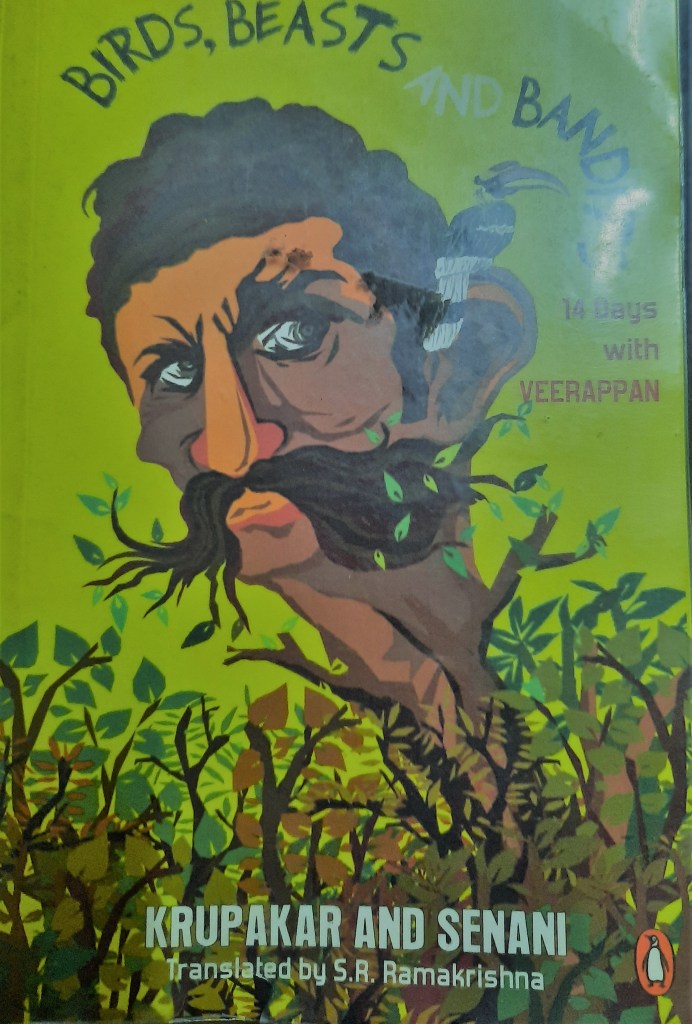
Why, 17 years after his death, have I suddenly been reminded about Veerappan? Well, I happened to stumble upon this book called BIRDS, BEASTS AND BANDITS: 14 DAYS WITH VEERAPPAN.
It is the true story of two wildlife-film maker-conservationists who were kidnapped by Veerappan and his gang under the mistaken impression that they were government officials who could be useful as bargaining chips for some of their demands. The gang captures a Bengali scientist visiting the forests as a tourist, as well as three forest guards as well, to add heft to their bargaining power. The seven hostages are marched across the forest for 14 days before they are released. The book is the account of these 14 days by the two main hostages, Krupakar and Senani.
They wrote their account for a Kannada weekly magazine ‘Sudha’ in 1998, a year after they were captured and released, and subsequently, as a book in Kannada. About 10 years after that, the book was translated and brought out in English by Penguin.
It is a light-hearted book, though it talks of an ordeal which must have taken a lot of guts to endure. And though light-hearted, it is not trivial. It touches upon many serious issues, from the injustice that Veerappan and others in his gang have faced, which may have driven them to become what they did. But it does not justify their actions. It mentions the unfair portrayal of his misdeeds in the press and by officialdom, in terms of chalking up a lot of crimes, elephant-poachings and murders to his account, than he could have possibly committed.
Most importantly, it brings us glimpses of Veerappan as a person. His incredible abilities as well as his incredible instability; his naiveté and ignorance of the world, as well as his understanding of the jungles and the tribulations of the poor; his humour as well as his tantrums; his readiness to use the gun, as well as his gentleness in some situations.
As much as bringing Veerappan to us, the book brings us Krupakar and Senani. How they take the whole ordeal as pretty much routine—all in a day’s work, so to speak. Their equanimity, their fearlessness, their presence of mind, their strategic and thoughtful approach to communicating with their captors to move them towards the decision to release them—all these shine through. They don’t mention any of this explicitly, but as one reads, one is completely awed by this. The equanimity and stoicism of Dr. Maithi, an agricultural scientist from West Bengal who is another captive is unbelievable too! He spends his time meditating, indifferent to his situation, and in fact trying to teach the others meditation! And the incredible integrity of all the three, whether in their intentions that a peaceful resolution be brokered between Veerappan and the official machinery, or in their sympathy and empathy with the gang members, is touching.
There can be no sympathy with ruthless killers like these, but the book does portray their human side—their motivations, hopes and dreams.
The prize goes however to the following incident that Veerappan narrates to his prisoners, with whom the gang builds up a warm and emotional relationship. Veerappan tells them of how he had once kidnapped a government official and asked for a ransom of Rs. 3 crore for his release. A government emissary appears on bike, carrying a bag. Veerappan asks him to throw the money on the road to ensure that the bag does not have a bomb or something. He sees that the money is much less than promised (Rs. 3 lakh in fact). When angrily questioned, the emissary, a second-division clerk, is pretty fearless and says that this is what he was given. Disgusted, Veerappan tells him to go. But the man keeps standing there. The story continues in Veerappan’s words as follows:
‘I was taken aback. People run the moment they see Verappan. But here I was telling this man to get lost, and he was still standing around.
‘What else?’ I asked loudly.
‘He bent forward, scratching his head with his left hand, and said ‘Nothing for me, sir?’
‘I gave him ten thousand, to rid myself of his wretched presence’.
It has been some years now since I used what we called a Fountain pen. All through my schooldays, from the time that we reached the class where we graduated from pencils to pens, the fountain pen was an essential part of our compass box. The pens had a number of accoutrements—ink bottles (think Quink!), plastic ink fillers, rags of cloth to mop up spills, and sometimes even extra nibs. The ritual of filling (and spilling) the ink was as much a part of the evening routine as packing the schoolbags. The fountain pen was an integral part of life, and being gifted a Parker pen or a Waterman pen by someone who came from abroad was a highlight of that life!
I was surprised to learn recently that until the late 1950s India did not manufacture pens; all pens were imported, as also was ink. It was only after Independence, due to the thrust by the government to encourage domestic production that Indian pen manufacturing companies were set up. By the mid-1960s there were 12 Indian manufacturers of which Ratnam and Sons, based in Rajamundry were the most famous. It is believed that the Ratnam pen was the first truly ‘swadeshi’ pen. The story goes that when Gandhi had just launched the Swadeshi movement, he met KV Ratnam in 1921, and advised him to make a product using solely Indian components. When Ratnam asked him what he should make Gandhi said that he could make anything, from a pin to a pen. And Ratnam chose the pen! After studying the intricacies of a fountain pen, Ratnam set about meeting Gandhi’s mandate to make a truly ‘Indian’ pen. After several years of experimenting with local materials and technology, he finally developed one in 1933 and sent it to Gandhiji. Gandhiji was not fully convinced. He sent one of his secretaries to the Ratnam factory to confirm that no imported element was used in the product. It was in 1935 that Gandhiji was satisfied, and he started using the Ratnam pen, which he continued to do till his death in 1948.
For years ink-stained fingertips were the sign of a prolific writer, or a leaky pen! It was to address the issue of leaking ink that in other parts of the world, the path to the invention of what came to be called the ballpoint pen were already underway. The international history of the transition from the fountain pen to the ball pen is interesting.
The first patent for this kind of pen was obtained by an American lawyer John J Loud in 1888. Loud wanted an ink pen which would be able to write on rougher materials such as wood and leather, as well as paper. He experimented with, and developed a pen with a revolving steel ball, which was held in place by a socket—literally a pen with a ball point. Loud’s pen was indeed able to write on leather and wood, but it was too rough for paper. The device was deemed to have no commercial value and the patent eventually lapsed. But inventors continued to experiment with variations on the ball point.
One of these was a Hungarian-Argentinian journalist named László Biro who was frustrated with the leaky pens that he had to use in large numbers. László had realised that the ink used in fountain pens was too slow to dry; what was needed was something more like the quick-drying ink used on newspapers. In his quest for a more suitable ink he turned to his brother, Győrgy, a dentist who was also a talented chemist. Győrgy came up with a viscous ink which spread easily but dried quickly. After a number of trials, the brothers filed a patent, in 1943, for the ballpoint pen. Their pen was originally called a ‘Birome’ but became popularly known as a biro (an example of an eponym!) The pen became an instant hit. The Biro brothers sold their patent to Bic. And Bic pens are known all over the world even today. The ballpoint pen revolutionized the act of writing. Where the fountain pen needed a fixed place for writing where the accompaniments like the inkpot could be kept, the ballpoint pen led to great mobility and flexibility; it could be carried and used anywhere and anytime..
By the time I graduated from school to college, the trend in India had also moved from fountain pens to what we then called ballpoint pens, that later became the ubiquitous ball pens. At the time relatives coming from abroad used to bring Bic pens as gifts, although Milton Reynolds an American entrepreneur had introduced ballpoint pens in India in 1947. While Rajamundari was the cradle of the indigenous fountain pen, it was in Rajkot in Gujarat that the first Indian ballpoint inks and pens were manufactured. It was only in 1962 that Dhirajlal Joshi, after a lot of struggle, got approval to make ballpoint pen ink in India. There were hiccups in terms of quality of ink, nibs etc. but by the 1970s these had been smoothened and many pen manufacturing partnerships were set up, including with countries like Japan and Germany.
From Ratnam pen to Space pen–I value them all!
In the last two decades the market has been flooded with a great variety of pens, transitioning from pens with refills, to use-and-throw gel pens. There is even a Space Pen that is able to write in zero gravity and works upside down, under water, over grease and in extreme temperatures. Today fountain pens have become collector’s items or status symbols. Ink fillers, ink bottles and ink stained rags may soon be seen only in museums. Even refills for ball point pens are not easily available at my local stationary shop, as I painfully steel myself to throw away gel pens when they run out. These are perhaps manifestations of a time, which is almost upon us, when pens themselves, in any form, become redundant in an age of digital technology.
I have, all my life, loved writing by hand, and pens have been an integral part of that process of writing; each transition in the type of pen that I have used, marking also a different phase in my life. Pens gifted with love, pens picked up as souvenirs, pens handed out at meetings and conferences, and pens chosen and bought from stationary shops, and more…I have kept them all. These are my valued pen friends even today.
Some months ago, I wrote a piece called High-tech Barriers to Heritage, describing how we had to have smartphones to buy tickets to get into a monument.
But my trip last week to Mysuru as a tourist reminded me that there were low-tech barriers aplenty too in our country.
To begin with, both in the Mysuru Palace (about half of which is closed to visitors due to renovation), and in the Jaganmohan Palace Art Gallery, it is necessary for visitors to take off footwear. The reason is that in the Palace, there are sacred shaligrams which are worshipped. But the shaligrams are behind thick silver doors, and anyway not in the view of, or within shoe-shod feet of visitors. In the Jaganmohan Palace, the reason is that there is a large Ganesha idol as part of the exhibits. It would not be too difficult to move the beautiful idol to a secluded room so that visitors interested in seeing it could take off their shoes just outside that room. Both of these are largish museums and are spread over various floors. Tourists are on the road all day. It is neither comfortable, nor hygienic to go around with dirty feet. If footwear must not enter, then can cloth covers for feet be provided, which can be collected back at the exit, washed, sanitized and re-used? Or any other solution? Raghu who hates walking barefoot, and is also seriously diabetic and hence paranoid about getting his feet hurt, sat out both the visits while the rest of us went in. Sad, because he would have enjoyed seeing the exhibits, including the large collection of Ravi Varmas at the Jaganmohan Palace.
The visit to Brindavan Gardens was traumatic in a different way. We went in fairly late and were eager to catch a glimpse of the gardens before dark. We saw an electric buggy just as we entered, but the decrepit vehicle had just gathered its full load and took off for its round. We looked around for an Information Desk to check when the next buggy trip was scheduled. But there wasn’t a desk or kiosk. Nor even a schedule of buggy departures. We asked around in the shops which cluster and mess up the entrance, but no two answers coincided. We decided to have a coffee and wait for the next ride. We ordered the coffees, but didn’t get them because the electricity went off in between. We looked for loos, but as there was no Information Desk or signage, it took us quite some wandering around before we found them. At the end of 45 minutes, there was no sign of a buggy, it was quite dark, and we decided to leave.
The next day was a Tuesday. We wanted to visit the Rail Museum. But when we reached there, it was closed. So we decided to visit the Zoo, which is counted among the best in the country. But Tuesday was off for this site too!
Not that the Mysuru trip was a total disaster. The city itself is beautiful, green and stately, and driving around was a pleasure. We (some of us) did see the Palace and the Museum. We savoured the crispest dosas, the fluffiest idlies, the most flavourful of sambhars, the tangiest of chutneys—all in clean, modest, reasonably priced places.
And the highlight of the trip: the illuminations at the Palace in the evening. Lit up by 99,000 bulbs, it was a scene out of a fairytale or a dream. Apparently the Palace is lit up on Sundays and public holidays. We might have missed if we had not been told about by our Palace tour guide, for there were no signboards informing us that this was one of the evenings when the lighting was on.
It is not news that India is home to rich treasures. Indians now have the means, the time and desire to travel and see them. Can we not make life just a little easier for our tourists? Can we not treat them with respect and dignity? Can we not make the travel experience easy, pleasant, memorable, and an opportunity for learning?
To begin with, can we take a few simple steps?
Have information desks not only at the sites, but also prominent places in tourist cities, with helpful people who really want tourists to see and enjoy the sights?
Have basic informational and directional signs, as well as imaginatively conceived informational signage?
Not force people to trail through miles of corridor barefoot, inviting germs. If we are particular about keeping out shoes, can we come out with dignified alternatives?
Have some system of universally-accepted holidays for public places? After my experience, I did a bit of Google research and this is what I found:
FACILITY
OFF-DAY
Delhi Zoo
Friday
Hyderabad Zoo
Monday
Mysuru Zoo
Tuesday
Chennai Zoo
Tuesday
National Museum, Delhi
Monday
Dr. Bhau Daji Lad Museum, Mumbai
Wednesday
Kelkar Museum, Pune
No off-day
National Gallery of Modern Art, Delhi
Monday
Visveswaraya Science Museum, Bangalore
No off-day
Science City, Kolkatta
No off-day
National Science Centre, Delhi
Saturday and Sunday
Surely there is a case for rationalization!
Let’s celebrate Amazing India! But powers-that-be, could you just make it a little more convenient for the public?
A recent news item caught my eye. It said that the price of a matchbox is to go up after 14 years. And what is the price hike? A whole rupee more—from Rs 1/- to Rs 2/-! The last time the price was revised was in 2007 when the rate went up from 50 paise for a matchbox to Rs1/-. In a time when prices of foodstuff and fuel are in the ‘hundreds’ range, and spiralling every day, it is unbelievable that there is even an item in the market that costs as little as Rs 2/-
Yes, this is the ubiquitous, but not really noticed, little box that we need so many times a day, for so many uses—a matchbox.
The early history of the matchbox, as we know it, in India is not well documented. It appears that one of the early indigenous match manufacturers in India was the Gujarat Islam Match Factory founded in 1895 in Ahmedabad. However there was no commercially successful manufacture of matches in the country till 1921. In fact before World War 1 most of India’s matches were imported, mainly from Sweden, Austria and Japan. In the early 1900s, about half of the total imports of matches came from Japan. After World War I there was a struggle for supremacy in the Indian matchbox market between the Japanese and the Swedish who were represented by the Swedish Match Company
Around the same period some Japanese immigrants settled in Calcutta and began manufacturing matches. The locals also picked up the skills and small match factories came up in and around Calcutta. Following World War I, many manufacturers migrated to the state of Tamil Nadu where the climate was dry, labour was cheap, and raw materials were easily available. Starting as small family-based units, match-making continued as a mainly small-scale cottage industry, but over time, expanded into a booming industry. Today, the Match Kings of South India as they are called, supply the bulk of the country’s matchbox needs, employing around four lakh people, directly or indirectly, of which 90% are women. Sivakasi of the fireworks manufacturing fame is also the home of match production. Fourteen raw materials are needed to make matchsticks and matchboxes, including red phosphorus, potassium chlorate, and sulphur as well as wax, paper board, and splints.
In 1950 a matchbox cost 5 Paise, in 1980 it went up to 25 paise, in 1994 to 50 paise, and in 2008 to Rs 1/-. Considering that the cost of all the raw materials has increased manifold, the matchbox seems to have defied all laws of inflation!
While the economics of the industry is about numbers, the labels of the matchboxes reveal fascinating facets of history and culture. These are the aspects that fascinate matchbox collectors or phillumenists as they are called. It is from their collections that that many interesting stories emerge.
Some early matchbox labels which bore the sign Made in Sweden had pictures of Mughal emperors on the labels. It is believed that the royal family of Bhavnagar in Gujarat commissioned a special matchbox for their personal use during British rule.
During the freedom movement Swadeshi matchboxes appeared in the market, carrying slogans (in different Indian languages) extolling boycott of foreign goods and promoting swadeshi. These were often confiscated by the British. India’s independence was celebrated with matchbox labels carrying the tricolour, and pictures of people who had played a role in the struggle for independence. In the 1960s, popular matchbox labels included pictures of ‘matinee idols’ of the day—popular film stars, as well as a number of sports superstars. Matchbox labels have also carried pictures of brands like Pepsi, Fanta, Thums Up, Pan Parag, Frooti, Parle, Nescafe, Vat 69, Kitkat, Complan, Amul, Lux, as well as of TVs, cameras and computers (most likely not with permission from the companies, but definitely free publicity for them!) to name a few.
A souvenir of my phillumeny phase
Phillumeny or the hobby of collecting different match-related items: matchboxes, matchbox labels, matchbooks, match covers, etc. has its own band of aficionados, perhaps not as large as stamp or coin collectors. I went through a brief period of phillumeny in my college days. In the days when smoking in public places was not taboo, restaurants and hotels had interesting matchbooks, and for us these were great souvenirs of places visited, and memorable events!
Economics and commerce, history and culture–the matchbox has its little niche in many subjects. But perhaps the most innovative use of the matchbox has been in the teaching of basic science. In the words of Arvind Gupta one of India’s pioneering simple science educators who has used the matchbox in an amazing number of ways: In the seventies a pioneering science programme in India attempted to revitalize the learning of science in village schools which had no science labs. The shift was from the chalk-and-talk method to hands-on, on making things with simple humble material available in the village. The hunt was on for low-cost, locally available very affordable things to do science.
The matchbox surprisingly emerged as a STAR. Being mass produced in a factory the matchbox confirmed to certain standard dimensions. The length of the matchbox is very close to 5-cm (2- inches) – a very good estimate of length. You could put six matchboxes back-to-back to make 30-cm (1-foot). The weight of the new matchbox was very close to 10-gms. Ten new matchsticks (not burnt) weight about 1-gm and the weight of a single matchstick is very close to 0.1-gm! Paint the matchbox drawer with some oil to make it water proof. Fill it with water and the drawer holds roughly 20-ml of water. Pour out 5 drawers of water in a bottle to make 100-ml. The humble matchbox becomes a good measure for volume. So, using a universally available matchbox, children could get a good feel of length, weight and volume – all very basic entities of any science curriculum!
How many things can you fit in a matchbox? 20…. 30…. 100? This exercise was given to children many years back. One child actually managed to pack in a whopping 250 things inside a matchbox! Just look around for small minute things – a mustard seed, hair, thread, cumin, moong dal etc. While doing this project children searched for the smallest artifacts in their vicinity and they came up with surprises which are difficult to imagine! They really had a good peep in the world of small things! Science is all about keeping our eyes open and looking at similarities, forms, patterns in the world around us. Science in short, is the discovery of order.
As our markets and homes get flooded with numerous new gadgets and geegaws, we tend to forget some of the simplest but most versatile household items. As we celebrate the festival of lights let us give thanks for the small things that make our life better and easier. Let us spark a match and light a lamp.
I recently came across a fascinating 2017 publication titled ‘Cantonments: A Transition from Heritage to Modernity’. This coffee table book has been brought out by the Director General of Defence Estates, which has ‘the task of Cantonment Administration and Land Management of all the defence land in the country’.
The word cantonment is derived from the French word canton, which means corner or district. Originally, it referred to temporary arrangements made for armies to stay during campaigns or for the winter. However, with colonization, the colonial powers had to set up more permanent military stations, and in India and other parts of South Asia, such permanent military stations came to be referred to as cantonments. In the US too, a cantonment is essentially ‘a permanent residential section (ie., barracks) of a fort or other military installation’. In India, the very first cantonment was set up by the British at Barrackpore about 250 years ago (though Danapur in Bihar also makes a claim to be the first!), and they grew in numbers in the 18th century.
A Coffee table book on Indian Cantonments
There are 62 cantonments in India, classified into four categories, depending on their size and population. The total cantonment land in the country totals to over 2 lakh acres. Cantonments are mixed-use areas, with both military and civil populations, unlike Military Stations which are exclusively inhabited by the Armed Forces. Cantonments are governed by the Cantonments Act, 2006, and the ultimate decision-making body is the Cantonment Board, which has equal representation of elected and nominated/ex-officio members.
Coming back to the book I started the piece with, it is a fascinating display of visuals from cantonments, and a great showcase of the diversity that cantonments are home to.
I learnt a lot of things I was not aware of. For instance, that the site of the Kumbh Mela, the Sangam, is within the Fort Cantonment of Allahabad. During the Kumbhs, the state government takes over the management of the area. Or that the Agra Fort, to which all of us troop, to get a glimpse of the Taj as Shah Jehan did a few centuries ago, is within a cantonment. Or that the Allahabad Cantonment houses an Ashokan pillar with edicts. This pillar is unique in that apart from Ashoka’s inscriptions, it contains later inscriptions attributed to the Gupta emperor, Samudragupta of the 4th century (an early case of state-sponsored graffiti?). Forts at Ahmednagar, Belgaum, Cannanore etc., are also part of cantonments.
Dr. Ambedkar, the father of our Constitution, was born in Mhow Cantonment—his father Ramji Maloji Sakpal held the rank of Subedar in the British army. Mhow is in fact today officially called Dr. Ambedkar Nagar. The Cantonment houses the Dr. B.R. Ambedkar Smarak, a marble structure which has an exhibition on the life of the leader.
Gurudev Rabindranath Tagore spent considerable time at the Almora Cantonment Board and is said to have written a number of books, including parts of the Gitanjali, during his sojourn here. The building where he stayed is now called Tagore House.
Cantonments house excellent buildings—the Flag Staff House built in 1828 on the banks of the Hooghly is now the Barrackpore home of the Governor of Bengal. The Rashtrapathi Nilayam at Secunderabad is part of a cantonment.
Expectedly, many war memorials are also housed in various cantonments, including the Madras War Cemetery, the Kirkee War Cemetery, Delhi War Cemetery, etc.
These areas also have a number of old and revered places of worship, from churches to temples to masjids.
And of course these are biodiversity havens—especially the ones up in the hill reaches of Shillong, Ranikhet, Landsdowne etc. Migratory birds visit the Danapur Cantonment, and thousands of open-billed white storks breed here.
We have all seen/passed through/visited/lived in cantonments, and have to admit they feel like serene, clean, green, well-ordered oases. But cantonments are not without their controversies. Not only are they criticized as Raj-era relics perpetuating colonial mindsets, but also, there have been several tussles between civilians and the Forces establishment—whether public access to roads that run through these areas, or the issues of civilians who live within them—they cannot for instance, access home loans or government housing schemes.
The Comptroller and Auditor General of India (CAG) has been rather scathing with regard to the management of lands under Defence Control. The Army itself at some stage has wondered if it can afford the money spent on the upkeep of these areas. In a major development, at the start of 2021, the PMO has asked for views on the abolition of all cantonments.
So it seems there is some kind of a push at the top levels to do away with them. But one wonders—is that throwing out the baby with the bathwater? Would it not be better to re-conceive them to give a fair say to all stakeholders, and make the management more inclusive and responsive? And learn lessons from them on how to run our urban settlements well?
Every few months when we step out onto our little sit-out deck in the morning, we find pockets of sawdust strewn on the floor. Initially we thought that it was termites that had started eating away at the old wooden pergolas over the deck. But a general check could not reveal any other tell-tale signs of termites. So we continued to be baffled about what was responsible for this.
One morning as we sat there we saw a large black bumble bee flying about the pergolas, and then quite mysteriously disappearing somewhere into the wooden beam. A closer examination revealed a hole in the wood, and it seemed to be the one into which the bee had vanished. So now we had a possible suspect, but as yet no confirmation of the link between the sawdust and the bee. The next time there was sawdust, we checked the wood just above it and sure enough we found a neat hole. The next step was to find out if a bumble bee could also be a boring bee!
Some preliminary research confirmed one suspicion—that the drilling in the wood was indeed the work of a bee. But it also refuted the supposition that this was a bumble bee. What we discovered was that this was a bee called the Carpenter Bee, and also many interesting facts.
To start with, of course, the name. Carpenter bees are aptly named for their habits of drilling into wooden surfaces such as logs and tree branches, or in urban areas, wood used for construction. They drill a neat hole in the wood and tunnel into the wood in order to make their nest and lay their eggs. In a couple of hours the carpenter bee can drill a hole a few inches deep, leaving beneath the debris of sawdust.
Source: en.wikipedia.org
Carpenter Bees (Xylocopa latipes) are one of the largest bees we have here in India. They are big and black with an intimidating appearance. Their wings shine in the sunlight with metallic blue, green and purple colours. The male and the female are more or less similar, but the male has hairier legs.
Carpenter bees do indeed resemble bumblebees, but while bumblebees usually have a hairy abdomen with black and yellow stripes, carpenter bees typically have a shiny, hairless abdomen. The two bees also have different nesting habits–bumblebees nest in an existing cavity often underground (e.g., in abandoned rodent burrows), whereas carpenter bees tunnel into wood to lay their eggs.
Another distinguishing feature of Carpenter bees is that they are solitary bees, unlike most other honeybees and bumblebees that live in colonies and are known as social insects. The honeybees make hives, while carpenter bees excavate and make well structured tunnels in wood. They vibrate their bodies as they rasp their mandibles against the wood.
After boring a short distance, the bee makes a right angle turn and continues to make a tunnel extending about 30-45 centimetres, parallel to the wood surface. Inside the tunnel, five or six cells are constructed. Each cell houses a single egg, and each one is provided with a wad of pollen collected from flowers, which could serve as nourishment for the larva when the egg hatches. Each cell is then sealed with regurgitated wood pulp and saliva. The larvae feed on the high protein and calorie pollen beebread, and enter hibernation, before they turn into adult bees and emerge from the tunnel. Adult females can live up to three years and can produce two generations of offspring per year, though they never see their offspring!
What an amazing feat of insect architecture was going on, hidden from us, in the single beam of wood right over our head, as we sipped our morning tea!
Equally impressive is the contribution of these bees to the cycle of nature. Carpenter bees typically visit large open-faced flowers which have a lot of pollen as well as nectar. They use vibrations to release the pollen from the flower’s anthers, and are described as buzz pollinators. As they feed on nectar from many flowers, the pollen from the flowers sticks to the underside of the abdomen and the legs, which is transported from flower to flower as they flit and settle to feed, playing a vital role in pollination.
Curiously while I have seen the bee hovering around the wooden beams, I have yet to see one buzzing around the flowers. So the next step in my tracking the bee’s journey still remains incomplete. Even the drilling seems to happen after dusk, as the saw dust appears only in the morning, when the bee appears to be rather ominously hovering around, guarding the entrance to its nesting tunnel, and then flying off into the sunlight.
Interestingly, despite their intimidating appearance, it seems that the males are harmless and do not sting. Female carpenter bees can inflict a painful sting but will seldom do so — unless they are handled or bothered by people– another difference between these solitary bees and other bees and wasps that inflict dangerous stings.
While carpenter bees are have their own place in nature, when they start their drilling activities in wood in houses and gardens, they can become pests. As they hollow out the wood, this can lead to the deterioration or collapse of wooden structures. With our already old and weather-worn wooden beams starting to become favoured nesting sites for Carpenter bees, we had to look for ways to stop these boring buzzers. Research indicated that one option was to inject chemical insecticides or pesticides into the holes. We could not bring ourselves to do this.
We then read that these quiet-loving bees do not like vibration or noise around their nests, but seeing as they were happily drilling right next to our large and loud wind chime, this was obviously not bothering them.
Another thing that these bees are said to be very sensitive to is citrus scents near their nest, and spraying citrus oil into the holes was a recommended way to foist them off. We have arrived at our version of this by plugging the new holes with wedges of lemon. We think that this is playing some part in preventing their access, so one battle at a time is won. But this has certainly not deterred their efforts at drilling new holes; so if the hollowed-out beam collapses on our heads one fine morning, the bees would have won the war!