A Feast for all the Senses

Mango

Mango looks like gift-wrapped sunbeamsIMG_20180608_203804.jpg

Mango sounds like ‘slurp’

Mango smells like only a mango can

Mango tastes like Kesar    (*pick your favourite!)

Mango feels like one can survive the summer after all!

Ah Mangifera indica!


About 1,500 varieties of mango are grown in India, including 1,000 commercial varieties. Each of the main varieties of mango has a unique flavour.

* Take your pick!

IMG_20180608_203550.jpg

1. Taimoorlang
2. Husnaara

3. Aabehayat

4. Zawahiri
5. Dussheri
6. Chosa
7. Lucknowi
8. Langra
9. Neelum
10. Rumani
11. Alphonsa
12. Bombay Green (Sarauli)
13. Banganpalli
14. Samar Behest Chausa
15. Fazli 16. Kishenbhog 17. Himsagar 18. Gulabkhas 19. Zardalu 20. Airi   21. Malkurad (Goa) 22. Kesar 23. Rajapuri 24. Jamadar(Gujarat) 25. Beneshan 26. Bangalora
27. Suvarnarekha 28. Mulgoa 29. Raspuri 30. Badami 31. Allampur Beneshan 32. Himayuddin 33. Jehangir 34. Cherukurasam 35. Bathua 36. Bombai 37. Sukul
38. Fernandin 39. Mankurad 40. Vanraj 41. Mundappa 42. Olour 43. Pairi 44. Safeda
45. Raspoonia 46. Mithwa Sundar Shah 47. Mithwa Ghazipur 48. Taimuriya
49. Sharbati Begrain 50. Gilas 51. Nauras 52. Rasgola 53. Hardil-aziz 54. Cherukurasam
55. Peddarasam 56. Totapuri 57. Kothapalli Kobbari 58. Chinna Rasam 59. Cheruku Rasam 60. Pedda Rasam 61. Mallika 62. Ratole 63. Kaju
64. Himayat 65. Khatta Meetha 66. Panchadara Kalasa 67. Manjeera
68. Amrapali 69. Arkapuneet 70. Sindhu

Source: http://www.festivalsofindia.in/mango/varieties.aspx

–Mamata

Average is Normal

It is that time of the year again. It is the season of Superlatives. Exam results with Beyond Belief percentages, pictures of the Highest Scorers in the papers, magazines listing the Best Colleges, coaching classes advertising Record-breaking Achievers. So many wonder-kids? Are there no ‘average’ children anymore?

Even several years ago, I remember meeting my children’s classmates’ mothers when we were summoned to meet the teachers after the exam results were given. I heard exchanges about the achievements of the respective prodigy—prizes for painting, dancing, skating, swimming and more. Class toppers, school leaders all. I wondered, if every child is so brilliant, are there any simply ordinary children in the class?

I began to have doubts about my own parenting responsibilities and skills. Well, I did try to get the children to go for swimming coaching, largely because their cousins were going too (50% success—my daughter picked it up, and my son did not), dance lessons (my daughter did last a couple of years, but never made it till an arangetram!), and karate (my daughter made it till the first camp, my son till the white-one belt!).  Neither they, nor I, seemed to have the endurance run the gauntlet and emerge a Winner every time!

As parents who followed a relatively laissez-faire style of parenting, our considerations were mainly that the children were given the space to simply be, and blossom as they will. But as they grew, it became increasingly difficult to cope with the expectations of a competitive system. Still we thought that we were managing ok within the larger environment. We got a jolt one fine morning, when our son was denied readmission into Class 11 in the same school he had studied in for 10 years, because he missed the “cut off” by a couple of marks. Imagine the devastation for a fifteen year old. The experience that followed is a story in itself. One of the outcomes was that we decided that we did not wish our daughter (who was even less equipped to cope with a mindlessly competitive system) to go through this. Despite being told that “this is the system, your children and you will need to learn to swim with the tide, or sink”, we actively explored alternatives….and found them.

The children made it through! Today they are in the ‘system’ as it were, without being sucked into its vortex. They may not meet the generally accepted norms of Mainstream Success. (“Settled” so to speak, with six-figure earnings, car and apartment, designation, the skills to compete ruthlessly …and burn out at 35). They are following somewhat unconventional paths; they continue to explore, and discover new passions, new horizons, and new accomplishments. They are rich in experience, life skills, and relationships. They have the confidence to be themselves, and “not just another brick in the wall”.

Perhaps the greatest freedom we can offer our children is to allow them to think differently, and more importantly, to act differently.  Gunter Pauli

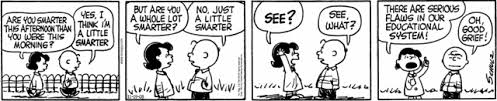
peanuts flaws

From Peanuts by Charles Schulz

Supermom

It is building up to Mother’s Day again! As we are reminded by all the mushy gushy ads—a day to thank dear mummy with gifts galore! There is even on offer, an online course that will teach mothers “how to re-connect back to you, let go of mummy guilt, practice self care, gratitude and how to turn mundane tasks into magical mindful meditations. Learn how to feel connected, content and calm on your motherhood journey!”

This made me smile! If only mothers had the time and energy to take such a course! “Hey Presto! Look kids, Mummy is Connected!!”

Being a mother seems to get harder every day—you have tiger moms, helicopter moms, soccer moms, and more. I am reminded of the early phase of my own motherhood journey. We did not bear such titles, nor wear such mantles. We were simply hassled mothers!

I think back to the many years when, waking at dawn, I used to pack bags of clothes, boxes of food, and paraphernalia for the day, for two infants, and take ourselves off (the whole caboodle being dropped by husband, on a trusty scooter) to my office by 9.15 every morning. I was indeed blessed to have a crèche on the premises, but that did not excuse me from taking back, at the end of a long demanding working day, piles of soiled diapers (yes, dear ‘Pamper’ed mommies, it was before the days of disposables!)… all to be washed and dried and repacked the next morning. Coming home tired and cranky, while the children were fresh and raring to go, one barely made it through the evening of domestic chores (packing into a couple of hours an entire day’s agenda), till one collapsed with exhaustion, only to rise and shine again the following day.

Somewhere along that journey I wrote a little poem.

Superwoman

A song of those in mid-career,

who start a family.

Coping with home and job and kids,

with never a moment free.

No breathing time from dawn till night,

nor energy to take stock of life.

Burdened with the nagging guilt,

of being an inadequate housewife.

Juggling all the fronts at once,

trying to keep the balls aloft.

A precarious state it is indeed,

never sure if the battle’s won or lost.

Few realise the task it is

unless they really wear the shoes.

“Where am I going, and where is arriving?”

These are the superwoman’s true blues!

Dedicated to all those who are today, where I was yesterday! This too shall pass!

–Mamata


A Soft Pause

I like the comma! It is perhaps my favourite among the punctuation marks! Many years ago when I started out as an editor, it was a comfort and joy to work with Kiran, my “commarade”, who an equally ardent follower of the comma! Over the many years of copy editing since then, I am finding that the comma is increasingly dispensed with (as are most punctuation marks, as emoticons take over). Most people see no use or value in it, or maybe they haven’t ever paused to think about it!

Ah commas, these often overlooked tiny squiggles that lend order, and often sense, to a sentence. While a full stop ends a sentence, a comma indicates a smaller break–as a soft pause that separates words, clauses, or ideas within a sentence.

Indeed that is what it was always meant to be. The word comma itself comes from Greek word koptein, which means “to cut off.” The comma, as we know it, was introduced by a 15th century Italian printer Aldo Manuzio as a way to separate things.

While word lovers like us value the comma, it takes a master word-crafter like Pico Iyer to eloquently express these sentiments.

“The gods, they say, give breath, and they take it away. But the same could be said — could it not? — of the humble comma. Add it to the present clause, and, of a sudden, the mind is, quite literally, given pause to think; take it out if you wish or forget it and the mind is deprived of a resting place. Yet still the comma gets no respect. It seems just a slip of a thing, a pedant’s tick, a blip on the edge of our consciousness, a kind of printer’s smudge almost. Small, we claim, is beautiful (especially in the age of the microchip). Yet what is so often used, and so rarely recalled, as the comma — unless it be breath itself?

(In Praise of the Humble Comma. Essay in Time Magazine 24 June 2001)

So there is the humble comma, and then, as I discovered, there is the Oxford comma! The Oxford or ‘serial’ comma is an optional comma before the word ‘and’ at the end of a list: We sell milk, cheese, and icecream. It is known as the Oxford comma because it was traditionally used by printers, readers, and editors at Oxford University Press.

While this may seem not so important to worry about, this little squiggle before an ‘and’ can create hilarity, or confusion. For example if you write ‘I love my parents, Amitabh Bachchan, and Mary Kom’ without that little squiggle before the ‘and’, you may end up, unwittingly,  being the offspring of AB and MK!  

A comma, then, is a matter of care. Care for words, yes, but also, and more important, for what the words imply!

–Mamata


MKG–LLB MD(Hon)

“His vocation to be a medical healer was deeper than his vocation to practice law.  He practiced law for about 20 years and then quit forever (though vigorously engaged in politics); his medical healing of sick individuals continued throughout the rest of his life.”

A recent lecture by Dr Mark Lindley at the Sabarmati Ashram in Ahmedabad explored Gandhi’s persona as a healer, and health advisor as well as practitioner. Lindley himself wears many hats! An internationally renowned musicologist, as well as an ecological economist, he is also a Gandhi scholar with particular interest in Gandhi’s views on health.

While I was aware of Gandhi’s strong and passionate views on health, diet and lifestyle, a lot of which can be found in his seminal work Key to Health, Lindley’s talk revealed several new aspects of Gandhi which I felt would be interesting to share.

We all know that Mohandas Gandhi went to England in 1888 when he was 18 years old to study law, under advice from family elders. What is perhaps not as well known is that Gandhi’s own desire was to study medicine there. At that point however, apparently the popular perception that becoming a barrister would be an ‘economically’ more practical choice prevailed.

The idea resurfaced around 1908 after he had already been practising law in South Africa. Gandhi may have felt that he could serve people better by practicing medicine than by practicing law. This time, it was the fact that studying medicine would involve vivisection that led him to reject the idea. During his visit to London in 1909, he wrote to a friend that a certain doctor there “…tells me that in the course of his studies he must have killed about fifty frogs. An examination in physiology without this, he tells me, is not possible. If this is so, I have absolutely no desire to go in for medical studies. I would neither kill a frog, nor use one for dissecting if it has been specially killed [by someone else] for the purpose of dissection.”

Interestingly Gandhi’s writings soon after that visit reflect a radical change of view. In Hind Swaraj which he wrote on board the ship while returning from England in 1909, Gandhi vociferously avers “I was at one time a great lover of medical profession. It was my intention to become a doctor for the sake of my country. I no longer hold that opinion.”

“It is worth considering why we take up the profession of medicine. It is certainly not taken up for the purpose of serving humanity. We become doctors so that we may obtain honours and riches. I have endeavoured to show that there is no real service of humanity in the profession, and that it is injurious to mankind. Doctors make a show of their knowledge, and charge exorbitant fees. …The populace, in its credulity and in the hope of ridding itself of some disease, allows itself to be cheated.”

Reading these lines, 109 years later, I was struck by how much this sounds like some of the concerns about the medical profession today!

As the famous French epigram goes “plus ça change, plus c’est la même chose”, in other words “the more things change, the more they stay the same.”

–Mamata

How-to-be-Happy Curriculum

Psyc 157: Psychology and the Good Life is reported to be the most popular course ever offered at Yale University. Within a week of registration being open, nearly one third of Yale undergraduates had signed up for the twice-weekly lectures. What is the course all about?

Basically about teaching college students how to be happy! In an age where “getting there as quickly as you can” and “excelling” are seen to be the key indicators to success, it is sad that young people who are just about entering one of the best phases of their lives—with so many journeys of exploration and discovery ahead of them, need to take a course that teaches them how to lead less stressful, more satisfying lives. Such is the irony of the times we live in.

I think back to my undergraduate days as the most enriching, exciting, and yes, some of happiest years of my life. Ok, so I did not go into the ‘pressure cooker’ of an IIT or a medical college (I was “one of those Arts types”) but I did get into an Indian equivalent of an ‘Ivy League’ college. For someone who had never enjoyed her school years as much as many seemed to have done, stepping into college, was from day one, a joyous journey that lasted three years. It was indeed a time of the opening up of the mind, not just in terms of the curricular, but more so in the extra-curricular. It was the Film Club that opened windows to different ways of seeing; the Hiking Club that opened up unforgettable vistas of nature; it was the invaluable exposure to music and dance and theatre, all of which we always had time for.

Even more precious it was the making of friends that have remained so for almost fifty years! This was the gang for hanging out with in the canteen, with laughs and giggles, and the pouring out of woes. It was the bunking of classes to go see the morning show, or catching a bus to go all the way to centre of town just have a lassi between classes, and the book fairs at which entire wholly satisfying, and oh-so-happy days were to be spent.

College was indeed the cradle for what was later to be described as the “all round development” of the personality, for which today there are Life Coaches and Grooming Gurus (not forgetting the ultimate go-to-Guru Google!).

Sadly college life today sounds different—unhealthy competition; the pressure of justifying the sky-high fees that parents are shelling out; the continuous looking at how to ‘plan’ one’s future career; and the dangerous encroachment of politics into campuses….and news that young people are ‘burning out’ at an age when they should be blossoming into vibrant human beings…What a tragedy indeed!

To top it all we need a Yale Professor to remind us that feelings of happiness are fostered through socialization, exercise, meditation and plenty of sleep! How sad is that?

PS: I am proud to be an LSRite!   (And yes, intercollege rivalry was healthy and produced excellence rather than antagonism).

–Mamata

A Sad Ending

We are wakened at dawn every day by the melodious duet of the Coucals. The Coucal couple share our little garden, and we watch over each other. The Coucal or Crow Pheasant is a handsome bird; its glossy black body, chestnut wings and long black tail lends it a special dignity and grandeur. After the morning duet of soft whoops and klak-kloks, they join us as we have our morning tea. Sitting amongst orange flowers of the Cordia tree, or flitting across to the Champa tree, they offer a reassuring start to our day. As the day progresses, they descend lower to drink from the water container, as the smaller birds respectfully make way for them. Then as the sun reaches its peak, the omnivorous birds stride confidently across our small patch of lawn, looking for sustenance. Through the rest of the day, they call to each other using an amazing repertoire of calls. We could never have imagined that a single bird could produce such a variety of sounds.

About a month ago we noticed that the Coucal couple were more than usually busy. We saw them flying back and forth all day long, carrying in their beak a strand of the creeper with the white flowers, twigs from the nearby neem tree, long blades of grass and other trailing vegetation. Some days later, having tracked their destination, we discovered that they had made a nest high up in the tangle of our bougainvillea. The nest was very large, and from ground level looked quite messy! Even though we only had a worm’s eye view of their new home; there it was, testimony to the well-coordinated effort of our faithful couple. We were honoured that they liked our garden enough to move on from cooing and courting to setting up home! We were not quite sure when Mrs Coucal decided to start her family in her new home. But we watched and waited eagerly, like anxious grandparents-to-be. We hoped that at least one or two eggs had successfully hatched. While we could not follow all that went on in the nest, we were reassured that the parents were assiduously flying back and forth, this time with morsels in their beaks. It was amazing to see how the couple worked relentlessly and in perfect tandem—getting food, keeping an eye on the nest and around, being alert and protective—all the while calling to each other, with gurgling chuckles and raucous croaks.

Then yesterday we heard a rustling in the dry flowers and leaves piled under the bougainvillea. A closer look revealed a tiny little cluster of black and brown feathers fluttering weakly in the undergrowth. The chick had not yet developed wings strong enough to make it back to the nest. We were very concerned, and felt quite helpless as the anxious parents hovered nearby. We prayed, and tried to see how it could be safe. When we did not see it late last evening, we hoped for the best.

Sadly this morning we saw the still little bundle of feathers. Nature had not meant it to grow into a handsome young Coucal, and to share our garden. Today, the Coucals do not call.

–Mamata

The Cup That Bonded

So the newest management mantra is FIKA. This is a Swedish word that roughly translates as drinking coffee, munching homemade goods and spending time with people. In many companies it is mandatory for all workers to have a designated time during the day to sit down and do fika. Most Swedes have Fika several times a day.

Over two decades before Chai pe Charcha became the flavour of the nation, CpC was an integral part of our working day. Twice a day, as the footsteps heralded the bearer of the teas, it was literally and (later) figuratively ‘pens down’. Time to cluster around and “fika” as it were. It was a time for sharing—news and views, happenings and unhappenings (propah English not mandatory, and language khichdi quite delicious!), cribbings and crabbings–and above all, energising. There were snacks too—“hey taste what I baked yesterday,” “oh great, banana chips all the way from home state”, “guess what, I discovered this new naasta shop with 50 flavours of khakhra….”

Tea table became the venue for easing in the newcomers; teasing and ribbing the old-timers; there were no hierarchies and no bosses. The agenda was whatever the mood of the table—sharing, admonishing, admiring, agonising and venting, and yes, laughing a lot.

It was an important support system in so many ways. After just 15 minutes, one returned to one’s desk feeling much better. You weren’t the only one who struggled to keep going as you juggled work and home; your child’s behaviour was not as worrisome as you imagined it was; and yes, in-laws happened to the best of us!

It was not only about chit-chat and food; it was where serious discussions took place—about work and work culture; about the state of the world and the nation; about books read and films seen, people met and to be met. It was where so many “aha” moments happened—the title of a new book; the resource person to invite; the sequence of sessions for the seminar…

The two tea times were the significant watersheds of our daily schedules. I did not realise how much we took this for granted, until I spent three months working from an office in Washington DC. Everyone was so “busy”–each communing with their machines as they sipped their coffees (also from a machine) in silence, and lunch sandwiches in solitary isolation. I craved so much for some human connect and communication, I took myself off, to perhaps some raised eyebrows, to the nearby park to spend 20 minutes watching the world go by. “Time wasted”, my diligent workmates may have thought; “what wasted opportunities to bond” thought I.

It’s not just in a CCD that a lot can happen over a cup of tea!

–Mamata

Emma Watson’s ‘Eats Shoots and Leaves’ Moment

Last week, Emma Watson was seen with a tattoo at a red carpet event. The tattoo said ‘Times Up’ and was in support of the movement against sexual harassment in the workplace which is snowballing, and is a follow on from the #metoo campaign.

Laudable intent. But less-than-laudable grammar!  What really caught everyone’s eye was that the tattoo said ‘Times Up’, rather than ‘Time’s Up’. With her characteristic sense of humour, Watson responded to the criticisms with a tweet: “Fake tattoo proofreading position available. Experience with apostrophes a must.”

Everyone is talking about it! I am happy for Watson, I am happy for the movement. But most of all, I am happy for the APOSTROPHE! Difficult for a punctuation mark to get red carpet attention, but the apostrophe’s done it (yes, and I think I got the apostrophe right, see rules below!).

So maybe we should give it some attention too! When you are out tomorrow, look out for how often the apostrophe is misused. I find more ‘errors of commission’, as compared to Watson’s ‘error of omission’. For instance, within 50 metres of my house is ‘Shri Ganesh Tyre’s’. Not much further down the road is ‘Sai Krishna Sweet’s and Snack’s’. (Raghu tells me that for some reason, in his school, they used to refer to it as a ‘post office comma’).

It may be worth taking a few moments to briefly review the usage (no guarantee we will still  get it right!):

The apostrophe is used in two situations (and I quote all the rules below from https:// en.oxforddictionaries.com/ punctuation/ apostrophe): (1) to show that a thing or person belongs or relates to someone or something: instead of saying the party of Sudha, you can write Sudha’s party; and (2) an apostrophe is used to show that letters or numbers have been omitted. For instance, I’m – short for I am, or he’ll – short for he will.

The biggest controversy about apostrophes is in the its and it’s!

These are the rules to remember:

  • Its(without an apostrophe) means ‘belonging to it’: The dog wagged its tail.
  • It’s(with an apostrophe) means ‘it is’ or ‘it has’: It’s been a long day.

Wondering if apostrophes are really worth a blog? Well Lynne Truss has written a whole book on punctuation and it was a bestseller! Do read her ‘Eats, Shoots & Leaves: The Zero Tolerance Approach to Punctuation

And for more on the apostrophe, including the county which has banned it, go to

https://blog.oxforddictionaries.com/2013/05/28/do-we-need-the-apostrophe/

–Meena