Crossed Digits

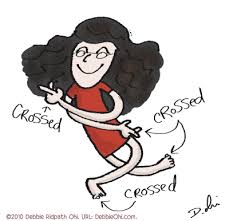
“Digits crossed!” is an expression that my friends and I use when we are hoping for things to turn out well—with double the power of “fingers crossed!” Yes, we hope to ensure this by metaphorically crossing not just the fingers, but also the toes.

In today’s ‘digital age’ where the digit-related terms  are so commonly used—digitization, digital camera, digital natives, digital divide, digital detox….we relate the word only to numbers. We seem to have forgotten that the word’s anatomical meaning. The word digit has its roots in the Latin root word digitus which means “finger or toe,” and English borrowed from this to mean “number.”

In fact, the practice of calling numbers digits comes from the digits on the hands — specifically, the habit of counting to ten on one’s fingers.

The digit in this sense was also a unit of measurement, long ago when  people used their hands and arms for measuring things. The width of a first finger was called a digit. This was used to measure things. The width of a palm was called a hand breadth. The width of an outstretched hand was called a span. The distance between an elbow and the tip of the longest finger was called a cubit.

The Egyptians had a standard length from the elbow to the middle fingertip, a distance of about 45-50 cm which they called a cubit. The width of the hand or four fingers was called a palm or hand and was about 9-10 cm. Hands is still used for measuring horses.

The ancient fathom was the distance between the outstretched arms about 1.8 metres. It is still used for measuring depth at sea.

The foot may have come from an ancient Babylonian brick measurement but in fact it works out to the approximate length of a man’s foot about 30 cm. The finger became an inch, which the Roman’s made one-twelfth of a foot.

In this digital age, if you want to sound smart, you can refer to your finger, thumb, or toe as a digit!

If you want to sound smarter still, go digital in Latin!

Here’s what they are called:

Thumb Pollex

Index finger  (pointer finger, fore finger) Digitus Secundus Manus

Middle finger Digitus Medius Manus

Ring finger Digitus Annularis Manus

Pinky ( little finger) Digitus Minimus Manus

And keep your digits crossed!

–Mamata

digits
source: Google

What’s in a Moth?

When is a butterfly not a butterfly? When it is a moth!

20180725_163659_resized.jpg

Butterflies have always hogged the limelight with their beauty and colour. Moths have always been the Cinderella, perceived as drab and uninteresting, and usually overlooked. Yet, moths greatly outnumber butterflies by a ratio of 10:1 and there are more than 12,000 species of moths.

There’s a lot in a moth for Dr Shubhalakshmi Vaylure, the first woman in India to study moths! “Why moths?” she was often asked when she started her research over 15 years ago. In fact, as she related in an interview, once she was asked why she chose to spend the nights studying moths (not quite suited to being a girl!) when she could study butterflies during the day, she replied “Well, someone’s gotta do this unpleasant night shift.”

It is that approach – Passion, Persistence and Push that sums up India’s Moth Lady!

Shubhalakshmi started by studying zoology and entomology in college, which is also when she signed up with Bombay Natural History Society (BNHS) as a student member to use the library, and volunteering, joining nature walks and trails. After graduation she joined the Conservation Education Centre of the BNHS as an administrative assistant. At the time BNHS was the only institution in Mumbai which was offering a master’s degree through research, and she signed up for this.  Isaac Kehimkar, an eminent butterfly expert, suggested she study moths as they had not  been much studied in India. And that is where it all began. On completing her master’s degree, she became an Education Officer at the CEC, and went on to head the Centre.

As fellow environmental educators and Fulbright scholars, Shubha and I have met several times, and her energy and enthusiasm have been inspiring and infectious. Over the years I have been following Shubha’s journey and have seen how capably she has combined her passion for nature with smart use of technology and successful entrepreneurship.

Shubha is one of the pioneers of Citizen Science in India which empowers and enables ordinary citizens to be part of wildlife and environmental research by observing, collecting and sharing local data.

In 2014 she started a social enterprise Ladybird Environmental Consulting. The first project that Ladybird undertook was the development of three mobile-based applications iButterflies, iTrees, iNaturewatch birds under iNaturewatch Urban Challenge, a citizen science programme that worked with schools in Mumbai, New Delhi, Kolkata and Hyderabad to collect data on their city’s flora and fauna. Following this she set up iNaturewatch Foundation, to continue such urban biodiversity citizen projects.

For those who are inspired to become citizen scientists, and follow in the steps of the Moth Lady, a great start will be Shubhalakshmi’s book Field Guide to Indian Moths. The culmination of 15 years of research, this reader-friendly field guide features descriptions of 733 species of moths, supported by over 1000 colour photographs. Shubha also coined for the first time, common names for several of the species. Way to go Shubha!

What better way to mark this week which is designated as National Moth Week.

–Mamata

What Say You?

When I lived in Kenya, and learnt a little bit of Kiswahili, it was great fun to discover curious words or phrases. One of the best ones was to the local word for curd/yogurt. This was called Mazeevaa Lala—literally “sleeping milk!”

I was reminded of this recently when I chanced upon a Maltese saying My eye went with me, to mean that you have fallen asleep, as not taking your eyes with you would result in a sleepless night!

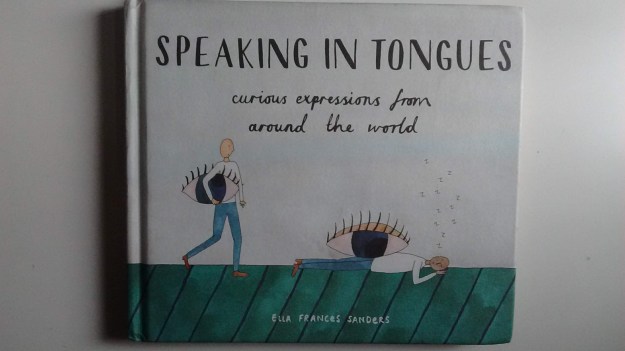
This is one of the many sayings in a delightful book titled Speaking in Tongues: curious expressions from around the world–a compilation of proverbs, idioms and sayings from different languages of the world, put together by Ella Frances Sanders. What brings the words alive are the accompanying illustrations, also by Ella who describes herself as “a writer out of necessity and an illustrator by accident.”

IMG_20180725_181146775.jpgFrom Finnish to Igbo, Armenian to Yiddish, each double spread presents delectable sayings and drawings that blend the wit and wisdom of the ages while also placing these in their cultural context.
Cannot resist sharing some:

Even the monkeys fall from trees. This well-known Japanese saying reminds that even the best and the cleverest can still make mistakes, and cautioning to keep overconfidence in check!  Perhaps the recent World Cup surprises where the superheroes fell from grace is an apt analogy!

You are my orange half. A Spanish term of endearment that means that someone is your soulmate or love of your life. Not quite sure what is so endearing about an orange, but reminded of the Amul chocolate ads that urged us to “Share it with someone you love!”

Horse horse Tiger tiger. To describe something that is so-so, or neither here nor there. This is a Mandarin expression; its origin lies in a story about a painter who painted a half tiger half horse but nobody bought it as it was neither one nor the other.

To pull someone out of their watermelons. A Romanian idiom that means to drive someone crazy! Not much light on why being in or out of watermelons can be harmful to mental health!

Stop ironing my head. An Armenian way of saying “Stop bugging me!” Popularly used when someone keeps asking irritating questions and won’t leave you alone. In many Indian languages we have our own equivalents in the form of “Don’t eat my head.”

To give a green answer to a blue question. A Tibetan reference to when the answer is completely unrelated to the question asked. Something that people in politics are adept at!

This is just a sampler of the 52 proverbs, expressions and idioms that have been passed on from one generation to another in diverse cultures. Interestingly, they reflect not just diversity, but also the sameness as it were. As I read I immediately thought of similar ones in Hindi and Gujarati, as will surely be the case in all languages. Remember how we had to memorise proverbs in our language subjects in school and what a pain it was? Maybe it is time to revisit these!

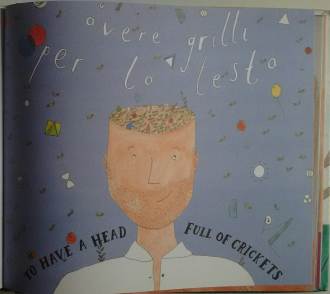
A perfect one to end with. To have a head full of crickets. 

IMG_20180725_181247.jpg

How the Spanish describe a mind buzzing with crazy, wonderful ideas, whims, and flights of fantasy…(what some would call nonsense!)

Nicely sums up how I often feel!

–Mamata

Otherness and Sameness

When we were in school one of the most assigned topics for essay was Unity in Diversity. We prepared hard for this by finding out many examples from India to demonstrate this. We were proud of living in a country where people of such diversity could co-exist, and celebrated this diversity. We also sang with fervour a school song in Hindi that proclaimed that all people of Hind were one, even though there were many colours and features, attires and languages. Hind desh ke nivasi, sabhi jan ek hai, Rang, roop, vesh-bhasha chahe anek hai.

 My heart breaks today, day after day, to read about a country and a world where it is this very diversity that is broken into identity fragments that divide rather than unite; a world that is increasingly emphasising the ‘otherness’ to create chasms, rather than the ‘sameness’ that builds bridges.

This sentiment is beautifully expressed by Maria Popova:

“Where Walt Whitman once invited us to celebrate the glorious multitudes we each contain and to welcome the wonder that comes from discovering one another’s multitudes afresh, we now cling to our identity-fragments, using them as badges and badgering artillery in confronting the templated identity-fragments of others.”

And then, this past month there was a ray of hope in the World Cup with the multi-ethnic compositions of many of the teams, and much was written about how the not-so-long ago ‘outsiders’ had become integral parts of National teams. This was best demonstrated by the multicultural French team that lifted the Cup…where the Otherness was transcended by the Sameness.

“You gave me blue and I gave you yellow

Together we are simple green. You gave me

What you did not have, and I gave you

What I had to give—together, we made

Something greater than the difference.” (Alberto Rios)

Yes it can happen, and yes there is hope, even in these strange and uncertain times, as Barack Obama said in his centennial memorial lecture to Nelson Mandela, and reminding us of his words: “No one is born hating another person because of the color of his skin, or his background, or his religion. People must learn to hate, and if they can learn to hate, they can be taught to love, for love comes more naturally to the human heart.”

–Mamata


Talk Time

All through school and college, one of the best parts was the ‘night-spend’ (before it was called ‘sleep-over’!) at a friend’s place. The high point of this was staying awake till very late, sometimes even till dawn, simply nattering the hours away. Though well past our school and college days, for myself and my friends, this continues to be so, even today!

We never seemed to run out of conversation. Conversation was comfort, it was catharsis, it was heart-to-heart and tête-à-tête, and more. Conversation was face-to-face communication.

It was not just with friends–face-to-face communication was a way of life. Families caught up with doings and happenings/news over daily meals, and at family get-togethers; colleagues exchanged views over a cup of tea; housewives met at the corner for a chinwag to exchange neighbourhood gossip, and senior citizens bemoaned the state of the world as they took their constitutional in the park. We communicated daily with the shopkeepers, the domestic help, the essential service providers like the milkman, the presswalla, the newspaper supplier, and the auto drivers.

Today we are told that the world is “connected” like never before. We are in constant communication, as it were…Through the press of a button we can order our groceries and daily requirements; we can book tickets for movies or order in food; we can upload pictures of our latest travels; we can stream live the family wedding from the exotic destination; we can open our hearts to the BFF through Twitter and Instagram…and we can even text our children in their bedroom to say that dinner is ready!

The world is “connected” 24/7. Time saving, effort saving, technological marvels we say.  But somewhere in all this, have we not lost something precious? Something that is a basic human need–Face-to-face communication, an ancient and abiding human gift? Are we losing a vital connection?

“When you speak a word to a listener, the speaking is an act. …Listening is not a reaction, it is a connection. …And it is a mutual act: the listener’s listening enables the speaker’s speaking. It is a shared event, intersubjective: the listener and speaker entrain with each other.  …When you can and do entrain, you are synchronising with the people you’re talking with, physically getting in time and tune with them. No wonder speech is so strong a bond, so powerful in forming community.” (Ursula K. Le Guin in a piece titled Telling Is Listening.)

Perhaps the next time, before we sign up for “Unlimited Talk Time” offers, let us see if we can make real Time for Talk.

–Mamata

Needs, Wants and Luxuries

So the ultimate in luxury seems to be “Make Google Do It”! As the ads remind us your little Google Assistant will do it all for you—Play music, Cast videos, Control your lights, Get step-by-step cooking recipes, Stay updated with news and sports, and anything else that you shall wish for—Just Ask and your wish is its command. This is the new age Aladdin’s Lamp, no less!

Not so long ago, we still remember walking back and forth from the Black and White television set to change the channel (from the limited selection available). Then came the Remote! And its fallout—a generation of couch potatoes! And more recently, the Fitbit and Gym generation that needs to burn the calories collected courtesy the hard-working Bot!

It is the age of too much, an age of choices galore. For those who can afford it, the choice is no longer ‘Keeping up with the Joneses’, but staying ahead of ‘Those who have Everything.’

But what are the choices being offered, and what are we choosing?

I am reminded of a simulation exercise that we often did as environmental educators. We would ask participants to imagine that they have to leave their home due to a sudden disaster in the area. Before they leave they have time to take just 20 things that they can carry with them. They are not allowed to take money. They do not know where they are going, when they will reach, and if and when they will be able to return. They must make a list of these 20 things. Once they had done this, they were told that the truck that was carrying them is overloaded, and they have to drop 5 of the 20 things they were carrying. What would they choose to leave? Once they have done this, they were further told that the truck has broken down and they will have to walk. Which 5 of the 15 items will they discard? Now the list has 10 items. As they go ahead they are stopped by a gang of dacoits who demand five items from the ones they are carrying. Which ones will they give, and which ones will they keep? Now they are left with 5 items.

At the end we would review each one’s list, and think about the choices each one made, and the reasons for these. We would, perhaps for the first time, review our own belongings from the perspective of Needs–those that were essential for survival; Wants–those that were desirable but not indispensable, and those that were things we owned because we could afford to—Luxuries.

This is not simply an abstract exercise;  in news reports every day we see heart-rending  scenes of millions of refugees—ousted from their countries and homes by natural calamities, political upheavals, social and cultural persecution. People with nothing to their name. People for whom simple survival is a luxury.

For those of us fortunate enough to have choices, and the luxury of more than we need, it may be worth sparing some thought to our personal List of 20-5-5-5. How much do we really need?

“He who knows he has enough is rich.” (From the Tao Te Ching an ancient Chinese philosophical poetry.)

–Mamata

A Special Week

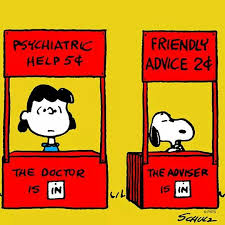
Last week was special for the Matriarchs. A week of reunions and catching-ups. Meeting old friends in new places. A week to celebrate friendship, and be grateful for good times, and even bad times, savoured and shared.

Sharing some thoughts that capture the spirit.

“We trust our friends to tell us what we need to know, and to shield us from what we don’t need to discover, and to have the wisdom to know the difference. Real friends offer both hard truths and soft landings, and realise that sometimes it is more important to be nice than to be honest. That too is knowledge that comes only with age…. In other words friends are what we have in addition to, or in lieu of therapists.”                Anna Quindlen

doc is in.jpg
Source: Google

–Mamata

My Crores vs. Your Millions

India gave the world Zero. So should we not be a bit more assertive in the matter of numbers?

I have grown up with lakhs and crores. And I have not heard that India has officially moved to millions and billions.

2018-06-15 17.29.16_resizedWhy then does my newspaper headline inform me that 55 million Indians are pushed into poverty every year due to health spending? Isn’t it a sad enough fact for me to take in, without having to contend with doing mental callisthenics?

And an Indian research journal in which I hope to publish a paper also says that figures must be in millions and billions, not in good old familiar lakhs and crores.

Well, in the case of the research study, maybe it has been done in collaboration with American researchers? And in the second, maybe it is that the journal hopes for an international audience?

Whatever the reasons, when communicating to Indians, would it not make more sense to use familiar number-names? Is 55 million a lot? Or not so much? What proportion of the population is it? I can’t do these calculations early in the morning.

And writing numbers too! I write and relate to 10,00,000. Not 1,000,000. But will Excel allow me to? NO!

India, we hear has a lot of soft power (as well as software power). Can we not prevail upon companies making programs to have an ‘Indian number variation’, like there are options for UK and US spellings?

And even more important, can we in India—the media, academia et.al., use lakhs and crores? The Americans have proved that a country can get by in the comity of nations without switching to the metric system. Mine is a relatively small ask!

–Meena


Cacophony

Just about fifteen years ago, as I lay in bed at night, I could hear the howling of jackals, the rhythmic beat of the distant train, hoots of owls, and the chorus of frogs after the first rains. I would waken to the call of the Sarus cranes, and the meowing cry of the Jacanas in the open ground across from my house.

Today I lie awake all night to the rattling, shattering clangour of the monstrous mechanical cranes and concrete mixers as they dig deep into the soil where the Sarus sang and Jacanas nested, and from where rise the gigantic metal skeletons of multi-storey towers. On the weekends I can no longer listen to the music that used to be a part of our evenings, over the incessant honking, beeping, screeching and yelling from the traffic jams outside my gate, as a noisy, rambunctious crowd heads for the ‘happening’ mall that looms in neon-lit glory, where once the buffalo wallowed and the froggies sang.

Our lives are so cluttered with noise, we do not know silence any more. We are almost afraid of the quiet. We get anxious if we are not continuously reassured by the hum, buzz or ringtone of our phone…Why no calls, no messages, no alerts?? Does nobody ‘like’ us anymore? We feel unmoored without the 24/7 din around us. Is there a moment in our day when we can hear simply silence?

On a visit to Bali last year I learned about Nyepi–the Day of Silence. This day falls (usually in March) on the day after the dark moon of the spring equinox when the day and night are of approximately equal duration. It marks the start of “Caka” year – Balinese New Year – which is celebrated over six days. The first two days are marked by parades, noise and revelry, and Nyepi falls on day 3. The observance of the Day of Silence is based on an ancient myth that, after the boisterous and active celebrations of day 1 and day 2, the Island goes into hiding to protect itself from the evil spirits, fooling them to believe that Bali, enveloped in an atmosphere of complete tranquility and peace, is a deserted Island.

The quietest day of the year is guided by the four precepts:
No fire or light, including no electricity.
No form of physical working other than that which is dedicated to spiritual cleansing and renewal.
No movement or traveling.
Fasting and no revelry/entertainment or general merrymaking.

Everyone stays indoors, engaged in fasting, prayer, meditation, reflection and introspection—erasing the clamour, and cleansing the body and spirit. What a wonderful tradition and even more, how wonderful that it is so well honoured and celebrated in spirit and deed, even today.

If only we could all disconnect from the din, and connect within.

STOP PRESS!

This year for Nyepi all phone companies on the island of Bali agreed to shut down the mobile internet for 24 hours. Imagine a day without internet, Facebook and Instagram and instant messaging apps! And this, on one of the world’s most popular and busy tourist destinations! Yes, they did it, and survived!

–Mamata


Living Magic!

How can you not be cured by a medicine called Living Magic! That is what ‘Zinda Tilismat’, translates to! With a name like that, can you wonder that it claims to cure everything from colds to upset stomachs to toothaches, to ‘new’ ailments like swine flu and bird flu? (But no, I haven’t heard of its use in Nipah, I have to admit!)

The ‘wonder drug’ was formulated by Hakim Mohammed Moizuddin Farooqui, way back in 1920, and has been manufactured in the Zinda Tilismath Karkhana in Hyderabad since then. This Unani medicine is basically made from aromatic herbals—mainly eucalyptus, and also some camphor, menthol, thymol, etc. Amazingly, you can apply it externally or ingest it.

The pack seems to have been unchanged for all these 100 years too. It carries a picture of a spear-toting African. The reason, it seems, is that the founder was so impressed by the Siddhi guards of the Nizam that he thought that such a picture on his medicine would give it an association with strength and well-being.

1428BDE4-BC2D-494A-9D66-81395EF8673B

I have no idea if there have been clinical trials on this medicine to substantiate any or all the claims. But can you argue with a sale of 1 crore vials every year?

And the romance of the name! I am ready to be cured of anything with this. And, to its credit, the ingredients cannot do me harm!

As a Hyderabadi for some years, I obviously knew of this magic potion. But as we do with things which are local, I didn’t bother to buy it or try it. Now that I have left Hyderabad and someone reminded me of ZT, I became obsessed with it! So I made some friends buy and send me some. Now I am waiting for some (minor) illness to strike me, so that I may be magically cured.

So I suppose my message is, everything is in a name! An invaluable lesson to product managers (I began my life as one), innovators, company founders, et.al.

–Meena