
One Man’s Meat….

‘One man’s meat is another man’s poison’. This expression is often used when two people disagree over something, especially food. Believed to have been coined by Roman poet and philosopher Lucretius in the first century BC, the expression is a pithy reflection of how deeply food tastes and taboos are ingrained in every culture (and indeed every family). What is tasty and what is not; what is healthy and what is harmful; what is culturally acceptable and what is not…the history of food and cultures has laid down norms since time immemorial.

I was reminded of this when I read about the Disgusting Food Museum which opened recently in the city of Malmo in Sweden. The museum features 80 dishes from around the world that, for one reason or another, have earned the epithet of being “disgusting.” Among these are Surströmming: fermented herring from Sweden; Cuy: roasted guinea pigs from Peru; Casu marzu: maggot-infested cheese from Sardinia; Mouse wine from China; Hákarl: well-aged shark from Iceland, and Durian: the infamously stinky fruit from Thailand.

The purpose of the museum is not so much to sensationalize the weird and the exotic, but rather to sensitize to the fact that food-related notions are subjective. What is delicious to one person can be revolting to another. The Museum invites visitors to explore the world of food and challenge their notions of what is and what isn’t edible.

This made me think about the many examples of these notions that are so intrinsically entwined with our food and food habits. In a country as diverse as India, the notions are as diverse as the nation; the state, the region, religion, schools of health (from hot and cold foods in Ayurveda to mutually incompatible foods in other systems), and above all family traditions and cuisines—all these combine to define what kind of food each one of us considers suitable, tasty and palatable.

This diversity presented a challenge when I had the opportunity to be a part of an exercise to develop national textbooks for primary students. One of the objectives was to develop lessons that celebrated the richness of diversity, especially food. How to do this led to numerous debates within the team itself—to talk about the fried caterpillar larvae as a delicacy in the Northeast of India, to talk about “non-vegetarian” food, even to talk about the different cooking oils used in different parts of the country? And how to present these in a manner that evokes not disgust and shutting out of ‘what is different’ but rather curiosity and openness about the richness of cuisines and cultures.

When I was in school we did not have too many such theoretical lessons, but every recess time was a live lesson. It was food that connected us—lunch boxes were opened, food was shared and tasted, and new tastes were cultivated; mothers exchanged recipes, and exploring and discovering different food that you and your friends ate was an everyday adventure, not part of a visit to a food museum!

Today with the homogenization of food (I suspect many lunch boxes contain the ubiquitous Maggi and Lays) we are losing such a rich link. Even more worrying is the fact that food is being used to create boundaries rather than bonds. The old Lucretius expression is, sadly, more true than ever before. It is time to remember another adage “Sharing a meal is the best way to turn strangers into friends.”

–Mamata


Old Wine in New Bottles

In recent days the life and style sections of the newspapers are carrying numerous articles with titles like 10 Beauty Hacks to Make you Glow, Be the Best Hostess With These 20 Useful Party Hacks; 15 Kitchen Hacks to Save Time; Have a Sparkling Diwali With These Simple Hacks…

I was intrigued by this oft-used word Hack. My vocabulary dates back to days before even Computer Hackers became news. The only meaning of Hack that I could recall related to the act of roughly chopping down a tree or, as we read in novels, a word used to refer to a slogging journalist or so-so writer. How the word leant itself to beauty and parties and kitchens was a mystery to me.

Being the curious word aficionado that I am, I looked up the word Hack in the dictionary. I was surprised to find the word had many more meanings than I had imagined:

Cut away

Fix a computer programme piecemeal until it works

Significantly cut up a manuscript

Cough spasmodically

Be able to manage successfully

Kick on the shins

One who works hard at boring tasks

A mediocre and disdained writer

An old-fashioned taxi

An old and overworked horse.

This search, having significantly expanded my list of two meanings, still did not reveal what I was looking for—the links with beauty, kitchens and parties. I thought to myself “What the Hack”!

And then Eureka—I came upon the word Life Hacks! And I discovered…

Life hack (or life hacking) refers to any trick, shortcut, skill, or novelty method that increases productivity and efficiency, in all walks of life.

It is a tool or technique that makes some aspect of one’s life easier or more efficient.

Aha thought I,  at last!

Then came the more amusing part. I discovered that there are so many websites offering innumerable Life Hacks for everything from how to get up in the morning, to how to carry out some of the most basic functions of life and living—from the sublime to the absurd! For example: ‘Do a 20 minute good workout in the morning and you can be lazy the whole day without feeling guilty!’ OR  ‘If you left home and forgot to brush your teeth or you ran out of toothpaste, chewing an apple can help with bad breath.’

I am sure one could come across some handy tips, but thinking back a bit…

Were these nifty suggestions not too long ago shared widely as DIY TIPS!

Baking soda and hot water to clean drains; a face pack of honey, cream and turmeric for that glowing skin…where did I hear those before? From mothers and aunts, of course. And magazines carried them under the title Grandmother’s Secrets!

I certainly spent an amusing hour browsing the many sites, and along the way I also found what I think is the best way to describe this term: A life hack is a colloquial term for common sense that makes people feel good about their basic creativity, or lack thereof. Typically life hacks are not all that helpful, they are simply advertised well so as to provide a false sense of improvement in the user’s day-to-day operation.

Well well well. What a great way of repackaging tried and tested ‘do-it-yourself’ ideas. Why go to Granny when Youtube will show you how!

–Mamata

Stitch and Rip

I am clumsy and so often put rips and tears on my clothes, and break my buttons. I only have to look at food and I put on weight. Between these two tendencies, I need to stitch up tears, and let out clothes.

So the two most important ‘simple machines’ in my life are the Needle Threader and Stitch Ripper. Simple, but oh, what amazing inventions. For those who don’t know what these are, here is a brief.  And even if you are young and sharp-eyed and the super sorted-out, do not scoff at these, for the day will come when you need them!

Needle Threader: A needle threader is a small sewing tool designed to help pull a thread through the eye of a sewing needle.

When exactly the first needle threader was invented is unknown, but within the European context it is likely to be an eighteenth or early nineteenth century development. There were various forms of nineteenth century needle threaders. But the one most commonly in use even today is a late nineteenth century form which consists of a small plate (often stamped with a profile image of a woman), with a diamond shaped loop of fine steel wire attached to it. The wire loop is flexible and easily passes through the eye of a needle. The sewing thread is passed through the loop and the loop (with thread) is then pulled back through the needle eye.

A number of needle threading devices were patented in the United States in the early 1900s, including Herman Trzeciak’s model patented in 1924 and Carl J. Schuster’s design in 1945. The first automatic needle threader incorporated into a sewing machine was designed by Juki in 1978.

Seam Ripper: There doesn’t seem to be much agreement on who invented this but there is a patent application by Allie  M. Minter, from Petersburg, Colorado in the US and Canada, in 1903.

Seam rippers are an item designed for breaking or undoing sewn stitches, often on seams. A seam ripper is also known as a ‘stitch unpicker’, ‘quick unpic’ and a ‘quick unpick’. (I call them Stitch Rippers). Typically, seam rippers have two spokes, one sharp and the other blunt, connected by a handle, while the intersection is usually a sharp blade.

I sometimes have nightmares of a gangsta (or a lady older and clumsier than me), holding me up with a gun (or pair of knitting needles), and saying “Your Needle Threader or your Stitch Ripper”. I have thought this horrific scenario through. I will part with the Stitch Ripper. One can substitute a safety pin to do this function (albeit a bit clumsily). But for the Needle Threader, there is no substitute!

–Meena


Bananadrama

Guess what is making cricketing news these days? Runs and wickets? Tantrums and tampering? No, it is none other than the good old Banana! It is reported that the Indian team has requested an ample supply of bananas for the team during their 2019 World Cup tour to England. The banana has been designated the “fruit of their choice!”

While the mango always lays claim to being the king of fruits, the solid trustworthy banana is taken much for granted, as it does not make a dashing seasonal appearance and compete for awards of the most varieties and the best of them all!

But, there’s more to a banana…

Bananas are both a fruit and not a fruit. While the banana plant is colloquially called a banana tree, it’s actually an herb distantly related to ginger, since the plant has a succulent tree stem, instead of a wood one.

Bananas grow in what are known as “hands,” so-called because of their appearance, which make up the larger stalk, known as a “bunch.”

The banana skin that we peel and throw is, in fact, a fruit because it contains the seeds of the plant. Although since bananas have been commercially grown, the plants are sterile, and the seeds have gradually been reduced to little specs.

The banana plant evolved in the humid tropical regions of S.E. Asia with India as one of its centres of origin. During the seventh century AD its cultivation spread to Egypt and Africa.  Carl Linnaeus an 18th century Swedish botanist whose work led to the creation of modern-day biological nomenclature for classifying organisms was the first person to successfully grow a fully flowered banana tree in the Netherlands.

Today banana is grown in more than 150 countries, and it is widely believed there are more than 1,000 types of bananas in the world, which are subdivided into 50 groups. There are at least 300 varieties of banana in India.

Even then, Linnaeus speculated about other uses for the versatile banana such as boiling bananas with sugar to cure anger, mashing bananas with honey to soothe eye inflammation and crushing banana root soaked in milk to alleviate dizziness. Today the banana is an acknowledged as a Superfood by all schools of health from Ayurveda to the trendy Diet and Nutrition experts. From digestive issues to depression…the banana is the panacea for all ills!

banana.jpg
source: Google

And there is an International Banana Museum in California, which they claim is “the most aPEELing destination” with over 20,000 (and still adding) banana related items…the world’s largest collection devoted to any one fruit!

I do know that the Banana was my father’s favourite fruit. He always used to say “sabse achha kela!” “Banana is the best”. So true…The scientific name for banana is musa sapientum, which means “fruit of the wise men.”

–Mamata


It’s All in the Name!

In Gujarat it was, till quite recently, very common to ask for “Amul ni Cadbury”, where Cadbury was used as the generic name for chocolate! In the days of yore, (before Amul became utterly butterly ubiquitous) was a time when one used to “lagaao Polson” or in other words “Butter someone up” as it were!

Similarly all photocopy related matters were clubbed under “Xerox”. So one would get papers Xeroxed from a Xeroxer and enclose Xeroxes with applications! Then of course, even older, was something called “Bata price” for anything that was priced at 9.99 or the same in higher figures.

Brand names often become synonymous with a generic product or process, and trip easily over millions of tongues. Brand names are critical—they are what gives a product a single universally recognised identity that leads to the best consumer recall. It is said that more time is spent in deciding the name of a new product than on any other aspect of its development. Inventing a new name that does not clash with the already registered trade marks is a highly complex and time-consuming process. Several hundred names need to be proposed and each has to be checked from a linguistic, marketing and legal aspect.

An old story about the well-known Dunlop tyres is a case in point. The company spent over two years researching a name for a new tyre, to no avail. They then launched an international campaign among their employers, receiving over 10,000 entries. 300 names were shortlisted from these, but not one was found to be legally available in all the countries where it was to be marketed. After further work, a viable name was found–Denovo–for the world’s first ‘fail-safe’ tyre.

A word pronounceable in one language may be impossible to say in another, or unanticipated connotations may creep in. Here is the latest one on this.

Starbucks has recently sued the Indian coffee chain SardarBuksh for sounding too close to them for comfort! Newspapers report that Delhi’s home-grown coffeewalalogo.jpgs have agreed to change their brand to Sardarji-Bakhsh on a condition that it, too, would be allowed to sue any businesses who tried to use the name ‘Baksh’ in their branding!  Star Wars continue!
–Mamata

Will I Hear the Lion Roar?

Reports of the deaths, within a few weeks, of 23 lions of a pride in Gir Forest, the only home of the Asiatic Lion, have deeply disturbed us all.

Historically, the range of the Asiatic lion included South-eastern Europe, Black Sea basin, Caucasus, Persia, Mesopotamia, Baluchistan, and the Indian subcontinent from Sind in the west to Bengal in the east. (IUCN). Today Panthera leo persica is confined to the Gir Forest and its environs, in Saurashtra, Gujarat.

As per a 2015 census, there were only 523 lions and they were all in the Gir area. Nowhere else in the world!

‘The lions face the usual threats of poaching and habitat fragmentation. Three major roads and a railway track pass through the Gir Protected Area (PA). Also, there are three big temples inside the PA that attract large number of pilgrims, particularly during certain times of the year. There has been an increase in lion population, and more than 200 lions stay outside the PA. Though the conflict is not high now, with changing lifestyles and values these may increase in the future. There are also cases of lions dying by falling into the unguarded wells around the Gir PA.’ says WWF.

But the single most serious threat could be the fact that the population is confined only to one place. It is well established scientifically that any such population is vulnerable to threats of various types.

One obvious danger is the risk of genetic inbreeding arising from a single population in one place.

But the other, even more serious risk, as IUCN puts it, is: ‘The small pocket of distribution of the Asiatic lions has led IUCN to consider them an endangered species, in fears that if an epidemic or forest fire were to break out, the whole population of Asian lions would be wiped out from the wild.’

The worst fears are coming true. A single episode has brought a whole pride to the brink in a few days. What is the guarantee that the epidemic will not spread? We can only pray.

For decades, biodiversity and conservation experts have been advocating that some lions from Gir be re-located to another suitable habitat, after proper research and preparation, so as to create another viable population. It is not that efforts have not been made. Palpur Kuno Sanctuary in Madhya Pradesh has been identified, numerous studies undertaken and a lot of preparation done.

But Gujarat has refused to let the lions be re-located, claiming that these lions are the Pride of Gujarat.

No doubt they are! But they are also the universal heritage of humankind. The loss of a species is irretrievable and irreversible. When we lose a species, we lose something of ourselves. In such a situation, is there a ‘mine’ and a ‘yours’? Or is there only an ‘ours’?

Vasudhaiva kudumbakam.

–Meena


Man and Machine

On 22 August our land line phone (yes, we are perhaps the few remaining dinosaurs who still have a land line!) went dead. My husband in whose name the number is registered, called the complaints number and after being taken through the usual route of Press 1 for___and Press 2 for ___ , and so on finally made contact with a human voice to register the complaint.  He was told that someone would come to our home the same day by midday. In the meanwhile, I received at least four automatic messages on my cell phone (not in any way connected with the landline provider, with various offers and deals.) My husband has innumerable times told the landline providers that he should be contacted on the landline number only. But that is another story!

Back to this story! We waited at the stipulated time, and well beyond, for the person to show up. Towards evening we got a call (on the landline, at least!) from the engineer to say that he would be arriving shortly. When he finally did arrive and we told him that he was to have come at least 6 hours ago, he said that he had got the message about his call, just an hour ago. The gentleman, (one from the not-quite-all-tech generation) himself expressed anguish at how the mechanised ‘auto-response call systems’ were so out of synch with the human work force that was meant to execute the work.

During the same period that he was at our place I received three messages on my cell phone saying that “Your service request has been assigned to engineer _______. He will be visiting at your premises between 23 August 2018  09.30 am-23 August 2018 10.30 am.”

By the time the many messages were received, the engineer had solved the issue. Now he had to report to the ‘authorities’ that the task had been successfully completed. This too through the automated number system. However, try as he might, his completion report was not registered. The engineer tried patiently for over half an hour, through whatever means he knew to simply report  ‘task completed on 22 August’, to no avail.  He was quite at his wits’ end, and finally left befuddled, (and worried about how to account for the visit and the task).

On 23 August at precisely 09.40 am, I received three messages on my cell phone confidently informing me that “Dear Customer. Our engineer ________just arrived at your premises to attend to your service request.” !?!

–Mamata


Totum maior summa partum

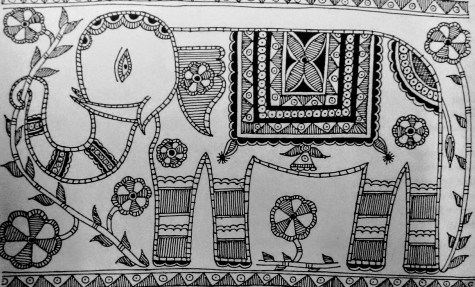
Six blind humans once encountered an elephant. Each of them tentatively approached the unknown form that they could neither see nor hear, and each happened to touch a different part of the great beast. They moved their sensitive fingertips across what their hands could reach, and curiously explored.

Meeting together again, each was excited to exchange notes. For what a curious thing this was! What was it called and what purpose did it serve?

The first one said:

“What tree is this that we have chanced upon?

Its trunk just seems to go on and on.

Or is it a pillar thick and round

Solidly planted in the ground?”


The second one shook his head to exclaim:

“Oh no, you are mistaken, friend

It is simply a wall without end.

I just ran my hand from side to side

It is so solid, so firm, broad and wide.”


The third person was amazed at such tall tales:

“What do you mean ‘so high and strong’?

I assure you that you have got it quite wrong.

It’s quite simply a snake, soft, thick and long,

I could feel its breath as it swayed along.”


The fourth one was a bit confused now:

“It’s true it was long, but I have a doubt,

It wasn’t supple nor smooth as you make out.

It was surely a rope you felt my friend

Why, it even had long tassels at the end.”


The fifth individual thought the four were quite crazy:

“Imagine, imagining it to be a tree or a wall

Just what has come over you all?

Do snakes or ropes flap like sails on boats?

They were those giant punkhas, like ones in the royal courts.”


By now the sixth was convinced that the rest were mad:

“Why are we making wild guesses and playing foolish games?

I know not to what you give different names.

Firm to the touch, sharp at the end; nothing large or loose or long

How could it be anything but a spear sharp and strong?”


And thus each one ‘saw’ a different sight

And each was convinced that they were right.

Alas the six could only see a part, but never understand

That it all the parts together that made the whole elephant.

IMG_20180910_165057.jpg
Illustration: Roopalika V.

“The whole is more than the sum of its parts.” Aristotle

–Mamata

In a Word

When we were in school we were told that the Eskimos have a hundred or more words for Snow and forest-dwelling indigenous people have a multitude of words for Green. In recent years this information has been debunked by many linguists. While the numbers are not that important, to my mind this example is still meaningful as it draws attention to the fact that every culture and language has its own vocabulary to describe the nuances of a phenomenon or event or feeling.

In the past few years I have come across some really evocative words which I love to share.

Tsundoku A Japanese word which refers to the habit of accumulating books with the intention of reading them by and by, as opposed to obsessively collecting books just for the sake of having them. This word apparently has been used for over a century, and a person with a large collection of unread books was called a tsundoku sensei. This is something I have always done, and I was so happy to find a respectable name for the same!

Komorebi Another Japanese word for the delicate interplay of light and leaves when sunlight filters through the foliage of trees. How often we have been touched by this delicate and fleeting moment. Artists and photographers have tried to capture this, but this single word perfectly paints the picture.

Shinrin-yoku If you want to prolong the moment and immerse yourself in the experience—the Japanese have a word for that too. This word means ‘forest bathing’, a practice that includes mindfully experiencing the beauty of the komorebi while breathing the cool fresh air and hearing the leaves rustle in the gentle breeze.

Waldeinsamkeit If you were German and enjoying Shirin-yoku, a feeling of solitude, and a connectedness to nature, this is the perfect word to describe how you feel!

Mångata If you lingered long enough for the sunlight to be replaced by moonlight, this is what you would also see. A Swedish word for the glimmering, road-like reflection that the moon creates on water. Another luminescent word that paints a perfect picture.

Hygge Back home after a rejuvenating walk in the woods, what could be better that to curl up with a book from your tsundoku and get lost in the wonderful world of words! The Swedish have the perfect word for just such cosy comfort and contentment!

If only, we may say, our life could be a series of shinrin-yoku and hygge! The Japanese say that there is no reason why it cannot be. After all, is it not a lot about how you approach life? It is all about having a sense of purpose and meaning and a feeling of wellbeing–essentially ‘a reason to get up in the morning’, and to see the sunlight rather the clouds. They call it Ikigai.

IMG_20180902_085434387.jpg

According to the Japanese, everyone has an ikigai. We just have to find our own.

–Mamata

A Parliament of Owls

No this does not refer to a House of sleep-deprived MPs at an all-night Parliament debate!

This is what a group of Owls can be called!

IMG_20180822_160618795.jpg

The English language has some wild and wonderful names to describe groups of animals or birds. We use some of these collective nouns occasionally when we talk about a Herd of cattle or a Flock of sheep. In school we often had to fill in the blanks or match the following– a Pride of lions, a School of fish or a Pack of wolves.

I have always been intrigued and fascinated by some of these collective nouns. I think that a Gaggle of Geese sounds just so appropriate, as does an Army of Ants (especially having once been literally attacked and badly bitten a marching regiment of army ants—no joking!).

Here are some delightful feathery ones!

Imagine a Parliament of Owls which includes members from the following: A Murder of Crows, a Convocation of Eagles, a Deceit of Lapwings, a Ballet of Swans, a Siege of Cranes, a Conspiracy of Ravens, a Company of Parrots, a Murmuration of Starlings and a Flamboyance of Flamingos!

And what about our four-legged friends? Here are some quirky ones!

When Noah invited representatives of all animals onto his Ark, he had to select a pair each from: An Ambush of Tigers, an Array of Hedgehogs, a Bloat of Hippos, a Crash of Rhinos, a Rumpus of Baboons, a Shrewdness of Apes, a Singular of Boar, a Skulk of Foxes, a Sleuth of Bears and a Mob of Kangaroos!

Not to mention the hoppers and slitherers from a Colony of Frogs, a Knot of Toads, a Quiver of Cobras, a Bask of Crocodiles, and even a Culture of Bacteria!

These are only a small taste of the numerous terms used to describe groups of different kinds, the history of which can be traced back to the Middle Ages in England. The earliest known collection of terms of collective nouns or ‘venery’ (an archaic term for ‘hunting’) is in the Book of Saint Albans, a kind of handbook for hunters first published in 1486. Included among chapters was a list of the Compaynys of Beestys and Fowlys, where many of the common terms of venery made their first appearances including pride of lions, flock of sheep and herd of deer.

While serious scientists may not be amused at the attribution of human traits to describe the animal world, for the language lovers, discovering new terms can be great fun.

Even more fun is trying to coin one’s own terms! Here are some that I thought of: A Cacophony of Koels, a Preening of Peacocks, a Menace of Mosquitoes, and a Buzzload of Bumblebees!

–Mamata