Go Figure: National Mathematics Day

December 22, the birthday of the mathematical genius Shri Srinivasa Ramanujam, has been observed as National Mathematics Day in India since 2012, the start of the celebration of his 125th birth anniversary. The Day has, since then, been marked in schools and colleges by special events like maths quizzes, competitions etc. Hopefully, the enthusiasm will be carried over to the digital medium this year.

Those of us who fear math will also recall they feared their math teachers. In fact, the fear of math stems in most of us because we just did not understand what was happening in the class. And math teachers seldom felt the need to do anything differently to help students understand the abstract concepts better.

It is in this light that Mathematics Educators like Shri AR Rao stand out. He dedicated his life to math education and inspired generations.

Born in the small village of Jakka Samudram of Salem district, Tamilnadu, he had his initial schooling at Tanjore—not far from Kumbakonam, where Ramanujam and studied lived when he was young.  He studied chemistry, not mathematics at graduate level, and then took a post graduate degree from Chennai. But his karmabhumi was Gujarat. He joined Bahauddin College, Junagadh in 1933, as a Professor of Mathematics and spent 27 years there. After that he taught in various other colleges in the state.

After ‘retirement’ in 1974, he started his second innings. He became a mathematician at VASCSC (Vikram Sarabhai Community Science Centre), a pioneering science education facility in the county. The teacher of formal mathematics became the flag-bearer of non-formal mathematics as a means to popularize mathematics. His mission was to make mathematics enjoyable for students and everyone else.

His innovative mind came up with dozens of puzzles, games, models and teaching aids towards this.

He set up India’s first Mathematics Laboratory at VASCSC. He traveled, attended workshops and seminars, and spoke all over the country to popularize these ideas.

I had the great good fortune of having interacted with Shri AR Rao to some extent. When I was helping at VASCSC, his 90th birthday came up. It was decided to throw a surprise party at the Centre. Just to ensure that he did come in that day, a message was sent to him that the Trustees wanted to meet him.

I still remember the joy and the excitement of the many students and bhakts who came for the party. And at last the guest of honour, Shri AR Rao, walked in. He was truly surprised and thrilled. He almost broke down when it was his turn to speak. He said that he had come in very nervously, thinking that the Trustees had wanted to meet him to ask him to retire now that he was 90! Such was his love and passion for spreading the word on mathematics education that he wanted to come in to work at this age. And indeed he did, till the age of 100. He passed away on 4th April, 2011.

If today the teaching of mathematics in India has become more comprehensible to the average student, if students appreciate and enjoy the beauty of mathematics, and if teachers have begun to employ innovative methods to teach the subject, Prof. AR Rao had a lot to do with it.

It would be appropriate to end with a quote from him:

“Although everyone concedes that without mathematics, modern science and technology can hardly make any progress, it is common knowledge that the students everywhere consider mathematics as a very difficult subject. Of the many reasons that can be found for this, perhaps, the most important are, some defective methods of teaching, over emphasis on exams and indiscriminate cramming of materials from the text books and the so-called guides. So what is really needed is inculcation of a power of understanding and a capacity of creative thinking.” AR Rao.

Blessed indeed to have met such people!

–Meena

Much of the material has been drawn from http://www.vascsc.org/images/pdfs/Glorious-Innings-of-Prof.A-R-Rao.pdf.
Across and Down

1 Across: Word that describes the author of this piece (14 letters).

Answer: Cruciverbalist

Yes, that’s what I am. A crossword lover! My day does not end until I have tackled my three daily crossword puzzles. Over the years while this has become a habit, in recent years I have been not just trying to crack the clues and fill in the blank squares with the right answers, but equally looking more closely at how the clues are framed. And every day, I applaud not so much myself for having got the answers, but even more the creator for the clever wording of the clues.

And as with most things that interest me, I am curious to know what goes on behind the scenes. That led me to the history of the crossword puzzle.

The earliest form may have been simple word games that were published in children’s books in the 19th century in England.  These were called Word Squares where children had to fill in the words to fit the squares so that the words read the same across and down.

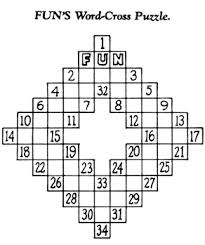
Arthur Wynne a young English boy in Liverpool was one of the children who had been taught by his grandfather to solve these puzzles. When he was 19, Arthur, emigrated to America. He went on to work with the newspaper New York World where he managed the jokes and puzzles supplement called Fun. One December day, as Arthur was working on the Christmas Edition of Fun he felt that the readers needed something new and challenging. He remembered the word games he used to play as a child. Drawing upon that memory Wynne designed a numbered, diamond-shape grid with an empty centre. As the first top Across entry, he inserted the word FUN. He fitted in words in the rest of the squares, for which he devised clues. He called this puzzle Word-Cross. An illustrator later accidentally changed Word-Cross to Cross-Word, and Arthur was fine with it, so the name stuck. Later Wynne played around with a variety of shapes and finally settled on the rectangle.

Arthur Wynne’s first Fun word Cross was published in his paper New York World on Sunday 21 December, 1913. The Word-Cross was well received and became a regular feature of the Fun page. Soon after that, World War 1 started. As the war progressed and the newspapers were full of depressing headlines and dire news reports, the crossword became a much needed refuge where readers could temporarily apply their minds to something challenging as well as satisfying. Crosswords became a comforting anchor through the uncertainty of wartime. By the time the war ended crosswords had become immensely popular.

During the early 1920’s other newspapers picked up the newly discovered pastime, and within a decade crossword puzzles were featured in almost all American newspapers. It was in this period crosswords began to assume their familiar form.

Crosswords were now being published in almost all newspapers—except in the New York Times. A 1924 editorial in the Times called crosswords “a primitive sort of mental exercise.” Interestingly, it took another World War for the New York Times to introduce the crossword—two decades after the rest of the newspapers in the USA did. Through the 20s and 30s the New York Times brushed it off as a passing fad, and deemed carrying a crossword on its pages as too low brow. They felt that the paper should hold the reader’s interest without needing to rely on a puzzle. But with the war, they realised the therapeutic value of the crossword. The first New York Times crossword ran on Sunday, February 15, 1942. Today the New York Times crosswords are among the trickiest and cleverest, and ones that solvers most aspire to crack.

After a decade of popularity in America, the crossword crossed the Atlantic. The first crossword to be published in Britain appeared in Pearson’s Magazine in February 1922, and it became very popular. The Times of London, as had the New York Times, initially scoffed at what it called “a menace because it (crossword) is making devastating inroads on the working hours of every rank of society. Everywhere, at every hour of the day, people can be seen quite shamelessly poring over the checker-board diagrams, cudgelling their brains for a four-letter word meaning ‘molten rock’ …”  The Times resisted the popular wave until February 1 1930 when it published its first crossword.

The British crosswords quickly developed their own style. While the American crosswords usually had clues for which the answers were direct, based on general knowledge or word definitions, the British ones were more complex and the clues cleverly worded so as to have double or hidden meanings. And so emerged what became known as Cryptic crosswords. One of the creators of this kind of puzzle was a school master Derrick Somerset Macnutt. He compiled his puzzles under the pseudonym Ximenes, to avoid the wrath of frustrated cruciverbalists who could not crack his cryptic clues!

Simple or cryptic, the crossword was here to stay and developed its own band of followers, who went on to become addicts.

When the world was once again in the throes of World War II, the crossword played a similar role as it did in the first War–providing a respite from the gloom and doom stories on the news pages, and something to do in the blackout hours.  

The crossword had its own intriguing WW II moments. In England, Intelligence Officers found that some of the answers in the The Daily Telegraph’s puzzles were code names for secret undercover war missions. They were worried that crosswords were being used to communicate secret messages. They traced the puzzles back to a mild-mannered headmaster Leonard Dawe. But they could not find anything to incriminate him. The mystery remained unsolved until 1984, when one of Dawe’s former students came forward and said that along with some other students he had helped Dawe fill in his puzzles. The boys had used words that they had heard being used by soldiers in a military camp next to their school. Neither they nor their headmaster had the faintest idea that they had been accidental traitors!

By the time the war ended in 1945, for crossword solvers in Britain and America, it had transitioned from providing solace to becoming a ritual. And the faithful following of cruciverbalists has grown across the world. Today, the internet has brought changes in the form of the crossword, and many today get their daily fix on their computers and smart phones. But its function remains the same—to engage the mind in bringing order out of seeming chaos, and the very personal sense of achievement when the blanks begin to be populated with letters.

1 Down: Crossword lover American President (7 letters)        Answer: Clinton

Cheers to the Cruciverbalists! We have nothing to use but our brains!

–Mamata

Stamp on Numbers

Actually, that should read ‘Stamps on Numbers’. But ‘Stamp on Numbers’ is something I would have liked to say to my Math teachers, so let me work it out my system!

Browsing through the books in the home bookshelf is an obsessive COVID activity with me, as with many others. In this exercise, I came across a book entitled ‘Wonder of Numbers’ by Clifford Pickover. While I am sure the book has lots to teach on mathematics, what I found most interesting was a snippet that the country of Nicaragua had, in 1971, issued a series of stamps called the “The 10 mathematical formulas which have changed the face of the world”. The ten selected formulae:

  • 1 + 1 = 2
  • Pythagorean law for right-angled triangles
  • Archimedes’ law of moments
  • Napier’s law of logarithms
  • Newton’s law of gravitation
  • Maxwell’s law of electromagnetism
  • de Broglie’s law of light waves
  • Tsiolkovskii’s law of rocket motion
  • Boltzmann’s law of entropy, and
  • Einstein’s law of relativity.  

The back of each stamp apparently has a small explanation of the formula. No one is quite sure how these particular formulae were selected, but what I found most fascinating was that a country would think of putting out such a series!

Delving a little more taught me that there were several hundreds of stamps across the world, devoted to mathematics and mathematicians.

Several countries have brought out stamps on Mathematics Education. https://mathematicalstamps.eu/news/100

Nicaragua, Iran and Mexico have brought out stamps on the theme of ‘Counting on Fingers’. There are several stamps which highlight calculating instruments like Pascal’s Mechanical Calculator, William Schickard’ calculating device, the Slide Rule, etc.

A number of stamps have featured statistical themes, such as a graph showing the Norwegian gross national product growth from 1876 to 1976, and one depicting the decline in malaria.

There have been many stamps devoted to games and pastimes based on mathematical reasoning. Chess and Go—a Chinese game—have quite a few each. But so do other lesser known ones–Senet an early form of backgammon; an Egyptian game from 1350 BC played by two players on a 3 x 10 board; the African game of eklan which consists of a board with 24 holes, arranged in concentric squares into which sticks are inserted etc.  Of course, the Rubik cube, invented by the Hungarian engineer Erno Rubik, a coloured cube whose six faces can be independently rotated so as to yield 43,252,003,274,489,856,000 different patterns, has a stamp or two.

The metric system was introduced in 1960 and gradually, most countries have adopted this system of weights and measures. There are quite a few ‘metrication stamps’ including:

  • a Brazilian metric ruler
  • a Romanian stamp demonstrating that a metre is one ten-millionth of the distance from the north pole to the equator
  • a stamp from Pakistan demonstrating the metric units of weight, capacity and length
  • two Australian cartoon stamps featuring the metric conversion of length and temperature
  • a Ghanaian stamp indicating that a metre of cloth is a little more than 3 feet 3 inches.

Since 1897, International Congresses of Mathematicians have been held at which thousands of mathematicians from around the world gather to learn about the latest developments in their subject. These meetings usually take place every four years. Several of these congresses have been commemorated by stamps.

India has a few mathematical stamps too. Aryabhatta, Ramanujam and DD Kosambi are celebrated on Indian stamps. Jantar Mantar, the remarkable observatory designed by mathematicians and astronomers figures on a stamp too. The decimal system which originated in India and is a fundamental contribution, is actually celebrated in a stamp brought out by Nepal through a depiction of an Ashoka Pillar from Lumbini, which portrays this.

My search engine wanderings led me to a world which I did not know existed, and from where I have gleaned most of this information. The world of people who love mathematics, stamps and mathematical stamps .

Some of these, which are also the sources of much of the above information:

https://mathematicalstamps.eu/news/100

http://users.wfu.edu/kuz/Stamps/stamppage.htm

Stamping through Mathematics. Robin J. Wilson. Springer.

Mathematics and science : an adventure in postage stamps. William L.Schaaf. Reston.

Have fun!

–Meena

Totalitea

Many moons ago, my husband and I were on a short trek on the Annapurna Trail. Late one afternoon we reached a small village where we would spend the night. As we sat, enjoying the unmatched feeling of contentment after a beautiful day’s walk, we were joined by a young man. He bowed low, as only the Japanese do, and joined us in quiet contemplation. After a while, in broken English, he asked if we may be so kind as to join him in a small ceremony. We were happy to do so.

The young man led us to a large spreading tree around which was a built platform, and gestured to us to sit. From his backpack he took out a beautiful bowl and a brush, and with fluid movement cleaned the bowl. He then put in it some tea powder and hot water from his flask, and carefully stirred. With a low bow, he respectfully held the bowl in both hands and passed it to my husband, so that he may take a sip. He indicated that the bowl be passed on to me to do the same, and then he did the same when I passed it to him. All this was done in peaceful silence. When we had finished the bowl of tea, he explained, half in words and half by gestures that this was a traditional Japanese tea ceremony and that his guru in Japan had asked him to share it in a beautiful place with the right people. We were humbled that we had the privilege of this sharing amidst the breath-taking majesty of the mountains, the song of birds, and the crisp air. 

It was one of the most meaningful and beautiful moments of sharing that we have ever experienced. The memory is vivid even after so many years.

We later discovered that our host had meticulously followed both the form and spirit of the chado or Japanese tea ceremony, an experience that is centred on respect, beauty, and simplicity. As is the tradition, before the ceremony begins, the host and the guests prepare their mind and spirit for the experience by leaving worries behind, and focusing on harmony and tranquility. The rest of the ceremony gently unfolds just as our young friend had done.

The history of the tea ceremony is equally engaging. The tea plant was brought to Japan in the 9th century by a Buddhist monk named Eichū on his return from China, where tea had been in widespread use for centuries. Eichū served the drink to an emperor, and not long after, an imperial decree was issued to start cultivating tea plantations in Japan. Initially tea drinking was limited to the social elite and only later it spread to other levels of Japanese society. It would take another three centuries before tea ceremonies would become a spiritual practice.

In the 15th century, Murata Jukō a Buddhist introduced the four core values of the ceremony–kin, or reverence; kei, respect for food and drink; sei, purity in body and spirit; and ji, calmness and freedom from desire.

In the 16th century, another Buddhist, Sen no Rikyū incorporated the philosophy of Ichi-go ichi-e (‘one time, one meeting’), the idea that each individual encounter should be treasured as such a meeting may never happen again.

Our chance encounter with the Japanese tea ceremony and our host was literally and spiritually “one time, one meeting”.

Tea and rituals related to tea have an important role in Oriental cultures. In China, where tea is said to have originated, one of the first written accounts about the tea ceremonies dates as far back as 1200 years ago, during the Tang Dynasty. The serving of tea was also named cha dao which meant ‘the way of tea’.  Attention to tea preparation and serving became the preoccupations of the Chinese tea connoisseurs, which transformed the way tea was regarded by the Chinese.

The Chinese tea ceremony is a blend of the philosophies of Confucianism, Taoism and Buddhism and is based on the respect for nature and need for peace. The traditional tea ceremonies were described as he which translates as ‘peace’, jing which translates as ‘quiet’, yi which means ‘enjoyment’ and zhen meaning ‘truth’.

The tea ceremony remains one of the most significant traditions, even today, in Chinese weddings. The ceremony is conducted on the day of the wedding and sees the bride and groom respectfully serve tea to their parents, in-laws, and other family members. This symbolises the union of two families, the respect for the elders on both sides, and the elders’ acceptance of the marriage. In Chinese, the expression “drinking a daughter-in-law’s tea” is used to represent a wedding. What a simple but eloquent symbol tea can be.

While Japanese and Chinese poets have written lyrical odes to tea, the British approach to their cuppa is much more “stiff upper lip” and mundane! As William Gladstone said:

If you are cold, tea will warm you;
If you are too heated, it will cool you;
If you are depressed, it will cheer you;
If you are exhausted, it will calm you.

As for India, as with all other things there are myriad versions and preparations of the ubiquitous chai! Every home and every family has its own special brew, and chatting over chai is a national pastime.

In my home, the long morning tea session is an unbroken tradition, complete with a big teapot and numerous cups of ‘English tea.’ It is a time to sip, and savour our little garden while we each peruse the morning papers. It is a comforting and happy way to start a new day. And to remember the words of the Vietnamese spiritual leader, poet, and peace activist Thich Nhat Hanh:

Drink your tea slowly and reverently, as if it is the axis on which the world earth revolves—slowly, evenly, without rushing toward the future. Live the actual moment. Only this moment is life.

What brought on these ramblings about tea? Every year, since 2005, tea-producing countries have been celebrating International Tea Day on December 15th. The day seeks to draw the attention of governments and citizens around the world to the impact that tea trade has on workers and growers. Last year it was proposed to expand this celebration to all countries around the world and to move the day to May 21st.

December or May, for tea drinkers every day is Tea Day.

–Mamata

Peanuts for Bulls

One of Bangalore’s landmarks is the Dodda Basavana Gudi (Big Bull Temple), which is situated–surprise, surprise, on Bull Temple Road, Basanvangudi, South Bengaluru. It was built by Kempe Gowda, the founder of Bangalore, around 1537. It is dedicated to Nandi, the vahana or mount of Lord Shiva, and the monolithic statue has a height of 4.6 metres and a length of 6.1 metres. This Nandi is probably the biggest in the world.

But where do the peanuts come in? Well, apparently, this was a prolific peanut-growing area many centuries ago. But year after year, a wild bull would rampage through the fields just when they were ready for harvest, and would destroy the crops. Over time, the problem grew so worrisome that the farmers were desperate. They vowed to build a temple dedicated to Nandi if only the bull would stop. They did so, and miraculously, the bull stopped its depredations.

A board at the temple has a slightly different version. According to this, one of the angry farmers whose peanut fields the bull was destroying, hit it with a club. The stunned bull sat down motionless and turned into stone. But then it started to grow and grow! The worried farmers prayed to Lord Shiva. A trident found near the feet of the bull was placed on its head, and at last it stopped growing. The grateful farmers then built a small temple, which was later enlarged by Kempe Gowda.

And in gratitude, farmers also decided to hold an annual peanut fair (Kadalekai Parase) in the area around the temple. It is held on the last Monday of the month of Karthik (that is next Monday, 14 December). Originally, farmers would make an annual visit to Bengaluru to sell their peanuts, but today most sellers here are traders who buy from the farmers and sell. Not only can groundnuts be bought and stored for the year, but peanut connoisseurs will  find a large variety of snacks to choose from–spiced, fried, boiled, roasted and sugar-coated groundnuts.

Not just a tasty snack, groundnuts are good as a source of protein. It is of course a major oil crop—in fact India’s most significant one. The green or dried leaves are used as cattle-feed. Being a leguminous crop, it does the soil good too, by fixing nitrogen. Approximately 85 lakh hectares of agricultural land in India are under groundnut cultivation and the annual production is about 7200 thousand tonnes.  

Well, COVID is bound to interfere with beautiful traditions like the peanut fair, but its importance in our lives will not wane. And hopefully Kadalekai Parase 2021 will give us all our nut-fix!

–Meena

See also: ‘The Worshipful Bull’, https://wordpress.com/post/millennialmatriarchs.com/823

Save Our Soil

Unless we are a farmer or a gardener, few of us consciously think about soil. And yet, it is soil that sustains life on earth. Scientists study biodiversity on land and in the water, but not as many look that closely at soil and what it harbours. Soil is home to more than 1/4 of our planet’s biodiversity, but we only know 1 per cent of this universe. 

December 5 is World Soil Day–an international day to celebrate Soil. This day was first recommended by the International Union of Soil Sciences (IUSS) in 2002; it was supported by the FAO and endorsed by the UN General Assembly in June 2013. The day means to raise global awareness about the importance of healthy soil and advocate for the sustainable management of soil resources. It is marked on December 5 was chosen because it corresponds with the official birthday of the late H.M. King Bhumibol Adulyadej, King of Thailand, who was one of the main proponents of this initiative.

There are more living creatures in a single teaspoon of healthy soil than there are people on Earth.

This year’s World Soil Day theme is Keep Soil Alive, Protect Soil Biodiversity. Now, more than ever before, soil biodiversity is under pressure due to unsustainable soil management that affects life belowground. This theme focuses attention on the workers belowground–from tiny bacteria to agile millipedes and slimy earthworms–all of which contribute to processes that are indispensable to life on Earth.

It is a reminder that unless people around the world proactively engage in improving soil health, soon, the fertility of soil will continue to be adversely affected at an alarming rate, threatening global food supplies and food safety.

Here is my small contribution to this day.  Giving soil a voice!

The Soil’s Lament

I am soil. Ever thought about me?

Always underfoot, you think I’m here for free.

In your fields and gardens, roads and lawns

On mountains in deserts, in cities and towns.

I can be living, feeling, strong and healthy like you

But I can also get sick, and sometimes tired too.

Then I get weaker, unable to nurture life to grow.

How can that happen, would you like to know?

Year after year, season after season

You plant me with the same crops with the reason

That the more you put in, the more you will get.

But that’s just where you will lose the bet.

In such a hurry you are, to sow and reap

Have you ever thought that I’d like time to breathe?

Ever considered that I too need to recuperate

From trying to deliver at such an unnatural rate?

Give me a break, give me a rest. Be kind to me, I’ll give you my best.

The unending cycle will sap all my strength

Suck the minerals and nutrients out from my depth

One fine day I’ll just run out of steam

Then those bountiful harvests will be just a dream.

And then you will pump me with every artificial aid

Chemicals, fertilizers, all the tricks of the trade.

Hoping the fruit I then bear will be so fast and good.

But could you thrive on pills alone, and no natural food?

Give me a break, give me a rest. Be kind to me, I’ll give you my best.

Or will you drug me with pesticides and insecticides

To destroy the “enemies”– the aphids, thrips and mites.

You don’t realize that with every deadly dose

My allies too are dying, not just my foes.  

You strip me of my protective cover

Tear away trees, shrubs, grasses, every small flower

That keep me secure with a protective cloak

From the fury of rains and the winds that blow.

You leave me exposed, vulnerable, and bare

To be blown, swept and washed away, here and there.

Or you clad me in an armour of concrete and stone

So I can no longer breathe, nor give my friends a home.

Give me a break, give me a rest. Be kind to me, I’ll give you my best.

Cover me again with a mantle of green

Let my own special magic do the job you’re so keen

To assign to the factories, the labs and the vans

And potions from bottles and boxes, sprays and cans.

Let the humus, leaf litter and the biomass,

The lichen, the algae, the roots and grass,

The bugs, the beetles, the worms and snails

Do the job they’ve always done, and that never fails.

It’s these millions of dwellers that give me life

That in turn I bestow on all plant life.

Let my friends and foes do all they might

If I’m strong and healthy, it’ll be all right.

Give me a break, give me a rest. Be kind to me, I’ll give you my best.

–Mamata

When Social Responsibility was Risky Business!

Philanthropy has been garnering headlines in the world media for some years now, with the most successful entrepreneurs speaking more about their giving initiatives than their businesses. And it has indeed set off a virtuous cycle.  

But lest we think giving by industrialists is a new phenomenon …

In continuation of last week’s blog which marked 13 November (designated as World Kindness Day), and November 16 (International Day for Tolerance and Peace), here is a look at a few examples of Indian industrialists whose philanthropy exhibited a sense of enlightenment and responsibility that was path-breaking . The critical thing to remember is that most industrialists of the late 18th and the early 19th centuries saw building up India’s industry and infrastructure and supporting the freedom movement as their most critical social responsibilities. They were flying in the face of the Raj in doing this, and the Raj had the power to destroy them! But that did not stop them.

The Vision of Jamsetji Tata

Shri Jamsetji Tata was a pioneer in setting India on the path to industrial self-reliance. But it was not just about technology. His vision for the well-being of his workers was truly enlightened. Way back in the 1880s, he offered facilities like crèches for workers in his mills, as well as short working hours, properly ventilated workspaces, fire safety, etc. In 1886 he instituted a Pension Fund, and in 1895, began to pay accident compensation.

The story of Jamshedpur is another testimony to his vision. The work on this township for housing the workers of the Steel Mills was commenced in 1908. Shri Jamsetji dreamt of more than basic housing for his workers. He wanted to build a proper modern planned city. His instructions regarding the city were:  “Be sure to lay wide streets planted with shady trees, every other of a quick-growing variety. Be sure that there is plenty of space for lawns and gardens; reserve large areas for football, hockey and parks; earmark areas for Hindu temples, Muslim mosques and Christian churches.”

It was private philanthropy that led to the creation of institutions like the Indian Institute of Science (IISc), Bangalore and Tata Institute for Fundamental Research, Mumbai. It is said that Jamsetji mooted the idea of contributing to an institute like IISC as early as 1898, long before Carnegie’s endowment to set up a Technical School (today Carnegie Mellon University).

From Temples to Gods, to Temples of Education

Shri G.D. Birla was a strong supporter of Gandhiji and gave considerable resources to the freedom struggle. Many of us would have at some time or other visited a Birla Mandir–many a large town in India boasts one. Apart from this charitable activity of temple-building, a landmark contribution of Shri Birla is the creation of one of India’s best higher educational institutions—the Birla Institute of Technology. This was started as a school for G.D. Birla and R.D. Birla by their grandfather in 1901. It grew into a high school  in the 1920s. In the forties, the Birla Education Trust was founded and the institution went from strength to strength, adding degree and post-graduate courses in a variety of disciplines.  In 1964, taking advantage of a Ford Foundation grant, the institute formed a partnership with Massachusetts Institute of Technology (MIT), USA, and was well on the path to leading India’s achievements in technical education.

Gandhi Ashram is Saved!

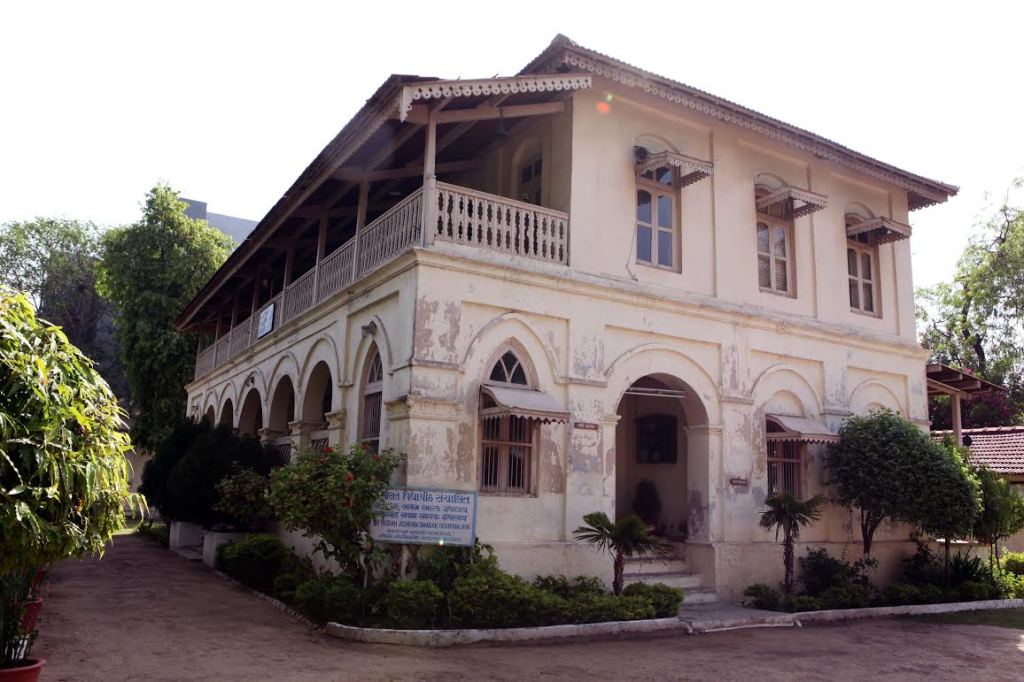
When Gandhiji  first came to Ahmedabad, he set up his Ashram at Kochrab. He invited a Dalit family– Dudabhai and Danibehn–to come and live at the Ashram. This led to considerable agitation among the Ashram’s neighbours as well as many funders, leading to a financial crisis, which forced Gandhiji to think of shifting the Ashram.

Kochrab Ashram

And then one day, in Gandhiji’s words: “A car drew up near our quarters and the horn was blown. The children came with the news. The sheth did not come in. I went out to see him. He placed in my hands currency notes to the value of Rs 13,000 and drove away. I had never expected this help, and what a novel way of rendering it!”

This gift saved the Ashram. It is well-known that the ‘Sheth’ was Shri Ambalal Sarabhai, one of the foremost industrialists of the time. However, neither he nor Gandhiji ever admitted this!

Jamnalal Bajaj: Exemplary Patriotism

Jamnalal Bajaj was considered Gandhiji’s fifth son, and adopted all his values—from Ahimsa to his dedication to the poor to his commitment to locally made goods and his patriotic spirit. He fought for admission of Harijans into temples, and in the face of strong objections, opened up his own family temple in Wardha—the first temple in the country to do this.

Shri Bajaj was an active member of the Congress Party, and gave up the Rai Bahadur title conferred on him by the British Government and joined the non-cooperation movement.


Importantly, Jamnalalji, in line with the trusteeship concept propounded by Gandhiji, felt that inherited wealth was a sacred trust to be used for the benefit of the people, and dedicated most of his wealth for the poor and under-privileged.

On the shoulders of giants….

–Meena

 www.tata.com

https://jamnalalbajajfoundation.org/jamnalal-bajaj/about

Mr Kindness

Last week I wrote about Children’s Day. Earlier this month two other important international days passed almost unnoticed. 13 November which is designated as World Kindness Day, and November 16 which is marked as International Day for Tolerance and Peace.

For its fiftieth anniversary on 16 November 1995, UNESCO’s Member States adopted a Declaration of Principles on Tolerance. Among other things, the Declaration affirms that tolerance is respect and appreciation of the rich variety of our world’s cultures, our forms of expression and ways of being human. While this is a universal ideal and aspiration, it is at the level of the individual that the foundation of tolerance and respect is laid.

And this is what the World Kindness Day seeks to do–reinforce the understanding that compassion for others is what binds us all together. It is this that has the power to bridge the gap between people, communities and nations. This global day promotes the importance of being kind to each other, to oneself, and to the world.

The idea of this day was promoted by an international non-profit organisation called the World Kindness Movement which works to inspire individuals towards greater kindness to create a kinder world; and their guiding tenet: The world is full of kind people. If you can’t find one, be one.

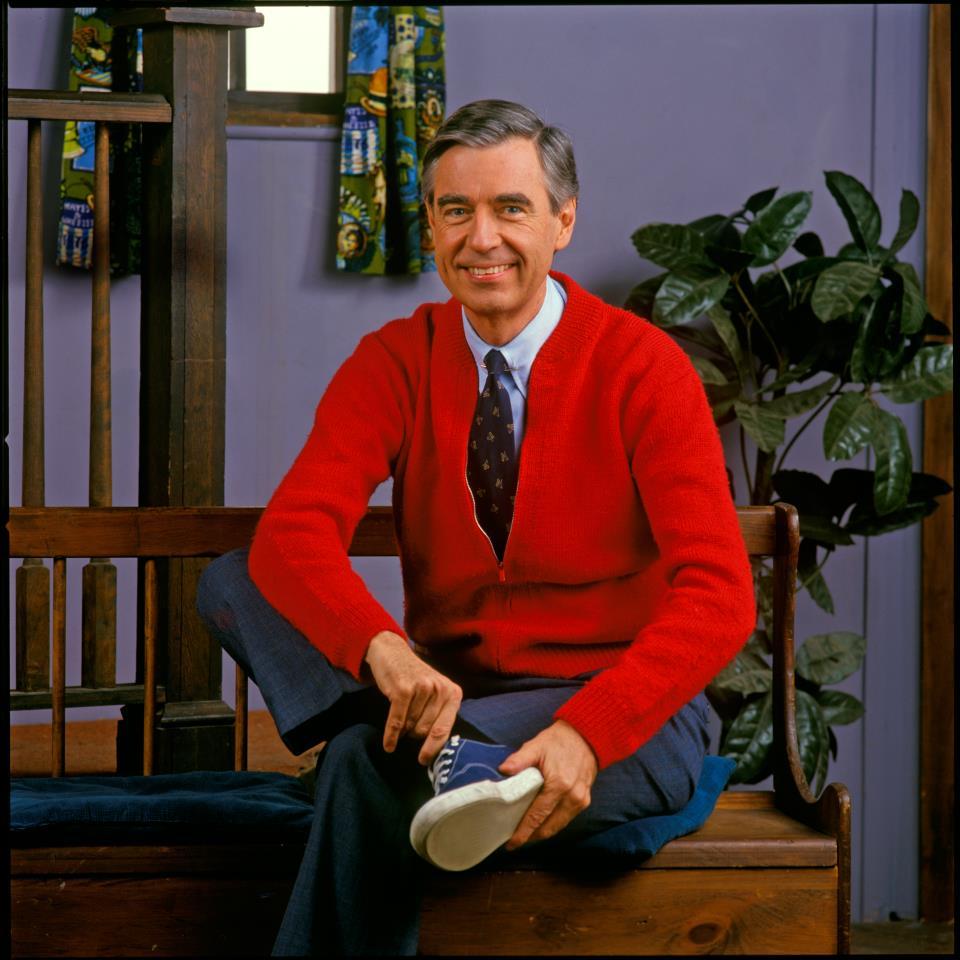
Nothing, and no one, exemplifies the spirit and practice of all the three days better than the beloved Mr Rogers whose TV show celebrated kindness, and helped millions of children to develop empathy.

I came upon the inspiring story of Mr Rogers via Tom Hanks when I saw the movie A Beautiful Day in the Neighbourhood. After seeing Tom Hank’s version I wanted to know about the real Mr Rogers!

Fred McFeely Rogers grew up in America in the 1930s as a shy, somewhat awkward, and sometimes bullied child. After getting his first degree in music, he returned home for the vacation before he prepared to enter the seminary and study to become a priest. It was then that he saw television for the first time at his parent’s home. He was appalled to see the kind of programmes where as he said ‘people were throwing pies in each other’s faces.’ While he found this disgusting, he also saw the enormous potential that TV had for connection and enrichment. That eureka moment changed his life—and the lives of millions of Americans.

Fred Rogers went on to create a TV show called Mister Rogers’ Neighborhood, which first aired on 19 February 1968 and continued for over 30 years. The last episode of the 31 seasons was aired on 31 August 2001. Fred Rogers was the host of all 895 episodes, the composer of its more than 200 songs, and its puppeteer.

The set of simple hand puppets featuring 14 characters from his first show continued to be with the friendly Mr Rogers, clad in his trademark red cardigan and sneakers, for over 40 years. The puppets who inhabit the Neighbourhood of Make Believe, portray real-life feelings as they live and learn with the help of their neighbourhood human friends who represent a wide variety of interests and talents. The puppets and the humans live together, care about and learn from each other. As they often reminded viewers “We all have different gifts, so we all have different ways of saying to the world who we are. It’s our job to encourage each other to discover that uniqueness and to provide ways of developing its expression.”

Mr Rogers was far from preachy. He did not shy away from difficult topics like bullying, divorce, and death; he talked honestly and openly about subjects that adults are hesitant to discuss with children, but that children wonder and worry about silently. He reassured children and adults that it was ok if there were some things that they could not understand. He addressed children’s fears and insecurities, and instilled a sense of faith and trust. “When I was a boy and I would see scary things in the news, my mother would say to me, ‘Look for the helpers. You will always find people who are helping”.

Although Fred Rogers later acquired graduate degrees in child development as well as divinity, he always consulted with his close associate and child psychologist Dr Margaret Mcfarland, to ensure that his scripts would authentically reflect the real concerns and feelings of children.

His show also offered children the tools to be lifelong learners—a sense of wonder, a curiosity about the world around us, the willingness to ask questions. “Did you know, when you wonder you are learning?”

The concept of neighbour and neighbourhood in the leitmotif of Mr Rogers’ life and work. “Neighbours are people who live close to each other. Neighbours look at each other, they talk to each other; they listen to each other. That’s how they get to know each other.” In his neighbourhood everyone was welcomed and valued, and the characters taught how to appreciate and respect others.

Mr Rogers’ ‘neighbourhood’ in a sense becomes the symbol of community; it extends beyond a residential address to embrace the city, the country, the continent, and ultimately the planet that we all inhabit. It metaphorically embraces the universe. And it reminds us of the dire need for, and the gentle power of sharing and compassion. “All of us, at some time or other, need help. Whether we’re giving or receiving help, each one of us has something valuable to bring to this world. That’s one of the things that connects us as neighbours—in our own way, each one of us is a giver and a receiver.”

Today teaching and learning respect, tolerance, sharing, acceptance of differences, and celebration of diversity are highlighted in “values education” curricula. This is the kind of education proposed by UNESCO in its declaration of four pillars of education, i.e. learning to know, learning to do, learning to live together and learning to be.

Over 50 years ago Fred Rogers planted the seeds of basic human values in millions of children, who must themselves have grandchildren now! And for all this he offered only one mantra: “There are three ways to ultimate success: The first way is to be kind. The second way is to be kind. The third way is to be kind.”

–Mamata

Toilet Travails

Last week we marked World Toilet Day. Continuing on the theme, I thought I would share some experiences of constructing and running urban public pay-and-use toilets. Never a dull moment in this game, I assure you. But the stories about operations I shall keep for another occasion. Here I would like to share some feedback from a survey we did of women in Hyderabad, as part of our planning exercise before we took up construction of toilets when the city decided, for the first time, to open up this activity in Public Private Partnership mode. The survey is over a decade old. But sadly, most of the challenges we found still probably stand.

Here are some of the findings from a survey of close to 400 women:

  • About a fourth of the respondents were not even aware that there are Pay-and-Use toilet facilities for women.
  • About half the respondents reported that they wait till they reach home even if they feel the need to use a toilet when they are out. 
  • Women in higher economic strata, non-working women and students use these facilities significantly less than women from lower economic strata and working women.
  • 64.2% of those respondents who used public convenience had a bad experience. The reported major reasons for the  ‘bad experience’ were:
ReasonPercentage
1. Unhygienic Conditions92.5
2. Insufficient water availability69.2
3. Bad smell62.8
4. Caretaker being male57
5. Joint infrastructure (both male and female facilities in one building, with a partition)53
6. Feeling of insecurity36.4

The respondents also made several valuable suggestions:

  • About 53% women suggested that there should be exclusive toilets for women.
  • Around 57% women opined that the caretaker of the public toilet should be properly trained and should be gentle, and he/she should be educated and middle-aged.
  • Respondents also expressed that the following facilities are needed by women in  public toilets; dustbins for disposable things; small shelves for women carrying things; mug and bucket provision; mirror; good lighting and alternative lighting arrangement in case of power fails.
  • Indian and western toilets both to be provided for convenience of various types of users.
  • Security is paramount.
  • Proper maintenance, cleaning at regular intervals and supervision.
  • In some cases, men are using the space around the toilets as the toilets! This not only leads to bad smell but also a feeling of embarrassment on the part of women who want to enter.
  • In many toilets, there is no proper indication for “gents” and “ladies”, which creates problem for women in using public toilets.

Public toilets are definitely more prevalent today than a decade ago. And the maintenance is not as bad as it was. But I think some of the survey findings and recommendations are still very relevant to those concerned about public sanitation, and about making the most basic of facilities accessible to one half of humanity!

–Meena

Of the Children, For the Children

A recent article titled What We Want Our Parents to Know was a poignant reminder of the difference between what adults think they know about children, and how children perceived adults. Written by a child psychologist, with specific reference to the impact that the corona-imposed lockdown is having on the mental health of children, it reflected some of the (often unheard) pleas of children to be heard and respected.

The profound idea that children are not just objects who belong to their parents and for whom decisions are made, or adults in training; rather, they are human beings and individuals with their own rights got international recognition when world leaders came together and made a promise to every child to protect and fulfil their rights. This was by adopting an international legal framework that laid down that children have their unique set of rights, and that these need to be articulated, advocated, protected, and implemented.

On 20 November 1989 this commitment was officially endorsed when the United Nations General Assembly adopted the United Nations Convention on the Rights of the Child (UNCRC).

The Convention says that childhood is separate from adulthood, and lasts until the age of 18 years. This is a special, protected time, in which children must be allowed to grow, learn, play, develop and flourish with dignity.

The Convention views children not as objects of compassion or pity, but as subjects of human rights under international law. It protects children’s rights by setting standards in health care, education, and legal, civil and social services. It sees children as active participants in their own development and agents of change.

The four core principles of the Convention are: Non-discrimination; devotion to the best interests of the child; the right to life, survival and development, and respect for the views of the child.

The UNCRC is a detailed document with an explicit list of 54 articles covering a wide variety of rights all children automatically enjoy, regardless of where or when they are born. Broadly these rights fall under four main categories–rights to:

  • Life, survival and development
  • Protection from violence, abuse or neglect
  • An education that enables children to fulfil their potential
  • Be raised by, or have a relationship with, their parents
  • Express their opinions and be listened to.

The Convention provides a universal set of non-negotiable standards to be adhered to by all countries. These were negotiated by governments, non-governmental organizations, human rights advocates, lawyers, health specialists, social workers, educators, child development experts and religious leaders from all over the world, over a 10-year period. The standards set minimum entitlements and freedoms that should be respected by governments. They are founded on respect for the dignity and worth of each individual, regardless of race, colour, gender, language, religion, opinions, or origins.

The Convention obliges the State and other responsibility holders (parents, guardians, care-givers, civil society, etc.) to address the needs and interests of children as entitlements or rights.

The UNCRC has become the most ratified international human rights treaty in history, now signed by 196 countries. But as with most international treaties, while the intentions are noble, there is often a wide gap between intent and implementation. It has been thirty-one years since the Convention came into force, yet every day one hears and reads of children in tragic situations—from the home to the school; from the homeless to those deprived of education; from those who are suppressed and exploited in so many ways–from the local to the global.

The time is well past the Victorian norm of “children should be seen and not heard.” It is the time when children should be heard. And while governments and non-government organisations continue efforts towards protecting and ensuring these rights, it is the family, as the fundamental group of society and the natural environment for the growth and well-being of all its members, where children should experience the empowerment of having rights, and not just the onus of having duties. And it is for every parent to remember that these rights need to be respected.

India celebrates Children’s Day on 14 November, and November 20 is marked across the globe as World Children’s Day. A good week to remind ourselves of the UNCRC.

–Mamata