Kindness Day

Yes indeed, there is a World Day for Kindness! It is marked on 13 November, and the idea is to promote kindness. Initiated in 1998 by a group of NGOs, it ‘aims to promote kindness throughout the world and presents us with the opportunity to reflect upon one of the most important and unifying human principles. It is a day devoted to the positive potential of both large and small acts of kindness, trying to promote and diffuse this crucial quality that brings people of every kind together.’ 

Kindness Day
Kindness Day

Kindness is defined as ‘the quality of being friendly, generous, and considerate’. Kindness is obviously not to be confined to one day. But this Day is designated to prompt us to think consciously about kindness, and to make resolutions to help us practice kindness every day

It sounds simplistic. Why on earth should anyone be reminded to be kind? But when we look around us, we find there is indeed need to do so. Why look ‘around us’? We will find the same thing when we look into ourselves. Did we say a smiling thank you to someone who was nice to us? When was the last time we did anything for anyone? Do we show basic courtesies in queues, on the roads, in public places?

In a world where people are growing increasingly disconnected, and it’s all about ME, ME, ME, it definitely seems that these behaviours we used to take for granted are disappearing. Never was the need for an initiative like Kindness Day greater.

A measurable proxy for kindness is an attribute called ‘Social Mindfulness’. This refers to being thoughtful of others and considering their needs before making decisions. Social mindfulness is related personality traits of honesty, humility, empathy, agreeableness and pro-social value orientation.

There have been international studies to understand social mindfulness and associated behaviours. One of the best known studies in recent times is the one by Neils Doesum and his associates, who carried out research across 31 countries to understand differences in social mindfulness among the countries. They studied most common, everyday acts of cooperation which require very little effort– for example, stepping to a side to let someone pass on a sidewalk.

Alas, India came up near the bottom of the pack! Japanese scored the highest—they made socially mindful decisions– decisions which kept the well-being of others in mind–72% of the time. Austrians and Mexicans were also towards the top of the list. People in Indonesia were at the bottom, making such co-operative, unselfish decisions only 46% of the time. But India at 50% was not much better.

So obviously, we Indians need to be more aware of this trait, and if at all there is an occasion to be marked with earnestness, it is World Kindness Day.

And remember, it is not about some earth-shaking decisions or major actions. It is about our everyday interactions with people around us—can we make their lives more better, less difficult, more pleasant?  The simplest way to start being more kind and socially mindful would probably be with the old adage ‘Do unto others what you would have them do unto you.’

Specific steps would include:

  • Being conscious of the needs, feelings and thoughts of others.
  • Taking these into consideration before making decisions.
  • Not restricting choices available to other people by being selfish.
  • Being grateful for the kindness of others, and expressing that gratitude.
  • Taking a moment to help someone in need, or to make someone’s life easier.
  • Making it a habit to do random acts of kindness, however small.
  • Resolving to bring a smile to someone’s face, everyday.

Let’s take the occasion of World Kindness Day 2022 to start the personal journey to a more kind, caring and socially mindful world.

Go on, make your resolutions today.

–Meena

Poppy for Remembrance

As a watcher of the BBC news channel, one thing that I have been noticing since this month began was that all the newscasters and other people who appeared on the channel have been wearing a lapel pin in the form of a poppy. This week there was also a picture of Britain’s new Prime Minister Rishi Sunak also wearing the same while flagging off the Poppy Appeal.

Why are poppies so much in the news? The crimson poppy flower has become a symbol to honour those who have fallen in battle over the years, and also symbolizes hope and gratitude. The history of this century-old tradition goes all the way back all to World War I.

 As the story goes, during World War I, after a particularly bloody battle in the fields of Flanders in Belgium, thousands of bright red flowers mysteriously appeared. These were common poppies. Interestingly, the common poppy (Papaver rheos) is technically classified a weed which can grow even in the most inhospitable of landscapes. Basically it sprouts naturally in areas where there is massive disruption of the soil and the natural environment, such as bare lands which had been disturbed by the movement of troops and battle equipment. It is believed that during the Napoleanic wars of the early nineteenth century poppies bloomed profusely around the bodies of fallen soldiers, painting the battleground blood red. The same thing must have happened at Flanders.

John McCrae, a lieutenant colonel in the Canadian Expeditionary Forces fighting in Flanders, who had just lost a close friend in the battle, was so moved by this spontaneous bloom that he wrote a poem about the flowers’ resilience and ability to grow in such inhospitable conditions. Titled In Flander’s Field, it was told from the perspective of the fallen soldiers buried beneath the poppies, and honoured the troops who lost their lives in that conflict. The opening lines of the poem:

In Flanders’ fields the poppies blow
Between the crosses, row on row,
That mark our place: and in the sky

The larks, still bravely singing, fly
Scarce heard amid the guns below.

McCrae’s poem was published in London’s Punch magazine in December 1915. It touched a chord in all those who were suffering the losses of loved ones in the war. The poem was read at memorial services, and reprinted it in many publications. Moina Michael, a professor at the University of Georgia in the United States, first came across In Flanders Field in the Ladies Home Journal and was so moved by it that she vowed always to wear a red poppy in remembrance of the lives lost in war. She found some poppies made of fabric in a store; and bought 25 silk poppies for herself and her friends. Once the war ended she herself began to make poppies out of red silk, and sell these to raise money to support the veterans returning from the war. She also lobbied for the poppy to be recognised as a memorial symbol. In 1920 the little red flower was recognized by the National American Legion as the official national emblem of remembrance.

The United States marks this memory on two days– Memorial Day is celebrated in May while 11 November marks Veterans Day. Over time, in the United States, the tradition of the poppy as the symbol of the day has been largely replaced by the yellow ribbon and red, blue and white ribbon campaigns. 

The poppy tradition however took firm root across the Atlantic, and continues to flourish. It first reached France through a French lady Madame Guerin who had seen the introduction of the poppy in America. She thought that selling poppies was a great way to raise money for children who had been affected by the war in France, and she engaged thousands of war widows in making paper poppies, and selling over a million poppies by 1921.  The Royal British Legion adopted the symbol immediately. The idea also spread to the other Commonwealth countries. The first poppy event was held on 11 November 1921.

Thus for over a century now, wearing a poppy has become a symbol of remembering the soldiers lost during World War I in many countries. The flower made of paper or fabric, is generally affixed to the left shoulder to symbolize the act of keeping those who have passed away close to one’s heart; the left shoulder is also one where military medals are worn. 

In the United Kingdom, Canada, France, Belgium, Australia and New Zealand, red poppies are worn in November, especially on 11 November. This date is marked as Remembrance Day as it commemorates the anniversary of the signing of the armistice that formally ended World War I “at the 11th hour of the 11th day of the 11th month” of 1918. This day is now an occasion to remember all those who have lost their lives in all conflicts since World War I.

While the original batch of poppies were bought from France, the first factory to produce poppies in England was set up in 1922, employing five disabled ex-military personnel. Today the Royal British Legion has a factory that employs 50 ex-servicemen all the year round to make poppies for fund-raising events. The poppy has transcended its purely commemorative status to become an object that provides financial stability for the war-affected. 

The annual Poppy Appeal flagged off by the British Prime Minister last week raises funds for The Royal British Legion to support the armed forces community who have served, or are currently serving in the armed forces, and have subsequently been affected physically, mentally or economically by war.

In an age that is even today more war-torn than ever, where young people are laying down their lives in brutal and meaningless warfare in so many parts of the world, this single flower serves as a powerful symbol not only of remembrance, but also a mark of honour, pride and support for those who still give up everything for the security and peace of nations.

–Mamata

Elaben Bhatt: Simply Inspiring, Inspiringly Simple

Last week we lost Elaben Bhatt, Gandhian, founder of Self-Employed Women’s Association (SEWA), co-founder of Women’s World Banking, Chancellor of Gujarat Vidyapith, Trustee of Gandhi Ashram;  winner of national and international awards including the Ramon Magsaysay Award, the Right Livelihood award and the Padma Bhushan.

Ela Bhatt

As people who worked in the development sector in Ahmedabad, we have of course seen her, heard her and admired her. Her simplicity, her straight-forwardness and compete dedication to the cause of the economic empowerment of unorganized women, lifted our eyes and minds to a higher plane, and showed us the possibility of the difference one soft-voiced person could make.

Much has been written about her in the last few days, and maybe there is nothing startlingly new to add. But we still need to refresh our memories of this stalwart and pay our homage.

So here are some excerpts from a book called ‘Don’t Sprint the Marathon’* which can give us some insights on the early influences which shaped her. Elaben spoke to the author and the write-up is based on these conversations.

‘Ela never topped her school or the college. She might have been in the top 10 percentile, but was never unduly pushed into driving herself very hard. Her father would typically buy a variety of books during the summer vacations and expect her to read them to improve her language skills, which she largely did. Her overall value system was shaped not only by her highly principled father, but the entire nationalistic climate of the time. She was growing up in an India which was all set to break the shackles of British rule. Gandhi was a household name, his teachings the religion of the day, and his life and example to be emulated.

Ela, even as a child, seems to have had a highly developed sense of fairness as well as being highly sensitive to any form of exploitation of the under-privileged.

Her mother’s deep involvement in the women’s movement seems to have raised her hackles against the exploitation of women, who she saw were contributing more than their fair share to the economy of the country. But just because they weren’t paid for their ‘service’ and they were not organized in any manner, they seemed to be easy prey for all sorts of exploitation at the hands of the entire organized system. For example, even as a youngster, Ela was sensitive to the fact that while women did most of the agricultural work in the villages, apart from running the households, they did not qualify for any loans from the banking system.

It is awareness of inequities such as these which probably came through her parent’s work that shaped Ela’s perspective and future. Given her nature, she had to stand up for the underdog.’

Nothing can capture her humility and sensitivity like this para in the introduction to her book ‘We Are Poor, But So Many’: ‘In writing about the lives of poor self-employed women, I have been presumptuous. I have written about women who are unlikely to read what I have written about them. Moreover, my perception is unavoidably limited by the economic and social environment to which I belong. So in all honesty, I cannot claim to speak for the women I write about, I can only speak for myself.’ And this from the person who spent her entire working life working with these very women and among them!

May her soul rest in peace, and may she continue to inspire.

–Meena

*V. Raghunathan. Don’t’ Sprint the Marathon. Harper Collins.

Bridge-building Women

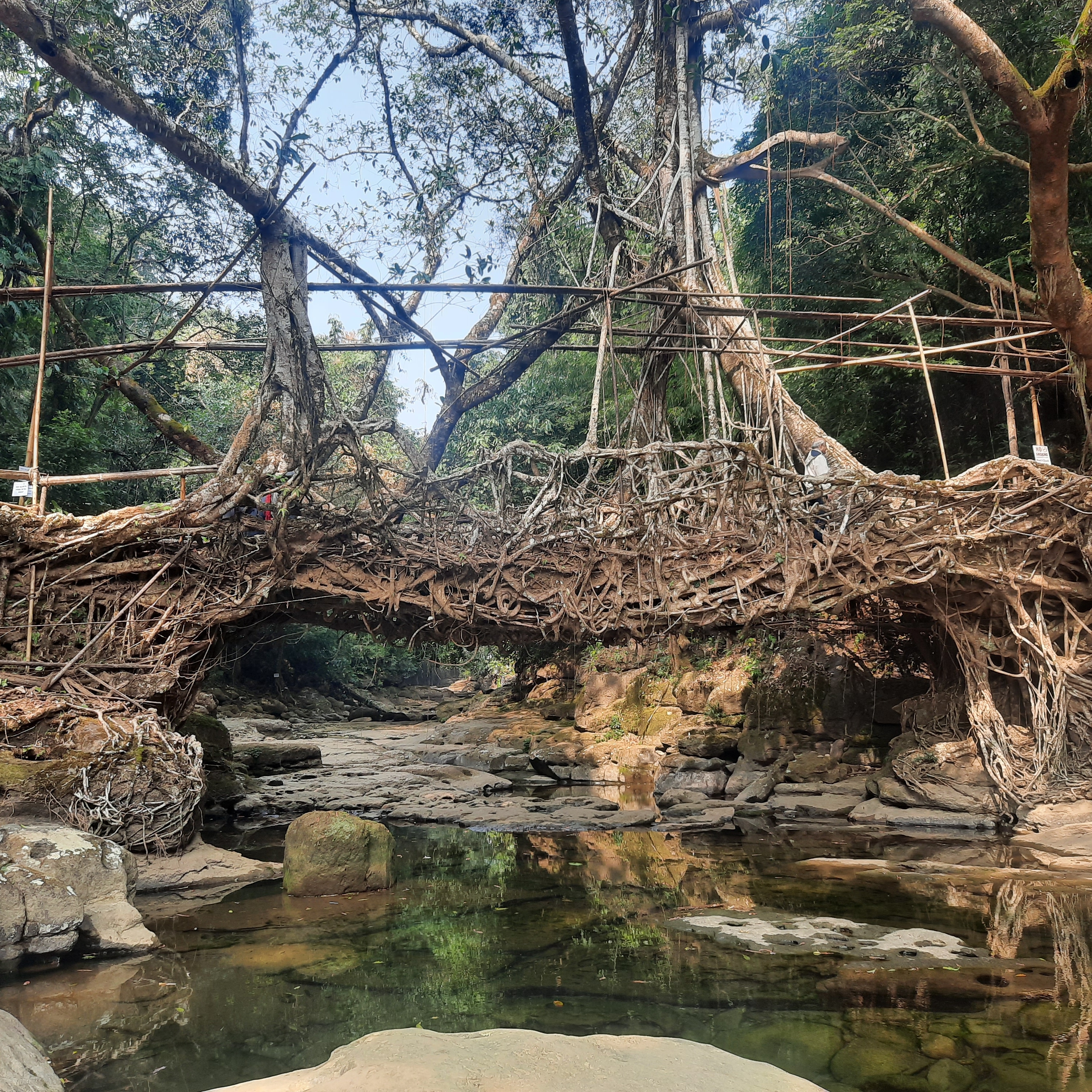
The recent tragedy of the collapse of the suspension bridge in Morbi in Gujarat has brought into focus a lot of information on bridges and news reports are filled with engineering terms related to bridges.   

While the blame game is on about who was at fault—engineers, contractors, civic authorities, or just the uncontrollable rush of holiday makers, it is perhaps a good week to go back and understand a little about early bridges and bridge builders. And to discover that one of the first patents for a chain-suspended bridge in England was filed in 1811 by a woman! This was Sarah Guppy an engineer, inventor, campaigner, designer, reformer, writer, environmentalist and business woman, in a period when it was unthinkable that women could be anything except wives, homemakers and mothers.

Sarah was born in 1770 in a wealthy merchant family of Birmingham. It was a period when the industrial revolution was shifting the largely agrarian economy of England towards mechanized manufacture. In 1795 Sarah married Samuel Guppy, a rich Bristol merchant fifteen years older to her and settled into family life in Bristol.    

As per the societal norms of the time, women were expected to keep house and raise children. Sarah largely conformed to her role (she went on to have six children), but she was far from docile and dull. Sarah was exceptionally well-read, talented and creative; she and her husband were part of a Bristol social set that included mercantile and innovative people. Among their friends were Thomas Telford a road and tunnel engineer, and the family of Isambard Kingdom Brunel. Brunel was one of the most versatile engineers of the 19th century, responsible for the design of tunnels, bridges, railway lines and ships. He is best remembered for his construction of a network of tunnels, bridges and viaducts for the Great Western Railway (GWR). Coming into contact with such people sparked Sarah’s interest in the science and craft of engineering, and triggered in her creative mind the desire to herself invent engineering solutions.

Sarah was an early advocate of a suspension bridge in Clifton, and was engaged in preparing models of a bridge that could span the river Avon, a project that had long been debated and discussed. Her idea was to work on a way of piling foundations to create a new type of suspension bridge, and she made drawings for the same. Her son Thomas was GWR’s principal engineer, and she gave the design and plans for her bridge over the Avon to Brunel.

When her youngest daughter was just a year old, Sarah applied for a patent for a way of piling foundations to create a new type of suspension bridge. In March 1811, she obtained a patent for ‘erecting and constructing bridges and rail-roads without arches or sterlings, whereby the danger of being washed away by floods is avoided’.  What was noteworthy was that Sarah became the first woman ever to patent a bridge. Even more noteworthy that this was in a period when married women could not even own property in their own name. This included patents which were considered to be intellectual property which could have some value.

The patent had no drawings and no detailed information as to how the bridge was actually to be built. However her designs provided the blueprints for Brunel’s Clifton Suspension Bridge and Thomas Telford’s Menai Bridge. When Telford approached her for permission to use her patented invention, she reportedly waived the fees, but managed to claim credit for its design.

Sarah’s inventive mind did not stop with that. She developed a devise to prevent barnacles forming on boat hulls, and sold the contract to the British Navy. She also put forward a scheme to prevent soil erosion on railway embankments by planting willow and poplar trees. Even as she played her role as homemaker, she came up with innovations. She designed a bed that could also be used as a gym with steps and bars for exercising; and a coffee urn whose steam could be used to boil an egg and at the same time keep the toast warm. An all-in-one breakfast hotplate! She was even granted a patent for this in 1812. In all Sarah took out ten patents, a remarkable achievement.in the late Georgian and early Victorian period.  

Sarah was not just ahead of her times in her engineering prowess. She wrote and presented schemes for a wide range of issues including animal welfare, education, agriculture and horticulture. She also wrote a book for children, and founded a charity school for girls. 

Bridging the span across continents, and across nearly a century, this is a good time to remember Shakuntala A. Bhagat—India’s first woman civil engineer. Shakuntala was born on 6 February 1933. Her father S.B. Joshi is regarded as the Father of Bridge Engineering in India. She was just 20 years old when she got her civil engineering degree from VJTI in Mumbai, the first woman in India to do so. From 1954-1956 she went to West Germany and UK for practical training, and went on to get her master’s degree in civil engineering from the University of Pennsylvania. She returned to India to join IIT Mumbai as assistant professor in 1960. She went on to become Head of the Heavy Structures Laboratory at IIT.

Shakuntala was more than an academic. She pioneered many innovative structural designs, especially for bridges. She and her husband designed and patented an innovative prefabricated modular system known today as the Quadricon Modular Bridge System. This is a series of prefabricated mass-produced modular bridge steel parts, small and lightweight enough to make transport easier for builders. They can be used in different types of bridges, different spans, traffic widths, and loads, all they had to do was change the combination of the assemblies.

Shakuntala Bhagat was awarded the Woman Engineer of the Year Award in 1993.  She passed away in 2012, a century after the first patent for a bridge was awarded to Sarah Guppy. She left behind a lasting legacy of over 200 Quadricon bridges around the world (including 69 in India) in terrains that challenge engineers even today.

Recently the Government of India announced the establishment of the Indian bridge management system to collect information on bridges. This would certainly be enriched by adding information on the pioneers who designed and built bridges.   

–Mamata

Two States are Born

November 1 is marks the birth of two states in the country—Karnataka and Haryana.

Karnataka State Emblem

Karnataka came into being on this date in 1956, after the passage of the States Reorganization Act. It is also called the Unification of Karnataka. During the British Raj, the area now called Karnataka was part of many administrative units. About one-third was part of the Mysore Princely State. The rest was divided among Nizam’s Hyderabad, the Bombay Presidency, the Madras Presidency, and the territory of Kodagu.  The Kannadigas were minorities in all these areas, and felt that their language as well as socio-economic development were not being given priority. Hence started the movement to unite all Kannada-speaking people into one state. The demand started way back in 1856 and got a fillip with the formation of the Karnataka Vidhyavardhaka Sangha in 1890. But it gathered momentum when Aluru Venkata Rao made an appeal in 1903 for the unification of the Kannada-speaking area of Madras and Bombay Presidencies with Mysore State. The movement grew stronger over the years, with a literary thrust and the formation of the Kannada Sahitya Parishad in 1915. The initiative developed in parallel with the Independence struggle, and also gained political strength. The growing strength led to the approval of the formation of the Karnataka Pradesh Congress in 1920.

The Nehru Report of 1928 which appealed for dominion status for India, a federal set up, joint electorates etc., also recommended a separate state for Kannada-speakers. Nothing much happened during the Raj though the Congress pushed for it and the idea had the support of the Maharaja of Mysore. This was probably due to the British not being quite sure how they would manage this. At Independence, the portions of Karnataka that were a part of Nizam’s Hyderabad did not become free along with the rest of India, because the Nizam did not accede. It was only on 17 Sept 1948 that they became part of free India after the Nizam was overthrown. But at this point, neither the Congress nor the Maharaja showed any urgency in the matter of creating the State of Karnataka. In fact, it was only after violent protests, strikes and fasts that the unification was approved in Parliament, and the State of Mysore came into being. It was renamed Karnataka on November 1, 1973.

November 1 is marked as Karnataka Rajyotsava, and is a holiday in the State.

Harayana State Emblem

Haryana too was formed on 1 November 1966, 10 years after the unification of Karnataka. It was formed by the partition of the former state of East Punjab into Punjabi-speaking Punjab, and Hindi-speaking Haryana. In fact, the original clubbing of Haryana with Punjab was arbitrary. The area had been ceded to the East India Company in 1803. It passed to the British, who made it part of the North-Western Provinces and then merged it with Punjab in 1858. But it was never a happy union. The people of both Punjab and Haryana wanted the separation, though the Punjab side was more vociferous. The movement for separation started early in the 1900s, led by stalwarts like Lala Lajpat Rai and Asaf Ali in the early days, and spearheaded by the Punjabi Suba continuing into the ‘60s. The Union Territory of Chandigarh serves as the capital of both the states. Which is a another story!

Celebrating the spirit of federalism, diversity, many languages and cultures!

–Meena

Splendid Bloomer: Silk floss Tree

In most parts of India, March is usually the month when the big trees are in bloom. In cities like Delhi which have avenues of old trees, it is a delight to see the changing colours of the blooms on different trees. October however, is the month that is marked by the spectacular blooming of the Silk floss tree.

Sometimes mistaken for the Silk Cotton tree with its flamboyant red flowers, the Silk floss tree (Ceiba speciosa), is unique in many ways. The species was originally named Chorisia speciosa in 1828. The generic name Chorisia was in honour of Louis Choris, a Russo-German painter and explorer who was one of the earliest expeditionary artists (artists who accompanied military, exploring, and trade expeditions to document the expedition through sketches and paintings). He accompanied Otto von Kotzebue, a Baltic German navigator in Russian service on several expeditions across South America and Europe, and is said to have painted nature as he saw it.  However, in 1998 the genus Chorisia was merged with the genus Ceiba (which is the Brazilian name for the tree). Speciosa means ‘beautiful’, or ‘splendid’ (Latin), alluding to its spectacular flowers. Thus, the currently accepted name for the species is Ceiba speciosa.

This grand ornamental deciduous tree is in fact native to Argentina and Brazil. With its bulging prickly trunk, exotic flowers, great height, and pods with pea-sized seeds and silky floss, this unique tree literally stands out from other trees.

The Silk floss tree begins as a young sapling with a small bulge near the base of the trunk that slowly enlarges as it grows. But the tree tapers again upwards of the bulge, reaching a height of anywhere between 50 to 70 feet, with wide-spreading branches. The immature trees have an attractive green bark, which turns grey as the tree ages, and its girth increases. The trunk and branches are characterized by the coarse sharp conical spines that cover it, but these fall off as the tree gets older. The spines not only protect the tree from climbing animals, they are also good dew collectors; they collect the moisture from the air that the drips down to the soil below, making the tree capable of surviving even in arid conditions. In dry regions, in ancient times, the presence of the ceiba trees indicated the presence of nearby water sources, which led to the establishment of human settlements where these trees grew.

It may take many years before the trees start to flower. But when they do, it is the flowers that make this tree a show-stopper. Each one as large as an open hand, the hibiscus-like flowers are usually in different shades of mauve-pink. The five petals envelope a delicate creamy-white centre. The flowers appear after the tree has shed its leaves, and they cover the branches with a profusion of blossoms that make for a spectacular sight. The nectar attracts pollinating insects such as butterflies and bees, as well as hummingbirds in their native South America.

It takes a Ceiba tree at least seven years to mature to produce its first seed pods. These woody avocado-shaped pods were called pochote by the Mayan people. The pods grow gradually, and then crack open, exposing pea-sized black seeds surrounded by flossy white fibres.  It is this component that gives the tree its common English name Silk floss tree. In Hindi it is popularly known as resham rui (literally silk cotton). In pre-Hispanic times this fibre was important for making cloth. The floss was traditionally used for stuffing pillows and mattresses as this did not cause any allergies. In the 1940s it was also used to fill life jackets because of its buoyant properties and water resistant abilities. In the 1950’s it was used to fill automobile seats and upholstery. Over time it has been replaced by synthetic fibres.

Other parts of the tree also have multiple uses; the wood from the trunk has been used to make wood pulp; the light and flexible wood is suitable for making boxes, packing material and even canoes; while thin strips of the bark can be woven to make ropes, and the seeds pressed into edible and industrial oil. 

As in all indigenous cultures, where people lived in close connect with their surroundings, this tree is associated with its share of myths and legends in its native lands. In Argentina the tree is commonly referred to as Palo Boracho, literally ‘drunken stick’ referring to its swollen trunk that tends to lean on one side.

In Bolivia this tree is called Toborochi which means ‘tree of refuge’ or ‘sheltering tree’. A beautiful legend explains why this is so.

When the world was still very new, the Aña, or spirits of the darkness, liked to abuse and kill humans. When they found out that Araverá, the beautiful daughter of a native chief, cacique Ururuti, who had married the god Colibri (Hummingbird), was pregnant and would give birth to a son, the spirits were alerted. The spirits believed the son would punish them when he grew up, so they decided to kill Araverá. With the help of a flying seat her husband Colibrí had given to her, Araverá fled from the village, but the evil spirits followed her and harassed her wherever they found her hiding.

Finally she was so exhausted that she decided to hide in the trunk of a Toborochi tree. Sheltered within, feeling secure and at peace, she gave birth to her son. The boy grew up and fulfilled the prophecy, killing the spirits and avenging his mother. But as the gods had decreed, Araverá, could never come out of hiding, and had to stay inside the tree until she died.

But as the legend goes, while forever buried in the bulging trunk of a Toborochi, Araverá does come out, in the shape of a beautiful flower that attracts hummingbirds. And thus, she keeps contact with her husband.

While the tree is indigenous in South America it is also native to Central America, where the ceiba or yaxché, is considered as the sacred tree of the Mayas, a place to withdraw for meditation. The Mayans believed that the ceiba tree connected the different levels of the universe, from the underworld to the sky. The story is told of a mythical ceiba tree that functioned as the axis or centre of the world, encompassing the three planes of the universe: the roots are Xibalba, the underworld, the trunk and branches are Cab or the terrestrial level, and the bird Quetzal, perched on top of its canopy, the sky. Once again, reinforcing the link between the flowers and the birds. The Ceiba is thus a tree of life that plays an important part in ceremonies, art and mythology.

Though far from their native lands, the Silk floss trees which have taken roots in other parts of the world, are a majestic symbol of the ancient spirit of trees of life. And nothing is a better reminder of this than the magnificent flowering of these towering trees.  

–Mamata

Red is the Notice

In the last few weeks, we have seen Interpol in the news in Inida, what with the 90th General Assembly of the organization having concluded just last week in New Delhi. The GA is the supreme governing body of the Interpol, and is made up of delegates appointed by the governments of the member countries. It is the top decision-making body of the organziation.

But to take a step back, what is Interpol itself?

Well, Interpol is the International Criminal Police Organization. It is an inter-governmental organization with 195 member countries. The idea is to help police in all the countries work together. They do this by connecting all the member countries via a secure communications system called I-24/7. Members can use this network to contact each other, and the Interpol Secretariat. They can also access Interpol databases and services. The agency also coordinates networks of police and experts in different crime areas, and facilitates their coming together through working groups and at conferences to share experiences and ideas.

Most of us usually hear the term INTERPOL in connection with Red Notices. These are international requests for cooperation or alerts allowing police in member countries to share critical crime-related information. Though we most often hear about Red Notices, notices come in a rainbow of colours.

The best known Red Notice is about wanted people and is a request to seek the location and arrest of persons wanted for prosecution or to serve a sentence. These are by far the commonest and there are currently about 70,000 valid ones out. Within Red Notices, there is a specific type of criminal notice for fugitives wanted for environmental crimes put out on the occasion of World Environment Day. There are seven people in this list including people wanted for smuggling protected species and their derived products; illicitly dealing in wildlife trophies and organized criminal activity; and illegal logging in a protected forest.

Next in numbers but far behind are Blue Notices which seek to collect additional information about a person’s identity, location or activities in relation to a criminal investigation. There are about 15,000 such notices out currently.              

Yellow and Green Notices follow with about 12.500 currently valid ones in each category. Yellow Notices are about missing people and seek help to locate such persons, often minors, or to help identify persons who are unable to identify themselves. Green Notices are warnings and intelligence about a person’s criminal activities, where the person is considered to be a possible threat to public safety.

Black Notices seek information on unidentified bodies, while Purple Notices seek or provide information on modus operandi, objects, devices and concealment methods used by criminals. There are between 1000-2000 of each.

Orange Notices are the fewest in numbers, just a few hundreds. They are about imminent threat, and seek to warn of an event, a person, an object or a process representing a serious and imminent threat to public safety.

Apart from this, there is the INTERPOL–United Nations Security Council Special Notice which is issued for entities and individuals who are the targets of UN Security Council Sanctions Committees.

When I glanced through the list of most wanted Red Notices, what I found most disturbing was that many of the persons listed are under 30 years of age, with some as young as 19. The list also had a 74 year old woman. And in the quick browse, it seemed to me that most of the listed people were from South America. So do these countries resort to asking for Red Notices more often? Or do their requests get accepted faster?

Who knows? But for sure, when I see something in media about Interpol Notices, I will take more notice now!

–Meena

Based on: https://www.interpol.int/

Saralabehn: Gandhian, Educator, Enviromentalist, Feminist

Of the many women who dedicated themselves to Gandhiji’s thoughts and practices, the name of his English disciple Mirabehn (nee Madeleine Slade) is well known. Perhaps not as much written about, but no less inspiring, is the story of his other English follower who took the name Saralabehn.

Catherine Mary Heilman was born in Shepherd’s Bush, London on April 5 1901. Her mother was English and her father was of German origin, who had come to England via France. As a child living in a bi-national and bi-lingual liberal family, When she was in her teens, Catherine was rudely shocked when her German surname led her to be stigmatized during the World War and its aftermath. Her father was wrongly jailed as an enemy, and the young Catherine was not allowed to take part in school activities, and deprived of a scholarship. At sixteen she had to leave her studies and work in an office where the hostility continued.

It was while she was in a London boarding house in 1920 that she met a group of Indians who became her friends. This is when she began to learn and understand something about the nationalist struggle that was going on in India against the imperialist colonial rule. She realised that the way her history books had presented the colonies as the “white man’s burden” was quite different from the accounts she heard from her new friends. She also learnt about the non-violent nationalist struggle that was being led by Mahatma Gandhi. She started following news of the movement as it was evolving in India, and began to empathize with his thinking and practice. As she later wrote: “For the first time in my life, I was exposed to ideas that resonated with me. Every statement uttered and every word written by this individual, Gandhi, clad in just a small dhoti, held true meaning”.  Even as her European friends warned and discouraged her from getting carried away by events that were happening in a country far away, Catherine was planning to go to India herself.

Catherine wrote to Gandhi to request permission to join his work but he was not very encouraging. She continued to explore ways of getting to India. She had no particular skills nor training, so she enrolled for a midwifery course which brought her in contact with English pacifist groups. Before she finished the course she received a letter inviting her to work at a school in Udaipur, so she transferred to a short programme in child education. In January 1932 Catherine finally reached India, and did not go back again.

She started work in Vidya Bhavan in Udaipur; work which along with teaching included manual work in fields, cleaning toilets, washing one’s own clothes and utensils. This gave her a sense of the typical chores that women did, as well as the dignity of labour. But she still did not feel that she had achieved what she had set out for—to participate in Gandhi’s Constructive Programme, which she considered to be “the true foundation of the freedom struggle”. She continued to write to Gandhiji, the man whose pull had brought her to India, but did not hear from him. In the meanwhile Catherine steeped herself in the life and culture of her new home, and at some point also took on the name Saralabehn.

In 1935 Saralabehn visited Mahila Ashram in Wardha. Gandhi was there at the time, and one morning the two finally met. Gandhiji asked her who she was and how long she was staying, and on being told ten days, he assigned her some work. Saralaben relocated to Wardha in 1936 and worked on the education of the girls in the Ashram based on the principles of Nai Talim. In 1941, when her health declined and Gandhi suggested that she move to cooler climes and concentrate on Nature Cure. There was a Gandhian Ashram in a village called Chanauda in the foothills of the Uttarakhand Himalaya and this is where she reached in August 1941.

As her physical health improved, Saralabehn began to get restless. She had her own routine which included learning how to spin Tibetan wool; she started travelling through the villages of the area and learning the local language. She also interacted with the villagers, especially the women, and began to discuss Gandhi’s ideas on Gram Swaraj or village self-reliance. She continued to be active in Gandhi’s nationwide civil disobedience movement.

The British placed her under house arrest for her involvement in the 1942 Quit India Movement. As soon as she was released, she again devoted herself to helping freedom fighters and to further preparations for the freedom movement. Hence in 1944 she was arrested and imprisoned again. After her release Saralabehn returned to her karma bhoomi. Having lived and work in the Kumaon villages she felt that the best way to carry forward Gandhiji’s constructive programme was to establish an educational institution for the local girls.  

A local Indian Civil Service officer offered a cottage which he had named Lakshmi after his wife, for the new venture. Thus was founded the Lakshmi Ashram in 1946. Beginning with three students, Lakshmi Ashram began imparting education based on the principles of Nai Talim—education for economic self-reliance where Hands, Heart, and Head should all develop in Harmony.

As there was no local tradition of sending girls to residential schools, Saralabehn had first to gain the trust of the parents. Saralabehn designed her own syllabi and taught the first girls herself. Her curriculum included science, mathematics, Hindi, history and geography. In keeping with the applied-learning focus of Gandhian education, field work which involved close interaction with the local community and manual labour was an important component. This provided the opportunity of learning directly from villagers, especially women, as well as interactive settings for ashram students and teachers to share information about hygiene and health, as well as social, ecological, and political issues. Students also learned to spin, weave, and sew khadi.

An important step was to make the Ashram self-supporting. Saralabehn and her first students worked together to do all the chores of the Ashram. Milk and yogurt came from their own cows, and they collected fuel wood and fodder from the forest. They dined on vegetables, spices, and fruit that flourished in terraced gardens that they established on the ashram grounds, and prepared simple meals over a wood-burning hearth. They did their own housekeeping and ran a khadi shop and a homeopathic dispensary in a roadside bazaar. The aim of the all-round education and exposure was to teach girls to become self-reliant, self-confident community activists who could meaningfully contribute to the Gandhian ideal of Gram Swaraj.

Lakshmi Ashram grew to accommodate more students. Saralabehn continued to engage herself not only with its programme but also with other movements for similar causes. She journeyed to Bihar to join the Bhoodan movement, which Vinoba Bhave had initiated in 1951. In the early 1970s, she went to the Chambal Valley to work with families of surrendered bandits.

By then many of her early students had themselves taken on unconventional leadership roles, pioneering social and environmental movements especially in the Uttarakhand region. These include the famous Chipko Movement, protests against large dams and strip mining, campaigns against alcoholism, and protecting the forests and natural resources. The important role many of her students played demonstrates how a different type of education can have a powerful impact.

Saralabehn continued to live and work in her adopted country until she passed away on 8 July 1982. She was cremated at Lakshmi Ashram where she lived and worked not just as an educator but as a visionary who helped change lives of Himalayan women, and equally fought for the cause of the environment.

–Mamata

Scarecrows Forever

For as long as humans have cultivated crops, they have had to worry about keeping birds away from the fields. Not that birds don’t play a huge positive role in agriculture. They do—by pollinating some species, and by eating pests and rodents which destroy crops.

But the damage they do to crops is considerable too. A government of India report has identified 63 species of birds that are responsible for the bulk of this damage in India. Cereals seem particularly attractive to birds, with 52 bird species feasting on these crops. 14 bird species enjoy pulses, while 15 species like oilseeds. Fruit crops attract 23 species.

Traditionally in India, children or others who could not put in hard labour in the fields were deployed to guard crops with the help of slings. They took up a vantage highpoint among the crops and aimed at the birds—hopefully only scaring them and not injuring them. Scarecrows were also put up.

Across the world, maybe because there were not so many children or people to deploy, the use of scarecrows was more widespread. Scarecrows are decoys, usually made of straw or farm waste and fabric, made to look somewhat human and dressed in human clothes. They often have loose sleeves and pants, which move in the wind and scare the birds.

But the scarecrow is not really effective for too long. Once the birds get used to the scarecrow, they barely spare it a glance. In fact, they often use it as a perch!

So agriculturists have gotten innovative too, and come out with many ingenious ways to scare birds, including:

  1. Using shiny, reflective objects: Birds are bothered by the reflection of light from these and keep away. Farmers hang old CDs, aluminium cans, small mirrors or just plain metallic wrapping paper.
  2. Hanging balls: Round colourful garden balls are hung from trees, fences, etc.  Large eyes are often painted on them to mimic predatory birds. Birds get confused and try to avoid them.
  3. Balloons: Large floating balloons too, especially with eyes painted on them, work effectively.
  4. Predator images: Placing objects in the shape of birds’ natural predators– cats, owls, and larger birds of prey—does deter birds. But like with scarecrows, they will get used to these too. So these ‘predators’ need to be moved around frequently. Or they need to be hung from somewhere so that they move. One particular variation of this marketed in some countries is an owl than can be hung, which not only swings around in the wind, but also emits owl-like sounds every now and then.
  5. Sound-based repellents: Birds can hear in the 1-4 kHz range, a range human ears can’t hear too well. Electronic pest control devices take advantage of this by creating sound deterrent-devices that emit distress calls and predator growls in this range, which confuse birds and scare them away. 

Experts agree that no matter which the method deployed, the key is change. Birds quickly recognize that these objects don’t actually harm them, and are emboldened to flock to the fields. So the trick is to keep changing the position of the bird-scarers and add new ones frequently.

There are of course less kind ways to scare away birds.  The use of dogs and predatory birds which attack birds, drones which chase them, letting off cannons or fire crackers, firing plastic projectiles, and use of lasers are among these methods.


But of all these methods, the one that has been around the longest and plays a big part in our imaginations, stories, myths and films is the scarecrow. The most famous one of course is the Scarecrow in search of brains, who plays an important part in ‘Wizard of Oz’.  The Scarecrow is also one of the villains in the contemporary Batman trilogy.

Scarecrows
Scenes from Scarecrow Festivals

Scarecrows also figure in myths and legends of old—for instance, there is a story about a scarecrow in ‘Kojiki’, the oldest surviving book in Japan, dating back to about 712 A.D. A scarecrow called Kuebiko figures in this. He is a god who cannot walk, but knows everything that is happening.  

Several villages and towns in England have Scarecrow festivals.US and Canada also have their share. Many of these are of fairly recent origin. Phillipines is the latest entrant, with the Province of Isabela starting a festival a few years ago.


So even as newer methods of scaring birds emerge—from electronic, to laser, to drone–the fascination with scarecrows continues!

–Meena

The Post Lady Always Knocks Twice

9 October is marked as World Post Day. As an extension to this, the Indian Department of Post is celebrating 9 to 13 October as National Postal Week.

The last month has been unusual in that we have had more knocks on the door by our post lady than by couriers. In the last few years one had become so used to sending and receiving letters and parcels through courier services that we had almost forgotten what an important part post offices and postal services had played in our lives. In the days of ‘life in the slow lane’ the process of hand-writing letters, finding appropriate envelopes, going to the neighbourhood post office to get stamps, and slipping the letter in the post box afforded a great sense of satisfaction. Equally wonderful was the anticipation of receiving letters of response, and other exciting missives announcing results, admission notices, job interviews, and news from near and far. We didn’t consciously realize it then, but the postal service was an integral part of our life.

The history of the postal communication in India dates back to ancient times of kings who used to convey important messages, especially wartime news, through a relay of runners on foot. During the reign of Emperor Chandragupta Maurya, trained pigeons with small cachets of letters tied to their feet were used to send communications across the vast kingdom. This system of ‘pigeon post’ continued even during the time of Emperor Ashoka. The Mughals used a system of runner services which expanded to include horses. Horses were stationed at relay posts every few miles, and the messages were passed on from horseman to horseman. During the reign of Sher Shah Suri it is believed that there were 3400 horses with riders all along the Grand Trunk Road, for conveyance of news.

Post offices, as we know them, were first established in India by the East India Company. The Company opened its first post office in 1727 and the postal service was administered with the main aim to serve their own commercial interests. The post service was opened to the public in March 1774 with the establishment of the Calcutta GPO. This was followed by the opening of the Madras GPO in 1786, and then the Bombay GPO in 1794, and the Bangalore GPO in 1800.  The Post Offices were manned by the respective District Collectors or military officers acting as ex-officio Postmasters.

In addition to managing the postal services of British India, the Post Office was involved in the transmission of correspondence between England and India. This was done by the sea route, and one way travel time was up to three months. In the 1820s Thomas Waghorn, then a naval officer with the East India Company, investigated a possible overland route between Alexandria and Suez, which could cut down the time to just over a month. It took ten years for the British Government and East India Company to be convinced of the viability of this route, which it subsequently took over.

Lord Dalhousie appointed a Post Office Commission in 1850 and the approved recommendations of Commission were framed as Post office Act XVII, 1854. Under this Lord Dalhousie recognized the Indian Post Offices as separate organization of national importance. 700 Post offices which included what were called 55 Receiving Houses were placed, for the first time, under the unitary control of a Director General, Henry Phillip Archibald Buchanan Riddell, on 1st October 1854. The Head Quarters was at Bengal, and was responsible to Home Department of the Government of India.

Roadways were at the time the main form of transporting post. The first line of postal communication by railway was opened from 18th September 1854. Mail service by steamer was introduced between Calcutta and Port Blair on 28 May 1859. And it was in India that the world’s first official “airmail” was operated on 21 February 1911 when Henri Pequet, a French pilot flew a biplane carrying 6500 pieces of mail from Allahabad to Nainital—a distance of six miles.

The Indian Postal Service has come a long way since then, to become the world’s largest postal network managing more than one-and-a-half lakh post offices. The postal department has met the challenges of India’s diverse geography, catering innovatively to remote areas. There is a floating post office in a houseboat on the Dal Lake in Kashmir; and the world’s highest post office in a small cottage in Hikkim district in Himachal Pradesh. The Nagpur Post Office is located in a large Victorian-style heritage building which accommodates the post master’s residence, a parcel hub, a postal depot, a recreation club, and a canteen. And there is a small metal post box among the tea plantations of Munnar in Kerala which has been used for a hundred years now. Known simply as Postal Number 9, the oldest postal number in the country, the post office continues to deliver mail to thousands of plantation workers. 

The Indian Postal Service does much more than delivering mail. It offers a range of other services that help reach out to people and places which do not have access to variety of institutions like banks and other agencies. The post office remits money in the form of money orders (which is the only way of sending money for many Indians). The Postal Department also offers a variety of small savings schemes. It provides life insurance coverage under Postal Life Insurance and Rural Postal Life Insurance. It also plays an important role in discharging government services such as payment of pensions to senior and retired citizens. Wages under government welfare MGNREGA are also distributed through post offices. During the COVID lockdown the red postal vans were even used to deliver medical equipment like N95 masks, medicines, test kits and ventilators across states as part of their “essential services”.

My family has had pleasant experiences with India Post in the past few years. From efficient despatch and delivery of parcels both within the country, and even overseas (all the way to New Zealand!), to the Speed Post with its online Track and Trace (that is sometimes overzealous in informing about the journey of the post), it is indeed a service that calls for respect. This year we could also avail of the home visit by Postal Staff for taking biometrics of my 97 year-old father-in-law for his Jeevan Praman (Life Certificate for continuing pension).    

No wonder then that the post office (dak khana) and the postman (dakiya) on his trusted bicycle were always a component of “village life” in stories and movies in the past. Even today, when we get message on our phone that Tinuben our post lady is on her way to deliver a speed post, we await her scooter and her knock on the door. From pigeon post to speed post, India Post has come a long way indeed!

–Mamata