
One day we’re marking World Environment Day with a clean-up drive, or organizing a panel discussion for International Women’s Day. These “days” exist for good reason—they shine a spotlight on important causes, create opportunities for collective action, and remind us, at least once a year, to pay attention to things that might otherwise slip through the cracks.
And then, almost without warning, the calendar develops a personality. Not a dignified, solemn type anymore, but the slightly quixotic, overenthusiastic kind that insists everything deserves a moment in the spotlight.
Because once you stray beyond the serious list, you enter a parallel universe of observances—one where seriousness gives way to sheer creativity. Days that I call ‘Silly Days’.
The original of course is All Fools Day, April 1, which has a hoary past, though the precise origin is unknown. Common explanations link it to France’s 1564 Edict of Roussillon, which shifted New Year’s Day to January 1—those who continued celebrating near April 1 were mocked as “April fools.” Other scholars trace it to ancient spring festivals such as the Roman Hilaria, marked by masquerades and mirth. But it continues to be celebrated across the world as a day of hoaxes and pranks.
But now there a day for every crazy cause! There’s ‘International Talk Like a Pirate Day’, which asks otherwise respectable adults to say “Arrr” in meetings. There’s ‘World Emoji Day’, a tribute to the tiny icons substituting so conveniently for words. ‘International Caps Lock Day’ is marked each year on October 22 that humorously celebrates—or mocks—the use of the Caps Lock key. It originated as a light-hearted internet tradition highlighting the overuse of all-caps text online. ‘World Beard Day’ celebrates facial hair. ‘International Day of No Dieting’ offers a brief rebellion against restraint.
‘International Talk Like Shakespeare Day’ is celebrated annually on April 23, honouring the birthday and death date of playwright William Shakespeare. On this day, participants imitate Shakespearean English in speech, writing, and social media, celebrating his linguistic influence and dramatic legacy.
There is ‘International Left-Handers Day’, finally giving lefties their moment in a right-handed world. There’s ‘World Sleep Day’, which feels less like a celebration and more like a universally shared aspiration. On the opposite end of the energy spectrum sits ‘Global Running Day’—a day that divides humanity neatly into those who lace up enthusiastically and those who scroll past quietly.
There are also the ‘International Day of Happiness’ and ‘International Joke Day’. And then, just when you think it can’t get more niche, along comes ‘International Day of Awesomeness’!
Food is a major part of this landscape. There is ‘International Pancake Day’, ‘World Nutella Day’, and ‘International Sushi Day’—as if these foods were at risk of being forgotten without formal intervention. There is even International Coffee Day—arguably redundant, given that many already observe it daily, without prompting. In India, we have ‘World Idli Day!’
As are animals—’International Cat Day’ celebrates creatures that barely acknowledge our existence, while ‘World Penguin Day’ honours birds most of us will never meet.
There are some days which feel like gentle nudges toward better behaviour. ‘World Kindness Day’ and ‘World Compliment Day’ ask us to be just a little nicer, a little more generous with our words.
And then there are the truly puzzling ones. ‘World UFO Day’ invites us to look skyward–just in case. ‘International Day of Failure’ encourages us to celebrate our missteps—a concept that feels admirable in theory and mildly uncomfortable in practice. ‘World Password Day’ is perhaps the only observance that comes with an implicit to-do list.
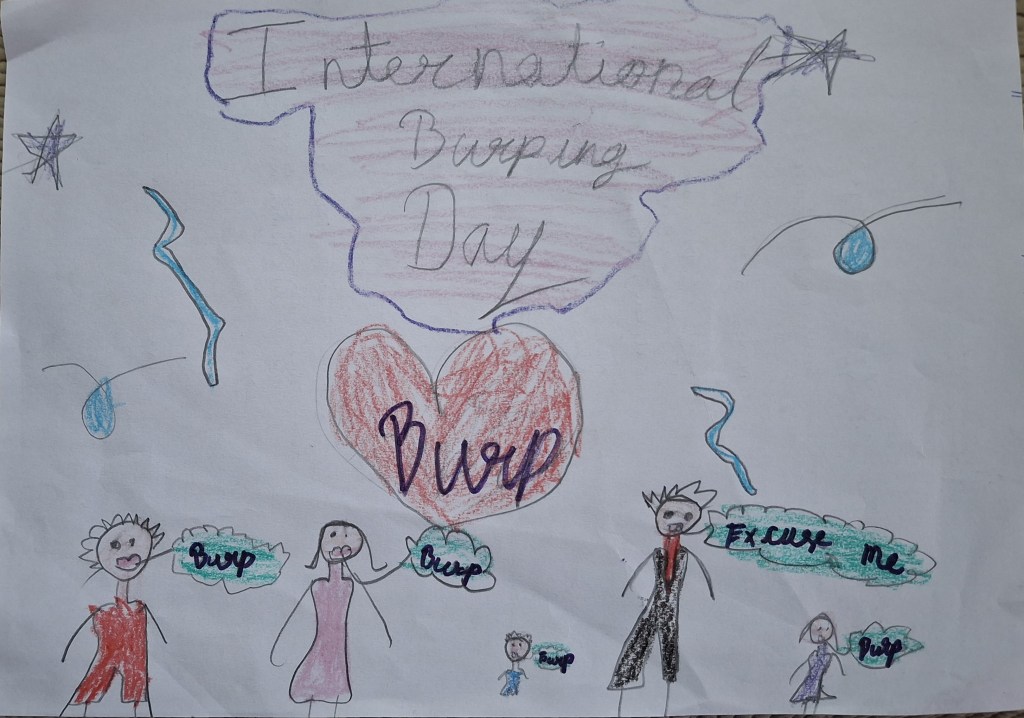
But the day that has fast become my favourite is the one suggested by my 7-year old grandchild. She has the gift of being able to burp at will, and a few weeks ago, she was exercising the gift incessantly. When told that it was very rude, she countered saying that it was ‘International Burping Day’, and that she was obligated to burp. She followed this up by making a poster for the day!
My calendar now feels less like a schedule and more like a collage of human quirks—earnest, excessive, occasionally absurd. And perhaps that’s the point. In trying to give everything its day, we reveal not just what we value, but also what makes us smile, pause, or raise an eyebrow and think: really, this too?
–Meena
Art by Barnalee

 Millennial Matriarchs