
Black on white, or white on black? This is the question that is most commonly asked about the zebra. The striking black and white pattern on a zebra is its most distinguishing feature. If it were not for this, a stripe-less zebra may well pass off as a sturdy mule! What the zebra does have in common with a mule and a horse, is that all these are equines. What makes zebras different is their patterned coat, and the fact that they are found in the wild only in Africa. Three main species of zebra are found across different countries of the African subcontinent. Plains zebras have wide stripes set far apart. They are found in grasslands across much of eastern and southern Africa. The Mountain zebra, the smallest species, lives in dry upland plains and is native to Southern Africa, Namibia and Angola. Grevy’s zebra, is the largest and most distinctive, with thin stripes, and lives in dry, sparsely wooded areas in Kenya and southern Ethiopia.
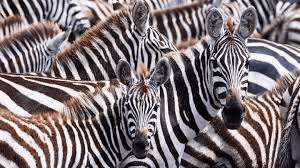
Zebras are not just known for their striking appearance; they also hold a unique place in the animal kingdom with respect to their social structures and behaviors. These herbivores are highly social animals, often forming large herds that provide support, and protection against predators. Within a herd, zebras tend to stay together in smaller family groups. Families are generally made up of a male, several females, and their young. Mutual grooming by standing close to each other and pulling loose hairs off each other is a way of strengthening bonds between members. The friendly grooming may turn aggressive in mating season when the males may use bites and powerful kicks to combat their rivals in order to obtain a mate.
Zebras also graze in groups. They are herbivores and often spend up to 18 hours daily feeding in the wild. As a zebra grazes, it uses its sharper strong front teeth to bite the grass, and then uses its duller back teeth to crush and grind. A zebra’s teeth keep growing for its entire life, because constant grazing and chewing wears them down. They have special digestive systems (hindgut fermenter) which can break down highly fibrous plants, twigs and even bark!
Within the herd, these animals have a range of communication systems, with distinct vocalizations that include whinnies, barks, snorts, and huffs. They also use body language, such as ear positioning, to express emptions. When feeling threatened, zebras flatten their ears against their heads; whereas ears pricked forward indicate that they are alert to something. They have exceptional hearing and eyesight which serves to sense danger early. A two-syllable call warns the herd of approaching predators. This is also the signal for the herd to take off and run for their lives. And they can move incredibly fast, reaching speeds of 65 km per hour. Zebras rely on this speed as well as their agility and stamina to help them outrun predators. One trick they use, is to run in a zigzag direction to confuse other animals. Another asset that helps is their ability to sleep while standing. This is possible because of locking joints–they can subconsciously lock their knees into position while they doze, without fear of toppling over. This means that they save time in getting to their feet and running in case of a threat. For deep sleep they need to lie down.
While zebras need to move fast to save their lives, they also have to be on the constant move in search of fresh grass and water to sustain the large numbers. In the dry season, they join other grazers and browsers like wildebeest, in huge herds of hundreds of thousands, for a humongous migration. One of the most famous of these is the Serengeti migration.
While zebras may look identical from a distance, each one has a distinct pattern, much like human fingerprints. There are several theories about the role of stripes. One is that these can help individuals recognize each other within the herd. A single zebra stands out in the landscape. But when the striped herds move in unison, it makes for a dazzling optical illusion that makes it difficult for predators like lions and hyenas to single out individuals, thus providing a critical defense mechanism. It is most appropriate then that the collective noun for a group of zebras, is a dazzle of zebras!
Colours aside, the pattern also blends with the tall wavy lines of grass and help to conceal the animal in the wilderness. It is also believed that while the white stripes reflect light and keep the zebras cool while they stand and graze in the hot African sun all day, the black stripes absorb heat from the sun and warm up the animals in the morning. Some other researchers think that zebra stripes may have evolved to protect the animals from horsefly bites.
While scientists continue to research ‘why’ the zebra has stripes, African folk tales creatively imagine ‘how’ the zebra got its stripes. A popular Zulu story explains this.
Long, long ago, a big fierce Baboon came to live on the banks of the river where all the animals in the grassland came to drink water. But now Baboon declared himself the sole proprietor of the area, and declared that no other animal could drink from the river. Several animals tried to remind Baboon of the shared rights, but no one could stand up to the big bully who bared his long sharp teeth and flexed his might. Until a brave young zebra decided to challenge him to a fight. In those days, zebras were pure white. Baboon was a veteran of many battles, and was so confident of winning that he agreed, with the condition that the loser would be banished to the barren land across the river. And so the fight began. Zebra used his sharp hooves and strong kicks, Baboon attacked with his fangs. Baboon gained the upper hand and threw zebra backwards into the blazing logs of a fire. The flames seared Zebra’s white coat. In dreadful pain, but in a huge burst of final strength, Zebra gave a mighty kick to Baboon that sent him flying across the river. Baboon fell with such force onto a sunbaked rock, the hair on his behind was singed away. And till today, baboons have a bald red patch on their behind. As for the zebra, the flames charred permanent black marks on his white coat. Since then zebras wear their striped coats with pride, and a tribute to the brave zebra! So instead of pondering the “black on white or white on black” conundrum, let’s just say that zebras are black and white!
While zebras are still found in large numbers, as with all wildlife, they too face threats from loss and degradation of their natural habitat, human-wildlife conflict, and poaching.
31 January is marked as International Zebra Day. A good day to learn more about, and to celebrate this striking animal.
–Mamata

 Millennial Matriarchs