
When we hear the name ‘Michealangelo’, we think of the Sistine Chapel. But there was another one of the same name, Michelangelo Merisi da Caravaggio (known as Caravaggio) born a few years after the original’s death, who played own his part in significantly re-defining art.
Born in Milan, his father was an architect. The family left the city in 1576 to escape a plague and moved to Caravaggio. In 1584 our Caravaggio was apprenticed for four years Simone Peterzano, a painter. He became familiar with the works of Leonardo da Vinci, Michelangelo, Titian, Raphael, and other Renaissance masters during this time.
He moved to Rome, and set up in due course as an artist in his own right. Caravaggio’s work is known for its chiaroscuro (from Italian chiaro, “light,” and scuro, “dark”) technique—basically the use of light and shadow to define three-dimensional objects. Caravaggio and his followers used a harsh, dramatic light to isolate their figures and heighten emotional tension. Caravaggio’s use of realism and chiaroscuro helped to create a new style of painting that came to be known as Baroque, which shaped European art in the centuries to come.
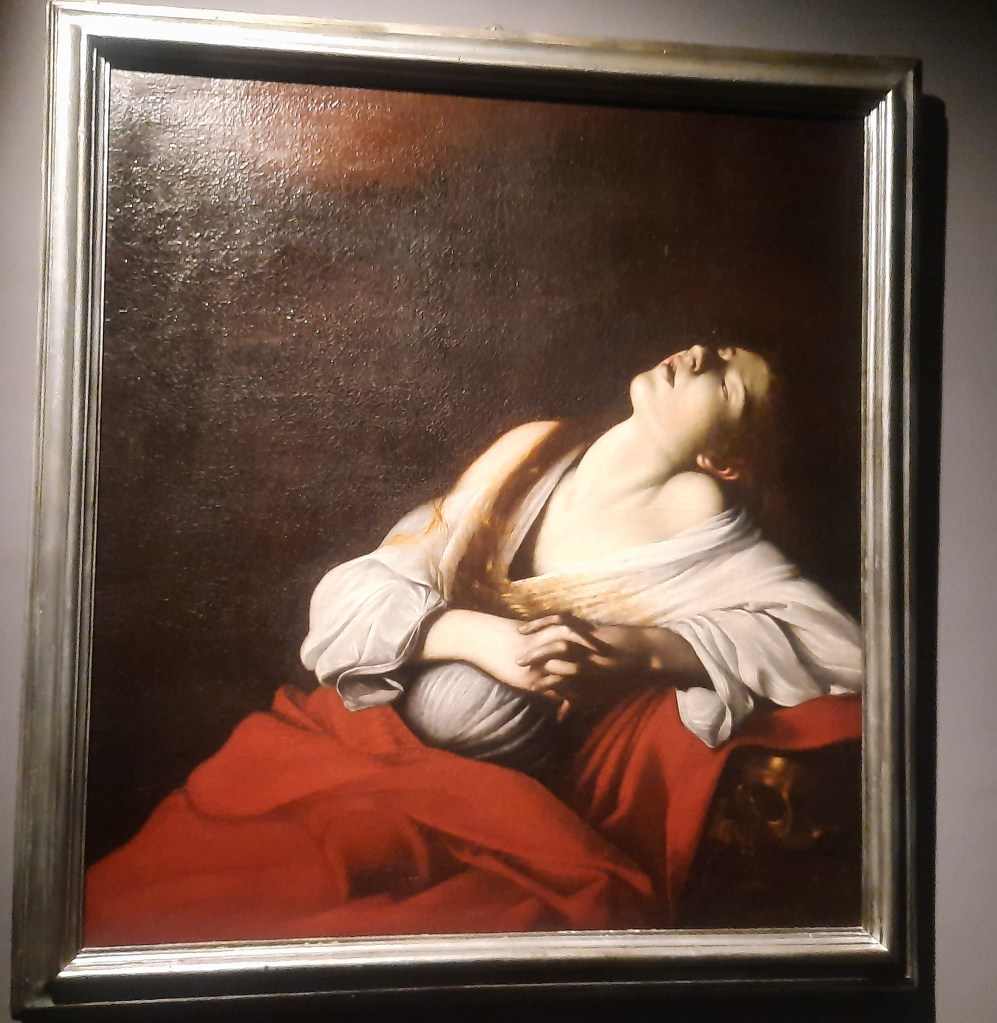
One of his masterpieces has come to India. This is ‘Mary Magdalene in Ecstasy’, which was painted around 1606, and exemplifies his use of chiaroscuro. This painting was lost for centuries, re-surfacing only in 2014. It was authenticated as an original masterpiece by a team of leading art historians and is generally accepted as such today.
The painting travelled to India a few months ago, and was first exhibited in Delhi under the aegis of The Kiran Nadar Museum of Art, in partnership with The Cultural Centre of the Italian Embassy. Now it has come to Bangalore, and is exhibited at the National Gallery of Modern Art.
Three armed policemen are at the entrance to guard this $50 million work.The NGMA has also done its best to make it an enriching experience, with detailed panels about the artist and the painting, as well as a Virtual Reality experience.
Admittedly, It is a slightly strange feeling to go into a large, empty, almost-dark hall with only the one painting on the wall, with just one light focussed on it. A very different experience from seeing tens of paintings displayed in a room, with visitors filing from one to the other, and sometimes sitting on the benches provided to contemplate on something that catches their attention (or just to rest tired feet).
But all the care being taken with the work certainly proves India’s seriousness to protect and display of priceless art that comes to visit us.
It is not as if international masterpieces have not come to India before. Picasso’s works have been exhibited in India–the first exhibition of his works in South Asia was held at the National Museum in Delhi in December 2001 and featured 122 works.
There are reports of original Botticelli paintings being exhibited in India too. For example, there are some reports that “Madonna of the Pomegranate” was displayed at an exhibition in Thiruvananthapuram.
While no originals were physically displayed, there was an online exhibition of Raphael’s drawings by the India International Centre (IIC) IIC to commemorate the 500th death anniversary of the artist.
Immersive, virtual experiences around Van Gogh’s work as well as da Vinci’s work have come to India in recent years.
Looks like India is now on the art-map, and we will be getting to see more such international masterpieces in the near future.
In the meantime, we can of course take in all the amazing art, craft, sculpture and architecture our own country offers!
–Meena

 Millennial Matriarchs