
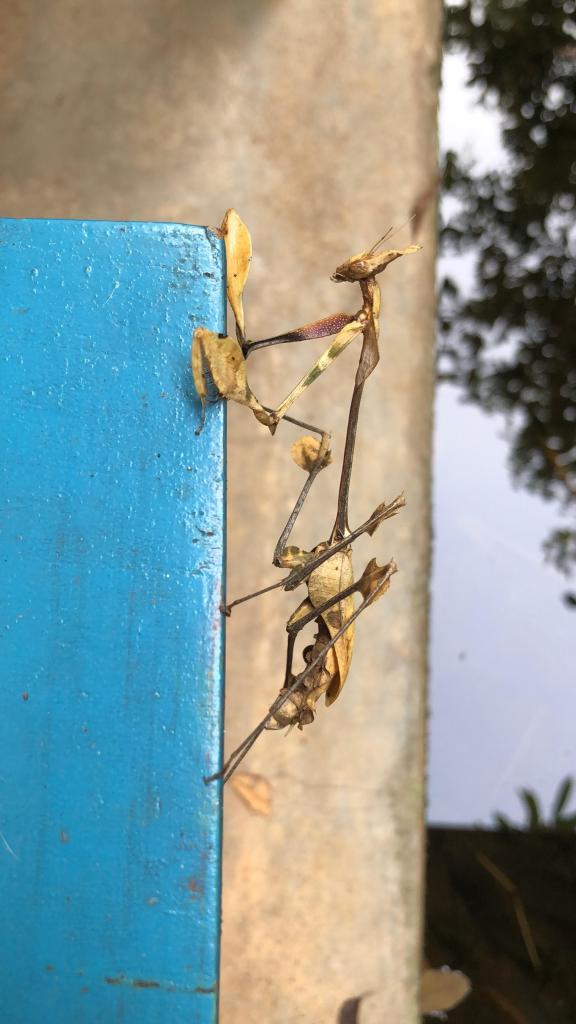
Recently my son shared a photo and asked us to guess what it was. At first glance it seems like a lovely composition of dried leaves and twigs. But a closer look revealed that this did not seem to be a random coming together of bits and pieces but a cleverly designed creature of nature. While our guesses revolved around thinking it to be some kind of stick insect, I, as usual wanted to probe deeper! To start with I asked Aditya to tell where and how he came upon this intriguing creature.
This is what Aditya shared.
The other day I was stepping out to see if the laundry was dry. As I stepped into the afternoon sunshine, over the narrow water channel circling the house — ostensibly keeping ants away but long defeated by the garden’s branches and vines that reached over and served as bridges, for not only ants but squirrels and civets too — I did a double-take of the bench by the door. This is where we spend a quiet hour every morning drinking tea and slowly waking up; by the bench is an abandoned wooden drawer set on its side, now a teapoy. From its corner hung a couple of dry leaves on a twig — the overnight cobwebs must have caught them.
But something had made me turn and look closer, though I couldn’t say what. Perhaps it was the way the leaves dangled, defying gravity, or their neatly stacked arrangement, or simply that their brown was striking against the blue-painted face of the drawer. It took another moment, and then it was clear these were no leaves, though the disguise was commendable. The twig bobbed up and down, took a few steps along the edge of the drawer, and made for the bench.
I recognised this bug — I had been mesmerised by it a few years before when I had encountered it just as unexpectedly in a friend’s outdoor kitchen. That’s when I had found out what it was called — the Wandering Violin Mantis — and this had tickled me especially because the kitchen belonged to a luthier and violinist, whom I was house-sitting for as he was away wandering the world.
I called out to my partner and she rushed downstairs to see. In turns, as one of us took pictures, the other attempted to invite the mantis onto our hand. After a quick survey of the landscape with its beady eyes and a few of its legs, it climbed on. Then it was on its way, making long strides up our arms, slightly prickly and very tickly as one felt the weightless but saw-toothed limbs on the skin. The attentive head kept looking around and exploring its changing geography, as we kept twisting and turning, and giggling and marvelling at the lanky visitor. We deposited him back on the bench, where he stayed a while longer before wandering off somewhere else.
Wow! Close encounters with a Wandering Violin Mantis! While I had missed out on this first-hand experience I turned to secondary sources to find out more.
To start with my guess that it was a stick insect proved wrong. This was a mantis, which belonged to a different order (Mantodea). The name ‘mantis’ is derived from Greek, meaning ‘prophet’ or ‘diviner’, and the Wandering Violin Mantis is known scientifically as Gongylus gongylodes. Gongylus is derived from the Greek word gongylos meaning round which may refer to the shape of its appendages. This unique creature was first described by Carl Linnaeus, also known as the father of modern taxonomy.
Its common name is Wandering Violin Mantis, and it is also known as Indian Rose Mantis, Dead Leaf Mantis and Ornate Mantis. The most intriguing of the names is the first one. Look closely and one will see very long spindly legs that support the wide thorax which is shaped like the soundboard of a violin, while the long neck that ends in an arrow-shaped head resembles the neck of the violin. The thin legs that resemble dry sticks, end in large appendages. The mantis usually walks on its mid and hind legs, keeping its strong forelegs raised. Thus the moniker Violin Mantis. (I cannot find any reference to why the addition of the prefix ‘Wandering’.)
A close up of its face with its biting-chewing mouth parts demonstrates its predatory instincts. This mantid feeds exclusively on flying insects, but it is not an active hunter. The insect find a spot where it is perfectly camouflaged as dry twigs and leaves, and sits and waits for an insect to fly by, or to land nearby. With the ability to rotate its head a full 180 degrees, the mantis has a panoramic view of its surroundings. To further enhance their disguise, mantids often adopt a unique pose, tilting their body sideways and lifting their front legs. Remaining motionless, stealthily hanging upside down from a stem or sitting erect they easily pass for a twig swaying in the breeze.
In case of a flier-by, the mantis grabs it right out of the air, using its fast reflexes and remarkable accuracy to snatch its prey from mid-air. In case of an unsuspecting one that lands on a flower in search of nectar, it is efficiently snatched up by the predator. The raptorial front legs are perfect for grasping and holding the unwary prey. The mantis selects its prey wisely, avoiding insects that are too large to easily capture.
In turn the Wandering Violin Mantis is preyed upon by a variety of animals including birds, bats, spiders and lizards. I wonder how useful their camouflage is in protecting them from being spotted by these predators. I am sure that many a mantis has escaped the beady eyes looking for a meal by passing off as a sprig of dry leaves! And in case it is spotted, the mantis makes a last attempt to escape by spreading out its wings to display the brightly-coloured underside that may startle the hunter.
These masters of camouflage can be found in diverse habitats including forests, grasslands and even gardens. They are found is several parts of South and Southeast Asia, especially South India Sri Lanka, Myanmar, Thailand and Java.
Curiously these gentle and non-aggressive insects are popular as pets in the US and some other countries. Unlike other mantis species the males and females can live together (without eating each other up!). However their enclosures would require to create and maintain the temperature and humidity of their natural habitats, plenty of climbing space with foliage and sticks, and a diet of flying insects. Judging from the number of websites with tips on how to cage and keep this mantis, this seems to be a popular insect pet.
I feel sad about this confinement. Why not celebrate this fascinating creature of nature where it belongs? And feel the excitement when one has the WoW! (Wonder of Wildlife) moment of making the acquaintance of the Wandering Violin Mantis!
— Mamata

 Millennial Matriarchs
Aditya’s writing is so beautiful! Thanks for sharing, Mamata!
LikeLiked by 1 person
Thank you Kalyani!!
LikeLike