
The Indian-American domination of a peculiarly American phenomenon—the Spell Bee—is something that intrigues me no end. Not to say Indian-Americans don’t excel in many pursuits out there, but these kids winning the national level spelling competitions year after year after year after year is quite something.
The American tradition of spelling competitions may have started with the Puritans. By the mid-18th century, spelling competitions were common across the country. In 1750, Benjamin Franklin apparently recommended their use in a proposal for a school. Spelling challenges were quite the rage with both adults and children in the 19th century. Mark Twain apparently mentions ‘spelling fights’ in Adventures of Tom Sawyer!
The use of the term ‘bee’ for these competitions started in the mid 1870s. It is an unusual usage of the word, as ‘bee’ usually refers to a community activity with a shared goal—like quilting bees or knitting bees.
English, with words from various sources and a variety of languages, probably peculiarly lends itself to this pastime. Afterall, I don’t think there can be much confusion how 99% of words are spelt in Tamil or Kannada or Oriya– languages with phonetic writing systems do not have so much confusion in spelling. Moreover, because English has borrowed words from many languages through its history, the result is a diverse vocabulary with inconsistent spelling patterns which are carried over from the mother-languages.
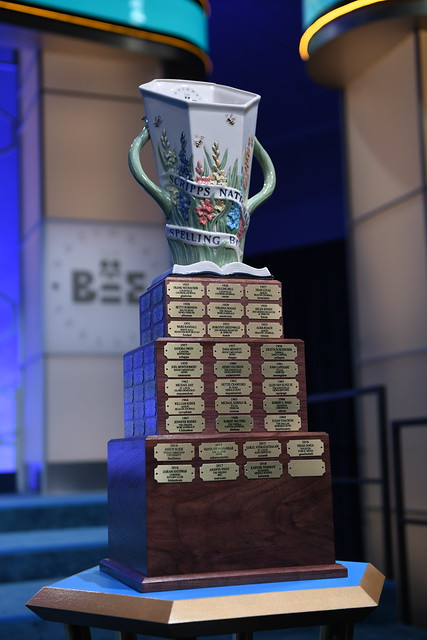
In the US, the National Spelling Bee, as we know it today, was established in 1925. The Louisville Courier-Journal was the first sponsor, who saw it as a way to foster interest in spelling and language.
The E.W. Scripps Company acquired the rights to the National Spelling Bee in 1941. This company was started by E.W. Scripps who founded The Penny Press, a daily newspaper in Cleveland. Today, the company is involved in investigative documentaries and enterprise journalism with the purpose to ‘…advancing understanding of the world around us.’
The Spell Bee has been held annually, in late May or early June since its inception, except for a few years during World War II and in 2020 due to COVID-19. It has evolved over time, beyond just spelling, encompassing vocabulary development and broader language knowledge.
The first winner of the Spell Bee, in 1925, was Frank Neuhauser of Louisville, whose winning word was “gladiolus”. The next year saw a girl winning for the first time– Pauline Bell, also of Louisville, who spelt the word “cerise”. (Incidentally, girls won nine consecutive competitions from 1932 to 1940.)
Now coming to winners of Indian origin. 30 of the last 36 competitions have been won by them. Which is surely not a chance thing. Before 1999, there were only two spelling bee winners of Indian-American descent—Balu Natarajan in 1985, with the word “milieu”, and Rageshree Ramachandran in 1989 with “elegiacal”. Nupur Lala opened the floodgates in 1999 winning with “logorrhoea,” and there has been no looking back since then! This year of course we celebrate Faizan Zaki, a 13-year-old Indian-American student from Texas, who won with the word ‘éclaircissement”
Rebecca Sealfon who won in 1997 against Prem Murthy Trivedi, has done some analysis on the subject of Spell Bee competitors, and tells us that children practice for about 500 hours in the years in which they compete; some hire ex-competitors as coaches; and they typically and unsurprisingly relax by playing word games like Scrabble or Boogle. Some try to learn every word in the dictionary. She further tells us that double ‘ll’ words are the ones which have tripped up a large number of contestants, along with the words ‘metastasize’ and ‘metonymy’.
Since I don’t know many of these words, and would certainly not be able to spell them, I can only express my wonder at these sub-14 year olds who can.
Kudos to all of you! You have cast a spell on me!
–Meena
Pic: https:spellingbee.comblogscripps-cups

 Millennial Matriarchs