
Now what is this creature who is undertaking so many space odysseys? We don’t recall seeing a bear of any kind suited up and entering a space vehicle. And what is a water bear anyway—we’ve heard of polar bears, sloth bears, brown bears, black bears and several others; but never a water bear.
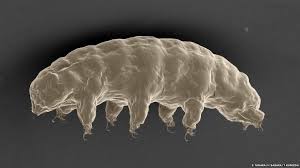
Well water bears or tardigrades are microscopic eight-legged animals. Because they look like bears under the microscope, they have been dubbed water bears. However, they don’t necessarily live in water, though they need a coating of water around themselves to prevent dehydration. They live in all kinds of places, from deep seas and hot springs to sand dunes! They also like to live in the moist environment provided by mosses and lichens and hence are also called moss piglets.
The German scientist Johann Goeze first described these creatures in 1773, and called them Kleiner Wasserbär in German, which translates to ‘little water bear’. In 1776, the Italian biologist Lazzaro Spallanzani named the phylum Tardigrada, meaning ‘slow walkers’. Today, about 1500 species of tardigrades have been documented.
They are generally about 0.5 mm in length when fully grown, short and plump, with four pairs of legs, each ending in claws or sticky pads. They are visible under low-power microscopes, so can be viewed easily even at schools or homes.
But it is not all this that makes tardigrades creatures of special interest. What sets them apart scientifically is that they belong to an elite category of animals known as extremophiles. They can survive extreme environments that most animals can’t.
For instance, tardigrades can go up to 30 years without food or a water supply. They can live even at absolute zero, and can survive above boiling temperatures. They can take pressures six times greater than the ocean’s deepest trenches, and exist in the vacuum of space. They have survived five mass extinctions!
One reason for their resilience is a unique protein in their body which protects their DNA from harmful radiation which is present all around us. A strategy they employ in dry environments is to push all water out of their body, pull in their head and limbs, and roll up into a small ball. They go into a deep sleep until conditions improve
Tardigrade biology is unique, and scientists study tardigrades to understand their indestructibility, to transfer these learnings to many fields.
The idea of sending tardigrades to space was first proposed in 1964. Actual experiments began in 2007 when they went up with NASA’s FOTON-M3 mission, where they were exposed to space’s vacuum for 10 days, and reanimated just by rehydration, back on Earth.
Then, in 2011, tardigrades were on board the International Space Station, and in 2019, a capsule containing tardigrades was sent on board the Israeli lunar lander Beresheet which crashed on the Moon. SpaceX-22 Commercial Resupply Services mission on June 3, 2021 also carried tardigrades to do an experiment to identify the genes involved in their ability to survive and adapt to high-stress environments, including the one astronauts experience in space. NASA hopes the findings can help guide research into protecting humans from the stresses of long-duration space travel, and ultimately help in setting up sustainable colonies on the Moon and Mars.
These space-veterans are also part of Group Captain Shubanshu Shukla’s crew! He and his fellow Polish astronaut Uzanaski-Wisniewski will study several aspects of tardigrades duing their 2-week trip–their revival, survival, and reproduction; they will count the number of eggs laid and hatched duringthe mission; compare the gene expression patterns of the astronaut-tardigrades with those of ground populations; and identify molecular mechanisms of resilience
Thank you, Grp Captain Shukla and your brave mates on Axiom 4. Wishing you a safe journey and that you extend the boundaries of space and knowledge.
–Meena
PIC: From BBC

 Millennial Matriarchs